


818 Results
Form:
books
books

Actions:
Price:
$20.95
(available to order)
Summary:
Que faire de l’aventure communiste ? En quoi nous concerne-t-elle encore aujourd’hui ? Depuis la chute du mur de Berlin et l’intégration de la Chine et des pays de l’ex-Union soviétique à l’économie mondialisée, on considère souvent l’épisode communiste comme un simple accroc dans le déroulement de l’Histoire, une sorte de régression dans l’avancée irrésistible du(...)
$20.95
(available to order)
Summary:
Que faire de l’aventure communiste ? En quoi nous concerne-t-elle encore aujourd’hui ? Depuis la chute du mur de Berlin et l’intégration de la Chine et des pays de l’ex-Union soviétique à l’économie mondialisée, on considère souvent l’épisode communiste comme un simple accroc dans le déroulement de l’Histoire, une sorte de régression dans l’avancée irrésistible du(...)
Title:
Comment sauver le commun du communisme
Actions:
Price:
$20.95
(available to order)
Summary:
Que faire de l’aventure communiste ? En quoi nous concerne-t-elle encore aujourd’hui ? Depuis la chute du mur de Berlin et l’intégration de la Chine et des pays de l’ex-Union soviétique à l’économie mondialisée, on considère souvent l’épisode communiste comme un simple accroc dans le déroulement de l’Histoire, une sorte de régression dans l’avancée irrésistible du capitalisme. Et pourtant, si le communisme n’est plus l’horizon indépassable de notre temps, comme Sartre a pu un jour le déclarer, la nécessité de repenser le commun, elle, se manifeste avec plus d’insistance que jamais. Pour ceux qui éprouvent, de manière plus ou moins confuse et intermittente, le besoin de renouer avec l’action politique pour contrer l’isolement et l’impuissance générés par la barbarie néolibérale, la question la plus urgente de notre époque serait peut-être : comment sauver le commun du communisme ?
Comment sauver le commun du communisme
Actions:
Price:
$20.95
(available to order)
Summary:
Que faire de l’aventure communiste ? En quoi nous concerne-t-elle encore aujourd’hui ? Depuis la chute du mur de Berlin et l’intégration de la Chine et des pays de l’ex-Union soviétique à l’économie mondialisée, on considère souvent l’épisode communiste comme un simple accroc dans le déroulement de l’Histoire, une sorte de régression dans l’avancée irrésistible du capitalisme. Et pourtant, si le communisme n’est plus l’horizon indépassable de notre temps, comme Sartre a pu un jour le déclarer, la nécessité de repenser le commun, elle, se manifeste avec plus d’insistance que jamais. Pour ceux qui éprouvent, de manière plus ou moins confuse et intermittente, le besoin de renouer avec l’action politique pour contrer l’isolement et l’impuissance générés par la barbarie néolibérale, la question la plus urgente de notre époque serait peut-être : comment sauver le commun du communisme ?
Form:
books
books
Publication:
October 2014
October 2014
Form:
books
books
Actions:
Price:
$35.00
(available to order)
Summary:
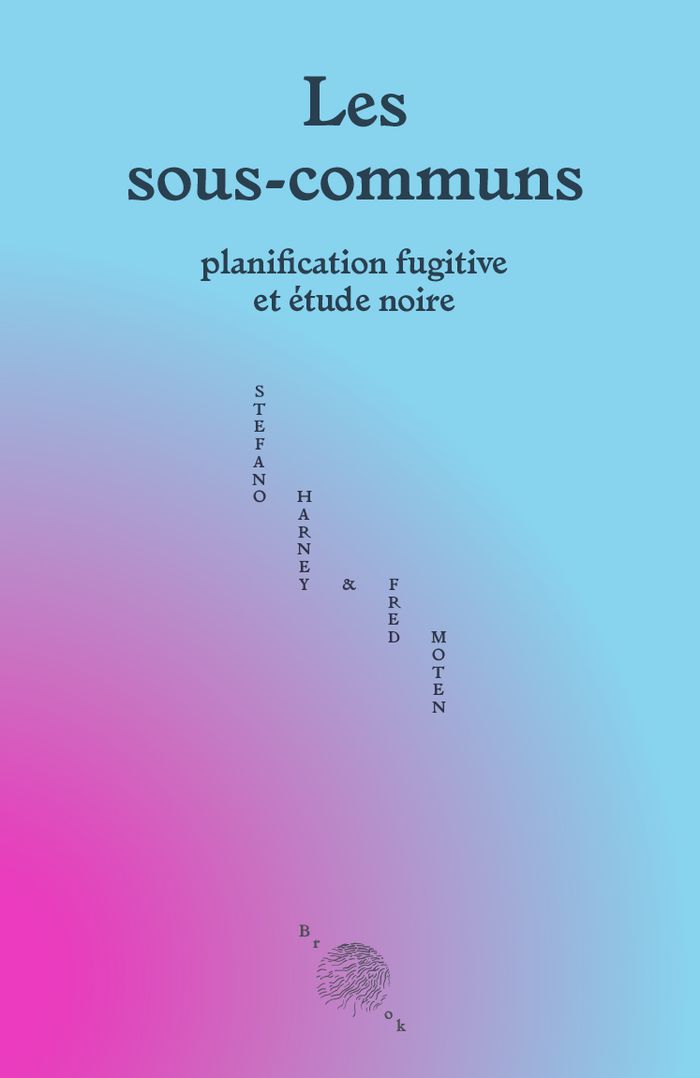
Cette publication est une série d'essais publiée en 2013 par deux amis, Stefano Harney et Fred Moten. Au fil de ces textes, les auteurs proposent une critique du capitalisme racial et de ses outils (gouvernance, crédit, université) ainsi que des modes d'expérimentation sociale en forme de résistance au colonial. La recherche passe par l'étude et se déroule bien au-delà de(...)
$35.00
(available to order)
Summary:
Cette publication est une série d'essais publiée en 2013 par deux amis, Stefano Harney et Fred Moten. Au fil de ces textes, les auteurs proposent une critique du capitalisme racial et de ses outils (gouvernance, crédit, université) ainsi que des modes d'expérimentation sociale en forme de résistance au colonial. La recherche passe par l'étude et se déroule bien au-delà de(...)
Title:
Les sous-communs : Planification fugitive et étude noire
Actions:
Price:
$35.00
(available to order)
Summary:
Cette publication est une série d'essais publiée en 2013 par deux amis, Stefano Harney et Fred Moten. Au fil de ces textes, les auteurs proposent une critique du capitalisme racial et de ses outils (gouvernance, crédit, université) ainsi que des modes d'expérimentation sociale en forme de résistance au colonial. La recherche passe par l'étude et se déroule bien au-delà de l'université, au travail, lors d'une pause cigarette, en famille, autour d'un repas, à la lisière de la lutte et de la fuite, à l'intérieur d'un mouvement de tremblement des fondations impérialistes, d'un mouvement de refus des termes du combat tel qu'il est imposé par le système dominant, vers la construction d'un espace social et politique en perpétuel déplacement. Le lieu et l'être sous-communs relèvent de l'incertitude de la création collective, de l'habitation par l'échange, de l'improvisation comme critique.
Les sous-communs : Planification fugitive et étude noire
Actions:
Price:
$35.00
(available to order)
Summary:
Cette publication est une série d'essais publiée en 2013 par deux amis, Stefano Harney et Fred Moten. Au fil de ces textes, les auteurs proposent une critique du capitalisme racial et de ses outils (gouvernance, crédit, université) ainsi que des modes d'expérimentation sociale en forme de résistance au colonial. La recherche passe par l'étude et se déroule bien au-delà de l'université, au travail, lors d'une pause cigarette, en famille, autour d'un repas, à la lisière de la lutte et de la fuite, à l'intérieur d'un mouvement de tremblement des fondations impérialistes, d'un mouvement de refus des termes du combat tel qu'il est imposé par le système dominant, vers la construction d'un espace social et politique en perpétuel déplacement. Le lieu et l'être sous-communs relèvent de l'incertitude de la création collective, de l'habitation par l'échange, de l'improvisation comme critique.
Form:
books
books
Publication:
February 2022
February 2022
Subject:
Social
Social
Form:
audio
audio
Title:
Melanie K. Yazzie.
Melanie K. Yazzie.
Actions:
Description:
1 online resource.
Author:
Subject:
Publication:
[Place of publication not identified] : The Funambulist, 2020.
[Place of publication not identified] : The Funambulist, 2020.
Form:
audio
audio
Publication:
[Place of publication not identified] : The Funambulist, 2020.
[Place of publication not identified] : The Funambulist, 2020.
Author:
Subject:
Form:
books
books
Actions:
Price:
$88.95
(available to order)
Summary:
Bearing witness to the changing economic landscape amid the Cold War, artists in the 1960s created works that critiqued, reshaped, and sometimes reinforced the spirit of capitalism. At a time when currency and finance were becoming ever more abstracted—and the art market increasingly an arena for speculation—artists on both sides of the Atlantic turned to economic themes,(...)
$88.95
(available to order)
Summary:
Bearing witness to the changing economic landscape amid the Cold War, artists in the 1960s created works that critiqued, reshaped, and sometimes reinforced the spirit of capitalism. At a time when currency and finance were becoming ever more abstracted—and the art market increasingly an arena for speculation—artists on both sides of the Atlantic turned to economic themes,(...)
Title:
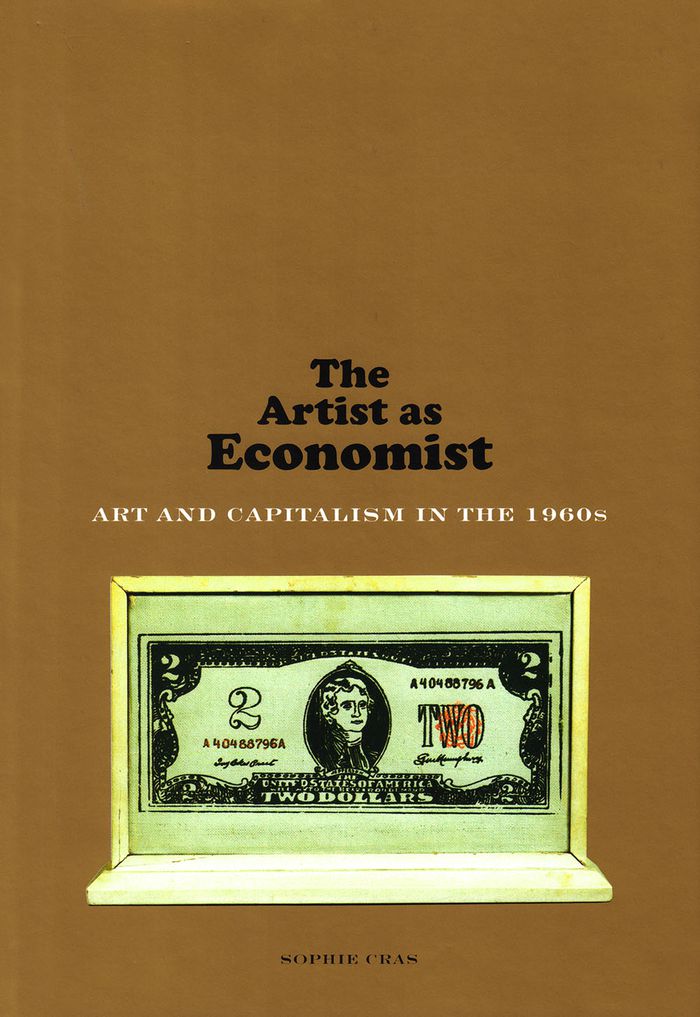
The artist as economist: art and capitalism in the 1960s
Actions:
Price:
$88.95
(available to order)
Summary:
Bearing witness to the changing economic landscape amid the Cold War, artists in the 1960s created works that critiqued, reshaped, and sometimes reinforced the spirit of capitalism. At a time when currency and finance were becoming ever more abstracted—and the art market increasingly an arena for speculation—artists on both sides of the Atlantic turned to economic themes, often grounded in a human context. ''The artist as economist'' examines artists who approached these issues in critical, imaginative, and humorous ways. Such examples, which author Sophie Cras insightfully situates within their historic economic context, reveal capitalism’s visual dimension. As art and economics grow more entangled, this volume offers a timely consideration of art’s capacity to reflect on and reimagine economic systems.
The artist as economist: art and capitalism in the 1960s
Actions:
Price:
$88.95
(available to order)
Summary:
Bearing witness to the changing economic landscape amid the Cold War, artists in the 1960s created works that critiqued, reshaped, and sometimes reinforced the spirit of capitalism. At a time when currency and finance were becoming ever more abstracted—and the art market increasingly an arena for speculation—artists on both sides of the Atlantic turned to economic themes, often grounded in a human context. ''The artist as economist'' examines artists who approached these issues in critical, imaginative, and humorous ways. Such examples, which author Sophie Cras insightfully situates within their historic economic context, reveal capitalism’s visual dimension. As art and economics grow more entangled, this volume offers a timely consideration of art’s capacity to reflect on and reimagine economic systems.
Form:
books
books
Publication:
November 2019
November 2019
Form:
books
books
Price:
$25.95
(available to order)
Summary:
Fiscal crises have cascaded across much of the developing world with devastating results, from Mexico to Indonesia, Russia and Argentina. The extreme volatility in contemporary political economic fortunes seems to mock our best efforts to understand the forces that drive development in the world economy. David Harvey is the single most important geographer writing today(...)
$25.95
(available to order)
Summary:
Fiscal crises have cascaded across much of the developing world with devastating results, from Mexico to Indonesia, Russia and Argentina. The extreme volatility in contemporary political economic fortunes seems to mock our best efforts to understand the forces that drive development in the world economy. David Harvey is the single most important geographer writing today(...)
Title:
Spaces of global capitalism: a theory of uneven geographical development
Actions:
Price:
$25.95
(available to order)
Summary:
Fiscal crises have cascaded across much of the developing world with devastating results, from Mexico to Indonesia, Russia and Argentina. The extreme volatility in contemporary political economic fortunes seems to mock our best efforts to understand the forces that drive development in the world economy. David Harvey is the single most important geographer writing today and a leading social theorist of our age, offering a comprehensive critique of contemporary capitalism. In this book, he shows the way forward for just such an understanding, enlarging upon the key themes in his recent work: the development of neoliberalism, the spread of inequalities across the globe, and ‘space’ as a key theoretical concept.
Spaces of global capitalism: a theory of uneven geographical development
Actions:
Price:
$25.95
(available to order)
Summary:
Fiscal crises have cascaded across much of the developing world with devastating results, from Mexico to Indonesia, Russia and Argentina. The extreme volatility in contemporary political economic fortunes seems to mock our best efforts to understand the forces that drive development in the world economy. David Harvey is the single most important geographer writing today and a leading social theorist of our age, offering a comprehensive critique of contemporary capitalism. In this book, he shows the way forward for just such an understanding, enlarging upon the key themes in his recent work: the development of neoliberalism, the spread of inequalities across the globe, and ‘space’ as a key theoretical concept.
Form:
books
books
Publication:
March 2019
March 2019
Subject:
Urban Theory
Urban Theory
Form:
books
books
Actions:
Price:
$43.95
(available in store)
Summary:
How design can transcend the logics, structures, and subjectivities of capitalism: a framework, theoretical grounding, and practical principles. The designed things, experiences, and symbols that we use to perceive, understand, and perform our everyday lives are much more than just props. They directly shape how we live. In ''Design after capitalism,'' Matthew Wizinsky(...)
$43.95
(available in store)
Summary:
How design can transcend the logics, structures, and subjectivities of capitalism: a framework, theoretical grounding, and practical principles. The designed things, experiences, and symbols that we use to perceive, understand, and perform our everyday lives are much more than just props. They directly shape how we live. In ''Design after capitalism,'' Matthew Wizinsky(...)
Title:
Design after capitalism: transforming design today for an equitable tomorrow
Actions:
Price:
$43.95
(available in store)
Summary:
How design can transcend the logics, structures, and subjectivities of capitalism: a framework, theoretical grounding, and practical principles. The designed things, experiences, and symbols that we use to perceive, understand, and perform our everyday lives are much more than just props. They directly shape how we live. In ''Design after capitalism,'' Matthew Wizinsky argues that the world of industrial capitalism that gave birth to modern design has been dramatically transformed. Design today needs to reorient itself toward deliberate transitions of everyday politics, social relations, and economies. Looking at design through the lens of political economy, Wizinsky calls for the field to transcend the logics, structures, and subjectivities of capitalism—to combine design entrepreneurship with social empowerment in order to facilitate new ways of producing those things, symbols, and experiences that make up everyday life.
Design after capitalism: transforming design today for an equitable tomorrow
Actions:
Price:
$43.95
(available in store)
Summary:
How design can transcend the logics, structures, and subjectivities of capitalism: a framework, theoretical grounding, and practical principles. The designed things, experiences, and symbols that we use to perceive, understand, and perform our everyday lives are much more than just props. They directly shape how we live. In ''Design after capitalism,'' Matthew Wizinsky argues that the world of industrial capitalism that gave birth to modern design has been dramatically transformed. Design today needs to reorient itself toward deliberate transitions of everyday politics, social relations, and economies. Looking at design through the lens of political economy, Wizinsky calls for the field to transcend the logics, structures, and subjectivities of capitalism—to combine design entrepreneurship with social empowerment in order to facilitate new ways of producing those things, symbols, and experiences that make up everyday life.
Form:
books
books
Publication:
March 2022
March 2022
Subject:
Design Theory
Design Theory
Form:
books
books
Description:
1 online resource
Author:
Subject:
Publication:
[Place of publication not identified] : Alex Williams, 2013., [Place of publication not identified] : Nick Srnicek, 2013.
[Place of publication not identified] : Alex Williams, 2013., [Place of publication not identified] : Nick Srnicek, 2013.
Title:
#Accelerate : Manifesto for an Accelerationist Politics.
Actions:
Description:
1 online resource
#Accelerate : Manifesto for an Accelerationist Politics.
Actions:
Description:
1 online resource
Form:
books
books
Publication:
[Place of publication not identified] : Alex Williams, 2013., [Place of publication not identified] : Nick Srnicek, 2013.
[Place of publication not identified] : Alex Williams, 2013., [Place of publication not identified] : Nick Srnicek, 2013.
Author:
Subject:
Form:
books
books
Title:
Rent / Joe Collins.
Rent / Joe Collins.
Actions:
Holdings:
Description:
ix, 116 pages : illustrations ; 22 cm.
Description:
ix, 116 pages : illustrations ; 22 cm.
Author:
Subject:
Publication:
Cambridge : Polity Press, 2022., ©2022
Cambridge : Polity Press, 2022., ©2022
Form:
books
books
Publication:
Cambridge : Polity Press, 2022., ©2022
Cambridge : Polity Press, 2022., ©2022
Author:
Subject:
Form:
books
books
Actions:
Holdings:
Description:
xvii, 323 pages ; 23 cm
Description:
xvii, 323 pages ; 23 cm
Author:
Subject:
Publication:
Athens : University of Georgia Press, ©2008.
Athens : University of Georgia Press, ©2008.
Title:
Uneven development : nature, capital, and the production of space / Neil Smith ; with a new afterword by the author and a foreword by David Harvey.
Actions:
Holdings:
Description:
xvii, 323 pages ; 23 cm
Uneven development : nature, capital, and the production of space / Neil Smith ; with a new afterword by the author and a foreword by David Harvey.
Actions:
Holdings:
Description:
xvii, 323 pages ; 23 cm
Form:
books
books
Publication:
Athens : University of Georgia Press, ©2008.
Athens : University of Georgia Press, ©2008.
Author:
Subject:
Form:
books
books

Actions:
Price:
$37.95
(available to order)
Summary:
Face à la marche en avant du capital, voué à conquérir des territoires toujours plus reculés au dehors comme en dedans de nous-même, des voix s'élèvent et en appellent à prendre en compte les limites. Mais leur nature reste encore à définir : tel est l’objet de ce livre. Les limites sont constitutives de notre être-au-monde, elles lui donnent sa densité et sa saveur. Dans(...)
$37.95
(available to order)
Summary:
Face à la marche en avant du capital, voué à conquérir des territoires toujours plus reculés au dehors comme en dedans de nous-même, des voix s'élèvent et en appellent à prendre en compte les limites. Mais leur nature reste encore à définir : tel est l’objet de ce livre. Les limites sont constitutives de notre être-au-monde, elles lui donnent sa densité et sa saveur. Dans(...)
Title:
Le sens des limites : contre l'abstraction capitaliste
Actions:
Price:
$37.95
(available to order)
Summary:
Face à la marche en avant du capital, voué à conquérir des territoires toujours plus reculés au dehors comme en dedans de nous-même, des voix s'élèvent et en appellent à prendre en compte les limites. Mais leur nature reste encore à définir : tel est l’objet de ce livre. Les limites sont constitutives de notre être-au-monde, elles lui donnent sa densité et sa saveur. Dans chaque moment de la vie quotidienne, nous évoluons dans un lieu précis du vaste monde, situé autour de notre corps et imprégné de nos manières d'être personnelles. Or le capitalisme s'attaque à cette dimension fondamentale, en sapant toujours davantage les possibilités de contact direct avec notre environnement. Alliant philosophie, sociologie et littérature, ce livre tente de déterminer où se situent désormais les résistances à opposer à la dynamique du capital, en redonnant à notre sensibilité une puissance politique.
Le sens des limites : contre l'abstraction capitaliste
Actions:
Price:
$37.95
(available to order)
Summary:
Face à la marche en avant du capital, voué à conquérir des territoires toujours plus reculés au dehors comme en dedans de nous-même, des voix s'élèvent et en appellent à prendre en compte les limites. Mais leur nature reste encore à définir : tel est l’objet de ce livre. Les limites sont constitutives de notre être-au-monde, elles lui donnent sa densité et sa saveur. Dans chaque moment de la vie quotidienne, nous évoluons dans un lieu précis du vaste monde, situé autour de notre corps et imprégné de nos manières d'être personnelles. Or le capitalisme s'attaque à cette dimension fondamentale, en sapant toujours davantage les possibilités de contact direct avec notre environnement. Alliant philosophie, sociologie et littérature, ce livre tente de déterminer où se situent désormais les résistances à opposer à la dynamique du capital, en redonnant à notre sensibilité une puissance politique.
Form:
books
books
Publication:
April 2018
April 2018
Subject:
Critical Theory
Critical Theory


