


5813 Results
Form:
books
books
Title:
Chaos and culture: Renzo Piano Building Workshop and the Stavros Niarchos Foundation Cultural center
Chaos and culture: Renzo Piano Building Workshop and the Stavros Niarchos Foundation Cultural center
Actions:
Price:
$66.00
(available to order)
Summary:
In 2006 the Stavros Niarchos Foundation announced its gift of a new cultural center in Athens to house both Greek National Library and the Greek National Opera House within a forty-acre landscaped public park. Two years later, with designers and engineers in place and the project underway, the Greek economy collapsed. In "Chaos and culture", Victoria Newhouse weaves a(...)
$66.00
(available to order)
Summary:
In 2006 the Stavros Niarchos Foundation announced its gift of a new cultural center in Athens to house both Greek National Library and the Greek National Opera House within a forty-acre landscaped public park. Two years later, with designers and engineers in place and the project underway, the Greek economy collapsed. In "Chaos and culture", Victoria Newhouse weaves a(...)
Title:
Chaos and culture: Renzo Piano Building Workshop and the Stavros Niarchos Foundation Cultural center
Actions:
Price:
$66.00
(available to order)
Summary:
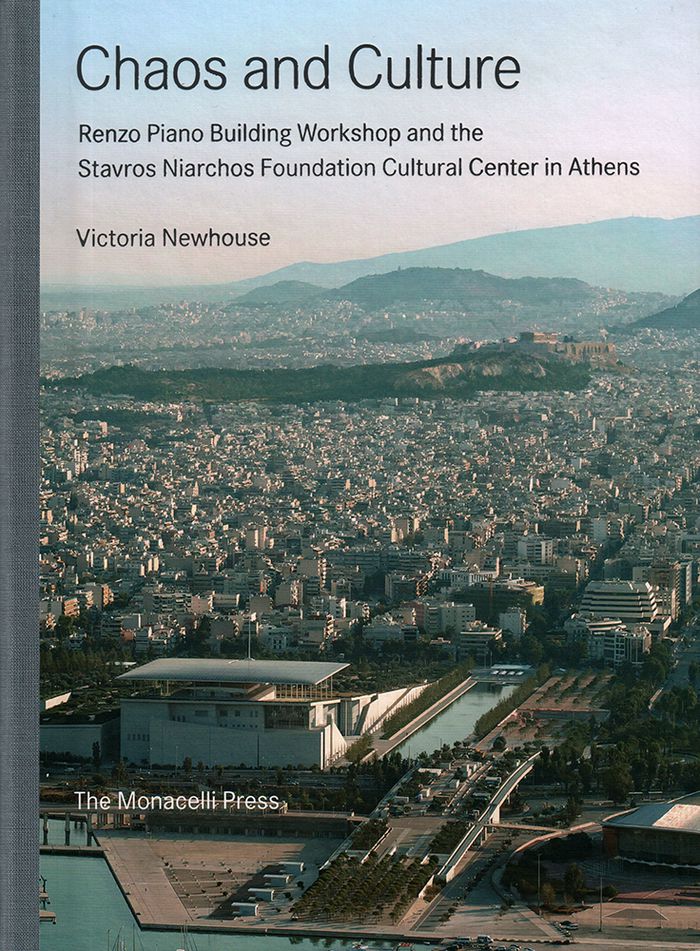
In 2006 the Stavros Niarchos Foundation announced its gift of a new cultural center in Athens to house both Greek National Library and the Greek National Opera House within a forty-acre landscaped public park. Two years later, with designers and engineers in place and the project underway, the Greek economy collapsed. In "Chaos and culture", Victoria Newhouse weaves a fascinating narrative of how a philanthropist and an extraordinary design team became convinced that architecture could serve as a beacon of hope amid Greece’s economic crisis and political upheaval. With meticulous methodology of primary research, interviews with designers, and historic context, Newhouse describes the decade-long process leading to the creation of the Stavros Niarchos Foundation Cultural Center (SNFCC), an $800 million dollar project that became the symbol of recovery and survival. The Stavros Niarchos Foundation Cultural Center (SNFCC) cannot but assume unusual cultural significance, standing as it does on a hill in view of the Parthenon (to the north) and Faliro Bay (to the south). Newhouse further situates the project within the modern history of Athens, beginning with Greece’s independence in 1832, and reaches back much earlier to describe two-thousand-year old cemeteries unearthed on the site. Aerial views by the photographer Iwan Baan are among the 200 photographs and drawings documenting the process and context of the SNFCC.
Chaos and culture: Renzo Piano Building Workshop and the Stavros Niarchos Foundation Cultural center
Actions:
Price:
$66.00
(available to order)
Summary:
In 2006 the Stavros Niarchos Foundation announced its gift of a new cultural center in Athens to house both Greek National Library and the Greek National Opera House within a forty-acre landscaped public park. Two years later, with designers and engineers in place and the project underway, the Greek economy collapsed. In "Chaos and culture", Victoria Newhouse weaves a fascinating narrative of how a philanthropist and an extraordinary design team became convinced that architecture could serve as a beacon of hope amid Greece’s economic crisis and political upheaval. With meticulous methodology of primary research, interviews with designers, and historic context, Newhouse describes the decade-long process leading to the creation of the Stavros Niarchos Foundation Cultural Center (SNFCC), an $800 million dollar project that became the symbol of recovery and survival. The Stavros Niarchos Foundation Cultural Center (SNFCC) cannot but assume unusual cultural significance, standing as it does on a hill in view of the Parthenon (to the north) and Faliro Bay (to the south). Newhouse further situates the project within the modern history of Athens, beginning with Greece’s independence in 1832, and reaches back much earlier to describe two-thousand-year old cemeteries unearthed on the site. Aerial views by the photographer Iwan Baan are among the 200 photographs and drawings documenting the process and context of the SNFCC.
Form:
books
books
Publication:
May 2017
May 2017
Subject:
Architecture Monographs
Architecture Monographs
Form:
journals and magazines
journals and magazines
Actions:
Price:
$40.00
(available to order)
Summary:
New Geographies 11: Extraterrestrial explores the historical and contemporary consequence of our planetary relationship with space. It interprets this duality through the conceptual lens of “extraterrestrial,” which engages an entangled zone of expanding practices in geography, landscape, and architecture, stretching Earth to space, and conversely, space to Earth. This(...)
$40.00
(available to order)
Summary:
New Geographies 11: Extraterrestrial explores the historical and contemporary consequence of our planetary relationship with space. It interprets this duality through the conceptual lens of “extraterrestrial,” which engages an entangled zone of expanding practices in geography, landscape, and architecture, stretching Earth to space, and conversely, space to Earth. This(...)
Title:
New Geographies 11: Extraterrestrial
Actions:
Price:
$40.00
(available to order)
Summary:
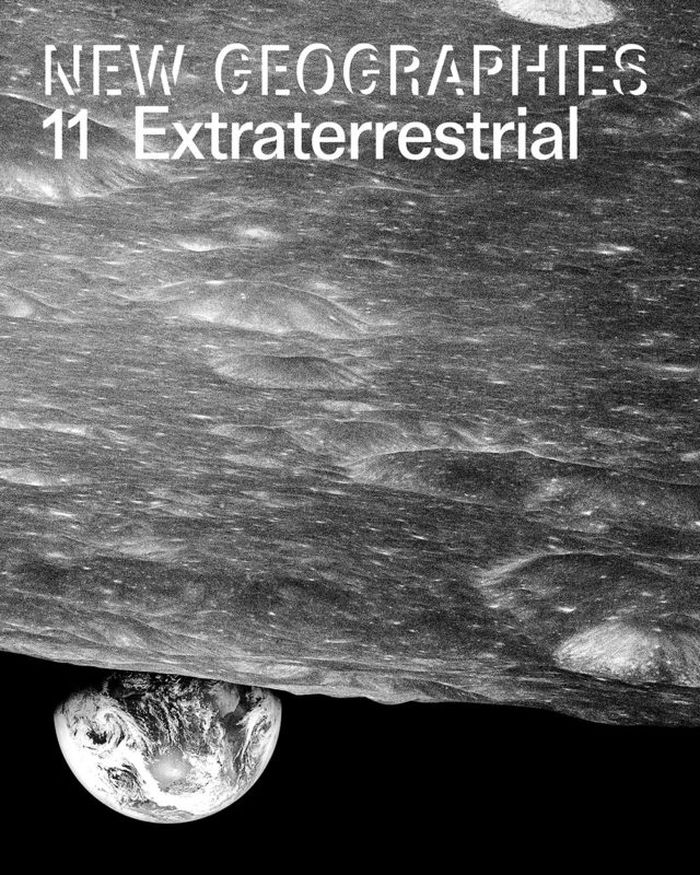
New Geographies 11: Extraterrestrial explores the historical and contemporary consequence of our planetary relationship with space. It interprets this duality through the conceptual lens of “extraterrestrial,” which engages an entangled zone of expanding practices in geography, landscape, and architecture, stretching Earth to space, and conversely, space to Earth. This issue questions the means through which space is forged as a condition extra to our own terra. Complicit within this imagination resides a deep political and economic logic that serves to territorialize outer space as an exception to, and extension of, Earth. These critical processes are revealed as not extra at all, but rather distinctly of terra. Through a series of written, photographic, and representational investigations, this edition of New Geographies builds on earlier studies of outer space from science, technology and society, as well as from the design disciplines, history, and critical geography. It reinforces the need for humanity’s changing relationship with outer space to be recorded, critiqued, and theorized from a breadth of academic traditions and projected within design discourse. This issue brings together experts contributing to the social, political, and cultural imaginary implicit in extraterrestrial. Three primary thematic territorial devices structure these explorations: a technologically constructed space between, a material culture constructed and discharged, and a space politically and economically reflective, all revealed through historical and contemporary society.
New Geographies 11: Extraterrestrial
Actions:
Price:
$40.00
(available to order)
Summary:
New Geographies 11: Extraterrestrial explores the historical and contemporary consequence of our planetary relationship with space. It interprets this duality through the conceptual lens of “extraterrestrial,” which engages an entangled zone of expanding practices in geography, landscape, and architecture, stretching Earth to space, and conversely, space to Earth. This issue questions the means through which space is forged as a condition extra to our own terra. Complicit within this imagination resides a deep political and economic logic that serves to territorialize outer space as an exception to, and extension of, Earth. These critical processes are revealed as not extra at all, but rather distinctly of terra. Through a series of written, photographic, and representational investigations, this edition of New Geographies builds on earlier studies of outer space from science, technology and society, as well as from the design disciplines, history, and critical geography. It reinforces the need for humanity’s changing relationship with outer space to be recorded, critiqued, and theorized from a breadth of academic traditions and projected within design discourse. This issue brings together experts contributing to the social, political, and cultural imaginary implicit in extraterrestrial. Three primary thematic territorial devices structure these explorations: a technologically constructed space between, a material culture constructed and discharged, and a space politically and economically reflective, all revealed through historical and contemporary society.
Form:
journals and magazines
journals and magazines
Publication:
June 2020
June 2020
Subject:
Magazines
Magazines
Form:
books
books
Price:
$25.95
(available to order)
Summary:
This publication sheds light on the reflections that led to the creation of EXIT, the 360° video installation created for the exhibition spaces of the Fondation Cartier pour l'art contemporain in Paris. Based on an idea by French philosopher and urbanist, Paul Virilio, the 360° video installation EXIT was created in 2008 by the New York-based studio of artists and(...)
$25.95
(available to order)
Summary:
This publication sheds light on the reflections that led to the creation of EXIT, the 360° video installation created for the exhibition spaces of the Fondation Cartier pour l'art contemporain in Paris. Based on an idea by French philosopher and urbanist, Paul Virilio, the 360° video installation EXIT was created in 2008 by the New York-based studio of artists and(...)
Title:
Diller Scofidio + Renfro: Exit: Based on an idea by Paul Virilio
Actions:
Price:
$25.95
(available to order)
Summary:
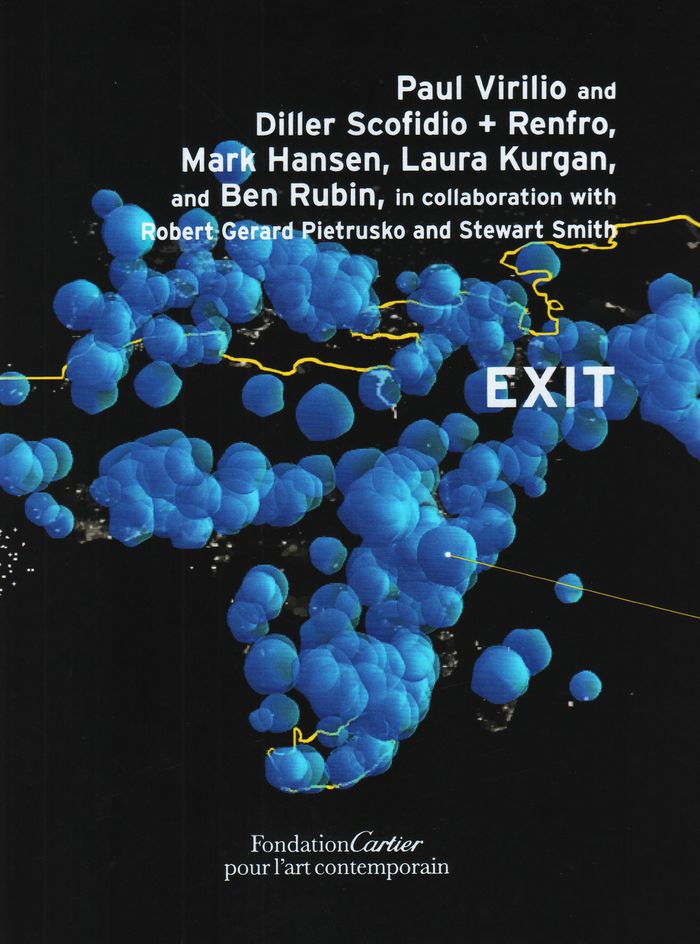
This publication sheds light on the reflections that led to the creation of EXIT, the 360° video installation created for the exhibition spaces of the Fondation Cartier pour l'art contemporain in Paris. Based on an idea by French philosopher and urbanist, Paul Virilio, the 360° video installation EXIT was created in 2008 by the New York-based studio of artists and architects Diller Scofidio + Renfro for the exhibition spaces of the Fondation Cartier pour l'art contemporain in Paris. Composed of a series of animated maps generated by data, this immersive installation investigates human migrations today and their leading causes, including the impact of climate change. Through six scenarios - Population Shifts: Cities; Remittances: Sending Money Home; Political Refugees and Forced Migration; Rising Seas, Sinking Cities; Natural Disasters; and Speechless and Deforestation - it provides the rare opportunity to understand visually the complex relationships between the various economic, political and environmental factors underpinning contemporary human migrations. The work was updated entirely in 2015, reflecting the alarming evolution of the data since it was first presented in 2008. Through various texts, descriptions of the animated maps, and numerous illustrations, this book sheds light on the reflections that led to the creation of EXIT, and proposes to delve deeper into the very notions and questions that it raises and that are more relevant today than ever.
Diller Scofidio + Renfro: Exit: Based on an idea by Paul Virilio
Actions:
Price:
$25.95
(available to order)
Summary:
This publication sheds light on the reflections that led to the creation of EXIT, the 360° video installation created for the exhibition spaces of the Fondation Cartier pour l'art contemporain in Paris. Based on an idea by French philosopher and urbanist, Paul Virilio, the 360° video installation EXIT was created in 2008 by the New York-based studio of artists and architects Diller Scofidio + Renfro for the exhibition spaces of the Fondation Cartier pour l'art contemporain in Paris. Composed of a series of animated maps generated by data, this immersive installation investigates human migrations today and their leading causes, including the impact of climate change. Through six scenarios - Population Shifts: Cities; Remittances: Sending Money Home; Political Refugees and Forced Migration; Rising Seas, Sinking Cities; Natural Disasters; and Speechless and Deforestation - it provides the rare opportunity to understand visually the complex relationships between the various economic, political and environmental factors underpinning contemporary human migrations. The work was updated entirely in 2015, reflecting the alarming evolution of the data since it was first presented in 2008. Through various texts, descriptions of the animated maps, and numerous illustrations, this book sheds light on the reflections that led to the creation of EXIT, and proposes to delve deeper into the very notions and questions that it raises and that are more relevant today than ever.
Form:
books
books
Publication:
November 2019
November 2019
Subject:
Architecture Monographs
Architecture Monographs
Form:
books
books
Actions:
Price:
$33.95
(available to order)
Summary:
With the concept of the ''Imperial mode of living,'' Brand and Wissen highlight the fact that capitalism implies uneven development as well as a constant and accelerating universalisation of a Western mode of production and living. The logic of liberal markets since the nineteenth century, and especially since World War II, has been inscribed into everyday practices that(...)
$33.95
(available to order)
Summary:
With the concept of the ''Imperial mode of living,'' Brand and Wissen highlight the fact that capitalism implies uneven development as well as a constant and accelerating universalisation of a Western mode of production and living. The logic of liberal markets since the nineteenth century, and especially since World War II, has been inscribed into everyday practices that(...)
Title:
The imperial mode of living: everyday life and the ecological crisis of capitalism
Actions:
Price:
$33.95
(available to order)
Summary:
With the concept of the ''Imperial mode of living,'' Brand and Wissen highlight the fact that capitalism implies uneven development as well as a constant and accelerating universalisation of a Western mode of production and living. The logic of liberal markets since the nineteenth century, and especially since World War II, has been inscribed into everyday practices that are usually unconsciously reproduced. The authors show that they are a main driver of the ecological crisis and economic and political instability. ''The imperial mode of living'' implies that people’s everyday practices, including individual and societal orientations, as well as identities, rely heavily on the unlimited appropriation of resources; a disproportionate claim on global and local ecosystems and sinks; and cheap labour from elsewhere. This availability of commodities is largely organised through the world market, backed by military force and/or the asymmetric relations of forces as they have been inscribed in international institutions. Moreover, the ''Imperial mode of living'' implies asymmetrical social relations along class, gender and race within the respective countries. Here too, it is driven by the capitalist accumulation imperative, growth-oriented state policies and status consumption. The concrete production conditions of commodities are rendered invisible in the places where the commodities are consumed. The imperialist world order is normalised through the mode of production and living.
The imperial mode of living: everyday life and the ecological crisis of capitalism
Actions:
Price:
$33.95
(available to order)
Summary:
With the concept of the ''Imperial mode of living,'' Brand and Wissen highlight the fact that capitalism implies uneven development as well as a constant and accelerating universalisation of a Western mode of production and living. The logic of liberal markets since the nineteenth century, and especially since World War II, has been inscribed into everyday practices that are usually unconsciously reproduced. The authors show that they are a main driver of the ecological crisis and economic and political instability. ''The imperial mode of living'' implies that people’s everyday practices, including individual and societal orientations, as well as identities, rely heavily on the unlimited appropriation of resources; a disproportionate claim on global and local ecosystems and sinks; and cheap labour from elsewhere. This availability of commodities is largely organised through the world market, backed by military force and/or the asymmetric relations of forces as they have been inscribed in international institutions. Moreover, the ''Imperial mode of living'' implies asymmetrical social relations along class, gender and race within the respective countries. Here too, it is driven by the capitalist accumulation imperative, growth-oriented state policies and status consumption. The concrete production conditions of commodities are rendered invisible in the places where the commodities are consumed. The imperialist world order is normalised through the mode of production and living.
Form:
books
books
Publication:
January 2021
January 2021
Subject:
Critical Theory
Critical Theory
Form:
books
books
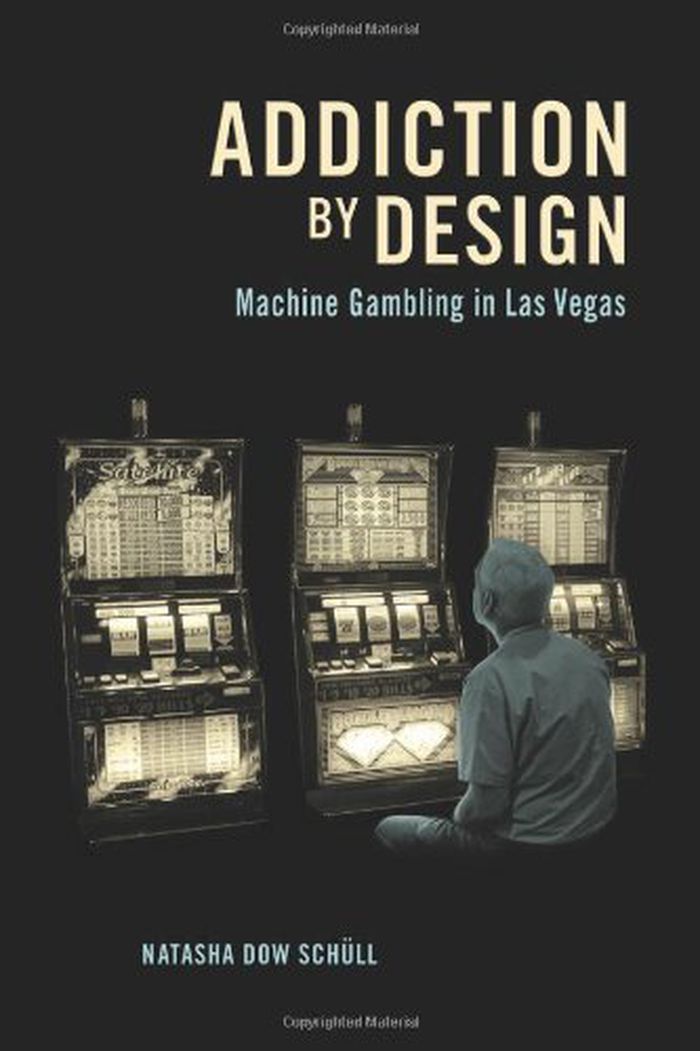
Actions:
Price:
$35.95
(available to order)
Summary:
Drawing on fifteen years of field research in Las Vegas, anthropologist Natasha Dow Schüll shows how the mechanical rhythm of electronic gambling pulls players into a trancelike state they call the "machine zone," in which daily worries, social demands, and even bodily awareness fade away. Once in the zone, gambling addicts play not to win but simply to keep playing, for(...)
$35.95
(available to order)
Summary:
Drawing on fifteen years of field research in Las Vegas, anthropologist Natasha Dow Schüll shows how the mechanical rhythm of electronic gambling pulls players into a trancelike state they call the "machine zone," in which daily worries, social demands, and even bodily awareness fade away. Once in the zone, gambling addicts play not to win but simply to keep playing, for(...)
Title:
Addiction by design: machine gambling in Las Vegas
Actions:
Price:
$35.95
(available to order)
Summary:
Drawing on fifteen years of field research in Las Vegas, anthropologist Natasha Dow Schüll shows how the mechanical rhythm of electronic gambling pulls players into a trancelike state they call the "machine zone," in which daily worries, social demands, and even bodily awareness fade away. Once in the zone, gambling addicts play not to win but simply to keep playing, for as long as possible?even at the cost of physical and economic exhaustion. In continuous machine play, gamblers seek to lose themselves while the gambling industry seeks profit. Schüll describes the strategic calculations behind game algorithms and machine ergonomics, casino architecture and "ambience management," player tracking and cash access systems?all designed to meet the market's desire for maximum "time on device." Her account moves from casino floors into gamblers' everyday lives, from gambling industry conventions and Gamblers Anonymous meetings to regulatory debates over whether addiction to gambling machines stems from the consumer, the product, or the interplay between the two. ''Addiction by design'' is a compelling inquiry into the intensifying traffic between people and machines of chance, offering clues to some of the broader anxieties and predicaments of contemporary life. At stake in Schüll's account of the intensifying traffic between people and machines of chance is a blurring of the line between design and experience, profit and loss, control and compulsion.
Addiction by design: machine gambling in Las Vegas
Actions:
Price:
$35.95
(available to order)
Summary:
Drawing on fifteen years of field research in Las Vegas, anthropologist Natasha Dow Schüll shows how the mechanical rhythm of electronic gambling pulls players into a trancelike state they call the "machine zone," in which daily worries, social demands, and even bodily awareness fade away. Once in the zone, gambling addicts play not to win but simply to keep playing, for as long as possible?even at the cost of physical and economic exhaustion. In continuous machine play, gamblers seek to lose themselves while the gambling industry seeks profit. Schüll describes the strategic calculations behind game algorithms and machine ergonomics, casino architecture and "ambience management," player tracking and cash access systems?all designed to meet the market's desire for maximum "time on device." Her account moves from casino floors into gamblers' everyday lives, from gambling industry conventions and Gamblers Anonymous meetings to regulatory debates over whether addiction to gambling machines stems from the consumer, the product, or the interplay between the two. ''Addiction by design'' is a compelling inquiry into the intensifying traffic between people and machines of chance, offering clues to some of the broader anxieties and predicaments of contemporary life. At stake in Schüll's account of the intensifying traffic between people and machines of chance is a blurring of the line between design and experience, profit and loss, control and compulsion.
Form:
books
books
Publication:
May 2014
May 2014
Subject:
Design Theory
Design Theory
Form:
books
books
Title:
Dominio : This is a book on architecture = Dominio: Este es un libro de arquitectura / Onnis Luque.
Dominio : This is a book on architecture = Dominio: Este es un libro de arquitectura / Onnis Luque.
Actions:
Holdings:
Description:
80 unnumbered pages : chiefly illustrations ; 33 cm.
Description:
80 unnumbered pages : chiefly illustrations ; 33 cm.
Author:
Subject:
Publication:
Mexico City : Gato Negro Ediciones, 2023.
Mexico City : Gato Negro Ediciones, 2023.
Title:
Dominio : This is a book on architecture = Dominio: Este es un libro de arquitectura / Onnis Luque.
Actions:
Holdings:
Description:
80 unnumbered pages : chiefly illustrations ; 33 cm.
Dominio : This is a book on architecture = Dominio: Este es un libro de arquitectura / Onnis Luque.
Actions:
Holdings:
Description:
80 unnumbered pages : chiefly illustrations ; 33 cm.
Form:
books
books
Publication:
Mexico City : Gato Negro Ediciones, 2023.
Mexico City : Gato Negro Ediciones, 2023.
Author:
Subject:
Form:
books
books
Title:
Readings in urban analysis : perspectives on urban form and structure / edited by Robert W. Lake.
Readings in urban analysis : perspectives on urban form and structure / edited by Robert W. Lake.
Actions:
Holdings:
Description:
xxv, 316 pages : illustrations ; 23 cm
Description:
xxv, 316 pages : illustrations ; 23 cm
Author:
Subject:
Publication:
New Brunswick, N.J. : Center for Urban Policy Research, ©1983.
New Brunswick, N.J. : Center for Urban Policy Research, ©1983.
Title:
Readings in urban analysis : perspectives on urban form and structure / edited by Robert W. Lake.
Actions:
Holdings:
Description:
xxv, 316 pages : illustrations ; 23 cm
Readings in urban analysis : perspectives on urban form and structure / edited by Robert W. Lake.
Actions:
Holdings:
Description:
xxv, 316 pages : illustrations ; 23 cm
Form:
books
books
Publication:
New Brunswick, N.J. : Center for Urban Policy Research, ©1983.
New Brunswick, N.J. : Center for Urban Policy Research, ©1983.
Author:
Subject:
Form:
books
books
Actions:
Holdings:
Description:
x, 331 pages ; 22 cm
Description:
x, 331 pages ; 22 cm
Author:
Subject:
Publication:
Oxford : Oxford University Press, 2016., ©2014
Oxford : Oxford University Press, 2016., ©2014
Title:
Sustainability : a history / Jeremy L. Caradonna.
Actions:
Holdings:
Description:
x, 331 pages ; 22 cm
Sustainability : a history / Jeremy L. Caradonna.
Actions:
Holdings:
Description:
x, 331 pages ; 22 cm
Form:
books
books
Publication:
Oxford : Oxford University Press, 2016., ©2014
Oxford : Oxford University Press, 2016., ©2014
Author:
Subject:
Form:
books
books
Title:
Using our natural resources.
Using our natural resources.
Actions:
Holdings:
Description:
xxxix, 572 pages : illustrations (some color) ; 22 cm
Description:
xxxix, 572 pages : illustrations (some color) ; 22 cm
Author:
Subject:
Publication:
[Washington, D.C.] : U.S. Department of Agriculture ; [U.S. Government Printing Office], 1983
[Washington, D.C.] : U.S. Department of Agriculture ; [U.S. Government Printing Office], 1983
Title:
Using our natural resources.
Actions:
Holdings:
Description:
xxxix, 572 pages : illustrations (some color) ; 22 cm
Using our natural resources.
Actions:
Holdings:
Description:
xxxix, 572 pages : illustrations (some color) ; 22 cm
Form:
books
books
Publication:
[Washington, D.C.] : U.S. Department of Agriculture ; [U.S. Government Printing Office], 1983
[Washington, D.C.] : U.S. Department of Agriculture ; [U.S. Government Printing Office], 1983
Author:
Subject:
Form:
books
books
Actions:
Holdings:
Description:
272 pages : illustrations (some color), plans (some color) ; 33 cm.
Description:
272 pages : illustrations (some color), plans (some color) ; 33 cm.
Author:
Subject:
Publication:
Basel : Birkhäuser, [2020, actually 2019], ©2020
Basel : Birkhäuser, [2020, actually 2019], ©2020
Title:
Hospitals : a design manual / Cor Wagenaar, Noor Mens, Guru Manja, Colette Niemeijer, Tom Guthknecht ; contributions by Giuseppe Lacanna, Peter Luscuere.
Actions:
Holdings:
Description:
272 pages : illustrations (some color), plans (some color) ; 33 cm.
Hospitals : a design manual / Cor Wagenaar, Noor Mens, Guru Manja, Colette Niemeijer, Tom Guthknecht ; contributions by Giuseppe Lacanna, Peter Luscuere.
Actions:
Holdings:
Description:
272 pages : illustrations (some color), plans (some color) ; 33 cm.
Form:
books
books
Publication:
Basel : Birkhäuser, [2020, actually 2019], ©2020
Basel : Birkhäuser, [2020, actually 2019], ©2020
Author:
Subject:


