


13794 Results
Form:
books
books
Actions:
Price:
$36.95
(available to order)
Summary:
In ''Designs for the Pluriverse'' Arturo Escobar presents a new vision of design theory and practice aimed at channeling design's world-making capacity toward ways of being and doing that are deeply attuned to justice and the Earth. Noting that most design—from consumer goods and digital technologies to built environments—currently serves capitalist ends, Escobar argues(...)
$36.95
(available to order)
Summary:
In ''Designs for the Pluriverse'' Arturo Escobar presents a new vision of design theory and practice aimed at channeling design's world-making capacity toward ways of being and doing that are deeply attuned to justice and the Earth. Noting that most design—from consumer goods and digital technologies to built environments—currently serves capitalist ends, Escobar argues(...)
Title:
Designs for the pluriverse: Radical interdependence, autonomy, and the making of world
Actions:
Price:
$36.95
(available to order)
Summary:
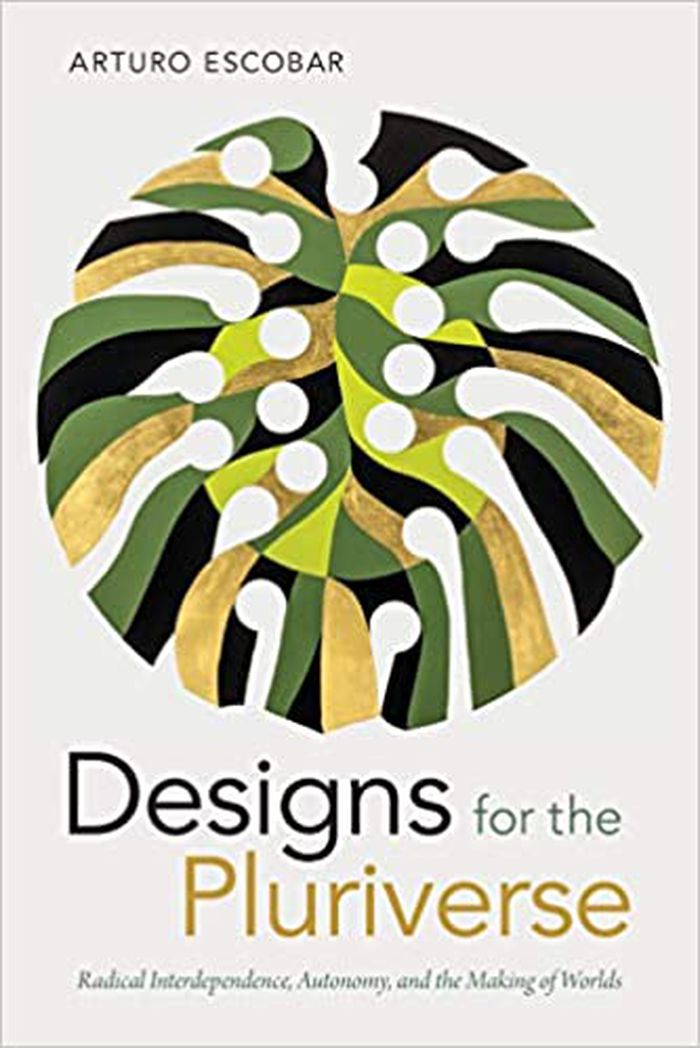
In ''Designs for the Pluriverse'' Arturo Escobar presents a new vision of design theory and practice aimed at channeling design's world-making capacity toward ways of being and doing that are deeply attuned to justice and the Earth. Noting that most design—from consumer goods and digital technologies to built environments—currently serves capitalist ends, Escobar argues for the development of an 'autonomous design' that eschews commercial and modernizing aims in favor of more collaborative and placed-based approaches. Such design attends to questions of environment, experience, and politics while focusing on the production of human experience based on the radical interdependence of all beings. Mapping autonomous design’s principles to the history of decolonial efforts of indigenous and Afro-descended people in Latin America, Escobar shows how refiguring current design practices could lead to the creation of more just and sustainable social orders.
Designs for the pluriverse: Radical interdependence, autonomy, and the making of world
Actions:
Price:
$36.95
(available to order)
Summary:
In ''Designs for the Pluriverse'' Arturo Escobar presents a new vision of design theory and practice aimed at channeling design's world-making capacity toward ways of being and doing that are deeply attuned to justice and the Earth. Noting that most design—from consumer goods and digital technologies to built environments—currently serves capitalist ends, Escobar argues for the development of an 'autonomous design' that eschews commercial and modernizing aims in favor of more collaborative and placed-based approaches. Such design attends to questions of environment, experience, and politics while focusing on the production of human experience based on the radical interdependence of all beings. Mapping autonomous design’s principles to the history of decolonial efforts of indigenous and Afro-descended people in Latin America, Escobar shows how refiguring current design practices could lead to the creation of more just and sustainable social orders.
Form:
books
books
Publication:
March 2018
March 2018
Subject:
Environment and environmental theory
Environment and environmental theory
Form:
books
books
Actions:
Holdings:
Description:
viii, 208 pages ; 23 cm
Description:
viii, 208 pages ; 23 cm
Author:
Subject:
Publication:
London ; New York : Routledge, 1990.
London ; New York : Routledge, 1990.
Title:
The romance of culture in an urban civilization : Robert E. Park on race and ethnic relations in cities / Barbara Ballis Lal.
Actions:
Holdings:
Description:
viii, 208 pages ; 23 cm
The romance of culture in an urban civilization : Robert E. Park on race and ethnic relations in cities / Barbara Ballis Lal.
Actions:
Holdings:
Description:
viii, 208 pages ; 23 cm
Form:
books
books
Publication:
London ; New York : Routledge, 1990.
London ; New York : Routledge, 1990.
Author:
Subject:
Form:
books
books
Title:
October 138 : digital art
October 138 : digital art
Actions:
Price:
$16.00
(available to order)
Summary:
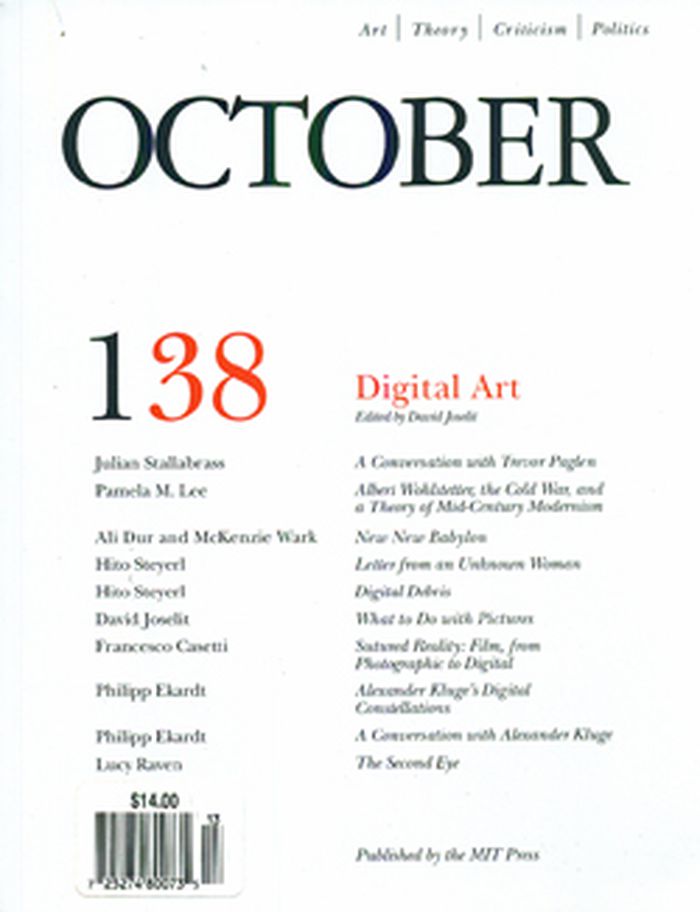
At the forefront of art criticism and theory, October focuses critical attention on the contemporary arts—film, painting, music, media, photography, performance, sculpture, and literature—and their various contexts of interpretation. Issue 138 : Digital art
$16.00
(available to order)
Summary:
At the forefront of art criticism and theory, October focuses critical attention on the contemporary arts—film, painting, music, media, photography, performance, sculpture, and literature—and their various contexts of interpretation. Issue 138 : Digital art
Title:
October 138 : digital art
Actions:
Price:
$16.00
(available to order)
Summary:
At the forefront of art criticism and theory, October focuses critical attention on the contemporary arts—film, painting, music, media, photography, performance, sculpture, and literature—and their various contexts of interpretation. Issue 138 : Digital art
October 138 : digital art
Actions:
Price:
$16.00
(available to order)
Summary:
At the forefront of art criticism and theory, October focuses critical attention on the contemporary arts—film, painting, music, media, photography, performance, sculpture, and literature—and their various contexts of interpretation. Issue 138 : Digital art
Form:
books
books
Publication:
January 2012
January 2012
Subject:
Magazines
Magazines
Form:
books
books
Actions:
Price:
$23.95
(available to order)
Summary:
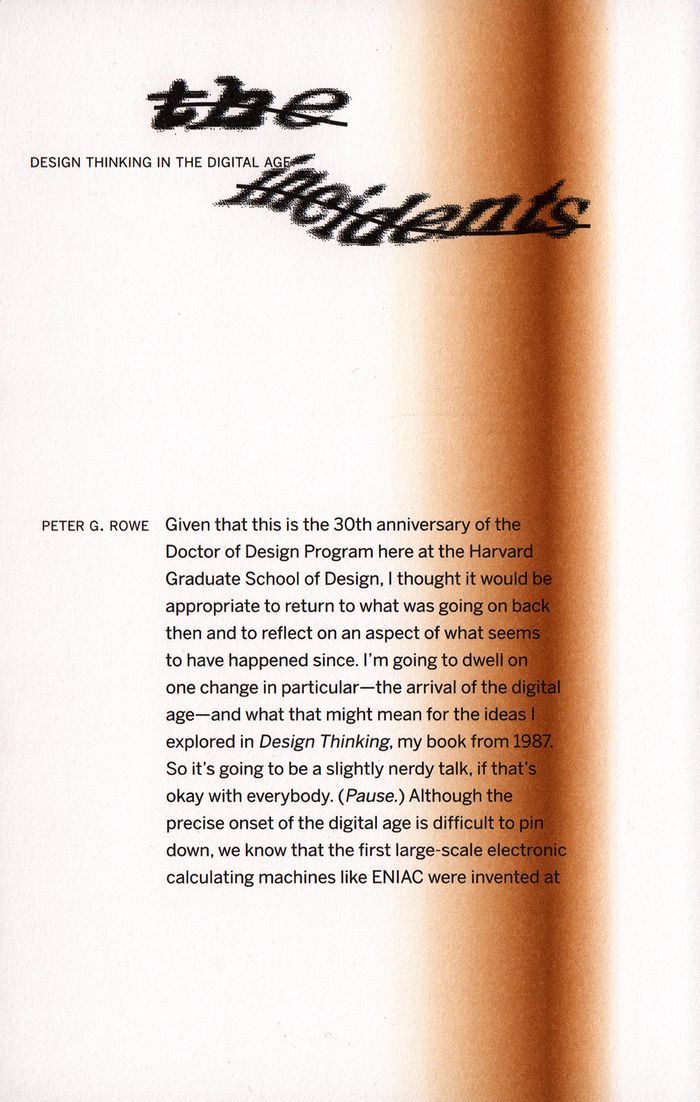
In this essay, professor Peter G. Rowe gives an overall description of how new technologies transformed the field of architectural design, addressing issues such as the precision and incompleteness of information, schema theory and heuristics.
$23.95
(available to order)
Summary:
In this essay, professor Peter G. Rowe gives an overall description of how new technologies transformed the field of architectural design, addressing issues such as the precision and incompleteness of information, schema theory and heuristics.
Title:
Design thinking in the digital age
Actions:
Price:
$23.95
(available to order)
Summary:
In this essay, professor Peter G. Rowe gives an overall description of how new technologies transformed the field of architectural design, addressing issues such as the precision and incompleteness of information, schema theory and heuristics.
Design thinking in the digital age
Actions:
Price:
$23.95
(available to order)
Summary:
In this essay, professor Peter G. Rowe gives an overall description of how new technologies transformed the field of architectural design, addressing issues such as the precision and incompleteness of information, schema theory and heuristics.
Form:
books
books
Publication:
February 2018
February 2018
Subject:
Digital Architecture
Digital Architecture
Form:
journals and magazines
journals and magazines
Title:
October 159
October 159
Actions:
Price:
$24.95
(available to order)
Summary:
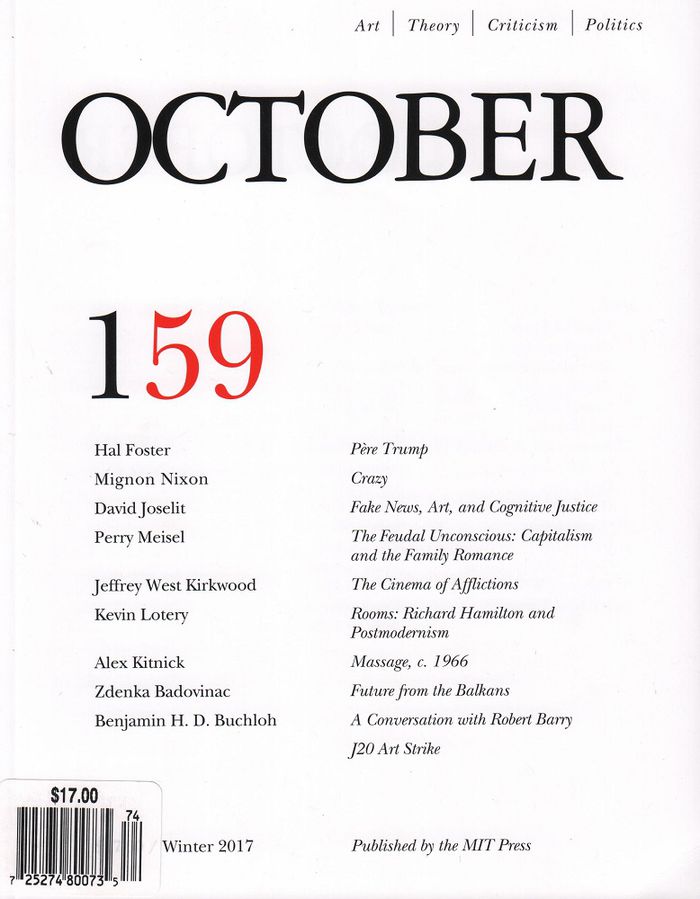
Latest issue in store! At the forefront of art criticism and theory, October focuses critical attention on the contemporary arts—film, painting, music, media, photography, performance, sculpture, and literature—and their various contexts of interpretation.
$24.95
(available to order)
Summary:
Latest issue in store! At the forefront of art criticism and theory, October focuses critical attention on the contemporary arts—film, painting, music, media, photography, performance, sculpture, and literature—and their various contexts of interpretation.
Title:
October 159
Actions:
Price:
$24.95
(available to order)
Summary:
Latest issue in store! At the forefront of art criticism and theory, October focuses critical attention on the contemporary arts—film, painting, music, media, photography, performance, sculpture, and literature—and their various contexts of interpretation.
October 159
Actions:
Price:
$24.95
(available to order)
Summary:
Latest issue in store! At the forefront of art criticism and theory, October focuses critical attention on the contemporary arts—film, painting, music, media, photography, performance, sculpture, and literature—and their various contexts of interpretation.
Form:
journals and magazines
journals and magazines
Publication:
January 2017
January 2017
Subject:
Magazines
Magazines
Form:
journals and magazines
journals and magazines
Title:
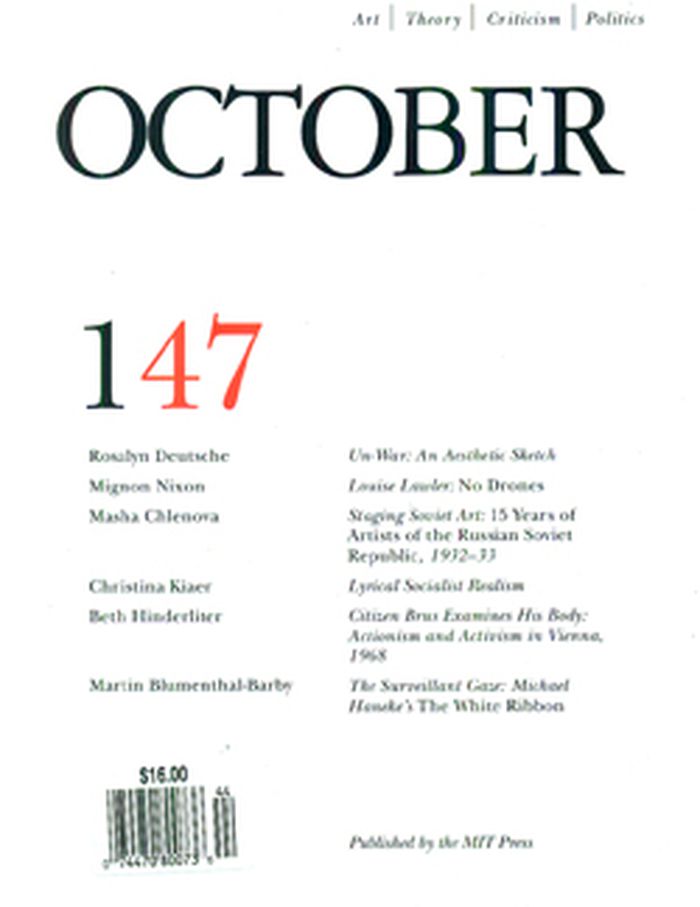
October 147
October 147
Actions:
Price:
$24.95
(available to order)
Summary:
At the forefront of art criticism and theory, October focuses critical attention on the contemporary arts—film, painting, music, media, photography, performance, sculpture, and literature—and their various contexts of interpretation. New issue in store!
$24.95
(available to order)
Summary:
At the forefront of art criticism and theory, October focuses critical attention on the contemporary arts—film, painting, music, media, photography, performance, sculpture, and literature—and their various contexts of interpretation. New issue in store!
Title:
October 147
Actions:
Price:
$24.95
(available to order)
Summary:
At the forefront of art criticism and theory, October focuses critical attention on the contemporary arts—film, painting, music, media, photography, performance, sculpture, and literature—and their various contexts of interpretation. New issue in store!
October 147
Actions:
Price:
$24.95
(available to order)
Summary:
At the forefront of art criticism and theory, October focuses critical attention on the contemporary arts—film, painting, music, media, photography, performance, sculpture, and literature—and their various contexts of interpretation. New issue in store!
Form:
journals and magazines
journals and magazines
Publication:
April 2014
April 2014
Subject:
Magazines
Magazines
Form:
books
books

Actions:
Price:
$50.95
(available to order)
Summary:
Architectural facades now have the potential to be literally kinetic, through automated sunscreens and a range of animated surfaces. This book explores the aesthetic potential of these new types of moving facades. Critique of theory and practice in architecture is combined here with ideas from kinetic art of the 1960's. From this background the basic principles of(...)
$50.95
(available to order)
Summary:
Architectural facades now have the potential to be literally kinetic, through automated sunscreens and a range of animated surfaces. This book explores the aesthetic potential of these new types of moving facades. Critique of theory and practice in architecture is combined here with ideas from kinetic art of the 1960's. From this background the basic principles of(...)
Title:
Designing kinetics for architectural facades: state change
Actions:
Price:
$50.95
(available to order)
Summary:
Architectural facades now have the potential to be literally kinetic, through automated sunscreens and a range of animated surfaces. This book explores the aesthetic potential of these new types of moving facades. Critique of theory and practice in architecture is combined here with ideas from kinetic art of the 1960's. From this background the basic principles of kinetics are defined and are used to generate experimental computer animations. By classifying the animations, a theory of kinetic form called 'state change' is developed. This design research provides a resource for those interested in the capacity of kinetics to enliven the public face of architecture.
Designing kinetics for architectural facades: state change
Actions:
Price:
$50.95
(available to order)
Summary:
Architectural facades now have the potential to be literally kinetic, through automated sunscreens and a range of animated surfaces. This book explores the aesthetic potential of these new types of moving facades. Critique of theory and practice in architecture is combined here with ideas from kinetic art of the 1960's. From this background the basic principles of kinetics are defined and are used to generate experimental computer animations. By classifying the animations, a theory of kinetic form called 'state change' is developed. This design research provides a resource for those interested in the capacity of kinetics to enliven the public face of architecture.
Form:
books
books
Publication:
July 2011
July 2011
Subject:
Digital Architecture
Digital Architecture
Form:
books
books
Actions:
Price:
$53.95
(available to order)
Summary:
In ''Japanese Creativity'', Japanese architect Yuichiro Edagawa sets out to try to determine the roots of a particularly Japanese architectural style by analyzing a wide variety of exemplary buildings from the sixth century to the present. Developing his theory out of close observation and practical knowledge and constantly shifting between historical and more recent(...)
$53.95
(available to order)
Summary:
In ''Japanese Creativity'', Japanese architect Yuichiro Edagawa sets out to try to determine the roots of a particularly Japanese architectural style by analyzing a wide variety of exemplary buildings from the sixth century to the present. Developing his theory out of close observation and practical knowledge and constantly shifting between historical and more recent(...)
Title:
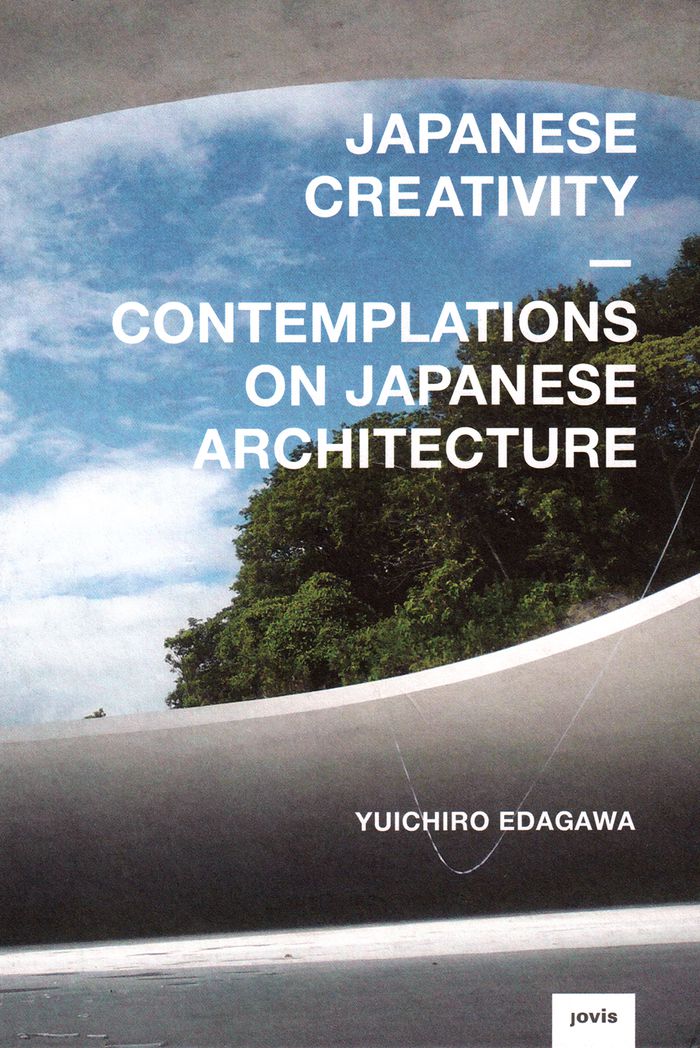
Japanese creativity: contemplations on Japanese architecture
Actions:
Price:
$53.95
(available to order)
Summary:
In ''Japanese Creativity'', Japanese architect Yuichiro Edagawa sets out to try to determine the roots of a particularly Japanese architectural style by analyzing a wide variety of exemplary buildings from the sixth century to the present. Developing his theory out of close observation and practical knowledge and constantly shifting between historical and more recent examples, Edagawa isolates what he considers to be the distinctive characteristics of Japanese architectural creativity and composition: intimacy with nature, importance of materials, bipolarity and diversity, asymmetry, devotion to small space and an appreciation for organic form. He finds these qualities across Japanese design, and from these extrapolates a theory of Japanese architectural creation.
Japanese creativity: contemplations on Japanese architecture
Actions:
Price:
$53.95
(available to order)
Summary:
In ''Japanese Creativity'', Japanese architect Yuichiro Edagawa sets out to try to determine the roots of a particularly Japanese architectural style by analyzing a wide variety of exemplary buildings from the sixth century to the present. Developing his theory out of close observation and practical knowledge and constantly shifting between historical and more recent examples, Edagawa isolates what he considers to be the distinctive characteristics of Japanese architectural creativity and composition: intimacy with nature, importance of materials, bipolarity and diversity, asymmetry, devotion to small space and an appreciation for organic form. He finds these qualities across Japanese design, and from these extrapolates a theory of Japanese architectural creation.
Form:
books
books
Publication:
October 2018
October 2018
Subject:
Contemporary Asian Architecture
Contemporary Asian Architecture
Form:
books
books
Price:
$48.99
(available to order)
Summary:
During the 1920s and 1930s, proponents of Soviet architecture looked to various principles within the human sciences in their efforts to formulate a methodological and theoretical basis for their modernist project. ''Architecture of life'' delves into the foundations of this transdisciplinary and transnational endeavor, analyzing many facets of their radical approach and(...)
$48.99
(available to order)
Summary:
During the 1920s and 1930s, proponents of Soviet architecture looked to various principles within the human sciences in their efforts to formulate a methodological and theoretical basis for their modernist project. ''Architecture of life'' delves into the foundations of this transdisciplinary and transnational endeavor, analyzing many facets of their radical approach and(...)
Title:
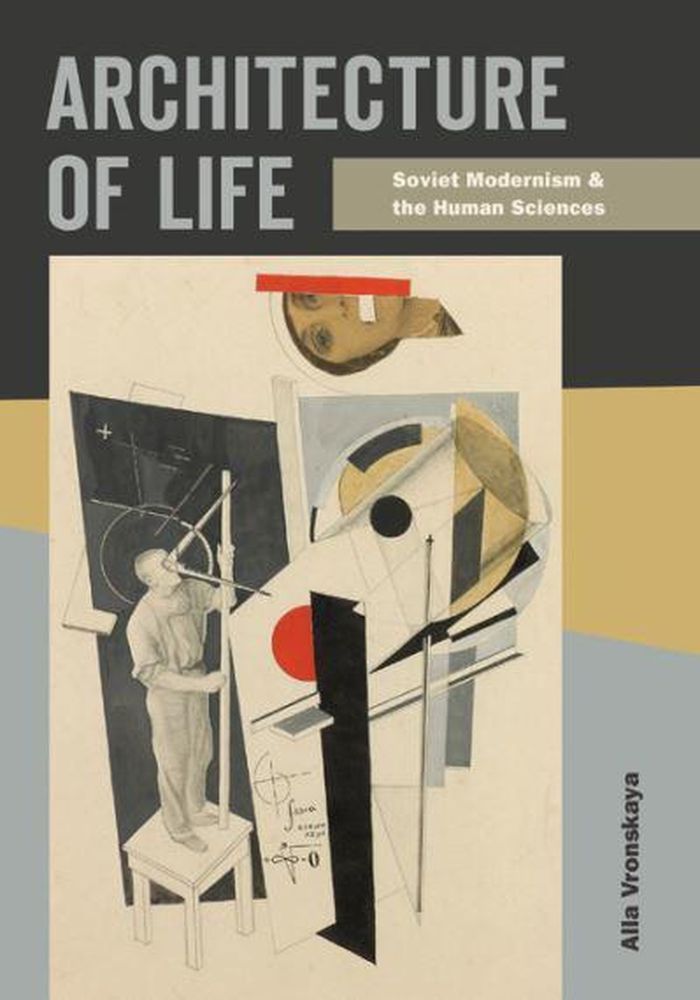
Architecture of life: Soviet modernism and the human sciences
Actions:
Price:
$48.99
(available to order)
Summary:
During the 1920s and 1930s, proponents of Soviet architecture looked to various principles within the human sciences in their efforts to formulate a methodological and theoretical basis for their modernist project. ''Architecture of life'' delves into the foundations of this transdisciplinary and transnational endeavor, analyzing many facets of their radical approach and situating it within the context of other modernist movements that were developing concurrently across the globe. Examining the theories advanced by El Lissitzky, Moisei Ginzburg, and Nikolay Ladovsky, as well as those of their lesser-known colleagues, this illuminating study demonstrates how Soviet architects of the interwar period sought to mitigate Fordist production methods with other, ostensibly more human-oriented approaches that drew on the biological and psychological sciences. Envisioning the built environment as innately connected to social evolution, their methods incorporated aspects of psychoanalysis, personality theory, and studies in spatial perception, all of which were integrated into an ideology that grounded functional design firmly within the attributes of the individual. A comprehensive overview of the ideals that permeated its expanded project, ''Architecture of life'' explicates the underlying impulses that motivated Soviet modernism, highlighting the deep interconnections among the ways in which it viewed all aspects of life, both natural and manufactured.
Architecture of life: Soviet modernism and the human sciences
Actions:
Price:
$48.99
(available to order)
Summary:
During the 1920s and 1930s, proponents of Soviet architecture looked to various principles within the human sciences in their efforts to formulate a methodological and theoretical basis for their modernist project. ''Architecture of life'' delves into the foundations of this transdisciplinary and transnational endeavor, analyzing many facets of their radical approach and situating it within the context of other modernist movements that were developing concurrently across the globe. Examining the theories advanced by El Lissitzky, Moisei Ginzburg, and Nikolay Ladovsky, as well as those of their lesser-known colleagues, this illuminating study demonstrates how Soviet architects of the interwar period sought to mitigate Fordist production methods with other, ostensibly more human-oriented approaches that drew on the biological and psychological sciences. Envisioning the built environment as innately connected to social evolution, their methods incorporated aspects of psychoanalysis, personality theory, and studies in spatial perception, all of which were integrated into an ideology that grounded functional design firmly within the attributes of the individual. A comprehensive overview of the ideals that permeated its expanded project, ''Architecture of life'' explicates the underlying impulses that motivated Soviet modernism, highlighting the deep interconnections among the ways in which it viewed all aspects of life, both natural and manufactured.
Form:
books
books
Publication:
August 2022
August 2022
Subject:
Architectural Theory
Architectural Theory
Form:
books
books
Title:
In praise of copying
In praise of copying
Actions:
Price:
$29.95
(available to order)
Summary:
This book is devoted to a deceptively simple but original argument: that copying is an essential part of being human, that the ability to copy is worthy of celebration, and that, without recognizing how integral copying is to being human, we cannot understand ourselves or the world we live in. In spite of the laws, stigmas, and anxieties attached to it, the word(...)
$29.95
(available to order)
Summary:
This book is devoted to a deceptively simple but original argument: that copying is an essential part of being human, that the ability to copy is worthy of celebration, and that, without recognizing how integral copying is to being human, we cannot understand ourselves or the world we live in. In spite of the laws, stigmas, and anxieties attached to it, the word(...)
Title:
In praise of copying
Actions:
Price:
$29.95
(available to order)
Summary:
This book is devoted to a deceptively simple but original argument: that copying is an essential part of being human, that the ability to copy is worthy of celebration, and that, without recognizing how integral copying is to being human, we cannot understand ourselves or the world we live in. In spite of the laws, stigmas, and anxieties attached to it, the word “copying” permeates contemporary culture, shaping discourse on issues from hip hop to digitization to gender reassignment, and is particularly crucial in legal debates concerning intellectual property and copyright. Yet as a philosophical concept, copying remains poorly understood. Working comparatively across cultures and times, Marcus Boon undertakes an examination of what this word means—historically, culturally, philosophically—and why it fills us with fear and fascination. He argues that the dominant legal-political structures that define copying today obscure much broader processes of imitation that have constituted human communities for ages and continue to shape various subcultures today. Drawing on contemporary art, music and film, the history of aesthetics, critical theory, and Buddhist philosophy and practice, In Praise of Copying seeks to show how and why copying works, what the sources of its power are, and the political stakes of renegotiating the way we value copying in the age of globalization.
In praise of copying
Actions:
Price:
$29.95
(available to order)
Summary:
This book is devoted to a deceptively simple but original argument: that copying is an essential part of being human, that the ability to copy is worthy of celebration, and that, without recognizing how integral copying is to being human, we cannot understand ourselves or the world we live in. In spite of the laws, stigmas, and anxieties attached to it, the word “copying” permeates contemporary culture, shaping discourse on issues from hip hop to digitization to gender reassignment, and is particularly crucial in legal debates concerning intellectual property and copyright. Yet as a philosophical concept, copying remains poorly understood. Working comparatively across cultures and times, Marcus Boon undertakes an examination of what this word means—historically, culturally, philosophically—and why it fills us with fear and fascination. He argues that the dominant legal-political structures that define copying today obscure much broader processes of imitation that have constituted human communities for ages and continue to shape various subcultures today. Drawing on contemporary art, music and film, the history of aesthetics, critical theory, and Buddhist philosophy and practice, In Praise of Copying seeks to show how and why copying works, what the sources of its power are, and the political stakes of renegotiating the way we value copying in the age of globalization.
Form:
books
books
Publication:
October 2010
October 2010
Subject:
Critical Theory
Critical Theory


