


6052 Results
Form:
books
books
Actions:
Price:
$89.99
(available to order)
Summary:
Written by the chair of the LEED-Neighborhood Development (LEED-ND) initiative, Sustainable Urbanism: Urban Design with Nature is both an urgent call to action and a comprehensive introduction to "sustainable urbanism"--the emerging and growing design reform movement that combines the creation and enhancement of walkable and diverse places with the need to build(...)
$89.99
(available to order)
Summary:
Written by the chair of the LEED-Neighborhood Development (LEED-ND) initiative, Sustainable Urbanism: Urban Design with Nature is both an urgent call to action and a comprehensive introduction to "sustainable urbanism"--the emerging and growing design reform movement that combines the creation and enhancement of walkable and diverse places with the need to build(...)
Title:
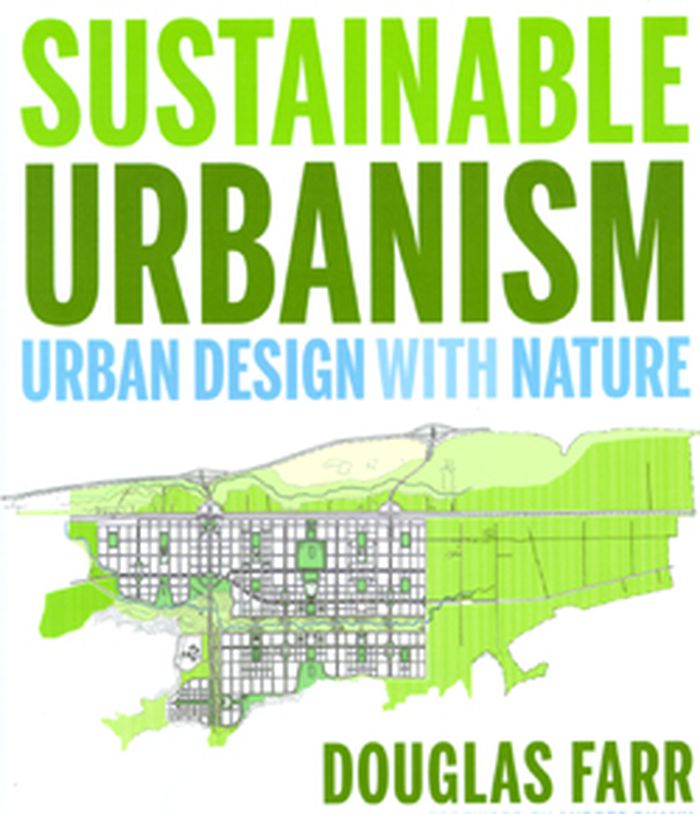
Sustainable urbanism: urban design with nature
Actions:
Price:
$89.99
(available to order)
Summary:
Written by the chair of the LEED-Neighborhood Development (LEED-ND) initiative, Sustainable Urbanism: Urban Design with Nature is both an urgent call to action and a comprehensive introduction to "sustainable urbanism"--the emerging and growing design reform movement that combines the creation and enhancement of walkable and diverse places with the need to build high-performance infrastructure and buildings. Providing a historic perspective on the standards and regulations that got us to where we are today in terms of urban lifestyle and attempts at reform, Douglas Farr makes a powerful case for sustainable urbanism, showing where we went wrong, and where we need to go. He then explains how to implement sustainable urbanism through leadership and communication in cities, communities, and neighborhoods. Essays written by Farr and others delve into such issues as: Increasing sustainability through density. Integrating transportation and land use. Creating sustainable neighborhoods, including housing, car-free areas, locally-owned stores, walkable neighborhoods, and universal accessibility. The health and environmental benefits of linking humans to nature, including walk-to open spaces, neighborhood stormwater systems and waste treatment, and food production. High performance buildings and district energy systems. Enriching the argument are in-depth case studies in sustainable urbanism, from BedZED in London, England and Newington in Sydney, Australia, to New Railroad Square in Santa Rosa, California and Dongtan, Shanghai, China. An epilogue looks to the future of sustainable urbanism over the next 200 years.
Sustainable urbanism: urban design with nature
Actions:
Price:
$89.99
(available to order)
Summary:
Written by the chair of the LEED-Neighborhood Development (LEED-ND) initiative, Sustainable Urbanism: Urban Design with Nature is both an urgent call to action and a comprehensive introduction to "sustainable urbanism"--the emerging and growing design reform movement that combines the creation and enhancement of walkable and diverse places with the need to build high-performance infrastructure and buildings. Providing a historic perspective on the standards and regulations that got us to where we are today in terms of urban lifestyle and attempts at reform, Douglas Farr makes a powerful case for sustainable urbanism, showing where we went wrong, and where we need to go. He then explains how to implement sustainable urbanism through leadership and communication in cities, communities, and neighborhoods. Essays written by Farr and others delve into such issues as: Increasing sustainability through density. Integrating transportation and land use. Creating sustainable neighborhoods, including housing, car-free areas, locally-owned stores, walkable neighborhoods, and universal accessibility. The health and environmental benefits of linking humans to nature, including walk-to open spaces, neighborhood stormwater systems and waste treatment, and food production. High performance buildings and district energy systems. Enriching the argument are in-depth case studies in sustainable urbanism, from BedZED in London, England and Newington in Sydney, Australia, to New Railroad Square in Santa Rosa, California and Dongtan, Shanghai, China. An epilogue looks to the future of sustainable urbanism over the next 200 years.
Form:
books
books
Publication:
November 2007, Hoboken, New Jersey
November 2007, Hoboken, New Jersey
Subject:
Urban Theory
Urban Theory
Form:
books
books
Title:
Overlook : exploring the internal fringes of America with the Center for land use interpretation
Overlook : exploring the internal fringes of America with the Center for land use interpretation
Actions:
Price:
$42.00
(available to order)
Summary:
The Center for land use interpretation is a research-based educational organization that produces public programs about the built landscape of the United States from its sites in Los Angeles, Utah and the Mojave desert, with an upstate New York location opening in 2006. The Center’s aim is to increase and diffuse information about how the nation’s lands are apportioned,(...)
$42.00
(available to order)
Summary:
The Center for land use interpretation is a research-based educational organization that produces public programs about the built landscape of the United States from its sites in Los Angeles, Utah and the Mojave desert, with an upstate New York location opening in 2006. The Center’s aim is to increase and diffuse information about how the nation’s lands are apportioned,(...)
Title:
Overlook : exploring the internal fringes of America with the Center for land use interpretation
Actions:
Price:
$42.00
(available to order)
Summary:
The Center for land use interpretation is a research-based educational organization that produces public programs about the built landscape of the United States from its sites in Los Angeles, Utah and the Mojave desert, with an upstate New York location opening in 2006. The Center’s aim is to increase and diffuse information about how the nation’s lands are apportioned, utilized and perceived. Recent examples of their work include a two-day "Tour of the monuments of the great American void" by bus and the exhibit "Immersed remains: towns submerged in America". This book takes readers on a tour through the strangely unfamiliar land that Americans live in, demonstrating that we can understand ourselves by examining the clues on display all around us, often clearly visible but ignored. Each chapter explores a different topic, from an in-depth look at Ohio ("the most all-American state"); through scale shifts in model landscapes, exemplified in the three largest hydraulic models in the world; and law-enforcement training environments that "simulate" public space. Readers can dive into the hidden and enchanting world of show caves, where America is on display underground; and come up into the Great Basin, a zone covering most of Nevada, and portions of Utah, California, Oregon, Idaho and Mexico, whose network of watersheds has no outlet to the ocean. Following lines and edges, through cities, suburbs, small towns and wide-open spaces, the Center guides us upstream, toward the heart of another America - the same, but different.
Overlook : exploring the internal fringes of America with the Center for land use interpretation
Actions:
Price:
$42.00
(available to order)
Summary:
The Center for land use interpretation is a research-based educational organization that produces public programs about the built landscape of the United States from its sites in Los Angeles, Utah and the Mojave desert, with an upstate New York location opening in 2006. The Center’s aim is to increase and diffuse information about how the nation’s lands are apportioned, utilized and perceived. Recent examples of their work include a two-day "Tour of the monuments of the great American void" by bus and the exhibit "Immersed remains: towns submerged in America". This book takes readers on a tour through the strangely unfamiliar land that Americans live in, demonstrating that we can understand ourselves by examining the clues on display all around us, often clearly visible but ignored. Each chapter explores a different topic, from an in-depth look at Ohio ("the most all-American state"); through scale shifts in model landscapes, exemplified in the three largest hydraulic models in the world; and law-enforcement training environments that "simulate" public space. Readers can dive into the hidden and enchanting world of show caves, where America is on display underground; and come up into the Great Basin, a zone covering most of Nevada, and portions of Utah, California, Oregon, Idaho and Mexico, whose network of watersheds has no outlet to the ocean. Following lines and edges, through cities, suburbs, small towns and wide-open spaces, the Center guides us upstream, toward the heart of another America - the same, but different.
Form:
books
books
Publication:
June 2006, New York
June 2006, New York
Subject:
Land Art
Land Art
Form:
books
books
Actions:
Price:
$30.00
(available to order)
Summary:
Amidst city concrete and suburban sprawl, Americans are discovering new ways to reconnect with the natural world. From community gardens in New York's Lower East Side to homeless shelters in California, the search for a more sustainable future has led grassroots groups to a profound reconnection to place and to the natural world. Studies of the health consequences of(...)
$30.00
(available to order)
Summary:
Amidst city concrete and suburban sprawl, Americans are discovering new ways to reconnect with the natural world. From community gardens in New York's Lower East Side to homeless shelters in California, the search for a more sustainable future has led grassroots groups to a profound reconnection to place and to the natural world. Studies of the health consequences of(...)
Title:
Urban place : reconnecting with the natural world
Actions:
Price:
$30.00
(available to order)
Summary:
Amidst city concrete and suburban sprawl, Americans are discovering new ways to reconnect with the natural world. From community gardens in New York's Lower East Side to homeless shelters in California, the search for a more sustainable future has led grassroots groups to a profound reconnection to place and to the natural world. Studies of the health consequences of renewing a connection with nature support the urgency of providing green surroundings as cities expand and the majority of the earth's population lives in urban areas. Medical research results, from groups as diverse as healthy volunteers, surgery patients, and heart attack survivors, suggest that contact with nature may improve health and well-being. Engagement with nearby natural places also provides restoration from mental fatigue and support for more resilient and cooperative behavior. Aspects of stronger community life are fostered by access to nature, suggesting that there are significant social as well as physical and psychological benefits from connection with the natural world. This volume brings together research from anthropology, sociology, public health, psychology, and landscape architecture to highlight how awareness of locale and a meaningful renewal of attachment with the earth are connected to delight in learning about nature as well as to civic action and new forms of community. Community garden coalitions, organic market advocates, and greenspace preservationists resist the power of global forces, enacting visions of a different future. Their creative efforts tell a story of a constructive and dynamic middle ground between private plots and public action, between human health and ecosystem health, between individual attachment and urban sustainability.
Urban place : reconnecting with the natural world
Actions:
Price:
$30.00
(available to order)
Summary:
Amidst city concrete and suburban sprawl, Americans are discovering new ways to reconnect with the natural world. From community gardens in New York's Lower East Side to homeless shelters in California, the search for a more sustainable future has led grassroots groups to a profound reconnection to place and to the natural world. Studies of the health consequences of renewing a connection with nature support the urgency of providing green surroundings as cities expand and the majority of the earth's population lives in urban areas. Medical research results, from groups as diverse as healthy volunteers, surgery patients, and heart attack survivors, suggest that contact with nature may improve health and well-being. Engagement with nearby natural places also provides restoration from mental fatigue and support for more resilient and cooperative behavior. Aspects of stronger community life are fostered by access to nature, suggesting that there are significant social as well as physical and psychological benefits from connection with the natural world. This volume brings together research from anthropology, sociology, public health, psychology, and landscape architecture to highlight how awareness of locale and a meaningful renewal of attachment with the earth are connected to delight in learning about nature as well as to civic action and new forms of community. Community garden coalitions, organic market advocates, and greenspace preservationists resist the power of global forces, enacting visions of a different future. Their creative efforts tell a story of a constructive and dynamic middle ground between private plots and public action, between human health and ecosystem health, between individual attachment and urban sustainability.
Form:
books
books
Publication:
January 1900, Cambridge, London
January 1900, Cambridge, London
Subject:
Urban Theory
Urban Theory
Form:
books
books
Actions:
Price:
$39.00
(available to order)
Summary:
Sylvia Lavin's “Form Follows Libido” argues that by the 1950s, some architects felt an urge to steer the cool abstraction of high modernism away from a neutral formalism toward the production of more erotic, affective environments. Lavin turns to the architecture of Richard Neutra (1892-1970) to explore the genesis of these new mood-inducing environments. In a series of(...)
$39.00
(available to order)
Summary:
Sylvia Lavin's “Form Follows Libido” argues that by the 1950s, some architects felt an urge to steer the cool abstraction of high modernism away from a neutral formalism toward the production of more erotic, affective environments. Lavin turns to the architecture of Richard Neutra (1892-1970) to explore the genesis of these new mood-inducing environments. In a series of(...)
Title:
Form follows libido : architecture and Richard Neutra in a psychoanalytic culture
Actions:
Price:
$39.00
(available to order)
Summary:
Sylvia Lavin's “Form Follows Libido” argues that by the 1950s, some architects felt an urge to steer the cool abstraction of high modernism away from a neutral formalism toward the production of more erotic, affective environments. Lavin turns to the architecture of Richard Neutra (1892-1970) to explore the genesis of these new mood-inducing environments. In a series of engaging essays weaving through the designs and writings of this Vienna-born, California-based architect, Lavin discovers in Neutra a sustained and poignant psychoanalytic reflection set in the context of a burgeoning psychoanalytic culture in America. Lavin shows that Neutra's redirection of modernism constituted not a lyrical regression to sentimentality but a deliberate advance of architectural theory and technique to engage the unconscious mind, fuelled by the ideas of psychoanalysis that were being rapidly disseminated at the time. In Neutra's responses to a vivid range of issues, from psychoanalysis proper to the popular psychology of tele-evangelical prayer, Lavin uncovers a radical reconstitution of the architectural discipline. Arguing persuasively that the received historical views of both psychoanalysis and architecture have led to a suppression of their compelling coincidences and unorthodoxies, Lavin sets out to unleash mid-century architecture's hidden libido. Neither Neutra nor psychoanalysis emerges unscathed from her investigation of how architecture came to be saturated by the intrigues of affect, often against its will. If Reyner Banham sought to put architecture "on the couch," then Lavin, through Neutra, leaps beyond Banham's ameliorative aim to lure contemporary architecture into the lush and dangerous liaisons of environmental design.
Form follows libido : architecture and Richard Neutra in a psychoanalytic culture
Actions:
Price:
$39.00
(available to order)
Summary:
Sylvia Lavin's “Form Follows Libido” argues that by the 1950s, some architects felt an urge to steer the cool abstraction of high modernism away from a neutral formalism toward the production of more erotic, affective environments. Lavin turns to the architecture of Richard Neutra (1892-1970) to explore the genesis of these new mood-inducing environments. In a series of engaging essays weaving through the designs and writings of this Vienna-born, California-based architect, Lavin discovers in Neutra a sustained and poignant psychoanalytic reflection set in the context of a burgeoning psychoanalytic culture in America. Lavin shows that Neutra's redirection of modernism constituted not a lyrical regression to sentimentality but a deliberate advance of architectural theory and technique to engage the unconscious mind, fuelled by the ideas of psychoanalysis that were being rapidly disseminated at the time. In Neutra's responses to a vivid range of issues, from psychoanalysis proper to the popular psychology of tele-evangelical prayer, Lavin uncovers a radical reconstitution of the architectural discipline. Arguing persuasively that the received historical views of both psychoanalysis and architecture have led to a suppression of their compelling coincidences and unorthodoxies, Lavin sets out to unleash mid-century architecture's hidden libido. Neither Neutra nor psychoanalysis emerges unscathed from her investigation of how architecture came to be saturated by the intrigues of affect, often against its will. If Reyner Banham sought to put architecture "on the couch," then Lavin, through Neutra, leaps beyond Banham's ameliorative aim to lure contemporary architecture into the lush and dangerous liaisons of environmental design.
Form:
books
books
Publication:
January 2005, Cambridge, Mass.
January 2005, Cambridge, Mass.
Subject:
Architecture Monographs
Architecture Monographs
Form:
books
books
Actions:
Price:
$27.00
(available to order)
Summary:
Since the first edition of "Edible Estates : Attack on the Front Lawn" was published in 2008, interest in edible gardening has exploded across the United States and abroad. This greatly expanded second edition of the book documents the eight Edible Estates regional prototype gardens that author Fritz Haeg has planted in California, Kansas, Texas, Maryland, New Jersey, New(...)
$27.00
(available to order)
Summary:
Since the first edition of "Edible Estates : Attack on the Front Lawn" was published in 2008, interest in edible gardening has exploded across the United States and abroad. This greatly expanded second edition of the book documents the eight Edible Estates regional prototype gardens that author Fritz Haeg has planted in California, Kansas, Texas, Maryland, New Jersey, New(...)
Title:
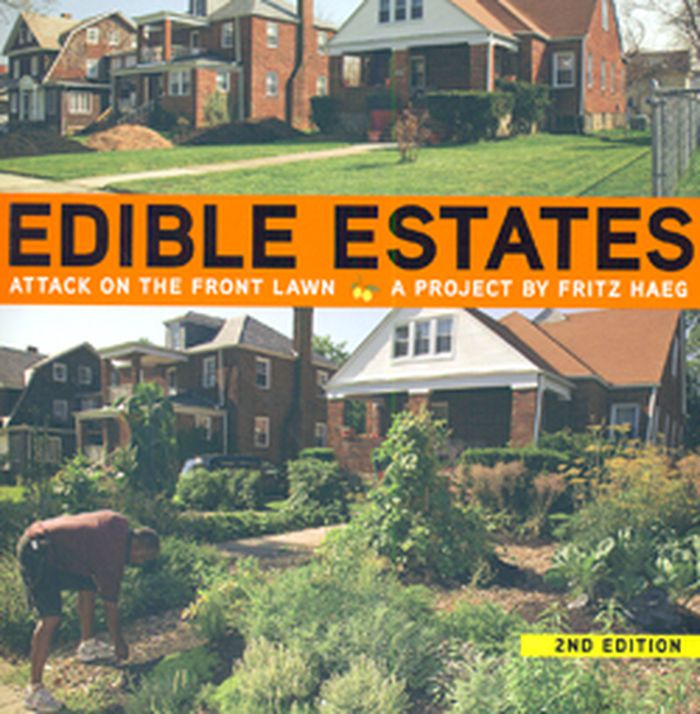
Edible estates : attack on the front lawn, 2nd edition
Actions:
Price:
$27.00
(available to order)
Summary:
Since the first edition of "Edible Estates : Attack on the Front Lawn" was published in 2008, interest in edible gardening has exploded across the United States and abroad. This greatly expanded second edition of the book documents the eight Edible Estates regional prototype gardens that author Fritz Haeg has planted in California, Kansas, Texas, Maryland, New Jersey, New York and England, and includes personal accounts from the homeowner-gardeners about the pleasures and challenges of publicly growing food where they live. Ten "Reports from Coast to Coast" tell the stories of others who have planted their own edible front yards in towns and cities across the country. In addition to essays by landscape architect and scholar Diana Balmori, edible-landscaping pioneer Rosalind Creasy, bestselling author and sustainable-food advocate Michael Pollan and artist and writer Lesley Stern, this edition features updated text by Haeg (including his observations on the Obama White House vegetable garden); a contribution from Mannahatta author Eric W. Sanderson; and Growing Power founder, MacArthur Fellow and urban farmer Will Allen's never-before-published Declaration of the Good Food Revolution. This is not a comprehensive how-to book, nor a showcase of impossibly perfect gardens. The stories presented here are intended to reveal something about how we are living today and to inspire readers to plant their own versions of an Edible Estate. If we see that our neighbor's typical grassy lawn instead can be a beautiful food garden, perhaps we will begin to look at the city around us with new eyes. Our private land can be a public model for the world in which we would like to live.
Edible estates : attack on the front lawn, 2nd edition
Actions:
Price:
$27.00
(available to order)
Summary:
Since the first edition of "Edible Estates : Attack on the Front Lawn" was published in 2008, interest in edible gardening has exploded across the United States and abroad. This greatly expanded second edition of the book documents the eight Edible Estates regional prototype gardens that author Fritz Haeg has planted in California, Kansas, Texas, Maryland, New Jersey, New York and England, and includes personal accounts from the homeowner-gardeners about the pleasures and challenges of publicly growing food where they live. Ten "Reports from Coast to Coast" tell the stories of others who have planted their own edible front yards in towns and cities across the country. In addition to essays by landscape architect and scholar Diana Balmori, edible-landscaping pioneer Rosalind Creasy, bestselling author and sustainable-food advocate Michael Pollan and artist and writer Lesley Stern, this edition features updated text by Haeg (including his observations on the Obama White House vegetable garden); a contribution from Mannahatta author Eric W. Sanderson; and Growing Power founder, MacArthur Fellow and urban farmer Will Allen's never-before-published Declaration of the Good Food Revolution. This is not a comprehensive how-to book, nor a showcase of impossibly perfect gardens. The stories presented here are intended to reveal something about how we are living today and to inspire readers to plant their own versions of an Edible Estate. If we see that our neighbor's typical grassy lawn instead can be a beautiful food garden, perhaps we will begin to look at the city around us with new eyes. Our private land can be a public model for the world in which we would like to live.
Form:
books
books
Publication:
April 2010
April 2010
Form:
books
books
Price:
$49.95
(available to order)
Summary:
"Last Landscapes" is an exploration of the cult and celebration of death, loss and memory. It traces the history and design of burial places throughout Europe and the USA, ranging from the picturesque tradition of the village churchyard to tightly packed ‘cities of the dead’, such as the Jewish Cemetery in Prague and Père Lachaise in Paris. Other landscapes that feature(...)
$49.95
(available to order)
Summary:
"Last Landscapes" is an exploration of the cult and celebration of death, loss and memory. It traces the history and design of burial places throughout Europe and the USA, ranging from the picturesque tradition of the village churchyard to tightly packed ‘cities of the dead’, such as the Jewish Cemetery in Prague and Père Lachaise in Paris. Other landscapes that feature(...)
Title:
Last landscapes : the architecture of the cemetery in the west
Actions:
Price:
$49.95
(available to order)
Summary:
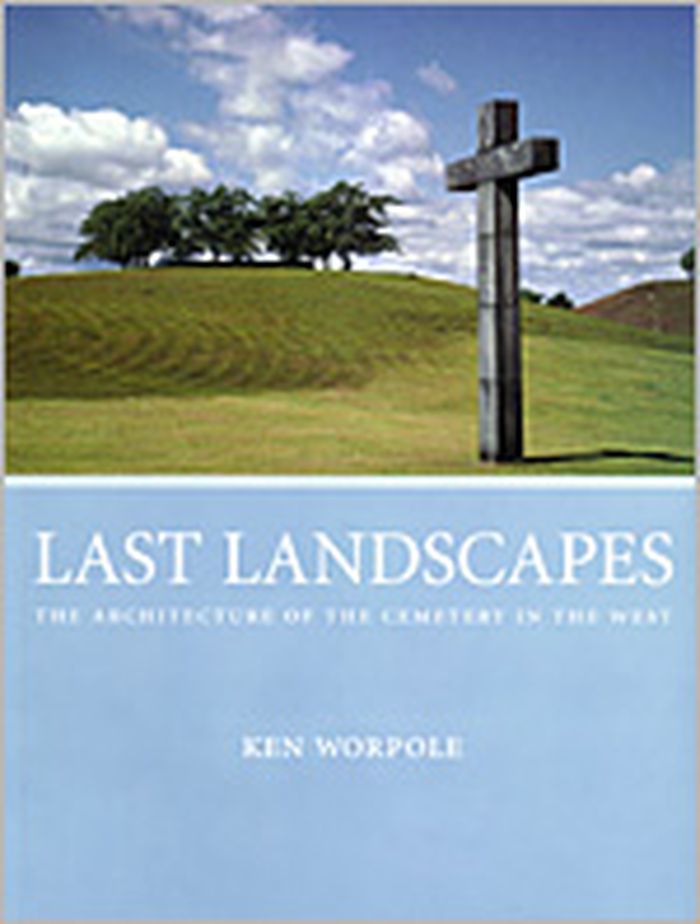
"Last Landscapes" is an exploration of the cult and celebration of death, loss and memory. It traces the history and design of burial places throughout Europe and the USA, ranging from the picturesque tradition of the village churchyard to tightly packed ‘cities of the dead’, such as the Jewish Cemetery in Prague and Père Lachaise in Paris. Other landscapes that feature in this book include the war cemeteries of northern France, Viking burial islands in central Sweden, Etruscan tombs and early Christian catacombs in Italy, the 17th-century Portuguese–Jewish cemetery 'Beth Haim' at Ouderkerk in the Netherlands, Forest Lawns in California, Derek Jarman’s garden in Kent and the Stockholm Woodland Cemetery. It is a fact that architecture ‘began with the tomb', yet, as Ken Worpole shows us in Last Landscapes, many historic cemeteries have been demolished or abandoned in recent times (notably the case with Jewish cemeteries in Eastern Europe), and there has been an increasing loss of inscription and memorialization in the modern urban cemetery. Too often cemeteries today are both poorly designed and physically and culturally marginalized. Worse, cremation denies a full architectural response to the mystery and solemnity of death. The author explores how modes of disposal – burial, cremation, inhumation in mausoleums and wall tombs – vary across Europe and North America, according to religious and other cultural influences. And Last Landscapes raises profound questions as to how, in an age of mass cremation, architects and landscape designers might create meaningful structures and settings in the absence of a body, since for most of history the human body itself has provided the fundamental structural scale. This evocative book also contemplates other forms of memorialization within modern societies, from sculptures to parks, most notably the extraordinary Duisberg Park, set in a former giant steelworks in Germany’s Ruhr Valley.
Last landscapes : the architecture of the cemetery in the west
Actions:
Price:
$49.95
(available to order)
Summary:
"Last Landscapes" is an exploration of the cult and celebration of death, loss and memory. It traces the history and design of burial places throughout Europe and the USA, ranging from the picturesque tradition of the village churchyard to tightly packed ‘cities of the dead’, such as the Jewish Cemetery in Prague and Père Lachaise in Paris. Other landscapes that feature in this book include the war cemeteries of northern France, Viking burial islands in central Sweden, Etruscan tombs and early Christian catacombs in Italy, the 17th-century Portuguese–Jewish cemetery 'Beth Haim' at Ouderkerk in the Netherlands, Forest Lawns in California, Derek Jarman’s garden in Kent and the Stockholm Woodland Cemetery. It is a fact that architecture ‘began with the tomb', yet, as Ken Worpole shows us in Last Landscapes, many historic cemeteries have been demolished or abandoned in recent times (notably the case with Jewish cemeteries in Eastern Europe), and there has been an increasing loss of inscription and memorialization in the modern urban cemetery. Too often cemeteries today are both poorly designed and physically and culturally marginalized. Worse, cremation denies a full architectural response to the mystery and solemnity of death. The author explores how modes of disposal – burial, cremation, inhumation in mausoleums and wall tombs – vary across Europe and North America, according to religious and other cultural influences. And Last Landscapes raises profound questions as to how, in an age of mass cremation, architects and landscape designers might create meaningful structures and settings in the absence of a body, since for most of history the human body itself has provided the fundamental structural scale. This evocative book also contemplates other forms of memorialization within modern societies, from sculptures to parks, most notably the extraordinary Duisberg Park, set in a former giant steelworks in Germany’s Ruhr Valley.
Form:
books
books
Publication:
June 2003, London
June 2003, London
Subject:
Gardens
Gardens
Form:
books
books
Actions:
Price:
$22.99
(available to order)
Summary:
In 1923, a group of young radical German thinkers and intellectuals came together to at Victoria Alle 7, Frankfurt, determined to explain the workings of the modern world. Among the most prominent members of what became the Frankfurt School were the philosophers Walter Benjamin, Theodor Adorno, Max Horkheimer, and Herbert Marcuse. Not only would they change the way we(...)
$22.99
(available to order)
Summary:
In 1923, a group of young radical German thinkers and intellectuals came together to at Victoria Alle 7, Frankfurt, determined to explain the workings of the modern world. Among the most prominent members of what became the Frankfurt School were the philosophers Walter Benjamin, Theodor Adorno, Max Horkheimer, and Herbert Marcuse. Not only would they change the way we(...)
Title:
Grand Hotel Abyss: the lives of the Frankfurt school
Actions:
Price:
$22.99
(available to order)
Summary:
In 1923, a group of young radical German thinkers and intellectuals came together to at Victoria Alle 7, Frankfurt, determined to explain the workings of the modern world. Among the most prominent members of what became the Frankfurt School were the philosophers Walter Benjamin, Theodor Adorno, Max Horkheimer, and Herbert Marcuse. Not only would they change the way we think, but also the subjects we deem worthy of intellectual investigation. Their lives, like their ideas, profoundly, sometimes tragically, reflected and shaped the shattering events of the twentieth century. "Grand Hotel Abyss" combines biography, philosophy, and storytelling to reveal how the Frankfurt thinkers gathered in hopes of understanding the politics of culture during the rise of fascism. Some of them, forced to escape the horrors of Nazi Germany, later found exile in the United States. Benjamin, with his last great work—the incomplete Arcades Project—in his suitcase, was arrested in Spain and committed suicide when threatened with deportation to Nazi-occupied France. On the other side of the Atlantic, Adorno failed in his bid to become a Hollywood screenwriter, denounced jazz, and even met Charlie Chaplin in Malibu. After the war, there was a resurgence of interest in the School. From the relative comfort of sun-drenched California, Herbert Marcuse wrote the classic One Dimensional Man, which influenced the 1960s counterculture and thinkers such as Angela Davis; while in a tragic coda, Adorno died from a heart attack following confrontations with student radicals in Berlin. By taking popular culture seriously as an object of study—whether it was film, music, ideas, or consumerism—the Frankfurt School elaborated upon the nature and crisis of our mass-produced, mechanised society. Grand Hotel Abyss shows how much these ideas still tell us about our age of social media and runaway consumption.
Grand Hotel Abyss: the lives of the Frankfurt school
Actions:
Price:
$22.99
(available to order)
Summary:
In 1923, a group of young radical German thinkers and intellectuals came together to at Victoria Alle 7, Frankfurt, determined to explain the workings of the modern world. Among the most prominent members of what became the Frankfurt School were the philosophers Walter Benjamin, Theodor Adorno, Max Horkheimer, and Herbert Marcuse. Not only would they change the way we think, but also the subjects we deem worthy of intellectual investigation. Their lives, like their ideas, profoundly, sometimes tragically, reflected and shaped the shattering events of the twentieth century. "Grand Hotel Abyss" combines biography, philosophy, and storytelling to reveal how the Frankfurt thinkers gathered in hopes of understanding the politics of culture during the rise of fascism. Some of them, forced to escape the horrors of Nazi Germany, later found exile in the United States. Benjamin, with his last great work—the incomplete Arcades Project—in his suitcase, was arrested in Spain and committed suicide when threatened with deportation to Nazi-occupied France. On the other side of the Atlantic, Adorno failed in his bid to become a Hollywood screenwriter, denounced jazz, and even met Charlie Chaplin in Malibu. After the war, there was a resurgence of interest in the School. From the relative comfort of sun-drenched California, Herbert Marcuse wrote the classic One Dimensional Man, which influenced the 1960s counterculture and thinkers such as Angela Davis; while in a tragic coda, Adorno died from a heart attack following confrontations with student radicals in Berlin. By taking popular culture seriously as an object of study—whether it was film, music, ideas, or consumerism—the Frankfurt School elaborated upon the nature and crisis of our mass-produced, mechanised society. Grand Hotel Abyss shows how much these ideas still tell us about our age of social media and runaway consumption.
Form:
books
books
Publication:
September 2017
September 2017
Subject:
Critical Theory
Critical Theory
Form:
books
books
Title:
Soleil of Persian Square
Soleil of Persian Square
Actions:
Price:
$68.00
(available in store)
Summary:
« Soleil of Persian Square »' est une recherche sur l’identité visuelle du style de vie de la diaspora iranienne à Los Angeles. Elle tente de donner un visage à cette ville fictionnelle qui a pour nom Tehrangeles, et que Hannah Darabi a découverte à travers des images associées à la musique populaire dans ses années d’adolescence. Il s’agit ici de tisser des liens entre(...)
$68.00
(available in store)
Summary:
« Soleil of Persian Square »' est une recherche sur l’identité visuelle du style de vie de la diaspora iranienne à Los Angeles. Elle tente de donner un visage à cette ville fictionnelle qui a pour nom Tehrangeles, et que Hannah Darabi a découverte à travers des images associées à la musique populaire dans ses années d’adolescence. Il s’agit ici de tisser des liens entre(...)
Title:
Soleil of Persian Square
Actions:
Price:
$68.00
(available in store)
Summary:
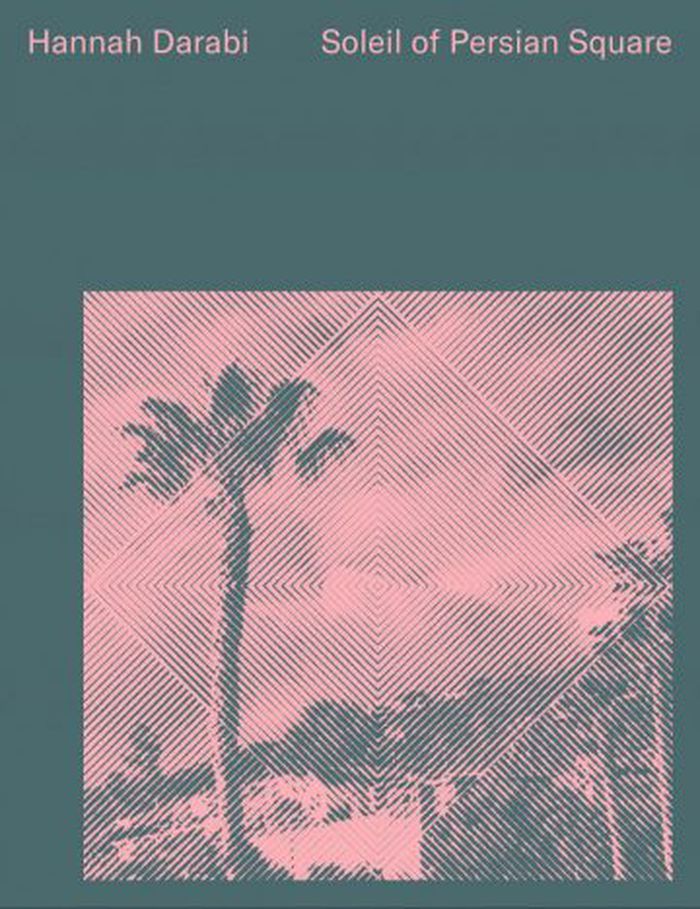
« Soleil of Persian Square »' est une recherche sur l’identité visuelle du style de vie de la diaspora iranienne à Los Angeles. Elle tente de donner un visage à cette ville fictionnelle qui a pour nom Tehrangeles, et que Hannah Darabi a découverte à travers des images associées à la musique populaire dans ses années d’adolescence. Il s’agit ici de tisser des liens entre des paysages ordinaires de Los Angeles et d’Orange County — comme porteurs de traces de cette diaspora iranienne —, des portraits de ses habitants, et des objets issus de la culture populaire, tels que des pochettes de cassettes, des paroles de chansons, des captures d’écran de clips musicaux des années 1980 et 1990, ou encore des pages d’annuaires consacrés aux activités de cette diaspora. « Soleil of Persian Square » ne désigne en effet pas seulement un voyage de l’espace réel à celui de l’imaginaire, mais aussi un mode de vie et une façon de penser incarnés dans la culture populaire. Cette culture, qui se positionne aujourd’hui en opposition avec les valeurs morales du régime iranien actuel, et que les intellectuels laïques critiquent par ailleurs pour son côté « low art », a pourtant survécu, notamment à travers la musique pop de Tehrangeles. Cette musique que nous aimons « détester » n’a jamais perdu sa place dans le cœur de cette nation dispersée, et n’a cessé de faire bouger nos corps, que ce soit dans un taxi à Téhéran, chez les amis de Paris, ou dans un concert à Toronto. Il a été tiré de cet ouvrage trente exemplaires de tête, accompagnés d’une affiche et d’une cassette de Post California coproduite par GwinZegal et Anywave. Avec le soutien à l’édition du Centre national des arts plastiques.
Soleil of Persian Square
Actions:
Price:
$68.00
(available in store)
Summary:
« Soleil of Persian Square »' est une recherche sur l’identité visuelle du style de vie de la diaspora iranienne à Los Angeles. Elle tente de donner un visage à cette ville fictionnelle qui a pour nom Tehrangeles, et que Hannah Darabi a découverte à travers des images associées à la musique populaire dans ses années d’adolescence. Il s’agit ici de tisser des liens entre des paysages ordinaires de Los Angeles et d’Orange County — comme porteurs de traces de cette diaspora iranienne —, des portraits de ses habitants, et des objets issus de la culture populaire, tels que des pochettes de cassettes, des paroles de chansons, des captures d’écran de clips musicaux des années 1980 et 1990, ou encore des pages d’annuaires consacrés aux activités de cette diaspora. « Soleil of Persian Square » ne désigne en effet pas seulement un voyage de l’espace réel à celui de l’imaginaire, mais aussi un mode de vie et une façon de penser incarnés dans la culture populaire. Cette culture, qui se positionne aujourd’hui en opposition avec les valeurs morales du régime iranien actuel, et que les intellectuels laïques critiquent par ailleurs pour son côté « low art », a pourtant survécu, notamment à travers la musique pop de Tehrangeles. Cette musique que nous aimons « détester » n’a jamais perdu sa place dans le cœur de cette nation dispersée, et n’a cessé de faire bouger nos corps, que ce soit dans un taxi à Téhéran, chez les amis de Paris, ou dans un concert à Toronto. Il a été tiré de cet ouvrage trente exemplaires de tête, accompagnés d’une affiche et d’une cassette de Post California coproduite par GwinZegal et Anywave. Avec le soutien à l’édition du Centre national des arts plastiques.
Form:
books
books
Publication:
December 2021
December 2021
Subject:
Photography monographs
Photography monographs
Form:
audio
audio
Actions:
Description:
1 online resource.
Author:
Subject:
Publication:
[Place of publication not identified] : Junior Aspirin Records, 2017.
[Place of publication not identified] : Junior Aspirin Records, 2017.
Form:
audio
audio
Publication:
[Place of publication not identified] : Junior Aspirin Records, 2017.
[Place of publication not identified] : Junior Aspirin Records, 2017.
Author:
Subject:
Form:
books
books
Actions:
Price:
$29.99
(available to order)
Summary:
In 1825 the Erie Canal, connecting the Atlantic with the American heartland via the Great Lakes, was completed, and in 1861 the Civil War, disrupting American unity, began. This volume examines the exhilarating period between these two far-reaching events. The(...)
$29.99
(available to order)
Summary:
In 1825 the Erie Canal, connecting the Atlantic with the American heartland via the Great Lakes, was completed, and in 1861 the Civil War, disrupting American unity, began. This volume examines the exhilarating period between these two far-reaching events. The(...)
Subject:
sale books
sale books
Publication:
October 2000, New York
October 2000, New York
Title:
Art and the empire city : New York, 1825-1861
Actions:
Price:
$29.99
(available to order)
Summary:
In 1825 the Erie Canal, connecting the Atlantic with the American heartland via the Great Lakes, was completed, and in 1861 the Civil War, disrupting American unity, began. This volume examines the exhilarating period between these two far-reaching events. The Erie Canal turned the port of New York into the gateway to the United States, ushering in a time of enormous growth and change for the city of New York. Still very much a work in progress, New York became both an international economic and cultural center: it was transformed into what contemporary observers variously termed the Empire City, the Great Emporium, and the Empress City of the West. The cultural component of this transformation was as significant as its economic aspect. Highly skilled artists and craftsmen working in New York, both native born and immigrant, grew in number, and institutions devoted to the arts emerged and flourished. With Broadway at its heart, the Great Emporium developed into the nation’s major manufacturing and retailing center, the depot for luxury goods made in and around the city and imported from Europe. The complex story of the proliferation of the arts in New York and the evolution of an increasingly discerning audience for those arts during the antebellum period is the focus of this book, which accompanies a major exhibition at The Metropolitan Museum of Art. In essays that will interest scholars as well as a more general audience, specialists from the Metropolitan Museum, the Museum of the City of New York, and the University of California at Berkeley bring new research and insights to bear on a broad range of subjects. Their texts offer both historical and cultural contexts and explore the city’s development as a nexus for the marketing and display of art, as well as private collecting; landscape painting viewed against the background of tourism; new departures in sculpture, architecture, and printmaking; the birth of photography; New York as a fashion center; shopping for home decorations; changing styles in furniture; and the evolution of the ceramics, glass, and silver industries. This volume is lavishly illustrated in color and black and white, providing reproductions of the more than three hundred works in the exhibition as well as comparative material. A checklist of works in the exhibition, a bibliography, and an index are included.
Art and the empire city : New York, 1825-1861
Actions:
Price:
$29.99
(available to order)
Summary:
In 1825 the Erie Canal, connecting the Atlantic with the American heartland via the Great Lakes, was completed, and in 1861 the Civil War, disrupting American unity, began. This volume examines the exhilarating period between these two far-reaching events. The Erie Canal turned the port of New York into the gateway to the United States, ushering in a time of enormous growth and change for the city of New York. Still very much a work in progress, New York became both an international economic and cultural center: it was transformed into what contemporary observers variously termed the Empire City, the Great Emporium, and the Empress City of the West. The cultural component of this transformation was as significant as its economic aspect. Highly skilled artists and craftsmen working in New York, both native born and immigrant, grew in number, and institutions devoted to the arts emerged and flourished. With Broadway at its heart, the Great Emporium developed into the nation’s major manufacturing and retailing center, the depot for luxury goods made in and around the city and imported from Europe. The complex story of the proliferation of the arts in New York and the evolution of an increasingly discerning audience for those arts during the antebellum period is the focus of this book, which accompanies a major exhibition at The Metropolitan Museum of Art. In essays that will interest scholars as well as a more general audience, specialists from the Metropolitan Museum, the Museum of the City of New York, and the University of California at Berkeley bring new research and insights to bear on a broad range of subjects. Their texts offer both historical and cultural contexts and explore the city’s development as a nexus for the marketing and display of art, as well as private collecting; landscape painting viewed against the background of tourism; new departures in sculpture, architecture, and printmaking; the birth of photography; New York as a fashion center; shopping for home decorations; changing styles in furniture; and the evolution of the ceramics, glass, and silver industries. This volume is lavishly illustrated in color and black and white, providing reproductions of the more than three hundred works in the exhibition as well as comparative material. A checklist of works in the exhibition, a bibliography, and an index are included.
Form:
books
books
Publication:
October 2000, New York
October 2000, New York
Subject:
sale books
sale books


