


3141 Results
Actions:
Reference number:
ARCH281671
Description:
The box indicates the film is from "CKCK TV, Regina, Saskatchewan," and an accompanying letter states this film is of an interview done when Parkin stepped off a plane in Regina for an architectural symposium
ARCH281671
Description:
The box indicates the film is from "CKCK TV, Regina, Saskatchewan," and an accompanying letter states this film is of an interview done when Parkin stepped off a plane in Regina for an architectural symposium
People:
Date:
1961
1961
Title:
16mm film recording of CKCK TV interview at architectural symposium
Actions:
ARCH281671
Description:
The box indicates the film is from "CKCK TV, Regina, Saskatchewan," and an accompanying letter states this film is of an interview done when Parkin stepped off a plane in Regina for an architectural symposium
16mm film recording of CKCK TV interview at architectural symposium
Actions:
ARCH281671
Description:
The box indicates the film is from "CKCK TV, Regina, Saskatchewan," and an accompanying letter states this film is of an interview done when Parkin stepped off a plane in Regina for an architectural symposium
Date:
1961
1961
People:
Form:
textual records
textual records
Reference number:
ARCH269518
Description:
Includes a brochure about the area issued by the government, a letter to Shoei Yoh from the government, a poster for Toyama Land 10th Anniversary" (1993), and a flyer for the event "Jet Anniversary Festa".
ARCH269518
Description:
Includes a brochure about the area issued by the government, a letter to Shoei Yoh from the government, a poster for Toyama Land 10th Anniversary" (1993), and a flyer for the event "Jet Anniversary Festa".
People:
Date:
1993
1993
Title:
Toyama ’92 JET 92 CG graphic (textual records)
Actions:
ARCH269518
Description:
Includes a brochure about the area issued by the government, a letter to Shoei Yoh from the government, a poster for Toyama Land 10th Anniversary" (1993), and a flyer for the event "Jet Anniversary Festa".
Toyama ’92 JET 92 CG graphic (textual records)
Actions:
ARCH269518
Description:
Includes a brochure about the area issued by the government, a letter to Shoei Yoh from the government, a poster for Toyama Land 10th Anniversary" (1993), and a flyer for the event "Jet Anniversary Festa".
Form:
textual records
textual records
Date:
1993
1993
People:
Form:
drawings
drawings
Title:
Sketchbook 285: Chiado
Sketchbook 285: Chiado
Actions:
Reference number:
AP178.S2.1989.003
Description:
This sketchbook includes notes and sketches of people, of the reconstruction of Chiado in Lisbon, Portugal, the FAUP in Porto, and the Palácio das Necessidades. It also includes a letter to the Gabinete do Chiado.
AP178.S2.1989.003
Description:
This sketchbook includes notes and sketches of people, of the reconstruction of Chiado in Lisbon, Portugal, the FAUP in Porto, and the Palácio das Necessidades. It also includes a letter to the Gabinete do Chiado.
People:
Date:
March 1989
March 1989
Title:
Sketchbook 285: Chiado
Actions:
AP178.S2.1989.003
Description:
This sketchbook includes notes and sketches of people, of the reconstruction of Chiado in Lisbon, Portugal, the FAUP in Porto, and the Palácio das Necessidades. It also includes a letter to the Gabinete do Chiado.
Sketchbook 285: Chiado
Actions:
AP178.S2.1989.003
Description:
This sketchbook includes notes and sketches of people, of the reconstruction of Chiado in Lisbon, Portugal, the FAUP in Porto, and the Palácio das Necessidades. It also includes a letter to the Gabinete do Chiado.
Form:
drawings
drawings
Date:
March 1989
March 1989
People:
Level of archival description:
Sub-series
Sub-series
Title:
Opera Houses
Opera Houses
Reference number:
CI001.S2.D3
Description:
Charles Rohault de Fleury's sustained involvement with the design of opera houses began with his appointment in 1846 as official architect of the existing Salle Le Pelletier, home to the *Paris Opera, and continued until an open competition was called in 1860 (Charles Garnier won this competition). During this period Rohault de Fleury submitted numerous proposals to replace theprovisional Salle Le Pelletier with a structure more appropriate to the grandeur and importance of France's national opera company. The CCA collection contains four projects related to his work for the Paris opera: two early projects (1846 and 1847) and one later one (1859) for a newopera house, and a portfolio of lithographs and drawings related to alterations and repairs to Salle Le Pelletier (1850-1854). The collection also includes Charles' earliest theatre project, a comprehensive plan for an opera house and surrounding infrastructure for the Theatre Royal Italien opera company (1838-1840), and an album containing drawings and prints of antique and contemporary theatres (1839-1854?). Charles' first project was for the Theatre Royal Italien opera company whose previous home, the Salle Favart, had burned down on the night of January 14 1838. The CCA collection contains an album of presentation drawings for a new theatre located on rue de la Paix with boutiques in the adjacent 'passages' (DR1974:0002:019:001-023). A second album consists of site plans including proposed 'maisons à loyers' (apartment buildings) and documents relating to the cost estimates and rental income for the entire project (DR1974:0002:036:001-016). The architectural style and interior arrangement of the theatre is heavily indebted to Francois Debret's Salle Le Pelletier. Charles' originality lies more in his conception of the social and economic role of the theatre in relation and integration, to its surrounding urban fabric. An explanation of the entire Theatre Royal Italien project, and Charles' role as architect in it, is found in two proposal letters (located in the Avery Library, Columbia University, NY) written by the entrepreneur Eugene Lecomte to the Minister of the Interior, Comte Duchatel, on May 15 and October 31 1839 (1). Charles' album of drawings at the CCA for the theatre and some of the cost and rental estimates are probably presentation copies directly related to the first letter, and most likely submitted to the Minister of the Interior. Charles' project was never executed, and the Italian opera company eventualy found a permanent home in the existing Salle Ventadour (1841). However, the inclusive nature of the Théâtre Royal Italien proposal, with its stress on urban development and contextuality, continued to play a seminal role in his later Paris Opera projects. Upon replacing Francois Debret as architect of Salle Le Pelletier in 1846, Charles proposed nine possible locations (site plans) for a new opera house for the Paris Opera (*Academie Royale de Musique) and, in the following year (1847) prepared a portfolio of drawings for the actual structure with an accompanying seven-page manuscript describing the project. Although executed in successive years, the site plans and 1847 drawings are conceptually related. Both components were undertaken in response to offical interest in a public competition that was never implemented (2)(3). The CCA has two sets of the nine site plans proposed in 1846 (DR1974:0002:036:001-016), one containing transfer lithographed site plans with a written analysis and cost estimate for each of the proposed locations, and the other with only the site plans (similar sets are located in the 'Archives Nationales' in France). They indicate that Charles, (heavily influenced by his Théâtre Royal Italien project) preferred the Rue de la Paix location (siteplan #3) for the new opera house. Although site plan number six, Boulevard des Capucines, was not favoured at this date, it is highly prophetic as it was the location officially chosen in 1860 for the new opera house. Apparently unique to the CCA collection is the 1847 manuscript and portfolio of drawings for the proposed opera house (DR1974:0002:036:001-016). The manuscript is both an indepth review of the requirements for a national opera house and a guide to his portfolio of drawings. Charles' conception and design continued to be strongly influenced by Debret's Salle Lepelletier, as well as his own Théâtre Italien project, and various antique and contemporary opera houses and theatres. Many of the French and Italian sources mentioned in the manuscript are collected in an album (DR1974:0002:010:001-048) as references for his own designs (4). As official architect of Salle Le pelletier, Charles was also responsible for repairs, restorations, and alterations to the existing structure. The drawings and transfer lithographs in the CCA collection (DR1974:0002:036:001-016) are primarily dated 1854, and relate to documented repair and restoration projects undertaken during this period (5)(6). The CCA collection has the presentation drawings and lithographs for the later 1859 project (DR1974:0002:027:001-027) for the Paris opera (*Theatre Imperiale de l'opera) that were sent to Achille Fould, the Minister of State. This project is probably a counterpart to a similiar one that he submitted to the Prefect of the Seine, Baron Haussmann, in the same year (7). Site plans show the opera house on an irregular polygonal site facing Boulevard des Capucines. The placement of the 'maisons à loyers' on the rear of the site reflects Charles' continued emphasis on integrating his opera projects into the surrounding urban context. In 1859, it appeared that Charles was favoured to build the new opera house. But late in the following year, a public competition was called in which Charles Garnier emerged as the victor. Although Charles did not build the final structure, his numerous projects, as exemplified in the CCA collection, were of prime importance in determining the location, configuration, and plan of the Place de l'Opera (8). * The 'Paris Opera' was France's national opera, and thus its name changed numerous times throughout its history according to altering perceptions of its role in French culture and/or changes in political regimes. For reasons of clarity, the national opera will be referred to as the Paris Opera. The names indicated in brackets with a star refer to the proper name of the opera company at the date of the project. (1) Eugene Le Comte, "Projet de Salle rue de la Paix, pour le Théâtre Royal Italien: Lettres à Monsieur le Ministre de l'Intérieur, en date des 15 mai et 31octobre 1839" (Paris: P. Dupont, 1839). (2) Christopher Curtis Mead, "Charles Garnier's Paris Opera and the Renaissance of Classicism in Nineteenth century French Architecture", 3 vols. (PhD thesis; Philadelphia: University of Pennsylvania, 1986), p. 234 and p. 956, fn. 30. (3) Monika Steinhauser, "Die Architektur des Pariser Oper" (Munich: Prestel Verlag, 1969), p. 45, fns. 143 and 144. (4) Barry Bergdoll, "Charles Rohault de Fleury: Part Three: Theatres and the Opera house", 'CCA Research Report', n.d., p. 3. (5) Larousse XIXth Century, s.v. "Rohault de Fleury, Charles". (6) Mead, p. 238. (7) Oeuvres de C. Rohault de Fleury, architecte" (Paris: Librarie centrale d'architecture, 1884).. (8) Macmillan, s.v. "Rohault de Fleury Familly".
CI001.S2.D3
Description:
Charles Rohault de Fleury's sustained involvement with the design of opera houses began with his appointment in 1846 as official architect of the existing Salle Le Pelletier, home to the *Paris Opera, and continued until an open competition was called in 1860 (Charles Garnier won this competition). During this period Rohault de Fleury submitted numerous proposals to replace theprovisional Salle Le Pelletier with a structure more appropriate to the grandeur and importance of France's national opera company. The CCA collection contains four projects related to his work for the Paris opera: two early projects (1846 and 1847) and one later one (1859) for a newopera house, and a portfolio of lithographs and drawings related to alterations and repairs to Salle Le Pelletier (1850-1854). The collection also includes Charles' earliest theatre project, a comprehensive plan for an opera house and surrounding infrastructure for the Theatre Royal Italien opera company (1838-1840), and an album containing drawings and prints of antique and contemporary theatres (1839-1854?). Charles' first project was for the Theatre Royal Italien opera company whose previous home, the Salle Favart, had burned down on the night of January 14 1838. The CCA collection contains an album of presentation drawings for a new theatre located on rue de la Paix with boutiques in the adjacent 'passages' (DR1974:0002:019:001-023). A second album consists of site plans including proposed 'maisons à loyers' (apartment buildings) and documents relating to the cost estimates and rental income for the entire project (DR1974:0002:036:001-016). The architectural style and interior arrangement of the theatre is heavily indebted to Francois Debret's Salle Le Pelletier. Charles' originality lies more in his conception of the social and economic role of the theatre in relation and integration, to its surrounding urban fabric. An explanation of the entire Theatre Royal Italien project, and Charles' role as architect in it, is found in two proposal letters (located in the Avery Library, Columbia University, NY) written by the entrepreneur Eugene Lecomte to the Minister of the Interior, Comte Duchatel, on May 15 and October 31 1839 (1). Charles' album of drawings at the CCA for the theatre and some of the cost and rental estimates are probably presentation copies directly related to the first letter, and most likely submitted to the Minister of the Interior. Charles' project was never executed, and the Italian opera company eventualy found a permanent home in the existing Salle Ventadour (1841). However, the inclusive nature of the Théâtre Royal Italien proposal, with its stress on urban development and contextuality, continued to play a seminal role in his later Paris Opera projects. Upon replacing Francois Debret as architect of Salle Le Pelletier in 1846, Charles proposed nine possible locations (site plans) for a new opera house for the Paris Opera (*Academie Royale de Musique) and, in the following year (1847) prepared a portfolio of drawings for the actual structure with an accompanying seven-page manuscript describing the project. Although executed in successive years, the site plans and 1847 drawings are conceptually related. Both components were undertaken in response to offical interest in a public competition that was never implemented (2)(3). The CCA has two sets of the nine site plans proposed in 1846 (DR1974:0002:036:001-016), one containing transfer lithographed site plans with a written analysis and cost estimate for each of the proposed locations, and the other with only the site plans (similar sets are located in the 'Archives Nationales' in France). They indicate that Charles, (heavily influenced by his Théâtre Royal Italien project) preferred the Rue de la Paix location (siteplan #3) for the new opera house. Although site plan number six, Boulevard des Capucines, was not favoured at this date, it is highly prophetic as it was the location officially chosen in 1860 for the new opera house. Apparently unique to the CCA collection is the 1847 manuscript and portfolio of drawings for the proposed opera house (DR1974:0002:036:001-016). The manuscript is both an indepth review of the requirements for a national opera house and a guide to his portfolio of drawings. Charles' conception and design continued to be strongly influenced by Debret's Salle Lepelletier, as well as his own Théâtre Italien project, and various antique and contemporary opera houses and theatres. Many of the French and Italian sources mentioned in the manuscript are collected in an album (DR1974:0002:010:001-048) as references for his own designs (4). As official architect of Salle Le pelletier, Charles was also responsible for repairs, restorations, and alterations to the existing structure. The drawings and transfer lithographs in the CCA collection (DR1974:0002:036:001-016) are primarily dated 1854, and relate to documented repair and restoration projects undertaken during this period (5)(6). The CCA collection has the presentation drawings and lithographs for the later 1859 project (DR1974:0002:027:001-027) for the Paris opera (*Theatre Imperiale de l'opera) that were sent to Achille Fould, the Minister of State. This project is probably a counterpart to a similiar one that he submitted to the Prefect of the Seine, Baron Haussmann, in the same year (7). Site plans show the opera house on an irregular polygonal site facing Boulevard des Capucines. The placement of the 'maisons à loyers' on the rear of the site reflects Charles' continued emphasis on integrating his opera projects into the surrounding urban context. In 1859, it appeared that Charles was favoured to build the new opera house. But late in the following year, a public competition was called in which Charles Garnier emerged as the victor. Although Charles did not build the final structure, his numerous projects, as exemplified in the CCA collection, were of prime importance in determining the location, configuration, and plan of the Place de l'Opera (8). * The 'Paris Opera' was France's national opera, and thus its name changed numerous times throughout its history according to altering perceptions of its role in French culture and/or changes in political regimes. For reasons of clarity, the national opera will be referred to as the Paris Opera. The names indicated in brackets with a star refer to the proper name of the opera company at the date of the project. (1) Eugene Le Comte, "Projet de Salle rue de la Paix, pour le Théâtre Royal Italien: Lettres à Monsieur le Ministre de l'Intérieur, en date des 15 mai et 31octobre 1839" (Paris: P. Dupont, 1839). (2) Christopher Curtis Mead, "Charles Garnier's Paris Opera and the Renaissance of Classicism in Nineteenth century French Architecture", 3 vols. (PhD thesis; Philadelphia: University of Pennsylvania, 1986), p. 234 and p. 956, fn. 30. (3) Monika Steinhauser, "Die Architektur des Pariser Oper" (Munich: Prestel Verlag, 1969), p. 45, fns. 143 and 144. (4) Barry Bergdoll, "Charles Rohault de Fleury: Part Three: Theatres and the Opera house", 'CCA Research Report', n.d., p. 3. (5) Larousse XIXth Century, s.v. "Rohault de Fleury, Charles". (6) Mead, p. 238. (7) Oeuvres de C. Rohault de Fleury, architecte" (Paris: Librarie centrale d'architecture, 1884).. (8) Macmillan, s.v. "Rohault de Fleury Familly".
People:
Date:
1717-1868
1717-1868
Title:
Opera Houses
CI001.S2.D3
Description:
Charles Rohault de Fleury's sustained involvement with the design of opera houses began with his appointment in 1846 as official architect of the existing Salle Le Pelletier, home to the *Paris Opera, and continued until an open competition was called in 1860 (Charles Garnier won this competition). During this period Rohault de Fleury submitted numerous proposals to replace theprovisional Salle Le Pelletier with a structure more appropriate to the grandeur and importance of France's national opera company. The CCA collection contains four projects related to his work for the Paris opera: two early projects (1846 and 1847) and one later one (1859) for a newopera house, and a portfolio of lithographs and drawings related to alterations and repairs to Salle Le Pelletier (1850-1854). The collection also includes Charles' earliest theatre project, a comprehensive plan for an opera house and surrounding infrastructure for the Theatre Royal Italien opera company (1838-1840), and an album containing drawings and prints of antique and contemporary theatres (1839-1854?). Charles' first project was for the Theatre Royal Italien opera company whose previous home, the Salle Favart, had burned down on the night of January 14 1838. The CCA collection contains an album of presentation drawings for a new theatre located on rue de la Paix with boutiques in the adjacent 'passages' (DR1974:0002:019:001-023). A second album consists of site plans including proposed 'maisons à loyers' (apartment buildings) and documents relating to the cost estimates and rental income for the entire project (DR1974:0002:036:001-016). The architectural style and interior arrangement of the theatre is heavily indebted to Francois Debret's Salle Le Pelletier. Charles' originality lies more in his conception of the social and economic role of the theatre in relation and integration, to its surrounding urban fabric. An explanation of the entire Theatre Royal Italien project, and Charles' role as architect in it, is found in two proposal letters (located in the Avery Library, Columbia University, NY) written by the entrepreneur Eugene Lecomte to the Minister of the Interior, Comte Duchatel, on May 15 and October 31 1839 (1). Charles' album of drawings at the CCA for the theatre and some of the cost and rental estimates are probably presentation copies directly related to the first letter, and most likely submitted to the Minister of the Interior. Charles' project was never executed, and the Italian opera company eventualy found a permanent home in the existing Salle Ventadour (1841). However, the inclusive nature of the Théâtre Royal Italien proposal, with its stress on urban development and contextuality, continued to play a seminal role in his later Paris Opera projects. Upon replacing Francois Debret as architect of Salle Le Pelletier in 1846, Charles proposed nine possible locations (site plans) for a new opera house for the Paris Opera (*Academie Royale de Musique) and, in the following year (1847) prepared a portfolio of drawings for the actual structure with an accompanying seven-page manuscript describing the project. Although executed in successive years, the site plans and 1847 drawings are conceptually related. Both components were undertaken in response to offical interest in a public competition that was never implemented (2)(3). The CCA has two sets of the nine site plans proposed in 1846 (DR1974:0002:036:001-016), one containing transfer lithographed site plans with a written analysis and cost estimate for each of the proposed locations, and the other with only the site plans (similar sets are located in the 'Archives Nationales' in France). They indicate that Charles, (heavily influenced by his Théâtre Royal Italien project) preferred the Rue de la Paix location (siteplan #3) for the new opera house. Although site plan number six, Boulevard des Capucines, was not favoured at this date, it is highly prophetic as it was the location officially chosen in 1860 for the new opera house. Apparently unique to the CCA collection is the 1847 manuscript and portfolio of drawings for the proposed opera house (DR1974:0002:036:001-016). The manuscript is both an indepth review of the requirements for a national opera house and a guide to his portfolio of drawings. Charles' conception and design continued to be strongly influenced by Debret's Salle Lepelletier, as well as his own Théâtre Italien project, and various antique and contemporary opera houses and theatres. Many of the French and Italian sources mentioned in the manuscript are collected in an album (DR1974:0002:010:001-048) as references for his own designs (4). As official architect of Salle Le pelletier, Charles was also responsible for repairs, restorations, and alterations to the existing structure. The drawings and transfer lithographs in the CCA collection (DR1974:0002:036:001-016) are primarily dated 1854, and relate to documented repair and restoration projects undertaken during this period (5)(6). The CCA collection has the presentation drawings and lithographs for the later 1859 project (DR1974:0002:027:001-027) for the Paris opera (*Theatre Imperiale de l'opera) that were sent to Achille Fould, the Minister of State. This project is probably a counterpart to a similiar one that he submitted to the Prefect of the Seine, Baron Haussmann, in the same year (7). Site plans show the opera house on an irregular polygonal site facing Boulevard des Capucines. The placement of the 'maisons à loyers' on the rear of the site reflects Charles' continued emphasis on integrating his opera projects into the surrounding urban context. In 1859, it appeared that Charles was favoured to build the new opera house. But late in the following year, a public competition was called in which Charles Garnier emerged as the victor. Although Charles did not build the final structure, his numerous projects, as exemplified in the CCA collection, were of prime importance in determining the location, configuration, and plan of the Place de l'Opera (8). * The 'Paris Opera' was France's national opera, and thus its name changed numerous times throughout its history according to altering perceptions of its role in French culture and/or changes in political regimes. For reasons of clarity, the national opera will be referred to as the Paris Opera. The names indicated in brackets with a star refer to the proper name of the opera company at the date of the project. (1) Eugene Le Comte, "Projet de Salle rue de la Paix, pour le Théâtre Royal Italien: Lettres à Monsieur le Ministre de l'Intérieur, en date des 15 mai et 31octobre 1839" (Paris: P. Dupont, 1839). (2) Christopher Curtis Mead, "Charles Garnier's Paris Opera and the Renaissance of Classicism in Nineteenth century French Architecture", 3 vols. (PhD thesis; Philadelphia: University of Pennsylvania, 1986), p. 234 and p. 956, fn. 30. (3) Monika Steinhauser, "Die Architektur des Pariser Oper" (Munich: Prestel Verlag, 1969), p. 45, fns. 143 and 144. (4) Barry Bergdoll, "Charles Rohault de Fleury: Part Three: Theatres and the Opera house", 'CCA Research Report', n.d., p. 3. (5) Larousse XIXth Century, s.v. "Rohault de Fleury, Charles". (6) Mead, p. 238. (7) Oeuvres de C. Rohault de Fleury, architecte" (Paris: Librarie centrale d'architecture, 1884).. (8) Macmillan, s.v. "Rohault de Fleury Familly".
Opera Houses
CI001.S2.D3
Description:
Charles Rohault de Fleury's sustained involvement with the design of opera houses began with his appointment in 1846 as official architect of the existing Salle Le Pelletier, home to the *Paris Opera, and continued until an open competition was called in 1860 (Charles Garnier won this competition). During this period Rohault de Fleury submitted numerous proposals to replace theprovisional Salle Le Pelletier with a structure more appropriate to the grandeur and importance of France's national opera company. The CCA collection contains four projects related to his work for the Paris opera: two early projects (1846 and 1847) and one later one (1859) for a newopera house, and a portfolio of lithographs and drawings related to alterations and repairs to Salle Le Pelletier (1850-1854). The collection also includes Charles' earliest theatre project, a comprehensive plan for an opera house and surrounding infrastructure for the Theatre Royal Italien opera company (1838-1840), and an album containing drawings and prints of antique and contemporary theatres (1839-1854?). Charles' first project was for the Theatre Royal Italien opera company whose previous home, the Salle Favart, had burned down on the night of January 14 1838. The CCA collection contains an album of presentation drawings for a new theatre located on rue de la Paix with boutiques in the adjacent 'passages' (DR1974:0002:019:001-023). A second album consists of site plans including proposed 'maisons à loyers' (apartment buildings) and documents relating to the cost estimates and rental income for the entire project (DR1974:0002:036:001-016). The architectural style and interior arrangement of the theatre is heavily indebted to Francois Debret's Salle Le Pelletier. Charles' originality lies more in his conception of the social and economic role of the theatre in relation and integration, to its surrounding urban fabric. An explanation of the entire Theatre Royal Italien project, and Charles' role as architect in it, is found in two proposal letters (located in the Avery Library, Columbia University, NY) written by the entrepreneur Eugene Lecomte to the Minister of the Interior, Comte Duchatel, on May 15 and October 31 1839 (1). Charles' album of drawings at the CCA for the theatre and some of the cost and rental estimates are probably presentation copies directly related to the first letter, and most likely submitted to the Minister of the Interior. Charles' project was never executed, and the Italian opera company eventualy found a permanent home in the existing Salle Ventadour (1841). However, the inclusive nature of the Théâtre Royal Italien proposal, with its stress on urban development and contextuality, continued to play a seminal role in his later Paris Opera projects. Upon replacing Francois Debret as architect of Salle Le Pelletier in 1846, Charles proposed nine possible locations (site plans) for a new opera house for the Paris Opera (*Academie Royale de Musique) and, in the following year (1847) prepared a portfolio of drawings for the actual structure with an accompanying seven-page manuscript describing the project. Although executed in successive years, the site plans and 1847 drawings are conceptually related. Both components were undertaken in response to offical interest in a public competition that was never implemented (2)(3). The CCA has two sets of the nine site plans proposed in 1846 (DR1974:0002:036:001-016), one containing transfer lithographed site plans with a written analysis and cost estimate for each of the proposed locations, and the other with only the site plans (similar sets are located in the 'Archives Nationales' in France). They indicate that Charles, (heavily influenced by his Théâtre Royal Italien project) preferred the Rue de la Paix location (siteplan #3) for the new opera house. Although site plan number six, Boulevard des Capucines, was not favoured at this date, it is highly prophetic as it was the location officially chosen in 1860 for the new opera house. Apparently unique to the CCA collection is the 1847 manuscript and portfolio of drawings for the proposed opera house (DR1974:0002:036:001-016). The manuscript is both an indepth review of the requirements for a national opera house and a guide to his portfolio of drawings. Charles' conception and design continued to be strongly influenced by Debret's Salle Lepelletier, as well as his own Théâtre Italien project, and various antique and contemporary opera houses and theatres. Many of the French and Italian sources mentioned in the manuscript are collected in an album (DR1974:0002:010:001-048) as references for his own designs (4). As official architect of Salle Le pelletier, Charles was also responsible for repairs, restorations, and alterations to the existing structure. The drawings and transfer lithographs in the CCA collection (DR1974:0002:036:001-016) are primarily dated 1854, and relate to documented repair and restoration projects undertaken during this period (5)(6). The CCA collection has the presentation drawings and lithographs for the later 1859 project (DR1974:0002:027:001-027) for the Paris opera (*Theatre Imperiale de l'opera) that were sent to Achille Fould, the Minister of State. This project is probably a counterpart to a similiar one that he submitted to the Prefect of the Seine, Baron Haussmann, in the same year (7). Site plans show the opera house on an irregular polygonal site facing Boulevard des Capucines. The placement of the 'maisons à loyers' on the rear of the site reflects Charles' continued emphasis on integrating his opera projects into the surrounding urban context. In 1859, it appeared that Charles was favoured to build the new opera house. But late in the following year, a public competition was called in which Charles Garnier emerged as the victor. Although Charles did not build the final structure, his numerous projects, as exemplified in the CCA collection, were of prime importance in determining the location, configuration, and plan of the Place de l'Opera (8). * The 'Paris Opera' was France's national opera, and thus its name changed numerous times throughout its history according to altering perceptions of its role in French culture and/or changes in political regimes. For reasons of clarity, the national opera will be referred to as the Paris Opera. The names indicated in brackets with a star refer to the proper name of the opera company at the date of the project. (1) Eugene Le Comte, "Projet de Salle rue de la Paix, pour le Théâtre Royal Italien: Lettres à Monsieur le Ministre de l'Intérieur, en date des 15 mai et 31octobre 1839" (Paris: P. Dupont, 1839). (2) Christopher Curtis Mead, "Charles Garnier's Paris Opera and the Renaissance of Classicism in Nineteenth century French Architecture", 3 vols. (PhD thesis; Philadelphia: University of Pennsylvania, 1986), p. 234 and p. 956, fn. 30. (3) Monika Steinhauser, "Die Architektur des Pariser Oper" (Munich: Prestel Verlag, 1969), p. 45, fns. 143 and 144. (4) Barry Bergdoll, "Charles Rohault de Fleury: Part Three: Theatres and the Opera house", 'CCA Research Report', n.d., p. 3. (5) Larousse XIXth Century, s.v. "Rohault de Fleury, Charles". (6) Mead, p. 238. (7) Oeuvres de C. Rohault de Fleury, architecte" (Paris: Librarie centrale d'architecture, 1884).. (8) Macmillan, s.v. "Rohault de Fleury Familly".
Level of archival description:
File 3
File 3
Date:
1717-1868
1717-1868
People:
Form:
textual records
textual records
Reference number:
PHCON2002:0016:006:027
Description:
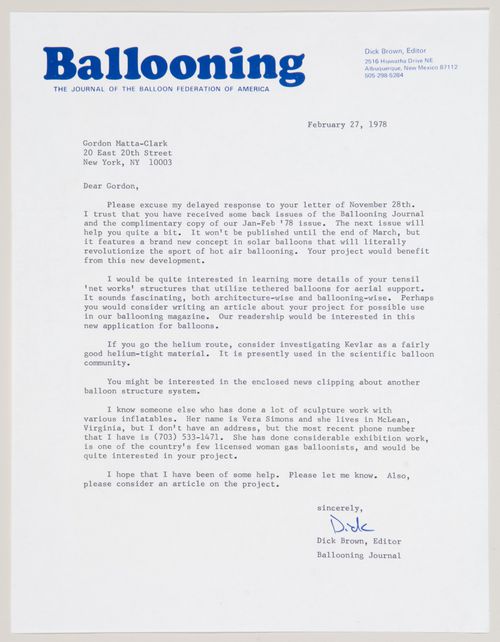
The letter is accompanied by a subscription form to the journal 'Ballooning' (PHCON2002:0016:006:027.2) and a news clipping (PHCON2002:0016:006:027.3) about a balloon structure system. The news clipping is titled "'Tumbleweed' may be Next Mars Vehicle".
PHCON2002:0016:006:027
Description:
The letter is accompanied by a subscription form to the journal 'Ballooning' (PHCON2002:0016:006:027.2) and a news clipping (PHCON2002:0016:006:027.3) about a balloon structure system. The news clipping is titled "'Tumbleweed' may be Next Mars Vehicle".
People:
Date:
27 February 1978
27 February 1978
Title:
Letter from Dick Brown to Gordon Matta-Clark, news clipping about a balloon structure system and subscription form to the journal 'Ballooning'
Actions:
PHCON2002:0016:006:027
Description:
The letter is accompanied by a subscription form to the journal 'Ballooning' (PHCON2002:0016:006:027.2) and a news clipping (PHCON2002:0016:006:027.3) about a balloon structure system. The news clipping is titled "'Tumbleweed' may be Next Mars Vehicle".
Letter from Dick Brown to Gordon Matta-Clark, news clipping about a balloon structure system and subscription form to the journal 'Ballooning'
Actions:
PHCON2002:0016:006:027
Description:
The letter is accompanied by a subscription form to the journal 'Ballooning' (PHCON2002:0016:006:027.2) and a news clipping (PHCON2002:0016:006:027.3) about a balloon structure system. The news clipping is titled "'Tumbleweed' may be Next Mars Vehicle".
Form:
textual records
textual records
Date:
27 February 1978
27 February 1978
People:
Form:
textual records
textual records
Actions:
Reference number:
PHCON2002:0016:002:071
Description:
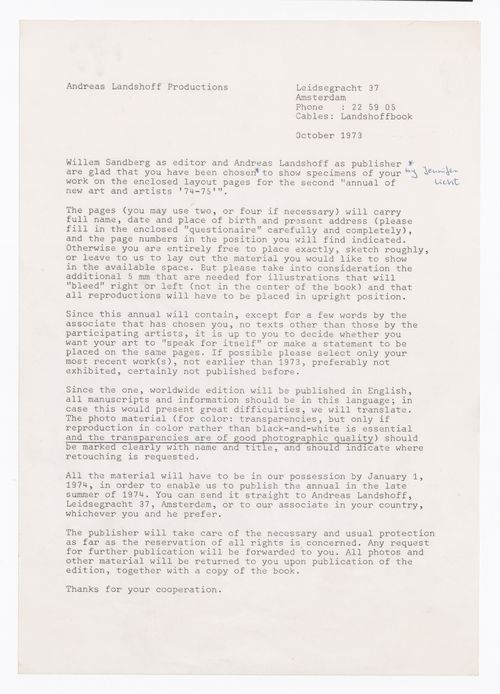
Letter from Andreas Landshoff Productions announcing that Gordon Matta-Clark has been chosen to show specimens of his work-second annual of new art and artists `74-75. Addition in ink states that Jennifer Licht chose Gordon Matta-Clark's work.
PHCON2002:0016:002:071
Description:
Letter from Andreas Landshoff Productions announcing that Gordon Matta-Clark has been chosen to show specimens of his work-second annual of new art and artists `74-75. Addition in ink states that Jennifer Licht chose Gordon Matta-Clark's work.
People:
Date:
October 1973
October 1973
Title:
Letter from Andreas Landshoff Productions to Gordon Matta-Clark
Actions:
PHCON2002:0016:002:071
Description:
Letter from Andreas Landshoff Productions announcing that Gordon Matta-Clark has been chosen to show specimens of his work-second annual of new art and artists `74-75. Addition in ink states that Jennifer Licht chose Gordon Matta-Clark's work.
Letter from Andreas Landshoff Productions to Gordon Matta-Clark
Actions:
PHCON2002:0016:002:071
Description:
Letter from Andreas Landshoff Productions announcing that Gordon Matta-Clark has been chosen to show specimens of his work-second annual of new art and artists `74-75. Addition in ink states that Jennifer Licht chose Gordon Matta-Clark's work.
Form:
textual records
textual records
Date:
October 1973
October 1973
People:
Form:
textual records
textual records
Actions:
Reference number:
DR1999:0465
Description:
documents include 4 photographs, drawings, correspondence, newspaper clippings, finances, budget, expenses, accounting, cost estimates, letter of intent, meeting minutes (1993), signs and graphics, memos, punch list, trade catalogues, cost, public relations, development report, insurance, correspondence/transmittals
DR1999:0465
Description:
documents include 4 photographs, drawings, correspondence, newspaper clippings, finances, budget, expenses, accounting, cost estimates, letter of intent, meeting minutes (1993), signs and graphics, memos, punch list, trade catalogues, cost, public relations, development report, insurance, correspondence/transmittals
People:
Title:
Photographs, drawings, correspondence, newspaper clippings, finances, budget, expenses
Actions:
DR1999:0465
Description:
documents include 4 photographs, drawings, correspondence, newspaper clippings, finances, budget, expenses, accounting, cost estimates, letter of intent, meeting minutes (1993), signs and graphics, memos, punch list, trade catalogues, cost, public relations, development report, insurance, correspondence/transmittals
Photographs, drawings, correspondence, newspaper clippings, finances, budget, expenses
Actions:
DR1999:0465
Description:
documents include 4 photographs, drawings, correspondence, newspaper clippings, finances, budget, expenses, accounting, cost estimates, letter of intent, meeting minutes (1993), signs and graphics, memos, punch list, trade catalogues, cost, public relations, development report, insurance, correspondence/transmittals
Form:
textual records
textual records
People:
Form:
textual records
textual records
Actions:
Reference number:
DR2012:0012:100:007
Description:
File containing documents in English related to granite suppliers for the Royal Canadian navy monument. Includes a letter related to the Canadian tribute to human rights for reference. Original folder inscribed in graphite: CAN NAVY MON - GRANITE
DR2012:0012:100:007
Description:
File containing documents in English related to granite suppliers for the Royal Canadian navy monument. Includes a letter related to the Canadian tribute to human rights for reference. Original folder inscribed in graphite: CAN NAVY MON - GRANITE
People:
Date:
1990, 2009
1990, 2009
Title:
Suppliers documentation and correspondence, Canadian Navy monument, Ottawa, Ontario
Actions:
DR2012:0012:100:007
Description:
File containing documents in English related to granite suppliers for the Royal Canadian navy monument. Includes a letter related to the Canadian tribute to human rights for reference. Original folder inscribed in graphite: CAN NAVY MON - GRANITE
Suppliers documentation and correspondence, Canadian Navy monument, Ottawa, Ontario
Actions:
DR2012:0012:100:007
Description:
File containing documents in English related to granite suppliers for the Royal Canadian navy monument. Includes a letter related to the Canadian tribute to human rights for reference. Original folder inscribed in graphite: CAN NAVY MON - GRANITE
Form:
textual records
textual records
Date:
1990, 2009
1990, 2009
People:
Form:
textual records
textual records
Actions:
Reference number:
AP140.S2.SS6.D1.P1
Description:
correspondence between James Stirling and Yale University, School of Art and Architecture, and with other American universities, relating to teaching activities, including some financial records, also a reprographic copy of a letter from publisher Gerd Hatje
AP140.S2.SS6.D1.P1
Description:
correspondence between James Stirling and Yale University, School of Art and Architecture, and with other American universities, relating to teaching activities, including some financial records, also a reprographic copy of a letter from publisher Gerd Hatje
People:
Title:
Correspondence between James Stirling and Yale University
Actions:
AP140.S2.SS6.D1.P1
Description:
correspondence between James Stirling and Yale University, School of Art and Architecture, and with other American universities, relating to teaching activities, including some financial records, also a reprographic copy of a letter from publisher Gerd Hatje
Correspondence between James Stirling and Yale University
Actions:
AP140.S2.SS6.D1.P1
Description:
correspondence between James Stirling and Yale University, School of Art and Architecture, and with other American universities, relating to teaching activities, including some financial records, also a reprographic copy of a letter from publisher Gerd Hatje
Form:
textual records
textual records
People:
Form:
textual records
textual records
Actions:
Reference number:
PHCON2002:0016:004:146
Description:
Letter is accompanied by a document written by the Visual Artists and Galleries Association (V.A.G.A.) entitled "Who We Are and What We Do", as well as an application form for membership as an artist of V.A.G.A.
PHCON2002:0016:004:146
Description:
Letter is accompanied by a document written by the Visual Artists and Galleries Association (V.A.G.A.) entitled "Who We Are and What We Do", as well as an application form for membership as an artist of V.A.G.A.
People:
Date:
19 December 1977
19 December 1977
Title:
Letter from Martin Bressler to Gordon Matta-Clark
Actions:
PHCON2002:0016:004:146
Description:
Letter is accompanied by a document written by the Visual Artists and Galleries Association (V.A.G.A.) entitled "Who We Are and What We Do", as well as an application form for membership as an artist of V.A.G.A.
Letter from Martin Bressler to Gordon Matta-Clark
Actions:
PHCON2002:0016:004:146
Description:
Letter is accompanied by a document written by the Visual Artists and Galleries Association (V.A.G.A.) entitled "Who We Are and What We Do", as well as an application form for membership as an artist of V.A.G.A.
Form:
textual records
textual records
Date:
19 December 1977
19 December 1977
People:


