


13794 Results
Form:
books
books
Title:
What moves us? : Le Corbusier and Asger Jorn in art and architecture / edited by Ruth Baumeister.
What moves us? : Le Corbusier and Asger Jorn in art and architecture / edited by Ruth Baumeister.
Actions:
Holdings:
Description:
210 pages : illustrations (some color), plans, portraits ; 29 cm
Description:
210 pages : illustrations (some color), plans, portraits ; 29 cm
Author:
Subject:
Publication:
Zürich : Verlag Scheidegger & Spiess, [2015], ©2015
Zürich : Verlag Scheidegger & Spiess, [2015], ©2015
Title:
What moves us? : Le Corbusier and Asger Jorn in art and architecture / edited by Ruth Baumeister.
Actions:
Holdings:
Description:
210 pages : illustrations (some color), plans, portraits ; 29 cm
What moves us? : Le Corbusier and Asger Jorn in art and architecture / edited by Ruth Baumeister.
Actions:
Holdings:
Description:
210 pages : illustrations (some color), plans, portraits ; 29 cm
Form:
books
books
Publication:
Zürich : Verlag Scheidegger & Spiess, [2015], ©2015
Zürich : Verlag Scheidegger & Spiess, [2015], ©2015
Author:
Subject:
Form:
books
books
Actions:
Holdings:
Description:
296 pages : chiefly illustrations (chiefly color) ; 29 cm
Description:
296 pages : chiefly illustrations (chiefly color) ; 29 cm
Author:
Subject:
Publication:
Zürich : Lars Müller Publishers, [2023]
Zürich : Lars Müller Publishers, [2023]
Title:
Willy Guhl, thinking with your hands / Museum für Gestaltung Zürich, Renate Menzi (eds.).
Actions:
Holdings:
Description:
296 pages : chiefly illustrations (chiefly color) ; 29 cm
Willy Guhl, thinking with your hands / Museum für Gestaltung Zürich, Renate Menzi (eds.).
Actions:
Holdings:
Description:
296 pages : chiefly illustrations (chiefly color) ; 29 cm
Form:
books
books
Publication:
Zürich : Lars Müller Publishers, [2023]
Zürich : Lars Müller Publishers, [2023]
Author:
Subject:
Form:
books
books
Actions:
Holdings:
Description:
x, 112 pages : illustrations ; 27 cm
Description:
x, 112 pages : illustrations ; 27 cm
Author:
Subject:
Publication:
Knoxville : University of Tennessee Press, [2013], ©2013
Knoxville : University of Tennessee Press, [2013], ©2013
Title:
Houses without names : architectural nomenclature and the classification of America's common houses / Thomas C. Hubka.
Actions:
Holdings:
Description:
x, 112 pages : illustrations ; 27 cm
Houses without names : architectural nomenclature and the classification of America's common houses / Thomas C. Hubka.
Actions:
Holdings:
Description:
x, 112 pages : illustrations ; 27 cm
Form:
books
books
Publication:
Knoxville : University of Tennessee Press, [2013], ©2013
Knoxville : University of Tennessee Press, [2013], ©2013
Author:
Subject:
Form:
books
books

Actions:
Price:
$48.00
(available to order)
Summary:
Online privacy is under constant attack by social media and big data technologies. But we cannot rely on individual actions to remedy this—it is a matter of social justice. Alice E. Marwick offers a new way of understanding how privacy is jeopardized, particularly for marginalized and disadvantaged communities—including immigrants, the poor, people of color, LGBTQ+(...)
$48.00
(available to order)
Summary:
Online privacy is under constant attack by social media and big data technologies. But we cannot rely on individual actions to remedy this—it is a matter of social justice. Alice E. Marwick offers a new way of understanding how privacy is jeopardized, particularly for marginalized and disadvantaged communities—including immigrants, the poor, people of color, LGBTQ+(...)
Title:
The private is political: networked privacy and social media
Actions:
Price:
$48.00
(available to order)
Summary:
Online privacy is under constant attack by social media and big data technologies. But we cannot rely on individual actions to remedy this—it is a matter of social justice. Alice E. Marwick offers a new way of understanding how privacy is jeopardized, particularly for marginalized and disadvantaged communities—including immigrants, the poor, people of color, LGBTQ+ populations, and victims of online harassment. Marwick shows that few resources or regulations for preventing personal information from spreading on the internet. Through a new theory of ''networked privacy,'' she reveals how current legal and technological frameworks are woefully inadequate in addressing issues of privacy—often by design. Drawing from interviews and focus groups encompassing a diverse group of Americans, Marwick shows that even heavy social media users care deeply about privacy and engage in extensive ''privacy work'' to protect it. But people are up against the violation machine of the modern internet. Safeguarding privacy must happen at the collective level.
The private is political: networked privacy and social media
Actions:
Price:
$48.00
(available to order)
Summary:
Online privacy is under constant attack by social media and big data technologies. But we cannot rely on individual actions to remedy this—it is a matter of social justice. Alice E. Marwick offers a new way of understanding how privacy is jeopardized, particularly for marginalized and disadvantaged communities—including immigrants, the poor, people of color, LGBTQ+ populations, and victims of online harassment. Marwick shows that few resources or regulations for preventing personal information from spreading on the internet. Through a new theory of ''networked privacy,'' she reveals how current legal and technological frameworks are woefully inadequate in addressing issues of privacy—often by design. Drawing from interviews and focus groups encompassing a diverse group of Americans, Marwick shows that even heavy social media users care deeply about privacy and engage in extensive ''privacy work'' to protect it. But people are up against the violation machine of the modern internet. Safeguarding privacy must happen at the collective level.
Form:
books
books
Publication:
May 2023
May 2023
Subject:
Social
Social
Form:
books
books
Actions:
Price:
$39.95
(available to order)
Summary:
This book is an account of the highly productive decade of architectural experimentation in Croatia lodged between the violent break-up of Yugoslavia and their slow integration into the EU. Ivan Rupnik guides the reader through the emergence of this bizarre and fascinating architectural scene on the very edge of united Europe, utilizing Ljubo Karaman's theory of the(...)
$39.95
(available to order)
Summary:
This book is an account of the highly productive decade of architectural experimentation in Croatia lodged between the violent break-up of Yugoslavia and their slow integration into the EU. Ivan Rupnik guides the reader through the emergence of this bizarre and fascinating architectural scene on the very edge of united Europe, utilizing Ljubo Karaman's theory of the(...)
Title:
A peripheral moment: Croatia 1990-2010
Actions:
Price:
$39.95
(available to order)
Summary:
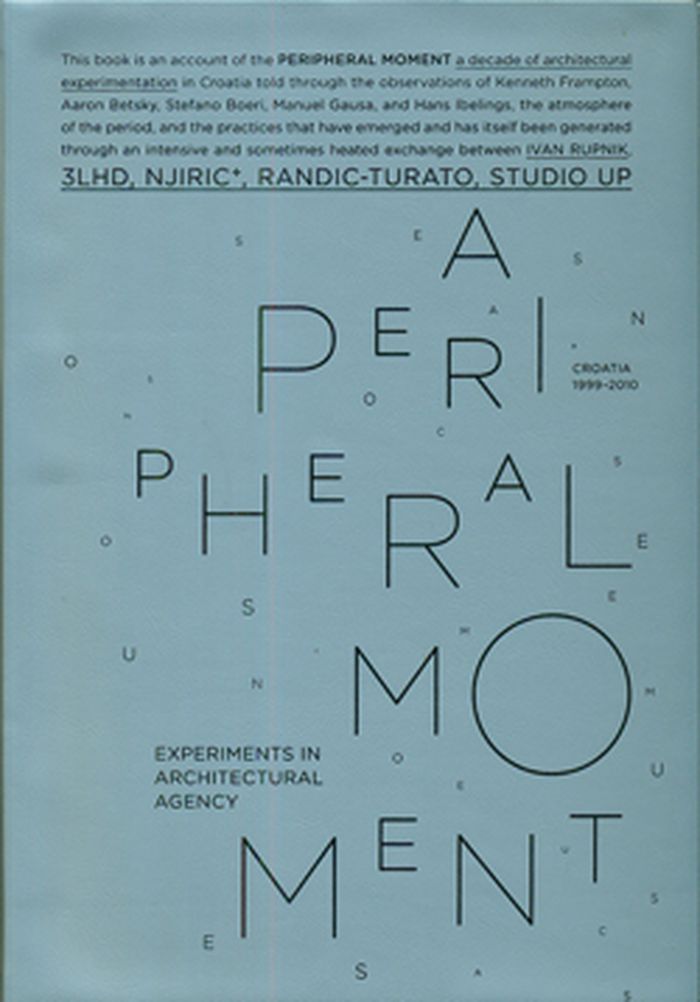
This book is an account of the highly productive decade of architectural experimentation in Croatia lodged between the violent break-up of Yugoslavia and their slow integration into the EU. Ivan Rupnik guides the reader through the emergence of this bizarre and fascinating architectural scene on the very edge of united Europe, utilizing Ljubo Karaman's theory of the periphery as a distinct space of artistic production from that of the center or province, Manfredo Tafuri's concept of architectural experimentation, as well contemporary notions of agency. The account is framed using a variety of different lenses, including the observations of this moment by renowned writers, through the atmosphere of the period as defined by Croatia's complex post-socialist/postwar identity and the subsequent positioning of the architectural profession vis-a-vis that context, the practices that emerged , and through a series of discussions with some of the peripheral moment's primary agent provocateurs: 3LHD, njiric +, Randic - Turato, and STUDIO UP.
A peripheral moment: Croatia 1990-2010
Actions:
Price:
$39.95
(available to order)
Summary:
This book is an account of the highly productive decade of architectural experimentation in Croatia lodged between the violent break-up of Yugoslavia and their slow integration into the EU. Ivan Rupnik guides the reader through the emergence of this bizarre and fascinating architectural scene on the very edge of united Europe, utilizing Ljubo Karaman's theory of the periphery as a distinct space of artistic production from that of the center or province, Manfredo Tafuri's concept of architectural experimentation, as well contemporary notions of agency. The account is framed using a variety of different lenses, including the observations of this moment by renowned writers, through the atmosphere of the period as defined by Croatia's complex post-socialist/postwar identity and the subsequent positioning of the architectural profession vis-a-vis that context, the practices that emerged , and through a series of discussions with some of the peripheral moment's primary agent provocateurs: 3LHD, njiric +, Randic - Turato, and STUDIO UP.
Form:
books
books
Publication:
November 2010
November 2010
Subject:
Architecture since 1900, Europe
Architecture since 1900, Europe
Form:
books
books

Price:
$102.95
(available to order)
Summary:
The Classroom shows how furniture designers from the late nineteenth century to the present have strived to enliven the classroom experience for children, telling for the first time the history of this neglected area of furniture design. The book is based on the collection of the VS school museum in Tauberbischofsheim, which houses a unique collection of school furniture(...)
$102.95
(available to order)
Summary:
The Classroom shows how furniture designers from the late nineteenth century to the present have strived to enliven the classroom experience for children, telling for the first time the history of this neglected area of furniture design. The book is based on the collection of the VS school museum in Tauberbischofsheim, which houses a unique collection of school furniture(...)
Subject:
Commercial interiors, Building types
Commercial interiors, Building types
Publication:
March 2011
March 2011
Title:
The classroom: From the late 19th Century until the present day
Actions:
Price:
$102.95
(available to order)
Summary:
The Classroom shows how furniture designers from the late nineteenth century to the present have strived to enliven the classroom experience for children, telling for the first time the history of this neglected area of furniture design. The book is based on the collection of the VS school museum in Tauberbischofsheim, which houses a unique collection of school furniture from Germany and abroad. Through this collection, it draws out the history of educational theory and school architecture over the past hundred years, tracing the ascent of a child-centered approach to education and attendant developments in design, as well as such topics as the use of propaganda in Soviet- and Nazi-era schools. Chairs, desks, classrooms and entire schools by Alvar Aalto, Arne Jacobsen, Charles Rennie Mackintosh, Jean-Baptiste Mathon, Jean Prouvé, Eero + Eliel Saarinen and Bruno Taut are abundantly illustrated and examined. The Classroom looks back over this history and looks forward to possible future developments.
The classroom: From the late 19th Century until the present day
Actions:
Price:
$102.95
(available to order)
Summary:
The Classroom shows how furniture designers from the late nineteenth century to the present have strived to enliven the classroom experience for children, telling for the first time the history of this neglected area of furniture design. The book is based on the collection of the VS school museum in Tauberbischofsheim, which houses a unique collection of school furniture from Germany and abroad. Through this collection, it draws out the history of educational theory and school architecture over the past hundred years, tracing the ascent of a child-centered approach to education and attendant developments in design, as well as such topics as the use of propaganda in Soviet- and Nazi-era schools. Chairs, desks, classrooms and entire schools by Alvar Aalto, Arne Jacobsen, Charles Rennie Mackintosh, Jean-Baptiste Mathon, Jean Prouvé, Eero + Eliel Saarinen and Bruno Taut are abundantly illustrated and examined. The Classroom looks back over this history and looks forward to possible future developments.
Form:
books
books
Publication:
March 2011
March 2011
Subject:
Commercial interiors, Building types
Commercial interiors, Building types
Form:
books
books
Title:
Dan Graham
Dan Graham
Actions:
Price:
$23.95
(available to order)
Summary:
Since the 1960s, Dan Graham's heterogeneous practice has touched on such disparate subjects as tract housing, the Shakers, punk music, and architectural theory; he has made videos, architectural models, closed-circuit installations, and glass pavilions. Graham as situated his work on the borders between these different strains of contemporary practice. Although varying(...)
$23.95
(available to order)
Summary:
Since the 1960s, Dan Graham's heterogeneous practice has touched on such disparate subjects as tract housing, the Shakers, punk music, and architectural theory; he has made videos, architectural models, closed-circuit installations, and glass pavilions. Graham as situated his work on the borders between these different strains of contemporary practice. Although varying(...)
Title:
Dan Graham
Actions:
Price:
$23.95
(available to order)
Summary:
Since the 1960s, Dan Graham's heterogeneous practice has touched on such disparate subjects as tract housing, the Shakers, punk music, and architectural theory; he has made videos, architectural models, closed-circuit installations, and glass pavilions. Graham as situated his work on the borders between these different strains of contemporary practice. Although varying widely in subject and medium, Graham's artwork and writings display a consistent interest in spectatorship, public-private relationships, and the constructed environment. Graham's extensive writings on his own work have made him, by default, the primary interpreter of his own art. This October Files volume provides a counterweight, gathering key texts by critics and theorists that offer alternative accounts of Graham's art. The essays span thirty years and include hard-to-find texts from exhibition catalogs and journals. The authors include such distinguished theorists, critics, and artists as Benjamin H. D. Buchloh, Beatriz Colomina, Thierry de Duve, and Jeff Wall.
Dan Graham
Actions:
Price:
$23.95
(available to order)
Summary:
Since the 1960s, Dan Graham's heterogeneous practice has touched on such disparate subjects as tract housing, the Shakers, punk music, and architectural theory; he has made videos, architectural models, closed-circuit installations, and glass pavilions. Graham as situated his work on the borders between these different strains of contemporary practice. Although varying widely in subject and medium, Graham's artwork and writings display a consistent interest in spectatorship, public-private relationships, and the constructed environment. Graham's extensive writings on his own work have made him, by default, the primary interpreter of his own art. This October Files volume provides a counterweight, gathering key texts by critics and theorists that offer alternative accounts of Graham's art. The essays span thirty years and include hard-to-find texts from exhibition catalogs and journals. The authors include such distinguished theorists, critics, and artists as Benjamin H. D. Buchloh, Beatriz Colomina, Thierry de Duve, and Jeff Wall.
Form:
books
books
Publication:
March 2011
March 2011
Subject:
Contemporary Art Monographs
Contemporary Art Monographs
Form:
books
books
Actions:
Price:
$49.95
(available to order)
Summary:
Although Piet Mondrian (1872–1944) was not an active member of the Bauhaus, his name is often mentioned in connection with the art school. Mondrian, cofounder of the De Stijl movement in the Netherlands, called for a strict reduction of visual language to orthogonal composition and primary colors, which met with great approval in Bauhaus circles. It is therefore not(...)
$49.95
(available to order)
Summary:
Although Piet Mondrian (1872–1944) was not an active member of the Bauhaus, his name is often mentioned in connection with the art school. Mondrian, cofounder of the De Stijl movement in the Netherlands, called for a strict reduction of visual language to orthogonal composition and primary colors, which met with great approval in Bauhaus circles. It is therefore not(...)
Title:
Piet Mondrian: New design. Bauhausbücher 5
Actions:
Price:
$49.95
(available to order)
Summary:
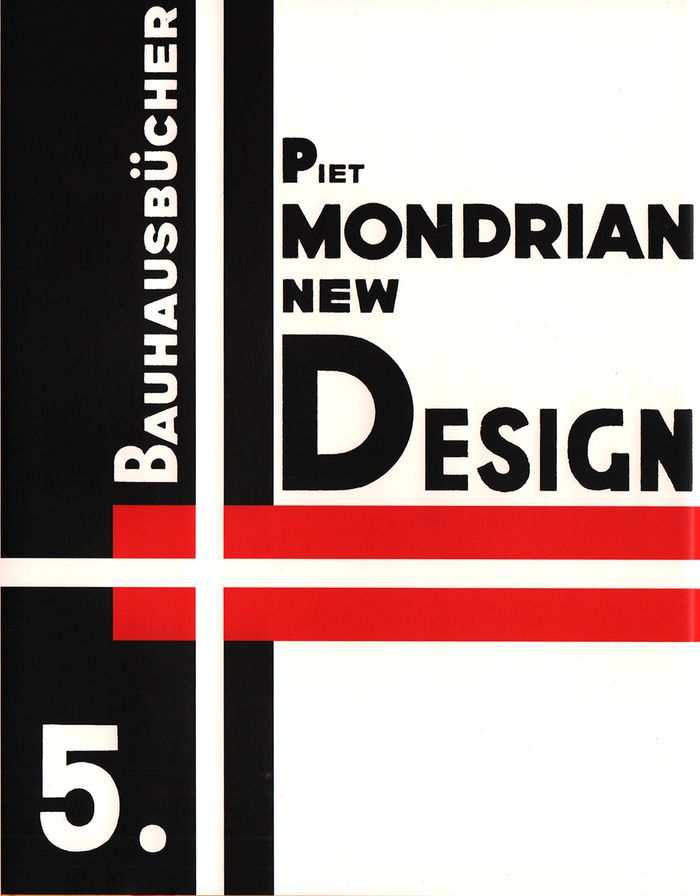
Although Piet Mondrian (1872–1944) was not an active member of the Bauhaus, his name is often mentioned in connection with the art school. Mondrian, cofounder of the De Stijl movement in the Netherlands, called for a strict reduction of visual language to orthogonal composition and primary colors, which met with great approval in Bauhaus circles. It is therefore not surprising that Mondrian’s essays on art theory, most of them written for the De Stijl journal, were translated into German and published as number five in the Bauhausbücher series. “New Design” starts with a philosophical foray into art, which Mondrian describes as a figurative expression of human existence—an expression which will find its natural conclusion in his own concept of a “New Design.” Mondrian then considers the relationship between painting and architecture and dares to take a far-reaching look at the future of Neoplasticism, which he imagines revolutionizing design and architecture around the world.
Piet Mondrian: New design. Bauhausbücher 5
Actions:
Price:
$49.95
(available to order)
Summary:
Although Piet Mondrian (1872–1944) was not an active member of the Bauhaus, his name is often mentioned in connection with the art school. Mondrian, cofounder of the De Stijl movement in the Netherlands, called for a strict reduction of visual language to orthogonal composition and primary colors, which met with great approval in Bauhaus circles. It is therefore not surprising that Mondrian’s essays on art theory, most of them written for the De Stijl journal, were translated into German and published as number five in the Bauhausbücher series. “New Design” starts with a philosophical foray into art, which Mondrian describes as a figurative expression of human existence—an expression which will find its natural conclusion in his own concept of a “New Design.” Mondrian then considers the relationship between painting and architecture and dares to take a far-reaching look at the future of Neoplasticism, which he imagines revolutionizing design and architecture around the world.
Form:
books
books
Publication:
March 2019
March 2019
Subject:
Modernism
Modernism
Form:
books
books
Actions:
Price:
$24.95
(available to order)
Summary:
The vast social apparatus of the computer network has aligned people with technology in unprecedented ways. The intimacy of the human-computer interface has made it impossible to distinguish technology from the social and cultural business of being human. Cyberculture is the broader name given to this process of becoming through technological means. This book shows that(...)
$24.95
(available to order)
Summary:
The vast social apparatus of the computer network has aligned people with technology in unprecedented ways. The intimacy of the human-computer interface has made it impossible to distinguish technology from the social and cultural business of being human. Cyberculture is the broader name given to this process of becoming through technological means. This book shows that(...)
Publication:
May 2014
May 2014
Title:
Prefiguring cyberculture: an intellectual history
Actions:
Price:
$24.95
(available to order)
Summary:
The vast social apparatus of the computer network has aligned people with technology in unprecedented ways. The intimacy of the human-computer interface has made it impossible to distinguish technology from the social and cultural business of being human. Cyberculture is the broader name given to this process of becoming through technological means. This book shows that cyberculture has been a long time coming.In Prefiguring Cyberculture, media critics and theorists, philosophers, and historians of science explore the antecedents of such aspects of contemporary technological culture as the Internet, the World Wide Web, artificial intelligence, genetic engineering, virtual reality, and the cyborg. The contributors examine key texts that anticipate cybercultural practice and theory, including Plato's "Simile of the Cave"; the Renaissance Ars Memoria; Descartes's Meditations (on the mind-body split); Mary Shelley's Frankenstein; Alan Turing's Computing Machinery and Intelligence; Philip K. Dick's Man, Android, and Machine; William Gibson's Neuromancer; and Arthur C. Clarke's Profiles of the Future.
Prefiguring cyberculture: an intellectual history
Actions:
Price:
$24.95
(available to order)
Summary:
The vast social apparatus of the computer network has aligned people with technology in unprecedented ways. The intimacy of the human-computer interface has made it impossible to distinguish technology from the social and cultural business of being human. Cyberculture is the broader name given to this process of becoming through technological means. This book shows that cyberculture has been a long time coming.In Prefiguring Cyberculture, media critics and theorists, philosophers, and historians of science explore the antecedents of such aspects of contemporary technological culture as the Internet, the World Wide Web, artificial intelligence, genetic engineering, virtual reality, and the cyborg. The contributors examine key texts that anticipate cybercultural practice and theory, including Plato's "Simile of the Cave"; the Renaissance Ars Memoria; Descartes's Meditations (on the mind-body split); Mary Shelley's Frankenstein; Alan Turing's Computing Machinery and Intelligence; Philip K. Dick's Man, Android, and Machine; William Gibson's Neuromancer; and Arthur C. Clarke's Profiles of the Future.
Form:
books
books
Publication:
May 2014
May 2014
Form:
books
books
Actions:
Price:
$42.00
(available to order)
Summary:
'Post-Branding' empowers better design of public communication for civic and activist groups by replacing corporate branding’s predatory principles with a new set of strategies embedded in a new culture of craft. A new way of being and knowing, for a new way of relating with the world. What is Post Branding? is a work of ‘practical theory’. It is a compact(...)
$42.00
(available to order)
Summary:
'Post-Branding' empowers better design of public communication for civic and activist groups by replacing corporate branding’s predatory principles with a new set of strategies embedded in a new culture of craft. A new way of being and knowing, for a new way of relating with the world. What is Post Branding? is a work of ‘practical theory’. It is a compact(...)
Title:
What is post-branding? , How to Counter Fundamentalist Marketplace Semiotics
Actions:
Price:
$42.00
(available to order)
Summary:
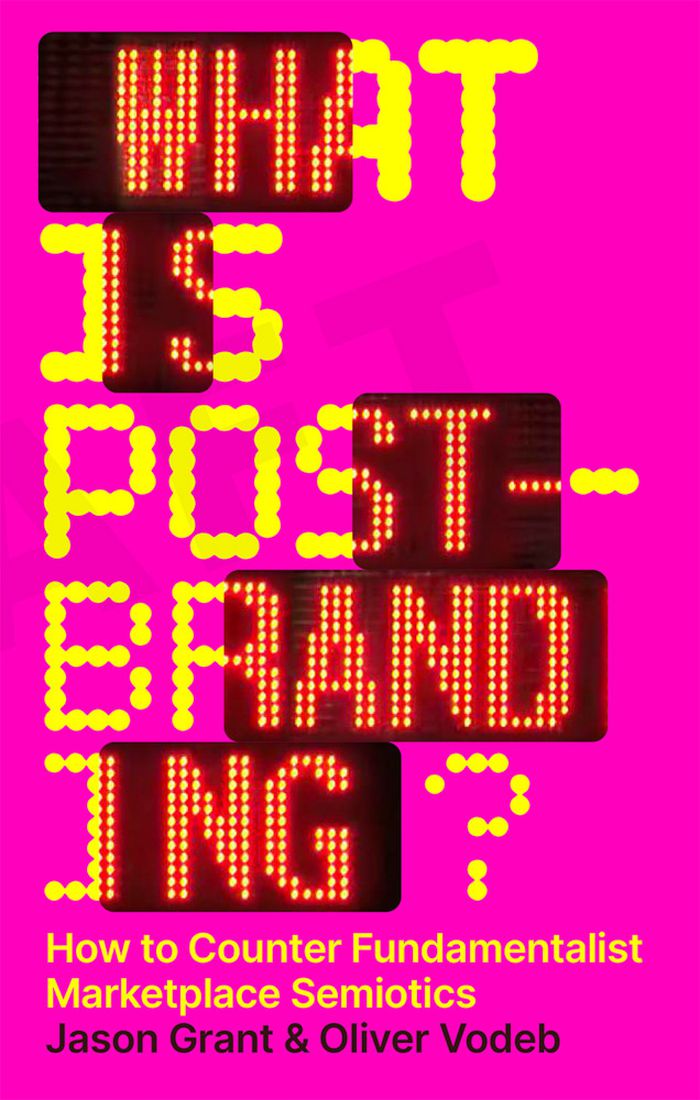
'Post-Branding' empowers better design of public communication for civic and activist groups by replacing corporate branding’s predatory principles with a new set of strategies embedded in a new culture of craft. A new way of being and knowing, for a new way of relating with the world. What is Post Branding? is a work of ‘practical theory’. It is a compact ‘pocket-book’ format publication composed of four main sections. The first, ‘DIS-BRANDED’, is a text of 20 short page-long chapters exposing the ideological underbelly and real-world impact of branding. The second, ‘MIXED MESSAGES’, is a visual essay illuminating the texts’ main themes. The third, ‘MANUAL’, presents a framework for a critical alternative to corporate branding, appropriating found instructional diagrams as a brand manual satire. This section also includes examples of completed contemporary projects that have implemented post-branding principles. The book concludes with ‘CONTEXT’, featuring a conversation with cultural theorist Brian Holmes and an argument with design historian Steven Heller.
What is post-branding? , How to Counter Fundamentalist Marketplace Semiotics
Actions:
Price:
$42.00
(available to order)
Summary:
'Post-Branding' empowers better design of public communication for civic and activist groups by replacing corporate branding’s predatory principles with a new set of strategies embedded in a new culture of craft. A new way of being and knowing, for a new way of relating with the world. What is Post Branding? is a work of ‘practical theory’. It is a compact ‘pocket-book’ format publication composed of four main sections. The first, ‘DIS-BRANDED’, is a text of 20 short page-long chapters exposing the ideological underbelly and real-world impact of branding. The second, ‘MIXED MESSAGES’, is a visual essay illuminating the texts’ main themes. The third, ‘MANUAL’, presents a framework for a critical alternative to corporate branding, appropriating found instructional diagrams as a brand manual satire. This section also includes examples of completed contemporary projects that have implemented post-branding principles. The book concludes with ‘CONTEXT’, featuring a conversation with cultural theorist Brian Holmes and an argument with design historian Steven Heller.
Form:
books
books
Publication:
July 2023
July 2023
Subject:
Graphic Design and Typography
Graphic Design and Typography


