


7238 Results
Form:
books
books
Actions:
Price:
$49.50
(available to order)
Summary:
Once symbols of the past, ruins have become ubiquitous signs of our future. Americans today encounter ruins in the media on a daily basis - images of abandoned factories and malls, toxic landscapes, devastating fires, hurricanes, and floods. In this sweeping study, Miles Orvell offers a new understanding of the spectacle of ruins in US culture, exploring how(...)
$49.50
(available to order)
Summary:
Once symbols of the past, ruins have become ubiquitous signs of our future. Americans today encounter ruins in the media on a daily basis - images of abandoned factories and malls, toxic landscapes, devastating fires, hurricanes, and floods. In this sweeping study, Miles Orvell offers a new understanding of the spectacle of ruins in US culture, exploring how(...)
Title:
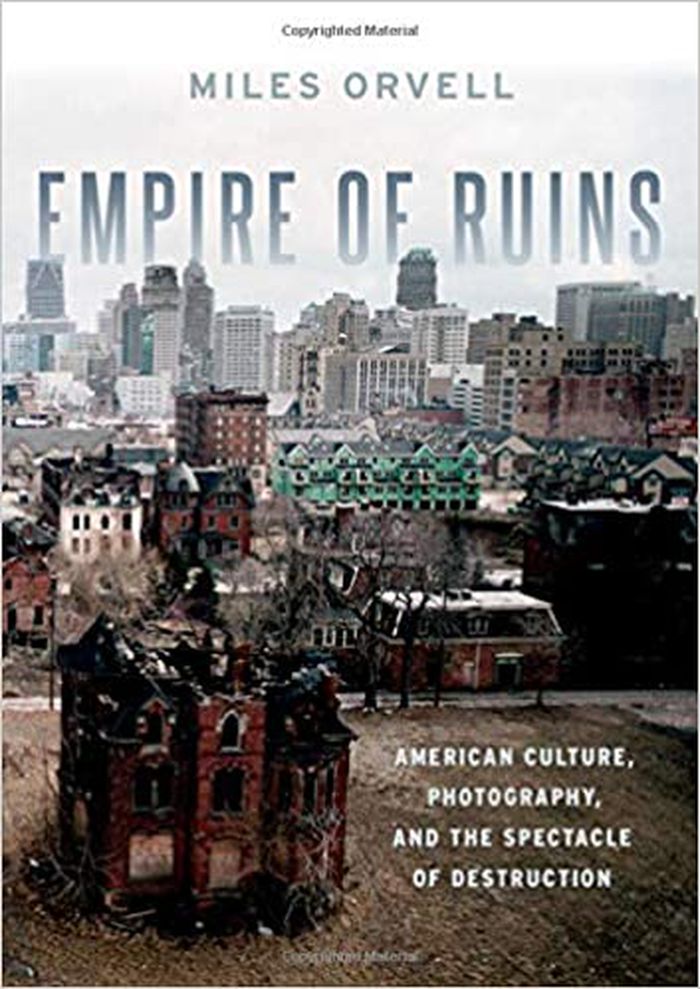
Empire of ruins: American culture, photography, and the spectacle of destruction
Actions:
Price:
$49.50
(available to order)
Summary:
Once symbols of the past, ruins have become ubiquitous signs of our future. Americans today encounter ruins in the media on a daily basis - images of abandoned factories and malls, toxic landscapes, devastating fires, hurricanes, and floods. In this sweeping study, Miles Orvell offers a new understanding of the spectacle of ruins in US culture, exploring how photographers, writers, painters, and filmmakers have responded to ruin and destruction, both real and imaginary, in an effort to make sense of the past and envision the future. ''Empire of ruins'' explains why Americans in the nineteenth century yearned for the ruins of Rome and Egypt and how they portrayed a past as ancient and mysterious in the remains of Native American cultures. As the romance of ruins gave way to twentieth-century capitalism, older structures were demolished to make way for grander ones, a process interpreted by artists as a symptom of America's "creative destruction." In the late twentieth century, Americans began to inhabit a perpetual state of ruins, made visible by photographs of decaying inner cities, derelict factories and malls, and the waste lands of the mining industry. This interdisciplinary work focuses on how visual media have transformed disaster and decay into spectacles that compel our moral attention even as they balance horror and beauty. Looking to the future, Orvell considers the visual portrayal of climate ruins as we face the political and ethical responsibilities of our changing world. A wide-ranging work by an acclaimed urban, cultural, and photography scholar, ''Empire of ruins'' offers a provocative and lavishly illustrated look at the American past, present, and future.
Empire of ruins: American culture, photography, and the spectacle of destruction
Actions:
Price:
$49.50
(available to order)
Summary:
Once symbols of the past, ruins have become ubiquitous signs of our future. Americans today encounter ruins in the media on a daily basis - images of abandoned factories and malls, toxic landscapes, devastating fires, hurricanes, and floods. In this sweeping study, Miles Orvell offers a new understanding of the spectacle of ruins in US culture, exploring how photographers, writers, painters, and filmmakers have responded to ruin and destruction, both real and imaginary, in an effort to make sense of the past and envision the future. ''Empire of ruins'' explains why Americans in the nineteenth century yearned for the ruins of Rome and Egypt and how they portrayed a past as ancient and mysterious in the remains of Native American cultures. As the romance of ruins gave way to twentieth-century capitalism, older structures were demolished to make way for grander ones, a process interpreted by artists as a symptom of America's "creative destruction." In the late twentieth century, Americans began to inhabit a perpetual state of ruins, made visible by photographs of decaying inner cities, derelict factories and malls, and the waste lands of the mining industry. This interdisciplinary work focuses on how visual media have transformed disaster and decay into spectacles that compel our moral attention even as they balance horror and beauty. Looking to the future, Orvell considers the visual portrayal of climate ruins as we face the political and ethical responsibilities of our changing world. A wide-ranging work by an acclaimed urban, cultural, and photography scholar, ''Empire of ruins'' offers a provocative and lavishly illustrated look at the American past, present, and future.
Form:
books
books
Publication:
January 2021
January 2021
Subject:
Theory of Photography
Theory of Photography
Form:
books
books
Actions:
Holdings:
Description:
x, 246 pages : illustrations ; 26 cm.
Description:
x, 246 pages : illustrations ; 26 cm.
Author:
Subject:
Publication:
London ; New York : Methuen, 1984.
London ; New York : Methuen, 1984.
Title:
Theatre and Playhouse : An Illustrated Survey of Theatre Building from Ancient Greece to the Present Day / Richard and Helen Leacroft ; with isometric reconstructions by Richard Leacroft.
Actions:
Holdings:
Description:
x, 246 pages : illustrations ; 26 cm.
Theatre and Playhouse : An Illustrated Survey of Theatre Building from Ancient Greece to the Present Day / Richard and Helen Leacroft ; with isometric reconstructions by Richard Leacroft.
Actions:
Holdings:
Description:
x, 246 pages : illustrations ; 26 cm.
Form:
books
books
Publication:
London ; New York : Methuen, 1984.
London ; New York : Methuen, 1984.
Author:
Subject:
Form:
books
books
Title:
Sprawl : a compact history
Sprawl : a compact history
Actions:
Price:
$34.50
(available to order)
Summary:
As anyone who has flown into Los Angeles at dusk or Houston at midday knows, urban areas today defy traditional notions of what a city is. Our old definitions of urban, suburban, and rural fail to capture the complexity of these vast regions with their superhighways, subdivisions, industrial areas, office parks, and resort areas pushing far out into the countryside.(...)
$34.50
(available to order)
Summary:
As anyone who has flown into Los Angeles at dusk or Houston at midday knows, urban areas today defy traditional notions of what a city is. Our old definitions of urban, suburban, and rural fail to capture the complexity of these vast regions with their superhighways, subdivisions, industrial areas, office parks, and resort areas pushing far out into the countryside.(...)
Title:
Sprawl : a compact history
Actions:
Price:
$34.50
(available to order)
Summary:
As anyone who has flown into Los Angeles at dusk or Houston at midday knows, urban areas today defy traditional notions of what a city is. Our old definitions of urban, suburban, and rural fail to capture the complexity of these vast regions with their superhighways, subdivisions, industrial areas, office parks, and resort areas pushing far out into the countryside. Detractors call it sprawl and assert that it is economically inefficient, socially inequitable, environmentally irresponsible, and aesthetically ugly. Robert Bruegmann calls it a logical consequence of economic growth and the democratization of society, with benefits that urban planners have failed to recognize. In his history of the expanded city, Bruegmann overturns every assumption we have about sprawl. Taking a long view of urban development, he demonstrates that sprawl is neither recent nor particularly American but as old as cities themselves, just as characteristic of ancient Rome and eighteenth-century Paris as it is of Atlanta or Los Angeles. Nor is sprawl the disaster claimed by many contemporary observers. Although sprawl, like any settlement pattern, has undoubtedly produced problems that must be addressed, it has also provided millions of people with the kinds of mobility, privacy, and choice that were once the exclusive prerogatives of the rich and powerful. The first major book to strip urban sprawl of its pejorative connotations, Sprawl offers a completely new vision of the city and its growth. Bruegmann leads readers to the powerful conclusion that ''in its immense complexity and constant change, the city-whether dense and concentrated at its core, looser and more sprawling in suburbia, or in the vast tracts of exurban penumbra that extend dozens, even hundreds, of miles-is the grandest and most marvelous work of mankind.''
Sprawl : a compact history
Actions:
Price:
$34.50
(available to order)
Summary:
As anyone who has flown into Los Angeles at dusk or Houston at midday knows, urban areas today defy traditional notions of what a city is. Our old definitions of urban, suburban, and rural fail to capture the complexity of these vast regions with their superhighways, subdivisions, industrial areas, office parks, and resort areas pushing far out into the countryside. Detractors call it sprawl and assert that it is economically inefficient, socially inequitable, environmentally irresponsible, and aesthetically ugly. Robert Bruegmann calls it a logical consequence of economic growth and the democratization of society, with benefits that urban planners have failed to recognize. In his history of the expanded city, Bruegmann overturns every assumption we have about sprawl. Taking a long view of urban development, he demonstrates that sprawl is neither recent nor particularly American but as old as cities themselves, just as characteristic of ancient Rome and eighteenth-century Paris as it is of Atlanta or Los Angeles. Nor is sprawl the disaster claimed by many contemporary observers. Although sprawl, like any settlement pattern, has undoubtedly produced problems that must be addressed, it has also provided millions of people with the kinds of mobility, privacy, and choice that were once the exclusive prerogatives of the rich and powerful. The first major book to strip urban sprawl of its pejorative connotations, Sprawl offers a completely new vision of the city and its growth. Bruegmann leads readers to the powerful conclusion that ''in its immense complexity and constant change, the city-whether dense and concentrated at its core, looser and more sprawling in suburbia, or in the vast tracts of exurban penumbra that extend dozens, even hundreds, of miles-is the grandest and most marvelous work of mankind.''
Form:
books
books
Publication:
October 2005, Chicago, London
October 2005, Chicago, London
Subject:
Urban Theory
Urban Theory
Form:
books
books
Price:
$29.95
(available to order)
Summary:
Les Guides Belles Lettres des Civilisations proposent un voyage dans le temps et l'espace (Égypte, Grèce, Rome, Inde, Chine, Japon...) et s'adressent aux étudiants, aux curieux d'histoire et de civilisations, aux voyageurs... Ouvrages pratiques et raisonnés de culture générale sur les principales civilisations anciennes qui nous ont laissé une trace écrite, ils proposent(...)
$29.95
(available to order)
Summary:
Les Guides Belles Lettres des Civilisations proposent un voyage dans le temps et l'espace (Égypte, Grèce, Rome, Inde, Chine, Japon...) et s'adressent aux étudiants, aux curieux d'histoire et de civilisations, aux voyageurs... Ouvrages pratiques et raisonnés de culture générale sur les principales civilisations anciennes qui nous ont laissé une trace écrite, ils proposent(...)
Title:
Le Siam
Actions:
Price:
$29.95
(available to order)
Summary:
Les Guides Belles Lettres des Civilisations proposent un voyage dans le temps et l'espace (Égypte, Grèce, Rome, Inde, Chine, Japon...) et s'adressent aux étudiants, aux curieux d'histoire et de civilisations, aux voyageurs... Ouvrages pratiques et raisonnés de culture générale sur les principales civilisations anciennes qui nous ont laissé une trace écrite, ils proposent au lecteur les clés nécessaires pour comprendre un texte ancien ou un livre d'histoire, ils l'aident à en déchiffrer les allusions, à en élucider les difficultés: Le Siam... Le nom suscite encore le rêve puisqu'il attire les voyageurs en quête d'une Asie fastueuse et raffinée dont le parfum émane toujours de ses anciennes capitales, Ayutthaya et Sukhothaï. En surgit l'évocation d'un royaume souvent brillant, celui des Thaïs qui se révèlent extraordinairement doués pour assimiler le meilleur des civilisations qui les avaient précédés et s'en approprier peu à peu les territoires. Ce guide analyse ce que fut la culture lentement élaborée de ce peuple à son apogée, soit à la fin du XVIIe siècle. Leur conception pratique permet à chacun de les utiliser de trois façons : soit les lire en suivant, comme un livre traditionnel, pour découvrir les divers aspects de la civilisation présentée, soit recourir directement à l'une des rubriques qui composent chaque chapitre grâce à une table des matières très détaillée, soit encore se servir directement de l'index très fourni afin de trouver rapidement une information précise. Les cartes, tableaux, schémas, permettent, en outre, d'aller à l'essentiel. Et une bibliographie choisie et récente offre à qui le souhaite d'amorcer une recherche plus approfondie. Les Guides Belles Lettres des Civilisations ne sont pas des dictionnaires. Toute information recherchée s'y trouve replacée dans le contexte des mentalités de chacune des civilisations étudiées. Car il n'est pas possible de comprendre un événement, une loi morale ou le caractère d'un personnage si rien n'est restitué des valeurs qui les justifient.
Le Siam
Actions:
Price:
$29.95
(available to order)
Summary:
Les Guides Belles Lettres des Civilisations proposent un voyage dans le temps et l'espace (Égypte, Grèce, Rome, Inde, Chine, Japon...) et s'adressent aux étudiants, aux curieux d'histoire et de civilisations, aux voyageurs... Ouvrages pratiques et raisonnés de culture générale sur les principales civilisations anciennes qui nous ont laissé une trace écrite, ils proposent au lecteur les clés nécessaires pour comprendre un texte ancien ou un livre d'histoire, ils l'aident à en déchiffrer les allusions, à en élucider les difficultés: Le Siam... Le nom suscite encore le rêve puisqu'il attire les voyageurs en quête d'une Asie fastueuse et raffinée dont le parfum émane toujours de ses anciennes capitales, Ayutthaya et Sukhothaï. En surgit l'évocation d'un royaume souvent brillant, celui des Thaïs qui se révèlent extraordinairement doués pour assimiler le meilleur des civilisations qui les avaient précédés et s'en approprier peu à peu les territoires. Ce guide analyse ce que fut la culture lentement élaborée de ce peuple à son apogée, soit à la fin du XVIIe siècle. Leur conception pratique permet à chacun de les utiliser de trois façons : soit les lire en suivant, comme un livre traditionnel, pour découvrir les divers aspects de la civilisation présentée, soit recourir directement à l'une des rubriques qui composent chaque chapitre grâce à une table des matières très détaillée, soit encore se servir directement de l'index très fourni afin de trouver rapidement une information précise. Les cartes, tableaux, schémas, permettent, en outre, d'aller à l'essentiel. Et une bibliographie choisie et récente offre à qui le souhaite d'amorcer une recherche plus approfondie. Les Guides Belles Lettres des Civilisations ne sont pas des dictionnaires. Toute information recherchée s'y trouve replacée dans le contexte des mentalités de chacune des civilisations étudiées. Car il n'est pas possible de comprendre un événement, une loi morale ou le caractère d'un personnage si rien n'est restitué des valeurs qui les justifient.
Form:
books
books
Publication:
January 2004, Paris
January 2004, Paris
Subject:
Arch Middle East
Arch Middle East
Form:
books
books
Price:
$49.00
(available to order)
Summary:
Buildings are more like us than we realize. They can be born into wealth or poverty, enjoying every privilege or struggling to make ends meet. They have parents - gods, kings and emperors, governments, visionaries and madmen - as well as friends and enemies. They have duties and responsibilities. They can endure crises of faith and purpose. They can succeed or fail. They(...)
$49.00
(available to order)
Summary:
Buildings are more like us than we realize. They can be born into wealth or poverty, enjoying every privilege or struggling to make ends meet. They have parents - gods, kings and emperors, governments, visionaries and madmen - as well as friends and enemies. They have duties and responsibilities. They can endure crises of faith and purpose. They can succeed or fail. They(...)
Title:
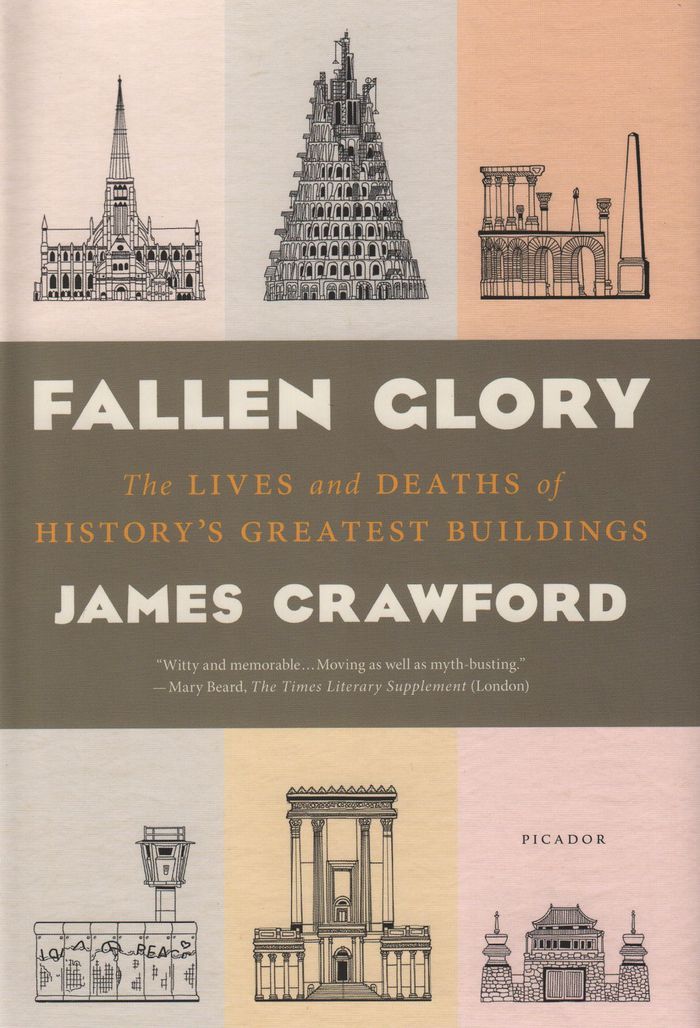
Fallen glory: the lives and deaths of history's greatest buildings
Actions:
Price:
$49.00
(available to order)
Summary:
Buildings are more like us than we realize. They can be born into wealth or poverty, enjoying every privilege or struggling to make ends meet. They have parents - gods, kings and emperors, governments, visionaries and madmen - as well as friends and enemies. They have duties and responsibilities. They can endure crises of faith and purpose. They can succeed or fail. They can live. And, sooner or later, they die. In "Fallen glory", James Crawford uncovers the biographies of some of the world's most fascinating lost and ruined buildings, from the dawn of civilization to the cyber era. The lives of these iconic structures are packed with drama and intrigue. Soap operas on the grandest scale, they feature war and religion, politics and art, love and betrayal, catastrophe and hope. Frequently their afterlives have been no less dramatic - their memories used and abused down the millennia for purposes both sacred and profane. They provide the stage for a startling array of characters, including Gilgamesh, the Cretan Minotaur, Agamemnon, Nefertiti, Genghis Khan, Henry VIII, Catherine the Great, Adolf Hitler, and even Bruce Springsteen. The twenty-one structures Crawford focuses on include The Tower of Babel, The Temple of Jerusalem, The Library of Alexandria, The Bastille, Kowloon Walled City, the Berlin Wall, and the Twin Towers of the World Trade Center. Ranging from the deserts of Iraq, the banks of the Nile and the cloud forests of Peru, to the great cities of Jerusalem, Istanbul, Paris, Rome, London and New York, Fallen Glory is a unique guide to a world of vanished architecture. And, by picking through the fragments of our past, it asks what history's scattered ruins can tell us about our own future.
Fallen glory: the lives and deaths of history's greatest buildings
Actions:
Price:
$49.00
(available to order)
Summary:
Buildings are more like us than we realize. They can be born into wealth or poverty, enjoying every privilege or struggling to make ends meet. They have parents - gods, kings and emperors, governments, visionaries and madmen - as well as friends and enemies. They have duties and responsibilities. They can endure crises of faith and purpose. They can succeed or fail. They can live. And, sooner or later, they die. In "Fallen glory", James Crawford uncovers the biographies of some of the world's most fascinating lost and ruined buildings, from the dawn of civilization to the cyber era. The lives of these iconic structures are packed with drama and intrigue. Soap operas on the grandest scale, they feature war and religion, politics and art, love and betrayal, catastrophe and hope. Frequently their afterlives have been no less dramatic - their memories used and abused down the millennia for purposes both sacred and profane. They provide the stage for a startling array of characters, including Gilgamesh, the Cretan Minotaur, Agamemnon, Nefertiti, Genghis Khan, Henry VIII, Catherine the Great, Adolf Hitler, and even Bruce Springsteen. The twenty-one structures Crawford focuses on include The Tower of Babel, The Temple of Jerusalem, The Library of Alexandria, The Bastille, Kowloon Walled City, the Berlin Wall, and the Twin Towers of the World Trade Center. Ranging from the deserts of Iraq, the banks of the Nile and the cloud forests of Peru, to the great cities of Jerusalem, Istanbul, Paris, Rome, London and New York, Fallen Glory is a unique guide to a world of vanished architecture. And, by picking through the fragments of our past, it asks what history's scattered ruins can tell us about our own future.
Form:
books
books
Publication:
March 2017
March 2017
Subject:
Architectural Theory
Architectural Theory
Form:
books
books
Price:
$25.00
(available to order)
Summary:
The rat has been described as the shadow of the human. From ancient times it spread via the routes of commerce and conquest to eventually inhabit almost every part of the world. Its impact on history has been enormous in terms of the damage done through plague and disease, the destruction of agricultural produce, and the infestations of cities. At the same time the rat(...)
$25.00
(available to order)
Summary:
The rat has been described as the shadow of the human. From ancient times it spread via the routes of commerce and conquest to eventually inhabit almost every part of the world. Its impact on history has been enormous in terms of the damage done through plague and disease, the destruction of agricultural produce, and the infestations of cities. At the same time the rat(...)
Title:
Rat
Actions:
Price:
$25.00
(available to order)
Summary:
The rat has been described as the shadow of the human. From ancient times it spread via the routes of commerce and conquest to eventually inhabit almost every part of the world. Its impact on history has been enormous in terms of the damage done through plague and disease, the destruction of agricultural produce, and the infestations of cities. At the same time the rat has provided science with a huge resource for experimentation. This highly adaptable, fertile and intelligent creature is almost universally loathed, but there are cultures in which it is revered, even deified. This book traces the history of the human relationship with rats from the first archaeological finds to the genetically engineered rats of the present day, describing its role in the arts and sciences, religion and myth, psychoanalysis and medicine. The author includes wide-ranging examples of the rat’s appearance: in literature – 'The Pied Piper'; Beatrix Potter stories, 'The Wind in the Willows'; in culture – Victorian rat-and-dog baiting pits, its popularity as a pet, even the subject of a ’70s pop song; folklore – it was a good luck symbol in ancient Rome, symbol of cunning in Chinese mythology; and psychoanalysis – Freud’s Rat Man, for example. The book also seeks to answer two problems raised by the complexity of human attitudes to the rat. The first concerns how it was that the rat came to be seen not just as verminous, but also as being particularly despised for being so – more so, in fact, than other parasitic animals. The second concerns the manner in which human attitudes to the rat can be so contradictory, when admiration for its abilities are set against this idea of hatred. The rat can be found at the heart of human preoccupations with hygiene, sexuality and appetite, and exists as a perverse totem for the worst excesses of human behaviour. In 'Rat', Jonathan Burt provides a fascinating account of this animal in history, myth and culture.
Rat
Actions:
Price:
$25.00
(available to order)
Summary:
The rat has been described as the shadow of the human. From ancient times it spread via the routes of commerce and conquest to eventually inhabit almost every part of the world. Its impact on history has been enormous in terms of the damage done through plague and disease, the destruction of agricultural produce, and the infestations of cities. At the same time the rat has provided science with a huge resource for experimentation. This highly adaptable, fertile and intelligent creature is almost universally loathed, but there are cultures in which it is revered, even deified. This book traces the history of the human relationship with rats from the first archaeological finds to the genetically engineered rats of the present day, describing its role in the arts and sciences, religion and myth, psychoanalysis and medicine. The author includes wide-ranging examples of the rat’s appearance: in literature – 'The Pied Piper'; Beatrix Potter stories, 'The Wind in the Willows'; in culture – Victorian rat-and-dog baiting pits, its popularity as a pet, even the subject of a ’70s pop song; folklore – it was a good luck symbol in ancient Rome, symbol of cunning in Chinese mythology; and psychoanalysis – Freud’s Rat Man, for example. The book also seeks to answer two problems raised by the complexity of human attitudes to the rat. The first concerns how it was that the rat came to be seen not just as verminous, but also as being particularly despised for being so – more so, in fact, than other parasitic animals. The second concerns the manner in which human attitudes to the rat can be so contradictory, when admiration for its abilities are set against this idea of hatred. The rat can be found at the heart of human preoccupations with hygiene, sexuality and appetite, and exists as a perverse totem for the worst excesses of human behaviour. In 'Rat', Jonathan Burt provides a fascinating account of this animal in history, myth and culture.
Form:
books
books
Publication:
August 2005, London
August 2005, London
Subject:
Fauna and flora
Fauna and flora
Form:
books
books
Actions:
Price:
$39.95
(available to order)
Summary:
In "The Geography of Nowhere", James Howard Kunstler declared suburbia "a tragic landscape of cartoon architecture, junked cities, and ravaged countryside" and put himself at the heart of a fierce debate over how we will live in twenty-first century America. Now, Kunstler turns his eye on urban life both in America and across the world. From classical Rome to the(...)
$39.95
(available to order)
Summary:
In "The Geography of Nowhere", James Howard Kunstler declared suburbia "a tragic landscape of cartoon architecture, junked cities, and ravaged countryside" and put himself at the heart of a fierce debate over how we will live in twenty-first century America. Now, Kunstler turns his eye on urban life both in America and across the world. From classical Rome to the(...)
Title:
The city in mind : notes on the urban condition
Actions:
Price:
$39.95
(available to order)
Summary:
In "The Geography of Nowhere", James Howard Kunstler declared suburbia "a tragic landscape of cartoon architecture, junked cities, and ravaged countryside" and put himself at the heart of a fierce debate over how we will live in twenty-first century America. Now, Kunstler turns his eye on urban life both in America and across the world. From classical Rome to the "gigantic hairball" of contemporary Atlanta, he offers a far-reaching discourse on the history and current state of urban life. "The City in Mind" tells the story of urban design and how the architectural makeup of a city directly influences its culture as well as its success. From the ingenious architectural design of Louis-Napoleon's renovation of Paris to the bloody collision of cultures that occurred when Cortés conquered the Aztec capital Tenochtitlan, from the grandiose architectural schemes of Hitler and Albert Speer to the meanings behind the ludicrous spectacle of Las Vegas, Kunstler opens up a new dialogue on the development and effects of urban construction. In his investigations, he discovers American communities in the Sunbelt and Southwest alienated from each other and themselves, Northeastern cities caught between their initial civic construction and our current car-obsessed society, and a disparate Europe with its mix of pre-industrial creativity, and war-marked reminders of the twentieth century. Expanding on ideas first discussed in Jane Jacobs' seminal work, "The Death and Life of Great American Cities", Kunstler looks to Europe to discover what is constant and enduring in cities at their greatest, and at the same time, how a city's design can be directly linked to its decline. In these excursions he finds the reasons that America got lost in its suburban wilderness and locates the pathways in culture that might lead to a civic revival here. Kunstler's examination of these cities is at once a concise history of their urban lives and a detailed criticism of how those histories have either aided or hindered the social and civil progress of the cities' occupants. By turns dramatic and comic, and always authoritative, "The City in Mind", is an exceptional glimpse into the urban condition.
The city in mind : notes on the urban condition
Actions:
Price:
$39.95
(available to order)
Summary:
In "The Geography of Nowhere", James Howard Kunstler declared suburbia "a tragic landscape of cartoon architecture, junked cities, and ravaged countryside" and put himself at the heart of a fierce debate over how we will live in twenty-first century America. Now, Kunstler turns his eye on urban life both in America and across the world. From classical Rome to the "gigantic hairball" of contemporary Atlanta, he offers a far-reaching discourse on the history and current state of urban life. "The City in Mind" tells the story of urban design and how the architectural makeup of a city directly influences its culture as well as its success. From the ingenious architectural design of Louis-Napoleon's renovation of Paris to the bloody collision of cultures that occurred when Cortés conquered the Aztec capital Tenochtitlan, from the grandiose architectural schemes of Hitler and Albert Speer to the meanings behind the ludicrous spectacle of Las Vegas, Kunstler opens up a new dialogue on the development and effects of urban construction. In his investigations, he discovers American communities in the Sunbelt and Southwest alienated from each other and themselves, Northeastern cities caught between their initial civic construction and our current car-obsessed society, and a disparate Europe with its mix of pre-industrial creativity, and war-marked reminders of the twentieth century. Expanding on ideas first discussed in Jane Jacobs' seminal work, "The Death and Life of Great American Cities", Kunstler looks to Europe to discover what is constant and enduring in cities at their greatest, and at the same time, how a city's design can be directly linked to its decline. In these excursions he finds the reasons that America got lost in its suburban wilderness and locates the pathways in culture that might lead to a civic revival here. Kunstler's examination of these cities is at once a concise history of their urban lives and a detailed criticism of how those histories have either aided or hindered the social and civil progress of the cities' occupants. By turns dramatic and comic, and always authoritative, "The City in Mind", is an exceptional glimpse into the urban condition.
Form:
books
books
Publication:
January 2002, New York
January 2002, New York
Subject:
Urban Theory
Urban Theory
Form:
books
books
Actions:
Holdings:
Description:
xi, 582 pages : illustrations graphs, maps
Description:
xi, 582 pages : illustrations graphs, maps
Author:
Subject:
Publication:
New York : Columbia University Press, 2006.
New York : Columbia University Press, 2006.
Title:
Foundation papers in landscape ecology / editors, John A. Wiens [and others].
Actions:
Holdings:
Description:
xi, 582 pages : illustrations graphs, maps
Foundation papers in landscape ecology / editors, John A. Wiens [and others].
Actions:
Holdings:
Description:
xi, 582 pages : illustrations graphs, maps
Form:
books
books
Publication:
New York : Columbia University Press, 2006.
New York : Columbia University Press, 2006.
Author:
Subject:


