


7919 Results
Form:
books
books
Title:
Musée Tomi Ungerer
Musée Tomi Ungerer
Actions:
Price:
$72.95
(available to order)
Summary:
On ne présente plus Tomi Ungerer. Les Trois Brigands, le Géant de Zéralda, Pas de baiser pour maman et tant d'autres histoires à succès l'ont hissé depuis longtemps au panthéon des auteurs pour enfants. Ses satires acérées de la société américaine, qui défraient la chronique dans les années 1970, n'ont guère perdu de leur actualité ; ses dessins publicitaires explosifs(...)
$72.95
(available to order)
Summary:
On ne présente plus Tomi Ungerer. Les Trois Brigands, le Géant de Zéralda, Pas de baiser pour maman et tant d'autres histoires à succès l'ont hissé depuis longtemps au panthéon des auteurs pour enfants. Ses satires acérées de la société américaine, qui défraient la chronique dans les années 1970, n'ont guère perdu de leur actualité ; ses dessins publicitaires explosifs(...)
Title:
Musée Tomi Ungerer
Actions:
Price:
$72.95
(available to order)
Summary:
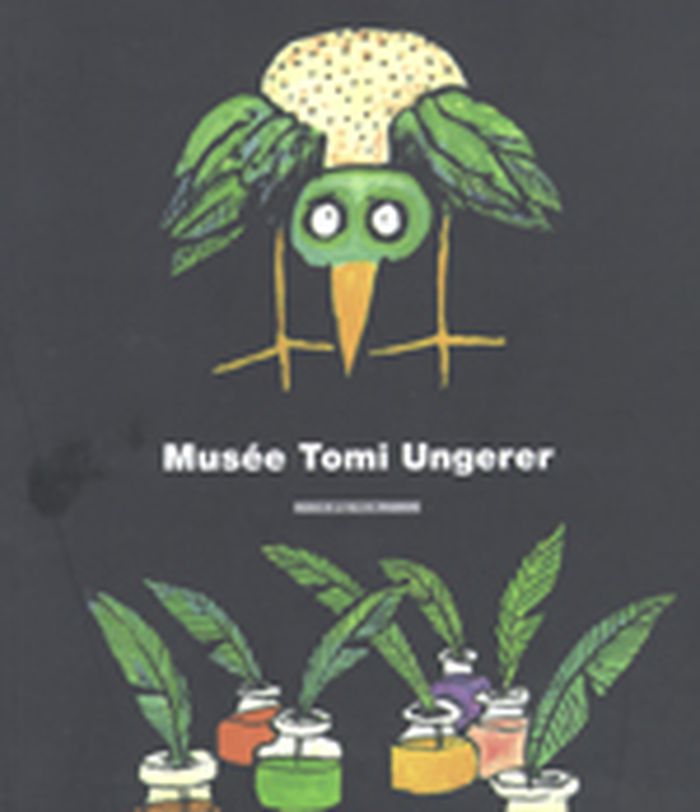
On ne présente plus Tomi Ungerer. Les Trois Brigands, le Géant de Zéralda, Pas de baiser pour maman et tant d'autres histoires à succès l'ont hissé depuis longtemps au panthéon des auteurs pour enfants. Ses satires acérées de la société américaine, qui défraient la chronique dans les années 1970, n'ont guère perdu de leur actualité ; ses dessins publicitaires explosifs ont fait date ; ses œuvres érotiques continuent d'évoquer avec ambivalence et délectation la place de la femme dans nos sociétés. Tomi Ungerer est aussi l'affichiste virulent de la lutte contre le sida, le nucléaire, le racisme. Mais il sait être tendre envers ce qui lui est cher: en témoignent ses illustrations de contes et de chansons populaires qui accompagnent l'imaginaire de plus d'un lecteur. A l'occasion de l'ouverture du Musée Tomi Ungerer, Centre international de l'Illustration, cet ouvrage présente pour la première fois une analyse rétrospective de son œuvre. Parmi les huit mille dessins et sculptures, les mille trois cents livres, les archives, les revues, les photographies dont Tomi Ungerer a fait donation à sa ville natale, ce livre propose quelques chemins de traverse dans la production protéiforme de l'artiste.
Musée Tomi Ungerer
Actions:
Price:
$72.95
(available to order)
Summary:
On ne présente plus Tomi Ungerer. Les Trois Brigands, le Géant de Zéralda, Pas de baiser pour maman et tant d'autres histoires à succès l'ont hissé depuis longtemps au panthéon des auteurs pour enfants. Ses satires acérées de la société américaine, qui défraient la chronique dans les années 1970, n'ont guère perdu de leur actualité ; ses dessins publicitaires explosifs ont fait date ; ses œuvres érotiques continuent d'évoquer avec ambivalence et délectation la place de la femme dans nos sociétés. Tomi Ungerer est aussi l'affichiste virulent de la lutte contre le sida, le nucléaire, le racisme. Mais il sait être tendre envers ce qui lui est cher: en témoignent ses illustrations de contes et de chansons populaires qui accompagnent l'imaginaire de plus d'un lecteur. A l'occasion de l'ouverture du Musée Tomi Ungerer, Centre international de l'Illustration, cet ouvrage présente pour la première fois une analyse rétrospective de son œuvre. Parmi les huit mille dessins et sculptures, les mille trois cents livres, les archives, les revues, les photographies dont Tomi Ungerer a fait donation à sa ville natale, ce livre propose quelques chemins de traverse dans la production protéiforme de l'artiste.
Form:
books
books
Publication:
November 2007, Strasbourg
November 2007, Strasbourg
Subject:
Illustration
Illustration
Form:
books
books
Price:
$104.95
(available to order)
Summary:
Cet ouvrage rétrospectif, jalonné de regards portés par Robert Delpire, Dominique Eddé, Michel Frizot, Anna Fàrovà, Petr Kràl, Otomar Krejca, Pierre Soulages et Gilles Tiberghien, rassemble les différentes étapes de l'œuvre de Koudelka et montre sa constante progression en intensité : dès ses premiers travaux (publiés pour la première fois), ses photographies de théâtre,(...)
$104.95
(available to order)
Summary:
Cet ouvrage rétrospectif, jalonné de regards portés par Robert Delpire, Dominique Eddé, Michel Frizot, Anna Fàrovà, Petr Kràl, Otomar Krejca, Pierre Soulages et Gilles Tiberghien, rassemble les différentes étapes de l'œuvre de Koudelka et montre sa constante progression en intensité : dès ses premiers travaux (publiés pour la première fois), ses photographies de théâtre,(...)
Subject:
Photography monographs
Photography monographs
Publication:
October 2006, Paris
October 2006, Paris
Title:
Koudelka
Actions:
Price:
$104.95
(available to order)
Summary:
Cet ouvrage rétrospectif, jalonné de regards portés par Robert Delpire, Dominique Eddé, Michel Frizot, Anna Fàrovà, Petr Kràl, Otomar Krejca, Pierre Soulages et Gilles Tiberghien, rassemble les différentes étapes de l'œuvre de Koudelka et montre sa constante progression en intensité : dès ses premiers travaux (publiés pour la première fois), ses photographies de théâtre, ses images des gitans, de l'invasion de Prague en 1968, la série Exils, jusqu'à ses panoramiques les plus récents. Biographie de l'auteur Josef Koudelka a quitté Prague en 1970. A cette date, il a déjà photographié l'invasion de la Tchécoslovaquie par les soviétiques et réalisé un travail sur les gitans. Exilé, solitaire, il traverse le monde, rencontre les hommes avec une exceptionnelle proximité à leurs vies, leurs tristesses, leurs douleurs, leurs joies. Il fait preuve d'une rage de voir peu commune. D'une composition toujours d'une grande justesse, ses images, hors du temps, ne donnent aucun repère. Pas d'autre certitude. Seulement l'évidence de l'intensité du regard, chargé d'émotion, que porte Koudelka sur la singularité des lieux, des objets et des hommes, l'œuvre de Josef Koudelka atteste qu'il est un photographe d'une personnalité et d'une puissance rare.
Koudelka
Actions:
Price:
$104.95
(available to order)
Summary:
Cet ouvrage rétrospectif, jalonné de regards portés par Robert Delpire, Dominique Eddé, Michel Frizot, Anna Fàrovà, Petr Kràl, Otomar Krejca, Pierre Soulages et Gilles Tiberghien, rassemble les différentes étapes de l'œuvre de Koudelka et montre sa constante progression en intensité : dès ses premiers travaux (publiés pour la première fois), ses photographies de théâtre, ses images des gitans, de l'invasion de Prague en 1968, la série Exils, jusqu'à ses panoramiques les plus récents. Biographie de l'auteur Josef Koudelka a quitté Prague en 1970. A cette date, il a déjà photographié l'invasion de la Tchécoslovaquie par les soviétiques et réalisé un travail sur les gitans. Exilé, solitaire, il traverse le monde, rencontre les hommes avec une exceptionnelle proximité à leurs vies, leurs tristesses, leurs douleurs, leurs joies. Il fait preuve d'une rage de voir peu commune. D'une composition toujours d'une grande justesse, ses images, hors du temps, ne donnent aucun repère. Pas d'autre certitude. Seulement l'évidence de l'intensité du regard, chargé d'émotion, que porte Koudelka sur la singularité des lieux, des objets et des hommes, l'œuvre de Josef Koudelka atteste qu'il est un photographe d'une personnalité et d'une puissance rare.
Form:
books
books
Publication:
October 2006, Paris
October 2006, Paris
Subject:
Photography monographs
Photography monographs
Form:
books
books

Actions:
Price:
$54.00
(available in store)
Summary:
ves Maes explores his doctoral research in the arts with David Campany, jury member of his PhD committee. Focussing on the intersection of architecture and photography, Maes has designed biodegradable refugee camps, photographed the remains of world’s fairs worldwide, and recaptured his homestead memories in photographic installations. His research postulates that(...)
$54.00
(available in store)
Summary:
ves Maes explores his doctoral research in the arts with David Campany, jury member of his PhD committee. Focussing on the intersection of architecture and photography, Maes has designed biodegradable refugee camps, photographed the remains of world’s fairs worldwide, and recaptured his homestead memories in photographic installations. His research postulates that(...)
Title:
Ives Maes & David Campany in Conversation
Actions:
Price:
$54.00
(available in store)
Summary:
ves Maes explores his doctoral research in the arts with David Campany, jury member of his PhD committee. Focussing on the intersection of architecture and photography, Maes has designed biodegradable refugee camps, photographed the remains of world’s fairs worldwide, and recaptured his homestead memories in photographic installations. His research postulates that architecture is inherently part of the photographic medium, initiated by the camera obscura pavilion. He proposes that world’s fairs came into being precisely because of the invention of a medium that could truthfully propagate them, and describes how this, in turn, affected architectural display strategies for photography. Campany has had a long career in curating and writing about photography exhibitions, with a focus on exhibition history, scale and design, temporality, and the role of both still and moving images within the exhibition context. Together, Maes and Campany discuss their own expanded practices and a multitude of historical examples such as the Crystal Palace at London’s Great Exhibition in 1851, Charlotte Perriand’s Agriculture Pavilion for the International Exposition of Art and Technology in Modern Life in 1937, the Pepsi-Cola Pavilion for the Japan World Exposition in 1970, and Simon Starling’s 2008 Plant Room for Kunstraum Dornbirn.
Ives Maes & David Campany in Conversation
Actions:
Price:
$54.00
(available in store)
Summary:
ves Maes explores his doctoral research in the arts with David Campany, jury member of his PhD committee. Focussing on the intersection of architecture and photography, Maes has designed biodegradable refugee camps, photographed the remains of world’s fairs worldwide, and recaptured his homestead memories in photographic installations. His research postulates that architecture is inherently part of the photographic medium, initiated by the camera obscura pavilion. He proposes that world’s fairs came into being precisely because of the invention of a medium that could truthfully propagate them, and describes how this, in turn, affected architectural display strategies for photography. Campany has had a long career in curating and writing about photography exhibitions, with a focus on exhibition history, scale and design, temporality, and the role of both still and moving images within the exhibition context. Together, Maes and Campany discuss their own expanded practices and a multitude of historical examples such as the Crystal Palace at London’s Great Exhibition in 1851, Charlotte Perriand’s Agriculture Pavilion for the International Exposition of Art and Technology in Modern Life in 1937, the Pepsi-Cola Pavilion for the Japan World Exposition in 1970, and Simon Starling’s 2008 Plant Room for Kunstraum Dornbirn.
Form:
books
books
Publication:
March 2025
March 2025
Subject:
Photography monographs
Photography monographs
Form:
books
books
Title:
Strange design
Strange design
Actions:
Price:
$47.00
(available to order)
Summary:
Depuis quelques années, des objets étranges ont fait leur apparition dans le monde du design, des objets dysfonctionnels, énigmatiques, compliqués, qui mettent en crise les catégories du projet, des objets, de la fonction au profit des processus, des explorations, des déviations. Ces objets relèvent d'une posture que les designers anglais Anthony Dunne et Fiona Raby ont(...)
$47.00
(available to order)
Summary:
Depuis quelques années, des objets étranges ont fait leur apparition dans le monde du design, des objets dysfonctionnels, énigmatiques, compliqués, qui mettent en crise les catégories du projet, des objets, de la fonction au profit des processus, des explorations, des déviations. Ces objets relèvent d'une posture que les designers anglais Anthony Dunne et Fiona Raby ont(...)
Title:
Strange design
Actions:
Price:
$47.00
(available to order)
Summary:
Depuis quelques années, des objets étranges ont fait leur apparition dans le monde du design, des objets dysfonctionnels, énigmatiques, compliqués, qui mettent en crise les catégories du projet, des objets, de la fonction au profit des processus, des explorations, des déviations. Ces objets relèvent d'une posture que les designers anglais Anthony Dunne et Fiona Raby ont défini Critical Design (design critique) : un design spéculatif, réflexif, qui ne veut pas proposer des solutions, mais plutôt poser des questions, qui veut défier les affirmations rapides, les préjugés et lieux communs sur le rôle des produits dans la vie de tous les jours. Un design qui ne se veut pas affirmatif, c'est-à-dire soumis aux impératifs des systèmes de pouvoir, mais au contraire critique. A partir de ces quatre moments saillants que sont le design radical italien de la fin des années 1960 et 1970, le design conceptuel néerlandais des années 1990, le critical design anglais des années 2000 et enfin la scène contemporaine, notamment en France, cet ouvrage montre comment ce strange design n'est pas tant un style qu'une posture critique qui ne cesse d'irriguer le champ du design.
Strange design
Actions:
Price:
$47.00
(available to order)
Summary:
Depuis quelques années, des objets étranges ont fait leur apparition dans le monde du design, des objets dysfonctionnels, énigmatiques, compliqués, qui mettent en crise les catégories du projet, des objets, de la fonction au profit des processus, des explorations, des déviations. Ces objets relèvent d'une posture que les designers anglais Anthony Dunne et Fiona Raby ont défini Critical Design (design critique) : un design spéculatif, réflexif, qui ne veut pas proposer des solutions, mais plutôt poser des questions, qui veut défier les affirmations rapides, les préjugés et lieux communs sur le rôle des produits dans la vie de tous les jours. Un design qui ne se veut pas affirmatif, c'est-à-dire soumis aux impératifs des systèmes de pouvoir, mais au contraire critique. A partir de ces quatre moments saillants que sont le design radical italien de la fin des années 1960 et 1970, le design conceptuel néerlandais des années 1990, le critical design anglais des années 2000 et enfin la scène contemporaine, notamment en France, cet ouvrage montre comment ce strange design n'est pas tant un style qu'une posture critique qui ne cesse d'irriguer le champ du design.
Form:
books
books
Publication:
April 2024
April 2024
Subject:
Design Theory
Design Theory
Form:
books
books
Actions:
Price:
$90.00
(available to order)
Summary:
Chicago is universally recognized as the cradle of modern architecture. It is known worldwide for the development, beginning in the late 1800s, of the renowned "Chicago School" of commercial building. In the early 1900s, Chicago saw the birth of Wright's "Prairie School" of residential design, which gave rise to the modern, open-plan house we know today. Other(...)
$90.00
(available to order)
Summary:
Chicago is universally recognized as the cradle of modern architecture. It is known worldwide for the development, beginning in the late 1800s, of the renowned "Chicago School" of commercial building. In the early 1900s, Chicago saw the birth of Wright's "Prairie School" of residential design, which gave rise to the modern, open-plan house we know today. Other(...)
Subject:
Architecture since 1900, Europe
Architecture since 1900, Europe
Publication:
June 2004, New York
June 2004, New York
Title:
Masterpieces of Chicago architecture
Actions:
Price:
$90.00
(available to order)
Summary:
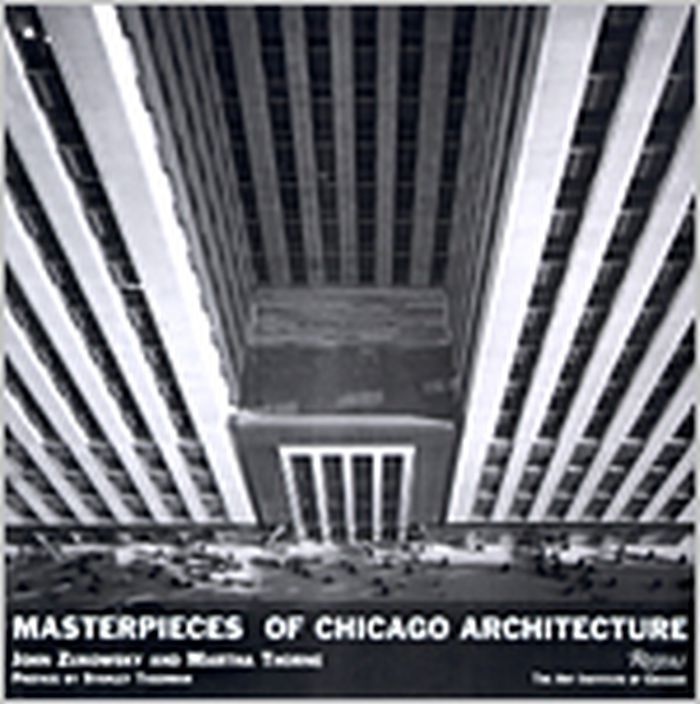
Chicago is universally recognized as the cradle of modern architecture. It is known worldwide for the development, beginning in the late 1800s, of the renowned "Chicago School" of commercial building. In the early 1900s, Chicago saw the birth of Wright's "Prairie School" of residential design, which gave rise to the modern, open-plan house we know today. Other world-renowned architects were also based in Chicago, such as Louis Sullivan, who designed the Chicago Stock Exchange, and Daniel Burnham, architect of the famous Rookery Building of the 1890s. The 1940s were to see the completion of Mies van der Rohe's revolutionary Illinois Institute of Technology and his astonishing Lake Shore Drive apartment buildings. Skidmore Owings & Merrill's landmark Inland Steel Building was finished in 1954, their John Hancock Center in 1970, and their Sears Tower in 1974. Philip Johnson and John Burgee's 190 South LaSalle Street office tower went up in 1987. The 200 illustrations in this volume all come from The Art Institute of Chicago's repository of 150,000 architectural drawings, vintage photographs, models, and building fragments, which comprise one of the most important such archives.
Masterpieces of Chicago architecture
Actions:
Price:
$90.00
(available to order)
Summary:
Chicago is universally recognized as the cradle of modern architecture. It is known worldwide for the development, beginning in the late 1800s, of the renowned "Chicago School" of commercial building. In the early 1900s, Chicago saw the birth of Wright's "Prairie School" of residential design, which gave rise to the modern, open-plan house we know today. Other world-renowned architects were also based in Chicago, such as Louis Sullivan, who designed the Chicago Stock Exchange, and Daniel Burnham, architect of the famous Rookery Building of the 1890s. The 1940s were to see the completion of Mies van der Rohe's revolutionary Illinois Institute of Technology and his astonishing Lake Shore Drive apartment buildings. Skidmore Owings & Merrill's landmark Inland Steel Building was finished in 1954, their John Hancock Center in 1970, and their Sears Tower in 1974. Philip Johnson and John Burgee's 190 South LaSalle Street office tower went up in 1987. The 200 illustrations in this volume all come from The Art Institute of Chicago's repository of 150,000 architectural drawings, vintage photographs, models, and building fragments, which comprise one of the most important such archives.
Form:
books
books
Publication:
June 2004, New York
June 2004, New York
Subject:
Architecture since 1900, Europe
Architecture since 1900, Europe
Form:
books
books
Actions:
Price:
$56.00
(available to order)
Summary:
Robert Smithson (1938–1973), an artist of paramount importance in postwar America, created radical new perspectives for landscape architecture, photography, art criticism, and site-specific installation. His Spiral Jetty - a 1,500-foot-long coil of rock built in 1970 at the edge of the Great Salt Lake - is widely appreciated as one of the most significant art projects of(...)
$56.00
(available to order)
Summary:
Robert Smithson (1938–1973), an artist of paramount importance in postwar America, created radical new perspectives for landscape architecture, photography, art criticism, and site-specific installation. His Spiral Jetty - a 1,500-foot-long coil of rock built in 1970 at the edge of the Great Salt Lake - is widely appreciated as one of the most significant art projects of(...)
Subject:
Contemporary Art Monographs
Contemporary Art Monographs
Publication:
April 2004, New Haven / London
April 2004, New Haven / London
Title:
Mirror-Travels : Robert Smithson and history
Actions:
Price:
$56.00
(available to order)
Summary:
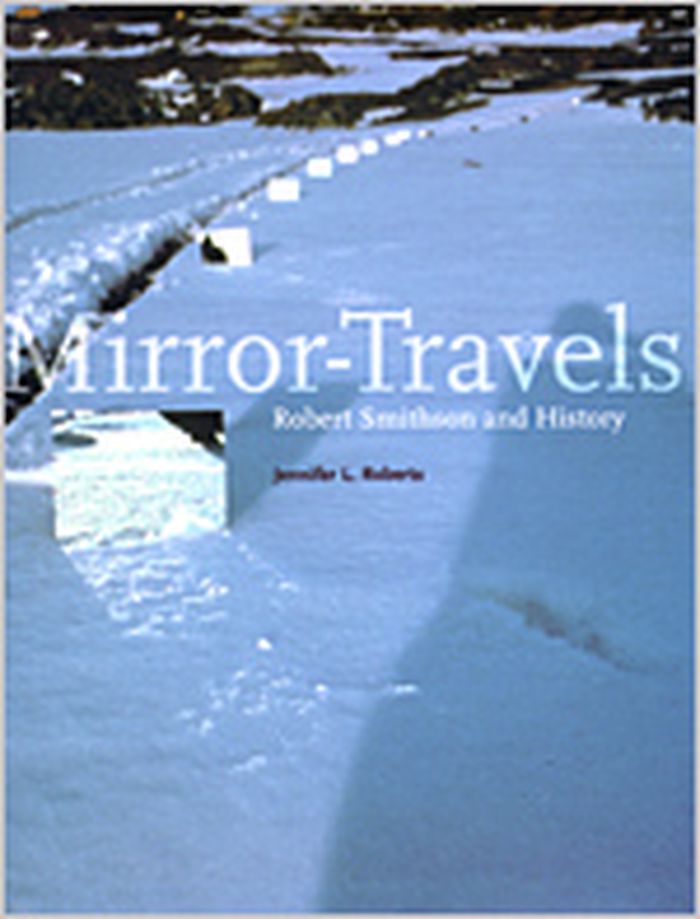
Robert Smithson (1938–1973), an artist of paramount importance in postwar America, created radical new perspectives for landscape architecture, photography, art criticism, and site-specific installation. His Spiral Jetty - a 1,500-foot-long coil of rock built in 1970 at the edge of the Great Salt Lake - is widely appreciated as one of the most significant art projects of the twentieth century. Less well known is the connection between the Jetty and the nearby Golden Spike National Historic Site, location of the completion of the first U.S. transcontinental railroad. The link between these two monuments is but one facet of an entire complex of historical reference and reflection that structures Smithson’s work. Mirror-Travels encompasses the full span of Smithson’s career, offering a close analysis of the artist’s working model of history and featuring comprehensive case studies of three of his most influential works: The Monuments of Passaic, Incidents of Mirror-Travel in the Yucatan, and the Spiral Jetty. Incorporating abundant new material from Smithson’s personal papers and library, Jennifer Roberts offers surprising new interpretations about the artist and his responses to the social, ideological, and material contradictions of his time.
Mirror-Travels : Robert Smithson and history
Actions:
Price:
$56.00
(available to order)
Summary:
Robert Smithson (1938–1973), an artist of paramount importance in postwar America, created radical new perspectives for landscape architecture, photography, art criticism, and site-specific installation. His Spiral Jetty - a 1,500-foot-long coil of rock built in 1970 at the edge of the Great Salt Lake - is widely appreciated as one of the most significant art projects of the twentieth century. Less well known is the connection between the Jetty and the nearby Golden Spike National Historic Site, location of the completion of the first U.S. transcontinental railroad. The link between these two monuments is but one facet of an entire complex of historical reference and reflection that structures Smithson’s work. Mirror-Travels encompasses the full span of Smithson’s career, offering a close analysis of the artist’s working model of history and featuring comprehensive case studies of three of his most influential works: The Monuments of Passaic, Incidents of Mirror-Travel in the Yucatan, and the Spiral Jetty. Incorporating abundant new material from Smithson’s personal papers and library, Jennifer Roberts offers surprising new interpretations about the artist and his responses to the social, ideological, and material contradictions of his time.
Form:
books
books
Publication:
April 2004, New Haven / London
April 2004, New Haven / London
Subject:
Contemporary Art Monographs
Contemporary Art Monographs
Form:
books
books
Actions:
Price:
$55.50
(available to order)
Summary:
In his own lifetime, William Blake (1757–1827) was a relatively unknown nonconventional artist with a strong political bent. William Blake and the Age of Aquarius is a beautifully illustrated look at how, some two hundred years after his birth, the antiestablishment values embodied in Blake’s art and poetry became a model for artists of the American counterculture. This(...)
$55.50
(available to order)
Summary:
In his own lifetime, William Blake (1757–1827) was a relatively unknown nonconventional artist with a strong political bent. William Blake and the Age of Aquarius is a beautifully illustrated look at how, some two hundred years after his birth, the antiestablishment values embodied in Blake’s art and poetry became a model for artists of the American counterculture. This(...)
Title:
William Blake and the age of Aquarius
Actions:
Price:
$55.50
(available to order)
Summary:
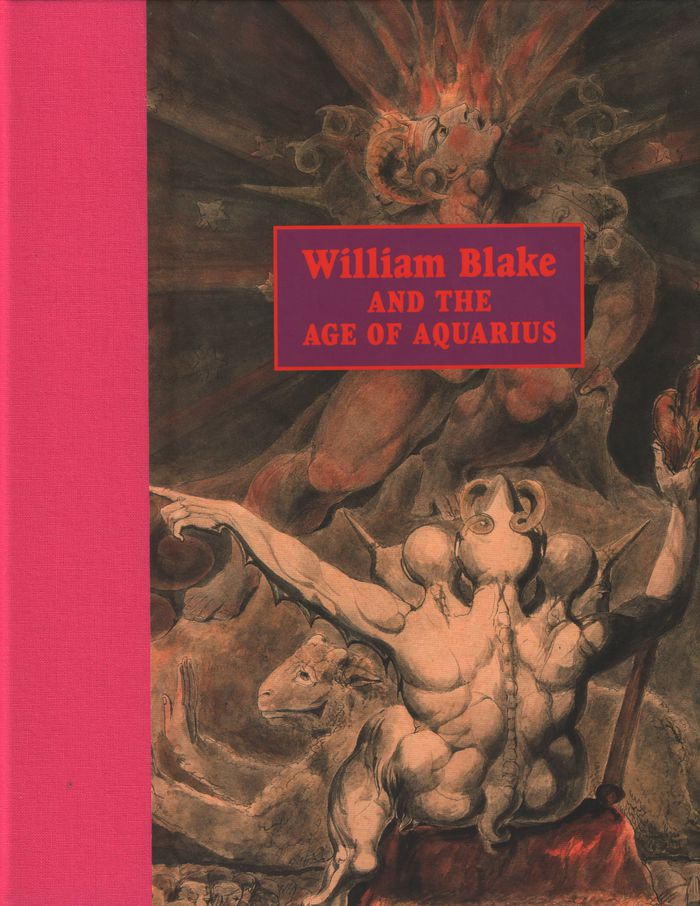
In his own lifetime, William Blake (1757–1827) was a relatively unknown nonconventional artist with a strong political bent. William Blake and the Age of Aquarius is a beautifully illustrated look at how, some two hundred years after his birth, the antiestablishment values embodied in Blake’s art and poetry became a model for artists of the American counterculture. This book provides new insights into the politics and protests of Blake’s own lifetime, and the generation of artists who revived and reimagined his work in the mid-1940s through 1970, or what might be called the “long sixties.” Contributors explore Blake’s outsider status in Georgian England and how his individualistic vision spoke to members of the Beat Generation, hippies, radical poets and writers, and other voices of the counterculture. Among the artists, musicians, and writers who looked to Blake were such diverse figures as Diane Arbus, Jay DeFeo, the Doors, Sam Francis, Allen Ginsberg, Jess, Agnes Martin, Ad Reinhardt, Charles Seliger, Maurice Sendak, Robert Smithson, Clyfford Still, and many others. This book also explores visual cultures around such galvanizing moments of the 1960s as Woodstock and the Summer of Love.
William Blake and the age of Aquarius
Actions:
Price:
$55.50
(available to order)
Summary:
In his own lifetime, William Blake (1757–1827) was a relatively unknown nonconventional artist with a strong political bent. William Blake and the Age of Aquarius is a beautifully illustrated look at how, some two hundred years after his birth, the antiestablishment values embodied in Blake’s art and poetry became a model for artists of the American counterculture. This book provides new insights into the politics and protests of Blake’s own lifetime, and the generation of artists who revived and reimagined his work in the mid-1940s through 1970, or what might be called the “long sixties.” Contributors explore Blake’s outsider status in Georgian England and how his individualistic vision spoke to members of the Beat Generation, hippies, radical poets and writers, and other voices of the counterculture. Among the artists, musicians, and writers who looked to Blake were such diverse figures as Diane Arbus, Jay DeFeo, the Doors, Sam Francis, Allen Ginsberg, Jess, Agnes Martin, Ad Reinhardt, Charles Seliger, Maurice Sendak, Robert Smithson, Clyfford Still, and many others. This book also explores visual cultures around such galvanizing moments of the 1960s as Woodstock and the Summer of Love.
Form:
books
books
Publication:
January 2018
January 2018
Subject:
Illustration
Illustration
Form:
books
books
Price:
$20.95
(available in store)
Summary:
" Pour mortels et dangereux qu'ils soient, les bidonvilles ont devant eux un avenir resplendissant. " Des taudis de Lima aux collines d'ordures de Manille, des bidonvilles marécageux de Lagos à la Vieille Ville de Pékin, on assiste à l'extension exponentielle des mégalopoles du tiers monde, produits d'un exode rural mal maîtrisé. Le big bang de la pauvreté des années 1970(...)
$20.95
(available in store)
Summary:
" Pour mortels et dangereux qu'ils soient, les bidonvilles ont devant eux un avenir resplendissant. " Des taudis de Lima aux collines d'ordures de Manille, des bidonvilles marécageux de Lagos à la Vieille Ville de Pékin, on assiste à l'extension exponentielle des mégalopoles du tiers monde, produits d'un exode rural mal maîtrisé. Le big bang de la pauvreté des années 1970(...)
Title:
Le pire des mondes possibles: de l'explosion urbaine au bidonville global
Actions:
Price:
$20.95
(available in store)
Summary:
" Pour mortels et dangereux qu'ils soient, les bidonvilles ont devant eux un avenir resplendissant. " Des taudis de Lima aux collines d'ordures de Manille, des bidonvilles marécageux de Lagos à la Vieille Ville de Pékin, on assiste à l'extension exponentielle des mégalopoles du tiers monde, produits d'un exode rural mal maîtrisé. Le big bang de la pauvreté des années 1970 et 1980 - dopé par les thérapies de choc imposées par le FMI et la Banque mondiale - a ainsi transformé les bidonvilles traditionnels en " mégabidonvilles " tentaculaires, où domine le travail informel, " musée vivant de l'exploitation humaine Un milliard de personnes survivent dans les bidonvilles du monde, lieux de reproduction de la misère, à laquelle les gouvernements n'apportent aucune réponse adaptée. Désormais, les habitants mettent en péril leur vie clans des zones dangereuses, instables ou polluées. Bien loin des villes de lumière imaginées par les urbanistes, le monde urbain du XXIe siècle ressemblera de plus en plus à celui du XIXe, avec ses quartiers sordides dépeints par Dickens, Zola ou Gorki. Le Pire des mondes possibles explore cette réalité urbaine méconnue et explosive, laissant entrevoir, à l'échelle planétaire, un avenir cauchemardesque.
Le pire des mondes possibles: de l'explosion urbaine au bidonville global
Actions:
Price:
$20.95
(available in store)
Summary:
" Pour mortels et dangereux qu'ils soient, les bidonvilles ont devant eux un avenir resplendissant. " Des taudis de Lima aux collines d'ordures de Manille, des bidonvilles marécageux de Lagos à la Vieille Ville de Pékin, on assiste à l'extension exponentielle des mégalopoles du tiers monde, produits d'un exode rural mal maîtrisé. Le big bang de la pauvreté des années 1970 et 1980 - dopé par les thérapies de choc imposées par le FMI et la Banque mondiale - a ainsi transformé les bidonvilles traditionnels en " mégabidonvilles " tentaculaires, où domine le travail informel, " musée vivant de l'exploitation humaine Un milliard de personnes survivent dans les bidonvilles du monde, lieux de reproduction de la misère, à laquelle les gouvernements n'apportent aucune réponse adaptée. Désormais, les habitants mettent en péril leur vie clans des zones dangereuses, instables ou polluées. Bien loin des villes de lumière imaginées par les urbanistes, le monde urbain du XXIe siècle ressemblera de plus en plus à celui du XIXe, avec ses quartiers sordides dépeints par Dickens, Zola ou Gorki. Le Pire des mondes possibles explore cette réalité urbaine méconnue et explosive, laissant entrevoir, à l'échelle planétaire, un avenir cauchemardesque.
Form:
books
books
Publication:
October 2006
October 2006
Subject:
Urban Theory
Urban Theory
Form:
books
books

Actions:
Price:
$25.00
(available in store)
Summary:
Image Bank began compiling artist’s addresses and image requests to prompt correspondence artworks using the postal system in 1970. These requests first appeared in print in General Idea’s & AA Bronson’s FILE Megazine issues 1, 2 and 3, and they were published in their own volume in 1972 by Talonbooks. Nearly fifty years after its initial release, this revised facsimile(...)
$25.00
(available in store)
Summary:
Image Bank began compiling artist’s addresses and image requests to prompt correspondence artworks using the postal system in 1970. These requests first appeared in print in General Idea’s & AA Bronson’s FILE Megazine issues 1, 2 and 3, and they were published in their own volume in 1972 by Talonbooks. Nearly fifty years after its initial release, this revised facsimile(...)
Title:
International image exchange directory
Actions:
Price:
$25.00
(available in store)
Summary:
Image Bank began compiling artist’s addresses and image requests to prompt correspondence artworks using the postal system in 1970. These requests first appeared in print in General Idea’s & AA Bronson’s FILE Megazine issues 1, 2 and 3, and they were published in their own volume in 1972 by Talonbooks. Nearly fifty years after its initial release, this revised facsimile edition includes the original list of image requests from over 200 artists alongside examples of mail art from many compelling contributors as well as new archival images from Western Front and Michael Morris. ''Internation image exchange directory'' comprises an alphabetically ordered list of over 200 artist’s addresses and image requests. Looking at the publication now, the book itself could be seen perhaps as a white pages telephone book for mail art. In between the directory listings, pages of compelling visual imagery from selected contributors adds additional context as to what mail art looked like in its very beginning. The book's directory includes submissions from artists such as Anna Banana, Joseph Beuys, William Burroughs, Robert Cumming, Robert Filliou, General Idea, Gilbert and George, Ray Johnson, Sol Lewitt, Lucy Lippard, Ed Ruscha, Robert Rauschenberg and many more.
International image exchange directory
Actions:
Price:
$25.00
(available in store)
Summary:
Image Bank began compiling artist’s addresses and image requests to prompt correspondence artworks using the postal system in 1970. These requests first appeared in print in General Idea’s & AA Bronson’s FILE Megazine issues 1, 2 and 3, and they were published in their own volume in 1972 by Talonbooks. Nearly fifty years after its initial release, this revised facsimile edition includes the original list of image requests from over 200 artists alongside examples of mail art from many compelling contributors as well as new archival images from Western Front and Michael Morris. ''Internation image exchange directory'' comprises an alphabetically ordered list of over 200 artist’s addresses and image requests. Looking at the publication now, the book itself could be seen perhaps as a white pages telephone book for mail art. In between the directory listings, pages of compelling visual imagery from selected contributors adds additional context as to what mail art looked like in its very beginning. The book's directory includes submissions from artists such as Anna Banana, Joseph Beuys, William Burroughs, Robert Cumming, Robert Filliou, General Idea, Gilbert and George, Ray Johnson, Sol Lewitt, Lucy Lippard, Ed Ruscha, Robert Rauschenberg and many more.
Form:
books
books
Publication:
October 2021
October 2021
Form:
books
books
Title:
Le discours des autres
Le discours des autres
Actions:
Price:
$19.95
(available in store)
Summary:
Craig Owens (1950-1990) a bouleversé la théorie de l’art en une décennie d’intense travail. À la fin des années 1970, aux États-Unis, il s’engage dans l’aventure intellectuelle postmoderne, en quête d’alternatives à un discours moderniste cramponné aux problèmes formels. Owens se penche sur des pratiques artistiques conçues à la croisée des médiums, comme celles de(...)
$19.95
(available in store)
Summary:
Craig Owens (1950-1990) a bouleversé la théorie de l’art en une décennie d’intense travail. À la fin des années 1970, aux États-Unis, il s’engage dans l’aventure intellectuelle postmoderne, en quête d’alternatives à un discours moderniste cramponné aux problèmes formels. Owens se penche sur des pratiques artistiques conçues à la croisée des médiums, comme celles de(...)
Title:
Le discours des autres
Actions:
Price:
$19.95
(available in store)
Summary:
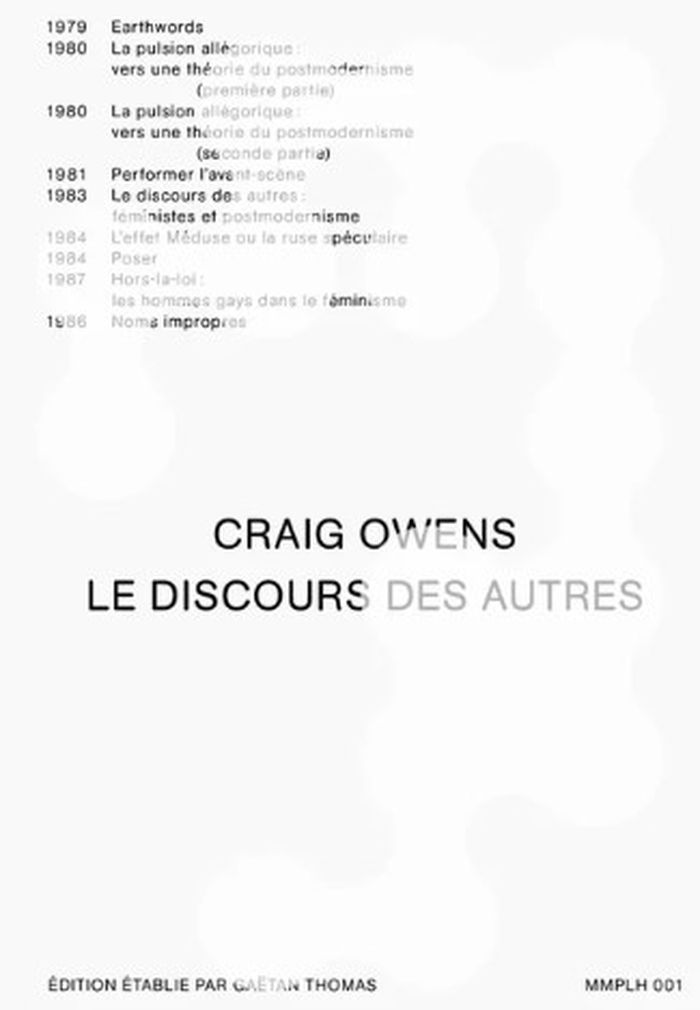
Craig Owens (1950-1990) a bouleversé la théorie de l’art en une décennie d’intense travail. À la fin des années 1970, aux États-Unis, il s’engage dans l’aventure intellectuelle postmoderne, en quête d’alternatives à un discours moderniste cramponné aux problèmes formels. Owens se penche sur des pratiques artistiques conçues à la croisée des médiums, comme celles de Robert Smithson ou de Trisha Brown. Lecteur des philosophes poststructuralistes, il soutient que les oeuvres se composent de signes ouverts à l’interprétation. Owens place ainsi les spectateur·ices au premier plan, tout en apportant une inscription théorique inédite aux performances de Laurie Anderson et aux oeuvres postconceptuelles de Barbara Kruger, Cindy Sherman, Sherrie Levine ou Martha Rosler. Attentif au genre des artistes et inspiré par des réflexions sur le pouvoir du regard masculin, Owens écrit ensuite sur le féminisme et la domination. Ses essais prennent une tonalité sociale et politique. Ils touchent aussi à des questions ouvertes par les études postcoloniales. Autant de recherches interrompues par le sida, dont Owens meurt en 1990. Ce recueil, établi, introduit et traduit par Gaëtan Thomas, permet de suivre les expérimentations d’une oeuvre portée par une réflexivité exceptionnelle.
Le discours des autres
Actions:
Price:
$19.95
(available in store)
Summary:
Craig Owens (1950-1990) a bouleversé la théorie de l’art en une décennie d’intense travail. À la fin des années 1970, aux États-Unis, il s’engage dans l’aventure intellectuelle postmoderne, en quête d’alternatives à un discours moderniste cramponné aux problèmes formels. Owens se penche sur des pratiques artistiques conçues à la croisée des médiums, comme celles de Robert Smithson ou de Trisha Brown. Lecteur des philosophes poststructuralistes, il soutient que les oeuvres se composent de signes ouverts à l’interprétation. Owens place ainsi les spectateur·ices au premier plan, tout en apportant une inscription théorique inédite aux performances de Laurie Anderson et aux oeuvres postconceptuelles de Barbara Kruger, Cindy Sherman, Sherrie Levine ou Martha Rosler. Attentif au genre des artistes et inspiré par des réflexions sur le pouvoir du regard masculin, Owens écrit ensuite sur le féminisme et la domination. Ses essais prennent une tonalité sociale et politique. Ils touchent aussi à des questions ouvertes par les études postcoloniales. Autant de recherches interrompues par le sida, dont Owens meurt en 1990. Ce recueil, établi, introduit et traduit par Gaëtan Thomas, permet de suivre les expérimentations d’une oeuvre portée par une réflexivité exceptionnelle.
Form:
books
books
Publication:
July 2022
July 2022
Subject:
Art Theory
Art Theory


