


89 Results
Form:
journals and magazines
journals and magazines
Price:
$19.50
(available in store)
Summary:
Log 41 both observes the state of architecture today and devotes 114 pages to a special section called Working Queer, guest-edited by architect Jaffer Kolb. From Hans Tursack’s commentary on “shape architecture” to Michael Young’s valuation of parafiction as a critique of realism; from Lisa Hsieh’s examination of modernology in Japan to Cynthia Davidson’s conversation(...)
$19.50
(available in store)
Summary:
Log 41 both observes the state of architecture today and devotes 114 pages to a special section called Working Queer, guest-edited by architect Jaffer Kolb. From Hans Tursack’s commentary on “shape architecture” to Michael Young’s valuation of parafiction as a critique of realism; from Lisa Hsieh’s examination of modernology in Japan to Cynthia Davidson’s conversation(...)
Title:
Log 41
Actions:
Price:
$19.50
(available in store)
Summary:
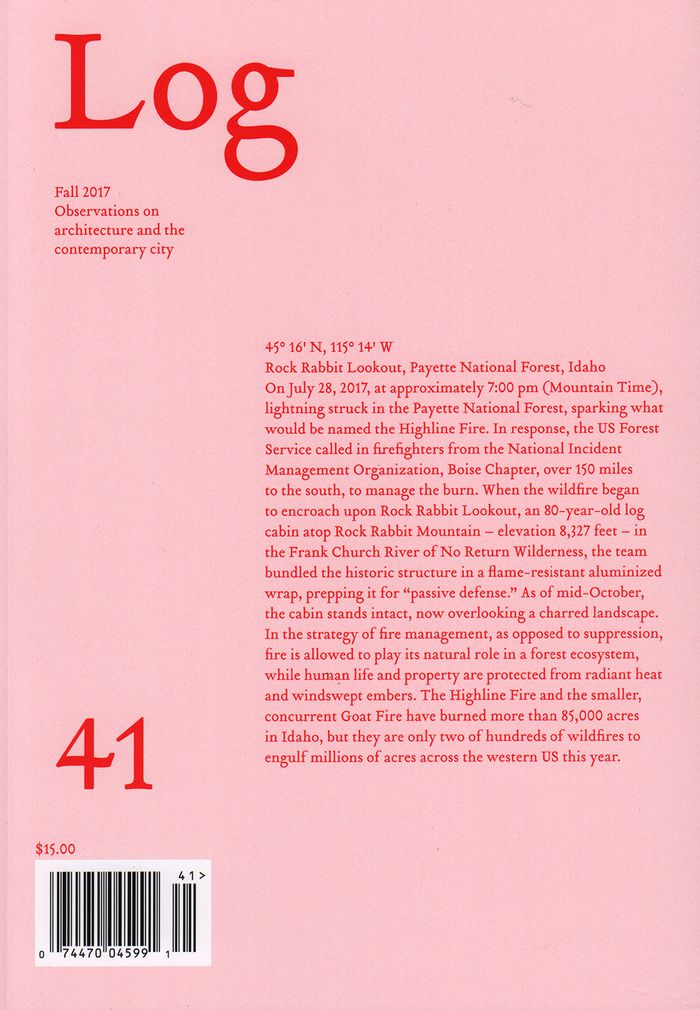
Log 41 both observes the state of architecture today and devotes 114 pages to a special section called Working Queer, guest-edited by architect Jaffer Kolb. From Hans Tursack’s commentary on “shape architecture” to Michael Young’s valuation of parafiction as a critique of realism; from Lisa Hsieh’s examination of modernology in Japan to Cynthia Davidson’s conversation with Martino Stierli, Log 41 considers both history and the contemporary. In Working Queer, nineteen authors take a similar look at history and the contemporary in articles ranging from homo-fascism in early 20th-century aesthetics to trans gender bathroom typologies for today, as well as methods of work, materials, and mediation that can all be considered queer, or queering, in our pluralist, mediated world.
Log 41
Actions:
Price:
$19.50
(available in store)
Summary:
Log 41 both observes the state of architecture today and devotes 114 pages to a special section called Working Queer, guest-edited by architect Jaffer Kolb. From Hans Tursack’s commentary on “shape architecture” to Michael Young’s valuation of parafiction as a critique of realism; from Lisa Hsieh’s examination of modernology in Japan to Cynthia Davidson’s conversation with Martino Stierli, Log 41 considers both history and the contemporary. In Working Queer, nineteen authors take a similar look at history and the contemporary in articles ranging from homo-fascism in early 20th-century aesthetics to trans gender bathroom typologies for today, as well as methods of work, materials, and mediation that can all be considered queer, or queering, in our pluralist, mediated world.
Form:
journals and magazines
journals and magazines
Publication:
December 2017
December 2017
Subject:
Magazines
Magazines
Form:
books
books
Actions:
Price:
$27.95
(available in store)
Summary:
As London emerged from the devastation of the Second World War, planners and policymakers sought to rebuild the city in ways that would reshape the behavior of its citizens as much as it would its buildings and infrastructure—a program defined by a strong emphasis on civic order and conservative values of national community. One of the groups most significantly affected(...)
$27.95
(available in store)
Summary:
As London emerged from the devastation of the Second World War, planners and policymakers sought to rebuild the city in ways that would reshape the behavior of its citizens as much as it would its buildings and infrastructure—a program defined by a strong emphasis on civic order and conservative values of national community. One of the groups most significantly affected(...)
Title:
The spiv and the architect: unruly life in postwar London
Actions:
Price:
$27.95
(available in store)
Summary:
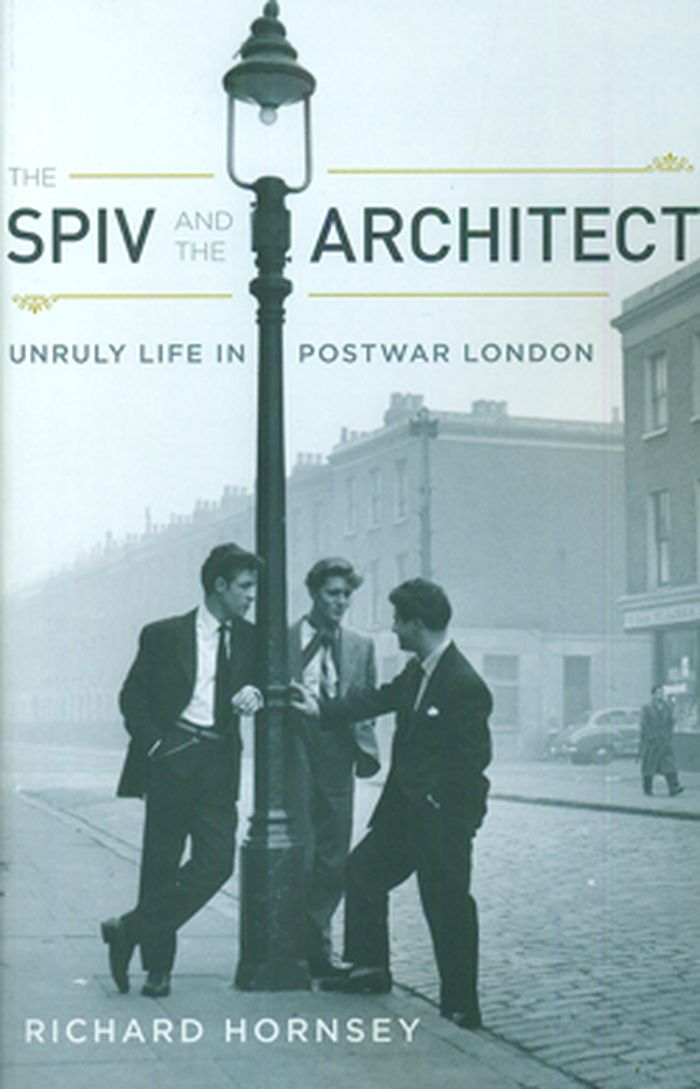
As London emerged from the devastation of the Second World War, planners and policymakers sought to rebuild the city in ways that would reshape the behavior of its citizens as much as it would its buildings and infrastructure—a program defined by a strong emphasis on civic order and conservative values of national community. One of the groups most significantly affected by this new, moralistic climate of reformation and renewal was queer men, whom the police, the media, and lawmakers targeted as an urgent urban problem by marking their lives and desires as criminal and deviant. Richard Hornsey examines how queer men legitimized, resisted, and reinvented this ambitious reconstruction program, which extended from the design of basic public spaces and municipal libraries to private living rooms and home decor. From their association with the urban stereotype of the spiv (slang for a young petty criminal who lived by his wits and shirked legitimate work) and vilification in the tabloids as perverts to the assimilated homosexuals within reformist psychology, Hornsey details how these efforts to transform London fundamentally restructured the experiences and identities of gay men in the city and throughout the country.
The spiv and the architect: unruly life in postwar London
Actions:
Price:
$27.95
(available in store)
Summary:
As London emerged from the devastation of the Second World War, planners and policymakers sought to rebuild the city in ways that would reshape the behavior of its citizens as much as it would its buildings and infrastructure—a program defined by a strong emphasis on civic order and conservative values of national community. One of the groups most significantly affected by this new, moralistic climate of reformation and renewal was queer men, whom the police, the media, and lawmakers targeted as an urgent urban problem by marking their lives and desires as criminal and deviant. Richard Hornsey examines how queer men legitimized, resisted, and reinvented this ambitious reconstruction program, which extended from the design of basic public spaces and municipal libraries to private living rooms and home decor. From their association with the urban stereotype of the spiv (slang for a young petty criminal who lived by his wits and shirked legitimate work) and vilification in the tabloids as perverts to the assimilated homosexuals within reformist psychology, Hornsey details how these efforts to transform London fundamentally restructured the experiences and identities of gay men in the city and throughout the country.
Form:
books
books
Publication:
April 2010
April 2010
Subject:
Gender Theory in Architecture
Gender Theory in Architecture
Form:
books
books

Actions:
Price:
$59.95
(available in store)
Summary:
Lurking under the surface of our modern world lies an unseen architecture—or anarchitecture. It is a possible architecture, an analogous architecture, an architecture of anarchy, which haunts in the form of monsters that are humans and machines and cities all at once; or takes the form of explosions, veils, queer, playful spaces, or visions from artwork and video games.(...)
$59.95
(available in store)
Summary:
Lurking under the surface of our modern world lies an unseen architecture—or anarchitecture. It is a possible architecture, an analogous architecture, an architecture of anarchy, which haunts in the form of monsters that are humans and machines and cities all at once; or takes the form of explosions, veils, queer, playful spaces, or visions from artwork and video games.(...)
Title:
The monster Leviathan: Anarchitecture
Actions:
Price:
$59.95
(available in store)
Summary:
Lurking under the surface of our modern world lies an unseen architecture—or anarchitecture. It is a possible architecture, an analogous architecture, an architecture of anarchy, which haunts in the form of monsters that are humans and machines and cities all at once; or takes the form of explosions, veils, queer, playful spaces, or visions from artwork and video games. In The Monster Leviathan, Aaron Betsky traces anarchitecture through texts, design, and art of the twentieth and early twenty-first century, and suggests that these ephemeral evocations are concrete proposals in and of themselves. Neither working models nor suggestions for new forms, they are scenes just believable enough to convince us they exist, or just fantastical enough to open our eyes.
The monster Leviathan: Anarchitecture
Actions:
Price:
$59.95
(available in store)
Summary:
Lurking under the surface of our modern world lies an unseen architecture—or anarchitecture. It is a possible architecture, an analogous architecture, an architecture of anarchy, which haunts in the form of monsters that are humans and machines and cities all at once; or takes the form of explosions, veils, queer, playful spaces, or visions from artwork and video games. In The Monster Leviathan, Aaron Betsky traces anarchitecture through texts, design, and art of the twentieth and early twenty-first century, and suggests that these ephemeral evocations are concrete proposals in and of themselves. Neither working models nor suggestions for new forms, they are scenes just believable enough to convince us they exist, or just fantastical enough to open our eyes.
Form:
books
books
Publication:
December 2023
December 2023
Subject:
Architectural Theory
Architectural Theory
Form:
books
books
Price:
$40.95
(available to order)
Summary:
Exploring the fields of architecture, philosophy, and queer theory, Grosz shows how feminism and cultural analysis have conceptually stripped bodies of their specificity, their corporeality, and the vestigal traces of their production as bodies. She investigates the work of Michel Foucault, Teresa de Lauretis, Gilles Deleuze, Judith Butler and Alphonso Lingi, considering(...)
$40.95
(available to order)
Summary:
Exploring the fields of architecture, philosophy, and queer theory, Grosz shows how feminism and cultural analysis have conceptually stripped bodies of their specificity, their corporeality, and the vestigal traces of their production as bodies. She investigates the work of Michel Foucault, Teresa de Lauretis, Gilles Deleuze, Judith Butler and Alphonso Lingi, considering(...)
Title:
Space, time, and perversion : essays on the politics of bodies
Actions:
Price:
$40.95
(available to order)
Summary:
Exploring the fields of architecture, philosophy, and queer theory, Grosz shows how feminism and cultural analysis have conceptually stripped bodies of their specificity, their corporeality, and the vestigal traces of their production as bodies. She investigates the work of Michel Foucault, Teresa de Lauretis, Gilles Deleuze, Judith Butler and Alphonso Lingi, considering their work by examining the ways in which the functioning of bodies transforms understandings of space and time, knowledge and desire. Grosz moves toward a radical consideration of bodies and their relationship to transgression and perversity.
Space, time, and perversion : essays on the politics of bodies
Actions:
Price:
$40.95
(available to order)
Summary:
Exploring the fields of architecture, philosophy, and queer theory, Grosz shows how feminism and cultural analysis have conceptually stripped bodies of their specificity, their corporeality, and the vestigal traces of their production as bodies. She investigates the work of Michel Foucault, Teresa de Lauretis, Gilles Deleuze, Judith Butler and Alphonso Lingi, considering their work by examining the ways in which the functioning of bodies transforms understandings of space and time, knowledge and desire. Grosz moves toward a radical consideration of bodies and their relationship to transgression and perversity.
Form:
books
books
Publication:
September 1995, New York
September 1995, New York
Subject:
Architectural Theory
Architectural Theory
Form:
archives
archives
Actions:
Holdings:
Description:
approximately 10 items : illustrations (some color), maps, plans
Description:
approximately 10 items : illustrations (some color), maps, plans
Author:
Subject:
Title:
Poole Harbour Crossing Bridge Design Competition : competition documents, 1995-1996.
Actions:
Holdings:
Description:
approximately 10 items : illustrations (some color), maps, plans
Poole Harbour Crossing Bridge Design Competition : competition documents, 1995-1996.
Actions:
Holdings:
Description:
approximately 10 items : illustrations (some color), maps, plans
Form:
archives
archives
Author:
Subject:
Form:
books
books
Title:
Haunted Bauhaus
Haunted Bauhaus
Actions:
Price:
$45.95
(available to order)
Summary:
The Bauhaus (1919–1933) is widely regarded as the twentieth century's most influential art, architecture, and design school, celebrated as the archetypal movement of rational modernism and famous for bringing functional and elegant design to the masses. In ''Haunted Bauhaus,'' art historian Elizabeth Otto liberates Bauhaus history, uncovering a movement that is vastly(...)
$45.95
(available to order)
Summary:
The Bauhaus (1919–1933) is widely regarded as the twentieth century's most influential art, architecture, and design school, celebrated as the archetypal movement of rational modernism and famous for bringing functional and elegant design to the masses. In ''Haunted Bauhaus,'' art historian Elizabeth Otto liberates Bauhaus history, uncovering a movement that is vastly(...)
Title:
Haunted Bauhaus
Actions:
Price:
$45.95
(available to order)
Summary:
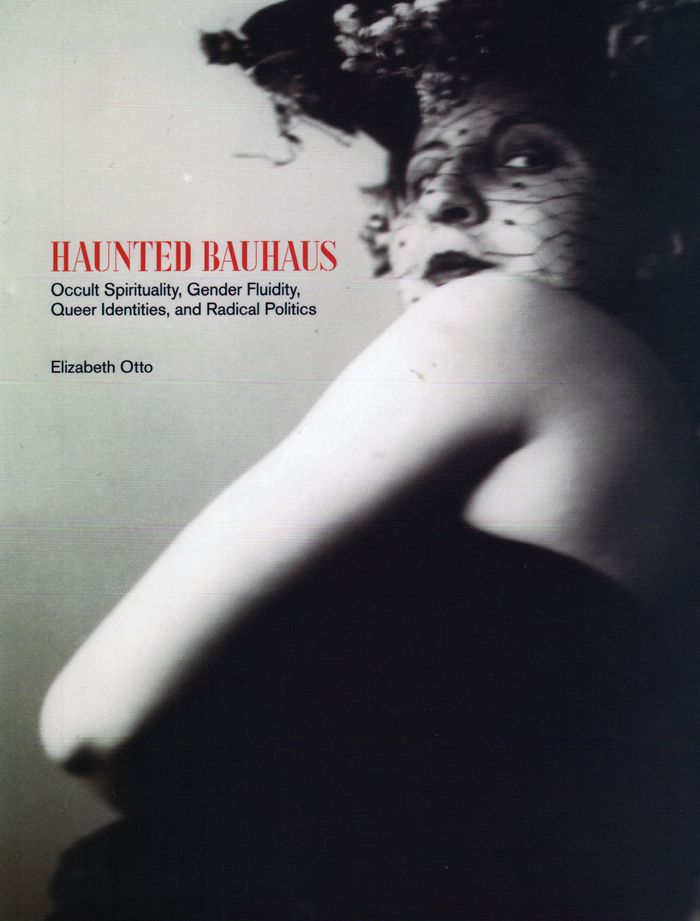
The Bauhaus (1919–1933) is widely regarded as the twentieth century's most influential art, architecture, and design school, celebrated as the archetypal movement of rational modernism and famous for bringing functional and elegant design to the masses. In ''Haunted Bauhaus,'' art historian Elizabeth Otto liberates Bauhaus history, uncovering a movement that is vastly more diverse and paradoxical than previously assumed. Otto traces the surprising trajectories of the school's engagement with occult spirituality, gender fluidity, queer identities, and radical politics. The Bauhaus, she shows us, is haunted by these untold stories.
Haunted Bauhaus
Actions:
Price:
$45.95
(available to order)
Summary:
The Bauhaus (1919–1933) is widely regarded as the twentieth century's most influential art, architecture, and design school, celebrated as the archetypal movement of rational modernism and famous for bringing functional and elegant design to the masses. In ''Haunted Bauhaus,'' art historian Elizabeth Otto liberates Bauhaus history, uncovering a movement that is vastly more diverse and paradoxical than previously assumed. Otto traces the surprising trajectories of the school's engagement with occult spirituality, gender fluidity, queer identities, and radical politics. The Bauhaus, she shows us, is haunted by these untold stories.
Form:
books
books
Publication:
September 2019
September 2019
Subject:
Modernism
Modernism
Form:
books
books

Price:
$66.00
(available to order)
Summary:
''Lost Days, Endless Nights'' tells a history from below—an account of the lives of the forgotten and dispossessed of Los Angeles: the unemployed, the precariously employed, the evicted, the alienated, the unhoused, the anxious, the exhausted. Through an analysis of abandoned archival works, experimental films, and other projects, Andrew Witt offers an expansive account(...)
$66.00
(available to order)
Summary:
''Lost Days, Endless Nights'' tells a history from below—an account of the lives of the forgotten and dispossessed of Los Angeles: the unemployed, the precariously employed, the evicted, the alienated, the unhoused, the anxious, the exhausted. Through an analysis of abandoned archival works, experimental films, and other projects, Andrew Witt offers an expansive account(...)
Title:
Lost days, endless nights: Photography and film from Los Angeles
Actions:
Price:
$66.00
(available to order)
Summary:
''Lost Days, Endless Nights'' tells a history from below—an account of the lives of the forgotten and dispossessed of Los Angeles: the unemployed, the precariously employed, the evicted, the alienated, the unhoused, the anxious, the exhausted. Through an analysis of abandoned archival works, experimental films, and other projects, Andrew Witt offers an expansive account of the artists who have lived or worked in Los Angeles, delving into the region's history and geography, highlighting its racial, gender, and class conflicts. Presented as a series of nine case studies, Witt explores how artists as diverse as Agnès Varda, Dana Lixenberg, Allan Sekula, Catherine Opie, John Divola, Gregory Halpern, Paul Sepuya, and Guadalupe Rosales have reimagined and reshaped our understanding of contemporary Los Angeles. The book features portraits of those who struggle and attempt to get by in the city: dock workers, students, bus riders, petty criminals, office workers, immigrants, queer and trans activists. Set against the landscape of economic turmoil and environmental crises that shadowed the 1970s, Witt highlights the urgent need for a historical perspective of cultural retrieval and counternarrative. Extending into the present, ''Lost Days, Endless Nights'' advocates for an approach that actively embraces the works and projects that have been overlooked and evicted from the historical imaginary
Lost days, endless nights: Photography and film from Los Angeles
Actions:
Price:
$66.00
(available to order)
Summary:
''Lost Days, Endless Nights'' tells a history from below—an account of the lives of the forgotten and dispossessed of Los Angeles: the unemployed, the precariously employed, the evicted, the alienated, the unhoused, the anxious, the exhausted. Through an analysis of abandoned archival works, experimental films, and other projects, Andrew Witt offers an expansive account of the artists who have lived or worked in Los Angeles, delving into the region's history and geography, highlighting its racial, gender, and class conflicts. Presented as a series of nine case studies, Witt explores how artists as diverse as Agnès Varda, Dana Lixenberg, Allan Sekula, Catherine Opie, John Divola, Gregory Halpern, Paul Sepuya, and Guadalupe Rosales have reimagined and reshaped our understanding of contemporary Los Angeles. The book features portraits of those who struggle and attempt to get by in the city: dock workers, students, bus riders, petty criminals, office workers, immigrants, queer and trans activists. Set against the landscape of economic turmoil and environmental crises that shadowed the 1970s, Witt highlights the urgent need for a historical perspective of cultural retrieval and counternarrative. Extending into the present, ''Lost Days, Endless Nights'' advocates for an approach that actively embraces the works and projects that have been overlooked and evicted from the historical imaginary
Form:
books
books
Publication:
December 2024
December 2024
Subject:
Architecture and Film, Set Design
Architecture and Film, Set Design
Form:
books
books
Actions:
Price:
$37.95
(available to order)
Summary:
« La gentrification des esprits » est un retour captivant sur les « années SIDA » et l'activisme d'ACT UP dans le New York des années 1980 et 1990. Sarah Schulman, elle-même new-yorkaise et militante de la cause LGBT, se souvient de la disparition, pratiquement du jour au lendemain, de la culture rebelle queer, des loyers à bas coûts et du prolifique mouvement artistique(...)
$37.95
(available to order)
Summary:
« La gentrification des esprits » est un retour captivant sur les « années SIDA » et l'activisme d'ACT UP dans le New York des années 1980 et 1990. Sarah Schulman, elle-même new-yorkaise et militante de la cause LGBT, se souvient de la disparition, pratiquement du jour au lendemain, de la culture rebelle queer, des loyers à bas coûts et du prolifique mouvement artistique(...)
Title:
La gentrification des esprits
Actions:
Price:
$37.95
(available to order)
Summary:
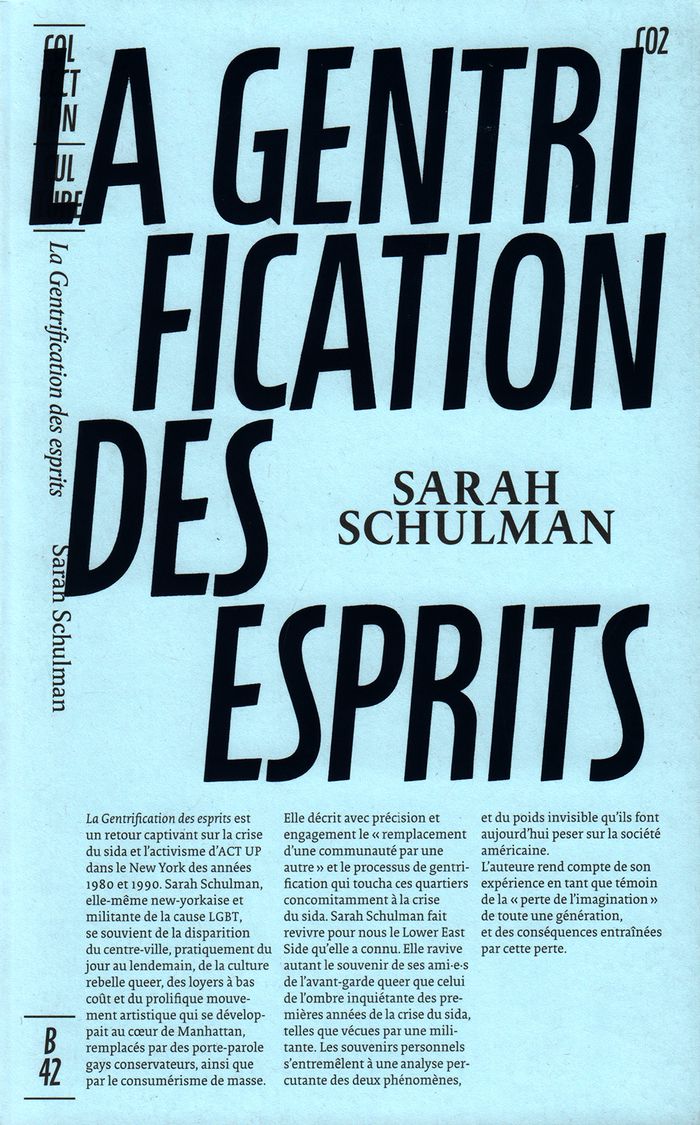
« La gentrification des esprits » est un retour captivant sur les « années SIDA » et l'activisme d'ACT UP dans le New York des années 1980 et 1990. Sarah Schulman, elle-même new-yorkaise et militante de la cause LGBT, se souvient de la disparition, pratiquement du jour au lendemain, de la culture rebelle queer, des loyers à bas coûts et du prolifique mouvement artistique qui se développait au coeur de Manhattan ; remplacés par des porte-parole gays conservateurs, ainsi que par le consumérisme de masse. Sarah Schulman décrit avec précision et engagement le « remplacement d'une communauté par une autre » et le processus de gentrification qui toucha ces quartiers concomitamment à la crise du SIDA.
La gentrification des esprits
Actions:
Price:
$37.95
(available to order)
Summary:
« La gentrification des esprits » est un retour captivant sur les « années SIDA » et l'activisme d'ACT UP dans le New York des années 1980 et 1990. Sarah Schulman, elle-même new-yorkaise et militante de la cause LGBT, se souvient de la disparition, pratiquement du jour au lendemain, de la culture rebelle queer, des loyers à bas coûts et du prolifique mouvement artistique qui se développait au coeur de Manhattan ; remplacés par des porte-parole gays conservateurs, ainsi que par le consumérisme de masse. Sarah Schulman décrit avec précision et engagement le « remplacement d'une communauté par une autre » et le processus de gentrification qui toucha ces quartiers concomitamment à la crise du SIDA.
Form:
books
books
Publication:
November 2018
November 2018
Subject:
Architectural Theory
Architectural Theory
Form:
books
books
Title:
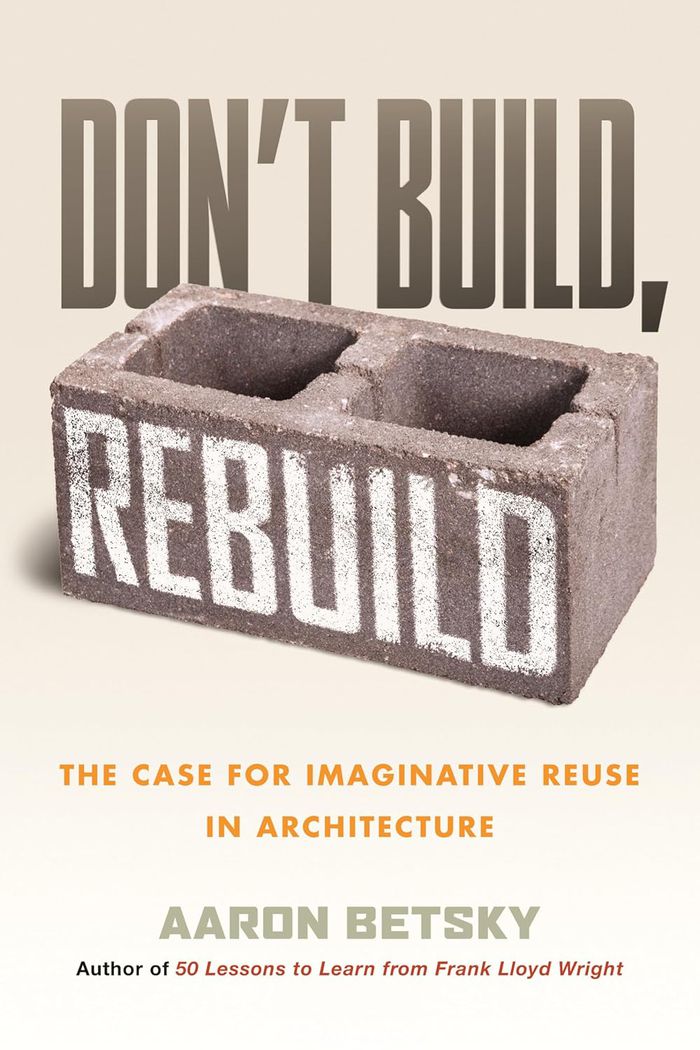
Don't build, rebuild
Don't build, rebuild
Actions:
Price:
$43.95
(available to order)
Summary:
As climate change has escalated into a crisis, the reuse of existing structures is the only way to even begin to preserve our wood, sand, silicon, and iron, let alone stop belching carbon monoxide into the air. Our housing crisis means that we need usable buildings now more than ever, but architect and critic Aaron Betsky shows that new construction—often seeking to(...)
$43.95
(available to order)
Summary:
As climate change has escalated into a crisis, the reuse of existing structures is the only way to even begin to preserve our wood, sand, silicon, and iron, let alone stop belching carbon monoxide into the air. Our housing crisis means that we need usable buildings now more than ever, but architect and critic Aaron Betsky shows that new construction—often seeking to(...)
Title:
Don't build, rebuild
Actions:
Price:
$43.95
(available to order)
Summary:
As climate change has escalated into a crisis, the reuse of existing structures is the only way to even begin to preserve our wood, sand, silicon, and iron, let alone stop belching carbon monoxide into the air. Our housing crisis means that we need usable buildings now more than ever, but architect and critic Aaron Betsky shows that new construction—often seeking to maximize profits rather than resources, often soulless in its feel—is not the answer. Whenever possible, it is better to repair, recycle, renovate, and reuse—not only from an environmental perspective, but culturally and artistically as well. Architectural reuse is as old as civilization itself. In the streets of Europe, you can find fragments from the Roman Empire. More recently, marginalized communities from New York to Detroit—queer people looking for places to gather or cruise, punks looking to make loud music, artists and displaced people looking for space to work and live—have taken over industrial spaces created then abandoned by capitalism, forging a unique style in the process. Their methods—from urban mining to dumpster diving—now inform architects transforming old structures today.
Don't build, rebuild
Actions:
Price:
$43.95
(available to order)
Summary:
As climate change has escalated into a crisis, the reuse of existing structures is the only way to even begin to preserve our wood, sand, silicon, and iron, let alone stop belching carbon monoxide into the air. Our housing crisis means that we need usable buildings now more than ever, but architect and critic Aaron Betsky shows that new construction—often seeking to maximize profits rather than resources, often soulless in its feel—is not the answer. Whenever possible, it is better to repair, recycle, renovate, and reuse—not only from an environmental perspective, but culturally and artistically as well. Architectural reuse is as old as civilization itself. In the streets of Europe, you can find fragments from the Roman Empire. More recently, marginalized communities from New York to Detroit—queer people looking for places to gather or cruise, punks looking to make loud music, artists and displaced people looking for space to work and live—have taken over industrial spaces created then abandoned by capitalism, forging a unique style in the process. Their methods—from urban mining to dumpster diving—now inform architects transforming old structures today.
Form:
books
books
Publication:
November 2024
November 2024
Subject:
Architectural Theory
Architectural Theory


