


11738 Results
Form:
books
books
Actions:
Holdings:
Description:
107, [38] pages : illustrations ; 19 cm
Description:
107, [38] pages : illustrations ; 19 cm
Author:
Subject:
Publication:
Geneva, N.Y. : Herendeen Mfg. Co., ©1890.
Geneva, N.Y. : Herendeen Mfg. Co., ©1890.
Title:
Illustrated catalogue : the Furman vertical water tube steam & hot-water heaters.
Actions:
Holdings:
Description:
107, [38] pages : illustrations ; 19 cm
Illustrated catalogue : the Furman vertical water tube steam & hot-water heaters.
Actions:
Holdings:
Description:
107, [38] pages : illustrations ; 19 cm
Form:
books
books
Publication:
Geneva, N.Y. : Herendeen Mfg. Co., ©1890.
Geneva, N.Y. : Herendeen Mfg. Co., ©1890.
Author:
Subject:
Form:
books
books
Actions:
Price:
$31.95
(available to order)
Summary:
The ugly buildings that characterize the modern landscape are inferior not only to the great cathedrals of medieval Europe and the temples of ancient Egypt and Greece, but even to lesser buildings of the more recent past. The great masterworks of our ancestors spoke to humanity’s higher nature. Architect Herbert Bangs reveals how today’s dysfunctional buildings bring out(...)
$31.95
(available to order)
Summary:
The ugly buildings that characterize the modern landscape are inferior not only to the great cathedrals of medieval Europe and the temples of ancient Egypt and Greece, but even to lesser buildings of the more recent past. The great masterworks of our ancestors spoke to humanity’s higher nature. Architect Herbert Bangs reveals how today’s dysfunctional buildings bring out(...)
Subject:
Commercial interiors, Building types
Commercial interiors, Building types
Publication:
January 2007, Rochester
January 2007, Rochester
Title:
The return of sacred architecture : the golden ratio and the end of modernism
Actions:
Price:
$31.95
(available to order)
Summary:
The ugly buildings that characterize the modern landscape are inferior not only to the great cathedrals of medieval Europe and the temples of ancient Egypt and Greece, but even to lesser buildings of the more recent past. The great masterworks of our ancestors spoke to humanity’s higher nature. Architect Herbert Bangs reveals how today’s dysfunctional buildings bring out the worst in humanity, reinforcing that which is most base within us. He shows how, through the ancient laws of proportion and number, architecture once expressed the harmonious relationship between man and the cosmos. In early times, the architect worked within a sacred and esoteric tradition of creating structures through which human beings could gain insight into the nature of the divine reality. Today, that tradition has been abandoned in favor of narrowly defined utilitarian principles of efficiency and economy. In The Return of Sacred Architecture, Bangs provides the key to freeing architecture from the crude functionality of the twentieth century: the architects of the modern human landscape must find the deep-felt connection to the cosmos that guided the inner lives of those who built the temples of the past. The form of their buildings will then reflect the sacred patterns of geometry and proportion and bring forth greater harmony in the world.
The return of sacred architecture : the golden ratio and the end of modernism
Actions:
Price:
$31.95
(available to order)
Summary:
The ugly buildings that characterize the modern landscape are inferior not only to the great cathedrals of medieval Europe and the temples of ancient Egypt and Greece, but even to lesser buildings of the more recent past. The great masterworks of our ancestors spoke to humanity’s higher nature. Architect Herbert Bangs reveals how today’s dysfunctional buildings bring out the worst in humanity, reinforcing that which is most base within us. He shows how, through the ancient laws of proportion and number, architecture once expressed the harmonious relationship between man and the cosmos. In early times, the architect worked within a sacred and esoteric tradition of creating structures through which human beings could gain insight into the nature of the divine reality. Today, that tradition has been abandoned in favor of narrowly defined utilitarian principles of efficiency and economy. In The Return of Sacred Architecture, Bangs provides the key to freeing architecture from the crude functionality of the twentieth century: the architects of the modern human landscape must find the deep-felt connection to the cosmos that guided the inner lives of those who built the temples of the past. The form of their buildings will then reflect the sacred patterns of geometry and proportion and bring forth greater harmony in the world.
Form:
books
books
Publication:
January 2007, Rochester
January 2007, Rochester
Subject:
Commercial interiors, Building types
Commercial interiors, Building types
Form:
books
books
Actions:
Price:
$84.00
(available to order)
Summary:
Arthur Brown Jr. (1874-1957) is celebrated by his peers for such masterpieces as the City Hall, War Memorial Opera House, Temple Emanu-El, and Coit Tower in San Francisco; the Pasadena City Hall; and the Labor-ICC block of the Federal Triangle in Washington, DC. Brown epitomized the idea that architecture not only houses society’s daily rituals and defining events but(...)
$84.00
(available to order)
Summary:
Arthur Brown Jr. (1874-1957) is celebrated by his peers for such masterpieces as the City Hall, War Memorial Opera House, Temple Emanu-El, and Coit Tower in San Francisco; the Pasadena City Hall; and the Labor-ICC block of the Federal Triangle in Washington, DC. Brown epitomized the idea that architecture not only houses society’s daily rituals and defining events but(...)
Title:
Arthur Brown, Jr. : progressive classicist
Actions:
Price:
$84.00
(available to order)
Summary:
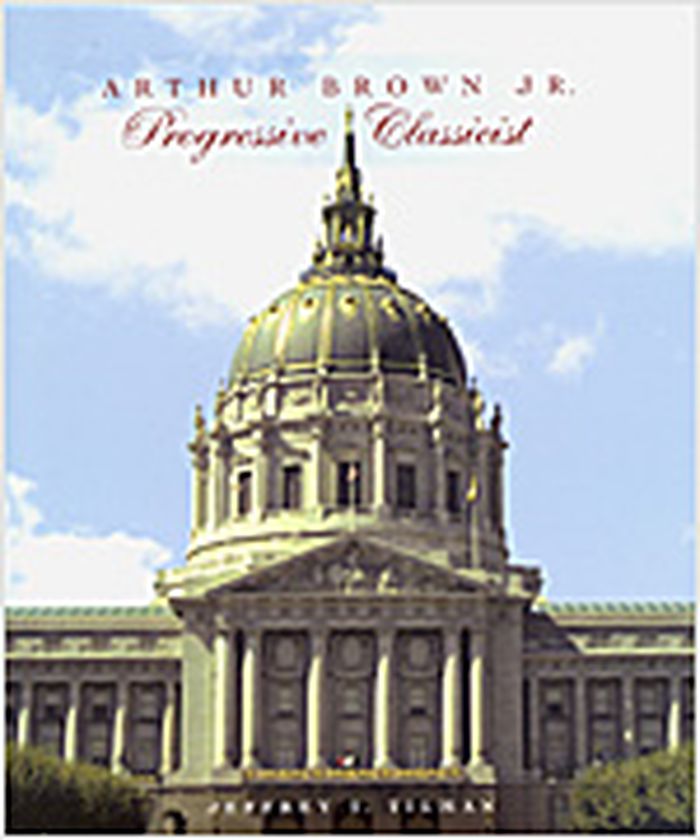
Arthur Brown Jr. (1874-1957) is celebrated by his peers for such masterpieces as the City Hall, War Memorial Opera House, Temple Emanu-El, and Coit Tower in San Francisco; the Pasadena City Hall; and the Labor-ICC block of the Federal Triangle in Washington, DC. Brown epitomized the idea that architecture not only houses society’s daily rituals and defining events but also can itself shape the sociopolitical landscape of America. "Arthur Brown Jr.: progressive classicist" unifies the varied strands of the architect’s life, from the architectural forms and methods of the Ecole des Beaux-Arts in Paris to the reforming spirit and self-reliant confidence of San Francisco after the earthquake and fire of 1906 to the challenging economics and changing aesthetics of machine-age America. It details the development of Brown’s major works and many other civic, commercial, religious, academic, and residential buildings. It chronicles his unflagging commitment to the classical tradition, which he employed in contemporary, forward-looking institutional buildings that emphasized continuity with the past while meeting the needs of the future. To Brown, the classical tradition was not a sacrosanct, unchanging body of knowledge; it was an expanding and evolving set of ideas about architectural design that permitted, and even demanded, change as new conditions and technologies were developed.
Arthur Brown, Jr. : progressive classicist
Actions:
Price:
$84.00
(available to order)
Summary:
Arthur Brown Jr. (1874-1957) is celebrated by his peers for such masterpieces as the City Hall, War Memorial Opera House, Temple Emanu-El, and Coit Tower in San Francisco; the Pasadena City Hall; and the Labor-ICC block of the Federal Triangle in Washington, DC. Brown epitomized the idea that architecture not only houses society’s daily rituals and defining events but also can itself shape the sociopolitical landscape of America. "Arthur Brown Jr.: progressive classicist" unifies the varied strands of the architect’s life, from the architectural forms and methods of the Ecole des Beaux-Arts in Paris to the reforming spirit and self-reliant confidence of San Francisco after the earthquake and fire of 1906 to the challenging economics and changing aesthetics of machine-age America. It details the development of Brown’s major works and many other civic, commercial, religious, academic, and residential buildings. It chronicles his unflagging commitment to the classical tradition, which he employed in contemporary, forward-looking institutional buildings that emphasized continuity with the past while meeting the needs of the future. To Brown, the classical tradition was not a sacrosanct, unchanging body of knowledge; it was an expanding and evolving set of ideas about architectural design that permitted, and even demanded, change as new conditions and technologies were developed.
Form:
books
books
Publication:
November 2005, New York
November 2005, New York
Subject:
Architecture Monographs
Architecture Monographs
Form:
books
books
Actions:
Price:
$34.95
(available to order)
Summary:
his book focuses on six brilliant women who are often seen as particularly tough-minded: Simone Weil, Hannah Arendt, Mary McCarthy, Susan Sontag, Diane Arbus, and Joan Didion. Aligned with no single tradition, they escape straightforward categories. Yet their work evinces an affinity of style and philosophical viewpoint that derives from a shared attitude toward(...)
$34.95
(available to order)
Summary:
his book focuses on six brilliant women who are often seen as particularly tough-minded: Simone Weil, Hannah Arendt, Mary McCarthy, Susan Sontag, Diane Arbus, and Joan Didion. Aligned with no single tradition, they escape straightforward categories. Yet their work evinces an affinity of style and philosophical viewpoint that derives from a shared attitude toward(...)
Title:
Tough enough: Arbus, Arendt, Didion, McCarthy, Sontag, Weil
Actions:
Price:
$34.95
(available to order)
Summary:
his book focuses on six brilliant women who are often seen as particularly tough-minded: Simone Weil, Hannah Arendt, Mary McCarthy, Susan Sontag, Diane Arbus, and Joan Didion. Aligned with no single tradition, they escape straightforward categories. Yet their work evinces an affinity of style and philosophical viewpoint that derives from a shared attitude toward suffering. What Mary McCarthy called a “cold eye” was not merely a personal aversion to displays of emotion: it was an unsentimental mode of attention that dictated both ethical positions and aesthetic approaches. Tough Enough traces the careers of these women and their challenges to the pre-eminence of empathy as the ethical posture from which to examine pain. Their writing and art reveal an adamant belief that the hurts of the world must be treated concretely, directly, and realistically, without recourse to either melodrama or callousness. As Deborah Nelson shows, this stance offers an important counter-tradition to the familiar postwar poles of emotional expressivity on the one hand and cool irony on the other. Ultimately, in its insistence on facing reality without consolation or compensation, this austere “school of the unsentimental” offers new ways to approach suffering in both its spectacular forms and all of its ordinariness.
Tough enough: Arbus, Arendt, Didion, McCarthy, Sontag, Weil
Actions:
Price:
$34.95
(available to order)
Summary:
his book focuses on six brilliant women who are often seen as particularly tough-minded: Simone Weil, Hannah Arendt, Mary McCarthy, Susan Sontag, Diane Arbus, and Joan Didion. Aligned with no single tradition, they escape straightforward categories. Yet their work evinces an affinity of style and philosophical viewpoint that derives from a shared attitude toward suffering. What Mary McCarthy called a “cold eye” was not merely a personal aversion to displays of emotion: it was an unsentimental mode of attention that dictated both ethical positions and aesthetic approaches. Tough Enough traces the careers of these women and their challenges to the pre-eminence of empathy as the ethical posture from which to examine pain. Their writing and art reveal an adamant belief that the hurts of the world must be treated concretely, directly, and realistically, without recourse to either melodrama or callousness. As Deborah Nelson shows, this stance offers an important counter-tradition to the familiar postwar poles of emotional expressivity on the one hand and cool irony on the other. Ultimately, in its insistence on facing reality without consolation or compensation, this austere “school of the unsentimental” offers new ways to approach suffering in both its spectacular forms and all of its ordinariness.
Form:
books
books
Publication:
April 2017
April 2017
Subject:
Critical Theory
Critical Theory
Form:
books
books
Price:
$42.95
(available to order)
Summary:
The attention Swiss architecture has received in recent years has mainly focused on a small number of architects whose work has appeared on the covers of the specialized press. Extending throughout the Modern Movement, this is an architecture with its roots in a rich building tradition. In Graubünden, under the attentive gaze of maestro Peter Zumthor, a(...)
$42.95
(available to order)
Summary:
The attention Swiss architecture has received in recent years has mainly focused on a small number of architects whose work has appeared on the covers of the specialized press. Extending throughout the Modern Movement, this is an architecture with its roots in a rich building tradition. In Graubünden, under the attentive gaze of maestro Peter Zumthor, a(...)
Subject:
Green Architecture
Green Architecture
Publication:
June 2000, Barcelona
June 2000, Barcelona
Title:
2G 14 : Building in the mountains, recent architecture in Graubünden
Actions:
Price:
$42.95
(available to order)
Summary:
The attention Swiss architecture has received in recent years has mainly focused on a small number of architects whose work has appeared on the covers of the specialized press. Extending throughout the Modern Movement, this is an architecture with its roots in a rich building tradition. In Graubünden, under the attentive gaze of maestro Peter Zumthor, a group of young architects educated at the ETH in Zurich, many of whom are former assistants in Zumthor's studio, demonstrate the extraordinary quality of the architectonic production of this small German-speaking region of Switzerland. These increasingly well-known names present a wide range of projects ranging from single-family houses to apartment blocks, schools, and public and commercial buildings of different sorts, yet with similarities in the way they handle materials and settings, a body of work that transcends the borders of the region and attracts the attention of the international architecture world. The introduction by Daniel Bosshard, Miguel Kreisler, Myriam Sterling and Txell Vaquer places the building tradition of Graubünden in its historical context. The Nexus section features a 1913 text by Adolf Loos called "Rules for Those Building in the Mountains", plus Bruno Reichlin's "When Moderns Architects Build in the Mountains" and an extract from Christoph Schaub's video "The Vrin Project".
2G 14 : Building in the mountains, recent architecture in Graubünden
Actions:
Price:
$42.95
(available to order)
Summary:
The attention Swiss architecture has received in recent years has mainly focused on a small number of architects whose work has appeared on the covers of the specialized press. Extending throughout the Modern Movement, this is an architecture with its roots in a rich building tradition. In Graubünden, under the attentive gaze of maestro Peter Zumthor, a group of young architects educated at the ETH in Zurich, many of whom are former assistants in Zumthor's studio, demonstrate the extraordinary quality of the architectonic production of this small German-speaking region of Switzerland. These increasingly well-known names present a wide range of projects ranging from single-family houses to apartment blocks, schools, and public and commercial buildings of different sorts, yet with similarities in the way they handle materials and settings, a body of work that transcends the borders of the region and attracts the attention of the international architecture world. The introduction by Daniel Bosshard, Miguel Kreisler, Myriam Sterling and Txell Vaquer places the building tradition of Graubünden in its historical context. The Nexus section features a 1913 text by Adolf Loos called "Rules for Those Building in the Mountains", plus Bruno Reichlin's "When Moderns Architects Build in the Mountains" and an extract from Christoph Schaub's video "The Vrin Project".
Form:
books
books
Publication:
June 2000, Barcelona
June 2000, Barcelona
Subject:
Green Architecture
Green Architecture
Form:
books
books
Holdings:
Description:
7 pages : illustrations ; 28 cm
Description:
7 pages : illustrations ; 28 cm
Author:
Subject:
Publication:
New York : American Institute of Steel Construction Inc., ©1951.
New York : American Institute of Steel Construction Inc., ©1951.
Title:
Steel insures strength and security : fabricated structural steel.
Actions:
Holdings:
Description:
7 pages : illustrations ; 28 cm
Steel insures strength and security : fabricated structural steel.
Actions:
Holdings:
Description:
7 pages : illustrations ; 28 cm
Form:
books
books
Publication:
New York : American Institute of Steel Construction Inc., ©1951.
New York : American Institute of Steel Construction Inc., ©1951.
Author:
Subject:
Form:
books
books
Actions:
Holdings:
Description:
40 pages : illustrations ; 28 cm
Description:
40 pages : illustrations ; 28 cm
Author:
Subject:
Publication:
Chicago, Ill. : C.F. Pease Co., ©1936.
Chicago, Ill. : C.F. Pease Co., ©1936.
Title:
Pease open flame and enclosed arc lamps for all photo-mechanical reproduction processes.
Actions:
Holdings:
Description:
40 pages : illustrations ; 28 cm
Pease open flame and enclosed arc lamps for all photo-mechanical reproduction processes.
Actions:
Holdings:
Description:
40 pages : illustrations ; 28 cm
Form:
books
books
Publication:
Chicago, Ill. : C.F. Pease Co., ©1936.
Chicago, Ill. : C.F. Pease Co., ©1936.
Author:
Subject:
Form:
books
books
Holdings:
Description:
80 pages : illustrations ; 27 cm
Description:
80 pages : illustrations ; 27 cm
Author:
Subject:
Publication:
Schenectady, N.Y. : General Electric Co., 1918.
Schenectady, N.Y. : General Electric Co., 1918.
Title:
24-inch high intensity searchlight shaft control, form AA.
Actions:
Holdings:
Description:
80 pages : illustrations ; 27 cm
24-inch high intensity searchlight shaft control, form AA.
Actions:
Holdings:
Description:
80 pages : illustrations ; 27 cm
Form:
books
books
Publication:
Schenectady, N.Y. : General Electric Co., 1918.
Schenectady, N.Y. : General Electric Co., 1918.
Author:
Subject:
Form:
books
books
Actions:
Holdings:
Description:
46 pages : illustrations (some color) ; 21 cm
Description:
46 pages : illustrations (some color) ; 21 cm
Author:
Subject:
Publication:
Birmingham : Henry Hope & Sons, 1926.
Birmingham : Henry Hope & Sons, 1926.
Title:
Hope's standard steel windows.
Actions:
Holdings:
Description:
46 pages : illustrations (some color) ; 21 cm
Hope's standard steel windows.
Actions:
Holdings:
Description:
46 pages : illustrations (some color) ; 21 cm
Form:
books
books
Publication:
Birmingham : Henry Hope & Sons, 1926.
Birmingham : Henry Hope & Sons, 1926.
Author:
Subject:
Form:
books
books
Actions:
Holdings:
Description:
16 pages : illustrations ; 20 cm
Description:
16 pages : illustrations ; 20 cm
Author:
Subject:
Publication:
Paris : Bourgeois Aîné, [1909?]
Paris : Bourgeois Aîné, [1909?]
Title:
Dessin au crayon incandescent ou gravure au feu, sculpture au feu, pyro-décor-velours.
Actions:
Holdings:
Description:
16 pages : illustrations ; 20 cm
Dessin au crayon incandescent ou gravure au feu, sculpture au feu, pyro-décor-velours.
Actions:
Holdings:
Description:
16 pages : illustrations ; 20 cm
Form:
books
books
Publication:
Paris : Bourgeois Aîné, [1909?]
Paris : Bourgeois Aîné, [1909?]
Author:
Subject:


