


12071 Results
Form:
books
books
Title:
Claus en Kaan building
Claus en Kaan building
Actions:
Price:
$100.95
(available to order)
Summary:
Building - for all its simplicity the title of this book speaks volumes about the work of Claus and Kaan. It reduces architecture to what they see as the essence of their profession. Kees Kaan and Felix Claus once claimed that their ambition was to extinguish the schism between low practice and high theory, between architecture that serves its immediate objective and(...)
$100.95
(available to order)
Summary:
Building - for all its simplicity the title of this book speaks volumes about the work of Claus and Kaan. It reduces architecture to what they see as the essence of their profession. Kees Kaan and Felix Claus once claimed that their ambition was to extinguish the schism between low practice and high theory, between architecture that serves its immediate objective and(...)
Title:
Claus en Kaan building
Actions:
Price:
$100.95
(available to order)
Summary:
Building - for all its simplicity the title of this book speaks volumes about the work of Claus and Kaan. It reduces architecture to what they see as the essence of their profession. Kees Kaan and Felix Claus once claimed that their ambition was to extinguish the schism between low practice and high theory, between architecture that serves its immediate objective and architecture that speaks over the heads of its users to colleagues and critics. Severity and repose are hallmarks of Claus and Kaan's oeuvre and these qualities are often found in it simultaneously. For even at its most Spartan, their architecture is never harsh. Although one can hardly describe Claus and Kaan's architecture as postmodern, their stance does owe something to postmodernism. This can be seen in their free handling of references, such as Marcel Breuer's Whitney Museum or Mies van der Rohe's Barcelona Pavilion, and in their undogmatically broad range of interest, spanning from Heinrich Tessenow to Gordon Bunshaft and from Auguste Perret to I.M. Pei. For them there is no essential contradiction between modernity and classical values. This first comprehensive monograph on Claus and Kaan gives a complete overview of all their projects (250 or so), including those yet to be realized. Of this total, fifty are exhaustively documented and illustrated. With essays by Rafael Moneo, David Chipperfield, Andrea Deplazes, Christoph Grafe, Han Michel, and Felix Claus and Kees Kaan themselves. The book is designed by Karel Martens and Jaap van Triest.
Claus en Kaan building
Actions:
Price:
$100.95
(available to order)
Summary:
Building - for all its simplicity the title of this book speaks volumes about the work of Claus and Kaan. It reduces architecture to what they see as the essence of their profession. Kees Kaan and Felix Claus once claimed that their ambition was to extinguish the schism between low practice and high theory, between architecture that serves its immediate objective and architecture that speaks over the heads of its users to colleagues and critics. Severity and repose are hallmarks of Claus and Kaan's oeuvre and these qualities are often found in it simultaneously. For even at its most Spartan, their architecture is never harsh. Although one can hardly describe Claus and Kaan's architecture as postmodern, their stance does owe something to postmodernism. This can be seen in their free handling of references, such as Marcel Breuer's Whitney Museum or Mies van der Rohe's Barcelona Pavilion, and in their undogmatically broad range of interest, spanning from Heinrich Tessenow to Gordon Bunshaft and from Auguste Perret to I.M. Pei. For them there is no essential contradiction between modernity and classical values. This first comprehensive monograph on Claus and Kaan gives a complete overview of all their projects (250 or so), including those yet to be realized. Of this total, fifty are exhaustively documented and illustrated. With essays by Rafael Moneo, David Chipperfield, Andrea Deplazes, Christoph Grafe, Han Michel, and Felix Claus and Kees Kaan themselves. The book is designed by Karel Martens and Jaap van Triest.
Form:
books
books
Publication:
May 2002, Rotterdam
May 2002, Rotterdam
Subject:
Architecture Monographs
Architecture Monographs
Form:
books
books
Actions:
Price:
$49.95
(available to order)
Summary:
This book looks at the spatial themes that preoccupy John Pawson’s work through a close examination of a range of different projects. It examines how light, mass and structure inform the architecture, the role of ritual and order, as well as the integration of internal and external spaces. Six new projects, ‘When Objects Work’, Calvin Klein Store, Paris, Vacherin(...)
$49.95
(available to order)
Summary:
This book looks at the spatial themes that preoccupy John Pawson’s work through a close examination of a range of different projects. It examines how light, mass and structure inform the architecture, the role of ritual and order, as well as the integration of internal and external spaces. Six new projects, ‘When Objects Work’, Calvin Klein Store, Paris, Vacherin(...)
Subject:
Architecture Monographs
Architecture Monographs
Publication:
October 2002, London
October 2002, London
Title:
John Pawson - themes and projects
Actions:
Price:
$49.95
(available to order)
Summary:
This book looks at the spatial themes that preoccupy John Pawson’s work through a close examination of a range of different projects. It examines how light, mass and structure inform the architecture, the role of ritual and order, as well as the integration of internal and external spaces. Six new projects, ‘When Objects Work’, Calvin Klein Store, Paris, Vacherin Constantin, the Marketmuseum, a private house in Germany, and the Novy Dvur monastery are featured. There are eight essays on the effect of the work by Deyan Sudjic, Sam Hecht, Michael Craig-Martin, Phoebe Greenwood, Robert Winder, Kate Bucknell, Bruce Chatwin, and Father Samuel.
John Pawson - themes and projects
Actions:
Price:
$49.95
(available to order)
Summary:
This book looks at the spatial themes that preoccupy John Pawson’s work through a close examination of a range of different projects. It examines how light, mass and structure inform the architecture, the role of ritual and order, as well as the integration of internal and external spaces. Six new projects, ‘When Objects Work’, Calvin Klein Store, Paris, Vacherin Constantin, the Marketmuseum, a private house in Germany, and the Novy Dvur monastery are featured. There are eight essays on the effect of the work by Deyan Sudjic, Sam Hecht, Michael Craig-Martin, Phoebe Greenwood, Robert Winder, Kate Bucknell, Bruce Chatwin, and Father Samuel.
Form:
books
books
Publication:
October 2002, London
October 2002, London
Subject:
Architecture Monographs
Architecture Monographs
Form:
books
books
Price:
$99.95
(available to order)
Summary:
This monograph is the first to document all of the built work by Morphosis, a Los Angeles-based practice headed by Thom Mayne and one of the most influential architecture firms of the past twenty years. Morphosis's unconventional geometries, sculptural models and complex, computer-generated drawings helped to usher in a new era of architectural experimentation in the(...)
$99.95
(available to order)
Summary:
This monograph is the first to document all of the built work by Morphosis, a Los Angeles-based practice headed by Thom Mayne and one of the most influential architecture firms of the past twenty years. Morphosis's unconventional geometries, sculptural models and complex, computer-generated drawings helped to usher in a new era of architectural experimentation in the(...)
Title:
Morphosis
Actions:
Price:
$99.95
(available to order)
Summary:
This monograph is the first to document all of the built work by Morphosis, a Los Angeles-based practice headed by Thom Mayne and one of the most influential architecture firms of the past twenty years. Morphosis's unconventional geometries, sculptural models and complex, computer-generated drawings helped to usher in a new era of architectural experimentation in the early 1980's. This book is comprised of bold, documentary-style colour photographs of thirty-five completed buildings presented in an almost cinematic layout, and publishes for the first time together all of Morphosis's completed work, from the early residential and restaurant projects in Los Angeles to the most recent large-scale work beyond California and the United States in Canada, Taiwan, Korea, Japan and Austria. Thom Mayne founded Morphosis in 1972 in partnership with Michael Rotondi, who now has his own firm. Over the past twenty years, Mayne's academic posts have included teaching positions at Columbia University, Harvard University, Yale University, the Berlage Institute in the Netherlands and the Bartlett School of Architecture in London.
Morphosis
Actions:
Price:
$99.95
(available to order)
Summary:
This monograph is the first to document all of the built work by Morphosis, a Los Angeles-based practice headed by Thom Mayne and one of the most influential architecture firms of the past twenty years. Morphosis's unconventional geometries, sculptural models and complex, computer-generated drawings helped to usher in a new era of architectural experimentation in the early 1980's. This book is comprised of bold, documentary-style colour photographs of thirty-five completed buildings presented in an almost cinematic layout, and publishes for the first time together all of Morphosis's completed work, from the early residential and restaurant projects in Los Angeles to the most recent large-scale work beyond California and the United States in Canada, Taiwan, Korea, Japan and Austria. Thom Mayne founded Morphosis in 1972 in partnership with Michael Rotondi, who now has his own firm. Over the past twenty years, Mayne's academic posts have included teaching positions at Columbia University, Harvard University, Yale University, the Berlage Institute in the Netherlands and the Bartlett School of Architecture in London.
Form:
books
books
Publication:
April 2003, London
April 2003, London
Subject:
Architecture Monographs
Architecture Monographs
Form:
books
books
Actions:
Price:
$89.95
(available to order)
Summary:
The architecture of ordinary people represents more than ninety per cent of the world's buildings, including some 800 million homes. Dwellings is about the types and forms of vernacular houses around the world. It documents the form of traditional buildings that are self-built by their owner-occupiers or built by members of a community, recording the means of construction(...)
$89.95
(available to order)
Summary:
The architecture of ordinary people represents more than ninety per cent of the world's buildings, including some 800 million homes. Dwellings is about the types and forms of vernacular houses around the world. It documents the form of traditional buildings that are self-built by their owner-occupiers or built by members of a community, recording the means of construction(...)
Title:
Dwellings : the vernacular house world wide
Actions:
Price:
$89.95
(available to order)
Summary:
The architecture of ordinary people represents more than ninety per cent of the world's buildings, including some 800 million homes. Dwellings is about the types and forms of vernacular houses around the world. It documents the form of traditional buildings that are self-built by their owner-occupiers or built by members of a community, recording the means of construction and decoration of the house in many different cultures. First published by Phaidon in 1987, "Dwellings", in its new updated, revised and expanded format, takes into account new scholarship in the field, including the author's own fieldwork, and also acknowledges theoretical developments in the areas of cultural geography, gender studies, sociology and anthropology. "Dwellings" is a reference work on domestic buildings and also a useful survey for understanding how different communities cope with issues of climate, migration, mass development, and symbolic and cultural meaning in architecture.
Dwellings : the vernacular house world wide
Actions:
Price:
$89.95
(available to order)
Summary:
The architecture of ordinary people represents more than ninety per cent of the world's buildings, including some 800 million homes. Dwellings is about the types and forms of vernacular houses around the world. It documents the form of traditional buildings that are self-built by their owner-occupiers or built by members of a community, recording the means of construction and decoration of the house in many different cultures. First published by Phaidon in 1987, "Dwellings", in its new updated, revised and expanded format, takes into account new scholarship in the field, including the author's own fieldwork, and also acknowledges theoretical developments in the areas of cultural geography, gender studies, sociology and anthropology. "Dwellings" is a reference work on domestic buildings and also a useful survey for understanding how different communities cope with issues of climate, migration, mass development, and symbolic and cultural meaning in architecture.
Form:
books
books
Publication:
January 2003, London
January 2003, London
Subject:
Green Architecture
Green Architecture
Form:
books
books
Title:
Infinity and perspective
Infinity and perspective
Actions:
Price:
$36.95
(available to order)
Summary:
Much postmodern rhetoric, suggests Karsten Harries, can be understood as a symptom of our civilization's discontent, born of regret that we are no longer able to experience our world as a cosmos that assigns us our place. But dissatisfaction with the modern world may also spring from a conviction that modernism has failed to confront the challenge of an inevitably open(...)
$36.95
(available to order)
Summary:
Much postmodern rhetoric, suggests Karsten Harries, can be understood as a symptom of our civilization's discontent, born of regret that we are no longer able to experience our world as a cosmos that assigns us our place. But dissatisfaction with the modern world may also spring from a conviction that modernism has failed to confront the challenge of an inevitably open(...)
Title:
Infinity and perspective
Actions:
Price:
$36.95
(available to order)
Summary:
Much postmodern rhetoric, suggests Karsten Harries, can be understood as a symptom of our civilization's discontent, born of regret that we are no longer able to experience our world as a cosmos that assigns us our place. But dissatisfaction with the modern world may also spring from a conviction that modernism has failed to confront the challenge of an inevitably open future. Such conviction has frequently led to a critique of modernity's founding heroes. Challenging that critique, Harries insists that modernity is supported by nothing other than human freedom. But more important to Harries is to show how modernist self-assertion is shadowed by nihilism and what it might mean to step out of that shadow. Looking at a small number of medieval and Renaissance texts, as well as some paintings, he uncovers the threshold that separates the modern from the premodern world. At the same time, he illuminates that other, more questionable threshold, between the modern and the postmodern. Two spirits preside over the book: Alberti, the Renaissance author on art and architecture, whose passionate interest in perspective and point of view offers a key to modernity; and Nicolaus Cusanus, the fifteenth-century cardinal, whose work shows that such interest cannot be divorced from speculations on the infinity of God. The title Infinity and Perspective connects the two to each other and to the shape of modernity.
Infinity and perspective
Actions:
Price:
$36.95
(available to order)
Summary:
Much postmodern rhetoric, suggests Karsten Harries, can be understood as a symptom of our civilization's discontent, born of regret that we are no longer able to experience our world as a cosmos that assigns us our place. But dissatisfaction with the modern world may also spring from a conviction that modernism has failed to confront the challenge of an inevitably open future. Such conviction has frequently led to a critique of modernity's founding heroes. Challenging that critique, Harries insists that modernity is supported by nothing other than human freedom. But more important to Harries is to show how modernist self-assertion is shadowed by nihilism and what it might mean to step out of that shadow. Looking at a small number of medieval and Renaissance texts, as well as some paintings, he uncovers the threshold that separates the modern from the premodern world. At the same time, he illuminates that other, more questionable threshold, between the modern and the postmodern. Two spirits preside over the book: Alberti, the Renaissance author on art and architecture, whose passionate interest in perspective and point of view offers a key to modernity; and Nicolaus Cusanus, the fifteenth-century cardinal, whose work shows that such interest cannot be divorced from speculations on the infinity of God. The title Infinity and Perspective connects the two to each other and to the shape of modernity.
Form:
books
books
Publication:
October 2002, Cambridge, Mass.
October 2002, Cambridge, Mass.
Subject:
Architectural Theory
Architectural Theory
Form:
books
books
Title:
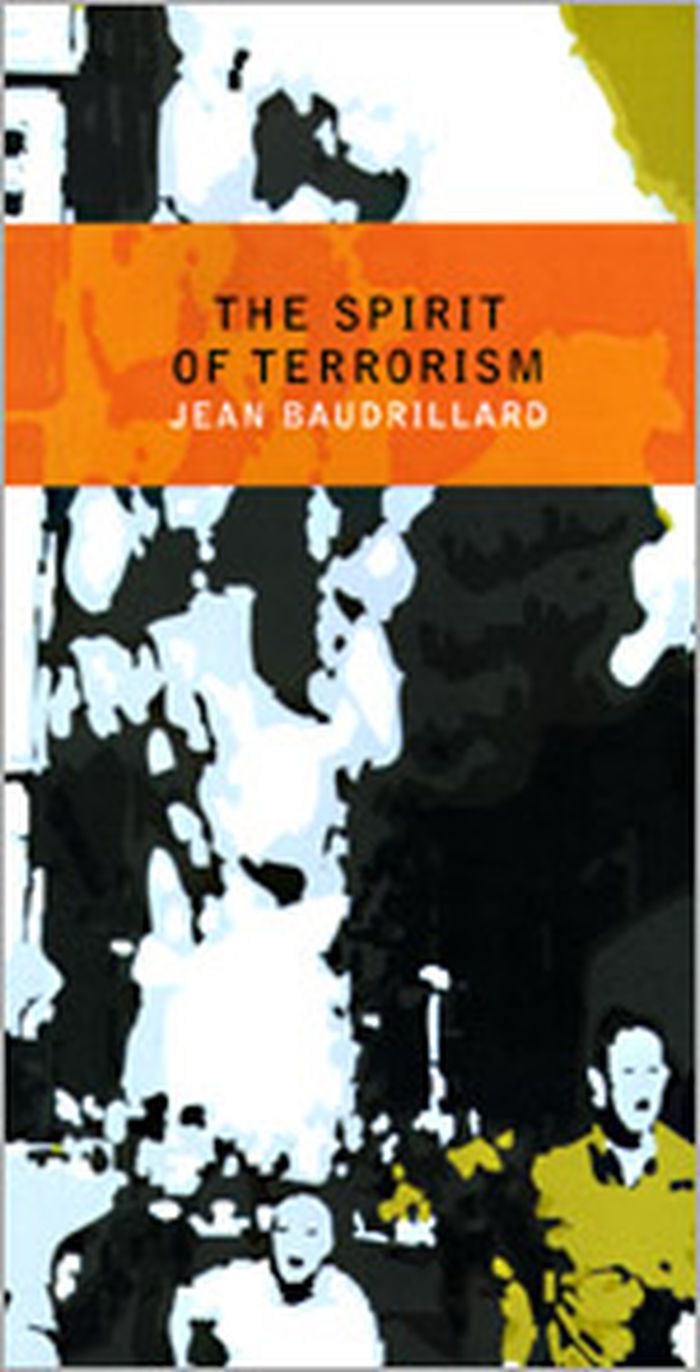
The spirit of terrorism
The spirit of terrorism
Actions:
Price:
$19.00
(available to order)
Summary:
«In dealing all the cards to itself, the system forced the Other to change the rules of the game. And the new rules are ferocious, because the game is ferocious.»
$19.00
(available to order)
Summary:
«In dealing all the cards to itself, the system forced the Other to change the rules of the game. And the new rules are ferocious, because the game is ferocious.»
Subject:
Architectural Theory
Architectural Theory
Publication:
September 2002, London / New York
September 2002, London / New York
Title:
The spirit of terrorism
Actions:
Price:
$19.00
(available to order)
Summary:
«In dealing all the cards to itself, the system forced the Other to change the rules of the game. And the new rules are ferocious, because the game is ferocious.»
The spirit of terrorism
Actions:
Price:
$19.00
(available to order)
Summary:
«In dealing all the cards to itself, the system forced the Other to change the rules of the game. And the new rules are ferocious, because the game is ferocious.»
Form:
books
books
Publication:
September 2002, London / New York
September 2002, London / New York
Subject:
Architectural Theory
Architectural Theory
Form:
books
books
Actions:
Price:
$93.95
(available in store)
Summary:
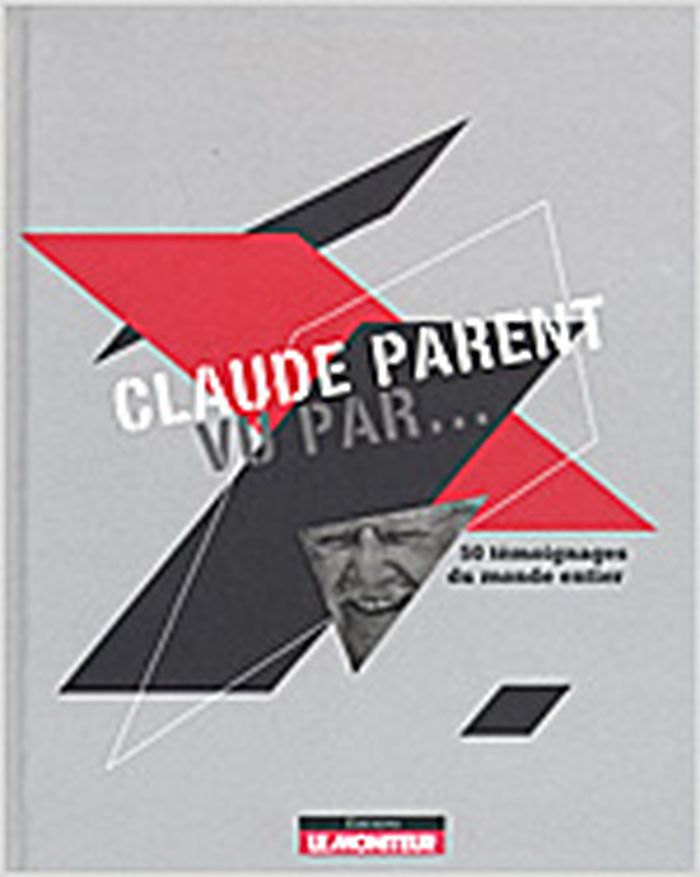
Ce livre est composé de témoignages adressés à l'architecte Claude Parent à l'occasion de son anniversaire et publié au moment de son entrée à l'Académie des Beaux-Arts. / This book comprises a collection of tributes to the architect Claude Parent on the occasion of his birthday and is published to coincide with his induction into the Académie des Beaux-Arts.
$93.95
(available in store)
Summary:
Ce livre est composé de témoignages adressés à l'architecte Claude Parent à l'occasion de son anniversaire et publié au moment de son entrée à l'Académie des Beaux-Arts. / This book comprises a collection of tributes to the architect Claude Parent on the occasion of his birthday and is published to coincide with his induction into the Académie des Beaux-Arts.
Subject:
Architecture Monographs
Architecture Monographs
Publication:
October 2006, Paris
October 2006, Paris
Title:
Claude Parent vu par . . . : 50 témoignages du monde entier
Actions:
Price:
$93.95
(available in store)
Summary:
Ce livre est composé de témoignages adressés à l'architecte Claude Parent à l'occasion de son anniversaire et publié au moment de son entrée à l'Académie des Beaux-Arts. / This book comprises a collection of tributes to the architect Claude Parent on the occasion of his birthday and is published to coincide with his induction into the Académie des Beaux-Arts.
Claude Parent vu par . . . : 50 témoignages du monde entier
Actions:
Price:
$93.95
(available in store)
Summary:
Ce livre est composé de témoignages adressés à l'architecte Claude Parent à l'occasion de son anniversaire et publié au moment de son entrée à l'Académie des Beaux-Arts. / This book comprises a collection of tributes to the architect Claude Parent on the occasion of his birthday and is published to coincide with his induction into the Académie des Beaux-Arts.
Form:
books
books
Publication:
October 2006, Paris
October 2006, Paris
Subject:
Architecture Monographs
Architecture Monographs
Form:
books
books
Actions:
Price:
$49.95
(available to order)
Summary:
Ce livre est une célébration des petits édifices, cabanes, kiosques et pavillons que l'on rencontre au détour d'une rue ou d'un chemin. Audacieuses et souvent insolites, ces micro-architectures constituent un ensemble hétéroclite dont le seul dénominateur commun est la petite taille. Étant donné la variété des fonctions et des styles qui les caractérisent, il est clair(...)
$49.95
(available to order)
Summary:
Ce livre est une célébration des petits édifices, cabanes, kiosques et pavillons que l'on rencontre au détour d'une rue ou d'un chemin. Audacieuses et souvent insolites, ces micro-architectures constituent un ensemble hétéroclite dont le seul dénominateur commun est la petite taille. Étant donné la variété des fonctions et des styles qui les caractérisent, il est clair(...)
Subject:
Miniature Architecture
Miniature Architecture
Publication:
January 1900, Paris
January 1900, Paris
Title:
XS: grandes idées, petites structures
Actions:
Price:
$49.95
(available to order)
Summary:
Ce livre est une célébration des petits édifices, cabanes, kiosques et pavillons que l'on rencontre au détour d'une rue ou d'un chemin. Audacieuses et souvent insolites, ces micro-architectures constituent un ensemble hétéroclite dont le seul dénominateur commun est la petite taille. Étant donné la variété des fonctions et des styles qui les caractérisent, il est clair que la taille n'impose aucune limite à la créativité et que l'utilité n'est pas contradictoire avec la beauté. À travers les projets les plus innovants du moment, "XS" témoigne de l'originalité de ces structures et montre que «penser petit» peut s'avérer un exercice merveilleux et collectif.
XS: grandes idées, petites structures
Actions:
Price:
$49.95
(available to order)
Summary:
Ce livre est une célébration des petits édifices, cabanes, kiosques et pavillons que l'on rencontre au détour d'une rue ou d'un chemin. Audacieuses et souvent insolites, ces micro-architectures constituent un ensemble hétéroclite dont le seul dénominateur commun est la petite taille. Étant donné la variété des fonctions et des styles qui les caractérisent, il est clair que la taille n'impose aucune limite à la créativité et que l'utilité n'est pas contradictoire avec la beauté. À travers les projets les plus innovants du moment, "XS" témoigne de l'originalité de ces structures et montre que «penser petit» peut s'avérer un exercice merveilleux et collectif.
Form:
books
books
Publication:
January 1900, Paris
January 1900, Paris
Subject:
Miniature Architecture
Miniature Architecture
Form:
books
books
Price:
$207.50
(available to order)
Summary:
For many architects he is a landmark - Jean Prouvé, creator of the metal curtain wall, pioneer in its application and early initiator of industrialised building techniques. His unfailing ability to combine functional engineering achievements with artistic sensitivity commands recognition. The period covered in this latest volume is significant in many respects. The(...)
$207.50
(available to order)
Summary:
For many architects he is a landmark - Jean Prouvé, creator of the metal curtain wall, pioneer in its application and early initiator of industrialised building techniques. His unfailing ability to combine functional engineering achievements with artistic sensitivity commands recognition. The period covered in this latest volume is significant in many respects. The(...)
Title:
Jean Prouvé : oeuvres complete /complete works, Volume 3 : 1944-1954
Actions:
Price:
$207.50
(available to order)
Summary:
For many architects he is a landmark - Jean Prouvé, creator of the metal curtain wall, pioneer in its application and early initiator of industrialised building techniques. His unfailing ability to combine functional engineering achievements with artistic sensitivity commands recognition. The period covered in this latest volume is significant in many respects. The post-war years placed enormous demands on housing and school construction. In his Maxéville factory Prouvé developed pre-fabricated housing, facade panelling, light filtering and other systems on a large scale. He was inspired by the works of the automobile and aeronautics industry, developing new applications for aluminium, which he presented in the 1954 Aluminium Centenary Pavilion. Moreover, Prouvé's furnitures of this period have become valuable collectors' items, some of which are now being reissued under licence.
Jean Prouvé : oeuvres complete /complete works, Volume 3 : 1944-1954
Actions:
Price:
$207.50
(available to order)
Summary:
For many architects he is a landmark - Jean Prouvé, creator of the metal curtain wall, pioneer in its application and early initiator of industrialised building techniques. His unfailing ability to combine functional engineering achievements with artistic sensitivity commands recognition. The period covered in this latest volume is significant in many respects. The post-war years placed enormous demands on housing and school construction. In his Maxéville factory Prouvé developed pre-fabricated housing, facade panelling, light filtering and other systems on a large scale. He was inspired by the works of the automobile and aeronautics industry, developing new applications for aluminium, which he presented in the 1954 Aluminium Centenary Pavilion. Moreover, Prouvé's furnitures of this period have become valuable collectors' items, some of which are now being reissued under licence.
Form:
books
books
Publication:
September 2004, Basel
September 2004, Basel
Subject:
Architecture Monographs
Architecture Monographs
Form:
books
books
Title:
The next house
The next house
Actions:
Price:
$55.95
(available to order)
Summary:
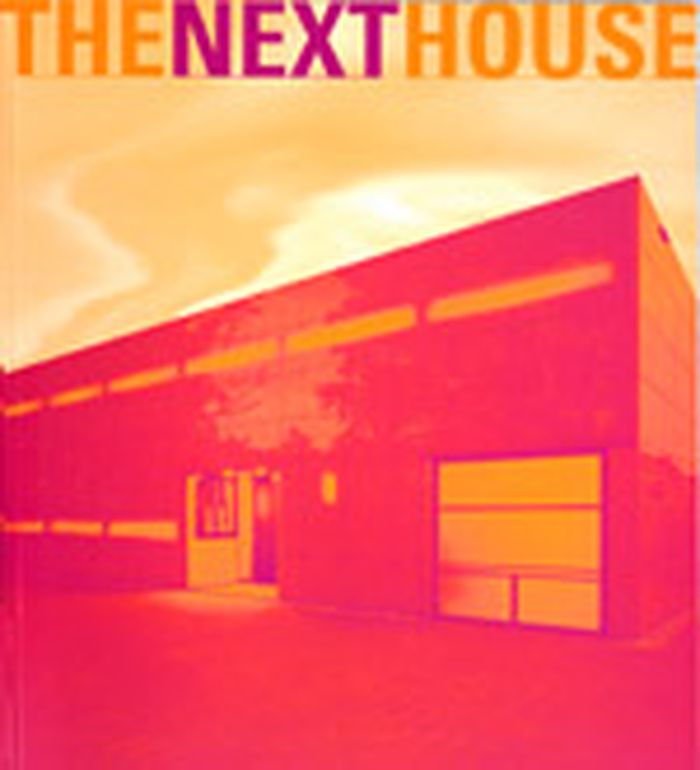
This book presents a selection of single-family homes. Designed by contemporary architects, they represent today's innovation. With over 300 color photographs of interiors and exteriors, and architectural plans and details.
$55.95
(available to order)
Summary:
This book presents a selection of single-family homes. Designed by contemporary architects, they represent today's innovation. With over 300 color photographs of interiors and exteriors, and architectural plans and details.
Subject:
Residential Architecture
Residential Architecture
Publication:
June 2002, New York
June 2002, New York
Title:
The next house
Actions:
Price:
$55.95
(available to order)
Summary:
This book presents a selection of single-family homes. Designed by contemporary architects, they represent today's innovation. With over 300 color photographs of interiors and exteriors, and architectural plans and details.
The next house
Actions:
Price:
$55.95
(available to order)
Summary:
This book presents a selection of single-family homes. Designed by contemporary architects, they represent today's innovation. With over 300 color photographs of interiors and exteriors, and architectural plans and details.
Form:
books
books
Publication:
June 2002, New York
June 2002, New York
Subject:
Residential Architecture
Residential Architecture


