


974 Results
Form:
books
books

Title:
Alanis Obomsawin: Lifework
Alanis Obomsawin: Lifework
Actions:
Price:
$79.00
(available to order)
Summary:
Never shying away from controversy, Obomsawin’s films have played a critical role in exposing ongoing systemic bias towards Indigenous populations—from fishing rights and education to health care and treaty violations. Obomsawin is also a graphic artist, and she incorporates her often dream-inspired etchings and prints into many of her films. This volume includes(...)
$79.00
(available to order)
Summary:
Never shying away from controversy, Obomsawin’s films have played a critical role in exposing ongoing systemic bias towards Indigenous populations—from fishing rights and education to health care and treaty violations. Obomsawin is also a graphic artist, and she incorporates her often dream-inspired etchings and prints into many of her films. This volume includes(...)
Title:
Alanis Obomsawin: Lifework
Actions:
Price:
$79.00
(available to order)
Summary:
Never shying away from controversy, Obomsawin’s films have played a critical role in exposing ongoing systemic bias towards Indigenous populations—from fishing rights and education to health care and treaty violations. Obomsawin is also a graphic artist, and she incorporates her often dream-inspired etchings and prints into many of her films. This volume includes illuminating essays exploring Obomsawin’s practice and mission as well as personal commentary from collaborators, archival materials, and photographs from the filmmaker’s personal life and professional exploits. As Obomsawin closes in on her ninth decade of life—and fifth decade behind the camera—this beautifully illustrated record of her astounding body of work and tireless efforts on behalf of Indigenous peoples and culture is an inspiring celebration of the power of film to dramatically change the course of history.
Alanis Obomsawin: Lifework
Actions:
Price:
$79.00
(available to order)
Summary:
Never shying away from controversy, Obomsawin’s films have played a critical role in exposing ongoing systemic bias towards Indigenous populations—from fishing rights and education to health care and treaty violations. Obomsawin is also a graphic artist, and she incorporates her often dream-inspired etchings and prints into many of her films. This volume includes illuminating essays exploring Obomsawin’s practice and mission as well as personal commentary from collaborators, archival materials, and photographs from the filmmaker’s personal life and professional exploits. As Obomsawin closes in on her ninth decade of life—and fifth decade behind the camera—this beautifully illustrated record of her astounding body of work and tireless efforts on behalf of Indigenous peoples and culture is an inspiring celebration of the power of film to dramatically change the course of history.
Form:
books
books
Publication:
May 2022
May 2022
Subject:
Canadian art
Canadian art
Form:
books
books

Price:
$88.00
(available to order)
Summary:
The Distant Early Warning Line, also known as the DEW Line, was a system of radar stations in the northern Arctic region of Canada, with additional stations along the north coast and Aleutian Islands of Alaska and the Faroe Islands, Greenland, and Iceland. It intended to detect incoming bombers of the Soviet Union during the Cold War and provide early warning of any sea(...)
$88.00
(available to order)
Summary:
The Distant Early Warning Line, also known as the DEW Line, was a system of radar stations in the northern Arctic region of Canada, with additional stations along the north coast and Aleutian Islands of Alaska and the Faroe Islands, Greenland, and Iceland. It intended to detect incoming bombers of the Soviet Union during the Cold War and provide early warning of any sea(...)
Title:
Early warning systems: Art, the DEW line, and an arctic on the front lines
Actions:
Price:
$88.00
(available to order)
Summary:
The Distant Early Warning Line, also known as the DEW Line, was a system of radar stations in the northern Arctic region of Canada, with additional stations along the north coast and Aleutian Islands of Alaska and the Faroe Islands, Greenland, and Iceland. It intended to detect incoming bombers of the Soviet Union during the Cold War and provide early warning of any sea and land invasion. Today, the Arctic is seen as a place primed for data storage and vaults––doomsday structures with a utilitarian vernacular of architecture, protecting the "knowledge" of places further south rather than recognizing the local presence and expertise of place and Indigenous lifeways and Indigenous science. This book looks at the role of artists as early warning systems and explores the ways we connect and disconnect place and people through technology and the ideas of boundaries.
Early warning systems: Art, the DEW line, and an arctic on the front lines
Actions:
Price:
$88.00
(available to order)
Summary:
The Distant Early Warning Line, also known as the DEW Line, was a system of radar stations in the northern Arctic region of Canada, with additional stations along the north coast and Aleutian Islands of Alaska and the Faroe Islands, Greenland, and Iceland. It intended to detect incoming bombers of the Soviet Union during the Cold War and provide early warning of any sea and land invasion. Today, the Arctic is seen as a place primed for data storage and vaults––doomsday structures with a utilitarian vernacular of architecture, protecting the "knowledge" of places further south rather than recognizing the local presence and expertise of place and Indigenous lifeways and Indigenous science. This book looks at the role of artists as early warning systems and explores the ways we connect and disconnect place and people through technology and the ideas of boundaries.
Form:
books
books
Publication:
April 2025
April 2025
Subject:
Art Theory
Art Theory
Form:
books
books

Price:
$32.95
(available to order)
Summary:
How does material culture become data? Why does this matter, and for whom? As the cultures of Indigenous peoples in North America were mined for scientific knowledge, years of organizing, classifying, and cataloguing hardened into accepted categories, naming conventions, and tribal affiliations – much of it wrong. 'Cataloguing Culture' examines how colonialism operates(...)
$32.95
(available to order)
Summary:
How does material culture become data? Why does this matter, and for whom? As the cultures of Indigenous peoples in North America were mined for scientific knowledge, years of organizing, classifying, and cataloguing hardened into accepted categories, naming conventions, and tribal affiliations – much of it wrong. 'Cataloguing Culture' examines how colonialism operates(...)
Title:
Cataloguing culture: legacies of colonialism in museum documentation
Actions:
Price:
$32.95
(available to order)
Summary:
How does material culture become data? Why does this matter, and for whom? As the cultures of Indigenous peoples in North America were mined for scientific knowledge, years of organizing, classifying, and cataloguing hardened into accepted categories, naming conventions, and tribal affiliations – much of it wrong. 'Cataloguing Culture' examines how colonialism operates in museum bureaucracies. Using the Smithsonian’s National Museum of Natural History as her reference, Hannah Turner organizes her study by the technologies framing museum work over two hundred years: field records, the ledger, the card catalogue, the punch card, and eventually the database. She examines how categories were applied to ethnographic material culture and became routine throughout federal collecting institutions. As Indigenous communities encounter the documentary traces of imperialism while attempting to reclaim what is theirs, this publication shines a light on access to and return of cultural heritage.
Cataloguing culture: legacies of colonialism in museum documentation
Actions:
Price:
$32.95
(available to order)
Summary:
How does material culture become data? Why does this matter, and for whom? As the cultures of Indigenous peoples in North America were mined for scientific knowledge, years of organizing, classifying, and cataloguing hardened into accepted categories, naming conventions, and tribal affiliations – much of it wrong. 'Cataloguing Culture' examines how colonialism operates in museum bureaucracies. Using the Smithsonian’s National Museum of Natural History as her reference, Hannah Turner organizes her study by the technologies framing museum work over two hundred years: field records, the ledger, the card catalogue, the punch card, and eventually the database. She examines how categories were applied to ethnographic material culture and became routine throughout federal collecting institutions. As Indigenous communities encounter the documentary traces of imperialism while attempting to reclaim what is theirs, this publication shines a light on access to and return of cultural heritage.
Form:
books
books
Publication:
December 2020
December 2020
Subject:
Museology
Museology
Form:
books
books

Actions:
Price:
$42.95
(available to order)
Summary:
After visiting hundreds of museums across Alberta, Lianne McTavish chronicles some of the most challenging and unexpected sites where the idea of the museum is being reshaped. Addressing themes of place, land, colonization, rurality, heritage, childhood, and play, McTavish reveals the museum visitor as multifaceted, with locals and tourists often interpreting museums(...)
$42.95
(available to order)
Summary:
After visiting hundreds of museums across Alberta, Lianne McTavish chronicles some of the most challenging and unexpected sites where the idea of the museum is being reshaped. Addressing themes of place, land, colonization, rurality, heritage, childhood, and play, McTavish reveals the museum visitor as multifaceted, with locals and tourists often interpreting museums(...)
Title:
Voluntary detours: small town and rural museums
Actions:
Price:
$42.95
(available to order)
Summary:
After visiting hundreds of museums across Alberta, Lianne McTavish chronicles some of the most challenging and unexpected sites where the idea of the museum is being reshaped. Addressing themes of place, land, colonization, rurality, heritage, childhood, and play, McTavish reveals the museum visitor as multifaceted, with locals and tourists often interpreting museums very differently. Case studies include the World Famous Gopher Hole Museum, Fort Chipewyan Bicentennial Museum, Blackfoot Crossing Historical Park, and the Museum of Fear and Wonder. A key chapter analyzing sites devoted to resource extraction explores how these places promote settler colonial understandings of land use. By contrast, Indigenous museums and cultural centres defy colonial messages in displays that adapt and refuse conventional museum formats. Honouring local, rural, and Indigenous knowledge, 'Voluntary Detours' enriches critical accounts of the past, present, and future of museums.
Voluntary detours: small town and rural museums
Actions:
Price:
$42.95
(available to order)
Summary:
After visiting hundreds of museums across Alberta, Lianne McTavish chronicles some of the most challenging and unexpected sites where the idea of the museum is being reshaped. Addressing themes of place, land, colonization, rurality, heritage, childhood, and play, McTavish reveals the museum visitor as multifaceted, with locals and tourists often interpreting museums very differently. Case studies include the World Famous Gopher Hole Museum, Fort Chipewyan Bicentennial Museum, Blackfoot Crossing Historical Park, and the Museum of Fear and Wonder. A key chapter analyzing sites devoted to resource extraction explores how these places promote settler colonial understandings of land use. By contrast, Indigenous museums and cultural centres defy colonial messages in displays that adapt and refuse conventional museum formats. Honouring local, rural, and Indigenous knowledge, 'Voluntary Detours' enriches critical accounts of the past, present, and future of museums.
Form:
books
books
Publication:
October 2021
October 2021
Subject:
Museology
Museology
Form:
books
books
Title:
Martín Chambi: Photography
Martín Chambi: Photography
Actions:
Price:
$75.00
(available to order)
Summary:
Of Indigenous origin, Peruvian photographer Martín Chambi (1891–1973) dedicated a large part of his life to photographing the Peruvian Andes, reclaiming the pre-Hispanic past through images of Inca ruins and portraits of life in Andean communities in the early 20th century. Chambi’s work brings a new perspective to photography of the time, highlighting the emerging(...)
$75.00
(available to order)
Summary:
Of Indigenous origin, Peruvian photographer Martín Chambi (1891–1973) dedicated a large part of his life to photographing the Peruvian Andes, reclaiming the pre-Hispanic past through images of Inca ruins and portraits of life in Andean communities in the early 20th century. Chambi’s work brings a new perspective to photography of the time, highlighting the emerging(...)
Title:
Martín Chambi: Photography
Actions:
Price:
$75.00
(available to order)
Summary:
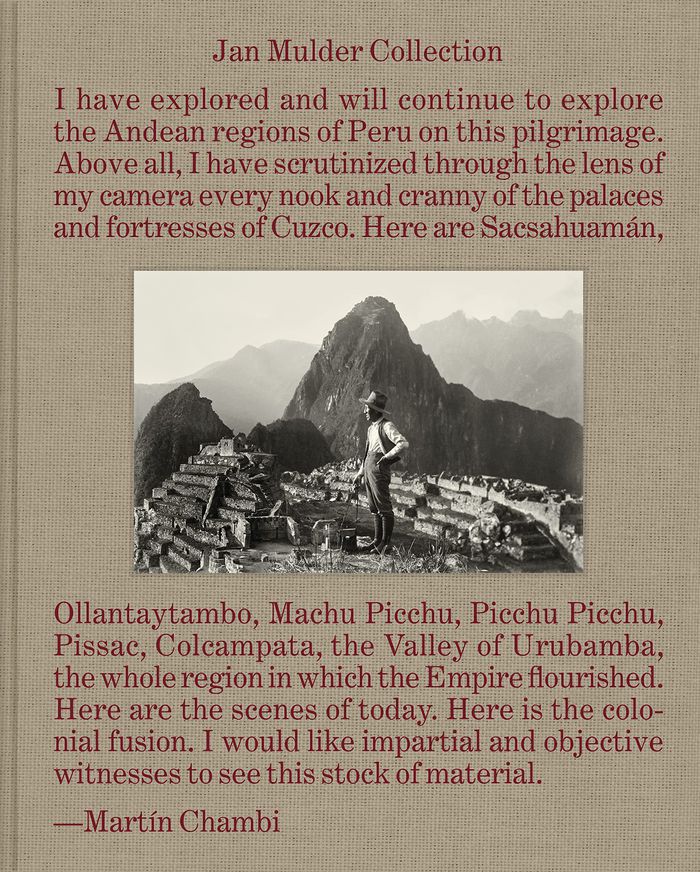
Of Indigenous origin, Peruvian photographer Martín Chambi (1891–1973) dedicated a large part of his life to photographing the Peruvian Andes, reclaiming the pre-Hispanic past through images of Inca ruins and portraits of life in Andean communities in the early 20th century. Chambi’s work brings a new perspective to photography of the time, highlighting the emerging Indigenous discourse that was starting to gain force in South America. While he was not the first to photograph Machu Picchu, Chambi was among the first Peruvian chroniclers of the Inca citadel. Drawing on Machu Picchu’s geometric forms, Chambi’s work entered a new phase in which shape, space and texture build toward more complex compositions and starker contrasts, making him an emblem of contemporary documentary photography in Peru and Latin America. This clothbound volume compiles 170 of Chambi’s black-and-white images.
Martín Chambi: Photography
Actions:
Price:
$75.00
(available to order)
Summary:
Of Indigenous origin, Peruvian photographer Martín Chambi (1891–1973) dedicated a large part of his life to photographing the Peruvian Andes, reclaiming the pre-Hispanic past through images of Inca ruins and portraits of life in Andean communities in the early 20th century. Chambi’s work brings a new perspective to photography of the time, highlighting the emerging Indigenous discourse that was starting to gain force in South America. While he was not the first to photograph Machu Picchu, Chambi was among the first Peruvian chroniclers of the Inca citadel. Drawing on Machu Picchu’s geometric forms, Chambi’s work entered a new phase in which shape, space and texture build toward more complex compositions and starker contrasts, making him an emblem of contemporary documentary photography in Peru and Latin America. This clothbound volume compiles 170 of Chambi’s black-and-white images.
Form:
books
books
Publication:
March 2021
March 2021
Subject:
Photography monographs
Photography monographs
Form:
books
books

Actions:
Price:
$32.95
(available to order)
Summary:
In "Winterlust", a farmer painstakingly photographs five thousand snowflakes, each one dramatically different from the next. Indigenous peoples thrive on frozen terrain, where famous explorers perish. Icicles reach deep underwater, then explode. Rooms warmed by crackling fires fill with scents of cinnamon, cloves, and pine. Skis carve into powdery slopes, and iceboats(...)
$32.95
(available to order)
Summary:
In "Winterlust", a farmer painstakingly photographs five thousand snowflakes, each one dramatically different from the next. Indigenous peoples thrive on frozen terrain, where famous explorers perish. Icicles reach deep underwater, then explode. Rooms warmed by crackling fires fill with scents of cinnamon, cloves, and pine. Skis carve into powdery slopes, and iceboats(...)
Title:
Winterlust: finding beauty in the fiercest season
Actions:
Price:
$32.95
(available to order)
Summary:
In "Winterlust", a farmer painstakingly photographs five thousand snowflakes, each one dramatically different from the next. Indigenous peoples thrive on frozen terrain, where famous explorers perish. Icicles reach deep underwater, then explode. Rooms warmed by crackling fires fill with scents of cinnamon, cloves, and pine. Skis carve into powdery slopes, and iceboats traverse glacial lakes.
Winterlust: finding beauty in the fiercest season
Actions:
Price:
$32.95
(available to order)
Summary:
In "Winterlust", a farmer painstakingly photographs five thousand snowflakes, each one dramatically different from the next. Indigenous peoples thrive on frozen terrain, where famous explorers perish. Icicles reach deep underwater, then explode. Rooms warmed by crackling fires fill with scents of cinnamon, cloves, and pine. Skis carve into powdery slopes, and iceboats traverse glacial lakes.
Form:
books
books
Publication:
November 2019
November 2019
Subject:
Literature and poetry
Literature and poetry
Form:
books
books

Price:
$25.00
(available in store)
Summary:
As Indigenous scientist and author of "Braiding sweetgrass" Robin Wall Kimmerer harvests serviceberries alongside the birds, she considers the ethic of reciprocity that lies at the heart of the gift economy. How, she asks, can we learn from Indigenous wisdom and the plant world to reimagine what we value most? Our economy is rooted in scarcity, competition, and the(...)
$25.00
(available in store)
Summary:
As Indigenous scientist and author of "Braiding sweetgrass" Robin Wall Kimmerer harvests serviceberries alongside the birds, she considers the ethic of reciprocity that lies at the heart of the gift economy. How, she asks, can we learn from Indigenous wisdom and the plant world to reimagine what we value most? Our economy is rooted in scarcity, competition, and the(...)
Subject:
Environment and environmental theory
Environment and environmental theory
Publication:
November 2024
November 2024
Title:
The serviceberry: Abundance and reciprocity in the natural world
Actions:
Price:
$25.00
(available in store)
Summary:
As Indigenous scientist and author of "Braiding sweetgrass" Robin Wall Kimmerer harvests serviceberries alongside the birds, she considers the ethic of reciprocity that lies at the heart of the gift economy. How, she asks, can we learn from Indigenous wisdom and the plant world to reimagine what we value most? Our economy is rooted in scarcity, competition, and the hoarding of resources, and we have surrendered our values to a system that actively harms what we love. Meanwhile, the serviceberry’s relationship with the natural world is an embodiment of reciprocity, interconnectedness, and gratitude. The tree distributes its wealth—its abundance of sweet, juicy berries—to meet the needs of its natural community. And this distribution ensures its own survival. As Kimmerer explains, "Serviceberries show us another model, one based upon reciprocity, where wealth comes from the quality of your relationships, not from the illusion of self-sufficiency."
The serviceberry: Abundance and reciprocity in the natural world
Actions:
Price:
$25.00
(available in store)
Summary:
As Indigenous scientist and author of "Braiding sweetgrass" Robin Wall Kimmerer harvests serviceberries alongside the birds, she considers the ethic of reciprocity that lies at the heart of the gift economy. How, she asks, can we learn from Indigenous wisdom and the plant world to reimagine what we value most? Our economy is rooted in scarcity, competition, and the hoarding of resources, and we have surrendered our values to a system that actively harms what we love. Meanwhile, the serviceberry’s relationship with the natural world is an embodiment of reciprocity, interconnectedness, and gratitude. The tree distributes its wealth—its abundance of sweet, juicy berries—to meet the needs of its natural community. And this distribution ensures its own survival. As Kimmerer explains, "Serviceberries show us another model, one based upon reciprocity, where wealth comes from the quality of your relationships, not from the illusion of self-sufficiency."
Form:
books
books
Publication:
November 2024
November 2024
Subject:
Environment and environmental theory
Environment and environmental theory
Form:
books
books

Actions:
Price:
$25.95
(available in store)
Summary:
From the excesses of world expositions to myths of better living through technology, modernist design, in its European-based guises, has excluded and oppressed the very people whose lands and lives it reshaped. This book first asks how modernist design has encompassed and advanced the harmful project of colonization—then shows how design might address these harms by(...)
$25.95
(available in store)
Summary:
From the excesses of world expositions to myths of better living through technology, modernist design, in its European-based guises, has excluded and oppressed the very people whose lands and lives it reshaped. This book first asks how modernist design has encompassed and advanced the harmful project of colonization—then shows how design might address these harms by(...)
Title:
Decolonizing design: A cultural justice guidebook
Actions:
Price:
$25.95
(available in store)
Summary:
From the excesses of world expositions to myths of better living through technology, modernist design, in its European-based guises, has excluded and oppressed the very people whose lands and lives it reshaped. This book first asks how modernist design has encompassed and advanced the harmful project of colonization—then shows how design might address these harms by recentering its theory and practice in global Indigenous cultures and histories. A leading figure in the movement to decolonize design, Dori Tunstall uses hard-hitting real-life examples and case studies drawn from over fifteen years of working to transform institutions to better reflect the lived experiences of Indigenous, Black, and People of Color communities. Her book is at once enlightening, inspiring, and practical, interweaving her lived experiences with extensive research to show what decolonizing design means, how it heals, and how to practice it in our institutions today.
Decolonizing design: A cultural justice guidebook
Actions:
Price:
$25.95
(available in store)
Summary:
From the excesses of world expositions to myths of better living through technology, modernist design, in its European-based guises, has excluded and oppressed the very people whose lands and lives it reshaped. This book first asks how modernist design has encompassed and advanced the harmful project of colonization—then shows how design might address these harms by recentering its theory and practice in global Indigenous cultures and histories. A leading figure in the movement to decolonize design, Dori Tunstall uses hard-hitting real-life examples and case studies drawn from over fifteen years of working to transform institutions to better reflect the lived experiences of Indigenous, Black, and People of Color communities. Her book is at once enlightening, inspiring, and practical, interweaving her lived experiences with extensive research to show what decolonizing design means, how it heals, and how to practice it in our institutions today.
Form:
books
books
Publication:
February 2023
February 2023
Subject:
Social
Social
Form:
books
books

Actions:
Price:
$70.00
(available to order)
Summary:
Three hundred years ago, intellectuals of the European Enlightenment constructed a mythology of technology. Influenced by a confluence of humanism, colonialism, and racism, this mythology ignored local wisdom and indigenous innovation, deeming it primitive. Today, we have slowly come to realize that the legacy of this mythology is haunting us. Designers understand the(...)
$70.00
(available to order)
Summary:
Three hundred years ago, intellectuals of the European Enlightenment constructed a mythology of technology. Influenced by a confluence of humanism, colonialism, and racism, this mythology ignored local wisdom and indigenous innovation, deeming it primitive. Today, we have slowly come to realize that the legacy of this mythology is haunting us. Designers understand the(...)
Title:
Lo-Tek. Design by radical indigenism
Actions:
Price:
$70.00
(available to order)
Summary:
Three hundred years ago, intellectuals of the European Enlightenment constructed a mythology of technology. Influenced by a confluence of humanism, colonialism, and racism, this mythology ignored local wisdom and indigenous innovation, deeming it primitive. Today, we have slowly come to realize that the legacy of this mythology is haunting us. Designers understand the urgency of reducing humanity’s negative environmental impact, yet perpetuate the same mythology of technology that relies on exploiting nature. Responding to climate change by building hard infrastructures and favoring high-tech homogenous design, we are ignoring millennia-old knowledge of how to live in symbiosis with nature. Without implementing soft systems that use biodiversity as a building block, designs remain inherently unsustainable. Lo-TEK, derived from Traditional Ecological Knowledge, is a cumulative body of multigenerational knowledge, practices, and beliefs, countering the idea that indigenous innovation is primitive and exists isolated from technology. It is sophisticated and designed to sustainably work with complex ecosystems.
Lo-Tek. Design by radical indigenism
Actions:
Price:
$70.00
(available to order)
Summary:
Three hundred years ago, intellectuals of the European Enlightenment constructed a mythology of technology. Influenced by a confluence of humanism, colonialism, and racism, this mythology ignored local wisdom and indigenous innovation, deeming it primitive. Today, we have slowly come to realize that the legacy of this mythology is haunting us. Designers understand the urgency of reducing humanity’s negative environmental impact, yet perpetuate the same mythology of technology that relies on exploiting nature. Responding to climate change by building hard infrastructures and favoring high-tech homogenous design, we are ignoring millennia-old knowledge of how to live in symbiosis with nature. Without implementing soft systems that use biodiversity as a building block, designs remain inherently unsustainable. Lo-TEK, derived from Traditional Ecological Knowledge, is a cumulative body of multigenerational knowledge, practices, and beliefs, countering the idea that indigenous innovation is primitive and exists isolated from technology. It is sophisticated and designed to sustainably work with complex ecosystems.
Form:
books
books
Publication:
January 2020
January 2020
Subject:
Green Architecture
Green Architecture
Form:
books
books

Actions:
Price:
$105.00
(available to order)
Summary:
During the last five decades we have witnessed an increase in activity among artists identifying themselves as Sami, the only recognised indigenous people of Scandinavia. At the same time, art and duodji (traditional Sami art and craft) have been organized and institutionalized, not least by the Sami artists themselves. ''Sami art and aesthetics'' discusses and highlights(...)
$105.00
(available to order)
Summary:
During the last five decades we have witnessed an increase in activity among artists identifying themselves as Sami, the only recognised indigenous people of Scandinavia. At the same time, art and duodji (traditional Sami art and craft) have been organized and institutionalized, not least by the Sami artists themselves. ''Sami art and aesthetics'' discusses and highlights(...)
Title:
Sami art and aesthetics: Contemporary perspectives
Actions:
Price:
$105.00
(available to order)
Summary:
During the last five decades we have witnessed an increase in activity among artists identifying themselves as Sami, the only recognised indigenous people of Scandinavia. At the same time, art and duodji (traditional Sami art and craft) have been organized and institutionalized, not least by the Sami artists themselves. ''Sami art and aesthetics'' discusses and highlights these developments and places them in historical and contemporary contexts for an international audience. At stake are complex, changing terms regarding the creative and the political agencies. The question is not how indigeneity, identity, people, art, duodji, and aesthetics correspond to conventional Western ideas, rather it is how they interact with the Sami and their neighbouring cultures and societies. The volume is written by some of the foremost art historians and literary scholars in Sami art, craft, architecture, culture, and indigenous studies. Artists presented include Johan Turi, Ivar Jaks, Outi Pieski, Folke Fjellstrom, Katarina Pirak Sikku, Geir Tore Holm, and Silje Figenschou Thoresen.
Sami art and aesthetics: Contemporary perspectives
Actions:
Price:
$105.00
(available to order)
Summary:
During the last five decades we have witnessed an increase in activity among artists identifying themselves as Sami, the only recognised indigenous people of Scandinavia. At the same time, art and duodji (traditional Sami art and craft) have been organized and institutionalized, not least by the Sami artists themselves. ''Sami art and aesthetics'' discusses and highlights these developments and places them in historical and contemporary contexts for an international audience. At stake are complex, changing terms regarding the creative and the political agencies. The question is not how indigeneity, identity, people, art, duodji, and aesthetics correspond to conventional Western ideas, rather it is how they interact with the Sami and their neighbouring cultures and societies. The volume is written by some of the foremost art historians and literary scholars in Sami art, craft, architecture, culture, and indigenous studies. Artists presented include Johan Turi, Ivar Jaks, Outi Pieski, Folke Fjellstrom, Katarina Pirak Sikku, Geir Tore Holm, and Silje Figenschou Thoresen.
Form:
books
books
Publication:
July 2017
July 2017
Subject:
Current Exhibitions
Current Exhibitions


