


866 Results
Form:
books
books
Actions:
Price:
$49.95
(available to order)
Summary:
Over the past decade, a seismic shift in economic and political forces has transformed life in the second-largest city on the West Coast, situated at the most heavily trafficked international border crossing in the world. Tijuana’s newfound wealth and haphazard expansion have changed patterns of migration for the city’s many artists, who once routinely moved north to Los(...)
$49.95
(available to order)
Summary:
Over the past decade, a seismic shift in economic and political forces has transformed life in the second-largest city on the West Coast, situated at the most heavily trafficked international border crossing in the world. Tijuana’s newfound wealth and haphazard expansion have changed patterns of migration for the city’s many artists, who once routinely moved north to Los(...)
Title:
Strange new world : art and design from Tijuana
Actions:
Price:
$49.95
(available to order)
Summary:
Over the past decade, a seismic shift in economic and political forces has transformed life in the second-largest city on the West Coast, situated at the most heavily trafficked international border crossing in the world. Tijuana’s newfound wealth and haphazard expansion have changed patterns of migration for the city’s many artists, who once routinely moved north to Los Angeles but are now staying or returning, and being joined by friends from Mexico City and beyond. This flourishing, strengthening artistic community has responded to the city’s accelerated evolution with a broad range of work, from painting to conceptually driven installations; from street-level digital video to ambitious photo-documentation, filmmaking and political work; from architectural proposals to product design associated with the "Nortec" musical movement. The work gathered in "Strange new world" embraces Tijuana as a paradigm of a new postmodern form of urbanization shaped by the pressures of economic globalization and cultural transnationalism since 1994. It struggles to make sense of new realities changing the ways in which people live in cities around the globe. Like Aldous Huxley's Brave New World, it is part science fiction, part political commentary and part artistic revolution and cultural critique. Arranged around the concepts of the urban theorist Michael Smith, it features work by ERRE, Einar and Jamex de la Torre and Yvonne Venegas, among others.
Strange new world : art and design from Tijuana
Actions:
Price:
$49.95
(available to order)
Summary:
Over the past decade, a seismic shift in economic and political forces has transformed life in the second-largest city on the West Coast, situated at the most heavily trafficked international border crossing in the world. Tijuana’s newfound wealth and haphazard expansion have changed patterns of migration for the city’s many artists, who once routinely moved north to Los Angeles but are now staying or returning, and being joined by friends from Mexico City and beyond. This flourishing, strengthening artistic community has responded to the city’s accelerated evolution with a broad range of work, from painting to conceptually driven installations; from street-level digital video to ambitious photo-documentation, filmmaking and political work; from architectural proposals to product design associated with the "Nortec" musical movement. The work gathered in "Strange new world" embraces Tijuana as a paradigm of a new postmodern form of urbanization shaped by the pressures of economic globalization and cultural transnationalism since 1994. It struggles to make sense of new realities changing the ways in which people live in cities around the globe. Like Aldous Huxley's Brave New World, it is part science fiction, part political commentary and part artistic revolution and cultural critique. Arranged around the concepts of the urban theorist Michael Smith, it features work by ERRE, Einar and Jamex de la Torre and Yvonne Venegas, among others.
Form:
books
books
Publication:
August 2006, La Jolla
August 2006, La Jolla
Subject:
Contemporary Art Monographs
Contemporary Art Monographs
Form:
books
books
Price:
$38.95
(available to order)
Summary:
Throughout the twentieth century, architects in Italy have attempted to define the role of architecture under diverse political systems, from the monarchy of the first seventy years since Italian unification, to the 21 years of Fascist control, to the post-Second World War parliamentary republic. At the same time, Italy holds some of the most prized architecture and art(...)
$38.95
(available to order)
Summary:
Throughout the twentieth century, architects in Italy have attempted to define the role of architecture under diverse political systems, from the monarchy of the first seventy years since Italian unification, to the 21 years of Fascist control, to the post-Second World War parliamentary republic. At the same time, Italy holds some of the most prized architecture and art(...)
Title:
Italy
Actions:
Price:
$38.95
(available to order)
Summary:
Throughout the twentieth century, architects in Italy have attempted to define the role of architecture under diverse political systems, from the monarchy of the first seventy years since Italian unification, to the 21 years of Fascist control, to the post-Second World War parliamentary republic. At the same time, Italy holds some of the most prized architecture and art in the world, from antiquity to the baroque, packed into its dense historic city centres, which planners and politicians have negotiated as they struggled to cope with massive migration from the countryside to the city. Diane Ghirardo addresses these and other issues by considering modern architectural production in Italy from the late nineteenth century to the present day within a clear presentation of the larger historical, social and political contexts. From the post-unification efforts to identify a distinctly Italian architectural language to the transformation of the urban environment in Italian cities undergoing industrialization in the late nineteenth and early twentieth centuries, Diane Ghirardo challenges received interpretations of modern architecture, as well as focusing on the subject of illegal building and responses to current ecological challenges. With up-to-date examples, both from the work of widely published architects in the largest cities and from throughout the peninsula, including small towns and rural areas, Italy provides a comprehensive view of the country’s modern built environment.
Italy
Actions:
Price:
$38.95
(available to order)
Summary:
Throughout the twentieth century, architects in Italy have attempted to define the role of architecture under diverse political systems, from the monarchy of the first seventy years since Italian unification, to the 21 years of Fascist control, to the post-Second World War parliamentary republic. At the same time, Italy holds some of the most prized architecture and art in the world, from antiquity to the baroque, packed into its dense historic city centres, which planners and politicians have negotiated as they struggled to cope with massive migration from the countryside to the city. Diane Ghirardo addresses these and other issues by considering modern architectural production in Italy from the late nineteenth century to the present day within a clear presentation of the larger historical, social and political contexts. From the post-unification efforts to identify a distinctly Italian architectural language to the transformation of the urban environment in Italian cities undergoing industrialization in the late nineteenth and early twentieth centuries, Diane Ghirardo challenges received interpretations of modern architecture, as well as focusing on the subject of illegal building and responses to current ecological challenges. With up-to-date examples, both from the work of widely published architects in the largest cities and from throughout the peninsula, including small towns and rural areas, Italy provides a comprehensive view of the country’s modern built environment.
Form:
books
books
Publication:
November 2011
November 2011
Subject:
Architecture since 1900, Europe
Architecture since 1900, Europe
Form:
books
books
Title:
The case for open borders
The case for open borders
Actions:
Price:
$30.95
(available to order)
Summary:
Because of restrictive borders, human beings suffer and die. Closed borders force migrants seeking safety and dignity to journey across seas, trudge through deserts, and clamber over barbed wire. In the last five years alone, at least 60,000 people have died or gone missing while attempting to cross a border. As we deny, cast out, and crack down, we have stripped borders(...)
$30.95
(available to order)
Summary:
Because of restrictive borders, human beings suffer and die. Closed borders force migrants seeking safety and dignity to journey across seas, trudge through deserts, and clamber over barbed wire. In the last five years alone, at least 60,000 people have died or gone missing while attempting to cross a border. As we deny, cast out, and crack down, we have stripped borders(...)
Title:
The case for open borders
Actions:
Price:
$30.95
(available to order)
Summary:
Because of restrictive borders, human beings suffer and die. Closed borders force migrants seeking safety and dignity to journey across seas, trudge through deserts, and clamber over barbed wire. In the last five years alone, at least 60,000 people have died or gone missing while attempting to cross a border. As we deny, cast out, and crack down, we have stripped borders of their creative potential — as lines of contact, catalyst, and blend — turning our thresholds into barricades. Brilliant and provocative, ''The Case for Open Borders'' deflates the mythology of national security through border lockdowns by revisiting their historical origins; it counters the conspiracies of immigration’s economic consequences; it urgently considers the challenges of climate change beyond the boundaries of narrow national identities. This book grounds its argument in the experiences and thinking of those on the frontlines of the crisis, spanning the world to do so. In each chapter, through detailed reporting, journalist and translator John Washington profiles a character impacted by borders. He adds to those portraits provocative analyses of the economics and ethics of bordering, concluding that if we are to seek justice or sustainability we must fight for open borders. In recent years, important thinkers have begun to urge a profoundly different approach to migration, but no book has made the argument as accessible or as compelling. Washington’s case shines with the multitudinous voices of people on the move, a portrait in miniature of what a world with open borders will give to our common future.
The case for open borders
Actions:
Price:
$30.95
(available to order)
Summary:
Because of restrictive borders, human beings suffer and die. Closed borders force migrants seeking safety and dignity to journey across seas, trudge through deserts, and clamber over barbed wire. In the last five years alone, at least 60,000 people have died or gone missing while attempting to cross a border. As we deny, cast out, and crack down, we have stripped borders of their creative potential — as lines of contact, catalyst, and blend — turning our thresholds into barricades. Brilliant and provocative, ''The Case for Open Borders'' deflates the mythology of national security through border lockdowns by revisiting their historical origins; it counters the conspiracies of immigration’s economic consequences; it urgently considers the challenges of climate change beyond the boundaries of narrow national identities. This book grounds its argument in the experiences and thinking of those on the frontlines of the crisis, spanning the world to do so. In each chapter, through detailed reporting, journalist and translator John Washington profiles a character impacted by borders. He adds to those portraits provocative analyses of the economics and ethics of bordering, concluding that if we are to seek justice or sustainability we must fight for open borders. In recent years, important thinkers have begun to urge a profoundly different approach to migration, but no book has made the argument as accessible or as compelling. Washington’s case shines with the multitudinous voices of people on the move, a portrait in miniature of what a world with open borders will give to our common future.
Form:
books
books
Publication:
February 2024
February 2024
Subject:
Social
Social
Form:
books
books
Title:
The Manifesta decade : debates on contemporary art exhibitions and biennials in post-wall Europe
The Manifesta decade : debates on contemporary art exhibitions and biennials in post-wall Europe
Actions:
Price:
$43.95
(available to order)
Summary:
Manifesta, the first itinerant European biennial for contemporary art, emerged in a post-wall, globalizing Europe. Founded in 1993, it organized traveling exhibitions aimed at providing a new framework for cultural exchange and collaboration between artists and curators from across the continent. "The Manifesta decade" marks Manifesta's ten years of exhibits with original(...)
$43.95
(available to order)
Summary:
Manifesta, the first itinerant European biennial for contemporary art, emerged in a post-wall, globalizing Europe. Founded in 1993, it organized traveling exhibitions aimed at providing a new framework for cultural exchange and collaboration between artists and curators from across the continent. "The Manifesta decade" marks Manifesta's ten years of exhibits with original(...)
Subject:
Museology
Museology
Publication:
September 2005, Cambridge, Mass.
September 2005, Cambridge, Mass.
Title:
The Manifesta decade : debates on contemporary art exhibitions and biennials in post-wall Europe
Actions:
Price:
$43.95
(available to order)
Summary:
Manifesta, the first itinerant European biennial for contemporary art, emerged in a post-wall, globalizing Europe. Founded in 1993, it organized traveling exhibitions aimed at providing a new framework for cultural exchange and collaboration between artists and curators from across the continent. "The Manifesta decade" marks Manifesta's ten years of exhibits with original essays, unpublished images, and texts that not only document the different Manifesta exhibits but also examine the cultural, curatorial, and political terrain of the Europe from which they sprang. Including contributions from philosophers, historians, and anthropologists, interviews with architect Rem Koolhaas and historian Jacques Le Goff, and essays by such curators and writers as Okwui Enwezor, Boris Groys, Maria Hlavajova, and Hans Ulrich Obrist, the collection traces the cultural and political developments of Europe in the 1990s. It reflects the debates incited by exhibitions such as "Magiciens de la terre", Documenta, and "After the wall" and explores the changing roles of curators and artists in the new geo-political context. The issues discussed include the effect of communism's collapse on Eastern Europe, the role of biennials in the context of globalization, and the ephemerality of exhibitions versus the permanence of the museum. The book's second section traces the history of Manifesta, from its conceptual foundations and contributions to artistic practices of the 1990s to the relationship of a roving biennial to themes of multiculturalism, migration and diaspora. At a moment when biennials continue to proliferate worldwide, "The Manifesta decade" takes Manifesta as a case study to look critically at the landscape from which new exhibition paradigms have emerged. The book's 100 images, both color and black and white, include unpublished installation shots of each Manifesta exhibition.
The Manifesta decade : debates on contemporary art exhibitions and biennials in post-wall Europe
Actions:
Price:
$43.95
(available to order)
Summary:
Manifesta, the first itinerant European biennial for contemporary art, emerged in a post-wall, globalizing Europe. Founded in 1993, it organized traveling exhibitions aimed at providing a new framework for cultural exchange and collaboration between artists and curators from across the continent. "The Manifesta decade" marks Manifesta's ten years of exhibits with original essays, unpublished images, and texts that not only document the different Manifesta exhibits but also examine the cultural, curatorial, and political terrain of the Europe from which they sprang. Including contributions from philosophers, historians, and anthropologists, interviews with architect Rem Koolhaas and historian Jacques Le Goff, and essays by such curators and writers as Okwui Enwezor, Boris Groys, Maria Hlavajova, and Hans Ulrich Obrist, the collection traces the cultural and political developments of Europe in the 1990s. It reflects the debates incited by exhibitions such as "Magiciens de la terre", Documenta, and "After the wall" and explores the changing roles of curators and artists in the new geo-political context. The issues discussed include the effect of communism's collapse on Eastern Europe, the role of biennials in the context of globalization, and the ephemerality of exhibitions versus the permanence of the museum. The book's second section traces the history of Manifesta, from its conceptual foundations and contributions to artistic practices of the 1990s to the relationship of a roving biennial to themes of multiculturalism, migration and diaspora. At a moment when biennials continue to proliferate worldwide, "The Manifesta decade" takes Manifesta as a case study to look critically at the landscape from which new exhibition paradigms have emerged. The book's 100 images, both color and black and white, include unpublished installation shots of each Manifesta exhibition.
Form:
books
books
Publication:
September 2005, Cambridge, Mass.
September 2005, Cambridge, Mass.
Subject:
Museology
Museology
Form:
books
books
Price:
$59.95
(available to order)
Summary:
Cet ouvrage retrace l'histoire méconnue d'un secteur du logement populaire à Paris : les «garnis», à savoir les maisons et hôtels meublés à destination des salariés modestes et des ouvriers. Certains drames de l'année 2005 (incendie de l'hôtel Paris-Opéra : 25 morts) ont de nouveau attiré l'attention sur les rares hôtels meublés qui subsistent aujourd'hui, vétustes et(...)
$59.95
(available to order)
Summary:
Cet ouvrage retrace l'histoire méconnue d'un secteur du logement populaire à Paris : les «garnis», à savoir les maisons et hôtels meublés à destination des salariés modestes et des ouvriers. Certains drames de l'année 2005 (incendie de l'hôtel Paris-Opéra : 25 morts) ont de nouveau attiré l'attention sur les rares hôtels meublés qui subsistent aujourd'hui, vétustes et(...)
Title:
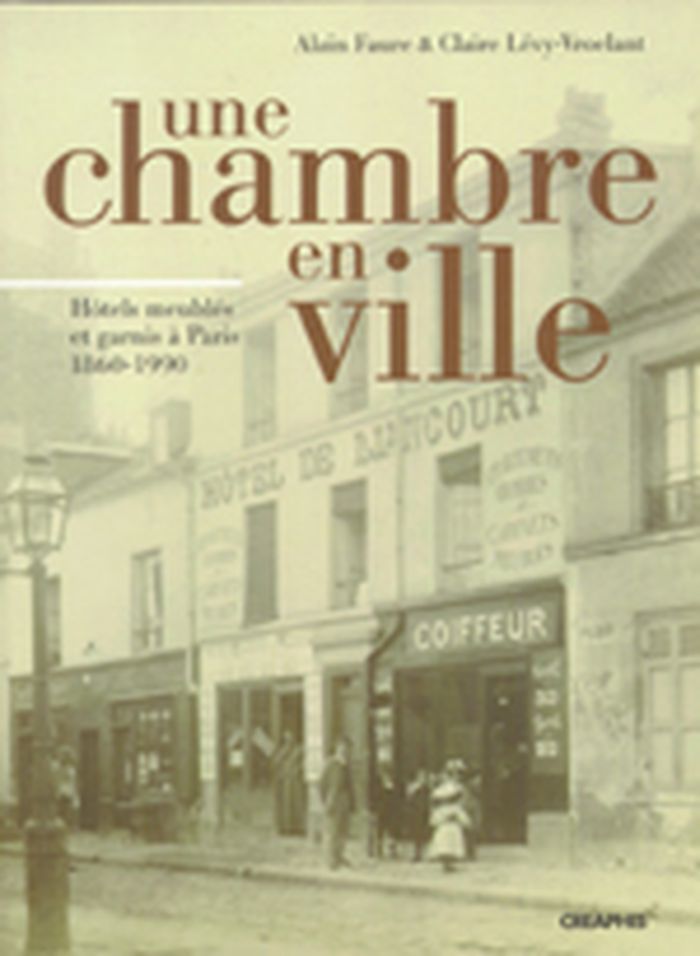
Une chambre en ville : hôtels meublés et garnis à Paris, 1860-1990
Actions:
Price:
$59.95
(available to order)
Summary:
Cet ouvrage retrace l'histoire méconnue d'un secteur du logement populaire à Paris : les «garnis», à savoir les maisons et hôtels meublés à destination des salariés modestes et des ouvriers. Certains drames de l'année 2005 (incendie de l'hôtel Paris-Opéra : 25 morts) ont de nouveau attiré l'attention sur les rares hôtels meublés qui subsistent aujourd'hui, vétustes et surpeuplés, signe de la pénurie de logements pour les plus démunis. Or, jadis, ces établissements pullulaient dans Paris : près de 10000 logeurs en 1880, et près de 200 000 personnes logées ; au tout début des années 1930, avant la crise économique, près de 350 000 Parisiens (11 % de la population de la capitale !) ne vivaient pas dans leurs meubles. Le migrant d'origine provinciale ou étrangère venant à Paris pour travailler s'installait tout naturellement à l'hôtel. Avoir une chambre en ville, c'était le gage banal d'une indépendance minimum. Cette fonction de sas valait surtout pour les hommes; les femmes, à leur arrivée à Paris, occupaient plutôt des emplois où elles étaient nourries et logées. Avec la crise économique des années 1930, le secteur commença un lent déclin. Au moment de la crise du logement des années 1950, l'hôtel meublé retrouva un second souffle. Le déclin s'accéléra ensuite dans les années 1960. Le garni était devenu dans l'opinion et pour l'État synonyme de taudis et de logement insalubre, destructeur de la famille et de la morale et une partie de ses habitants put accéder au logement social de masse. Subsistèrent longtemps des formes particulières d'accueil des plus pauvres : vieilles maisons insalubres du centre et des faubourgs, bidonvilles, foyers de travailleurs, cités de transit... Rôle rempli auparavant - et souvent infiniment mieux - par le garni. Maintenus en vie comme substitut dérisoire au logement social déficient, ou bien transformés en «résidences sociales», les hôtels sont aujourd'hui bien loin de leur rôle ancien d'habitat de transition entre migration et intégration en ville. Leur survivance, signe de la misère des temps, est aussi le gage du maintien des plus pauvres dans la ville.
Une chambre en ville : hôtels meublés et garnis à Paris, 1860-1990
Actions:
Price:
$59.95
(available to order)
Summary:
Cet ouvrage retrace l'histoire méconnue d'un secteur du logement populaire à Paris : les «garnis», à savoir les maisons et hôtels meublés à destination des salariés modestes et des ouvriers. Certains drames de l'année 2005 (incendie de l'hôtel Paris-Opéra : 25 morts) ont de nouveau attiré l'attention sur les rares hôtels meublés qui subsistent aujourd'hui, vétustes et surpeuplés, signe de la pénurie de logements pour les plus démunis. Or, jadis, ces établissements pullulaient dans Paris : près de 10000 logeurs en 1880, et près de 200 000 personnes logées ; au tout début des années 1930, avant la crise économique, près de 350 000 Parisiens (11 % de la population de la capitale !) ne vivaient pas dans leurs meubles. Le migrant d'origine provinciale ou étrangère venant à Paris pour travailler s'installait tout naturellement à l'hôtel. Avoir une chambre en ville, c'était le gage banal d'une indépendance minimum. Cette fonction de sas valait surtout pour les hommes; les femmes, à leur arrivée à Paris, occupaient plutôt des emplois où elles étaient nourries et logées. Avec la crise économique des années 1930, le secteur commença un lent déclin. Au moment de la crise du logement des années 1950, l'hôtel meublé retrouva un second souffle. Le déclin s'accéléra ensuite dans les années 1960. Le garni était devenu dans l'opinion et pour l'État synonyme de taudis et de logement insalubre, destructeur de la famille et de la morale et une partie de ses habitants put accéder au logement social de masse. Subsistèrent longtemps des formes particulières d'accueil des plus pauvres : vieilles maisons insalubres du centre et des faubourgs, bidonvilles, foyers de travailleurs, cités de transit... Rôle rempli auparavant - et souvent infiniment mieux - par le garni. Maintenus en vie comme substitut dérisoire au logement social déficient, ou bien transformés en «résidences sociales», les hôtels sont aujourd'hui bien loin de leur rôle ancien d'habitat de transition entre migration et intégration en ville. Leur survivance, signe de la misère des temps, est aussi le gage du maintien des plus pauvres dans la ville.
Form:
books
books
Publication:
June 2007, Grâne
June 2007, Grâne
Subject:
Urban Theory
Urban Theory
Form:
books
books
Actions:
Description:
1 online resource (253 pages) : illustrations, portraits.
Author:
Subject:
Publication:
Amsterdam : Amsterdam University Press, ©2004.
Amsterdam : Amsterdam University Press, ©2004.
Title:
City of darkness, city of light : émigré filmmakers in Paris 1929-1939 / Alastair Phillips.
Actions:
Description:
1 online resource (253 pages) : illustrations, portraits.
City of darkness, city of light : émigré filmmakers in Paris 1929-1939 / Alastair Phillips.
Actions:
Description:
1 online resource (253 pages) : illustrations, portraits.
Form:
books
books
Publication:
Amsterdam : Amsterdam University Press, ©2004.
Amsterdam : Amsterdam University Press, ©2004.
Author:
Subject:


