


8791 Results
Form:
books
books
Price:
$58.50
(available to order)
Summary:
Overcrowding, noise and air pollution, long commutes and lack of daylight can take a huge toll on the mental well-being of city-dwellers. With mental healthcare services under increasing pressure, could a better approach to urban design and planning provide a solution? The restrictions faced by city residents around the world during the COVID-19 pandemic has brought home(...)
$58.50
(available to order)
Summary:
Overcrowding, noise and air pollution, long commutes and lack of daylight can take a huge toll on the mental well-being of city-dwellers. With mental healthcare services under increasing pressure, could a better approach to urban design and planning provide a solution? The restrictions faced by city residents around the world during the COVID-19 pandemic has brought home(...)
Title:
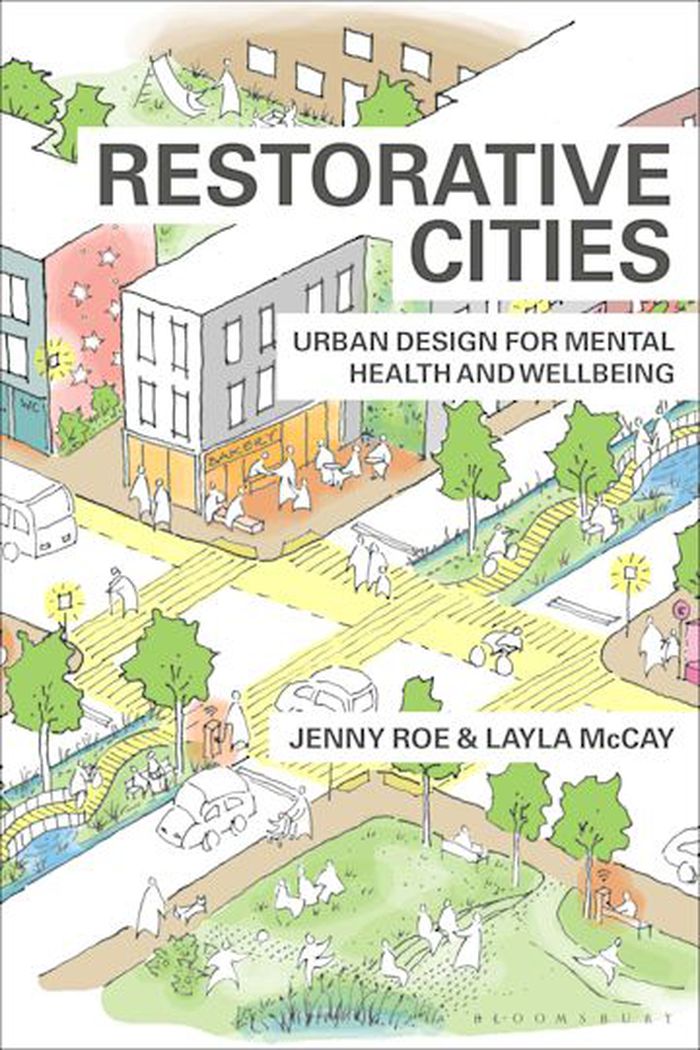
Restorative cities: urban design for mental health and wellbeing
Actions:
Price:
$58.50
(available to order)
Summary:
Overcrowding, noise and air pollution, long commutes and lack of daylight can take a huge toll on the mental well-being of city-dwellers. With mental healthcare services under increasing pressure, could a better approach to urban design and planning provide a solution? The restrictions faced by city residents around the world during the COVID-19 pandemic has brought home just how much urban design can affect our mental health – and created an imperative to seize this opportunity. ''Restorative cities'' explores a new way of designing cities, one which places mental health and wellness at the forefront. Establishing a blueprint for urban design for mental health, it examines a range of strategies – from sensory architecture to place-making for creativity and community – and brings a genuinely evidence-based approach that will appeal to designers and planners, health practitioners and researchers alike - and provide compelling insights for anyone who cares about how our surroundings affect us. Written by a psychiatrist and public health specialist, and an environmental psychologist with extensive experience of architectural practice, this much-needed work will prompt debate and inspire built environment students and professionals to think more about the positive potential of their designs for mental well-being.
Restorative cities: urban design for mental health and wellbeing
Actions:
Price:
$58.50
(available to order)
Summary:
Overcrowding, noise and air pollution, long commutes and lack of daylight can take a huge toll on the mental well-being of city-dwellers. With mental healthcare services under increasing pressure, could a better approach to urban design and planning provide a solution? The restrictions faced by city residents around the world during the COVID-19 pandemic has brought home just how much urban design can affect our mental health – and created an imperative to seize this opportunity. ''Restorative cities'' explores a new way of designing cities, one which places mental health and wellness at the forefront. Establishing a blueprint for urban design for mental health, it examines a range of strategies – from sensory architecture to place-making for creativity and community – and brings a genuinely evidence-based approach that will appeal to designers and planners, health practitioners and researchers alike - and provide compelling insights for anyone who cares about how our surroundings affect us. Written by a psychiatrist and public health specialist, and an environmental psychologist with extensive experience of architectural practice, this much-needed work will prompt debate and inspire built environment students and professionals to think more about the positive potential of their designs for mental well-being.
Form:
books
books
Publication:
August 2021
August 2021
Subject:
Humans and cities
Humans and cities
Form:
books
books
Title:
The ethics of architecture
The ethics of architecture
Actions:
Price:
$42.99
(available in store)
Summary:
A discussion of how architecture functions in a complex world of obligation and responsibility, with a preface offering specific discussion of architecture during and after the COVID-19 pandemic. What are the special ethical obligations assumed by architects? Because their work creates the basic material conditions that make all other human activity possible, architects(...)
$42.99
(available in store)
Summary:
A discussion of how architecture functions in a complex world of obligation and responsibility, with a preface offering specific discussion of architecture during and after the COVID-19 pandemic. What are the special ethical obligations assumed by architects? Because their work creates the basic material conditions that make all other human activity possible, architects(...)
Title:
The ethics of architecture
Actions:
Price:
$42.99
(available in store)
Summary:
A discussion of how architecture functions in a complex world of obligation and responsibility, with a preface offering specific discussion of architecture during and after the COVID-19 pandemic. What are the special ethical obligations assumed by architects? Because their work creates the basic material conditions that make all other human activity possible, architects and their associates in building enjoy vast influence on how we all live, work, play, worship, and think. With this influence comes tremendous, and not always examined, responsibility. This book addresses the range of ethical issues that architects face, with a broad understanding of ethics. Beyond strictly professional duties - transparency, technical competence, fair trading - lie more profound issues that move into aesthetic, political, and existential realms. Does an architect have a duty to create art, if not always beautiful art? Should an architect feel obliged to serve a community and not just a client? Is justice a possible orientation for architectural practice? Is there such a thing as feeling compelled to "shelter being" in architectural work? By taking these usually abstract questions into the region of physical creation, the book attempts a reformulation of "architectural ethics" as a matter of deep reflection on the architect's role as both citizen and caretaker.
The ethics of architecture
Actions:
Price:
$42.99
(available in store)
Summary:
A discussion of how architecture functions in a complex world of obligation and responsibility, with a preface offering specific discussion of architecture during and after the COVID-19 pandemic. What are the special ethical obligations assumed by architects? Because their work creates the basic material conditions that make all other human activity possible, architects and their associates in building enjoy vast influence on how we all live, work, play, worship, and think. With this influence comes tremendous, and not always examined, responsibility. This book addresses the range of ethical issues that architects face, with a broad understanding of ethics. Beyond strictly professional duties - transparency, technical competence, fair trading - lie more profound issues that move into aesthetic, political, and existential realms. Does an architect have a duty to create art, if not always beautiful art? Should an architect feel obliged to serve a community and not just a client? Is justice a possible orientation for architectural practice? Is there such a thing as feeling compelled to "shelter being" in architectural work? By taking these usually abstract questions into the region of physical creation, the book attempts a reformulation of "architectural ethics" as a matter of deep reflection on the architect's role as both citizen and caretaker.
Form:
books
books
Publication:
March 2021
March 2021
Subject:
Architectural Theory
Architectural Theory
Form:
books
books
Actions:
Price:
$170.00
(available to order)
Summary:
With cover artwork specially created by Ruscha, this book documents hundreds of projects and miscellaneous ephemera produced by the artist alongside his main oeuvre—including installations, films, painted book covers, contour gauge profiles, and more. Introducing readers to the stunning breadth of Edward Ruscha’s (b. 1937) creative output over the course of his entire(...)
$170.00
(available to order)
Summary:
With cover artwork specially created by Ruscha, this book documents hundreds of projects and miscellaneous ephemera produced by the artist alongside his main oeuvre—including installations, films, painted book covers, contour gauge profiles, and more. Introducing readers to the stunning breadth of Edward Ruscha’s (b. 1937) creative output over the course of his entire(...)
Title:
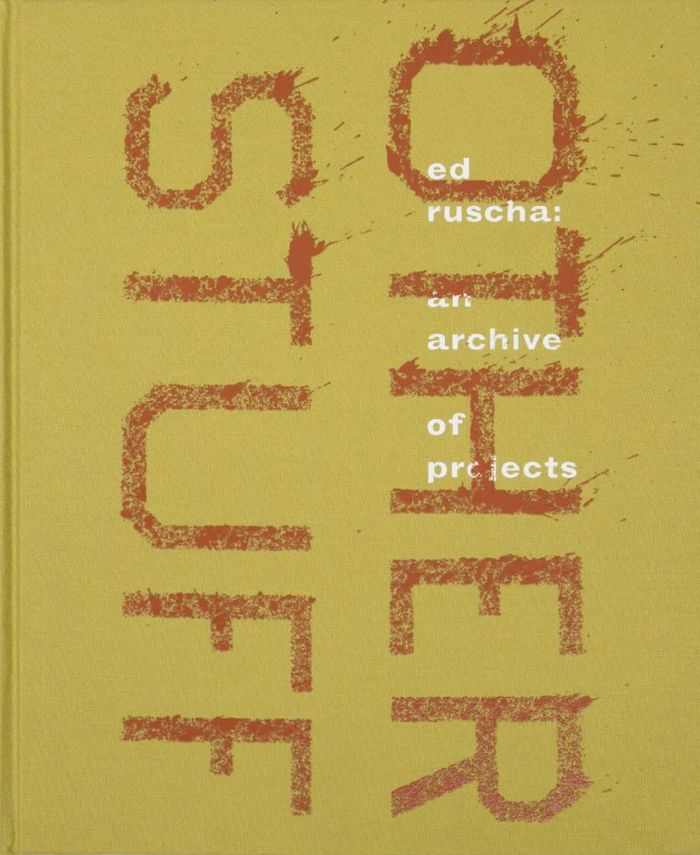
Ed Ruscha: An archive of projects
Actions:
Price:
$170.00
(available to order)
Summary:
With cover artwork specially created by Ruscha, this book documents hundreds of projects and miscellaneous ephemera produced by the artist alongside his main oeuvre—including installations, films, painted book covers, contour gauge profiles, and more. Introducing readers to the stunning breadth of Edward Ruscha’s (b. 1937) creative output over the course of his entire life, this book includes materials dating back to his childhood and extending to his present-day output. The projects featured here fall outside Ruscha’s production of paintings, drawings, prints, and artists’ books. Many of these are unknown and most are reproduced here for the first time. Composed of three sections—Projects and Ephemera; Contour Gauge Profiles; and Painted Book Covers—the book offers Ruscha enthusiasts and scholars a hitherto unknown aspect of Ruscha’s practice, while also showing how these projects coincide with, and sometimes even prefigure, the artistic work for which he is best known. The approximately 270 painted book covers, begun in 1990, utilize found books as support for small paintings and drawings. The 57 contour gauge profiles are silhouette-like profiles made using a mechanical device for reproducing contours. The largest section, Projects and Ephemera, consists of installations, sculpture and objects, films, book and poster design, utilitarian works, and more.
Ed Ruscha: An archive of projects
Actions:
Price:
$170.00
(available to order)
Summary:
With cover artwork specially created by Ruscha, this book documents hundreds of projects and miscellaneous ephemera produced by the artist alongside his main oeuvre—including installations, films, painted book covers, contour gauge profiles, and more. Introducing readers to the stunning breadth of Edward Ruscha’s (b. 1937) creative output over the course of his entire life, this book includes materials dating back to his childhood and extending to his present-day output. The projects featured here fall outside Ruscha’s production of paintings, drawings, prints, and artists’ books. Many of these are unknown and most are reproduced here for the first time. Composed of three sections—Projects and Ephemera; Contour Gauge Profiles; and Painted Book Covers—the book offers Ruscha enthusiasts and scholars a hitherto unknown aspect of Ruscha’s practice, while also showing how these projects coincide with, and sometimes even prefigure, the artistic work for which he is best known. The approximately 270 painted book covers, begun in 1990, utilize found books as support for small paintings and drawings. The 57 contour gauge profiles are silhouette-like profiles made using a mechanical device for reproducing contours. The largest section, Projects and Ephemera, consists of installations, sculpture and objects, films, book and poster design, utilitarian works, and more.
Form:
books
books
Publication:
January 2023
January 2023
Subject:
Contemporary Art Monographs
Contemporary Art Monographs
Form:
books
books
Title:
In praise of copying
In praise of copying
Actions:
Price:
$29.95
(available to order)
Summary:
This book is devoted to a deceptively simple but original argument: that copying is an essential part of being human, that the ability to copy is worthy of celebration, and that, without recognizing how integral copying is to being human, we cannot understand ourselves or the world we live in. In spite of the laws, stigmas, and anxieties attached to it, the word(...)
$29.95
(available to order)
Summary:
This book is devoted to a deceptively simple but original argument: that copying is an essential part of being human, that the ability to copy is worthy of celebration, and that, without recognizing how integral copying is to being human, we cannot understand ourselves or the world we live in. In spite of the laws, stigmas, and anxieties attached to it, the word(...)
Title:
In praise of copying
Actions:
Price:
$29.95
(available to order)
Summary:
This book is devoted to a deceptively simple but original argument: that copying is an essential part of being human, that the ability to copy is worthy of celebration, and that, without recognizing how integral copying is to being human, we cannot understand ourselves or the world we live in. In spite of the laws, stigmas, and anxieties attached to it, the word “copying” permeates contemporary culture, shaping discourse on issues from hip hop to digitization to gender reassignment, and is particularly crucial in legal debates concerning intellectual property and copyright. Yet as a philosophical concept, copying remains poorly understood. Working comparatively across cultures and times, Marcus Boon undertakes an examination of what this word means—historically, culturally, philosophically—and why it fills us with fear and fascination. He argues that the dominant legal-political structures that define copying today obscure much broader processes of imitation that have constituted human communities for ages and continue to shape various subcultures today. Drawing on contemporary art, music and film, the history of aesthetics, critical theory, and Buddhist philosophy and practice, In Praise of Copying seeks to show how and why copying works, what the sources of its power are, and the political stakes of renegotiating the way we value copying in the age of globalization.
In praise of copying
Actions:
Price:
$29.95
(available to order)
Summary:
This book is devoted to a deceptively simple but original argument: that copying is an essential part of being human, that the ability to copy is worthy of celebration, and that, without recognizing how integral copying is to being human, we cannot understand ourselves or the world we live in. In spite of the laws, stigmas, and anxieties attached to it, the word “copying” permeates contemporary culture, shaping discourse on issues from hip hop to digitization to gender reassignment, and is particularly crucial in legal debates concerning intellectual property and copyright. Yet as a philosophical concept, copying remains poorly understood. Working comparatively across cultures and times, Marcus Boon undertakes an examination of what this word means—historically, culturally, philosophically—and why it fills us with fear and fascination. He argues that the dominant legal-political structures that define copying today obscure much broader processes of imitation that have constituted human communities for ages and continue to shape various subcultures today. Drawing on contemporary art, music and film, the history of aesthetics, critical theory, and Buddhist philosophy and practice, In Praise of Copying seeks to show how and why copying works, what the sources of its power are, and the political stakes of renegotiating the way we value copying in the age of globalization.
Form:
books
books
Publication:
October 2010
October 2010
Subject:
Critical Theory
Critical Theory
Form:
books
books
Title:
Perverse cities
Perverse cities
Actions:
Price:
$39.95
(available to order)
Summary:
Urban sprawl -- low-density subdivisions and business parks, big box stores and mega-malls -- has increasingly come to define city growth despite decades of planning and policy. Urban planning has focused on curbing sprawl by treating its symptoms -- aiming to regulate more compact, livable urban forms into being. Most urbanists view sprawl as an expensive and(...)
$39.95
(available to order)
Summary:
Urban sprawl -- low-density subdivisions and business parks, big box stores and mega-malls -- has increasingly come to define city growth despite decades of planning and policy. Urban planning has focused on curbing sprawl by treating its symptoms -- aiming to regulate more compact, livable urban forms into being. Most urbanists view sprawl as an expensive and(...)
Title:
Perverse cities
Actions:
Price:
$39.95
(available to order)
Summary:
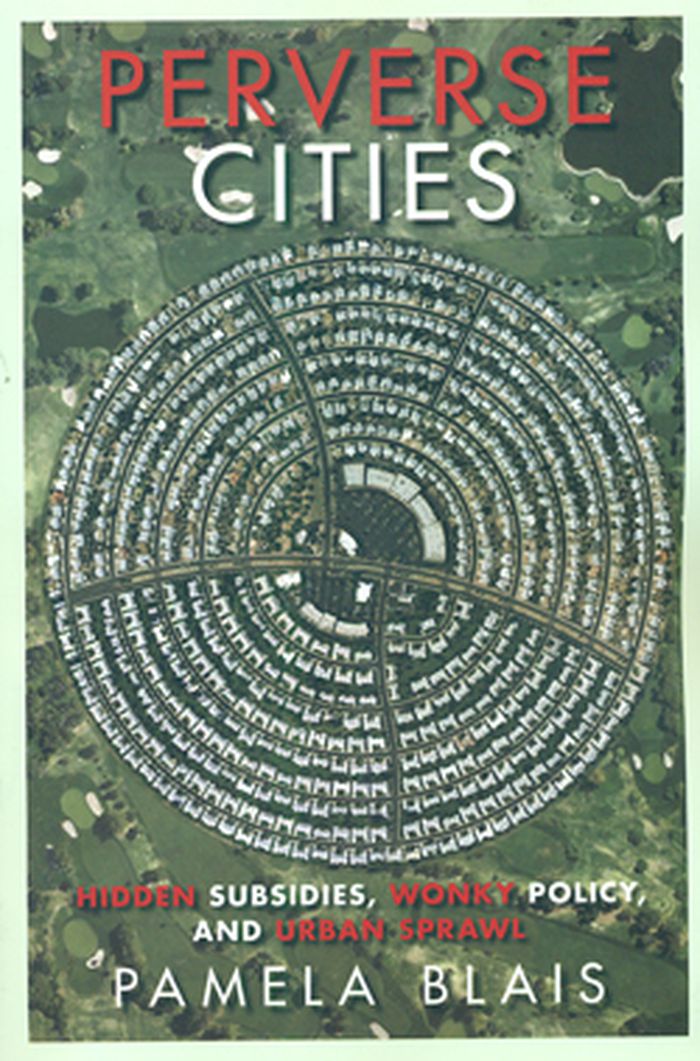
Urban sprawl -- low-density subdivisions and business parks, big box stores and mega-malls -- has increasingly come to define city growth despite decades of planning and policy. Urban planning has focused on curbing sprawl by treating its symptoms -- aiming to regulate more compact, livable urban forms into being. Most urbanists view sprawl as an expensive and unsustainable pattern of development. Yet a few defend it as the natural expression of the market neutrally responding to consumer demand and as a reflection of consumers’ lifestyle preferences. In Perverse Cities, Pamela Blais argues that both views fail to recognize market distortions and flawed policy that drive sprawl. She shows that, as a result of crude public policies, a wide range of urban goods and services are subject to inaccurate price signals, including housing, non-residential properties, transportation and utilities. Mis-pricing creates hidden, "perverse" subsidies and incentives that promote sprawl while discouraging more efficient and sustainable urban forms -- clearly not what most planners and environmentalists have in mind. Perverse Cities makes the case that accurate pricing and better policy are fundamental to curbing sprawl and shows how this can be achieved in practice through a range of market-oriented tools that promote efficient, sustainable cities.
Perverse cities
Actions:
Price:
$39.95
(available to order)
Summary:
Urban sprawl -- low-density subdivisions and business parks, big box stores and mega-malls -- has increasingly come to define city growth despite decades of planning and policy. Urban planning has focused on curbing sprawl by treating its symptoms -- aiming to regulate more compact, livable urban forms into being. Most urbanists view sprawl as an expensive and unsustainable pattern of development. Yet a few defend it as the natural expression of the market neutrally responding to consumer demand and as a reflection of consumers’ lifestyle preferences. In Perverse Cities, Pamela Blais argues that both views fail to recognize market distortions and flawed policy that drive sprawl. She shows that, as a result of crude public policies, a wide range of urban goods and services are subject to inaccurate price signals, including housing, non-residential properties, transportation and utilities. Mis-pricing creates hidden, "perverse" subsidies and incentives that promote sprawl while discouraging more efficient and sustainable urban forms -- clearly not what most planners and environmentalists have in mind. Perverse Cities makes the case that accurate pricing and better policy are fundamental to curbing sprawl and shows how this can be achieved in practice through a range of market-oriented tools that promote efficient, sustainable cities.
Form:
books
books
Publication:
April 2011
April 2011
Subject:
Urban Theory
Urban Theory
Form:
books
books

Actions:
Price:
$43.95
(available to order)
Summary:
Over the past twenty years, an abundance of art forms have emerged that use aesthetics to affect social dynamics. These works are often produced by collectives or come out of a community context; they emphasize participation, dialogue, and action, and appear in situations ranging from theater to activism to urban planning to visual art to health care. Engaged with the(...)
$43.95
(available to order)
Summary:
Over the past twenty years, an abundance of art forms have emerged that use aesthetics to affect social dynamics. These works are often produced by collectives or come out of a community context; they emphasize participation, dialogue, and action, and appear in situations ranging from theater to activism to urban planning to visual art to health care. Engaged with the(...)
Title:
Living as form : socially engaged art from 1991-2011
Actions:
Price:
$43.95
(available to order)
Summary:
Over the past twenty years, an abundance of art forms have emerged that use aesthetics to affect social dynamics. These works are often produced by collectives or come out of a community context; they emphasize participation, dialogue, and action, and appear in situations ranging from theater to activism to urban planning to visual art to health care. Engaged with the texture of living, these art works often blur the line between art and life. This book offers the first global portrait of a complex and exciting mode of cultural production — one that has virtually redefined contemporary art practice. This publication grew out of a major exhibition at Creative Time in New York City. Like the exhibition, the book is a landmark survey of more than 100 projects selected by a thirty-person curatorial advisory team; each project is documented by a selection of color images. The artists include the Danish collective Superflex, who empower communities to challenge corporate interest; Turner Prize nominee Jeremy Deller, creator of socially and politically charged performance works; Women on Waves, who provide abortion services and information to women in regions where the procedure is illegal; and Santiágo Cirugeda, an architect who builds temporary structures to solve housing problems.
Living as form : socially engaged art from 1991-2011
Actions:
Price:
$43.95
(available to order)
Summary:
Over the past twenty years, an abundance of art forms have emerged that use aesthetics to affect social dynamics. These works are often produced by collectives or come out of a community context; they emphasize participation, dialogue, and action, and appear in situations ranging from theater to activism to urban planning to visual art to health care. Engaged with the texture of living, these art works often blur the line between art and life. This book offers the first global portrait of a complex and exciting mode of cultural production — one that has virtually redefined contemporary art practice. This publication grew out of a major exhibition at Creative Time in New York City. Like the exhibition, the book is a landmark survey of more than 100 projects selected by a thirty-person curatorial advisory team; each project is documented by a selection of color images. The artists include the Danish collective Superflex, who empower communities to challenge corporate interest; Turner Prize nominee Jeremy Deller, creator of socially and politically charged performance works; Women on Waves, who provide abortion services and information to women in regions where the procedure is illegal; and Santiágo Cirugeda, an architect who builds temporary structures to solve housing problems.
Form:
books
books
Publication:
March 2012
March 2012
Form:
books
books
Actions:
Price:
$49.00
(available to order)
Summary:
The analysis of sanitary spaces and places dedicated to personal care, as in a privacy observatory, helps with the in-depth assessment of social changes, allowing us to determine how the lives of users can be improved, how conflicts of use in public places can be resolved between populations of different sexes and ages, and how the quality of public and private health can(...)
$49.00
(available to order)
Summary:
The analysis of sanitary spaces and places dedicated to personal care, as in a privacy observatory, helps with the in-depth assessment of social changes, allowing us to determine how the lives of users can be improved, how conflicts of use in public places can be resolved between populations of different sexes and ages, and how the quality of public and private health can(...)
Subject:
Commercial interiors, Building types
Commercial interiors, Building types
Publication:
January 2023
January 2023
Title:
Intimacy exposed: toilets, bathrooms, restrooms
Actions:
Price:
$49.00
(available to order)
Summary:
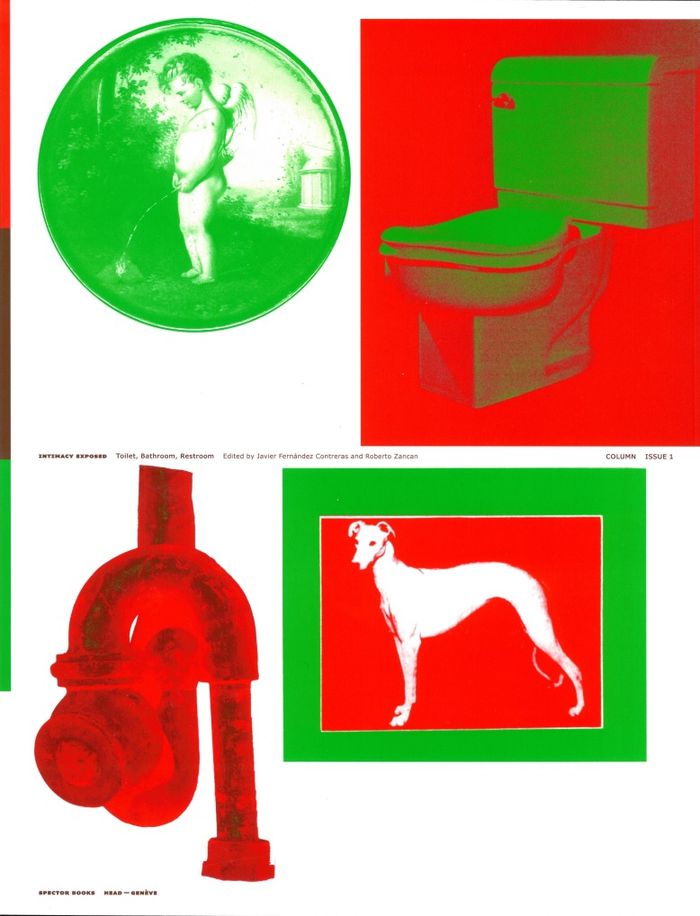
The analysis of sanitary spaces and places dedicated to personal care, as in a privacy observatory, helps with the in-depth assessment of social changes, allowing us to determine how the lives of users can be improved, how conflicts of use in public places can be resolved between populations of different sexes and ages, and how the quality of public and private health can be enhanced. Observing these issues pushes us to explore the forms and meanings of bathrooms and private spaces in relation to their different functions, including those of transgressive and informal meeting places and spaces of inevitable and forced social coexistence. This book constitutes a new step in this field of research, presenting a series of scientific and artistic interventions that proves the diverse range of uses to which ''wet rooms'' can be put in social life, the evolution of the use of furniture, and the new meanings of details and objects in domestic bathrooms and public toilets. The texts, largely written for the 2018 symposium ''Intimacy Exposed: Toilet, Bathroom, Restroom'' (organized by the Department of Interior Architecture at HEAD – Genève) present a practice-based study of the recent past of modernist technologies and a vision of the future of personal and collective practices regarding the realm of the toilet.
Intimacy exposed: toilets, bathrooms, restrooms
Actions:
Price:
$49.00
(available to order)
Summary:
The analysis of sanitary spaces and places dedicated to personal care, as in a privacy observatory, helps with the in-depth assessment of social changes, allowing us to determine how the lives of users can be improved, how conflicts of use in public places can be resolved between populations of different sexes and ages, and how the quality of public and private health can be enhanced. Observing these issues pushes us to explore the forms and meanings of bathrooms and private spaces in relation to their different functions, including those of transgressive and informal meeting places and spaces of inevitable and forced social coexistence. This book constitutes a new step in this field of research, presenting a series of scientific and artistic interventions that proves the diverse range of uses to which ''wet rooms'' can be put in social life, the evolution of the use of furniture, and the new meanings of details and objects in domestic bathrooms and public toilets. The texts, largely written for the 2018 symposium ''Intimacy Exposed: Toilet, Bathroom, Restroom'' (organized by the Department of Interior Architecture at HEAD – Genève) present a practice-based study of the recent past of modernist technologies and a vision of the future of personal and collective practices regarding the realm of the toilet.
Form:
books
books
Publication:
January 2023
January 2023
Subject:
Commercial interiors, Building types
Commercial interiors, Building types
Form:
books
books
Title:
The sun as error
The sun as error
Actions:
Price:
$75.50
(available to order)
Summary:
The Los Angeles based artist Shannon Ebner extends her exploration of photography, sculpture and language in this book. In collaboration with Dexter Sinister (design duo David Reinfurt and Stuart Bailey), "The Sun as Error" re-investigates the meaning and language of photographs, creating both an open-ended reading of her practice and also rethinking the idea of an(...)
$75.50
(available to order)
Summary:
The Los Angeles based artist Shannon Ebner extends her exploration of photography, sculpture and language in this book. In collaboration with Dexter Sinister (design duo David Reinfurt and Stuart Bailey), "The Sun as Error" re-investigates the meaning and language of photographs, creating both an open-ended reading of her practice and also rethinking the idea of an(...)
Title:
The sun as error
Actions:
Price:
$75.50
(available to order)
Summary:
The Los Angeles based artist Shannon Ebner extends her exploration of photography, sculpture and language in this book. In collaboration with Dexter Sinister (design duo David Reinfurt and Stuart Bailey), "The Sun as Error" re-investigates the meaning and language of photographs, creating both an open-ended reading of her practice and also rethinking the idea of an artist’s monograph. Far from straightforward, the book interweaves her bodies of work, previously unseen one-off pieces, with the language of technical diagrams, optical illusions, and graphic design. One of the persistent motifs through the book’s sequence is an asterisk and, specifically, one imbued with the legacy of the graphic designer Muriel Cooper. As the first design director for MIT Press and the cofounder of the Visible Language Workshop, Cooper’s legacy for reorienting and repositioning the direction of an artist’s monograph is imaginatively explored in the creative partnership of Dexter Sinister and Shannon Ebner. Shannon Ebner’s work has been shown in exhibitions including Trace at The Whitney Museum of American Art at Altria (2006), The 2006 California Biennial at The Orange County Museum of Art, Uncertain States of America, at The Serpentine Gallery, London (2006), Learn to Read, at the Tate Modern, London (2007), and the 2008 Whitney Biennial at The Whitney Museum of American Art.
The sun as error
Actions:
Price:
$75.50
(available to order)
Summary:
The Los Angeles based artist Shannon Ebner extends her exploration of photography, sculpture and language in this book. In collaboration with Dexter Sinister (design duo David Reinfurt and Stuart Bailey), "The Sun as Error" re-investigates the meaning and language of photographs, creating both an open-ended reading of her practice and also rethinking the idea of an artist’s monograph. Far from straightforward, the book interweaves her bodies of work, previously unseen one-off pieces, with the language of technical diagrams, optical illusions, and graphic design. One of the persistent motifs through the book’s sequence is an asterisk and, specifically, one imbued with the legacy of the graphic designer Muriel Cooper. As the first design director for MIT Press and the cofounder of the Visible Language Workshop, Cooper’s legacy for reorienting and repositioning the direction of an artist’s monograph is imaginatively explored in the creative partnership of Dexter Sinister and Shannon Ebner. Shannon Ebner’s work has been shown in exhibitions including Trace at The Whitney Museum of American Art at Altria (2006), The 2006 California Biennial at The Orange County Museum of Art, Uncertain States of America, at The Serpentine Gallery, London (2006), Learn to Read, at the Tate Modern, London (2007), and the 2008 Whitney Biennial at The Whitney Museum of American Art.
Form:
books
books
Publication:
October 2009
October 2009
Subject:
Photography monographs
Photography monographs
Form:
books
books
Actions:
Price:
$46.95
(available to order)
Summary:
Support structures is a manual for what bears, sustains, and props, for those things that encourage, care for, and assist; for that which advocates, articulates; for what stands behind, frames, and maintains: it is a manual for those things that give support. While the work of supporting might traditionally appear as subsequent, unessential, and lacking value in itself,(...)
$46.95
(available to order)
Summary:
Support structures is a manual for what bears, sustains, and props, for those things that encourage, care for, and assist; for that which advocates, articulates; for what stands behind, frames, and maintains: it is a manual for those things that give support. While the work of supporting might traditionally appear as subsequent, unessential, and lacking value in itself,(...)
Title:
Céline Condorelli: support structures
Actions:
Price:
$46.95
(available to order)
Summary:
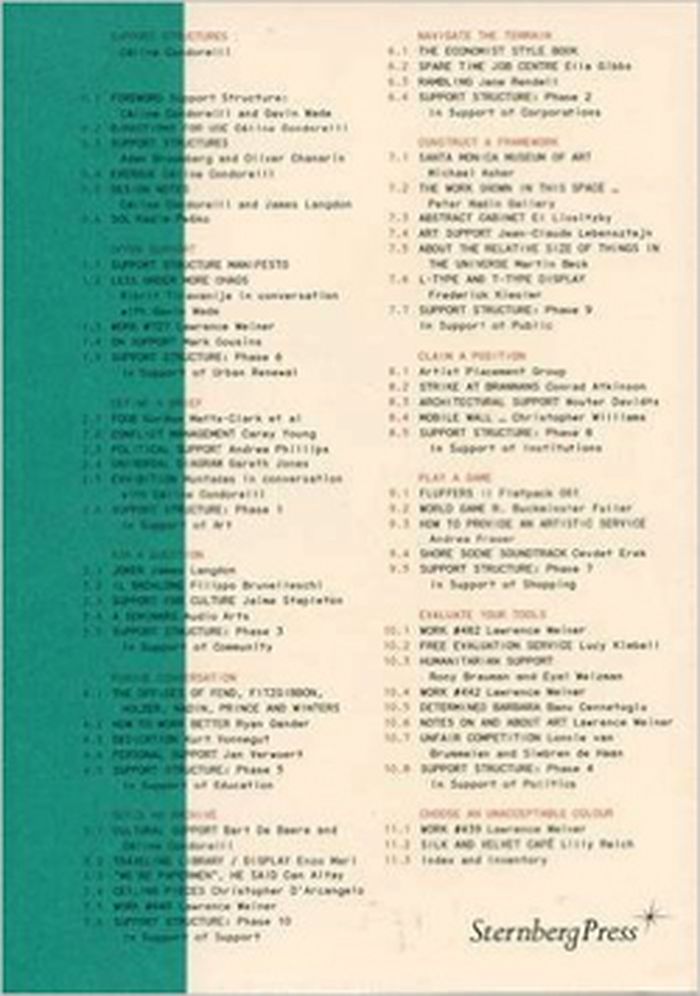
Support structures is a manual for what bears, sustains, and props, for those things that encourage, care for, and assist; for that which advocates, articulates; for what stands behind, frames, and maintains: it is a manual for those things that give support. While the work of supporting might traditionally appear as subsequent, unessential, and lacking value in itself, this manual is an attempt to restore attention to one of the neglected, yet crucial modes through which we apprehend and shape the world. Support structures is a critical enquiry into what constitutes “support,” and documents the collaborative project “Support Structure” by Céline Condorelli and Gavin Wade. While registering and collecting reference projects in a new archive of support structures alongside its ten-phase project, different writers, thinkers, and practitioners were invited from various fields to elaborate on frameworks and work on texts , which form the theoretical backbone of the publication. The collection of contributions offers different possibilities for engaging in this unchartered territory, from propositions to projects, existing systems to ones invented for specific creative processes. Support structures offers support through potential methodologies, inspirations and activations for practice, and addresses important questions for art and architecture practices on forms of display, organization, articulation, appropriation, autonomy, and temporariness, and the manifestations of blindness towards them.
Céline Condorelli: support structures
Actions:
Price:
$46.95
(available to order)
Summary:
Support structures is a manual for what bears, sustains, and props, for those things that encourage, care for, and assist; for that which advocates, articulates; for what stands behind, frames, and maintains: it is a manual for those things that give support. While the work of supporting might traditionally appear as subsequent, unessential, and lacking value in itself, this manual is an attempt to restore attention to one of the neglected, yet crucial modes through which we apprehend and shape the world. Support structures is a critical enquiry into what constitutes “support,” and documents the collaborative project “Support Structure” by Céline Condorelli and Gavin Wade. While registering and collecting reference projects in a new archive of support structures alongside its ten-phase project, different writers, thinkers, and practitioners were invited from various fields to elaborate on frameworks and work on texts , which form the theoretical backbone of the publication. The collection of contributions offers different possibilities for engaging in this unchartered territory, from propositions to projects, existing systems to ones invented for specific creative processes. Support structures offers support through potential methodologies, inspirations and activations for practice, and addresses important questions for art and architecture practices on forms of display, organization, articulation, appropriation, autonomy, and temporariness, and the manifestations of blindness towards them.
Form:
books
books
Publication:
October 2009
October 2009
Subject:
Contemporary Art Monographs
Contemporary Art Monographs
Form:
books
books
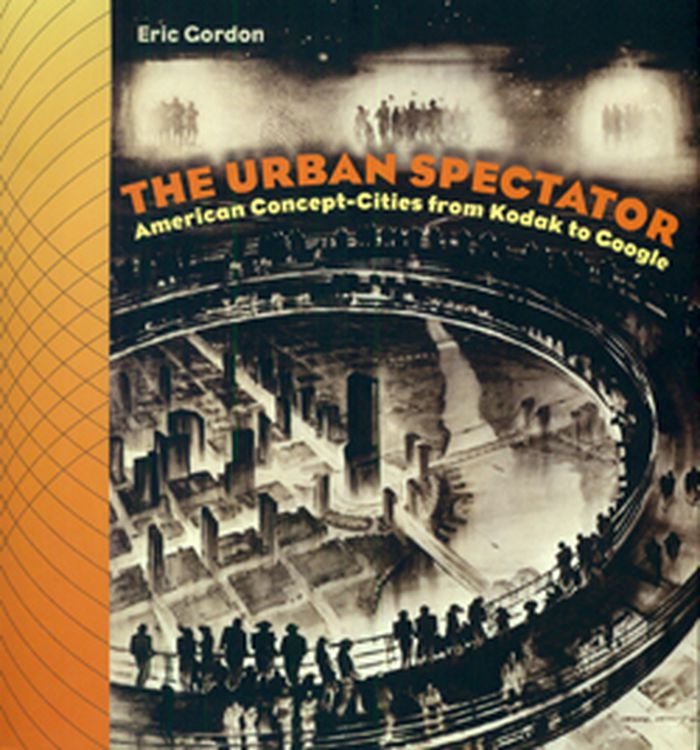
Price:
$41.95
(available to order)
Summary:
The Urban Spectator is a lively and utterly fascinating exploration of the ways in which technologies have influenced our collective conception of the American city, as well as our relationship with urban space and architecture. Eric Gordon argues that the city, developing late and in conjunction with a range of modern media, produced a particular way of seeing--what he(...)
$41.95
(available to order)
Summary:
The Urban Spectator is a lively and utterly fascinating exploration of the ways in which technologies have influenced our collective conception of the American city, as well as our relationship with urban space and architecture. Eric Gordon argues that the city, developing late and in conjunction with a range of modern media, produced a particular way of seeing--what he(...)
Title:
The urban spectator: American concept-cities from Kodak to Google
Actions:
Price:
$41.95
(available to order)
Summary:
The Urban Spectator is a lively and utterly fascinating exploration of the ways in which technologies have influenced our collective conception of the American city, as well as our relationship with urban space and architecture. Eric Gordon argues that the city, developing late and in conjunction with a range of modern media, produced a particular way of seeing--what he labels "possessive spectatorship." Lacking the historical rootedness of European cities, the American city was open to individual interpretation, definition, and ownership. Beginning with the White City of the Chicago World's Fair of 1893 and the efforts to commodify the concept city through photography, Gordon shows how the American city has always been a product of the collision between the dominant conceptualization, shaped by contemporary media, and the spectator. From the viewfinder of the Kodak camera, to the public display of early cinema, to the speculative desire of network radio, all the way to machine-age utopianism, nostalgia, and America's "rerun" culture, the city is an amalgam of practice and concept. All of this comes to a head in the "database city" where urban spectatorship takes on the characteristics of a Google search. In new urban developments, the spectator searches, retrieves, and combines urban references to construct each experience of the city.
The urban spectator: American concept-cities from Kodak to Google
Actions:
Price:
$41.95
(available to order)
Summary:
The Urban Spectator is a lively and utterly fascinating exploration of the ways in which technologies have influenced our collective conception of the American city, as well as our relationship with urban space and architecture. Eric Gordon argues that the city, developing late and in conjunction with a range of modern media, produced a particular way of seeing--what he labels "possessive spectatorship." Lacking the historical rootedness of European cities, the American city was open to individual interpretation, definition, and ownership. Beginning with the White City of the Chicago World's Fair of 1893 and the efforts to commodify the concept city through photography, Gordon shows how the American city has always been a product of the collision between the dominant conceptualization, shaped by contemporary media, and the spectator. From the viewfinder of the Kodak camera, to the public display of early cinema, to the speculative desire of network radio, all the way to machine-age utopianism, nostalgia, and America's "rerun" culture, the city is an amalgam of practice and concept. All of this comes to a head in the "database city" where urban spectatorship takes on the characteristics of a Google search. In new urban developments, the spectator searches, retrieves, and combines urban references to construct each experience of the city.
Form:
books
books
Publication:
February 2010
February 2010
Subject:
Urban Theory
Urban Theory


