


9193 Results
Form:
books
books
Actions:
Price:
$31.00
(available to order)
Summary:
Today on almost every desk in every office sits a computer. Eighty years ago, desktops were equipped with a nonelectronic data processing machine: a card file. In this publication, Markus Krajewski traces the evolution of this proto-computer of rearrangeable parts (file cards) that became ubiquitous in offices between the world wars. The story begins with Konrad(...)
$31.00
(available to order)
Summary:
Today on almost every desk in every office sits a computer. Eighty years ago, desktops were equipped with a nonelectronic data processing machine: a card file. In this publication, Markus Krajewski traces the evolution of this proto-computer of rearrangeable parts (file cards) that became ubiquitous in offices between the world wars. The story begins with Konrad(...)
Title:
Paper machines : about cards & catalogs, 1548-1929
Actions:
Price:
$31.00
(available to order)
Summary:
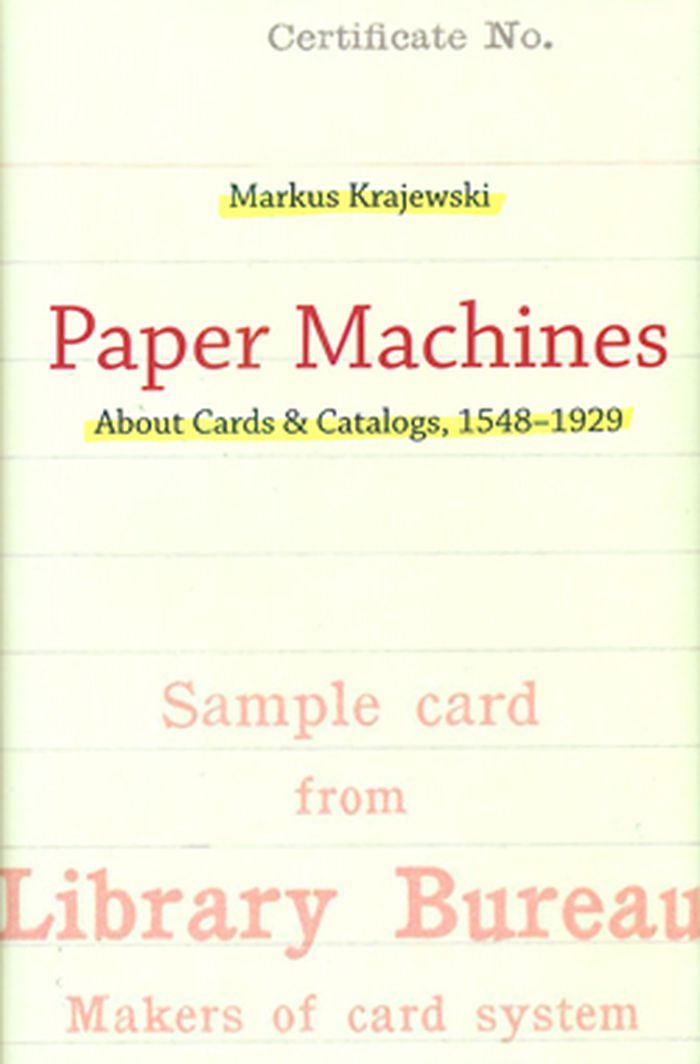
Today on almost every desk in every office sits a computer. Eighty years ago, desktops were equipped with a nonelectronic data processing machine: a card file. In this publication, Markus Krajewski traces the evolution of this proto-computer of rearrangeable parts (file cards) that became ubiquitous in offices between the world wars. The story begins with Konrad Gessner, a sixteenth-century Swiss polymath who described a new method of processing data: to cut up a sheet of handwritten notes into slips of paper, with one fact or topic per slip, and arrange as desired. In the late eighteenth century, the card catalog became the librarian's answer to the threat of information overload. Then, at the turn of the twentieth century, business adopted the technology of the card catalog as a bookkeeping tool. Krajewski explores this conceptual development and casts the card file as a "universal paper machine" that accomplishes the basic operations of Turing's universal discrete machine: storing, processing, and transferring data. In telling his story, Krajewski takes the reader on a number of illuminating detours, telling us, for example, that the card catalog and the numbered street address emerged at the same time in the same city (Vienna), and that Harvard University's home-grown cataloging system grew out of a librarian's laziness; and that Melvil Dewey (originator of the Dewey Decimal System) helped bring about the technology transfer of card files to business.
Paper machines : about cards & catalogs, 1548-1929
Actions:
Price:
$31.00
(available to order)
Summary:
Today on almost every desk in every office sits a computer. Eighty years ago, desktops were equipped with a nonelectronic data processing machine: a card file. In this publication, Markus Krajewski traces the evolution of this proto-computer of rearrangeable parts (file cards) that became ubiquitous in offices between the world wars. The story begins with Konrad Gessner, a sixteenth-century Swiss polymath who described a new method of processing data: to cut up a sheet of handwritten notes into slips of paper, with one fact or topic per slip, and arrange as desired. In the late eighteenth century, the card catalog became the librarian's answer to the threat of information overload. Then, at the turn of the twentieth century, business adopted the technology of the card catalog as a bookkeeping tool. Krajewski explores this conceptual development and casts the card file as a "universal paper machine" that accomplishes the basic operations of Turing's universal discrete machine: storing, processing, and transferring data. In telling his story, Krajewski takes the reader on a number of illuminating detours, telling us, for example, that the card catalog and the numbered street address emerged at the same time in the same city (Vienna), and that Harvard University's home-grown cataloging system grew out of a librarian's laziness; and that Melvil Dewey (originator of the Dewey Decimal System) helped bring about the technology transfer of card files to business.
Form:
books
books
Publication:
October 2011
October 2011
Subject:
Archive, library and the digital
Archive, library and the digital
Form:
books
books
Title:
Robert A.M. Stern buildings.
Robert A.M. Stern buildings.
Actions:
Holdings:
Description:
496 pages : chiefly illustrations (some color) ; 32 cm
Description:
496 pages : chiefly illustrations (some color) ; 32 cm
Author:
Subject:
Publication:
[New York] : Monacelli Press, [1996]
[New York] : Monacelli Press, [1996]
Title:
Robert A.M. Stern buildings.
Actions:
Holdings:
Description:
496 pages : chiefly illustrations (some color) ; 32 cm
Robert A.M. Stern buildings.
Actions:
Holdings:
Description:
496 pages : chiefly illustrations (some color) ; 32 cm
Form:
books
books
Publication:
[New York] : Monacelli Press, [1996]
[New York] : Monacelli Press, [1996]
Author:
Subject:
Form:
books
books
Actions:
Holdings:
Description:
159 pages : illustrations (chiefly color) ; 24 cm.
Description:
159 pages : illustrations (chiefly color) ; 24 cm.
Author:
Subject:
Publication:
Baden : Lars Müller, 2011.
Baden : Lars Müller, 2011.
Title:
After crisis : contemporary architectural conditions / [edited by Josep Lluís Mateo ; editor in charge: Krunoslav Ivanišin].
Actions:
Holdings:
Description:
159 pages : illustrations (chiefly color) ; 24 cm.
After crisis : contemporary architectural conditions / [edited by Josep Lluís Mateo ; editor in charge: Krunoslav Ivanišin].
Actions:
Holdings:
Description:
159 pages : illustrations (chiefly color) ; 24 cm.
Form:
books
books
Publication:
Baden : Lars Müller, 2011.
Baden : Lars Müller, 2011.
Author:
Subject:
Form:
audio
audio
Title:
Pulsar Threads.
Pulsar Threads.
Actions:
Description:
1 online resource.
Author:
Subject:
Publication:
[Place of publication not identified] : Lateral Addition, 2024.
[Place of publication not identified] : Lateral Addition, 2024.
Form:
audio
audio
Publication:
[Place of publication not identified] : Lateral Addition, 2024.
[Place of publication not identified] : Lateral Addition, 2024.
Author:
Subject:
Form:
books
books
Actions:
Holdings:
Description:
128 pages : illustrations, maps ; 22 x 28 cm
Description:
128 pages : illustrations, maps ; 22 x 28 cm
Subject:
Publication:
Great Britain : Architectural Press, 1975.
Great Britain : Architectural Press, 1975.
Title:
Architectural graphics / Frank Ching.
Actions:
Holdings:
Description:
128 pages : illustrations, maps ; 22 x 28 cm
Architectural graphics / Frank Ching.
Actions:
Holdings:
Description:
128 pages : illustrations, maps ; 22 x 28 cm
Form:
books
books
Publication:
Great Britain : Architectural Press, 1975.
Great Britain : Architectural Press, 1975.
Subject:
Form:
books
books
Actions:
Holdings:
Description:
xxix, 544 pages : illustrations, maps, plans ; 24 cm
Description:
xxix, 544 pages : illustrations, maps, plans ; 24 cm
Author:
Subject:
Publication:
Verso Books, 2014.
Verso Books, 2014.
Title:
New orleans under reconstruction.
Actions:
Holdings:
Description:
xxix, 544 pages : illustrations, maps, plans ; 24 cm
New orleans under reconstruction.
Actions:
Holdings:
Description:
xxix, 544 pages : illustrations, maps, plans ; 24 cm
Form:
books
books
Publication:
Verso Books, 2014.
Verso Books, 2014.
Author:
Subject:
Form:
books
books
Actions:
Price:
$40.00
(available to order)
Summary:
One of Spain’s most prominent and innovative artists, Joan Fontcuberta is best known for exploring the interstices between art, science, and illusion. Where science reaches its limits in his works, the imagination frequently finds a creative space in which to flourish. In "Landscapes without memory", Fontcuberta has co-opted a piece of computer software originally(...)
$40.00
(available to order)
Summary:
One of Spain’s most prominent and innovative artists, Joan Fontcuberta is best known for exploring the interstices between art, science, and illusion. Where science reaches its limits in his works, the imagination frequently finds a creative space in which to flourish. In "Landscapes without memory", Fontcuberta has co-opted a piece of computer software originally(...)
Subject:
Photography monographs
Photography monographs
Publication:
January 1900, New York
January 1900, New York
Title:
Joan Fontcuberta : landscapes without memory
Actions:
Price:
$40.00
(available to order)
Summary:
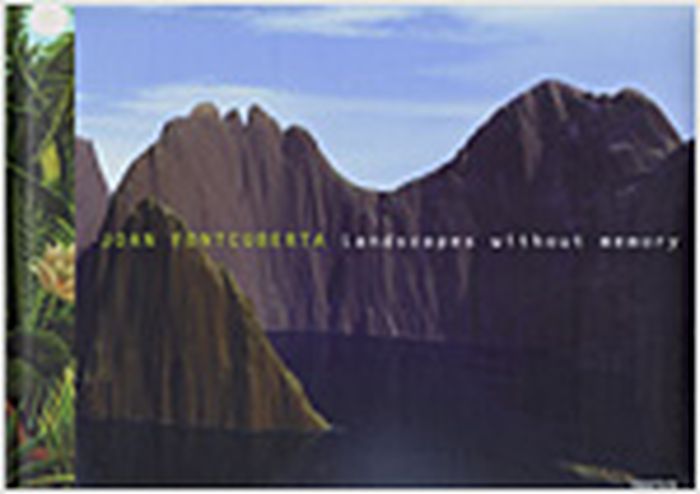
One of Spain’s most prominent and innovative artists, Joan Fontcuberta is best known for exploring the interstices between art, science, and illusion. Where science reaches its limits in his works, the imagination frequently finds a creative space in which to flourish. In "Landscapes without memory", Fontcuberta has co-opted a piece of computer software originally designed for military or scientific use in rendering three-dimensional images of landscapes. The software enables the user to build photo-realistic models based on information scanned from two-dimensional sources—usually satellite surveys or cartographic data. The result gives the user the illusion of navigating in three dimensions which had previously been visualized only as a flat image. With this widely available “freeware” as his starting point, Fontcuberta has created the two series that constitute his "Landscapes without memory". In the “Landscapes of landscapes” series, Fontcuberta feeds the software fragments of pictures by Turner, Cézanne, Dalí, Stieglitz, Weston, and others, forcing the program to interpret a variety of landscape masterworks as “real.” The contours and tones of these painted and photographic landscapes are transformed into three-dimensional mountains, rivers, valleys, and clouds. The vocabulary of art is thus transmuted into that of cartography. In the “Bodyscapes” series, Fontcuberta uses the same software to reinterpret photographs depicting fragments of his own body. The result? A wild, baroque, virtual- fantasy world. While referring to the contemporary exchange between illusion, nature, culture, and technology, "Landscapes without memory" also makes a pointed gesture aimed at fooling that epitome of machine rationalism: the computer.
Joan Fontcuberta : landscapes without memory
Actions:
Price:
$40.00
(available to order)
Summary:
One of Spain’s most prominent and innovative artists, Joan Fontcuberta is best known for exploring the interstices between art, science, and illusion. Where science reaches its limits in his works, the imagination frequently finds a creative space in which to flourish. In "Landscapes without memory", Fontcuberta has co-opted a piece of computer software originally designed for military or scientific use in rendering three-dimensional images of landscapes. The software enables the user to build photo-realistic models based on information scanned from two-dimensional sources—usually satellite surveys or cartographic data. The result gives the user the illusion of navigating in three dimensions which had previously been visualized only as a flat image. With this widely available “freeware” as his starting point, Fontcuberta has created the two series that constitute his "Landscapes without memory". In the “Landscapes of landscapes” series, Fontcuberta feeds the software fragments of pictures by Turner, Cézanne, Dalí, Stieglitz, Weston, and others, forcing the program to interpret a variety of landscape masterworks as “real.” The contours and tones of these painted and photographic landscapes are transformed into three-dimensional mountains, rivers, valleys, and clouds. The vocabulary of art is thus transmuted into that of cartography. In the “Bodyscapes” series, Fontcuberta uses the same software to reinterpret photographs depicting fragments of his own body. The result? A wild, baroque, virtual- fantasy world. While referring to the contemporary exchange between illusion, nature, culture, and technology, "Landscapes without memory" also makes a pointed gesture aimed at fooling that epitome of machine rationalism: the computer.
Form:
books
books
Publication:
January 1900, New York
January 1900, New York
Subject:
Photography monographs
Photography monographs
Form:
books
books
Price:
$31.50
(available to order)
Summary:
In "Enduring innocence", Keller Easterling tells the stories of outlaw "spatial products"- resorts, information technology campuses, retail chains, golf courses, ports, and other hybrid spaces that exist outside normal constituencies and jurisdictions-in difficult political situations around the world. These spaces-familiar commercial formulas of retail, business, and(...)
$31.50
(available to order)
Summary:
In "Enduring innocence", Keller Easterling tells the stories of outlaw "spatial products"- resorts, information technology campuses, retail chains, golf courses, ports, and other hybrid spaces that exist outside normal constituencies and jurisdictions-in difficult political situations around the world. These spaces-familiar commercial formulas of retail, business, and(...)
Subject:
Architectural Theory
Architectural Theory
Publication:
January 1900, Cambridge, London
January 1900, Cambridge, London
Title:
Enduring innocence : global architecture and its political masquerades
Actions:
Price:
$31.50
(available to order)
Summary:
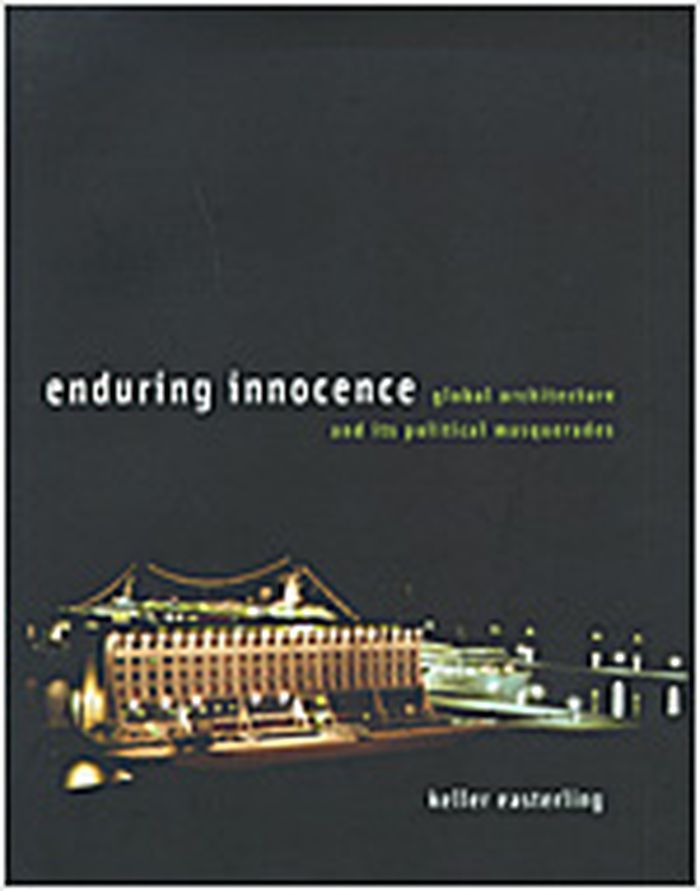
In "Enduring innocence", Keller Easterling tells the stories of outlaw "spatial products"- resorts, information technology campuses, retail chains, golf courses, ports, and other hybrid spaces that exist outside normal constituencies and jurisdictions-in difficult political situations around the world. These spaces-familiar commercial formulas of retail, business, and trade-aspire to be worlds unto themselves, self-reflexive and innocent of politics. But as Easterling shows, in reality these enclaves can become political pawns and objects of contention. Jurisdictionally ambiguous, they are imbued with myths, desires, and symbolic capital. Their hilarious and dangerous masquerades often mix quite easily with the cunning of political platforms. Easterling argues that the study of such "real estate cocktails" provides vivid evidence of the market's weakness, resilience, or violence. "Enduring innocence" collects six stories of spatial products and their political predicaments: cruise ship tourism in North Korea; high-tech agricultural formations in Spain (which have reignited labor wars and piracy in the Mediterranean); hyperbolic forms of sovereignty in commercial and spiritual organizations shared by gurus and golf celebrities; automated global ports; microwave urbanism in South Asian IT enclaves; and a global industry of building demolition that suggests urban warfare. These regimes of nonnational sovereignty, writes Easterling, "move around the world like weather fronts"; she focuses not on their blending- their global connectivity-but on their segregation and the cultural collisions that ensue. "Enduring innocence" resists the dream of one globally legible world found in many architectural discourses on globalization. Instead, Easterling's consideration of these segregated worlds provides new tools for practitioners sensitive to the political composition of urban landscapes.
Enduring innocence : global architecture and its political masquerades
Actions:
Price:
$31.50
(available to order)
Summary:
In "Enduring innocence", Keller Easterling tells the stories of outlaw "spatial products"- resorts, information technology campuses, retail chains, golf courses, ports, and other hybrid spaces that exist outside normal constituencies and jurisdictions-in difficult political situations around the world. These spaces-familiar commercial formulas of retail, business, and trade-aspire to be worlds unto themselves, self-reflexive and innocent of politics. But as Easterling shows, in reality these enclaves can become political pawns and objects of contention. Jurisdictionally ambiguous, they are imbued with myths, desires, and symbolic capital. Their hilarious and dangerous masquerades often mix quite easily with the cunning of political platforms. Easterling argues that the study of such "real estate cocktails" provides vivid evidence of the market's weakness, resilience, or violence. "Enduring innocence" collects six stories of spatial products and their political predicaments: cruise ship tourism in North Korea; high-tech agricultural formations in Spain (which have reignited labor wars and piracy in the Mediterranean); hyperbolic forms of sovereignty in commercial and spiritual organizations shared by gurus and golf celebrities; automated global ports; microwave urbanism in South Asian IT enclaves; and a global industry of building demolition that suggests urban warfare. These regimes of nonnational sovereignty, writes Easterling, "move around the world like weather fronts"; she focuses not on their blending- their global connectivity-but on their segregation and the cultural collisions that ensue. "Enduring innocence" resists the dream of one globally legible world found in many architectural discourses on globalization. Instead, Easterling's consideration of these segregated worlds provides new tools for practitioners sensitive to the political composition of urban landscapes.
Form:
books
books
Publication:
January 1900, Cambridge, London
January 1900, Cambridge, London
Subject:
Architectural Theory
Architectural Theory
Form:
books
books
Title:
Massive change
Massive change
Actions:
Price:
$39.95
(available to order)
Summary:
"Massive Change" is a modern illustrated primer on the new inventions, technologies, and events that are affecting the human race worldwide. The book is a part of a broader research project by Bruce Mau Design intended to provoke debate and discussion about the future of design culture, broadly defined as the “familiar objects and techniques that are transforming our(...)
$39.95
(available to order)
Summary:
"Massive Change" is a modern illustrated primer on the new inventions, technologies, and events that are affecting the human race worldwide. The book is a part of a broader research project by Bruce Mau Design intended to provoke debate and discussion about the future of design culture, broadly defined as the “familiar objects and techniques that are transforming our(...)
Subject:
Graphic Designers, Monographs
Graphic Designers, Monographs
Publication:
November 2004, New York
November 2004, New York
Title:
Massive change
Actions:
Price:
$39.95
(available to order)
Summary:
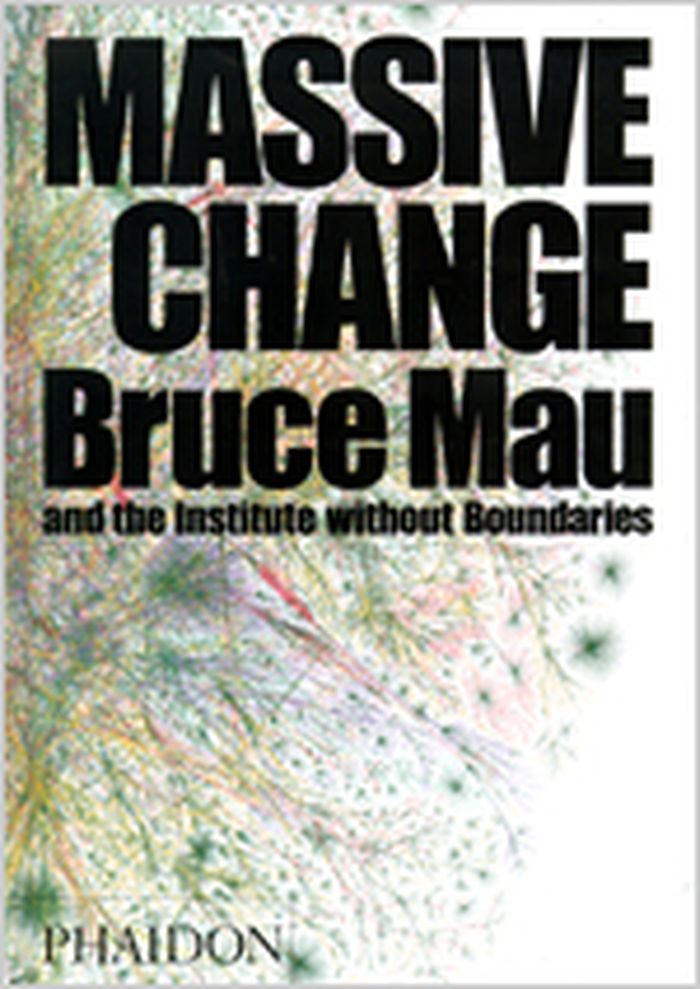
"Massive Change" is a modern illustrated primer on the new inventions, technologies, and events that are affecting the human race worldwide. The book is a part of a broader research project by Bruce Mau Design intended to provoke debate and discussion about the future of design culture, broadly defined as the “familiar objects and techniques that are transforming our lives.” In essays, interviews, and provocative imagery aimed at a broad audience, "Massive Change" explores the changing force of design in the contemporary world, and in doing so expands the definition of design to include the built environment, transportation technologies, revolutionary materials, energy and information systems, and living organisms. The book is divided into 11 heavily illustrated sections covering major areas of change in contemporary society — such as urbanism and architecture, the military, health and living, and wealth and politics. Each section intersperses intriguing documentary images with a general introductory essay, extended captions, and interviews with leading thinkers, including engineers, designers, philosophers, scientists, architects, artists, and writers. Concluding the book is a graphic timeline of significant inventions and world events from 10,000 B.C. to the present. "Massive Change" is a well designed, intelligent, visually provocative exploration of the myriad subjects percolating through popular culture: those we read about in magazines and on Web sites but rarely understand in any meaningful way. It poses the question: “Now that the human race can do almost anything, what will we do next?” Accompanies the internationally touring exhibition produced by Bruce Mau and his Institute without Borders.
Massive change
Actions:
Price:
$39.95
(available to order)
Summary:
"Massive Change" is a modern illustrated primer on the new inventions, technologies, and events that are affecting the human race worldwide. The book is a part of a broader research project by Bruce Mau Design intended to provoke debate and discussion about the future of design culture, broadly defined as the “familiar objects and techniques that are transforming our lives.” In essays, interviews, and provocative imagery aimed at a broad audience, "Massive Change" explores the changing force of design in the contemporary world, and in doing so expands the definition of design to include the built environment, transportation technologies, revolutionary materials, energy and information systems, and living organisms. The book is divided into 11 heavily illustrated sections covering major areas of change in contemporary society — such as urbanism and architecture, the military, health and living, and wealth and politics. Each section intersperses intriguing documentary images with a general introductory essay, extended captions, and interviews with leading thinkers, including engineers, designers, philosophers, scientists, architects, artists, and writers. Concluding the book is a graphic timeline of significant inventions and world events from 10,000 B.C. to the present. "Massive Change" is a well designed, intelligent, visually provocative exploration of the myriad subjects percolating through popular culture: those we read about in magazines and on Web sites but rarely understand in any meaningful way. It poses the question: “Now that the human race can do almost anything, what will we do next?” Accompanies the internationally touring exhibition produced by Bruce Mau and his Institute without Borders.
Form:
books
books
Publication:
November 2004, New York
November 2004, New York
Subject:
Graphic Designers, Monographs
Graphic Designers, Monographs
Form:
books
books
Actions:
Price:
$42.00
(available to order)
Summary:
In recent years building with stone has gained new significance, not only because of its impressive appearance, but also in the debate that has arisen in architecture between the monumental and the transparent. Principally used in façades, but also for interior design, natural stone - and even man-made stone such as concrete and bricks - is now being appreciated for its(...)
$42.00
(available to order)
Summary:
In recent years building with stone has gained new significance, not only because of its impressive appearance, but also in the debate that has arisen in architecture between the monumental and the transparent. Principally used in façades, but also for interior design, natural stone - and even man-made stone such as concrete and bricks - is now being appreciated for its(...)
Title:
Material stone : Construction and technologies for contemporary architecture
Actions:
Price:
$42.00
(available to order)
Summary:
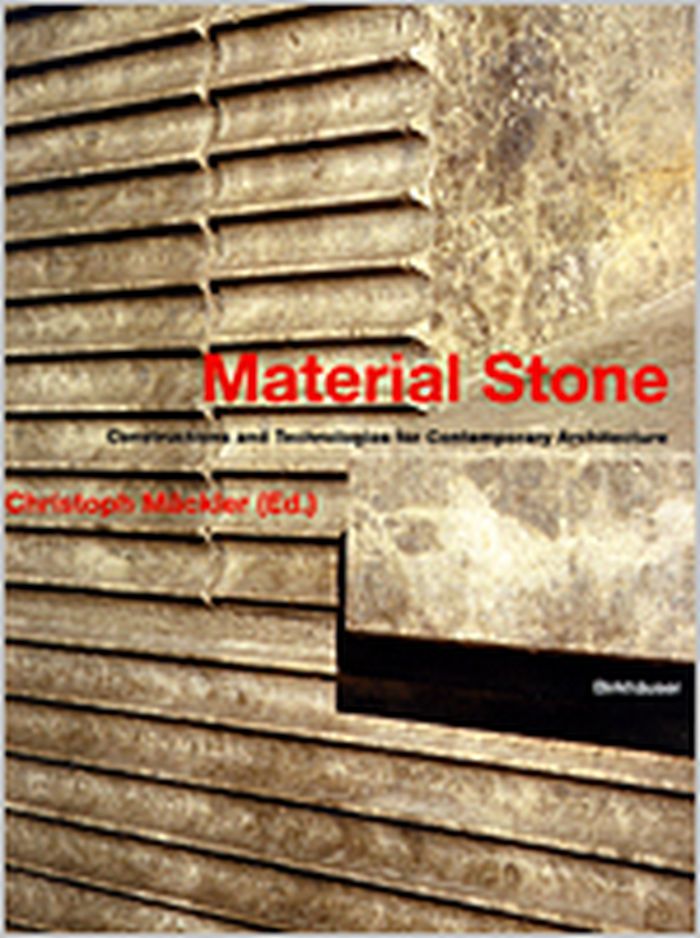
In recent years building with stone has gained new significance, not only because of its impressive appearance, but also in the debate that has arisen in architecture between the monumental and the transparent. Principally used in façades, but also for interior design, natural stone - and even man-made stone such as concrete and bricks - is now being appreciated for its high-quality performance. For international architects such as Michael Graves, Frank O. Gehry, Mario Botta or Richard Meier, this diverse material plays a major role. This publication examines the use of stone in contemporary architecture, drawing also on the work and experience of such great predecesors as Semper or Hoger. In thematic chapters, it presents the state of the art uses together with information on the extraction and treatment of stone. The emphasis of the book is laid on the many different kinds of natural stone, which come from a wide range of countries. Further chapters elucidate innovative applications of concrete and bricks, also illustrated by international examples. Contributions from Vittorio Magnago Lampugnani, Fritz Neumeyer and Stanislaus von Moos investigate stone as the enduring material of the town, consider its architectural expressiveness throughout history, and explore its significance as a surface material . A comprehensive appendix contains illustrations of some 70 kinds of natural stone, all of which are concisely documented, ensuring that this volume can be used as a reference for anybody interested in natural stone as a building material. Christoph Mäckler has been exploring stone as a building material both in architectural practice and in research for many years.
Material stone : Construction and technologies for contemporary architecture
Actions:
Price:
$42.00
(available to order)
Summary:
In recent years building with stone has gained new significance, not only because of its impressive appearance, but also in the debate that has arisen in architecture between the monumental and the transparent. Principally used in façades, but also for interior design, natural stone - and even man-made stone such as concrete and bricks - is now being appreciated for its high-quality performance. For international architects such as Michael Graves, Frank O. Gehry, Mario Botta or Richard Meier, this diverse material plays a major role. This publication examines the use of stone in contemporary architecture, drawing also on the work and experience of such great predecesors as Semper or Hoger. In thematic chapters, it presents the state of the art uses together with information on the extraction and treatment of stone. The emphasis of the book is laid on the many different kinds of natural stone, which come from a wide range of countries. Further chapters elucidate innovative applications of concrete and bricks, also illustrated by international examples. Contributions from Vittorio Magnago Lampugnani, Fritz Neumeyer and Stanislaus von Moos investigate stone as the enduring material of the town, consider its architectural expressiveness throughout history, and explore its significance as a surface material . A comprehensive appendix contains illustrations of some 70 kinds of natural stone, all of which are concisely documented, ensuring that this volume can be used as a reference for anybody interested in natural stone as a building material. Christoph Mäckler has been exploring stone as a building material both in architectural practice and in research for many years.
Form:
books
books
Publication:
December 2003, Basel
December 2003, Basel
Subject:
Materials and Lighting
Materials and Lighting


