


9272 Results
Form:
books
books
Actions:
Price:
$45.00
(available to order)
Summary:
In this book, Richard Hill examines the many-faceted relationship between aesthetic theory and architecture. Grounding his arguments in the practical issues related to building - the demands of site, materials, labor force, the nature of the commission - Hill expands our understanding and enjoyment of architecture. The book opens with an analysis of the relationship(...)
$45.00
(available to order)
Summary:
In this book, Richard Hill examines the many-faceted relationship between aesthetic theory and architecture. Grounding his arguments in the practical issues related to building - the demands of site, materials, labor force, the nature of the commission - Hill expands our understanding and enjoyment of architecture. The book opens with an analysis of the relationship(...)
Title:
Designs and their consequences
Actions:
Price:
$45.00
(available to order)
Summary:
In this book, Richard Hill examines the many-faceted relationship between aesthetic theory and architecture. Grounding his arguments in the practical issues related to building - the demands of site, materials, labor force, the nature of the commission - Hill expands our understanding and enjoyment of architecture. The book opens with an analysis of the relationship between buildings, drawings, and designs. Hill suggests that architectural drawings are essentially pictures of physical objects, although initially they may be imagined ones, and he considers the implications of this for architects and builders. He discusses the notion of "architectural experience" that has been important in the development of modern architecture, and the notion of "seeing as" that has been developed for other visual arts and that illuminates a range of architectural meaning. Asking how architecture can be expressive of a range of human states and qualities, Hill tests the idea that our ability to see the expressive aspects of buildings relates to our ability to see meaning in the faces and demeanor of other people. In the final section of the book, the author focuses on modern architecture's central aim to deepen the connection between usefulness and design, explores recent intense criticism of this outlook, and assesses the strengths and weaknesses of this body of criticism.
Designs and their consequences
Actions:
Price:
$45.00
(available to order)
Summary:
In this book, Richard Hill examines the many-faceted relationship between aesthetic theory and architecture. Grounding his arguments in the practical issues related to building - the demands of site, materials, labor force, the nature of the commission - Hill expands our understanding and enjoyment of architecture. The book opens with an analysis of the relationship between buildings, drawings, and designs. Hill suggests that architectural drawings are essentially pictures of physical objects, although initially they may be imagined ones, and he considers the implications of this for architects and builders. He discusses the notion of "architectural experience" that has been important in the development of modern architecture, and the notion of "seeing as" that has been developed for other visual arts and that illuminates a range of architectural meaning. Asking how architecture can be expressive of a range of human states and qualities, Hill tests the idea that our ability to see the expressive aspects of buildings relates to our ability to see meaning in the faces and demeanor of other people. In the final section of the book, the author focuses on modern architecture's central aim to deepen the connection between usefulness and design, explores recent intense criticism of this outlook, and assesses the strengths and weaknesses of this body of criticism.
Form:
books
books
Publication:
August 1999, New Haven
August 1999, New Haven
Subject:
Architectural Theory
Architectural Theory
Form:
books
books
Actions:
Price:
$86.00
(available to order)
Summary:
In the 11 days following the Chernobyl catastrophe on April 26, 1986, more than 116,000 people were permanently evacuated from the area surrounding the nuclear power plant. Declared unfit for human habitation, the zones of exclusion includes the towns of Pripyat (established in the 1970s to house workers) and Chernobyl. In May 2001, Robert Polidori photographed what was(...)
$86.00
(available to order)
Summary:
In the 11 days following the Chernobyl catastrophe on April 26, 1986, more than 116,000 people were permanently evacuated from the area surrounding the nuclear power plant. Declared unfit for human habitation, the zones of exclusion includes the towns of Pripyat (established in the 1970s to house workers) and Chernobyl. In May 2001, Robert Polidori photographed what was(...)
Title:
Robert Polidori : zones of exclusion : Pripyat and Chernobyl
Actions:
Price:
$86.00
(available to order)
Summary:
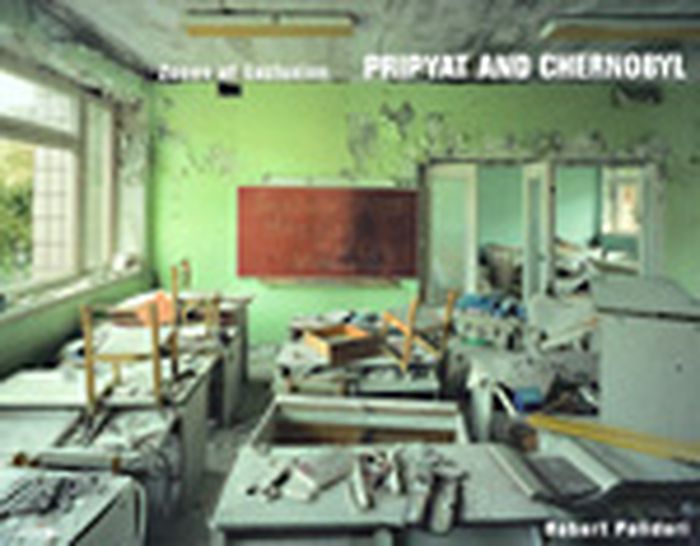
In the 11 days following the Chernobyl catastrophe on April 26, 1986, more than 116,000 people were permanently evacuated from the area surrounding the nuclear power plant. Declared unfit for human habitation, the zones of exclusion includes the towns of Pripyat (established in the 1970s to house workers) and Chernobyl. In May 2001, Robert Polidori photographed what was left behind in the this dead zone. His richly detailed images move from the burned-out control room of reactor 4, where technicians staged the experiment that caused the disaster, to the unfinished apartment complexes, ransacked schools and abandoned nurseries that remain as evidence of those who once called Pripyat home. Nearby, trucks and tanks used in the cleanup efforts rest in an auto graveyard, some covered in lead shrouds and others robbed of parts. Houseboats and barges rust in the contaminated waters of the Pripyat River. Foliage grows over the sidewalks and hides the modest homes of Chernobyl. In his large-scale photographs, Polidori captures the faded colors and desolate atmosphere of these two towns, producing haunting documents that present the reader with a rare view of not just a disastrous event, but a place and the people who lived there.
Robert Polidori : zones of exclusion : Pripyat and Chernobyl
Actions:
Price:
$86.00
(available to order)
Summary:
In the 11 days following the Chernobyl catastrophe on April 26, 1986, more than 116,000 people were permanently evacuated from the area surrounding the nuclear power plant. Declared unfit for human habitation, the zones of exclusion includes the towns of Pripyat (established in the 1970s to house workers) and Chernobyl. In May 2001, Robert Polidori photographed what was left behind in the this dead zone. His richly detailed images move from the burned-out control room of reactor 4, where technicians staged the experiment that caused the disaster, to the unfinished apartment complexes, ransacked schools and abandoned nurseries that remain as evidence of those who once called Pripyat home. Nearby, trucks and tanks used in the cleanup efforts rest in an auto graveyard, some covered in lead shrouds and others robbed of parts. Houseboats and barges rust in the contaminated waters of the Pripyat River. Foliage grows over the sidewalks and hides the modest homes of Chernobyl. In his large-scale photographs, Polidori captures the faded colors and desolate atmosphere of these two towns, producing haunting documents that present the reader with a rare view of not just a disastrous event, but a place and the people who lived there.
Form:
books
books
Publication:
August 2003, Göttingen
August 2003, Göttingen
Subject:
Photography monographs
Photography monographs
Form:
books
books
Actions:
Price:
$30.00
(available to order)
Summary:
Our culture has no concept of stopping. We continue to build motorways and airports for a future in which cars and planes may no longer exist. We’re converting our planet from a natural one to an artificial one in which the quantity of man-made objects – houses, asphalt, cars, plastic, computers and so on – now exceeds the totality of living matter. And while biomass(...)
$30.00
(available to order)
Summary:
Our culture has no concept of stopping. We continue to build motorways and airports for a future in which cars and planes may no longer exist. We’re converting our planet from a natural one to an artificial one in which the quantity of man-made objects – houses, asphalt, cars, plastic, computers and so on – now exceeds the totality of living matter. And while biomass(...)
Title:
The culture of stopping: obituary to myself
Actions:
Price:
$30.00
(available to order)
Summary:
Our culture has no concept of stopping. We continue to build motorways and airports for a future in which cars and planes may no longer exist. We’re converting our planet from a natural one to an artificial one in which the quantity of man-made objects – houses, asphalt, cars, plastic, computers and so on – now exceeds the totality of living matter. And while biomass continues to decline due to deforestation and species extinction, the mass of man-made objects is growing faster than ever. We’re on a treadmill to disaster. To get off this treadmill, argues Harald Welzer, we need to learn how to stop: as individuals and as societies, we need to stop doing what we’re doing and say ‘enough’. We find it hard to do this because our culture has trained us to regard endless escalation as desirable, and we’re reluctant to surrender the material benefits of growth. But as long as the expansive cultural model continues to prevail, there will be no change of course in favour of sustainable and climate-friendly practices and lifestyles. We need a cultural model in which the beauty of stopping is given the recognition needed for the project of civilization to continue. Optimizing processes that are heading in the wrong direction only makes matters worse.
The culture of stopping: obituary to myself
Actions:
Price:
$30.00
(available to order)
Summary:
Our culture has no concept of stopping. We continue to build motorways and airports for a future in which cars and planes may no longer exist. We’re converting our planet from a natural one to an artificial one in which the quantity of man-made objects – houses, asphalt, cars, plastic, computers and so on – now exceeds the totality of living matter. And while biomass continues to decline due to deforestation and species extinction, the mass of man-made objects is growing faster than ever. We’re on a treadmill to disaster. To get off this treadmill, argues Harald Welzer, we need to learn how to stop: as individuals and as societies, we need to stop doing what we’re doing and say ‘enough’. We find it hard to do this because our culture has trained us to regard endless escalation as desirable, and we’re reluctant to surrender the material benefits of growth. But as long as the expansive cultural model continues to prevail, there will be no change of course in favour of sustainable and climate-friendly practices and lifestyles. We need a cultural model in which the beauty of stopping is given the recognition needed for the project of civilization to continue. Optimizing processes that are heading in the wrong direction only makes matters worse.
Form:
books
books
Publication:
August 2023
August 2023
Subject:
Social
Social
Form:
books
books
Price:
$33.95
(available to order)
Summary:
A social history of AI that finally reveals its roots in the spatial computation of industrial factories and the surveillance of collective behaviour. What is AI? A dominant view describes it as the quest ''to solve intelligence,'' a solution supposedly to be found in the secret logic of the mind or in the deep physiology of the brain, such as in its complex neural(...)
$33.95
(available to order)
Summary:
A social history of AI that finally reveals its roots in the spatial computation of industrial factories and the surveillance of collective behaviour. What is AI? A dominant view describes it as the quest ''to solve intelligence,'' a solution supposedly to be found in the secret logic of the mind or in the deep physiology of the brain, such as in its complex neural(...)
Title:
The eye of the master: A social history of artificial intelligence
Actions:
Price:
$33.95
(available to order)
Summary:
A social history of AI that finally reveals its roots in the spatial computation of industrial factories and the surveillance of collective behaviour. What is AI? A dominant view describes it as the quest ''to solve intelligence,'' a solution supposedly to be found in the secret logic of the mind or in the deep physiology of the brain, such as in its complex neural networks. ''The eye of the master'' argues, to the contrary, that the inner code of AI is shaped not by the imitation of biological intelligence, but the intelligence of labour and social relations, as it is found in Babbage's ''calculating engines'' of the industrial age as well as in the recent algorithms for image recognition and surveillance. The idea that AI may one day become autonomous (or ''sentient'', as someone thought of Google's LaMDA) is pure fantasy. Computer algorithms have always imitated the form of social relations and the organisation of labour in their own inner structure and their purpose remains blind automation. ''The eye of the master'' urges a new literacy on AI for scientists, journalists and new generations of activists, who should recognise that the ''mystery'' of AI is just the automation of labour at the highest degree, not intelligence per se.
The eye of the master: A social history of artificial intelligence
Actions:
Price:
$33.95
(available to order)
Summary:
A social history of AI that finally reveals its roots in the spatial computation of industrial factories and the surveillance of collective behaviour. What is AI? A dominant view describes it as the quest ''to solve intelligence,'' a solution supposedly to be found in the secret logic of the mind or in the deep physiology of the brain, such as in its complex neural networks. ''The eye of the master'' argues, to the contrary, that the inner code of AI is shaped not by the imitation of biological intelligence, but the intelligence of labour and social relations, as it is found in Babbage's ''calculating engines'' of the industrial age as well as in the recent algorithms for image recognition and surveillance. The idea that AI may one day become autonomous (or ''sentient'', as someone thought of Google's LaMDA) is pure fantasy. Computer algorithms have always imitated the form of social relations and the organisation of labour in their own inner structure and their purpose remains blind automation. ''The eye of the master'' urges a new literacy on AI for scientists, journalists and new generations of activists, who should recognise that the ''mystery'' of AI is just the automation of labour at the highest degree, not intelligence per se.
Form:
books
books
Publication:
October 2023
October 2023
Subject:
Archive, library and the digital
Archive, library and the digital
Form:
books
books
Actions:
Price:
$40.00
(available to order)
Summary:
The crackling of a campfire. The scratch, hiss, and pop of a vinyl record. The first glug of wine as it is poured from a bottle. These are just a few of writer Caspar Henderson’s favorite sounds. In ''A book of noises,'' Henderson invites readers to use their ears a little better—to tune in to the world in all its surprising noisiness. Describing sounds from around(...)
$40.00
(available to order)
Summary:
The crackling of a campfire. The scratch, hiss, and pop of a vinyl record. The first glug of wine as it is poured from a bottle. These are just a few of writer Caspar Henderson’s favorite sounds. In ''A book of noises,'' Henderson invites readers to use their ears a little better—to tune in to the world in all its surprising noisiness. Describing sounds from around(...)
Title:
A book of noises: Notes on the auraculous
Actions:
Price:
$40.00
(available to order)
Summary:
The crackling of a campfire. The scratch, hiss, and pop of a vinyl record. The first glug of wine as it is poured from a bottle. These are just a few of writer Caspar Henderson’s favorite sounds. In ''A book of noises,'' Henderson invites readers to use their ears a little better—to tune in to the world in all its surprising noisiness. Describing sounds from around the natural and human world, the forty-eight essays that make up A Book of Noises are a celebration of all things ''auraculous.'' Henderson calls on his characteristic curiosity to explore sounds related to humans (anthropophony), other life (biophony), the planet (geophony), and space (cosmophony). Henderson finds the beauty in everyday sounds, like the ringing of a bell, the buzz of a bee, or the ''earworm'' songs that get stuck in our heads.''A book of noises'' also explores the marvelous, miraculous sounds we may never get the chance to hear, like the deep boom of a volcano or the quiet, rustling sound of the Northern Lights. ''A book of noises'' will teach readers to really listen to the sounds of the world around them, to broaden and deepen their appreciation of the humans, animals, rocks, and trees simultaneously broadcasting across the whole spectrum of sentience.
A book of noises: Notes on the auraculous
Actions:
Price:
$40.00
(available to order)
Summary:
The crackling of a campfire. The scratch, hiss, and pop of a vinyl record. The first glug of wine as it is poured from a bottle. These are just a few of writer Caspar Henderson’s favorite sounds. In ''A book of noises,'' Henderson invites readers to use their ears a little better—to tune in to the world in all its surprising noisiness. Describing sounds from around the natural and human world, the forty-eight essays that make up A Book of Noises are a celebration of all things ''auraculous.'' Henderson calls on his characteristic curiosity to explore sounds related to humans (anthropophony), other life (biophony), the planet (geophony), and space (cosmophony). Henderson finds the beauty in everyday sounds, like the ringing of a bell, the buzz of a bee, or the ''earworm'' songs that get stuck in our heads.''A book of noises'' also explores the marvelous, miraculous sounds we may never get the chance to hear, like the deep boom of a volcano or the quiet, rustling sound of the Northern Lights. ''A book of noises'' will teach readers to really listen to the sounds of the world around them, to broaden and deepen their appreciation of the humans, animals, rocks, and trees simultaneously broadcasting across the whole spectrum of sentience.
Form:
books
books
Publication:
November 2023
November 2023
Subject:
Acoustics
Acoustics
Form:
books
books
Actions:
Price:
$24.95
(available to order)
Summary:
Dr. Maya Angelou’s unforgettable poem is matched with the daring art of Jean-Michel Basquiat in this powerful ode to courage. Angelou’s brave, defiant poem celebrates the courage within each of us, young and old. From the scary thought of panthers in the park to the unsettling scene of a new classroom, fearsome images are summoned and dispelled by the power of faith in(...)
$24.95
(available to order)
Summary:
Dr. Maya Angelou’s unforgettable poem is matched with the daring art of Jean-Michel Basquiat in this powerful ode to courage. Angelou’s brave, defiant poem celebrates the courage within each of us, young and old. From the scary thought of panthers in the park to the unsettling scene of a new classroom, fearsome images are summoned and dispelled by the power of faith in(...)
Subject:
Children's Books
Children's Books
Publication:
January 2018
January 2018
Title:
Life doesn't frighten me (25th anniversary edition)
Actions:
Price:
$24.95
(available to order)
Summary:
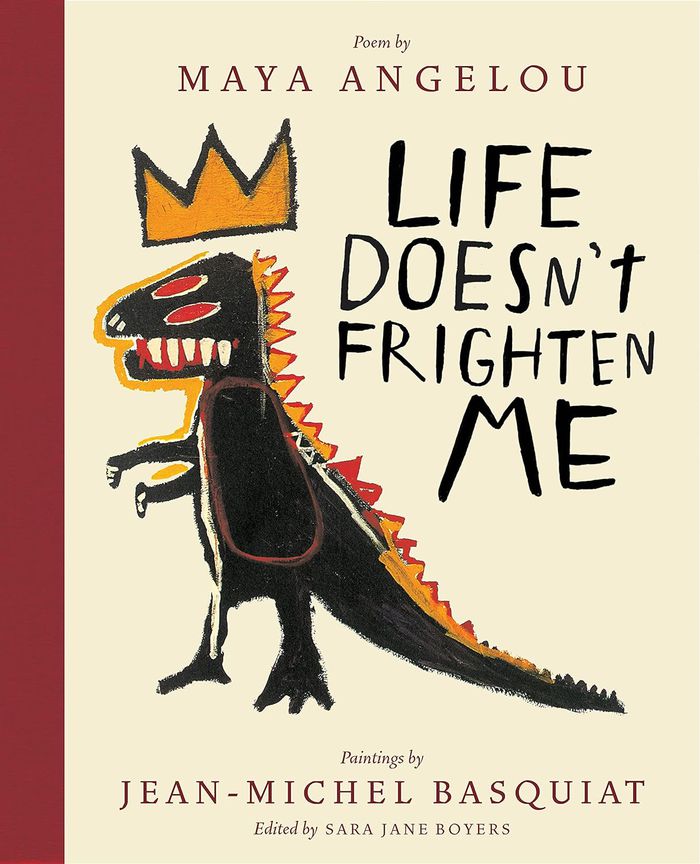
Dr. Maya Angelou’s unforgettable poem is matched with the daring art of Jean-Michel Basquiat in this powerful ode to courage. Angelou’s brave, defiant poem celebrates the courage within each of us, young and old. From the scary thought of panthers in the park to the unsettling scene of a new classroom, fearsome images are summoned and dispelled by the power of faith in ourselves. Angelou’s strong words are matched by the bold vision of artist Jean-Michel Basquiat, whose style reveals the powerful emotions and fanciful imaginings of childhood. Together, Angelou’s words and Basquiat’s paintings create a place where every child, indeed every person, may experience their own fearlessness. This brilliant introduction to poetry and contemporary art features brief biographies of Angelou and Basquiat and an afterword from the editor. A selected bibliography of Angelou’s books and a selected museum listing of Basquiat’s works open the door to further inspiration through the fine arts. Presented as an impassioned ode to courage, the late poet Dr. Maya Angelou’s 1993 poem in this handsome anniversary edition will inspire a new generation of brave readers, no matter the challenge. Young readers will be inspired by poetry, by art, and by the tremendous talent of these two legendary creators in one beautiful picture book.
Life doesn't frighten me (25th anniversary edition)
Actions:
Price:
$24.95
(available to order)
Summary:
Dr. Maya Angelou’s unforgettable poem is matched with the daring art of Jean-Michel Basquiat in this powerful ode to courage. Angelou’s brave, defiant poem celebrates the courage within each of us, young and old. From the scary thought of panthers in the park to the unsettling scene of a new classroom, fearsome images are summoned and dispelled by the power of faith in ourselves. Angelou’s strong words are matched by the bold vision of artist Jean-Michel Basquiat, whose style reveals the powerful emotions and fanciful imaginings of childhood. Together, Angelou’s words and Basquiat’s paintings create a place where every child, indeed every person, may experience their own fearlessness. This brilliant introduction to poetry and contemporary art features brief biographies of Angelou and Basquiat and an afterword from the editor. A selected bibliography of Angelou’s books and a selected museum listing of Basquiat’s works open the door to further inspiration through the fine arts. Presented as an impassioned ode to courage, the late poet Dr. Maya Angelou’s 1993 poem in this handsome anniversary edition will inspire a new generation of brave readers, no matter the challenge. Young readers will be inspired by poetry, by art, and by the tremendous talent of these two legendary creators in one beautiful picture book.
Form:
books
books
Publication:
January 2018
January 2018
Subject:
Children's Books
Children's Books
Form:
books
books
Actions:
Price:
$46.95
(available to order)
Summary:
The author, Gerhard Mack, explores the architecture of each individual museum in detail, and highlights current tendencies in museum building in his seminal essay "Time Rediscovered". This is complemented by an introduction by Harald Szeemann, who(...)
$46.95
(available to order)
Summary:
The author, Gerhard Mack, explores the architecture of each individual museum in detail, and highlights current tendencies in museum building in his seminal essay "Time Rediscovered". This is complemented by an introduction by Harald Szeemann, who(...)
Title:
Art museums into the 21st century
Actions:
Price:
$46.95
(available to order)
Summary:
The author, Gerhard Mack, explores the architecture of each individual museum in detail, and highlights current tendencies in museum building in his seminal essay "Time Rediscovered". This is complemented by an introduction by Harald Szeemann, who as curator of the Kunsthaus in Zürich, was appointed director for Fine Arts at the Biennale in Venice this year. The museums examined in this book are Kunsthaus in Bregenz, the Museum of the Beyeler Fondation near Basel, the Guggenheim Museum in Bilbao, the Getty Center in Los Angeles and the Moderna und Arkitektur Museet in Stockholm all opening within a year of one another. The Tate Gallery of Modern Art which is being built by Herzog & de Meuron in a former power station on the Thames in London is to be completed in May 1999. Conversations with the architects Frank O. Gehry, Jacques Herzog, Richard Meier, Rafael Moneo, Jean Nouvel, Renzo Piano and Peter Zumthor reveal the wide spectrum of design concerns in contemporary museum design and building. In the Pavilion at the Beyeler Fondation, the interaction of nature, light and the presentation of art is an impressive experience. Jean Nouvel perceives the museum as a public place, bringing the various areas of 'urban chaos' into contact with each other. A total of eight projects are presented.
Art museums into the 21st century
Actions:
Price:
$46.95
(available to order)
Summary:
The author, Gerhard Mack, explores the architecture of each individual museum in detail, and highlights current tendencies in museum building in his seminal essay "Time Rediscovered". This is complemented by an introduction by Harald Szeemann, who as curator of the Kunsthaus in Zürich, was appointed director for Fine Arts at the Biennale in Venice this year. The museums examined in this book are Kunsthaus in Bregenz, the Museum of the Beyeler Fondation near Basel, the Guggenheim Museum in Bilbao, the Getty Center in Los Angeles and the Moderna und Arkitektur Museet in Stockholm all opening within a year of one another. The Tate Gallery of Modern Art which is being built by Herzog & de Meuron in a former power station on the Thames in London is to be completed in May 1999. Conversations with the architects Frank O. Gehry, Jacques Herzog, Richard Meier, Rafael Moneo, Jean Nouvel, Renzo Piano and Peter Zumthor reveal the wide spectrum of design concerns in contemporary museum design and building. In the Pavilion at the Beyeler Fondation, the interaction of nature, light and the presentation of art is an impressive experience. Jean Nouvel perceives the museum as a public place, bringing the various areas of 'urban chaos' into contact with each other. A total of eight projects are presented.
Form:
books
books
Publication:
January 1900, Basel
January 1900, Basel
Subject:
Museums and Universal Exhibitions
Museums and Universal Exhibitions
Form:
books
books
Actions:
Price:
$33.00
(available to order)
Summary:
One of the most important things we do every day is eat. The question of eating – what and how – may seem simple at first, but it is dense with possible interpretations, reflecting the myriad roles food plays in our lives. In fact, as Raymond D. Boisvert and Lisa Heldke show in this book, it’s difficult to imagine a more philosophically charged act than eating.(...)
$33.00
(available to order)
Summary:
One of the most important things we do every day is eat. The question of eating – what and how – may seem simple at first, but it is dense with possible interpretations, reflecting the myriad roles food plays in our lives. In fact, as Raymond D. Boisvert and Lisa Heldke show in this book, it’s difficult to imagine a more philosophically charged act than eating.(...)
Title:
Philosophers at table: on food and being human
Actions:
Price:
$33.00
(available to order)
Summary:
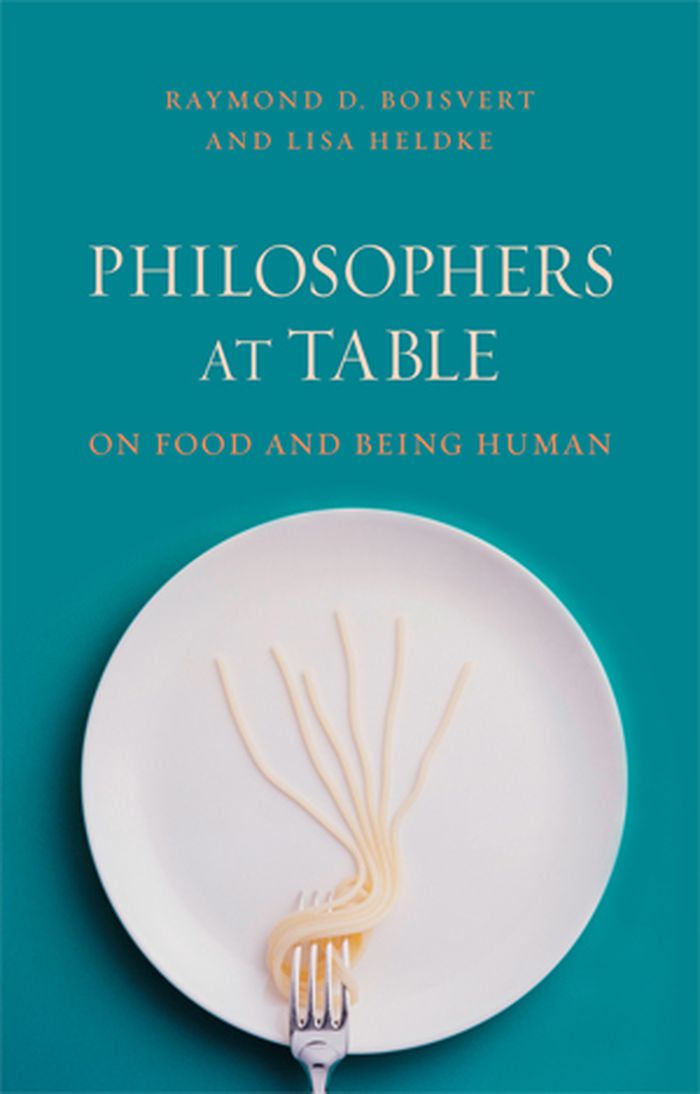
One of the most important things we do every day is eat. The question of eating – what and how – may seem simple at first, but it is dense with possible interpretations, reflecting the myriad roles food plays in our lives. In fact, as Raymond D. Boisvert and Lisa Heldke show in this book, it’s difficult to imagine a more philosophically charged act than eating. Philosophers at Table explores the philosophical scaffolding that supports this crucial aspect of everyday life, showing that humans are not just creatures with minds, but creatures with stomachs. Examining a wealth of myths, literary works, histories and films – as well as philosophical ideas – the authors make the case for a philosophy of food. They look at Babette’s Feast in a discussion of hospitality as a central ethical virtue. They compare eating a fast-food meal in Accra with dining at a molecular gastronomy restaurant as a way of considering the nature of food as art. And they describe biting into a slug to explore tasting as a learning tool, a way of knowing. A surprising, original take on something we have not philosophically savoured enough, Philosophers at Table invites readers to think in fresh ways about the simple and important act of eating.
Philosophers at table: on food and being human
Actions:
Price:
$33.00
(available to order)
Summary:
One of the most important things we do every day is eat. The question of eating – what and how – may seem simple at first, but it is dense with possible interpretations, reflecting the myriad roles food plays in our lives. In fact, as Raymond D. Boisvert and Lisa Heldke show in this book, it’s difficult to imagine a more philosophically charged act than eating. Philosophers at Table explores the philosophical scaffolding that supports this crucial aspect of everyday life, showing that humans are not just creatures with minds, but creatures with stomachs. Examining a wealth of myths, literary works, histories and films – as well as philosophical ideas – the authors make the case for a philosophy of food. They look at Babette’s Feast in a discussion of hospitality as a central ethical virtue. They compare eating a fast-food meal in Accra with dining at a molecular gastronomy restaurant as a way of considering the nature of food as art. And they describe biting into a slug to explore tasting as a learning tool, a way of knowing. A surprising, original take on something we have not philosophically savoured enough, Philosophers at Table invites readers to think in fresh ways about the simple and important act of eating.
Form:
books
books
Publication:
March 2016
March 2016
Subject:
Food
Food
Form:
books
books

Actions:
Price:
$35.00
(available in store)
Summary:
The rural, remote, and wild territories we call "countryside", or the 98% of the earth's surface not occupied by cities, make up the front line where today's most powerful forces-climate and ecological devastation, migration, tech, demographic lurches-are playing out. Increasingly under a 'Cartesian' regime-gridded, mechanized, and optimized for maximal production-these(...)
$35.00
(available in store)
Summary:
The rural, remote, and wild territories we call "countryside", or the 98% of the earth's surface not occupied by cities, make up the front line where today's most powerful forces-climate and ecological devastation, migration, tech, demographic lurches-are playing out. Increasingly under a 'Cartesian' regime-gridded, mechanized, and optimized for maximal production-these(...)
Title:
Koolhaas. Countryside, A Report (US edition)
Actions:
Price:
$35.00
(available in store)
Summary:
The rural, remote, and wild territories we call "countryside", or the 98% of the earth's surface not occupied by cities, make up the front line where today's most powerful forces-climate and ecological devastation, migration, tech, demographic lurches-are playing out. Increasingly under a 'Cartesian' regime-gridded, mechanized, and optimized for maximal production-these sites are changing beyond recognition. In his latest publication, Rem Koolhaas explores the rapid and often hidden transformations underway across the Earth's vast non-urban areas. This book gathers travelogue essays exploring territories marked by global forces and experimentation at the edge of our consciousness: a test site near Fukushima, where the robots that will maintain Japan's infrastructure and agriculture are tested; a greenhouse city in the Netherlands that may be the origin for the cosmology of today's countryside; the rapidly thawing permafrost of Central Siberia, a region wrestling with the possibility of relocation; refugees populating dying villages in the German countryside and intersecting with climate change activists; habituated mountain gorillas confronting humans on 'their' territory in Uganda; the American Midwest, where industrial-scale farming operations are coming to grips with regenerative agriculture; and Chinese villages transformed into all-in-one factory, e-commerce stores, and fulfillment centers.
Koolhaas. Countryside, A Report (US edition)
Actions:
Price:
$35.00
(available in store)
Summary:
The rural, remote, and wild territories we call "countryside", or the 98% of the earth's surface not occupied by cities, make up the front line where today's most powerful forces-climate and ecological devastation, migration, tech, demographic lurches-are playing out. Increasingly under a 'Cartesian' regime-gridded, mechanized, and optimized for maximal production-these sites are changing beyond recognition. In his latest publication, Rem Koolhaas explores the rapid and often hidden transformations underway across the Earth's vast non-urban areas. This book gathers travelogue essays exploring territories marked by global forces and experimentation at the edge of our consciousness: a test site near Fukushima, where the robots that will maintain Japan's infrastructure and agriculture are tested; a greenhouse city in the Netherlands that may be the origin for the cosmology of today's countryside; the rapidly thawing permafrost of Central Siberia, a region wrestling with the possibility of relocation; refugees populating dying villages in the German countryside and intersecting with climate change activists; habituated mountain gorillas confronting humans on 'their' territory in Uganda; the American Midwest, where industrial-scale farming operations are coming to grips with regenerative agriculture; and Chinese villages transformed into all-in-one factory, e-commerce stores, and fulfillment centers.
Form:
books
books
Publication:
April 2020
April 2020
Subject:
Architecture Monographs
Architecture Monographs
Form:
books
books
Title:
Hollaway: From now on
Hollaway: From now on
Actions:
Price:
$80.95
(available to order)
Summary:
Hollaway is an architectural and interior design practice that embraces the past, the present, and the future and places people and feeling at the core of its architecture philosophy. The RIBA award-winning practice has built its reputation working on a wide array of projects, including a cutting-edge skate park, the world’s first heritage theme park, a bespoke artist’s(...)
$80.95
(available to order)
Summary:
Hollaway is an architectural and interior design practice that embraces the past, the present, and the future and places people and feeling at the core of its architecture philosophy. The RIBA award-winning practice has built its reputation working on a wide array of projects, including a cutting-edge skate park, the world’s first heritage theme park, a bespoke artist’s(...)
Title:
Hollaway: From now on
Actions:
Price:
$80.95
(available to order)
Summary:
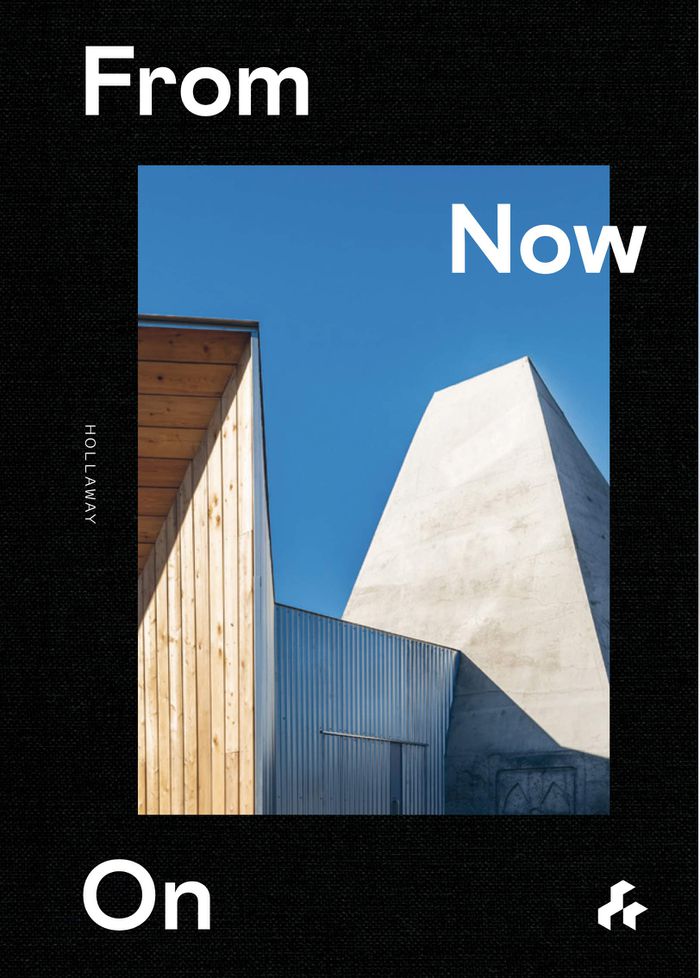
Hollaway is an architectural and interior design practice that embraces the past, the present, and the future and places people and feeling at the core of its architecture philosophy. The RIBA award-winning practice has built its reputation working on a wide array of projects, including a cutting-edge skate park, the world’s first heritage theme park, a bespoke artist’s studio in an open field, and a high-end seafood restaurant. They were also one of the first to install a tubular steel slide in an office redesign, and the chosen architects for the replanning of an entire town. The breadth of these projects may be wide, but each one brings the perfect balance of playfulness and sincerity, with a firm focus on placemaking, sustainability and the experience of the individuals who will use the space. "From now on" documents Hollaway’s inspirational buildings, brought alive by glowing client testimonies. It also reflects on where the practice has evolved from, where it finds itself today, and what the challenges of tomorrow demand of it – told in the words of those who make it what it was, is, and will become. A must for modern architecture lovers or anyone who is interested in seeing creative ideas made possible.
Hollaway: From now on
Actions:
Price:
$80.95
(available to order)
Summary:
Hollaway is an architectural and interior design practice that embraces the past, the present, and the future and places people and feeling at the core of its architecture philosophy. The RIBA award-winning practice has built its reputation working on a wide array of projects, including a cutting-edge skate park, the world’s first heritage theme park, a bespoke artist’s studio in an open field, and a high-end seafood restaurant. They were also one of the first to install a tubular steel slide in an office redesign, and the chosen architects for the replanning of an entire town. The breadth of these projects may be wide, but each one brings the perfect balance of playfulness and sincerity, with a firm focus on placemaking, sustainability and the experience of the individuals who will use the space. "From now on" documents Hollaway’s inspirational buildings, brought alive by glowing client testimonies. It also reflects on where the practice has evolved from, where it finds itself today, and what the challenges of tomorrow demand of it – told in the words of those who make it what it was, is, and will become. A must for modern architecture lovers or anyone who is interested in seeing creative ideas made possible.
Form:
books
books
Publication:
January 2021
January 2021
Subject:
Architecture Monographs
Architecture Monographs


