


12621 Results
Form:
drawings
drawings
Actions:
Reference number:
ARCH274218
Description:
Contains a design development submission (bound set of drawings) that includes general, landscape, architecture, structural, plumbing, mechanical and electrical drawings. There are also a few electrophotographic prints of plans.
ARCH274218
Description:
Contains a design development submission (bound set of drawings) that includes general, landscape, architecture, structural, plumbing, mechanical and electrical drawings. There are also a few electrophotographic prints of plans.
People:
Date:
ca. 2004
ca. 2004
Title:
Portfolio containing a design development submission for the project Laboratorios de ciencias moleculares para la Universidad de Puerto Rico, San Juan, Puerto Rico
Actions:
ARCH274218
Description:
Contains a design development submission (bound set of drawings) that includes general, landscape, architecture, structural, plumbing, mechanical and electrical drawings. There are also a few electrophotographic prints of plans.
Portfolio containing a design development submission for the project Laboratorios de ciencias moleculares para la Universidad de Puerto Rico, San Juan, Puerto Rico
Actions:
ARCH274218
Description:
Contains a design development submission (bound set of drawings) that includes general, landscape, architecture, structural, plumbing, mechanical and electrical drawings. There are also a few electrophotographic prints of plans.
Form:
drawings
drawings
Date:
ca. 2004
ca. 2004
People:
Level of archival description:
Project
Project
Actions:
Reference number:
AP046.S1.1983.PR02
Description:
This project documents Rose’s involvement with the design phase of the Old Port of Montreal Master Plan, Montréal, Québec and consists mainly of sketches, studies and presentation drawings for the redevelopment project with very few as built or architectural plans. The project materials reflect a Romantic design aesthetic and landscape development through numerous architectural design drawings for public amenities such as park benches, pedestrian walkways, various lighting sources, pavilions and fountains. This project also includes some of Rose’s submissions to the Faubourg Quebec development project which ran concurrent with the Old Port project. For the redevelopment of the Old Port of Montréal, Master Plan, Rose worked with the following firms: Cardinal Hardy e Associes, Chan Krieger & Associates, and Jodoin Lamarre Pratt. Rose was awarded a Progressive Architecture Urban Design Award (1992) and a Prix d’excellence for Urban Design from the Ordre des architectes du Québec (1993) for the realization of this urban project. The textual records in this project include budgets, correspondence, consultation documents, and intra office communiques as well as extensive research material on the history of the Old Port of Montreal including reproductions of historical photographs. The photographs in this project largely reflect the condition of the Old Port and Rue de la Commune prior to redevelopment and were used for reference and in presentation materials.
AP046.S1.1983.PR02
Description:
This project documents Rose’s involvement with the design phase of the Old Port of Montreal Master Plan, Montréal, Québec and consists mainly of sketches, studies and presentation drawings for the redevelopment project with very few as built or architectural plans. The project materials reflect a Romantic design aesthetic and landscape development through numerous architectural design drawings for public amenities such as park benches, pedestrian walkways, various lighting sources, pavilions and fountains. This project also includes some of Rose’s submissions to the Faubourg Quebec development project which ran concurrent with the Old Port project. For the redevelopment of the Old Port of Montréal, Master Plan, Rose worked with the following firms: Cardinal Hardy e Associes, Chan Krieger & Associates, and Jodoin Lamarre Pratt. Rose was awarded a Progressive Architecture Urban Design Award (1992) and a Prix d’excellence for Urban Design from the Ordre des architectes du Québec (1993) for the realization of this urban project. The textual records in this project include budgets, correspondence, consultation documents, and intra office communiques as well as extensive research material on the history of the Old Port of Montreal including reproductions of historical photographs. The photographs in this project largely reflect the condition of the Old Port and Rue de la Commune prior to redevelopment and were used for reference and in presentation materials.
People:
Date:
1983-1992
1983-1992
Title:
Old Port of Montreal Master Plan, Montréal, Québec
Actions:
AP046.S1.1983.PR02
Description:
This project documents Rose’s involvement with the design phase of the Old Port of Montreal Master Plan, Montréal, Québec and consists mainly of sketches, studies and presentation drawings for the redevelopment project with very few as built or architectural plans. The project materials reflect a Romantic design aesthetic and landscape development through numerous architectural design drawings for public amenities such as park benches, pedestrian walkways, various lighting sources, pavilions and fountains. This project also includes some of Rose’s submissions to the Faubourg Quebec development project which ran concurrent with the Old Port project. For the redevelopment of the Old Port of Montréal, Master Plan, Rose worked with the following firms: Cardinal Hardy e Associes, Chan Krieger & Associates, and Jodoin Lamarre Pratt. Rose was awarded a Progressive Architecture Urban Design Award (1992) and a Prix d’excellence for Urban Design from the Ordre des architectes du Québec (1993) for the realization of this urban project. The textual records in this project include budgets, correspondence, consultation documents, and intra office communiques as well as extensive research material on the history of the Old Port of Montreal including reproductions of historical photographs. The photographs in this project largely reflect the condition of the Old Port and Rue de la Commune prior to redevelopment and were used for reference and in presentation materials.
Old Port of Montreal Master Plan, Montréal, Québec
Actions:
AP046.S1.1983.PR02
Description:
This project documents Rose’s involvement with the design phase of the Old Port of Montreal Master Plan, Montréal, Québec and consists mainly of sketches, studies and presentation drawings for the redevelopment project with very few as built or architectural plans. The project materials reflect a Romantic design aesthetic and landscape development through numerous architectural design drawings for public amenities such as park benches, pedestrian walkways, various lighting sources, pavilions and fountains. This project also includes some of Rose’s submissions to the Faubourg Quebec development project which ran concurrent with the Old Port project. For the redevelopment of the Old Port of Montréal, Master Plan, Rose worked with the following firms: Cardinal Hardy e Associes, Chan Krieger & Associates, and Jodoin Lamarre Pratt. Rose was awarded a Progressive Architecture Urban Design Award (1992) and a Prix d’excellence for Urban Design from the Ordre des architectes du Québec (1993) for the realization of this urban project. The textual records in this project include budgets, correspondence, consultation documents, and intra office communiques as well as extensive research material on the history of the Old Port of Montreal including reproductions of historical photographs. The photographs in this project largely reflect the condition of the Old Port and Rue de la Commune prior to redevelopment and were used for reference and in presentation materials.
Level of archival description:
Project
Project
Date:
1983-1992
1983-1992
People:
Form:
archives
Level of archival description:
Fonds
archives
Level of archival description:
Fonds
Title:
Gene Summers fonds
Gene Summers fonds
Reference number:
AP114
Synopsis:
The Gene Summers fonds documents primarily the later part of Gene Summers' career as an architect, developer, artist and art collector. Summer's early work with the Office of Mies van der Rohe and C.F. Murphy Associates is summarily represented by notes, sketches and photographs.
AP114
Synopsis:
The Gene Summers fonds documents primarily the later part of Gene Summers' career as an architect, developer, artist and art collector. Summer's early work with the Office of Mies van der Rohe and C.F. Murphy Associates is summarily represented by notes, sketches and photographs.
People:
Date:
1957 - 2004
1957 - 2004
Title:
Gene Summers fonds
Actions:
AP114
Synopsis:
The Gene Summers fonds documents primarily the later part of Gene Summers' career as an architect, developer, artist and art collector. Summer's early work with the Office of Mies van der Rohe and C.F. Murphy Associates is summarily represented by notes, sketches and photographs.
Gene Summers fonds
Actions:
AP114
Synopsis:
The Gene Summers fonds documents primarily the later part of Gene Summers' career as an architect, developer, artist and art collector. Summer's early work with the Office of Mies van der Rohe and C.F. Murphy Associates is summarily represented by notes, sketches and photographs.
Form:
archives
Level of archival description:
Fonds
archives
Level of archival description:
Fonds
Date:
1957 - 2004
1957 - 2004
People:
Level of archival description:
Project
Project
Title:
São Victor, Porto
São Victor, Porto
Actions:
Reference number:
CD034.S1.1974.PR04
Description:
This project series contains reproductions of photographs, drawings and panels displayed in the exhibit to document the São Victor neighbourhood, in Porto, Portugal. The exhibit text explained that: ... the group of 12 houses built for the São Victor neighbourhood was one of SAAL's most important operations, despite the fact that only a small part of the project was carried out. Maintaining the urban fabric of the 'ilhas' (islands) and their internal community ties, the São Victor design combined the responsiveness inherent in the participatory nature of the project with architectural and technical precision. An important case study, it led Álvaro Siza Vieira, the project architect, being invited to design projects in Berlin and The Hague in the following decade. In many aspects, São Victor represents an ethically and politically-minded architectural practice, with a stress on understanding the link between being responsive to the voice of the people and the permanence of architectural design. (The SAAL Process, Housing in Portugal 1974–76) Álvaro Siza worked for SAAL/North with Adalberto Dias, Domingos Tavares, Eduardo Souto de Moura, Francisco Guedes, Graça Nieto, Manuel Borges, Manuela Sambade, Paula Cabral and the residents' association S. Victor, that was founded on April 14th, 1975. The first phase of the project included 32 dwellings and the second, 20 dwellings. The operation began in November 1974, with a construction date in October 1975. This project series contains reproductions of design development drawings, exhibition panels and photographs. The original material was produced around 1974-1975 and were reproduced in 2015 for the exhibit.
CD034.S1.1974.PR04
Description:
This project series contains reproductions of photographs, drawings and panels displayed in the exhibit to document the São Victor neighbourhood, in Porto, Portugal. The exhibit text explained that: ... the group of 12 houses built for the São Victor neighbourhood was one of SAAL's most important operations, despite the fact that only a small part of the project was carried out. Maintaining the urban fabric of the 'ilhas' (islands) and their internal community ties, the São Victor design combined the responsiveness inherent in the participatory nature of the project with architectural and technical precision. An important case study, it led Álvaro Siza Vieira, the project architect, being invited to design projects in Berlin and The Hague in the following decade. In many aspects, São Victor represents an ethically and politically-minded architectural practice, with a stress on understanding the link between being responsive to the voice of the people and the permanence of architectural design. (The SAAL Process, Housing in Portugal 1974–76) Álvaro Siza worked for SAAL/North with Adalberto Dias, Domingos Tavares, Eduardo Souto de Moura, Francisco Guedes, Graça Nieto, Manuel Borges, Manuela Sambade, Paula Cabral and the residents' association S. Victor, that was founded on April 14th, 1975. The first phase of the project included 32 dwellings and the second, 20 dwellings. The operation began in November 1974, with a construction date in October 1975. This project series contains reproductions of design development drawings, exhibition panels and photographs. The original material was produced around 1974-1975 and were reproduced in 2015 for the exhibit.
People:
Date:
circa 1974-1975
circa 1974-1975
Title:
São Victor, Porto
Actions:
CD034.S1.1974.PR04
Description:
This project series contains reproductions of photographs, drawings and panels displayed in the exhibit to document the São Victor neighbourhood, in Porto, Portugal. The exhibit text explained that: ... the group of 12 houses built for the São Victor neighbourhood was one of SAAL's most important operations, despite the fact that only a small part of the project was carried out. Maintaining the urban fabric of the 'ilhas' (islands) and their internal community ties, the São Victor design combined the responsiveness inherent in the participatory nature of the project with architectural and technical precision. An important case study, it led Álvaro Siza Vieira, the project architect, being invited to design projects in Berlin and The Hague in the following decade. In many aspects, São Victor represents an ethically and politically-minded architectural practice, with a stress on understanding the link between being responsive to the voice of the people and the permanence of architectural design. (The SAAL Process, Housing in Portugal 1974–76) Álvaro Siza worked for SAAL/North with Adalberto Dias, Domingos Tavares, Eduardo Souto de Moura, Francisco Guedes, Graça Nieto, Manuel Borges, Manuela Sambade, Paula Cabral and the residents' association S. Victor, that was founded on April 14th, 1975. The first phase of the project included 32 dwellings and the second, 20 dwellings. The operation began in November 1974, with a construction date in October 1975. This project series contains reproductions of design development drawings, exhibition panels and photographs. The original material was produced around 1974-1975 and were reproduced in 2015 for the exhibit.
São Victor, Porto
Actions:
CD034.S1.1974.PR04
Description:
This project series contains reproductions of photographs, drawings and panels displayed in the exhibit to document the São Victor neighbourhood, in Porto, Portugal. The exhibit text explained that: ... the group of 12 houses built for the São Victor neighbourhood was one of SAAL's most important operations, despite the fact that only a small part of the project was carried out. Maintaining the urban fabric of the 'ilhas' (islands) and their internal community ties, the São Victor design combined the responsiveness inherent in the participatory nature of the project with architectural and technical precision. An important case study, it led Álvaro Siza Vieira, the project architect, being invited to design projects in Berlin and The Hague in the following decade. In many aspects, São Victor represents an ethically and politically-minded architectural practice, with a stress on understanding the link between being responsive to the voice of the people and the permanence of architectural design. (The SAAL Process, Housing in Portugal 1974–76) Álvaro Siza worked for SAAL/North with Adalberto Dias, Domingos Tavares, Eduardo Souto de Moura, Francisco Guedes, Graça Nieto, Manuel Borges, Manuela Sambade, Paula Cabral and the residents' association S. Victor, that was founded on April 14th, 1975. The first phase of the project included 32 dwellings and the second, 20 dwellings. The operation began in November 1974, with a construction date in October 1975. This project series contains reproductions of design development drawings, exhibition panels and photographs. The original material was produced around 1974-1975 and were reproduced in 2015 for the exhibit.
Level of archival description:
Project
Project
Date:
circa 1974-1975
circa 1974-1975
People:
Form:
research
research
Title:
Visiting Scholars 2017
Visiting Scholars 2017
Actions:
Description:
Olumuyiwa Adegun, University of the Witwatersrand, Johannesburg, South Africa Topic: Informal Urban Housing: from 19th century Europe to 21st century Africa Susanne Bauer, The London Consortium, London, United Kingdom / Universidade Federal de Uberlândia, Uberlândia, Brazil Topic: Investigations Into Case: Peter Eisenman’s Dress Rehearsal For The Institute Of(...)
Olumuyiwa Adegun, University of the Witwatersrand, Johannesburg, South Africa Topic: Informal Urban Housing: from 19th century Europe to 21st century Africa Susanne Bauer, The London Consortium, London, United Kingdom / Universidade Federal de Uberlândia, Uberlândia, Brazil Topic: Investigations Into Case: Peter Eisenman’s Dress Rehearsal For The Institute Of(...)
Date:
June 2017 to September 2017
June 2017 to September 2017
Title:
Visiting Scholars 2017
Actions:
Description:
Olumuyiwa Adegun, University of the Witwatersrand, Johannesburg, South Africa Topic: Informal Urban Housing: from 19th century Europe to 21st century Africa Susanne Bauer, The London Consortium, London, United Kingdom / Universidade Federal de Uberlândia, Uberlândia, Brazil Topic: Investigations Into Case: Peter Eisenman’s Dress Rehearsal For The Institute Of(...)
Visiting Scholars 2017
Actions:
Description:
Olumuyiwa Adegun, University of the Witwatersrand, Johannesburg, South Africa Topic: Informal Urban Housing: from 19th century Europe to 21st century Africa Susanne Bauer, The London Consortium, London, United Kingdom / Universidade Federal de Uberlândia, Uberlândia, Brazil Topic: Investigations Into Case: Peter Eisenman’s Dress Rehearsal For The Institute Of(...)
Form:
research
research
Date:
June 2017 to
September 2017
June 2017 to
September 2017
Form:
research
research
Title:
Visiting Scholars 2016
Visiting Scholars 2016
Actions:
Description:
Olumuyiwa Adegun, University of the Witwatersrand, Johannesburg, South Africa Topic: Informal Urban Housing: from 19th century Europe to 21st century Africa Susanne Bauer, The London Consortium, London, United Kingdom / Universidade Federal de Uberlândia, Uberlândia, Brazil Topic: Investigations Into Case: Peter Eisenman’s Dress Rehearsal For The Institute Of(...)
Olumuyiwa Adegun, University of the Witwatersrand, Johannesburg, South Africa Topic: Informal Urban Housing: from 19th century Europe to 21st century Africa Susanne Bauer, The London Consortium, London, United Kingdom / Universidade Federal de Uberlândia, Uberlândia, Brazil Topic: Investigations Into Case: Peter Eisenman’s Dress Rehearsal For The Institute Of(...)
Date:
2 June 2016 to 2 September 2016
2 June 2016 to 2 September 2016
Title:
Visiting Scholars 2016
Actions:
Description:
Olumuyiwa Adegun, University of the Witwatersrand, Johannesburg, South Africa Topic: Informal Urban Housing: from 19th century Europe to 21st century Africa Susanne Bauer, The London Consortium, London, United Kingdom / Universidade Federal de Uberlândia, Uberlândia, Brazil Topic: Investigations Into Case: Peter Eisenman’s Dress Rehearsal For The Institute Of(...)
Visiting Scholars 2016
Actions:
Description:
Olumuyiwa Adegun, University of the Witwatersrand, Johannesburg, South Africa Topic: Informal Urban Housing: from 19th century Europe to 21st century Africa Susanne Bauer, The London Consortium, London, United Kingdom / Universidade Federal de Uberlândia, Uberlândia, Brazil Topic: Investigations Into Case: Peter Eisenman’s Dress Rehearsal For The Institute Of(...)
Form:
research
research
Date:
2 June 2016 to
2 September 2016
2 June 2016 to
2 September 2016
Level of archival description:
Project
Project
Title:
I.C.A. Building
I.C.A. Building
Reference number:
AP144.S2.D24
Description:
File documents an unexecuted proposal for new Headquarters for the Institute of Contemporary Arts on a site in South Kensington, London, England. File contains annotated conceptual drawings for a multi-functional building which includes an administration area, library, auditorium, lecture halls and galleries. Design proposal includes flexible and incomplete areas and an extensible open deck on top floor for future vertical expansion. Some material in this file was published in 'Architectural Design'. vol. 40, (October 1970), 518. Material in this file was produced in 1963. File contains conceptual drawings and photographic material.
AP144.S2.D24
Description:
File documents an unexecuted proposal for new Headquarters for the Institute of Contemporary Arts on a site in South Kensington, London, England. File contains annotated conceptual drawings for a multi-functional building which includes an administration area, library, auditorium, lecture halls and galleries. Design proposal includes flexible and incomplete areas and an extensible open deck on top floor for future vertical expansion. Some material in this file was published in 'Architectural Design'. vol. 40, (October 1970), 518. Material in this file was produced in 1963. File contains conceptual drawings and photographic material.
People:
Date:
[1963]
[1963]
Title:
I.C.A. Building
Actions:
AP144.S2.D24
Description:
File documents an unexecuted proposal for new Headquarters for the Institute of Contemporary Arts on a site in South Kensington, London, England. File contains annotated conceptual drawings for a multi-functional building which includes an administration area, library, auditorium, lecture halls and galleries. Design proposal includes flexible and incomplete areas and an extensible open deck on top floor for future vertical expansion. Some material in this file was published in 'Architectural Design'. vol. 40, (October 1970), 518. Material in this file was produced in 1963. File contains conceptual drawings and photographic material.
I.C.A. Building
Actions:
AP144.S2.D24
Description:
File documents an unexecuted proposal for new Headquarters for the Institute of Contemporary Arts on a site in South Kensington, London, England. File contains annotated conceptual drawings for a multi-functional building which includes an administration area, library, auditorium, lecture halls and galleries. Design proposal includes flexible and incomplete areas and an extensible open deck on top floor for future vertical expansion. Some material in this file was published in 'Architectural Design'. vol. 40, (October 1970), 518. Material in this file was produced in 1963. File contains conceptual drawings and photographic material.
Level of archival description:
File 24
File 24
Date:
[1963]
[1963]
People:
Form:
drawings
drawings
Actions:
Reference number:
ARCH288687
Description:
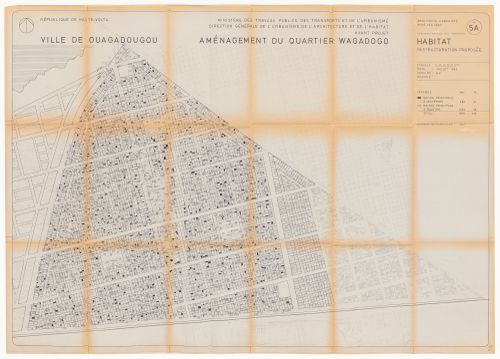
drawing number: 5A
ARCH288687
Description:
drawing number: 5A
People:
Date:
July 1982
July 1982
Title:
Plan for the Ouagadougou suburbs restructuring project, Burkina Faso
Actions:
ARCH288687
Description:
drawing number: 5A
Plan for the Ouagadougou suburbs restructuring project, Burkina Faso
Actions:
ARCH288687
Description:
drawing number: 5A
Form:
drawings
drawings
Date:
July 1982
July 1982
People:
Form:
drawings
drawings
Actions:
Reference number:
ARCH288688
Description:
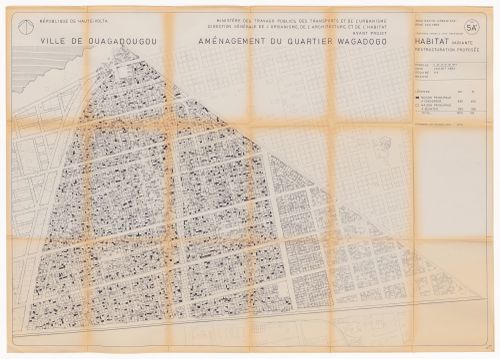
drawing number: 5Ax
ARCH288688
Description:
drawing number: 5Ax
People:
Date:
July 1982
July 1982
Title:
Plan for the Ouagadougou suburbs restructuring project, Burkina Faso
Actions:
ARCH288688
Description:
drawing number: 5Ax
Plan for the Ouagadougou suburbs restructuring project, Burkina Faso
Actions:
ARCH288688
Description:
drawing number: 5Ax
Form:
drawings
drawings
Date:
July 1982
July 1982
People:
Level of archival description:
Project
Project
Title:
Hague Hole
Hague Hole
Reference number:
AP144.S2.D25
Description:
File documents an unexecuted proposal for a truck transportable week-end house for a beach site in North Wales. Accordion-shaped extendible boxes with cross bracing are designed to be pulled out by car from a fixed central core onto structural rail sections levelled on jacks. The fixed central core consists of living, dining, kitchen and bathroom facilities. Some material in this file was published in 'Architectural Design', vol. 40, (October 1970), 511. File also contains measured drawings for unknown residence. Material in this file was produced in1960. File contains conceptual drawings, measured drawings, photographic materials, and textual records.
AP144.S2.D25
Description:
File documents an unexecuted proposal for a truck transportable week-end house for a beach site in North Wales. Accordion-shaped extendible boxes with cross bracing are designed to be pulled out by car from a fixed central core onto structural rail sections levelled on jacks. The fixed central core consists of living, dining, kitchen and bathroom facilities. Some material in this file was published in 'Architectural Design', vol. 40, (October 1970), 511. File also contains measured drawings for unknown residence. Material in this file was produced in1960. File contains conceptual drawings, measured drawings, photographic materials, and textual records.
People:
Date:
[1960]
[1960]
Title:
Hague Hole
Actions:
AP144.S2.D25
Description:
File documents an unexecuted proposal for a truck transportable week-end house for a beach site in North Wales. Accordion-shaped extendible boxes with cross bracing are designed to be pulled out by car from a fixed central core onto structural rail sections levelled on jacks. The fixed central core consists of living, dining, kitchen and bathroom facilities. Some material in this file was published in 'Architectural Design', vol. 40, (October 1970), 511. File also contains measured drawings for unknown residence. Material in this file was produced in1960. File contains conceptual drawings, measured drawings, photographic materials, and textual records.
Hague Hole
Actions:
AP144.S2.D25
Description:
File documents an unexecuted proposal for a truck transportable week-end house for a beach site in North Wales. Accordion-shaped extendible boxes with cross bracing are designed to be pulled out by car from a fixed central core onto structural rail sections levelled on jacks. The fixed central core consists of living, dining, kitchen and bathroom facilities. Some material in this file was published in 'Architectural Design', vol. 40, (October 1970), 511. File also contains measured drawings for unknown residence. Material in this file was produced in1960. File contains conceptual drawings, measured drawings, photographic materials, and textual records.
Level of archival description:
File 25
File 25
Date:
[1960]
[1960]
People:


