


Defining Vacancy
Rafico Ruiz invites Maurice Cox and Mio Tsuneyama to reframe vacancy as a generative condition
The following text is an excerpt from What places get to define vacancy?, a discussion that took place on 15 January 2026 in the Paul-Desmarais Theatre, marking the launch of the new edition of the CCA-WRI Research Fellowship Program.
- RR
- What places get to define vacancy? Economies shift and populations shrink. Homes, factories, public buildings, and other sites are left behind. These forms of vacancy reflect recurring cycles of urban and rural growth, but also of decline, exposing social and spatial fractures within local life across multiple scales. At the same time, they prompt a reconsideration of how land is valued, designed, and inhabited.
The CCA has been very fortunate to enter a dialogue with the Window Research Institute (WRI). We are opening a three-year program that is reconsidering vacancy as an urban and rural condition. Our aim is to investigate such vacant sites, how they come about and what their futures suggest.
- MC
- Vacancy has historically been associated with rapid deindustrialization, the decoupling of work and production from urban life, and its resulting population loss. The CCA-WRI program has reframed this challenge as a restorative act, a generative gesture, and an act of optimism to reimagine land and its many potential reuses.
I have been reflecting on the theme of vacancy in cities—particularly those that have too much fallow land without enough uses for it—for many years. Let me highlight the case of the city of Detroit, which in the 1940s and 1950s was the fifth largest city in America and reached a population peak of 1,800,000. Over the course of the last seventy years that population shrank to just 640,000 residents. When you lose population at that scale, the buildings that once housed vibrant institutions remain in place long after the people have left. The challenge, then, is how do you regenerate a city that has no programmatic use for two-thirds of its building stock? And the multiple cycles of demolition that have left the city with an unimaginable amount of vacant land—twenty-seven square miles of it—adds to the challenge.
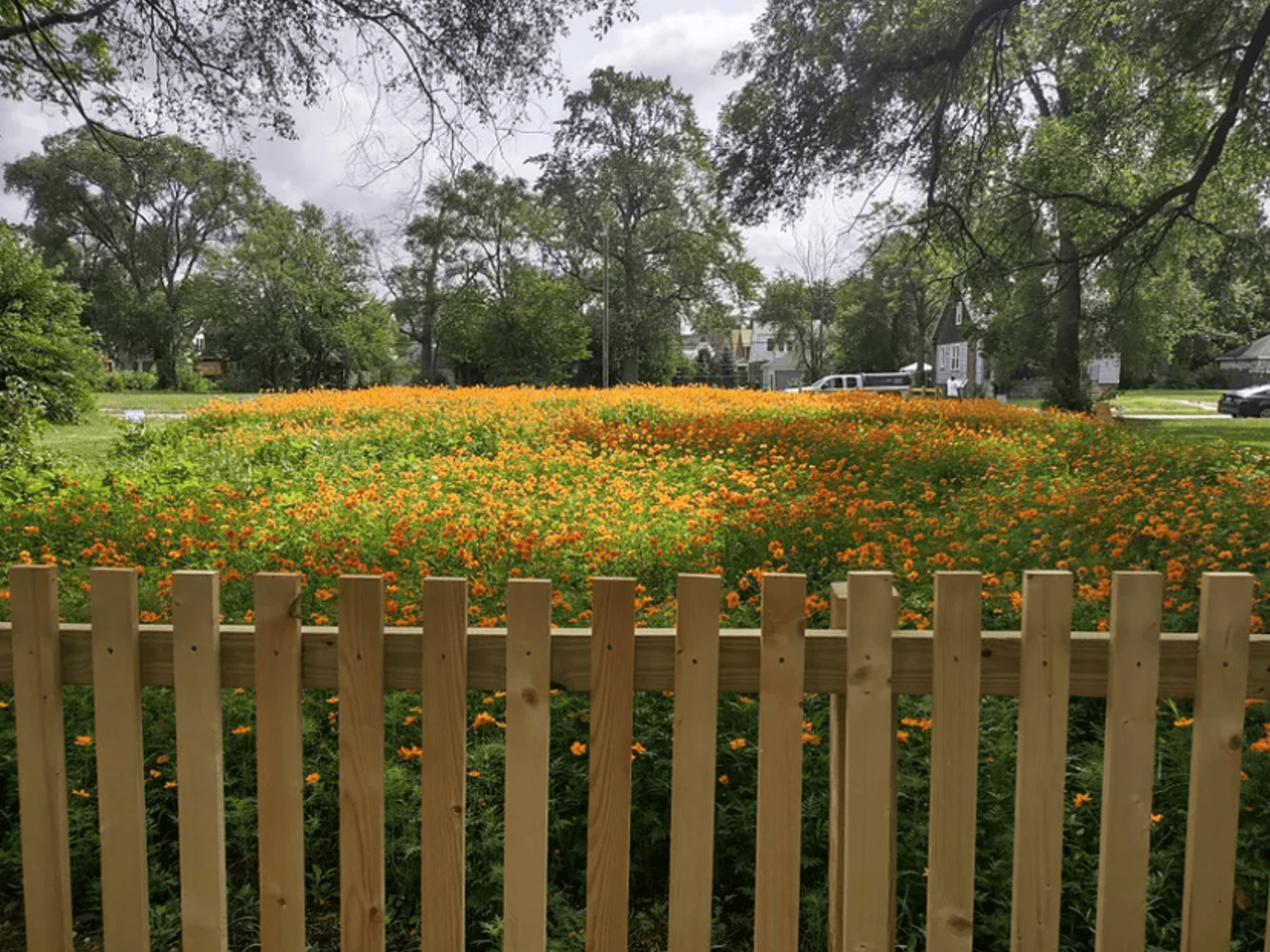
View of an urban meadow in Detroit, Michigan, 2018. Digital photograph. © Courtesy of the City of Detroit Planning Department
- MC
- The way that this land has been handed down to our generation of urbanists is unfortunately not a contiguous body, like a big central park. Instead, because of the historic pattern of scattered demolition campaigns, the vacant land pattern we inherit takes on a more speckled and scattered quality. One block may have only two occupied houses on it surrounded by vacant land, while another block may have twenty houses on it with very little vacant land. In many cases there’s an overabundance of land that basically has no programmatic purpose.
Bringing together architects and landscape architects to reflect on this condition, one can begin to answer the question, what land should remain open and what land should be built upon? One can reimagine a future where vacant land is considered as part of a larger ecological system that is restorative.
Detroit tackled this question by testing a range of landscape-based strategies in a variety of neighbourhoods experiencing vacancy. In each neighbourhood laboratory, we identified a quarter square mile area where we could deploy a land-based strategy for vacant lots and an adaptive reuse strategy for vacant buildings. Each of these strategies was led by a landscape architect working together with an urban designer or city planner to create a set of new neighbourhood typologies based on agricultural or community stewardship and heritage themes.
One such experiment is set in the centre of the Fitzgerald neighbourhood, where twenty-seven vacant lots were assembled, spanning across streets and alleys, to create a three-acre park named after legendary jazz singer, Ella Fitzgerald. The park design suggests how you can create a coherent vision across a neighbourhood street by using street paint as a graphic device to calm traffic and connect different parts of the park to each other. The park further links to the larger neighbourhood via a new pedestrian greenway that takes advantage of the vacant lots between homes. As a result of these complementary landscape strategies, the Fitzgerald community now has a connected three-acre gathering place at its centre that serves as a collective vision for the neighbourhood.
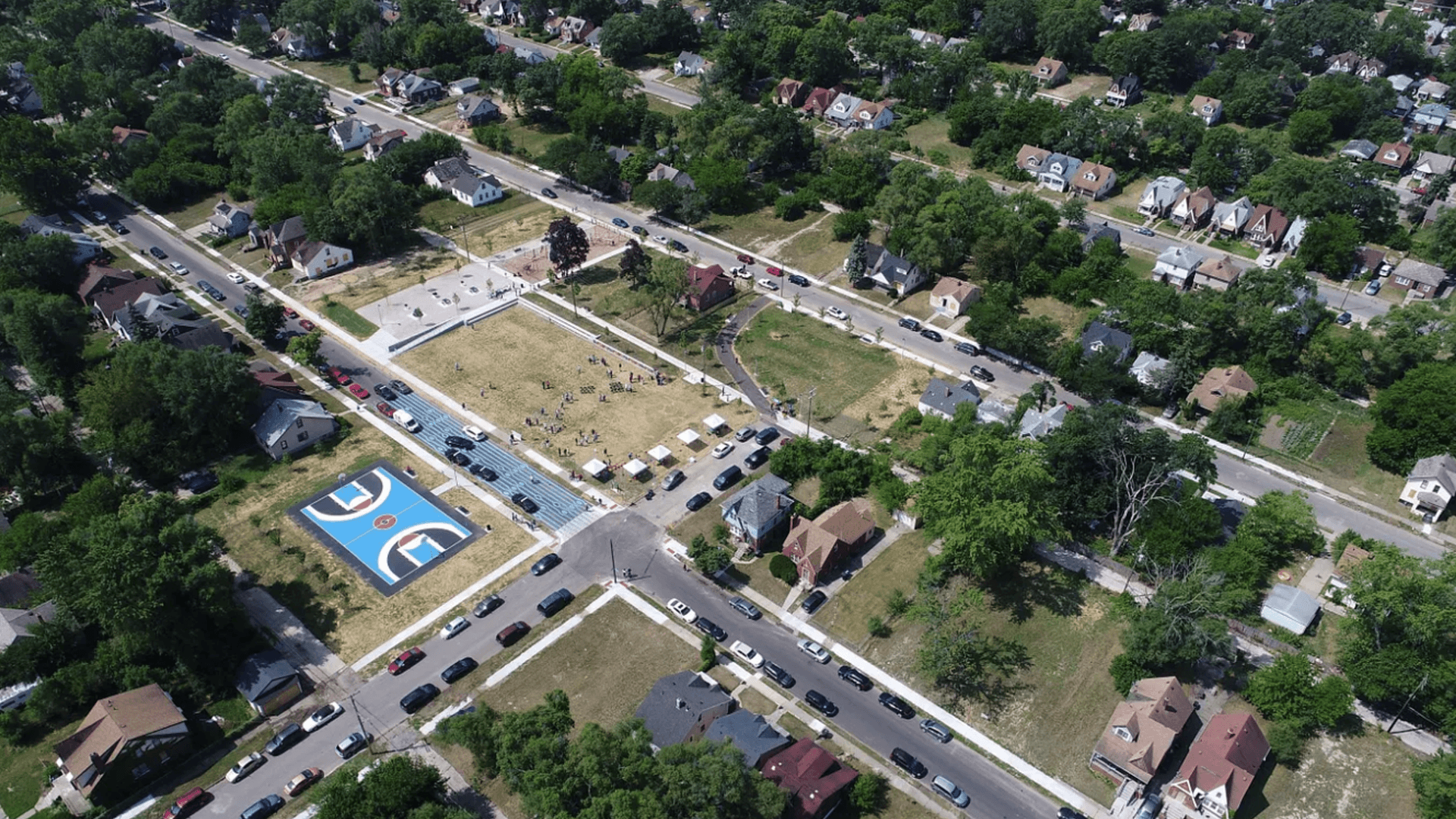
Aerial view of Ella Fitzgerald Park in Detroit, Michigan, 2018. Digital photograph. © Courtesy of the City of Detroit Planning Department
- MC
- In the same neighbourhood, an alternative strategy for vacant land stewardship reimagines the pattern of existing scattered lots as a living quilt of flowering meadows and perennial gardens. This strategy, coupled with the rehabilitation of dozens of vacant homes, helped to attract new families, repopulating the neighbourhood without generating displacement.
To get to this collective vision embraced by most Fitzgerald residents, a deep process of engagement involving dozens of community meetings unfolded over a sustained period of time. At its core, urban planners had to move at the speed of trust to get neighbours comfortable with the idea that a new park, a greenway, and a pattern of well-cared-for scattered flowering meadow lots could be an economic strategy to regenerate their neighbourhood.
This is just one case study out of many land-based regeneration strategies we deployed throughout Detroit’s neighbourhoods. The proof of success came with the most recent census results: after seventy years of consistent population decline, two years ago Detroit registered population growth for the first time. The city has turned a major corner, and the places where it is growing again are exactly the places where we planned for growth and community restoration.
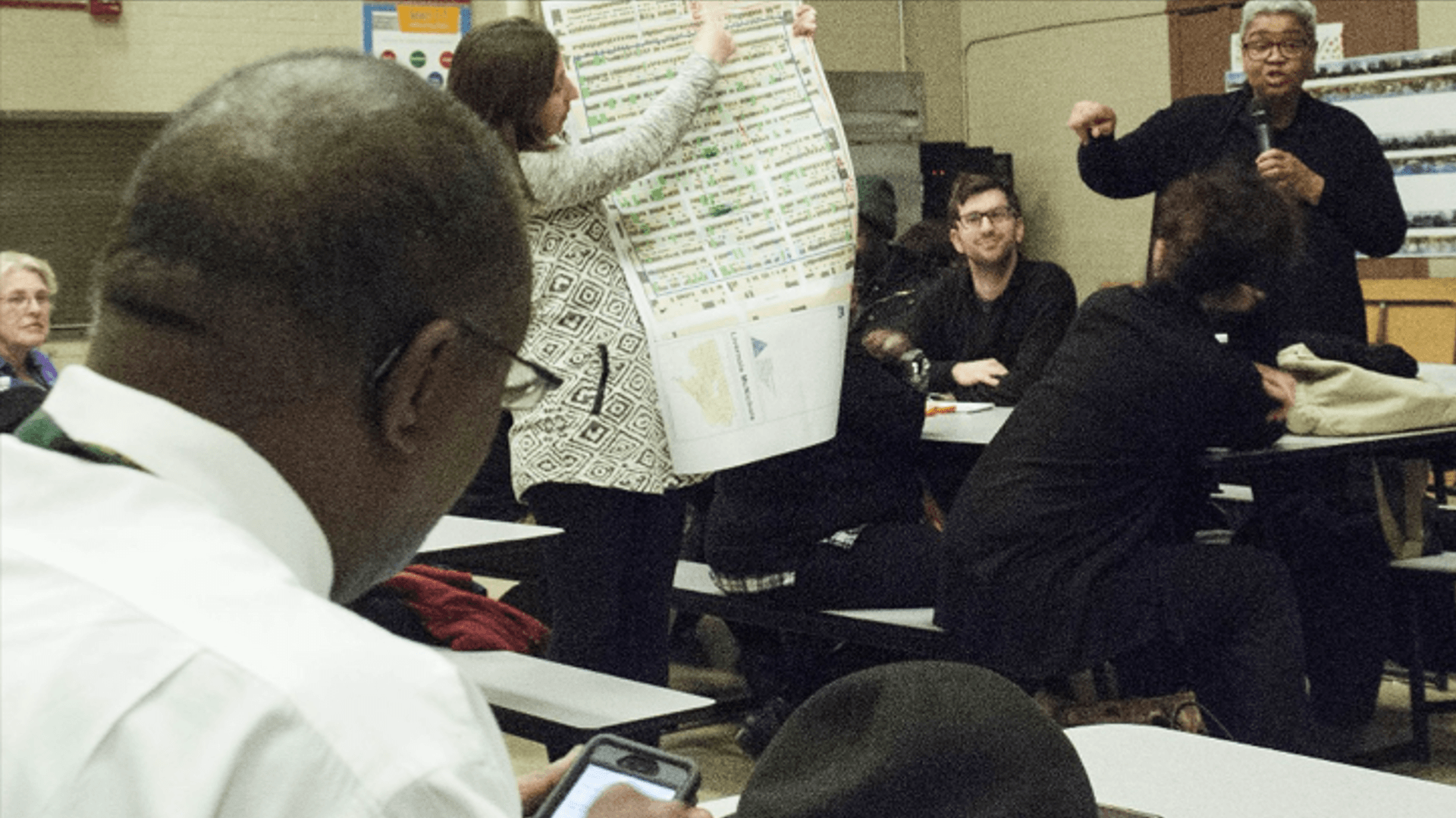
View of community engagement process in Detroit, Michigan. ca. 2016. 35mm colour negative. © Courtesy of the City of Detroit Planning Department
- MT
- Coming from Tokyo, our approach towards architecture is mediated by co-habitation with urban waste and soil. After World War II, Tokyo was devastated, and the city was left largely vacant. Today, vacancy is a product of a growth-oriented building industry and real-estate economy that can only sustain itself in a constant cycle of development and demolition.
For thirty years our economy has remained stagnant, and our population has been in decline. The city reflects this contrast with many vacant houses left undeveloped, which we call the “expired city”. As young architects, we started working on the expired city by refurbishing abandoned houses and gardens, transforming them into cafes or shared houses. In Japan, the lifecycle of a house is only thirty years, which makes urban waste abundant. This waste is an opportunity to invent new typologies, since the market is not interested in vacant homes which have no real market value.
While transforming a single-family home, which had been vacant for several years, into a House for Seven People, the architectural elements of the existing building served as a starting point for creating a new typology. For instance, a four-panel steel door, discovered between the walls during demolition. These elements helped create a sense of generosity between common spaces where residents with no familial ties can live comfortably together.
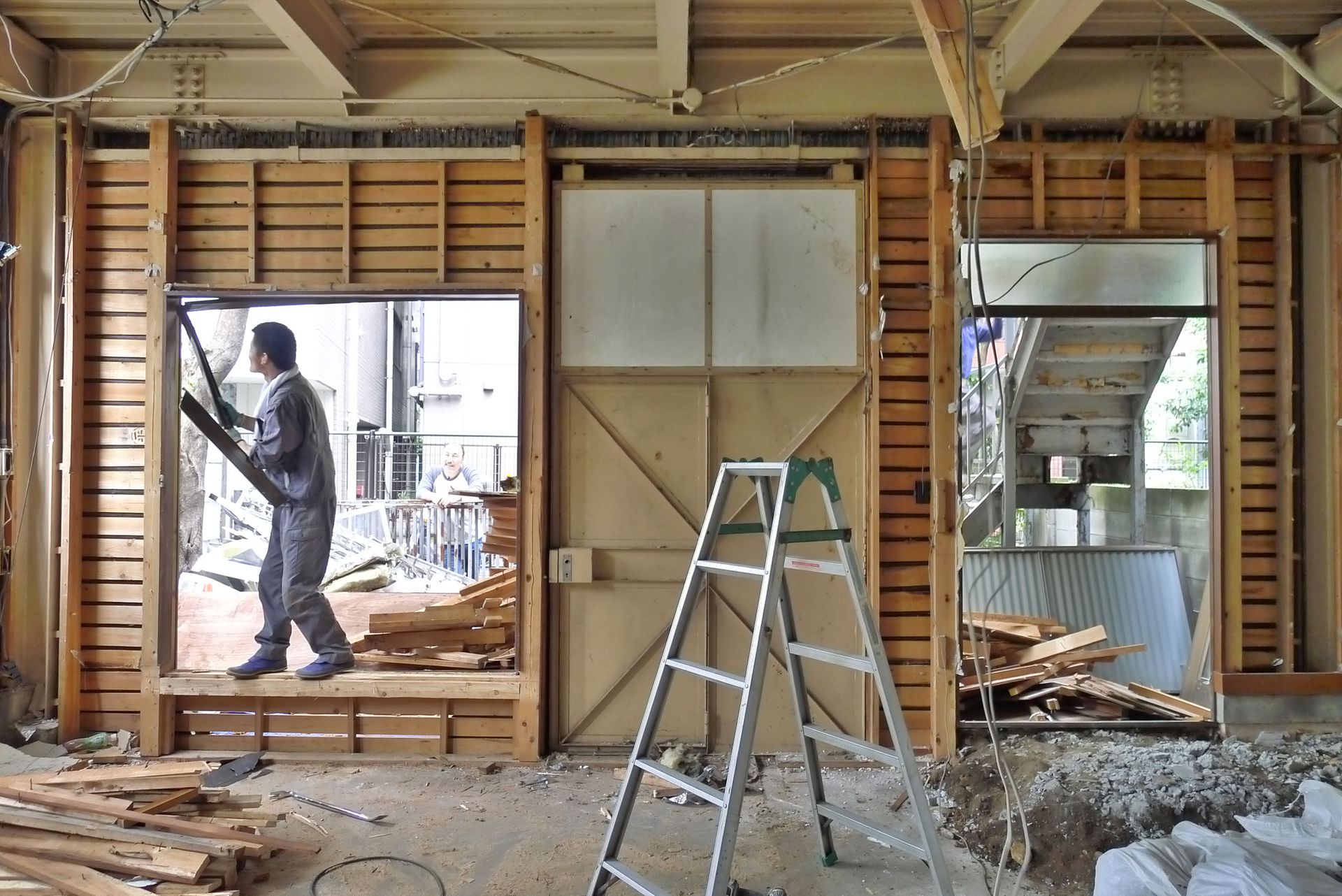
Studio mnm, View of House for Seven People under construction in Tokyo, by Studio mnm, Japan, 2013. Digital photograph. © Studio mnm
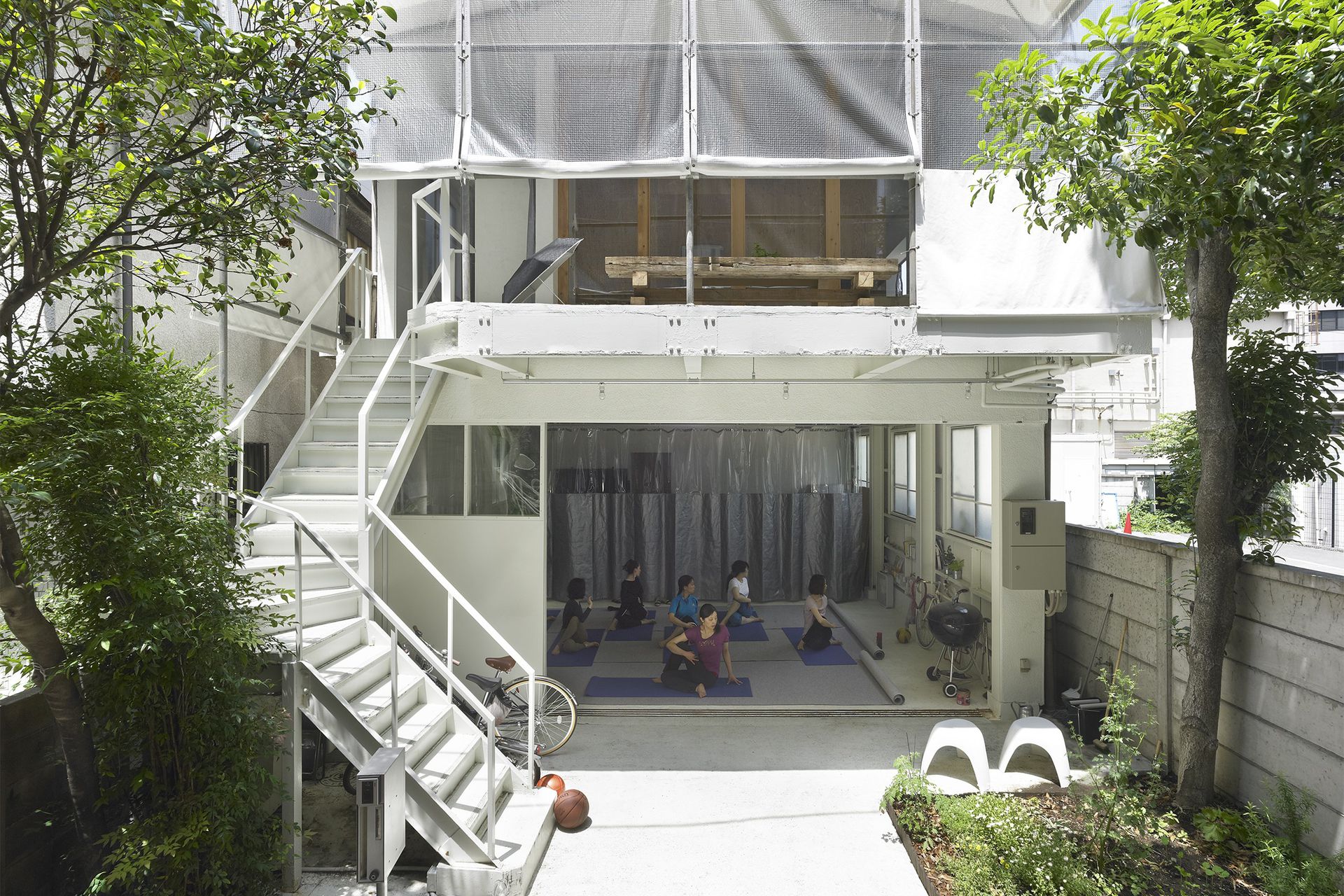
Sadao Hotta, View of the exterior of House for Seven People in Tokyo, by Studio mnm, Japan, 2014, Digital photograph. © Sadao Hotta
- MT
- In Holes in the House, I am renovating a forty-year-old home while living in it. In Japan, where the typical lifespan of a home is thirty years, this house was on the verge of becoming vacant. We saved this house to provide an experimental field for our architectural practice. By punching holes through surfaces, we can create connections that generate a new interior environment.
After we demolished part of the house, we moved in and lived without windows for a year. Cockroaches and mosquitoes could easily pass through, and we suffered a lot. Once we installed new windows, we really appreciated the comfort they provided us; something we could only experience since we were improving the building while living in it. Each time we fixed something, we really experienced the comfort it provided us with.
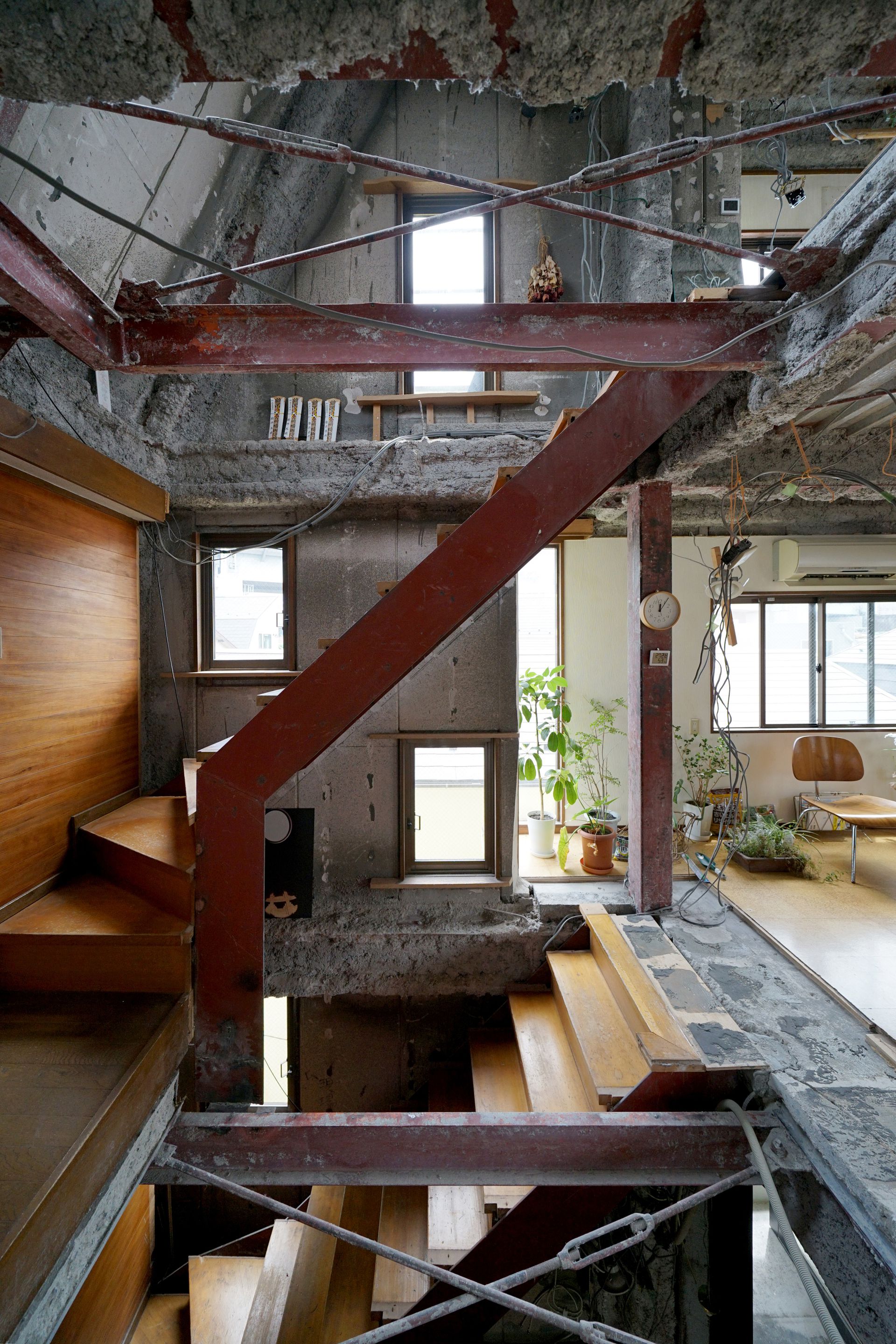
Ryogo Utatsu, View of the staircase in Holes in the House in Tokyo by Mio Tsuneytama and Fuminori Nousaku, Japan, 2024. Digital photograph. © Ryogo Utatsu
- MT
- When you work with vacant homes as a resource, vacant lots start to look like resources too. We returned our home’s concrete-covered parking space back into soil, creating a small soil cycle right here in the city. Soil is both the living foundation that nurtures our food and the foundation of architecture. How a structure meets the ground is fundamental. Traditional stone foundations co-exist with the soil environment, allowing oxygen and water to reach microorganisms that live in the soil. The modern city is filled with concrete slab foundations which seal off the soil and cause stagnation. We sought out construction methods that co-exist with the soil environment and maintain its productivity; we focused on foundations where soil and architecture meet.
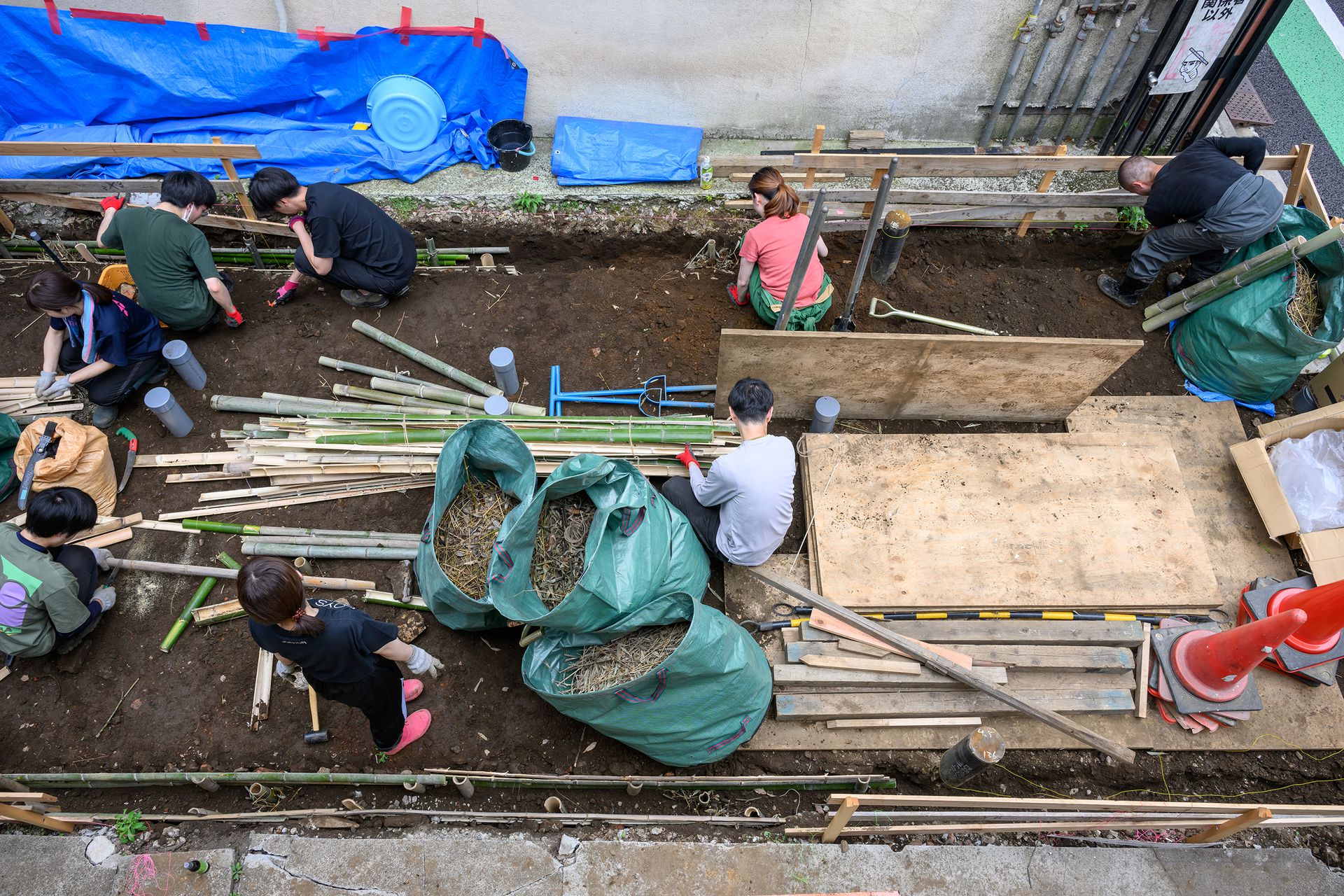
Junpei Suzuki, View of Piles and Pointed Roof under construction in Tokyo, by Mio Tsuneyama and Fuminori Nousaku, Japan, 2025. Digital photograph. © Junpei Suzuki
- MT
- In the centre of Tokyo, without much space, we designed a project using eight piles as independent foundations. In the low-lying areas of Tokyo, where the ground is soft, the presence of piles has become a hindrance to subsequent construction projects. To address this, we adopted steel pipe piles for the foundation, which do not contaminate the soil during operation and can be removed by reversing the rotation of the screw during demolition. We also installed natural drainage ditches to allow rainwater to seep back into the soil.
Urban soil lies hidden beneath the surface, becoming a void that people hardly notice. I believe that architecture and urban planning have the power to transform that void into a resource. Through vacancy, we developed our idea of how to connect the ground to the building by adapting our lifestyle to co-species habitation and building a soil-friendly architecture.
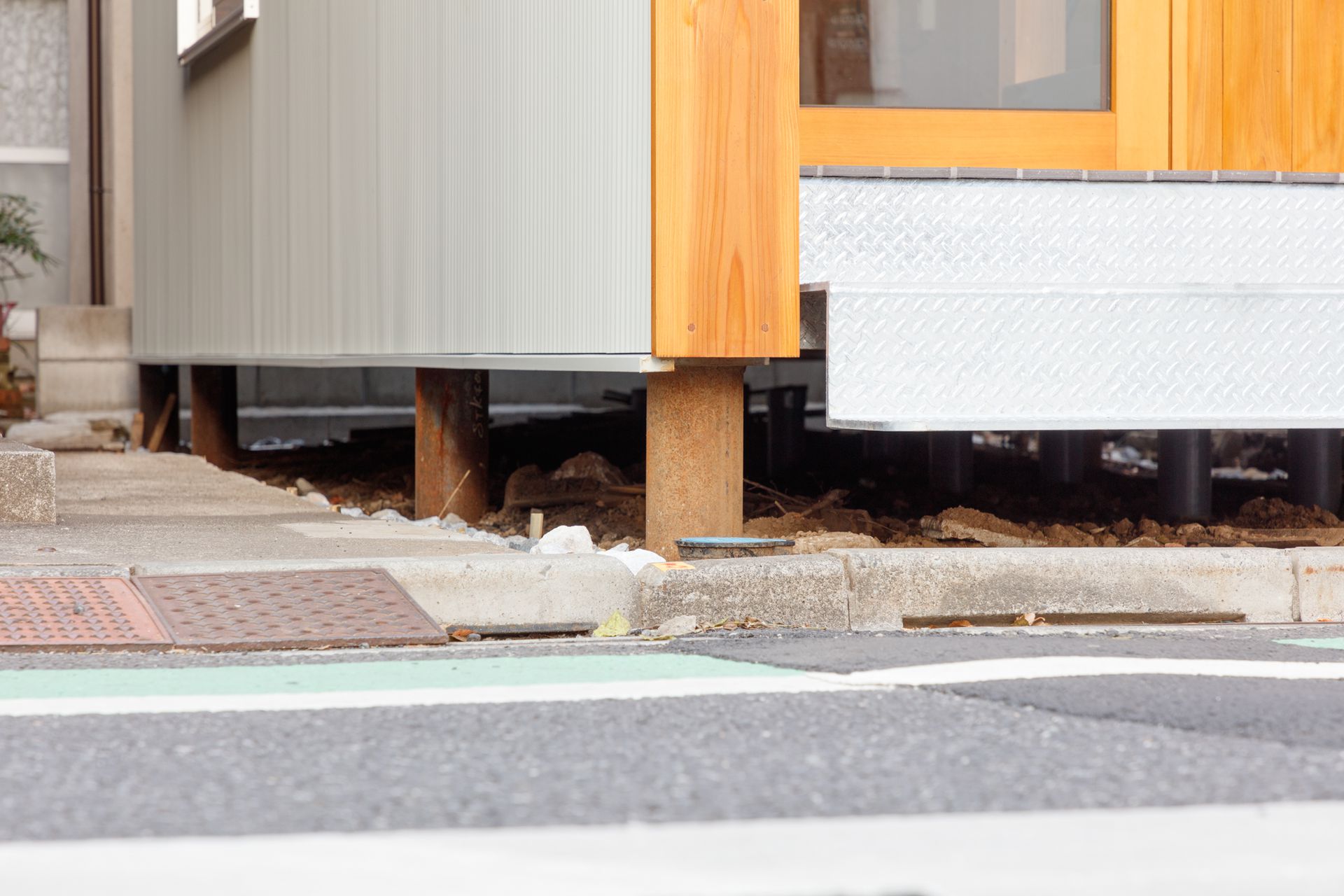
Junpei Suzuki, View of the foundation of Piles and Pointed Roof in Tokyo, by Mio Tsuneyama and Fuminori Nousaku, Japan, 2025. Digital photograph. © Junpei Suzuki
- RR
- Something I observed across both of your work is the range of scales that you work across. Firstly, in Detroit, at a territorial scale beyond the city’s boundaries. And then Mio, you showed your own home and other projects that gesture towards the building scale. My question is around the perception of vacancy as a static condition. Is it difficult to engage with land or buildings that are considered vacant?
- MC
- In 2013, Detroit hit rock bottom and filed for the largest municipal bankruptcy in U.S. history. For many decades prior to this milestone, the city simply tried its best to manage an intractable urban decline, a shrinking tax base, and a growing inventory of thousands of vacant buildings and parcels. In the face of such challenges, what can an architect offer? As you might imagine, architects tended to propose a mixture of new buildings and adaptive rehabilitation in a city that had thousands of vacant structures. By contrast, my first impulse was to bring in an allied discipline, landscape architecture, whose design professionals don’t see land as vacant but instead as simply fallow, waiting for regeneration.
In fact, the first design professional that I hired as Detroit’s new planning director was a landscape architect, Alexa Bush. The goal was to reset people’s expectations about the value of landscapes as a defining contributor to wellbeing and quality of life through the specific design of high-quality parks, greenways, and low-maintenance land stewardship models that could be scaled up.
Instead of proposing landscapes requiring active programs and a high degree of maintenance, could we propose instead vacant lot strategies covered by flowering meadows and tree orchards? We sought to implement these alternative landscape stewardship strategies to inspire confidence in existing residents that their neighbourhoods were regenerating, even without new housing being built and new neighbours moving in.
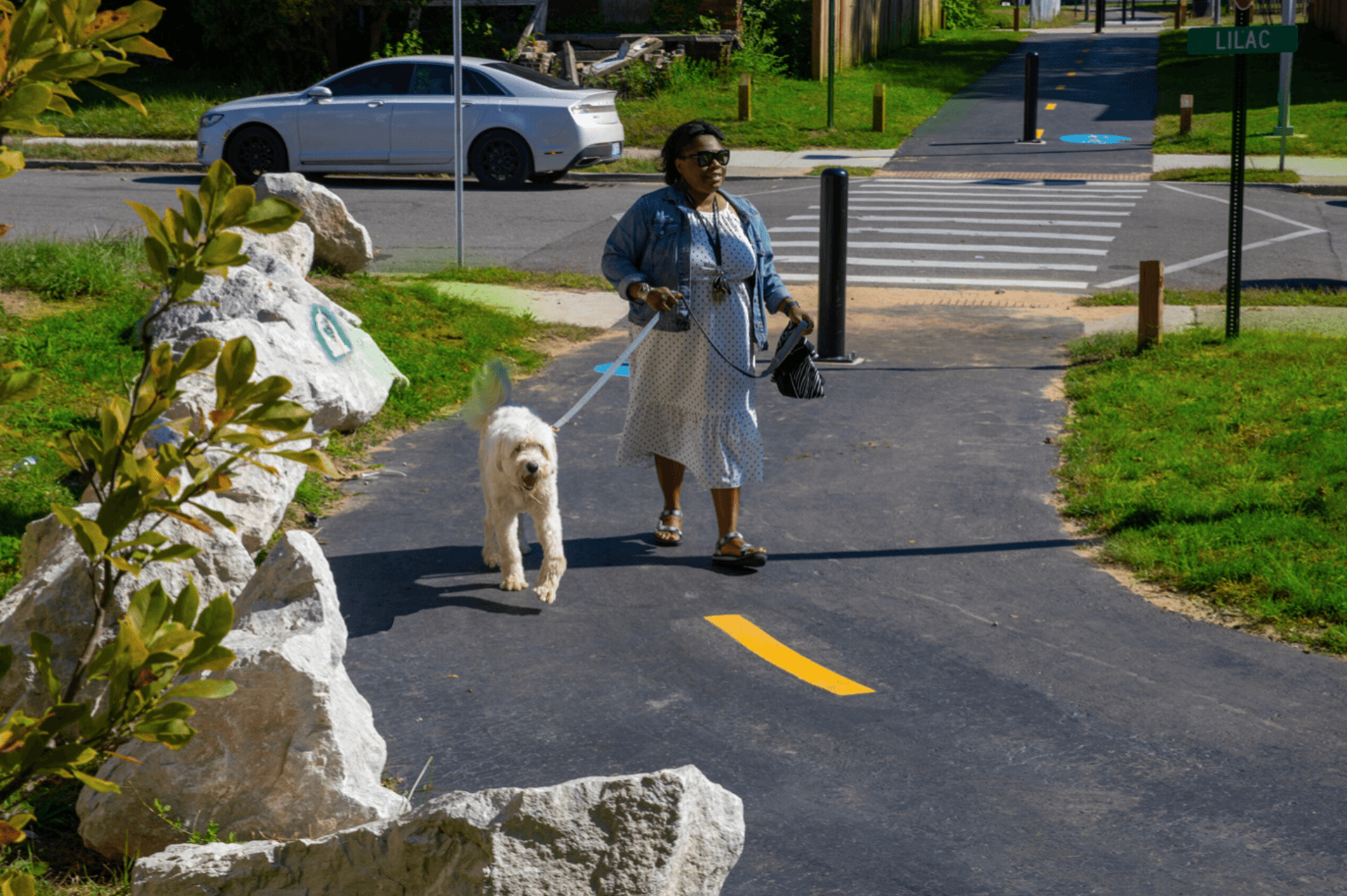
View of Ella Fitzgerald Greenway in Detroit, Michigan, 2019. Digital photograph. © Courtesy of the City of Detroit Planning Department
- MC
- The biggest challenge, of course, was convincing a very skeptical existing population that these landscape strategies—planting 100 flowering meadows in their neighbourhood, in the Fitzgerald example—were also economic development strategies. Could residents begin to see the value in turning twenty-seven vacant lots at the centre of their neighbourhood into a three-acre park? That’s something that had never been done before, and residents were amazed that it could happen. As these strategies helped residents imagine uses for vacant land that were restorative and beautiful, I would argue that they also helped stop the exodus of people leaving the neighbourhood.
When we moved to another neighbourhood, the strategy might have been proposing a tree orchard. In another neighbourhood, it might have been an arts greenway. I think this spectrum of ways to reframe vacant land as holding regenerative futures gave people a sense of what is possible and a new sense of optimism.
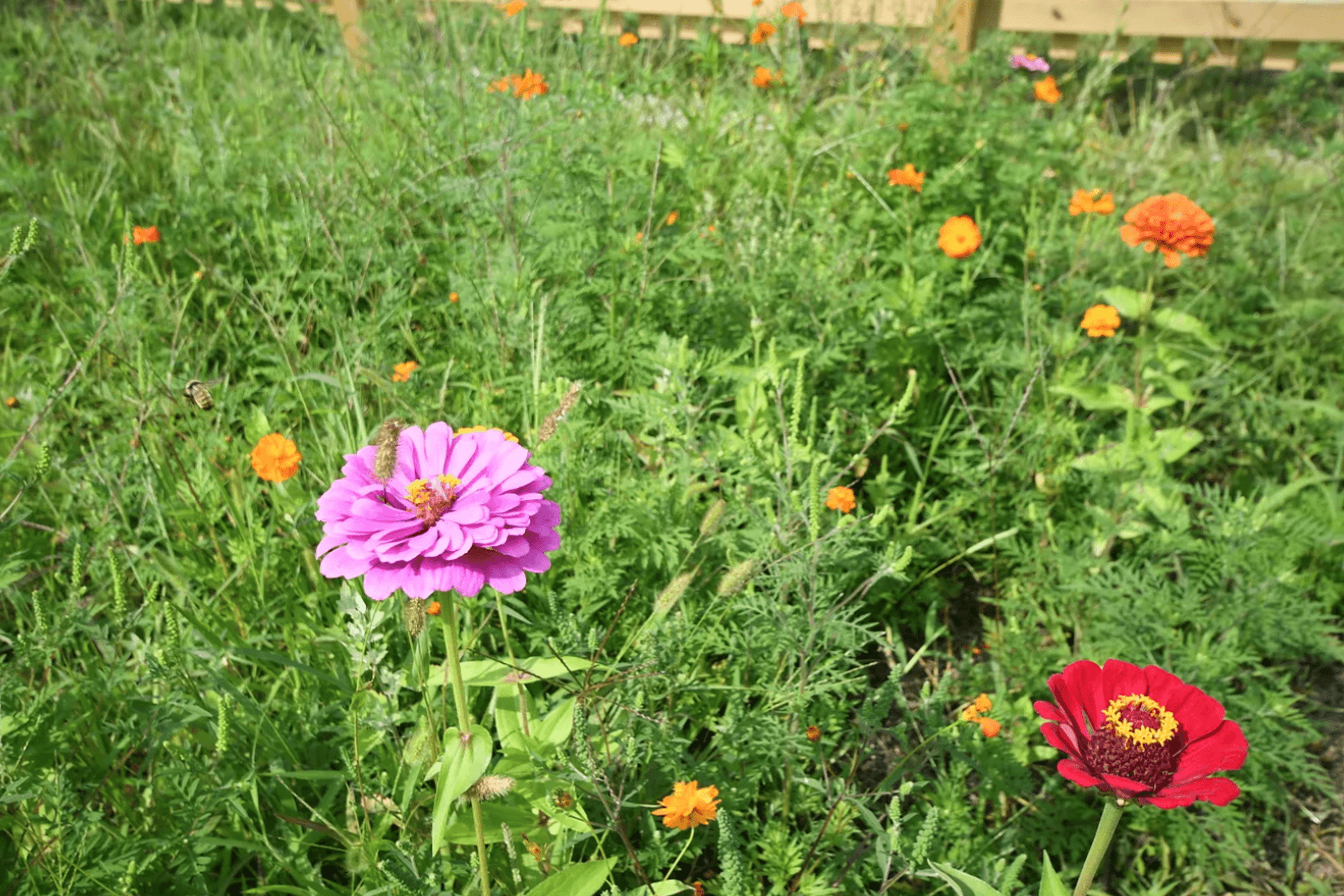
View of urban wildflowers blooming in Detroit, Michigan, 2019. Digital photograph .© Courtesy of the City of Detroit Planning Department

View of urban wildflowers blooming in Detroit, Michigan, 2019. Digital photograph © Courtesy of the City of Detroit Planning Department
- MT
- In Japan, regulations allow for the waiver of the building permit process if more than half of an existing structure is retained. While most vacant houses today are primarily wooden, the distinction between the wooden structural framework, wooden finishes, and even furniture is extremely blurry.
In Japan, it is common to dismantle architectural elements and reuse them in other buildings. There is a concept known as “building as a material bank,” and vacant wooden houses can be viewed as nodes in a fluid network. While the system only offers the option of supporting demolition, architects have contributed ideas for transforming vacant houses into resources in various ways, such as conversion to new uses, repurposing, and downcycling.
The social context of vacant houses—postwar reconstruction, population decline, and economic stagnation—has become a turning point in contemporary architecture.


