


Punchlines
Brian Boigon asks Bruce Mau and Rem Koolhaas to consider the audience as a surface
The following text is an excerpt from the Q&A session of Culture Lab 3.2: “Punchlines.” Culture Lab was a series of symposia hosted by Brian Boigon throughout the early 1990s at The Rivoli Club in Toronto. Boigon’s symposia are the central focus of the CCA exhibition Interactive Entertainment Architecture: Culture Lab, Toronto 1991–1994, curated by Farzin Lotfi-Jam.


Excerpt from Brian Boigon’s introduction at “Punchlines,” Culture Lab, 1994. Brian Boigon fonds, CCA. Gift of Brian Boigon © Brian Boigon
- BB
- It appears in front of the stage curtain, and he introduces himself or herself, and delivers a candid monologue; confiding and interacting with the audience directly. This new breach of the curtain may perhaps signify the dissolution of certain theatrical devices, but for the purpose of my presentation it signals the emergence of the profession of the “stand-up smart talk” and, in effect, a “stand-up smart space.”
I suggest here that stand-up smart space is a kind of playful description of space which has suddenly become itself like an event, and it no longer has the filter of the symbolic to shield it from the UV of real time. I’m speaking here of the punchlines; ones which emerge out of the screen and punch through the curtain.
I’m interested in what sustains the surface of impact. What are you trying to say? Who are you trying to say it to? And how are you going to say it? I would like to add: what surface are you impacting? What is the quality of the surface? How would you describe the character of the membrane that you address in your work?
We could be speaking here of an audience or the impact of an audience, but for each of you here, the notion of audience and impact are very different. Could you, for example, open this up for consideration? Explain what might constitute this membrane in some detail. You have five minutes.
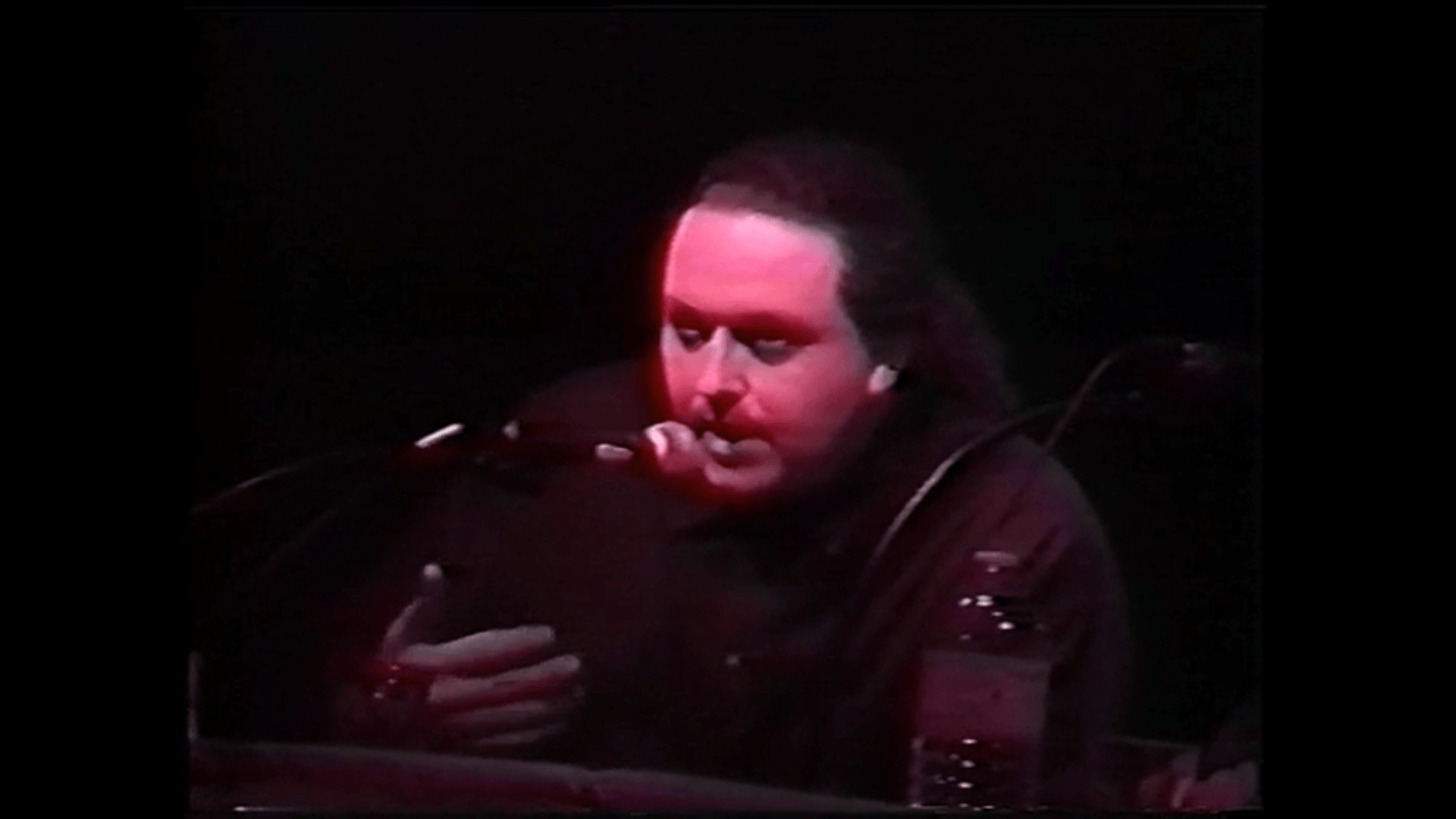
View of Bruce Mau during the “Punchlines” symposium, Culture Lab, Toronto, 1994. Brian Boigon fonds, CCA. Gift of Brian Boigon © Brian Boigon


- BM
- The is my first time on this side of the table. I always thought it was really difficult to understand the question from [the audience], but from this side, it’s even twice as hard.
- BB
- Um, Rem?
- BM
- Rem. You got the question right?
- RK
- I am just trying to hide. Just repeat it.
- BB
- Okay, instead of seeing an audience as a field that consists of a number of faces that you’re relating to directly, you can consider it almost like a surface, or a membrane, that you’re permeating and moving in-and-out of. So, it’s a question of how the audience performs as a surface for the presenter.
View of Brian Boigon and Bruce Mau during the “Punchlines” symposium (1/5), Culture Lab, Toronto, 1994. Brian Boigon fonds, CCA. Gift of Brian Boigon © Brian Boigon
View of Brian Boigon and Bruce Mau during the “Punchlines” symposium (2/5), Culture Lab, Toronto, 1994. Brian Boigon fonds, CCA. Gift of Brian Boigon © Brian Boigon
View of Brian Boigon and Bruce Mau during the “Punchlines” symposium (3/5), Culture Lab, Toronto, 1994. Brian Boigon fonds, CCA. Gift of Brian Boigon © Brian Boigon
View of Brian Boigon and Bruce Mau during the “Punchlines” symposium (4/5), Culture Lab, Toronto, 1994. Brian Boigon fonds, CCA. Gift of Brian Boigon © Brian Boigon
View of Brian Boigon and Bruce Mau during the “Punchlines” symposium (5/5), Culture Lab, Toronto, 1994. Brian Boigon fonds, CCA. Gift of Brian Boigon © Brian Boigon
- BB
- No one gets it? Okay. I’m not going to bother.
- RK
- [Chuckles] No, please. Please bother. But, on the other hand, don’t put words in our mouth. I mean, what can we do except agree to such a proposition? Should we describe how it feels?
- BB
- No, no. I’m suggesting that when you’re dealing with surfaces, when you’re dealing with any kind of plane or interface, there’s time, speed, and movement involved in that relationship. The question I have is: can you illuminate on this problem of a surface having a certain kind of resilience for an impact, like an interaction with the surface that goes beyond simply passing through it?
Surfaces have contained within them issues related to the problem of impact, like reception, containment, erosion, wear-and-tear, etcetera. It’s just a question related to seeing a surface as something which is more of an expandable membrane. - RK
- I think maybe we come back to this question, but maybe you have another question; a simpler one?
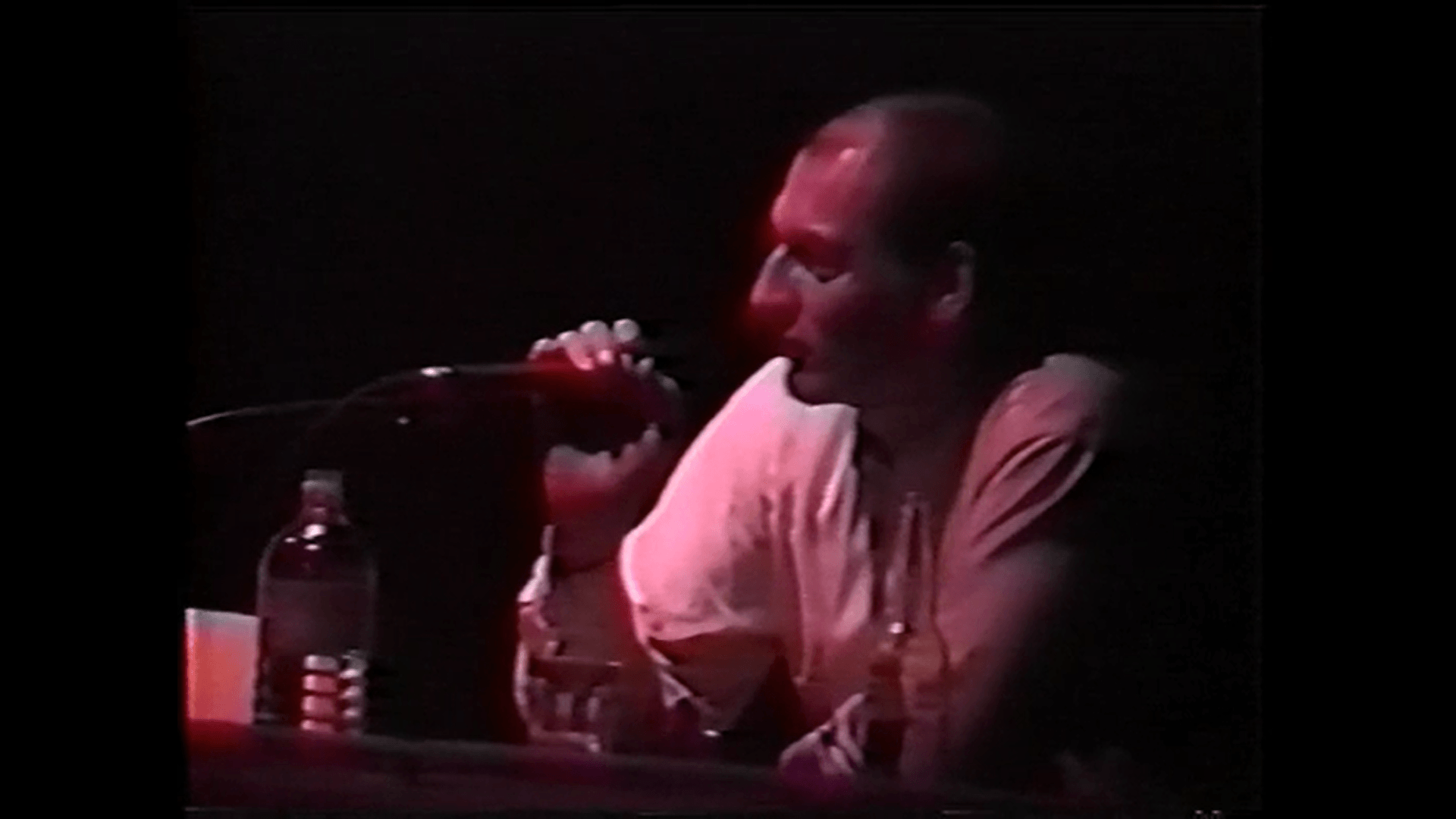
View of Rem Koolhaas during the “Punchlines” symposium, Culture Lab, Toronto, 1994. Brian Boigon fonds, CCA. Gift of Brian Boigon © Brian Boigon
- BB
- Do you want to ask one?
- RK
- I think what could be related is: which audience are we addressing? How are we addressing them? Because I think that’s what we are all doing to various degrees.
- BM
- I think that’s an interesting question. I’ll address the issue of the audience because one of the things that I’m trying to do in our work is to reconstitute the audience as citizens and not consumers; to work with readers and not viewers; and to disperse the audience into individuals and not a mass. I think if you use it as a strategy, it has a lot of potential to introduce a dignity to the work that is lost when the audience becomes a kind of surface and not a field of events.
Excerpt from Bruce Mau’s presentation at “Punchlines,” Culture Lab, 1994. Brian Boigon fonds, CCA. Gift of Brian Boigon © Brian Boigon
- RK
- My relationship with the audience is much more complicated than that because I have so many audiences. I have politicians, I have the users, I have the critics, I have a public. While you are trying to individualize the audience and break it down into different identities, I have to assume different identities to perform for different audiences—and I think that is one of the most rewarding, but also alarming, aspects of architecture today.
In terms of the communication about the profession, there are at least seven identities that you have to be able to assume, or seven roles that you have to be able to play. The suspense is whether these seven people can perform the same play.
Excerpt from Rem Koolhaas’s presentation at “Punchlines,” Culture Lab, 1994. Brian Boigon fonds, CCA. Gift of Brian Boigon © Brian Boigon
- BB
- I am slightly embarrassed, but I will answer the question as well, since there’s an audience here, and I helped at least construct it.
I guess I’m very different from Bruce, because I don’t I think of an audience as a consumer culture. I think of an audience that has a certain desire for an accelerated reception—different than they might when they’re reading a book, or in the car listening to the radio, or something. In my mind, a crowd situation, or an audience of this nature, is one which is very fast and embodies an almost intolerant space of reception. I try to construct material that goes in and out of that space.
My question was obviously too pedantic to be straightforward, and I apologize for that, but it comes out of trying to understand what kind of audience deals with complex material in a short cast of time, and that models itself on entertainment without taking on the superficiality of [poor quality] entertainment.
You obviously go back and you work on your ideas, and you perform in greater lengths of time than this. The duration of an event is longer than you would normally participate in, yet you try to encapsulate material and bring it to the table here in a shorter sequence, and it’s more compressed and intensive. So that’s my take on it. I don’t see a citizenship in the field of my work, per se.
- BM
- You don’t?
- BB
- No, not at all… Maybe a little.
- BM
- To me, the problem is: it’s fine to make a compression of ideas, but in the end, in order to develop certain concepts, they must be slowed down.
Excerpt from Bruce Mau’s presentation at “Punchlines,” Culture Lab, 1994. Brian Boigon fonds, CCA. Gift of Brian Boigon © Brian Boigon
- BB
- Or you could speed up?
- BM
- No. Certain events only happen in a certain kind of time. It’s sort of like the end of the book, Four Arguments for the Elimination of Television; there is a really interesting exchange between the writer and a television producer.
The writer gets a telephone call from a TV producer, and the producer says: “Look, we’re talking about a big audience here. We’re talking about millions of people. We’d really like you to come on the show and talk about your book.” And he says: “Look, I’ve written the book Four Arguments for the Elimination of Television for a reason. I can’t go on the show and explain the book.” And the producer just can’t get it through his skull and says: “We’re talking about a big audience here. We’re talking about major numbers. You don’t have to explain the whole book; just reduce it to a few good lines, and everything will be fine.” And in the end, the author of the book said: “Look, if you want to understand the book, it’s about 300,000 words—read it.”


