


406443 Results
Form:
photographs
photographs
Actions:
Reference number:
PH1986:0901:015:002
Description:
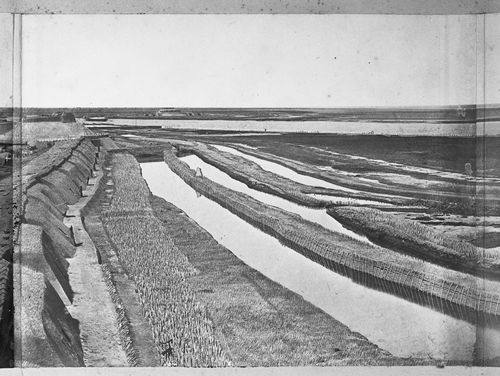
- This photograph is one in a series of views which Felice Beato made of the four Taku Forts (Harris, p. 139; Worswick, p. 138). - This photograph was made from the Great South Taku Fort looking north across the walls of the fort and the Pei (now Hai) River toward the Gulf of Chihli (now Bo Hai) (Harris, p. 143). - A copy print of this panorama under the title "Interior of South Taku Fort and Showing the Place of Landing June 25th 1859" is reproduced in Harris on pages 68-69 (cat. no. 23), and a copy print of PH1986:0901:015:002 (p. 167, fig. 23-3) under the title "Pei-Ho River and Taku Fort II" is reproduced in Harris on p. 167 (fig. 23-3).
PH1986:0901:015:002
Description:
- This photograph is one in a series of views which Felice Beato made of the four Taku Forts (Harris, p. 139; Worswick, p. 138). - This photograph was made from the Great South Taku Fort looking north across the walls of the fort and the Pei (now Hai) River toward the Gulf of Chihli (now Bo Hai) (Harris, p. 143). - A copy print of this panorama under the title "Interior of South Taku Fort and Showing the Place of Landing June 25th 1859" is reproduced in Harris on pages 68-69 (cat. no. 23), and a copy print of PH1986:0901:015:002 (p. 167, fig. 23-3) under the title "Pei-Ho River and Taku Fort II" is reproduced in Harris on p. 167 (fig. 23-3).
People:
Subject:
architecture, engineering, military, topographic
architecture, engineering, military, topographic
Date:
between 22 August and 21 September 1860
between 22 August and 21 September 1860
Title:
View showing part of the Great South Taku Fort and the Pei (now Hai) River delta, with the Lower North Taku Fort (also known as the 2nd North Fort) in the background, Taku (now Dagu), near Tientsin (now Tianjin), China
Actions:
PH1986:0901:015:002
Description:
- This photograph is one in a series of views which Felice Beato made of the four Taku Forts (Harris, p. 139; Worswick, p. 138). - This photograph was made from the Great South Taku Fort looking north across the walls of the fort and the Pei (now Hai) River toward the Gulf of Chihli (now Bo Hai) (Harris, p. 143). - A copy print of this panorama under the title "Interior of South Taku Fort and Showing the Place of Landing June 25th 1859" is reproduced in Harris on pages 68-69 (cat. no. 23), and a copy print of PH1986:0901:015:002 (p. 167, fig. 23-3) under the title "Pei-Ho River and Taku Fort II" is reproduced in Harris on p. 167 (fig. 23-3).
View showing part of the Great South Taku Fort and the Pei (now Hai) River delta, with the Lower North Taku Fort (also known as the 2nd North Fort) in the background, Taku (now Dagu), near Tientsin (now Tianjin), China
Actions:
PH1986:0901:015:002
Description:
- This photograph is one in a series of views which Felice Beato made of the four Taku Forts (Harris, p. 139; Worswick, p. 138). - This photograph was made from the Great South Taku Fort looking north across the walls of the fort and the Pei (now Hai) River toward the Gulf of Chihli (now Bo Hai) (Harris, p. 143). - A copy print of this panorama under the title "Interior of South Taku Fort and Showing the Place of Landing June 25th 1859" is reproduced in Harris on pages 68-69 (cat. no. 23), and a copy print of PH1986:0901:015:002 (p. 167, fig. 23-3) under the title "Pei-Ho River and Taku Fort II" is reproduced in Harris on p. 167 (fig. 23-3).
Form:
photographs
photographs
Date:
between 22 August and 21 September 1860
between 22 August and 21 September 1860
People:
Subject:
architecture, engineering, military, topographic
architecture, engineering, military, topographic
Form:
photographs
photographs
Actions:
Reference number:
PH1986:0901:015:003
Description:
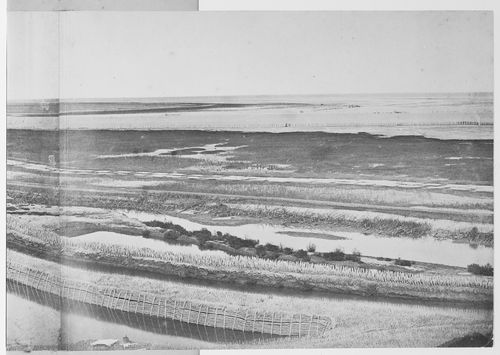
- This photograph is one in a series of views which Felice Beato made of the four Taku Forts (Harris, p. 139; Worswick, p. 138). - This photograph was made from the Great South Taku Fort looking north across the walls of the fort and the Pei (now Hai) River toward the Gulf of Chihli (now Bo Hai) (Harris, p. 143). - A copy print of this panorama under the title "Interior of South Taku Fort and Showing the Place of Landing June 25th 1859" is reproduced in Harris on pages 68-69 (cat. no. 23), and a copy print of PH1986:0901:015:002 (p. 167, fig. 23-3) under the title "Pei-Ho River and Taku Fort II" is reproduced in Harris on p. 167 (fig. 23-3).
PH1986:0901:015:003
Description:
- This photograph is one in a series of views which Felice Beato made of the four Taku Forts (Harris, p. 139; Worswick, p. 138). - This photograph was made from the Great South Taku Fort looking north across the walls of the fort and the Pei (now Hai) River toward the Gulf of Chihli (now Bo Hai) (Harris, p. 143). - A copy print of this panorama under the title "Interior of South Taku Fort and Showing the Place of Landing June 25th 1859" is reproduced in Harris on pages 68-69 (cat. no. 23), and a copy print of PH1986:0901:015:002 (p. 167, fig. 23-3) under the title "Pei-Ho River and Taku Fort II" is reproduced in Harris on p. 167 (fig. 23-3).
People:
Subject:
architecture, engineering, military, topographic
architecture, engineering, military, topographic
Date:
between 22 August and 21 September 1860
between 22 August and 21 September 1860
Title:
View showing part of the outworks of the Great South Taku Fort and the Pei (now Hai) River delta, Taku (now Dagu), near Tientsin (now Tianjin), China
Actions:
PH1986:0901:015:003
Description:
- This photograph is one in a series of views which Felice Beato made of the four Taku Forts (Harris, p. 139; Worswick, p. 138). - This photograph was made from the Great South Taku Fort looking north across the walls of the fort and the Pei (now Hai) River toward the Gulf of Chihli (now Bo Hai) (Harris, p. 143). - A copy print of this panorama under the title "Interior of South Taku Fort and Showing the Place of Landing June 25th 1859" is reproduced in Harris on pages 68-69 (cat. no. 23), and a copy print of PH1986:0901:015:002 (p. 167, fig. 23-3) under the title "Pei-Ho River and Taku Fort II" is reproduced in Harris on p. 167 (fig. 23-3).
View showing part of the outworks of the Great South Taku Fort and the Pei (now Hai) River delta, Taku (now Dagu), near Tientsin (now Tianjin), China
Actions:
PH1986:0901:015:003
Description:
- This photograph is one in a series of views which Felice Beato made of the four Taku Forts (Harris, p. 139; Worswick, p. 138). - This photograph was made from the Great South Taku Fort looking north across the walls of the fort and the Pei (now Hai) River toward the Gulf of Chihli (now Bo Hai) (Harris, p. 143). - A copy print of this panorama under the title "Interior of South Taku Fort and Showing the Place of Landing June 25th 1859" is reproduced in Harris on pages 68-69 (cat. no. 23), and a copy print of PH1986:0901:015:002 (p. 167, fig. 23-3) under the title "Pei-Ho River and Taku Fort II" is reproduced in Harris on p. 167 (fig. 23-3).
Form:
photographs
photographs
Date:
between 22 August and 21 September 1860
between 22 August and 21 September 1860
People:
Subject:
architecture, engineering, military, topographic
architecture, engineering, military, topographic
Form:
photographs
photographs
Actions:
Reference number:
PH1986:0901:016
PH1986:0901:016
People:
Subject:
architecture
architecture
Date:
23 September 1860
23 September 1860
Form:
photographs
photographs
Date:
23 September 1860
23 September 1860
People:
Subject:
architecture
architecture
Form:
photographs
photographs
Actions:
Reference number:
PH1986:0901:017
Description:
- The inscription accompanying this photograph refers to events between 18 September and 14 October 1860. On 18 September 1860, during the Second Opium War (1858-1860), 39 British and French civilians and soldiers were taken hostage by the Chinese. Among the hostages were Harry Smith Parkes, the British commissioner in Canton (now Guangzhou) and Henry Loch, private secretary to Lord Elgin, who were later released, and Captain Brabazon of the Royal Artillery, who was killed (Harris, p. 153).
PH1986:0901:017
Description:
- The inscription accompanying this photograph refers to events between 18 September and 14 October 1860. On 18 September 1860, during the Second Opium War (1858-1860), 39 British and French civilians and soldiers were taken hostage by the Chinese. Among the hostages were Harry Smith Parkes, the British commissioner in Canton (now Guangzhou) and Henry Loch, private secretary to Lord Elgin, who were later released, and Captain Brabazon of the Royal Artillery, who was killed (Harris, p. 153).
People:
Subject:
engineering
engineering
Date:
between 21 September and 2 October 1860
between 21 September and 2 October 1860
Title:
View of the Palichao (now Baliqiao) bridge, Tung-chow (Tongzhou, also now known as Tongxian), near Peking (now Beijing), China
Actions:
PH1986:0901:017
Description:
- The inscription accompanying this photograph refers to events between 18 September and 14 October 1860. On 18 September 1860, during the Second Opium War (1858-1860), 39 British and French civilians and soldiers were taken hostage by the Chinese. Among the hostages were Harry Smith Parkes, the British commissioner in Canton (now Guangzhou) and Henry Loch, private secretary to Lord Elgin, who were later released, and Captain Brabazon of the Royal Artillery, who was killed (Harris, p. 153).
View of the Palichao (now Baliqiao) bridge, Tung-chow (Tongzhou, also now known as Tongxian), near Peking (now Beijing), China
Actions:
PH1986:0901:017
Description:
- The inscription accompanying this photograph refers to events between 18 September and 14 October 1860. On 18 September 1860, during the Second Opium War (1858-1860), 39 British and French civilians and soldiers were taken hostage by the Chinese. Among the hostages were Harry Smith Parkes, the British commissioner in Canton (now Guangzhou) and Henry Loch, private secretary to Lord Elgin, who were later released, and Captain Brabazon of the Royal Artillery, who was killed (Harris, p. 153).
Form:
photographs
photographs
Date:
between 21 September and 2 October 1860
between 21 September and 2 October 1860
People:
Subject:
engineering
engineering
Form:
photographs
photographs
![View of the Yonghe Gong [Lamasery of Harmony and Peace] (also known as the Lama Temple) showing Wanfu Ge [Ten Thousand Blessings Hall] and other buildings, Peking (now Beijing), China](/img-collection/memXOugC1J7XlDuOTIOZg1NnBPM=/500x408/13843.jpg)
Actions:
Reference number:
PH1986:0901:018
Description:
- This photograph was taken from the top of the northern wall of Peking (now Beijing), near the Anting Gate (now Anding Men), looking into the northeastern section of the Inner City. - The title of a published identical image, "View of Confucian temple from An-ting Gate, Peking, October 1860" is inaccurate, as the Confucius Temple [also known as the Kongzimiao] is situated to the right of the buildings depicted in this view (Naquin, p. 444, map 12.1).
PH1986:0901:018
Description:
- This photograph was taken from the top of the northern wall of Peking (now Beijing), near the Anting Gate (now Anding Men), looking into the northeastern section of the Inner City. - The title of a published identical image, "View of Confucian temple from An-ting Gate, Peking, October 1860" is inaccurate, as the Confucius Temple [also known as the Kongzimiao] is situated to the right of the buildings depicted in this view (Naquin, p. 444, map 12.1).
People:
Subject:
architecture
architecture
Date:
13 October 1860 or later
13 October 1860 or later
Title:
View of the Yonghe Gong [Lamasery of Harmony and Peace] (also known as the Lama Temple) showing Wanfu Ge [Ten Thousand Blessings Hall] and other buildings, Peking (now Beijing), China
Actions:
PH1986:0901:018
Description:
- This photograph was taken from the top of the northern wall of Peking (now Beijing), near the Anting Gate (now Anding Men), looking into the northeastern section of the Inner City. - The title of a published identical image, "View of Confucian temple from An-ting Gate, Peking, October 1860" is inaccurate, as the Confucius Temple [also known as the Kongzimiao] is situated to the right of the buildings depicted in this view (Naquin, p. 444, map 12.1).
View of the Yonghe Gong [Lamasery of Harmony and Peace] (also known as the Lama Temple) showing Wanfu Ge [Ten Thousand Blessings Hall] and other buildings, Peking (now Beijing), China
Actions:
PH1986:0901:018
Description:
- This photograph was taken from the top of the northern wall of Peking (now Beijing), near the Anting Gate (now Anding Men), looking into the northeastern section of the Inner City. - The title of a published identical image, "View of Confucian temple from An-ting Gate, Peking, October 1860" is inaccurate, as the Confucius Temple [also known as the Kongzimiao] is situated to the right of the buildings depicted in this view (Naquin, p. 444, map 12.1).
Form:
photographs
photographs
Date:
13 October 1860 or later
13 October 1860 or later
People:
Subject:
architecture
architecture
Form:
photographs
photographs
![View of the Wanfu Ge [Ten Thousand Blessings Hall] and other buildings at the Yonghe Gong [Lamasery of Harmony and Peace] (also known as the Lama Temple), Peking (now Beijing), China](/img-collection/AQtrSSCvbddRkF4da_dJvdg63S0=/500x412/13844.jpg)
Actions:
Reference number:
PH1986:0901:019
Description:
- This photograph was taken from the top of the northern wall of Peking (now Beijing), near the Anting Gate (now Anding Men), looking into the northeastern section of the Inner City. - The inscription at l.c.: "The same", refers to photograph PH1986:0901:018 which immediately precedes this photograph in album PH1986:0901:001-045 and which is another view showing the Wanfu Ge [Ten Thousand Blessings Hall] and other buildings at the Yonghe Gong [Lamasery of Harmony and Peace] (also known as the Lama Temple). - The title of a published identical image, "Temple of Confucius, Pekin" is inaccurate, as the Confucius Temple [also known as the Kongzimiao] is situated to the right of the buildings depicted in this view (Naquin, p. 444, map 12.1).
PH1986:0901:019
Description:
- This photograph was taken from the top of the northern wall of Peking (now Beijing), near the Anting Gate (now Anding Men), looking into the northeastern section of the Inner City. - The inscription at l.c.: "The same", refers to photograph PH1986:0901:018 which immediately precedes this photograph in album PH1986:0901:001-045 and which is another view showing the Wanfu Ge [Ten Thousand Blessings Hall] and other buildings at the Yonghe Gong [Lamasery of Harmony and Peace] (also known as the Lama Temple). - The title of a published identical image, "Temple of Confucius, Pekin" is inaccurate, as the Confucius Temple [also known as the Kongzimiao] is situated to the right of the buildings depicted in this view (Naquin, p. 444, map 12.1).
People:
Subject:
architecture
architecture
Date:
13 October 1860 or later
13 October 1860 or later
Title:
View of the Wanfu Ge [Ten Thousand Blessings Hall] and other buildings at the Yonghe Gong [Lamasery of Harmony and Peace] (also known as the Lama Temple), Peking (now Beijing), China
Actions:
PH1986:0901:019
Description:
- This photograph was taken from the top of the northern wall of Peking (now Beijing), near the Anting Gate (now Anding Men), looking into the northeastern section of the Inner City. - The inscription at l.c.: "The same", refers to photograph PH1986:0901:018 which immediately precedes this photograph in album PH1986:0901:001-045 and which is another view showing the Wanfu Ge [Ten Thousand Blessings Hall] and other buildings at the Yonghe Gong [Lamasery of Harmony and Peace] (also known as the Lama Temple). - The title of a published identical image, "Temple of Confucius, Pekin" is inaccurate, as the Confucius Temple [also known as the Kongzimiao] is situated to the right of the buildings depicted in this view (Naquin, p. 444, map 12.1).
View of the Wanfu Ge [Ten Thousand Blessings Hall] and other buildings at the Yonghe Gong [Lamasery of Harmony and Peace] (also known as the Lama Temple), Peking (now Beijing), China
Actions:
PH1986:0901:019
Description:
- This photograph was taken from the top of the northern wall of Peking (now Beijing), near the Anting Gate (now Anding Men), looking into the northeastern section of the Inner City. - The inscription at l.c.: "The same", refers to photograph PH1986:0901:018 which immediately precedes this photograph in album PH1986:0901:001-045 and which is another view showing the Wanfu Ge [Ten Thousand Blessings Hall] and other buildings at the Yonghe Gong [Lamasery of Harmony and Peace] (also known as the Lama Temple). - The title of a published identical image, "Temple of Confucius, Pekin" is inaccurate, as the Confucius Temple [also known as the Kongzimiao] is situated to the right of the buildings depicted in this view (Naquin, p. 444, map 12.1).
Form:
photographs
photographs
Date:
13 October 1860 or later
13 October 1860 or later
People:
Subject:
architecture
architecture
Form:
photographs
photographs
![Panorama of the Garden of the Clear Ripples [Qing Yi Yuan] (now the Summer Palace or Yihe Yuan) showing Kunming Lake, ruins on Wanshou Shan (also known as Longevity Hill), and Yuquan Shan (also known as Jade Spring Hill), Peking (now Beijing), China](/img-collection/VIQ3xtTNw1sM7P-reEs1ZLTUBhA=/500x268/13845.jpg)
Actions:
Reference number:
PH1986:0901:020:001-002
Description:
- The title of a published identical image to PH1986:0901:020:002, "View of the Imperial Summer Palace, Yuen Ming Yuen, after the Burning, Taken from the Lake, Pekin" is inaccurate, as Yuen Ming Yuen (now Yuanming Yuan) [Garden of Perfect Clarity], though near the Garden of the Clear Ripples [Qing Yi Yuan] (now known as the Summer Palace or Yihe Yuan), is a separate garden complex (Naquin, pp. 312-314).
PH1986:0901:020:001-002
Description:
- The title of a published identical image to PH1986:0901:020:002, "View of the Imperial Summer Palace, Yuen Ming Yuen, after the Burning, Taken from the Lake, Pekin" is inaccurate, as Yuen Ming Yuen (now Yuanming Yuan) [Garden of Perfect Clarity], though near the Garden of the Clear Ripples [Qing Yi Yuan] (now known as the Summer Palace or Yihe Yuan), is a separate garden complex (Naquin, pp. 312-314).
People:
Subject:
architecture, landscape architecture, topographic
architecture, landscape architecture, topographic
Date:
between 20 October and 2 November 1860
between 20 October and 2 November 1860
Title:
Panorama of the Garden of the Clear Ripples [Qing Yi Yuan] (now the Summer Palace or Yihe Yuan) showing Kunming Lake, ruins on Wanshou Shan (also known as Longevity Hill), and Yuquan Shan (also known as Jade Spring Hill), Peking (now Beijing), China
Actions:
PH1986:0901:020:001-002
Description:
- The title of a published identical image to PH1986:0901:020:002, "View of the Imperial Summer Palace, Yuen Ming Yuen, after the Burning, Taken from the Lake, Pekin" is inaccurate, as Yuen Ming Yuen (now Yuanming Yuan) [Garden of Perfect Clarity], though near the Garden of the Clear Ripples [Qing Yi Yuan] (now known as the Summer Palace or Yihe Yuan), is a separate garden complex (Naquin, pp. 312-314).
Panorama of the Garden of the Clear Ripples [Qing Yi Yuan] (now the Summer Palace or Yihe Yuan) showing Kunming Lake, ruins on Wanshou Shan (also known as Longevity Hill), and Yuquan Shan (also known as Jade Spring Hill), Peking (now Beijing), China
Actions:
PH1986:0901:020:001-002
Description:
- The title of a published identical image to PH1986:0901:020:002, "View of the Imperial Summer Palace, Yuen Ming Yuen, after the Burning, Taken from the Lake, Pekin" is inaccurate, as Yuen Ming Yuen (now Yuanming Yuan) [Garden of Perfect Clarity], though near the Garden of the Clear Ripples [Qing Yi Yuan] (now known as the Summer Palace or Yihe Yuan), is a separate garden complex (Naquin, pp. 312-314).
Form:
photographs
photographs
Date:
between 20 October and 2 November 1860
between 20 October and 2 November 1860
People:
Subject:
architecture, landscape architecture, topographic
architecture, landscape architecture, topographic
Form:
photographs
photographs
Actions:
Reference number:
PH1986:0901:020:001
Description:
- The title of a published identical image to PH1986:0901:020:002, "View of the Imperial Summer Palace, Yuen Ming Yuen, after the Burning, Taken from the Lake, Pekin" is inaccurate, as Yuen Ming Yuen (now Yuanming Yuan) [Garden of Perfect Clarity], though near the Garden of the Clear Ripples [Qing Yi Yuan] (now known as the Summer Palace or Yihe Yuan), is a separate garden complex (Naquin, pp. 312-314).
PH1986:0901:020:001
Description:
- The title of a published identical image to PH1986:0901:020:002, "View of the Imperial Summer Palace, Yuen Ming Yuen, after the Burning, Taken from the Lake, Pekin" is inaccurate, as Yuen Ming Yuen (now Yuanming Yuan) [Garden of Perfect Clarity], though near the Garden of the Clear Ripples [Qing Yi Yuan] (now known as the Summer Palace or Yihe Yuan), is a separate garden complex (Naquin, pp. 312-314).
People:
Subject:
architecture, landscape architecture, topographic
architecture, landscape architecture, topographic
Date:
between 20 October and 2 November 1860
between 20 October and 2 November 1860
Title:
View of the Garden of the Clear Ripples [Qing Yi Yuan] (now known as the Summer Palace or Yihe Yuan), showing Kunming Lake, with Yuquan Shan (also known as Jade Spring Hill) in the background, Peking (now Beijing), China
Actions:
PH1986:0901:020:001
Description:
- The title of a published identical image to PH1986:0901:020:002, "View of the Imperial Summer Palace, Yuen Ming Yuen, after the Burning, Taken from the Lake, Pekin" is inaccurate, as Yuen Ming Yuen (now Yuanming Yuan) [Garden of Perfect Clarity], though near the Garden of the Clear Ripples [Qing Yi Yuan] (now known as the Summer Palace or Yihe Yuan), is a separate garden complex (Naquin, pp. 312-314).
View of the Garden of the Clear Ripples [Qing Yi Yuan] (now known as the Summer Palace or Yihe Yuan), showing Kunming Lake, with Yuquan Shan (also known as Jade Spring Hill) in the background, Peking (now Beijing), China
Actions:
PH1986:0901:020:001
Description:
- The title of a published identical image to PH1986:0901:020:002, "View of the Imperial Summer Palace, Yuen Ming Yuen, after the Burning, Taken from the Lake, Pekin" is inaccurate, as Yuen Ming Yuen (now Yuanming Yuan) [Garden of Perfect Clarity], though near the Garden of the Clear Ripples [Qing Yi Yuan] (now known as the Summer Palace or Yihe Yuan), is a separate garden complex (Naquin, pp. 312-314).
Form:
photographs
photographs
Date:
between 20 October and 2 November 1860
between 20 October and 2 November 1860
People:
Subject:
architecture, landscape architecture, topographic
architecture, landscape architecture, topographic
Form:
drawings
drawings
Actions:
Reference number:
DR1974:0002:011:027
DR1974:0002:011:027
People:
Subject:
architecture, military
architecture, military
Date:
1820
1820
Title:
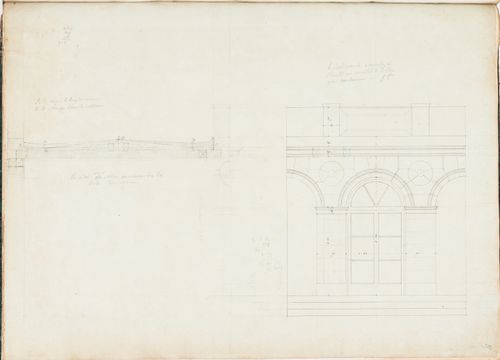
Project for the conversion of Hôtel Soyécourt, Paris, into barracks: Partial elevation and section for an arcade
Actions:
DR1974:0002:011:027
Project for the conversion of Hôtel Soyécourt, Paris, into barracks: Partial elevation and section for an arcade
Actions:
DR1974:0002:011:027
Form:
drawings
drawings
Date:
1820
1820
People:
Subject:
architecture, military
architecture, military
Form:
photographs
photographs
Actions:
Reference number:
PH1986:0901:020:002
Description:
- The title of a published identical image to PH1986:0901:020:002, "View of the Imperial Summer Palace, Yuen Ming Yuen, after the Burning, Taken from the Lake, Pekin" is inaccurate, as Yuen Ming Yuen (now Yuanming Yuan) [Garden of Perfect Clarity], though near the Garden of the Clear Ripples [Qing Yi Yuan] (now known as the Summer Palace or Yihe Yuan), is a separate garden complex (Naquin, pp. 312-314).
PH1986:0901:020:002
Description:
- The title of a published identical image to PH1986:0901:020:002, "View of the Imperial Summer Palace, Yuen Ming Yuen, after the Burning, Taken from the Lake, Pekin" is inaccurate, as Yuen Ming Yuen (now Yuanming Yuan) [Garden of Perfect Clarity], though near the Garden of the Clear Ripples [Qing Yi Yuan] (now known as the Summer Palace or Yihe Yuan), is a separate garden complex (Naquin, pp. 312-314).
People:
Subject:
architecture, landscape architecture, topographic
architecture, landscape architecture, topographic
Date:
between 20 October and 2 November 1860
between 20 October and 2 November 1860
Title:
View of the Garden of the Clear Ripples [Qing Yi Yuan] (now known as the Summer Palace or Yihe Yuan), showing Kunming Lake and ruins on Wanshou Shan (also known as Longevity Hill), Peking (now Beijing), China
Actions:
PH1986:0901:020:002
Description:
- The title of a published identical image to PH1986:0901:020:002, "View of the Imperial Summer Palace, Yuen Ming Yuen, after the Burning, Taken from the Lake, Pekin" is inaccurate, as Yuen Ming Yuen (now Yuanming Yuan) [Garden of Perfect Clarity], though near the Garden of the Clear Ripples [Qing Yi Yuan] (now known as the Summer Palace or Yihe Yuan), is a separate garden complex (Naquin, pp. 312-314).
View of the Garden of the Clear Ripples [Qing Yi Yuan] (now known as the Summer Palace or Yihe Yuan), showing Kunming Lake and ruins on Wanshou Shan (also known as Longevity Hill), Peking (now Beijing), China
Actions:
PH1986:0901:020:002
Description:
- The title of a published identical image to PH1986:0901:020:002, "View of the Imperial Summer Palace, Yuen Ming Yuen, after the Burning, Taken from the Lake, Pekin" is inaccurate, as Yuen Ming Yuen (now Yuanming Yuan) [Garden of Perfect Clarity], though near the Garden of the Clear Ripples [Qing Yi Yuan] (now known as the Summer Palace or Yihe Yuan), is a separate garden complex (Naquin, pp. 312-314).
Form:
photographs
photographs
Date:
between 20 October and 2 November 1860
between 20 October and 2 November 1860
People:
Subject:
architecture, landscape architecture, topographic
architecture, landscape architecture, topographic


