


14 Results
Form:
books
books
Price:
$28.95
(available in store)
Summary:
Following the publication of architect/theorist Markus Miessen's hugely successful ''The Nightmare of Participation'', on the politics of participatory practices in architecture, spatial practices and art, and the initiation of the popular pocket series Critical Spatial Practice, comes his timely new book engaging the ethics and politics of practice, ''Crossbenching''.(...)
$28.95
(available in store)
Summary:
Following the publication of architect/theorist Markus Miessen's hugely successful ''The Nightmare of Participation'', on the politics of participatory practices in architecture, spatial practices and art, and the initiation of the popular pocket series Critical Spatial Practice, comes his timely new book engaging the ethics and politics of practice, ''Crossbenching''.(...)
Title:
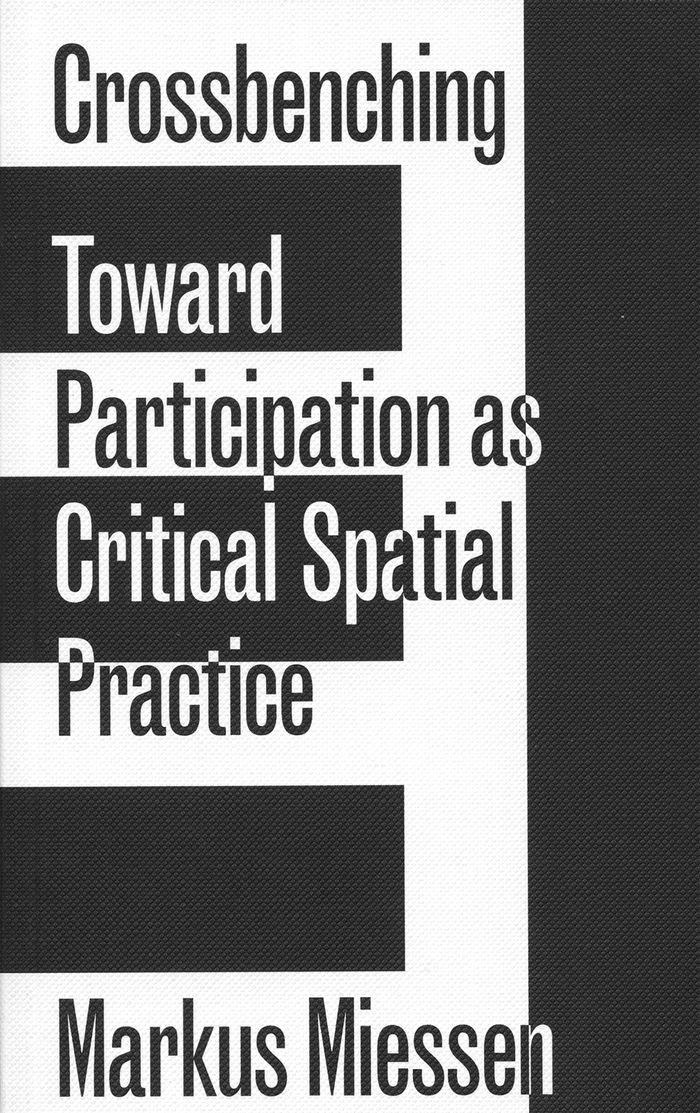
Crossbenching: toward participation as critical spatial practice
Actions:
Price:
$28.95
(available in store)
Summary:
Following the publication of architect/theorist Markus Miessen's hugely successful ''The Nightmare of Participation'', on the politics of participatory practices in architecture, spatial practices and art, and the initiation of the popular pocket series Critical Spatial Practice, comes his timely new book engaging the ethics and politics of practice, ''Crossbenching''. Following over a decade of theoretical research, the small softcover publication focuses on Miessen's own architecture "platform," Studio Miessen, in which he reapproaches the question of authorship in the context of a studio practice.
Crossbenching: toward participation as critical spatial practice
Actions:
Price:
$28.95
(available in store)
Summary:
Following the publication of architect/theorist Markus Miessen's hugely successful ''The Nightmare of Participation'', on the politics of participatory practices in architecture, spatial practices and art, and the initiation of the popular pocket series Critical Spatial Practice, comes his timely new book engaging the ethics and politics of practice, ''Crossbenching''. Following over a decade of theoretical research, the small softcover publication focuses on Miessen's own architecture "platform," Studio Miessen, in which he reapproaches the question of authorship in the context of a studio practice.
Form:
books
books
Publication:
August 2016
August 2016
Subject:
Architectural Theory
Architectural Theory
Form:
books
books
Title:
Spaces of uncertainty
Spaces of uncertainty
Actions:
Price:
$42.00
(available to order)
Summary:
"Spaces of Uncertainty" is a publication on issues of contemporary urban space, from the particular view of two young architects, Kenny Cupers and Markus Miessen. Their photographic and theoretic research constitutes a double movement, which opens up the traditional architectural gaze towards the social spectrum of urban spaces, while simultaneously offering an original(...)
$42.00
(available to order)
Summary:
"Spaces of Uncertainty" is a publication on issues of contemporary urban space, from the particular view of two young architects, Kenny Cupers and Markus Miessen. Their photographic and theoretic research constitutes a double movement, which opens up the traditional architectural gaze towards the social spectrum of urban spaces, while simultaneously offering an original(...)
Title:
Spaces of uncertainty
Actions:
Price:
$42.00
(available to order)
Summary:
"Spaces of Uncertainty" is a publication on issues of contemporary urban space, from the particular view of two young architects, Kenny Cupers and Markus Miessen. Their photographic and theoretic research constitutes a double movement, which opens up the traditional architectural gaze towards the social spectrum of urban spaces, while simultaneously offering an original theory of contemporary cultural practice. The issue of public space is one that crosses interdisciplinary boundaries and attracts high interest in the fields of architecture, urbanism, sociology and cultural studies. With Berlin as a case study for a globalised urban condition, the publication aims at a wide international public by providing a broadly conceived theory that approaches the city at the same time as a material phenomenon and as a social and philosophical idea. Public space in its traditional interpretations is unable to follow the heartbeat of today's rapidly changing city. Instead of adding force to an ongoing rhetorical discourse of loss, this publication acknowledges the existence of places beyond traditional definition. With a photographic essay on Berlin, it opens an unexpectedly contemporary view upon this agitated debate. Left with enormous amounts of infill and fallow land, Berlin is a city in which residual space and public space lose their definitions. As playgrounds for micro-political activities, permanent hiding-places or areas for temporary occupation, its residual spaces prove their necessity. Shy and unassuming, these very spaces of uncertainty show their value for public life in the contemporary city. With contributions by Margaret Crawford, Hilde Heynen, Paul Davies, Paul Halliday and Jürgen Mayer H.
Spaces of uncertainty
Actions:
Price:
$42.00
(available to order)
Summary:
"Spaces of Uncertainty" is a publication on issues of contemporary urban space, from the particular view of two young architects, Kenny Cupers and Markus Miessen. Their photographic and theoretic research constitutes a double movement, which opens up the traditional architectural gaze towards the social spectrum of urban spaces, while simultaneously offering an original theory of contemporary cultural practice. The issue of public space is one that crosses interdisciplinary boundaries and attracts high interest in the fields of architecture, urbanism, sociology and cultural studies. With Berlin as a case study for a globalised urban condition, the publication aims at a wide international public by providing a broadly conceived theory that approaches the city at the same time as a material phenomenon and as a social and philosophical idea. Public space in its traditional interpretations is unable to follow the heartbeat of today's rapidly changing city. Instead of adding force to an ongoing rhetorical discourse of loss, this publication acknowledges the existence of places beyond traditional definition. With a photographic essay on Berlin, it opens an unexpectedly contemporary view upon this agitated debate. Left with enormous amounts of infill and fallow land, Berlin is a city in which residual space and public space lose their definitions. As playgrounds for micro-political activities, permanent hiding-places or areas for temporary occupation, its residual spaces prove their necessity. Shy and unassuming, these very spaces of uncertainty show their value for public life in the contemporary city. With contributions by Margaret Crawford, Hilde Heynen, Paul Davies, Paul Halliday and Jürgen Mayer H.
Form:
books
books
Publication:
January 2002, Wuppertal
January 2002, Wuppertal
Subject:
Urban Theory
Urban Theory
Form:
books
books

Title:
East Coast Europe
East Coast Europe
Actions:
Price:
$28.00
(available to order)
Summary:
“East Coast Europe,” which took place during Spring 2008, is a project about the perceptions of contemporary European identity and its relation to spatial practices and international politics.
$28.00
(available to order)
Summary:
“East Coast Europe,” which took place during Spring 2008, is a project about the perceptions of contemporary European identity and its relation to spatial practices and international politics.
Title:
East Coast Europe
Actions:
Price:
$28.00
(available to order)
Summary:
“East Coast Europe,” which took place during Spring 2008, is a project about the perceptions of contemporary European identity and its relation to spatial practices and international politics.
East Coast Europe
Actions:
Price:
$28.00
(available to order)
Summary:
“East Coast Europe,” which took place during Spring 2008, is a project about the perceptions of contemporary European identity and its relation to spatial practices and international politics.
Form:
books
books
Publication:
October 2008, Berlin / New York
October 2008, Berlin / New York
Subject:
Critical Theory
Critical Theory
Form:
books
books
Title:
Reflections on democracy and urban form: Provocations from a panel at Harvard's Graduate School
Reflections on democracy and urban form: Provocations from a panel at Harvard's Graduate School
Actions:
Price:
$24.95
(available in store)
Summary:
This book builds on conversations that took place in the Fall of 2024 at Harvard’s Graduate School of Design marking the release of the book ''Democracy and Urban Form'', a co-publication by Harvard Design Press and Sternberg Press. The original book showcased a series of six lectures that the sociologist Richard Sennett gave under the same name at the GSD in the fall of(...)
$24.95
(available in store)
Summary:
This book builds on conversations that took place in the Fall of 2024 at Harvard’s Graduate School of Design marking the release of the book ''Democracy and Urban Form'', a co-publication by Harvard Design Press and Sternberg Press. The original book showcased a series of six lectures that the sociologist Richard Sennett gave under the same name at the GSD in the fall of(...)
Title:
Reflections on democracy and urban form: Provocations from a panel at Harvard's Graduate School
Actions:
Price:
$24.95
(available in store)
Summary:
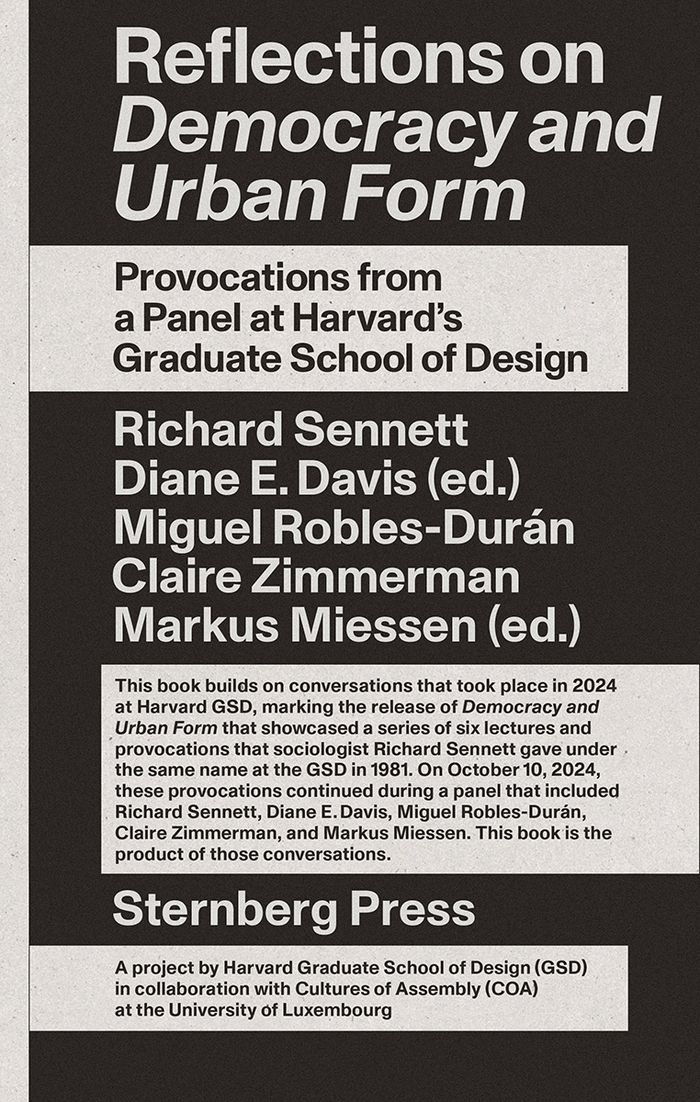
This book builds on conversations that took place in the Fall of 2024 at Harvard’s Graduate School of Design marking the release of the book ''Democracy and Urban Form'', a co-publication by Harvard Design Press and Sternberg Press. The original book showcased a series of six lectures that the sociologist Richard Sennett gave under the same name at the GSD in the fall of 1981. The original lectures, which happened more than forty years ago, addressed a much different political climate. Even so, Richard’s core insights into the connections between democracy and justice, matters of architecture and urban design, the growth of cities, cosmopolitanism, inclusion, free speech, and other related matters remain just as relevant today. In the spirit of reflecting on these urgencies, the GSD invited the political philosopher Michael Sandel to deliver a lecture that drew on themes from the new edition of his book ''Democracy’s Discontent''. In his opening talk, which took place on the evening of Wednesday, October 9, Sandel encouraged the audience to consider what might account for the polarization that imperils democracy today, as well as what might be done about it? Beyond analyzing the forces that were about to decide the 2024 election, he proposed a bold project of civic renewal to reimagine the economy and empower citizens as participants in a shared public life. On Thursday, October 10, these provocations continued during a panel discussion that included Richard Sennett, Diane Davis, Claire Zimmerman, Markus Miessen, and Miguel Robles-Durán. All reflected on Sandel’s talk, as well as on the state of democracy as it related more specifically to architecture and the design and planning of cities and metropolitan regions.
Reflections on democracy and urban form: Provocations from a panel at Harvard's Graduate School
Actions:
Price:
$24.95
(available in store)
Summary:
This book builds on conversations that took place in the Fall of 2024 at Harvard’s Graduate School of Design marking the release of the book ''Democracy and Urban Form'', a co-publication by Harvard Design Press and Sternberg Press. The original book showcased a series of six lectures that the sociologist Richard Sennett gave under the same name at the GSD in the fall of 1981. The original lectures, which happened more than forty years ago, addressed a much different political climate. Even so, Richard’s core insights into the connections between democracy and justice, matters of architecture and urban design, the growth of cities, cosmopolitanism, inclusion, free speech, and other related matters remain just as relevant today. In the spirit of reflecting on these urgencies, the GSD invited the political philosopher Michael Sandel to deliver a lecture that drew on themes from the new edition of his book ''Democracy’s Discontent''. In his opening talk, which took place on the evening of Wednesday, October 9, Sandel encouraged the audience to consider what might account for the polarization that imperils democracy today, as well as what might be done about it? Beyond analyzing the forces that were about to decide the 2024 election, he proposed a bold project of civic renewal to reimagine the economy and empower citizens as participants in a shared public life. On Thursday, October 10, these provocations continued during a panel discussion that included Richard Sennett, Diane Davis, Claire Zimmerman, Markus Miessen, and Miguel Robles-Durán. All reflected on Sandel’s talk, as well as on the state of democracy as it related more specifically to architecture and the design and planning of cities and metropolitan regions.
Form:
books
books
Publication:
August 2026
August 2026
Subject:
Urban Theory
Urban Theory


