


183 Results
Form:
books
books

Actions:
Price:
$54.00
(available to order)
Summary:
A rare document of the 1960s Black Arts Movement, “The Cricket” fostered critical and political dialogue for Black musicians and writers. Edited by poets and writers Amiri Baraka, A.B. Spellman, and Larry Neal between 1968 and 1969 and published by Baraka’s New Jersey–based Jihad productions shortly after the time of the Newark Riots, this experimental music magazine ran(...)
Title:
The Cricket: Black music in evolution, 1968-69
Actions:
Price:
$54.00
(available to order)
Summary:
A rare document of the 1960s Black Arts Movement, “The Cricket” fostered critical and political dialogue for Black musicians and writers. Edited by poets and writers Amiri Baraka, A.B. Spellman, and Larry Neal between 1968 and 1969 and published by Baraka’s New Jersey–based Jihad productions shortly after the time of the Newark Riots, this experimental music magazine ran poetry, position papers, and gossip alongside concert and record reviews and essays on music and politics. Over four mimeographed issues, “The Cricket” laid out an anticommercial ideology and took aim at the conservative jazz press, providing a space for critics, poets, and journalists, and a range of musicians to devise new styles of music writing. This publication gathers all issues of the magazine.
Form:
books
books
Publication:
January 2022
January 2022
Subject:
Acoustics
Acoustics
Form:
books
books
Actions:
Price:
$35.95
(available to order)
Summary:
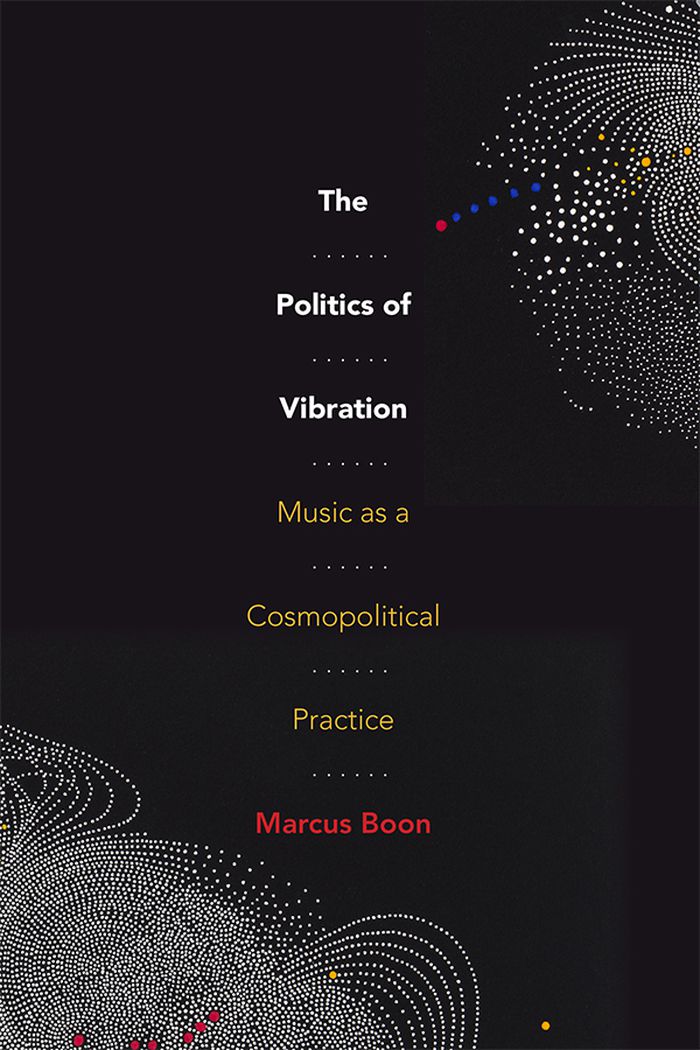
In this publication, Marcus Boon explores music as a material practice of vibration. Focusing on the work of three contemporary musicians—Hindustani classical vocalist Pandit Pran Nath, Swedish drone composer and philosopher Catherine Christer Hennix, and Houston-based hip-hop musician DJ Screw—Boon outlines how music constructs a vibrational space of individual and(...)
Title:
The politics of vibration: Music as cosmopolitical practice
Actions:
Price:
$35.95
(available to order)
Summary:
In this publication, Marcus Boon explores music as a material practice of vibration. Focusing on the work of three contemporary musicians—Hindustani classical vocalist Pandit Pran Nath, Swedish drone composer and philosopher Catherine Christer Hennix, and Houston-based hip-hop musician DJ Screw—Boon outlines how music constructs a vibrational space of individual and collective transformation. Contributing to a new interdisciplinary field of vibration studies, he understands vibration as a mathematical and a physical concept, as a religious or ontological force, and as a psychological determinant of subjectivity. Boon contends that music, as a shaping of vibration, needs to be recognized as a cosmopolitical practice—in the sense introduced by Isabelle Stengers—in which what music is within a society depends on what kinds of access to vibration are permitted, and to whom. This politics of vibration constitutes the hidden ontology of contemporary music because the organization of vibration shapes individual music scenes as well as the ethical choices that participants in these scenes make about how they want to live in the world.
Form:
books
books
Publication:
August 2022
August 2022
Subject:
Acoustics
Acoustics
Form:
books
books

Actions:
Price:
$18.95
(available to order)
Summary:
Dire le 'sonore' a été une des gageures de l’écriture esthétique et, au XXe siècle, on aura plus largement insisté sur la structure et la forme, au détriment de la sensation, en affirmant la toute-puissance du discours. Mais il suffit de porter l’oreille à une conque marine pour que le son de la mer qu’on y entend, ébranle les édifices, mette à bas les échafaudages(...)
Title:
Les mots et les sons : Un archipel sonore
Actions:
Price:
$18.95
(available to order)
Summary:
Dire le 'sonore' a été une des gageures de l’écriture esthétique et, au XXe siècle, on aura plus largement insisté sur la structure et la forme, au détriment de la sensation, en affirmant la toute-puissance du discours. Mais il suffit de porter l’oreille à une conque marine pour que le son de la mer qu’on y entend, ébranle les édifices, mette à bas les échafaudages rhétoriques de « ce qu’entendre veut dire ». Dans ce livre, François J. Bonnet explore les voix fantômes, l’inframince du son, le sampling, la phonographie et les résonances dont notre univers est peuplé et qui échappent aujourd’hui à la forme traditionnelle de l’écoute. Il ouvre sur des archipels sonores inouïs, éphémères et précaires comme les TAZs (Zones autonomes temporaires), mais riches de nouvelles expériences d’écoute, propres à éduquer nos oreilles à mieux entendre l’imperceptible.
Form:
books
books
Publication:
July 2022
July 2022
Subject:
Acoustics
Acoustics


