


2227 Results
Form:
books
books
Actions:
Price:
$39.95
(available to order)
Summary:
L'Europe est une entité culturelle façonnée par les civilisations grecque et romaine, le christianisme, les Lumières... De la Suède à l'Espagne, de la France à la Russie, sont explorés des lieux emblématiques qui révèlent des lignes de clivage et des points communs. Ces lieux sont évoqués à travers leur histoire politique, religieuse, sociale ; chacun de ces lieux a sa(...)
$39.95
(available to order)
Summary:
L'Europe est une entité culturelle façonnée par les civilisations grecque et romaine, le christianisme, les Lumières... De la Suède à l'Espagne, de la France à la Russie, sont explorés des lieux emblématiques qui révèlent des lignes de clivage et des points communs. Ces lieux sont évoqués à travers leur histoire politique, religieuse, sociale ; chacun de ces lieux a sa(...)
Title:
Europe, lieux communs : cafés, gares, jardins publics...
Actions:
Price:
$39.95
(available to order)
Summary:
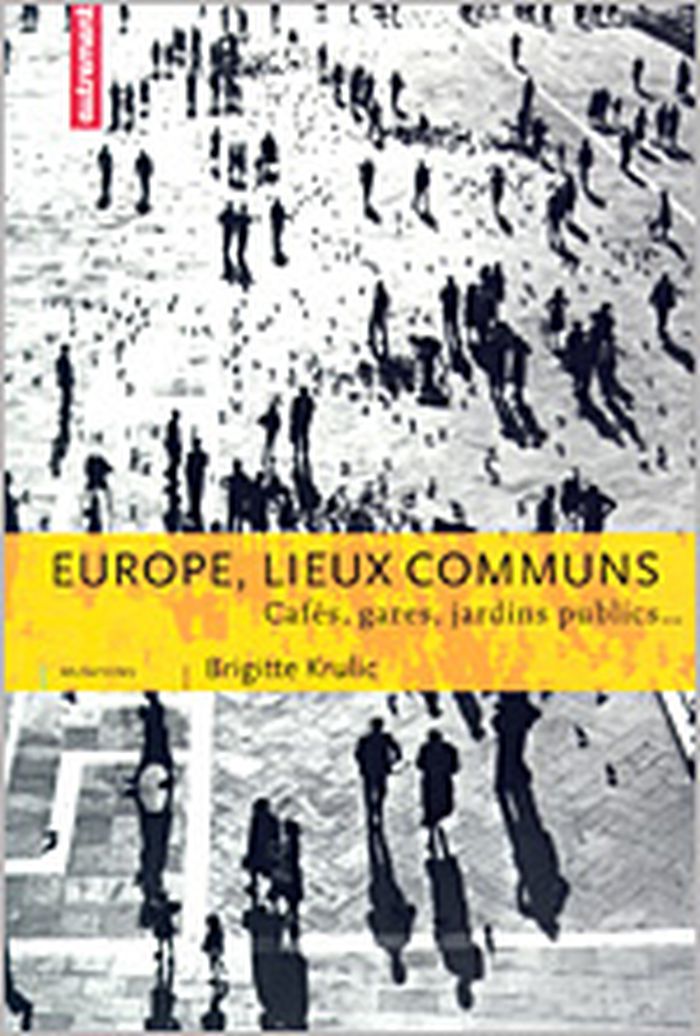
L'Europe est une entité culturelle façonnée par les civilisations grecque et romaine, le christianisme, les Lumières... De la Suède à l'Espagne, de la France à la Russie, sont explorés des lieux emblématiques qui révèlent des lignes de clivage et des points communs. Ces lieux sont évoqués à travers leur histoire politique, religieuse, sociale ; chacun de ces lieux a sa charge symbolique, nourrit un imaginaire littéraire, cinématographique, pictural... Chacun de ces lieux dit quelque chose de l'Europe d'aujourd'hui.
Europe, lieux communs : cafés, gares, jardins publics...
Actions:
Price:
$39.95
(available to order)
Summary:
L'Europe est une entité culturelle façonnée par les civilisations grecque et romaine, le christianisme, les Lumières... De la Suède à l'Espagne, de la France à la Russie, sont explorés des lieux emblématiques qui révèlent des lignes de clivage et des points communs. Ces lieux sont évoqués à travers leur histoire politique, religieuse, sociale ; chacun de ces lieux a sa charge symbolique, nourrit un imaginaire littéraire, cinématographique, pictural... Chacun de ces lieux dit quelque chose de l'Europe d'aujourd'hui.
Form:
books
books
Publication:
February 2004, Paris
February 2004, Paris
Subject:
Architectural Theory
Architectural Theory
Form:
books
books
Price:
$125.00
(available to order)
Summary:
The enduring influence of the architect Gottfried Semper (1803-79) derives less from his monumental buildings in Dresden, Zurich, and Vienna than from his "Style in the technical and tectonic arts" (1860-63). Semper's landmark survey of the motives giving rise to the technical arts (textiles, ceramics, carpentry, masonry) explores the symbolic and material preconditions(...)
$125.00
(available to order)
Summary:
The enduring influence of the architect Gottfried Semper (1803-79) derives less from his monumental buildings in Dresden, Zurich, and Vienna than from his "Style in the technical and tectonic arts" (1860-63). Semper's landmark survey of the motives giving rise to the technical arts (textiles, ceramics, carpentry, masonry) explores the symbolic and material preconditions(...)
Title:
Style
Actions:
Price:
$125.00
(available to order)
Summary:
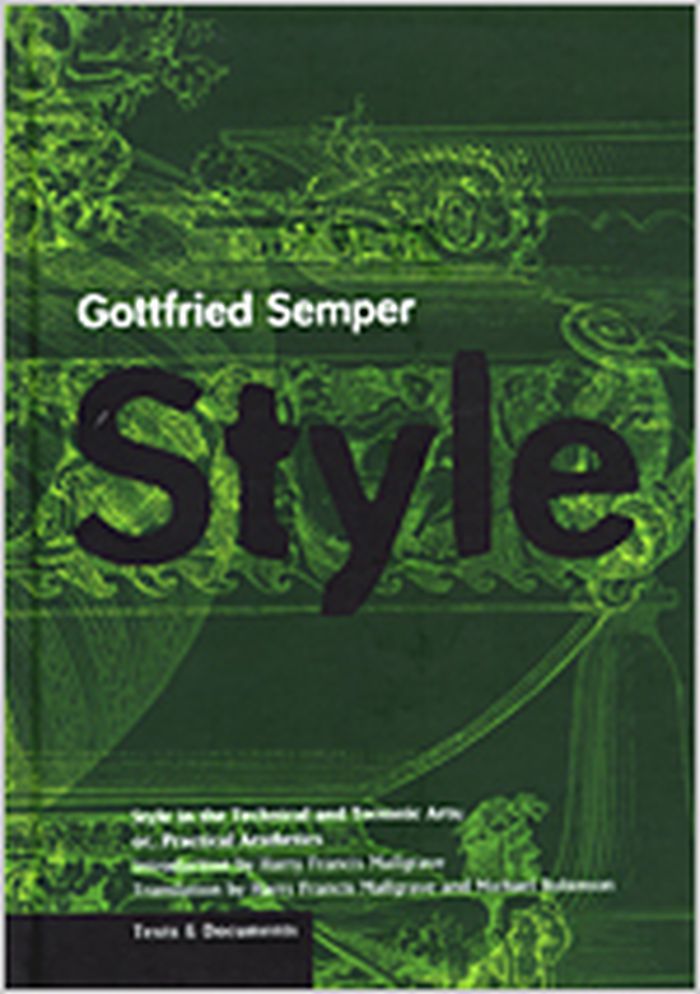
The enduring influence of the architect Gottfried Semper (1803-79) derives less from his monumental buildings in Dresden, Zurich, and Vienna than from his "Style in the technical and tectonic arts" (1860-63). Semper's landmark survey of the motives giving rise to the technical arts (textiles, ceramics, carpentry, masonry) explores the symbolic and material preconditions of style. An extended inquiry into the inner principles of artistic form, this work altered the intellectual field for aesthetics and art history and stands as a vital document in the construction of modern architectural theory. Translated by Harry Francis Mallgrave and Michael Robinson, with an introduction by Harry Francis Mallgrave.
Style
Actions:
Price:
$125.00
(available to order)
Summary:
The enduring influence of the architect Gottfried Semper (1803-79) derives less from his monumental buildings in Dresden, Zurich, and Vienna than from his "Style in the technical and tectonic arts" (1860-63). Semper's landmark survey of the motives giving rise to the technical arts (textiles, ceramics, carpentry, masonry) explores the symbolic and material preconditions of style. An extended inquiry into the inner principles of artistic form, this work altered the intellectual field for aesthetics and art history and stands as a vital document in the construction of modern architectural theory. Translated by Harry Francis Mallgrave and Michael Robinson, with an introduction by Harry Francis Mallgrave.
Form:
books
books
Publication:
May 2004, Los Angeles
May 2004, Los Angeles
Subject:
Architectural Theory
Architectural Theory
Form:
books
books
Actions:
Price:
$42.00
(available to order)
Summary:
This original and thoughtful study provides the first thorough examination of the relationship between architecture and language as complex social practices. The words we use when we talk and write about architecture describe more than just bricks and mortar—they direct the ways we think of and live with buildings. This groundbreaking book is the first thorough(...)
$42.00
(available to order)
Summary:
This original and thoughtful study provides the first thorough examination of the relationship between architecture and language as complex social practices. The words we use when we talk and write about architecture describe more than just bricks and mortar—they direct the ways we think of and live with buildings. This groundbreaking book is the first thorough(...)
Title:
Words and buildings : a vocabulary of modern architecture
Actions:
Price:
$42.00
(available to order)
Summary:
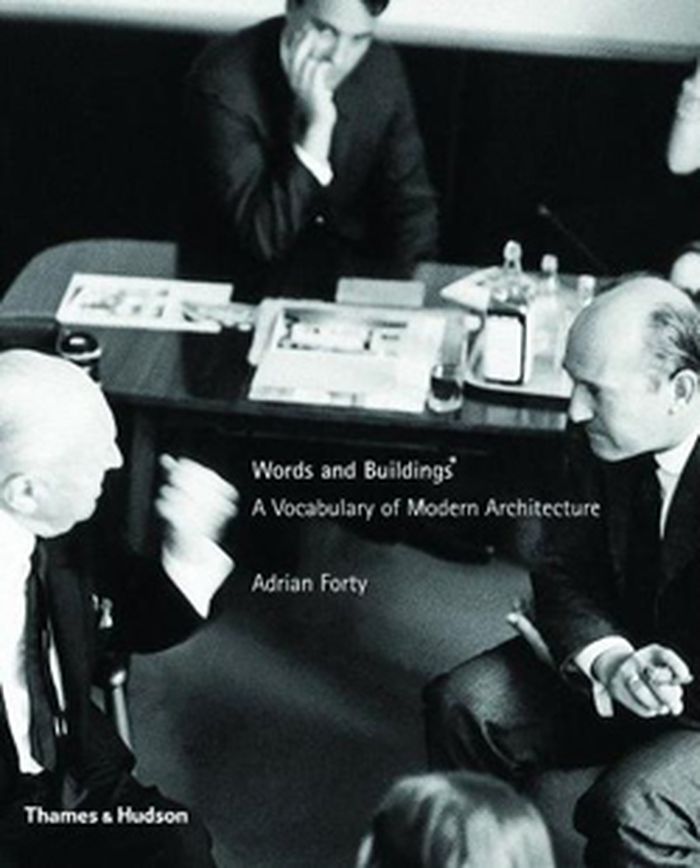
This original and thoughtful study provides the first thorough examination of the relationship between architecture and language as complex social practices. The words we use when we talk and write about architecture describe more than just bricks and mortar—they direct the ways we think of and live with buildings. This groundbreaking book is the first thorough examination of the complex relationship between architecture and language as intricate social practices. Six rigorously argued chapters and a vocabulary of key terms investigate the language of modernism; language and drawing; “masculine and feminine” architecture; language metaphors; science in architecture; and the social properties of architecture.
Words and buildings : a vocabulary of modern architecture
Actions:
Price:
$42.00
(available to order)
Summary:
This original and thoughtful study provides the first thorough examination of the relationship between architecture and language as complex social practices. The words we use when we talk and write about architecture describe more than just bricks and mortar—they direct the ways we think of and live with buildings. This groundbreaking book is the first thorough examination of the complex relationship between architecture and language as intricate social practices. Six rigorously argued chapters and a vocabulary of key terms investigate the language of modernism; language and drawing; “masculine and feminine” architecture; language metaphors; science in architecture; and the social properties of architecture.
Form:
books
books
Publication:
March 2012, London
March 2012, London
Subject:
Architectural Theory
Architectural Theory
Form:
books
books
Actions:
Price:
$34.00
(available in store)
Summary:
Our thermal environment is as rich in cultural associations as our visual, acoustic, olfactory, and tactile environments. This book explores the potential for using thermal qualities as an expressive element in building design.
$34.00
(available in store)
Summary:
Our thermal environment is as rich in cultural associations as our visual, acoustic, olfactory, and tactile environments. This book explores the potential for using thermal qualities as an expressive element in building design.
Title:
Thermal delight in architecture
Actions:
Price:
$34.00
(available in store)
Summary:
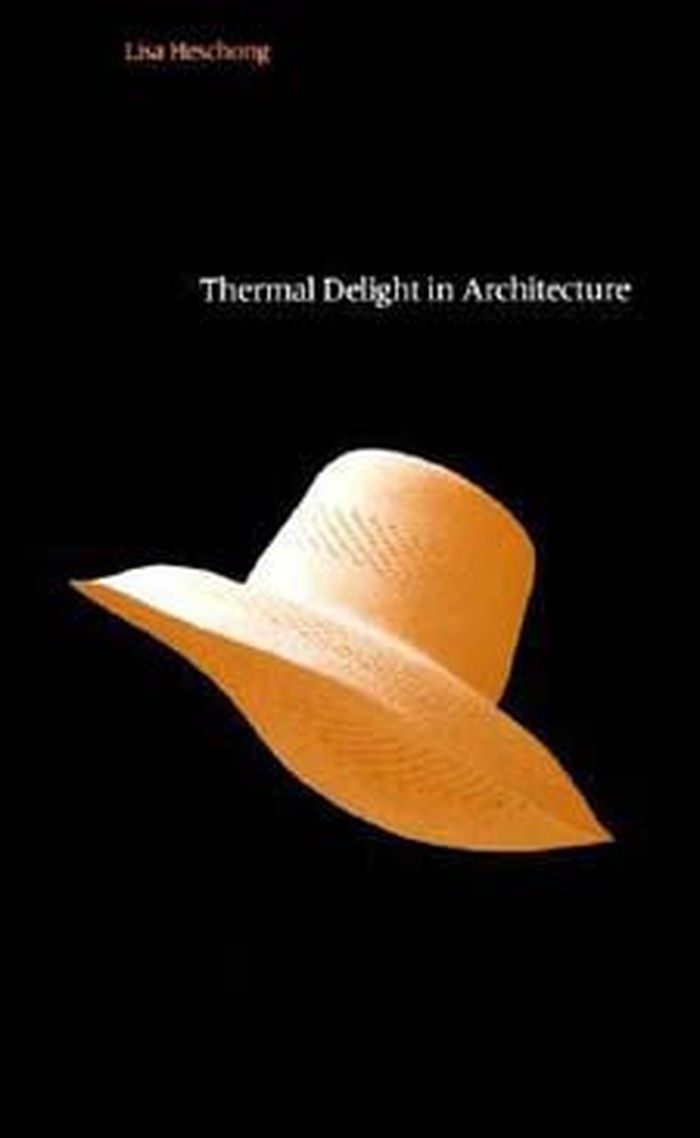
Our thermal environment is as rich in cultural associations as our visual, acoustic, olfactory, and tactile environments. This book explores the potential for using thermal qualities as an expressive element in building design.
Thermal delight in architecture
Actions:
Price:
$34.00
(available in store)
Summary:
Our thermal environment is as rich in cultural associations as our visual, acoustic, olfactory, and tactile environments. This book explores the potential for using thermal qualities as an expressive element in building design.
Form:
books
books
Publication:
December 1979, Cambridge, Mass.
December 1979, Cambridge, Mass.
Subject:
Architectural Theory
Architectural Theory
Form:
books
books
Actions:
Price:
$47.95
(available to order)
Summary:
L'évidence du cadre bâti serait telle que l'architecture se résumerait à un fait technique et matériel. Mais le diktat de l'évidence matérielle se brouille dès lors que l'on considère les causes et les effets de la construction. L'objectif de ce livre est de rendre à la pratique architecturale une pensée théorique cohérente, unifiée et ouverte, échappant à toute forme de(...)
$47.95
(available to order)
Summary:
L'évidence du cadre bâti serait telle que l'architecture se résumerait à un fait technique et matériel. Mais le diktat de l'évidence matérielle se brouille dès lors que l'on considère les causes et les effets de la construction. L'objectif de ce livre est de rendre à la pratique architecturale une pensée théorique cohérente, unifiée et ouverte, échappant à toute forme de(...)
Title:
Catastrophisme architectural : l'architecture comme sémio-physique de l'espace social
Actions:
Price:
$47.95
(available to order)
Summary:
L'évidence du cadre bâti serait telle que l'architecture se résumerait à un fait technique et matériel. Mais le diktat de l'évidence matérielle se brouille dès lors que l'on considère les causes et les effets de la construction. L'objectif de ce livre est de rendre à la pratique architecturale une pensée théorique cohérente, unifiée et ouverte, échappant à toute forme de dogmatisme mondain. Il s'intéresse essentiellement aux questions épistémologiques, méthodologiques et instrumentales nécessaires à la compréhension des phénomènes directement liés à la pratique architecturale.
Catastrophisme architectural : l'architecture comme sémio-physique de l'espace social
Actions:
Price:
$47.95
(available to order)
Summary:
L'évidence du cadre bâti serait telle que l'architecture se résumerait à un fait technique et matériel. Mais le diktat de l'évidence matérielle se brouille dès lors que l'on considère les causes et les effets de la construction. L'objectif de ce livre est de rendre à la pratique architecturale une pensée théorique cohérente, unifiée et ouverte, échappant à toute forme de dogmatisme mondain. Il s'intéresse essentiellement aux questions épistémologiques, méthodologiques et instrumentales nécessaires à la compréhension des phénomènes directement liés à la pratique architecturale.
Form:
books
books
Publication:
February 2004, Paris
February 2004, Paris
Subject:
Architectural Theory
Architectural Theory
Form:
books
books
![[Re] reading Perspecta : the first 50 years of the Yale Architectural Journal](/img-bookstore/U2zEypAg4vNoqdQ07aKvxPIdXbM=/700x919/MIG-13694.jpg)
Actions:
Price:
$93.95
(available to order)
Summary:
"Perspecta", the oldest and most respected student-edited architectural journal in the United States, marks its fiftieth anniversary with this selection of influential and provocative pieces published in its pages from the 1950s through the 1990s. The essays and portfolios in "[Re]Reading Perspecta" trace the development of architectural culture and discourse over the(...)
$93.95
(available to order)
Summary:
"Perspecta", the oldest and most respected student-edited architectural journal in the United States, marks its fiftieth anniversary with this selection of influential and provocative pieces published in its pages from the 1950s through the 1990s. The essays and portfolios in "[Re]Reading Perspecta" trace the development of architectural culture and discourse over the(...)
Subject:
Architectural Theory
Architectural Theory
Publication:
May 2004, Cambridge, Massachusetts
May 2004, Cambridge, Massachusetts
Title:
[Re] reading Perspecta : the first 50 years of the Yale Architectural Journal
Actions:
Price:
$93.95
(available to order)
Summary:
"Perspecta", the oldest and most respected student-edited architectural journal in the United States, marks its fiftieth anniversary with this selection of influential and provocative pieces published in its pages from the 1950s through the 1990s. The essays and portfolios in "[Re]Reading Perspecta" trace the development of architectural culture and discourse over the past fifty years and bear witness to the influential role played by "Perspecta" in a time of crucial debate about the function and future of architecture. This collection (with over 800 pages and 900 images) presents engaging and stimulating essays published in "Perspecta", written by such well-known historians, theorists, and architects as Vincent Scully, Colin Rowe, Roland Barthes, Karsten Harries, K. Michael Hays, Allan Greenberg, Sibyl Moholy-Nagy, John Hejduk, Francesco Dal Co, Bernard Tschumi, and Mark Wigley. "[Re]Reading Perspecta" also assembles the best examples of the richly-illustrated portfolios of projects published over the years, including work by Paul Rudolph, Louis Kahn, Robert Venturi, Eero Saarinen, Charles Moore, Philip Johnson, Peter Eisenman, John Hejduk, Steven Holl, Thomas Leeser, Hani Rashid, and others. The editors introduce each section with essays that offer historical context and critical commentary. "[Re]Reading Perspecta" also includes essays by Kenneth Frampton, K. Michael Hays, Joan Ockman, and Sandy Isenstadt on the history of "Perspecta" and its role in architectural discourse. This selection of the best of "Perspecta" covers a broad and lively spectrum of American architectural design, history, theory, and criticism.
[Re] reading Perspecta : the first 50 years of the Yale Architectural Journal
Actions:
Price:
$93.95
(available to order)
Summary:
"Perspecta", the oldest and most respected student-edited architectural journal in the United States, marks its fiftieth anniversary with this selection of influential and provocative pieces published in its pages from the 1950s through the 1990s. The essays and portfolios in "[Re]Reading Perspecta" trace the development of architectural culture and discourse over the past fifty years and bear witness to the influential role played by "Perspecta" in a time of crucial debate about the function and future of architecture. This collection (with over 800 pages and 900 images) presents engaging and stimulating essays published in "Perspecta", written by such well-known historians, theorists, and architects as Vincent Scully, Colin Rowe, Roland Barthes, Karsten Harries, K. Michael Hays, Allan Greenberg, Sibyl Moholy-Nagy, John Hejduk, Francesco Dal Co, Bernard Tschumi, and Mark Wigley. "[Re]Reading Perspecta" also assembles the best examples of the richly-illustrated portfolios of projects published over the years, including work by Paul Rudolph, Louis Kahn, Robert Venturi, Eero Saarinen, Charles Moore, Philip Johnson, Peter Eisenman, John Hejduk, Steven Holl, Thomas Leeser, Hani Rashid, and others. The editors introduce each section with essays that offer historical context and critical commentary. "[Re]Reading Perspecta" also includes essays by Kenneth Frampton, K. Michael Hays, Joan Ockman, and Sandy Isenstadt on the history of "Perspecta" and its role in architectural discourse. This selection of the best of "Perspecta" covers a broad and lively spectrum of American architectural design, history, theory, and criticism.
Form:
books
books
Publication:
May 2004, Cambridge, Massachusetts
May 2004, Cambridge, Massachusetts
Subject:
Architectural Theory
Architectural Theory
Form:
books
books
Actions:
Price:
$49.50
(available to order)
Summary:
"Digital Ground" is an architect's response to the design challenge posed by pervasive computing. One century into the electronic age, people have become accustomed to interacting indirectly, mediated through networks. But now as digital technology becomes invisibly embedded in everyday things, even more activities become mediated, and networks extend rather than replace(...)
$49.50
(available to order)
Summary:
"Digital Ground" is an architect's response to the design challenge posed by pervasive computing. One century into the electronic age, people have become accustomed to interacting indirectly, mediated through networks. But now as digital technology becomes invisibly embedded in everyday things, even more activities become mediated, and networks extend rather than replace(...)
Title:
Digital ground : architecture, pervasive computing, and environmental knowing
Actions:
Price:
$49.50
(available to order)
Summary:
"Digital Ground" is an architect's response to the design challenge posed by pervasive computing. One century into the electronic age, people have become accustomed to interacting indirectly, mediated through networks. But now as digital technology becomes invisibly embedded in everyday things, even more activities become mediated, and networks extend rather than replace architecture. The young field of interaction design reflects not only how people deal with machine interfaces but also how people deal with each other in situations where interactivity has become ambient. It shifts previously utilitarian digital design concerns to a cultural level, adding notions of premise, appropriateness, and appreciation. Malcolm McCullough offers an account of the intersections of architecture and interaction design, arguing that the ubiquitous technology does not obviate the human need for place. His concept of "digital ground" expresses an alternative to anytime-anyplace sameness in computing; he shows that context not only shapes usability but ideally becomes the subject matter of interaction design and that "environmental knowing" is a process that technology may serve and not erode.
Digital ground : architecture, pervasive computing, and environmental knowing
Actions:
Price:
$49.50
(available to order)
Summary:
"Digital Ground" is an architect's response to the design challenge posed by pervasive computing. One century into the electronic age, people have become accustomed to interacting indirectly, mediated through networks. But now as digital technology becomes invisibly embedded in everyday things, even more activities become mediated, and networks extend rather than replace architecture. The young field of interaction design reflects not only how people deal with machine interfaces but also how people deal with each other in situations where interactivity has become ambient. It shifts previously utilitarian digital design concerns to a cultural level, adding notions of premise, appropriateness, and appreciation. Malcolm McCullough offers an account of the intersections of architecture and interaction design, arguing that the ubiquitous technology does not obviate the human need for place. His concept of "digital ground" expresses an alternative to anytime-anyplace sameness in computing; he shows that context not only shapes usability but ideally becomes the subject matter of interaction design and that "environmental knowing" is a process that technology may serve and not erode.
Form:
books
books
Publication:
April 2004, Cambridge, Mass.
April 2004, Cambridge, Mass.
Subject:
Architectural Theory
Architectural Theory
Form:
books
books
Actions:
Price:
$46.95
(available to order)
Summary:
The internationally acclaimed architect Rafael Moneo is known to be a courageous architect. His major works include the Houston Museum of Fine Art, Davis Art Museum at Wellesley College, the Stockholm Museum of Modern Art and Architecture, and the Potzdammer Platz Hotel in Berlin. Now Moneo will be known as a daring critic as well. In this book he looks at eight of his(...)
$46.95
(available to order)
Summary:
The internationally acclaimed architect Rafael Moneo is known to be a courageous architect. His major works include the Houston Museum of Fine Art, Davis Art Museum at Wellesley College, the Stockholm Museum of Modern Art and Architecture, and the Potzdammer Platz Hotel in Berlin. Now Moneo will be known as a daring critic as well. In this book he looks at eight of his(...)
Title:
Theoretical anxiety and design strategies in the work of eight contemporary architects
Actions:
Price:
$46.95
(available to order)
Summary:
The internationally acclaimed architect Rafael Moneo is known to be a courageous architect. His major works include the Houston Museum of Fine Art, Davis Art Museum at Wellesley College, the Stockholm Museum of Modern Art and Architecture, and the Potzdammer Platz Hotel in Berlin. Now Moneo will be known as a daring critic as well. In this book he looks at eight of his contemporaries -- all architects of international stature -- and discusses the theoretical positions, technical innovations, and design contributions of each. Moneo's discussion of these eight architects -- James Stirling, Robert Venturi, Aldo Rossi, Peter Eisenman, Alvaro Siza, Frank Gehry, Rem Koolhaas, and the partnership of Jacques Herzog and Pierre De Meuron -- has the colloquial, engaging tone of a series of lectures on modern architecture by a master architect; the reader hears not the dispassionate theorizing of an academic, but Moneo's own deeply held convictions as he considers the work of his contemporaries. Discussing each of the eight architects in turn, Moneo first gives an introductory profile, emphasizing intentions, theoretical concerns, and construction procedures. He then turns to the work, offering detailed critical analyses of the works he considers to be crucial for an informed understanding of this architect's work. The many images he uses to illustrate his points resemble the rapid-fire flash of slides in a lecture, but Moneo's perspective is unique among lecturers. These profiles are not what Moneo calls the "tacit treatises" that can be found on the shelves of a university library, but lively encounters of architectural equals. More than 500 illustrations accompany the text.
Theoretical anxiety and design strategies in the work of eight contemporary architects
Actions:
Price:
$46.95
(available to order)
Summary:
The internationally acclaimed architect Rafael Moneo is known to be a courageous architect. His major works include the Houston Museum of Fine Art, Davis Art Museum at Wellesley College, the Stockholm Museum of Modern Art and Architecture, and the Potzdammer Platz Hotel in Berlin. Now Moneo will be known as a daring critic as well. In this book he looks at eight of his contemporaries -- all architects of international stature -- and discusses the theoretical positions, technical innovations, and design contributions of each. Moneo's discussion of these eight architects -- James Stirling, Robert Venturi, Aldo Rossi, Peter Eisenman, Alvaro Siza, Frank Gehry, Rem Koolhaas, and the partnership of Jacques Herzog and Pierre De Meuron -- has the colloquial, engaging tone of a series of lectures on modern architecture by a master architect; the reader hears not the dispassionate theorizing of an academic, but Moneo's own deeply held convictions as he considers the work of his contemporaries. Discussing each of the eight architects in turn, Moneo first gives an introductory profile, emphasizing intentions, theoretical concerns, and construction procedures. He then turns to the work, offering detailed critical analyses of the works he considers to be crucial for an informed understanding of this architect's work. The many images he uses to illustrate his points resemble the rapid-fire flash of slides in a lecture, but Moneo's perspective is unique among lecturers. These profiles are not what Moneo calls the "tacit treatises" that can be found on the shelves of a university library, but lively encounters of architectural equals. More than 500 illustrations accompany the text.
Form:
books
books
Publication:
May 2004, Cambridge, Mass.
May 2004, Cambridge, Mass.
Subject:
Architectural Theory
Architectural Theory
Form:
books
books
Title:
Eating architecture
Eating architecture
Actions:
Price:
$52.00
(available to order)
Summary:
The contributors to this highly original collection of essays explore the relationship between food and architecture, asking what can be learned by examining the (often metaphorical) intersection of the preparation of meals and the production of space. In a culture that includes the Food Channel and the knife-juggling chefs of Benihana, food has become not only an(...)
$52.00
(available to order)
Summary:
The contributors to this highly original collection of essays explore the relationship between food and architecture, asking what can be learned by examining the (often metaphorical) intersection of the preparation of meals and the production of space. In a culture that includes the Food Channel and the knife-juggling chefs of Benihana, food has become not only an(...)
Subject:
Architectural Theory
Architectural Theory
Publication:
May 2004, Cambridge, Mass.
May 2004, Cambridge, Mass.
Title:
Eating architecture
Actions:
Price:
$52.00
(available to order)
Summary:
The contributors to this highly original collection of essays explore the relationship between food and architecture, asking what can be learned by examining the (often metaphorical) intersection of the preparation of meals and the production of space. In a culture that includes the Food Channel and the knife-juggling chefs of Benihana, food has become not only an obsession but an alternative art form. The nineteen essays and "Gallery of Recipes" in "Eating Architecture" seize this moment to investigate how art and architecture engage issues of identity, ideology, conviviality, memory, and loss that cookery evokes. The essays are organized into four sections that lead the reader from the landscape to the kitchen, the table, and finally the mouth. The essays in "Place Settings" examine the relationships between food and location that arise in culinary colonialism and the global economy of tourism. "Philosophy in the Kitchen" traces the routines that create a site for aesthetic experimentation, including an examination of gingerbread houses as art, food, and architectural space. The essays in "Table Rules" consider the spatial and performative aspects of eating and the ways in which shared meals are among the most perishable and preserved cultural artifacts. Finally, "Embodied Taste" considers the sensual apprehension of food and what it means to consume a work of art. The "Gallery of Recipes" contains images by contemporary architects on the subject of eating architecture.
Eating architecture
Actions:
Price:
$52.00
(available to order)
Summary:
The contributors to this highly original collection of essays explore the relationship between food and architecture, asking what can be learned by examining the (often metaphorical) intersection of the preparation of meals and the production of space. In a culture that includes the Food Channel and the knife-juggling chefs of Benihana, food has become not only an obsession but an alternative art form. The nineteen essays and "Gallery of Recipes" in "Eating Architecture" seize this moment to investigate how art and architecture engage issues of identity, ideology, conviviality, memory, and loss that cookery evokes. The essays are organized into four sections that lead the reader from the landscape to the kitchen, the table, and finally the mouth. The essays in "Place Settings" examine the relationships between food and location that arise in culinary colonialism and the global economy of tourism. "Philosophy in the Kitchen" traces the routines that create a site for aesthetic experimentation, including an examination of gingerbread houses as art, food, and architectural space. The essays in "Table Rules" consider the spatial and performative aspects of eating and the ways in which shared meals are among the most perishable and preserved cultural artifacts. Finally, "Embodied Taste" considers the sensual apprehension of food and what it means to consume a work of art. The "Gallery of Recipes" contains images by contemporary architects on the subject of eating architecture.
Form:
books
books
Publication:
May 2004, Cambridge, Mass.
May 2004, Cambridge, Mass.
Subject:
Architectural Theory
Architectural Theory
Form:
books
books
Actions:
Price:
$59.95
(available to order)
Summary:
The goal of this book is to introduce designers to the many research tools that can be used to inform design as well as to ideas about how and when to deploy them effectively. The chapter authors come from diverse institutions and enterprises, including Stanford University, MIT, Intel, Maxis, Studio Anybody, Sweden?s HUMlab, and Big Blue Dot. Each has something to say(...)
$59.95
(available to order)
Summary:
The goal of this book is to introduce designers to the many research tools that can be used to inform design as well as to ideas about how and when to deploy them effectively. The chapter authors come from diverse institutions and enterprises, including Stanford University, MIT, Intel, Maxis, Studio Anybody, Sweden?s HUMlab, and Big Blue Dot. Each has something to say(...)
Title:
Design research : methods and perspectives
Actions:
Price:
$59.95
(available to order)
Summary:
The goal of this book is to introduce designers to the many research tools that can be used to inform design as well as to ideas about how and when to deploy them effectively. The chapter authors come from diverse institutions and enterprises, including Stanford University, MIT, Intel, Maxis, Studio Anybody, Sweden?s HUMlab, and Big Blue Dot. Each has something to say about how designers make themselves better at what they do through research, and illustrates it with real world examples--case studies, anecdotes, and images. Topics of this multi-voice conversation include qualitative and quantitative methods, performance ethnography and design improvisation, trend research, cultural diversity, formal and structural research practice, tactical discussions of design research process, and case studies drawn from areas as unique as computer games, museum information systems, and movies. Interspersed throughout the book are one-page "demos," snapshots of the design research experience. Design Research charts the paths from research methods to research findings to design principles to design results and demonstrates the transformation of theory into a richly satisfying and more reliably successful practice.
Design research : methods and perspectives
Actions:
Price:
$59.95
(available to order)
Summary:
The goal of this book is to introduce designers to the many research tools that can be used to inform design as well as to ideas about how and when to deploy them effectively. The chapter authors come from diverse institutions and enterprises, including Stanford University, MIT, Intel, Maxis, Studio Anybody, Sweden?s HUMlab, and Big Blue Dot. Each has something to say about how designers make themselves better at what they do through research, and illustrates it with real world examples--case studies, anecdotes, and images. Topics of this multi-voice conversation include qualitative and quantitative methods, performance ethnography and design improvisation, trend research, cultural diversity, formal and structural research practice, tactical discussions of design research process, and case studies drawn from areas as unique as computer games, museum information systems, and movies. Interspersed throughout the book are one-page "demos," snapshots of the design research experience. Design Research charts the paths from research methods to research findings to design principles to design results and demonstrates the transformation of theory into a richly satisfying and more reliably successful practice.
Form:
books
books
Publication:
February 2004, Cambridge, Mass.
February 2004, Cambridge, Mass.
Subject:
Architectural Theory
Architectural Theory


