


2244 Results
Form:
books
books
Actions:
Price:
$29.95
(available to order)
Summary:
Il n’est pas courant de considérer sa résidence d’abord et avant tout comme une marchandise intrinsèquement liée à l’économie capitaliste. Pourtant, ce chez-soi dont on a tant rêvé, et auquel on a finalement accès, a été construit puis mis en vente ou en location par des entreprises capitalistes, sur un marché qui s’adresse à des consommateurs dont le pouvoir d’achat(...)
Title:
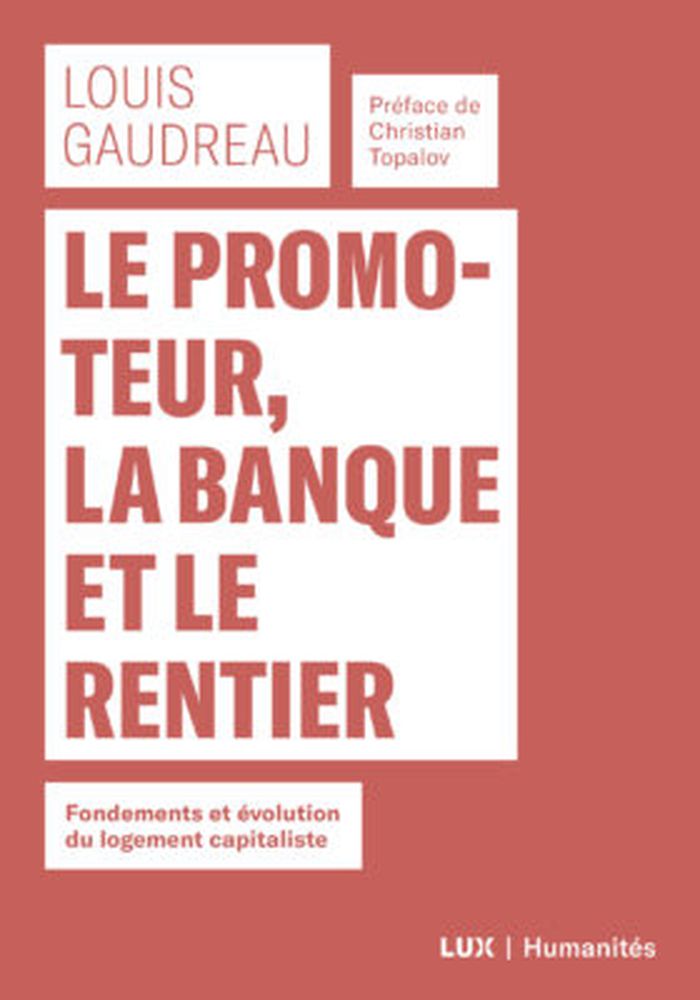
Le promoteur, la banque et le rentier : Fondements et évolution du logement capitaliste
Actions:
Price:
$29.95
(available to order)
Summary:
Il n’est pas courant de considérer sa résidence d’abord et avant tout comme une marchandise intrinsèquement liée à l’économie capitaliste. Pourtant, ce chez-soi dont on a tant rêvé, et auquel on a finalement accès, a été construit puis mis en vente ou en location par des entreprises capitalistes, sur un marché qui s’adresse à des consommateurs dont le pouvoir d’achat provient lui-même d’un autre marché, celui du travail. Et, comme l’a démontré la crise de 2008, le marché de l’immobilier peut subir des bouleversements considérables, affectant de manière drastique l’économie et la société dans son ensemble. Dans cet ouvrage, Louis Gaudreau entreprend d’illustrer le caractère évolutif de la relation entre capitalisme et logement, en retraçant l’histoire de ses trois principaux protagonistes : le promoteur, la banque et le rentier. Car même si le marché de l’habitation fait depuis longtemps partie intégrante du capitalisme, il n’est plus le même qu’au xixe siècle ou qu’il y a trente ans. Il s’appuie désormais sur des logiques financiarisées qui en modifient le fonctionnement. Cette tendance impose de nouvelles conditions au développement du logement et à ses usages, qui révèlent à leur tour la façon dont se pose aujourd’hui la question du droit au logement.
Form:
books
books
Publication:
June 2020
June 2020
Form:
books
books

Actions:
Price:
$34.95
(available to order)
Summary:
Quoiqu’en majorité urbains, nos contemporains connaissent peu les acteurs et les processus qui produisent leur cadre de vie. Cet ouvrage éclaire les coulisses de la fabrication de la ville à partir de la place qu’y occupent les architectes. L’évolution considérable de leur statut depuis les années 1980 est révélatrice de nombre de transformations profondes de notre(...)
Title:
Les architectes au défi de la ville néolibérale
Actions:
Price:
$34.95
(available to order)
Summary:
Quoiqu’en majorité urbains, nos contemporains connaissent peu les acteurs et les processus qui produisent leur cadre de vie. Cet ouvrage éclaire les coulisses de la fabrication de la ville à partir de la place qu’y occupent les architectes. L’évolution considérable de leur statut depuis les années 1980 est révélatrice de nombre de transformations profondes de notre société. La référence que constituait la grande commande publique, le rôle prépondérant de l’État dans la désignation des politiques architecturales s’effacent au profit de nouvelles situations de projet, mettant les grands opérateurs du BTP au centre des systèmes d’acteurs. Ce décadrage interroge le sens que les architectes attribuent à leur travail et les registres sous lesquels ils revendiquent d’être évalués.
Form:
books
books
Publication:
July 2020
July 2020
Subject:
Architectural Theory
Architectural Theory
Form:
books
books

Actions:
Price:
$67.98
(available to order)
Summary:
Founded by architect Walter Gropius (1883–1969) in 1919, the Bauhaus was the 20th century’s most influential school of art, architecture, and design. After the school was shuttered under pressure from the Nazis in 1933, many Bauhaus artists brought their innovative practices and teaching methods to the United States. Gropius himself accepted a position at Harvard, where(...)
Title:
Object lessons: the Bauhaus and Harvard
Actions:
Price:
$67.98
(available to order)
Summary:
Founded by architect Walter Gropius (1883–1969) in 1919, the Bauhaus was the 20th century’s most influential school of art, architecture, and design. After the school was shuttered under pressure from the Nazis in 1933, many Bauhaus artists brought their innovative practices and teaching methods to the United States. Gropius himself accepted a position at Harvard, where he would help establish a collection of Bauhaus material that has since grown to more than 30,000 objects—the largest such collection outside Germany. Harvard in turn became an unofficial center for the Bauhaus in America. Written by established and emerging voices in the field, the scholarship presented here expands on the special link between the two institutions, while highlighting understudied aspects of the Bauhaus, such as weaving, photography, and art made by women. Accompanied by illustrations—some of never-before-published objects—this book yields fascinating insights for Bauhaus devotees and design aficionados.
Form:
books
books
Publication:
September 2020
September 2020
Subject:
Architectural Theory
Architectural Theory
Form:
books
books

Actions:
Price:
$64.95
(available to order)
Summary:
L’enjeu de ce volume est de comprendre notre expérience du monde à l’heure où s’estompe la primauté du visible et du spatial. Traitant de l’ambiance, mais plus encore des conditions d’air des architectures de l’ambiance, l’auteur met en lumière une évolution autant architecturale que politique. Penser (à) l’air, cet invisible par nature, véhicule de notre inconscient(...)
Title:
Conditions d'air: politique des architectures par l'ambiance
Actions:
Price:
$64.95
(available to order)
Summary:
L’enjeu de ce volume est de comprendre notre expérience du monde à l’heure où s’estompe la primauté du visible et du spatial. Traitant de l’ambiance, mais plus encore des conditions d’air des architectures de l’ambiance, l’auteur met en lumière une évolution autant architecturale que politique. Penser (à) l’air, cet invisible par nature, véhicule de notre inconscient climatique, c’est repenser notre rapport à la production et au projet. Le projet, plutôt que projection, deviendrait processus, reflétant une transformation profonde des pratiques architecturales, alors que l’émergence de la notion d’espace laisserait place, et c’est la thèse de l’auteur, à un échec de l’espace. À travers l’examen critique de projets de Le Corbusier (Armée du Salut) et de Robain & Guieysse (Mie de Pain) à Paris, de Christophe Amsler et de Philippe Rahm, de SANAA (EPFL Learning Center, Lausanne) et de Lacaton & Vassal (École d’Architecture, Nantes), Emmanuel Doutriaux affronte le thème de l’ambiance – concept cardinal de notre contemporain – partagé entre phénoménologie, sociologie de l’action située et philosophie pragmatiste.
Form:
books
books
Publication:
August 2020
August 2020
Subject:
Architectural Theory
Architectural Theory
Form:
books
books
Price:
$70.00
(available to order)
Summary:
This book is a heterogeneous collection of writings, speeches, and interviews. Read together, they reveal the breadth of Mies’ deep engagement with architecture and education in Germany and the USA. By including both written and spoken words, the co-editors reveal how Mies was able to extend his influence well beyond the classroom-studio and the profession to reach a(...)
Publication:
October 2024
October 2024
Title:
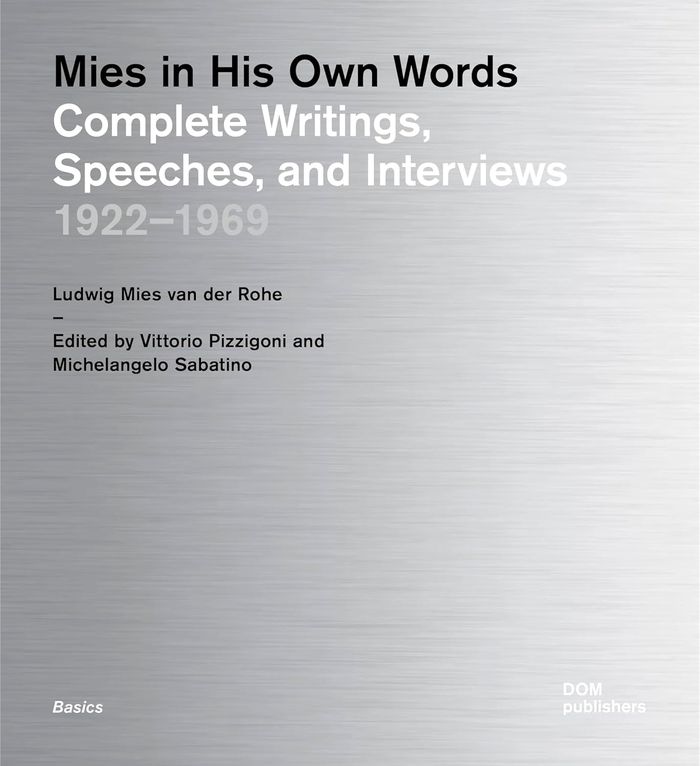
Mies in his own words: Complete writings,speeches and interviews 1922-1969
Actions:
Price:
$70.00
(available to order)
Summary:
This book is a heterogeneous collection of writings, speeches, and interviews. Read together, they reveal the breadth of Mies’ deep engagement with architecture and education in Germany and the USA. By including both written and spoken words, the co-editors reveal how Mies was able to extend his influence well beyond the classroom-studio and the profession to reach a general audience eager to learn more about his architectural philosophy during a time of great cultural and societal upheaval.
Form:
books
books
Publication:
October 2024
October 2024
Form:
books
books
Actions:
Price:
$62.00
(available to order)
Summary:
"Mute icons" challenges fixed aesthetic notions of beauty in architecture as both, disciplinary discourse and a spatial practice within the public realm, by intersecting historic antecedents and present instances within contemporary projects wherein indeterminacy, monolithicity and defamiliarization play a speculative role in constructing withdrawn, irritant and yet(...)
Title:
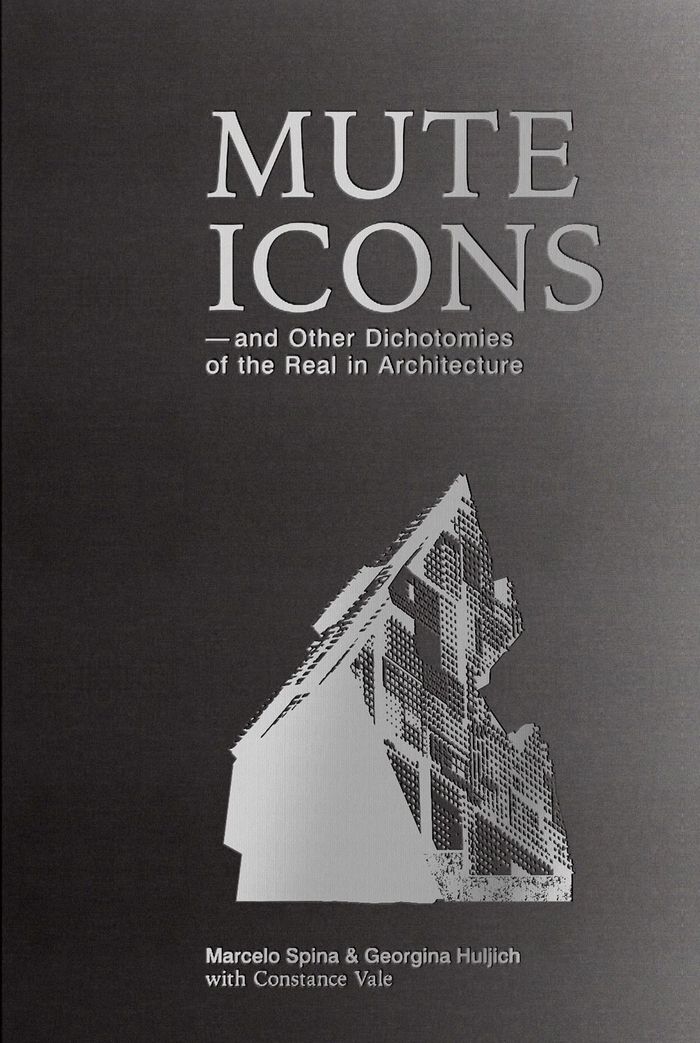
Mute icons: pressing dichotomy in contemporary architecture
Actions:
Price:
$62.00
(available to order)
Summary:
"Mute icons" challenges fixed aesthetic notions of beauty in architecture as both, disciplinary discourse and a spatial practice within the public realm, by intersecting historic antecedents and present instances within contemporary projects wherein indeterminacy, monolithicity and defamiliarization play a speculative role in constructing withdrawn, irritant and yet engaging architectural images. No longer concerned with narrative excesses or with the "shock and awe" of sensation making; the mute icon becomes intriguing in its deceptive indifference towards context, perplexing in its unmitigated apathy towards the body. Object and building, absolute and unstable, anticipated and strange, manifest and withdrawn, such is the dichotomy of mute icons. Dwelling in the paradox between silence and sign and aiming to debunk a false dichotomy between critical discourse, a pursue of formal novelty and the attainment of social ethics, "Mute icons" reaffirms the cultural need and socio-political relevance of the architectural image, suggesting a much-needed resolution to the present but incorrect antagonism between formal innovation, social responsibility and economic austerity. Intersecting relevant historical antecedents and polemic theoretical speculations with original design concepts and provocative representations of P-A-T-T-E-R-N-S recent work, the book aspires to stimulate authentic speculations on the real.
Form:
books
books
Publication:
July 2021
July 2021
Subject:
Architectural Theory
Architectural Theory
Form:
books
books
Actions:
Price:
$45.00
(available to order)
Summary:
Scott Ruff’s studio, 'Gullah/Geechee Institute', investigated architecture’s role as a cultural signifier in the African-American Gullah–Geechee community off the South Carolina coast. It challenged students to translate cultural ideas into tectonic and spatial strategies for a monument, museum, and memorial that serves as a gateway to the Gullah–Geechee corridor,(...)
Title:
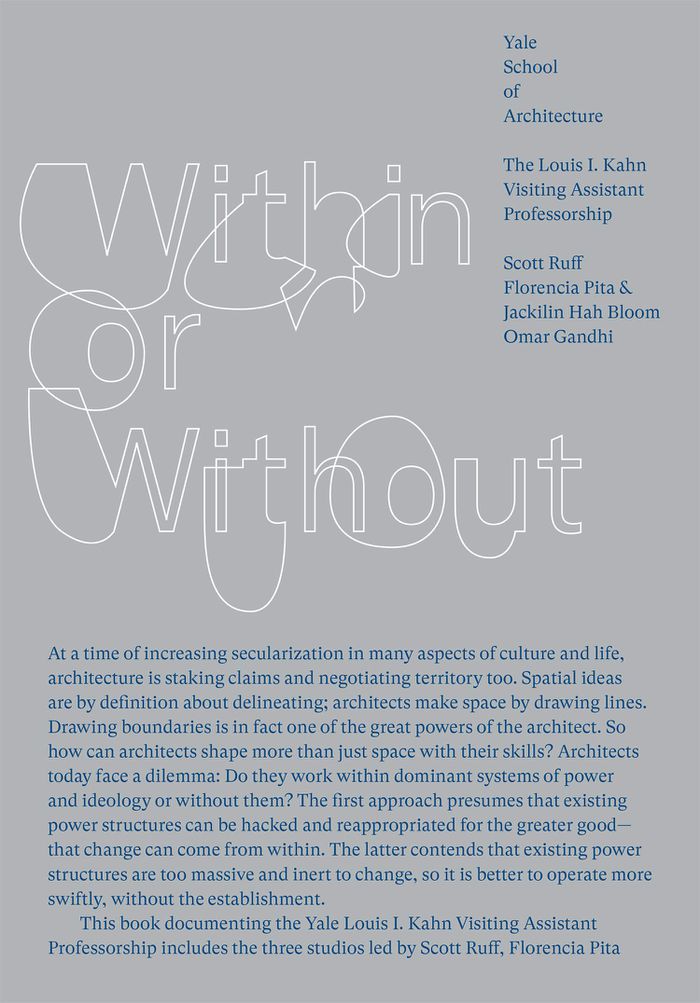
Within or without (Louis I. Kahn assistant professorship)
Actions:
Price:
$45.00
(available to order)
Summary:
Scott Ruff’s studio, 'Gullah/Geechee Institute', investigated architecture’s role as a cultural signifier in the African-American Gullah–Geechee community off the South Carolina coast. It challenged students to translate cultural ideas into tectonic and spatial strategies for a monument, museum, and memorial that serves as a gateway to the Gullah–Geechee corridor, incorporating public interpretive and historical programs. In Florencia Pita and Jackilin Bloom’s studio, 'Easy Office', students experimented with ways of generating new spatial, formal, material, and narrative ideas through the processes of collecting, collaging, and casting everyday objects. The studio considered notions of the creative office and the workplace based on the unexpected space, form, and materiality that emerged from these processes. Students in Omar Gandhi’s studio, 'Where the Wild Things Are', designed a campus of creatures for Rabbit Snare Gorge on the north coast of Cape Breton Island. They focused on a series of interventions that used vernacular approaches to produce specific functions, develop a process or ideology, and frame sensory experience. The students explored how Nova Scotia’s regional architecture takes advantage of phenomenological opportunities available on the site and inspires new responses to climate and geography.
Form:
books
books
Publication:
January 2020
January 2020
Subject:
Architectural Theory
Architectural Theory
Form:
books
books
Title:
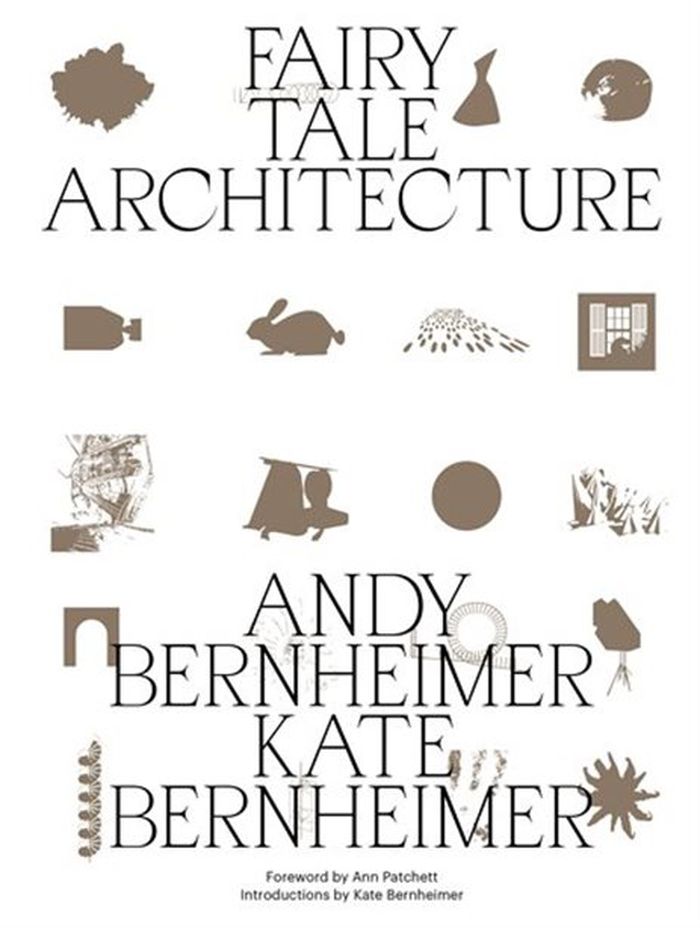
Fairy tale architecture
Fairy tale architecture
Actions:
Price:
$38.95
(available to order)
Summary:
Little Red Riding Hood, Baba Yaga, Rapunzel, Jack and the Beanstalk, The Snow Queen: these and more than fifteen other stories designed by Bernheimer Architecture, Snøhetta, Rural Studio, LEVENBETTS, and LTL Architects and many other international vanguards have created stunning works for this groundbreaking collection of architectural fairy tales. Story by story, Andrew(...)
Title:
Fairy tale architecture
Actions:
Price:
$38.95
(available to order)
Summary:
Little Red Riding Hood, Baba Yaga, Rapunzel, Jack and the Beanstalk, The Snow Queen: these and more than fifteen other stories designed by Bernheimer Architecture, Snøhetta, Rural Studio, LEVENBETTS, and LTL Architects and many other international vanguards have created stunning works for this groundbreaking collection of architectural fairy tales. Story by story, Andrew Bernheimer and Kate Bernheimer- a brother and sister team as in an old fairy tale- have built the ultimate home for lovers of fiction and design. Snow girls and spinning houses. Paper capes and engineered hair braids. Resin bee hives and infinite libraries. Here are futuristic structures made from traditional stories, inspired by everything from Hans Christian Andersen’s The Snow Queen and The Little Match Girl to the Brothers Grimm’s Rapunzel and The Juniper Tree to fairy tales by Jorge Luis Borges and Joy Williams and from China, Japan, Russia, Nigeria, and Mexico. A desire for story and shelter counts as among our most ancient instincts, and this dual desire continues to inspire our most imaginative architects and authors today. ''Fairy Tale Architecture'' invites the reader into a space of wonder, into a new form that will endure ever after.
Form:
books
books
Publication:
December 2020
December 2020
Subject:
Architectural Theory
Architectural Theory
Form:
books
books
Title:
The philosophy of dumbness
The philosophy of dumbness
Actions:
Price:
$35.00
(available to order)
Summary:
This is the dumbest smart book on contemporary architecture. What really is this ''technology'' that we speak of? How do we define ''intelligence''? These are just two of the questions that this book attempts to answer through the unconventional (and seemingly ironic) lens of ''dumbness.'' Historical examples in science, art, and architecture ground dumbness as a means to(...)
Title:
The philosophy of dumbness
Actions:
Price:
$35.00
(available to order)
Summary:
This is the dumbest smart book on contemporary architecture. What really is this ''technology'' that we speak of? How do we define ''intelligence''? These are just two of the questions that this book attempts to answer through the unconventional (and seemingly ironic) lens of ''dumbness.'' Historical examples in science, art, and architecture ground dumbness as a means to convey a trajectory to practice ''smarter.'' Instead of a singular authoritative vision, over fifty contributors answer the question, ''What is the dumbest, but smartest thing you’ve done?'' These unique responses provide a vivid lens into the culture of contemporary architecture and the rigor behind it.
Form:
books
books
Publication:
December 2020
December 2020
Subject:
Architectural Theory
Architectural Theory
Form:
books
books
Actions:
Price:
$49.95
(available to order)
Summary:
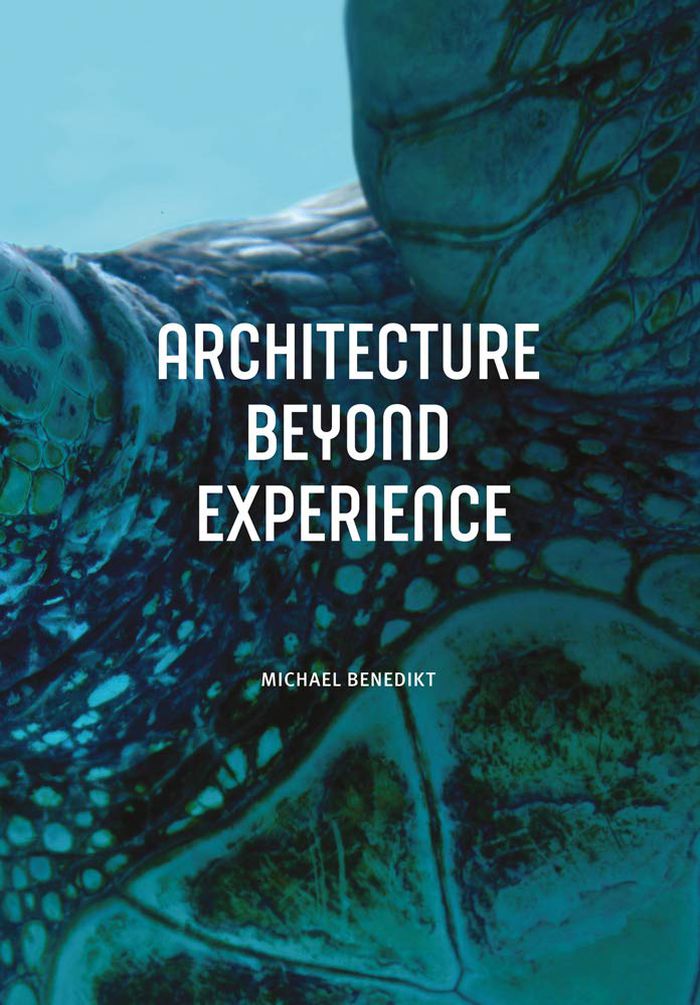
'Architecture Beyond Experience' is a work in the service of one goal: the bringing about of a more relational, "posthuman" and yet humanist strain in architecture. It argues against the values that currently guide much architectural production (and the larger economy's too), which is the making, marketing, and staging of ever more arresting experiences. The result, in(...)
Title:
Architecture beyond experience
Actions:
Price:
$49.95
(available to order)
Summary:
'Architecture Beyond Experience' is a work in the service of one goal: the bringing about of a more relational, "posthuman" and yet humanist strain in architecture. It argues against the values that currently guide much architectural production (and the larger economy's too), which is the making, marketing, and staging of ever more arresting experiences. The result, in architecture, is experientialism: the belief that what gives a building value, aside from fulfilling its shelter functions, is how its views and spaces make us personally feel as we move around it. The book argues that it's time to find a deeper basis for making and judging architecture, a basis which is not personal-experience-multiplied, but which is dialogical and relational from the start.
Form:
books
books
Publication:
May 2020
May 2020
Subject:
Architectural Theory
Architectural Theory


