


35831 Results
Level of archival description:
Project
Project
Actions:
Reference number:
AP075.S1.1997.PR02
Description:
Project series documents Cornelia Hahn Oberlander's landscape project for the Waterfall Building on West 2nd Avenue, near the entrance of Granville Island, in Vancouver, British Columbia. Oberlander worked on this project in 1998-2001 with architect Arthur Erickson and architectural firm Nick Milkovich Architects, who designed the building. The building consists in five separated structures to accomodate studios spaces as well as split-level residences. It also included a courtyard and roof gardens on all five building structures for which Oberlander was responsible of the design. The courtyard, formed by in the roof of the underground parking space, consists "a simple tapestry of pavers, ground cover, trees and a small reflecting basin [...]." [1] The roofs garden included planting of white roses at the edge of the building and ornemental grass. The rooftops serve as communal patio for the residents and was accesible to the public. The project was completed in 2001. The Waterfall Building was the last project Oberlander realized in collaboration with Arthur Erickson. The project series includes sketches, design development drawings, including planting plans for the courtyard and the rooftops, working drawings, such as landscape plans for the courtyard and planting plans. The drawings in this series also includes drawings of the building used as reference. The project is also documented through research material for the project, specifications, plant lists, correspondence, including correspondence with architects and client, meeting notes, reports, financial document, a promotional poster on the project, and photographs of the landscaping work and plant selection. Source: [1] Herrington, Susan. Cornelia Hahn Oberlander: Making the Modern Landscape, University of Virginia Press, 2014, 304 pages. p. 142.
AP075.S1.1997.PR02
Description:
Project series documents Cornelia Hahn Oberlander's landscape project for the Waterfall Building on West 2nd Avenue, near the entrance of Granville Island, in Vancouver, British Columbia. Oberlander worked on this project in 1998-2001 with architect Arthur Erickson and architectural firm Nick Milkovich Architects, who designed the building. The building consists in five separated structures to accomodate studios spaces as well as split-level residences. It also included a courtyard and roof gardens on all five building structures for which Oberlander was responsible of the design. The courtyard, formed by in the roof of the underground parking space, consists "a simple tapestry of pavers, ground cover, trees and a small reflecting basin [...]." [1] The roofs garden included planting of white roses at the edge of the building and ornemental grass. The rooftops serve as communal patio for the residents and was accesible to the public. The project was completed in 2001. The Waterfall Building was the last project Oberlander realized in collaboration with Arthur Erickson. The project series includes sketches, design development drawings, including planting plans for the courtyard and the rooftops, working drawings, such as landscape plans for the courtyard and planting plans. The drawings in this series also includes drawings of the building used as reference. The project is also documented through research material for the project, specifications, plant lists, correspondence, including correspondence with architects and client, meeting notes, reports, financial document, a promotional poster on the project, and photographs of the landscaping work and plant selection. Source: [1] Herrington, Susan. Cornelia Hahn Oberlander: Making the Modern Landscape, University of Virginia Press, 2014, 304 pages. p. 142.
People:
Date:
1997-2001
1997-2001
Title:
The Waterfall Building, Vancouver, British Columbia (1997)
Actions:
AP075.S1.1997.PR02
Description:
Project series documents Cornelia Hahn Oberlander's landscape project for the Waterfall Building on West 2nd Avenue, near the entrance of Granville Island, in Vancouver, British Columbia. Oberlander worked on this project in 1998-2001 with architect Arthur Erickson and architectural firm Nick Milkovich Architects, who designed the building. The building consists in five separated structures to accomodate studios spaces as well as split-level residences. It also included a courtyard and roof gardens on all five building structures for which Oberlander was responsible of the design. The courtyard, formed by in the roof of the underground parking space, consists "a simple tapestry of pavers, ground cover, trees and a small reflecting basin [...]." [1] The roofs garden included planting of white roses at the edge of the building and ornemental grass. The rooftops serve as communal patio for the residents and was accesible to the public. The project was completed in 2001. The Waterfall Building was the last project Oberlander realized in collaboration with Arthur Erickson. The project series includes sketches, design development drawings, including planting plans for the courtyard and the rooftops, working drawings, such as landscape plans for the courtyard and planting plans. The drawings in this series also includes drawings of the building used as reference. The project is also documented through research material for the project, specifications, plant lists, correspondence, including correspondence with architects and client, meeting notes, reports, financial document, a promotional poster on the project, and photographs of the landscaping work and plant selection. Source: [1] Herrington, Susan. Cornelia Hahn Oberlander: Making the Modern Landscape, University of Virginia Press, 2014, 304 pages. p. 142.
The Waterfall Building, Vancouver, British Columbia (1997)
Actions:
AP075.S1.1997.PR02
Description:
Project series documents Cornelia Hahn Oberlander's landscape project for the Waterfall Building on West 2nd Avenue, near the entrance of Granville Island, in Vancouver, British Columbia. Oberlander worked on this project in 1998-2001 with architect Arthur Erickson and architectural firm Nick Milkovich Architects, who designed the building. The building consists in five separated structures to accomodate studios spaces as well as split-level residences. It also included a courtyard and roof gardens on all five building structures for which Oberlander was responsible of the design. The courtyard, formed by in the roof of the underground parking space, consists "a simple tapestry of pavers, ground cover, trees and a small reflecting basin [...]." [1] The roofs garden included planting of white roses at the edge of the building and ornemental grass. The rooftops serve as communal patio for the residents and was accesible to the public. The project was completed in 2001. The Waterfall Building was the last project Oberlander realized in collaboration with Arthur Erickson. The project series includes sketches, design development drawings, including planting plans for the courtyard and the rooftops, working drawings, such as landscape plans for the courtyard and planting plans. The drawings in this series also includes drawings of the building used as reference. The project is also documented through research material for the project, specifications, plant lists, correspondence, including correspondence with architects and client, meeting notes, reports, financial document, a promotional poster on the project, and photographs of the landscaping work and plant selection. Source: [1] Herrington, Susan. Cornelia Hahn Oberlander: Making the Modern Landscape, University of Virginia Press, 2014, 304 pages. p. 142.
Level of archival description:
Project
Project
Date:
1997-2001
1997-2001
People:
Level of archival description:
Project
Project
Title:
Two Tree Island
Two Tree Island
Reference number:
AP144.S2.D84
Description:
File documents an unexecuted project for Two Tree Island, the last uninhabited island in the Thames Estuary, in Essex, England. Cedric Price collaborated with Yorke Rosenberg Mardall Architects (YMR) on the project for client David Keddie, to develop a 178-hectare site on the island which encompassed both existing and reclaimed land, some of which was reserved under a trust for nature conservation. Early proposals showed residential areas, commercial, as well as, industrial zones, and facilities for recreation and leisure activities, including a marina. The final design proposed a much smaller residential area and harbour and included larger conservation and marshland areas in response to local concerns. The project was rejected and a portion of Two Tree Island was leased to the Nature Conservancy (NERC). An Appeal and Public Enquiry lodged by the client was subsequently indefinitely postponed. The architects produced several versions of a consultant's report, created a 'logbook' for the project, and published a brochure and promotional material for a public meeting. Existing conditions and reference material in the file includes maps of the area showing locations for a photo survey; Port of Authority of London plans showing water depths at various locations; a drawing of Marine Island, Essex; and a collage of photos of the area mounted on a board. Sketches by Cedric Price show development plans for the island and explore alternate "open" and "closed" configurations for the basin. Sketch sections show established maximum flood heights on the proposed schemes (see sketches in Works II, p. 86). A series of schematic drawings by YMR develop preliminary schemes exploring alternate layouts in relation to the primary basin configuration. A perspective drawing shows a view of the site from the main road to the island. Design development drawings include both original drawings and reprographic copies and include bird's-eye view perspective sketches; diagrams showing "domestic development" and projected "typical patterning"; and diagrammatic plans/charts showing existing and reclaimed areas, compatibility of activities, and degrees of accessibility (see typical diagram in Works II, p. 87). Other design development drawings include standard plans, sections and elevations, as well as site plans, land-use plans for the marina, plans showing alternate layouts for the marina dock, plans showing Thames tidal defences, site sections, and breakwater profiles. Working drawings for the marina by consulting engineers Sir Frederick Snow and Partners include survey plans, detailed sections illustrating the reinforcement and stabilization of the marine bed, and task sequencing diagrams and charts. Publication and presentation material includes photographs of rendered perspectives, over 18 watercolour renderings of Two Tree Island by Cedric Price, and a mock-up for a 13-page brochure or report summarizing the project. Many drawings are also included in the textual records, which also include Cedric Price's diary on the project. Some material in this file was published in 'Cedric Price-Works II' (London: Architectural Press, 1984), 72, 86-87. Material in this file was produced between 1963 and 1989, but predominantly between 1971 and 1974. Cedric Price's office lists the following firms as the main consultants for this project: Felix J. Samuely & Partners and Sir Frederick Snow & Partners, Consulting Engineers; Baker Wilkins & Smith, Quantity Surveyors; Prof. Peter Cowan, Director, Joint Unit for Planning Research; Prof. Peter Willmott, Director Institute of Community Studies; Prof. G. P. Wibberley, Professor of Countryside Planning, University of London; M. A. B. Boddington, Rural Planning Services. One drawing in DR1995:0255:011-021 is attributed to Costain Civil Engineering Ltd. File contains cartographic materials, conceptual drawings, design development drawings, presentation drawings, consultant drawings, model, and textual records.
AP144.S2.D84
Description:
File documents an unexecuted project for Two Tree Island, the last uninhabited island in the Thames Estuary, in Essex, England. Cedric Price collaborated with Yorke Rosenberg Mardall Architects (YMR) on the project for client David Keddie, to develop a 178-hectare site on the island which encompassed both existing and reclaimed land, some of which was reserved under a trust for nature conservation. Early proposals showed residential areas, commercial, as well as, industrial zones, and facilities for recreation and leisure activities, including a marina. The final design proposed a much smaller residential area and harbour and included larger conservation and marshland areas in response to local concerns. The project was rejected and a portion of Two Tree Island was leased to the Nature Conservancy (NERC). An Appeal and Public Enquiry lodged by the client was subsequently indefinitely postponed. The architects produced several versions of a consultant's report, created a 'logbook' for the project, and published a brochure and promotional material for a public meeting. Existing conditions and reference material in the file includes maps of the area showing locations for a photo survey; Port of Authority of London plans showing water depths at various locations; a drawing of Marine Island, Essex; and a collage of photos of the area mounted on a board. Sketches by Cedric Price show development plans for the island and explore alternate "open" and "closed" configurations for the basin. Sketch sections show established maximum flood heights on the proposed schemes (see sketches in Works II, p. 86). A series of schematic drawings by YMR develop preliminary schemes exploring alternate layouts in relation to the primary basin configuration. A perspective drawing shows a view of the site from the main road to the island. Design development drawings include both original drawings and reprographic copies and include bird's-eye view perspective sketches; diagrams showing "domestic development" and projected "typical patterning"; and diagrammatic plans/charts showing existing and reclaimed areas, compatibility of activities, and degrees of accessibility (see typical diagram in Works II, p. 87). Other design development drawings include standard plans, sections and elevations, as well as site plans, land-use plans for the marina, plans showing alternate layouts for the marina dock, plans showing Thames tidal defences, site sections, and breakwater profiles. Working drawings for the marina by consulting engineers Sir Frederick Snow and Partners include survey plans, detailed sections illustrating the reinforcement and stabilization of the marine bed, and task sequencing diagrams and charts. Publication and presentation material includes photographs of rendered perspectives, over 18 watercolour renderings of Two Tree Island by Cedric Price, and a mock-up for a 13-page brochure or report summarizing the project. Many drawings are also included in the textual records, which also include Cedric Price's diary on the project. Some material in this file was published in 'Cedric Price-Works II' (London: Architectural Press, 1984), 72, 86-87. Material in this file was produced between 1963 and 1989, but predominantly between 1971 and 1974. Cedric Price's office lists the following firms as the main consultants for this project: Felix J. Samuely & Partners and Sir Frederick Snow & Partners, Consulting Engineers; Baker Wilkins & Smith, Quantity Surveyors; Prof. Peter Cowan, Director, Joint Unit for Planning Research; Prof. Peter Willmott, Director Institute of Community Studies; Prof. G. P. Wibberley, Professor of Countryside Planning, University of London; M. A. B. Boddington, Rural Planning Services. One drawing in DR1995:0255:011-021 is attributed to Costain Civil Engineering Ltd. File contains cartographic materials, conceptual drawings, design development drawings, presentation drawings, consultant drawings, model, and textual records.
People:
Date:
1963-1989, predominant 1971-1974
1963-1989, predominant 1971-1974
Title:
Two Tree Island
Actions:
AP144.S2.D84
Description:
File documents an unexecuted project for Two Tree Island, the last uninhabited island in the Thames Estuary, in Essex, England. Cedric Price collaborated with Yorke Rosenberg Mardall Architects (YMR) on the project for client David Keddie, to develop a 178-hectare site on the island which encompassed both existing and reclaimed land, some of which was reserved under a trust for nature conservation. Early proposals showed residential areas, commercial, as well as, industrial zones, and facilities for recreation and leisure activities, including a marina. The final design proposed a much smaller residential area and harbour and included larger conservation and marshland areas in response to local concerns. The project was rejected and a portion of Two Tree Island was leased to the Nature Conservancy (NERC). An Appeal and Public Enquiry lodged by the client was subsequently indefinitely postponed. The architects produced several versions of a consultant's report, created a 'logbook' for the project, and published a brochure and promotional material for a public meeting. Existing conditions and reference material in the file includes maps of the area showing locations for a photo survey; Port of Authority of London plans showing water depths at various locations; a drawing of Marine Island, Essex; and a collage of photos of the area mounted on a board. Sketches by Cedric Price show development plans for the island and explore alternate "open" and "closed" configurations for the basin. Sketch sections show established maximum flood heights on the proposed schemes (see sketches in Works II, p. 86). A series of schematic drawings by YMR develop preliminary schemes exploring alternate layouts in relation to the primary basin configuration. A perspective drawing shows a view of the site from the main road to the island. Design development drawings include both original drawings and reprographic copies and include bird's-eye view perspective sketches; diagrams showing "domestic development" and projected "typical patterning"; and diagrammatic plans/charts showing existing and reclaimed areas, compatibility of activities, and degrees of accessibility (see typical diagram in Works II, p. 87). Other design development drawings include standard plans, sections and elevations, as well as site plans, land-use plans for the marina, plans showing alternate layouts for the marina dock, plans showing Thames tidal defences, site sections, and breakwater profiles. Working drawings for the marina by consulting engineers Sir Frederick Snow and Partners include survey plans, detailed sections illustrating the reinforcement and stabilization of the marine bed, and task sequencing diagrams and charts. Publication and presentation material includes photographs of rendered perspectives, over 18 watercolour renderings of Two Tree Island by Cedric Price, and a mock-up for a 13-page brochure or report summarizing the project. Many drawings are also included in the textual records, which also include Cedric Price's diary on the project. Some material in this file was published in 'Cedric Price-Works II' (London: Architectural Press, 1984), 72, 86-87. Material in this file was produced between 1963 and 1989, but predominantly between 1971 and 1974. Cedric Price's office lists the following firms as the main consultants for this project: Felix J. Samuely & Partners and Sir Frederick Snow & Partners, Consulting Engineers; Baker Wilkins & Smith, Quantity Surveyors; Prof. Peter Cowan, Director, Joint Unit for Planning Research; Prof. Peter Willmott, Director Institute of Community Studies; Prof. G. P. Wibberley, Professor of Countryside Planning, University of London; M. A. B. Boddington, Rural Planning Services. One drawing in DR1995:0255:011-021 is attributed to Costain Civil Engineering Ltd. File contains cartographic materials, conceptual drawings, design development drawings, presentation drawings, consultant drawings, model, and textual records.
Two Tree Island
Actions:
AP144.S2.D84
Description:
File documents an unexecuted project for Two Tree Island, the last uninhabited island in the Thames Estuary, in Essex, England. Cedric Price collaborated with Yorke Rosenberg Mardall Architects (YMR) on the project for client David Keddie, to develop a 178-hectare site on the island which encompassed both existing and reclaimed land, some of which was reserved under a trust for nature conservation. Early proposals showed residential areas, commercial, as well as, industrial zones, and facilities for recreation and leisure activities, including a marina. The final design proposed a much smaller residential area and harbour and included larger conservation and marshland areas in response to local concerns. The project was rejected and a portion of Two Tree Island was leased to the Nature Conservancy (NERC). An Appeal and Public Enquiry lodged by the client was subsequently indefinitely postponed. The architects produced several versions of a consultant's report, created a 'logbook' for the project, and published a brochure and promotional material for a public meeting. Existing conditions and reference material in the file includes maps of the area showing locations for a photo survey; Port of Authority of London plans showing water depths at various locations; a drawing of Marine Island, Essex; and a collage of photos of the area mounted on a board. Sketches by Cedric Price show development plans for the island and explore alternate "open" and "closed" configurations for the basin. Sketch sections show established maximum flood heights on the proposed schemes (see sketches in Works II, p. 86). A series of schematic drawings by YMR develop preliminary schemes exploring alternate layouts in relation to the primary basin configuration. A perspective drawing shows a view of the site from the main road to the island. Design development drawings include both original drawings and reprographic copies and include bird's-eye view perspective sketches; diagrams showing "domestic development" and projected "typical patterning"; and diagrammatic plans/charts showing existing and reclaimed areas, compatibility of activities, and degrees of accessibility (see typical diagram in Works II, p. 87). Other design development drawings include standard plans, sections and elevations, as well as site plans, land-use plans for the marina, plans showing alternate layouts for the marina dock, plans showing Thames tidal defences, site sections, and breakwater profiles. Working drawings for the marina by consulting engineers Sir Frederick Snow and Partners include survey plans, detailed sections illustrating the reinforcement and stabilization of the marine bed, and task sequencing diagrams and charts. Publication and presentation material includes photographs of rendered perspectives, over 18 watercolour renderings of Two Tree Island by Cedric Price, and a mock-up for a 13-page brochure or report summarizing the project. Many drawings are also included in the textual records, which also include Cedric Price's diary on the project. Some material in this file was published in 'Cedric Price-Works II' (London: Architectural Press, 1984), 72, 86-87. Material in this file was produced between 1963 and 1989, but predominantly between 1971 and 1974. Cedric Price's office lists the following firms as the main consultants for this project: Felix J. Samuely & Partners and Sir Frederick Snow & Partners, Consulting Engineers; Baker Wilkins & Smith, Quantity Surveyors; Prof. Peter Cowan, Director, Joint Unit for Planning Research; Prof. Peter Willmott, Director Institute of Community Studies; Prof. G. P. Wibberley, Professor of Countryside Planning, University of London; M. A. B. Boddington, Rural Planning Services. One drawing in DR1995:0255:011-021 is attributed to Costain Civil Engineering Ltd. File contains cartographic materials, conceptual drawings, design development drawings, presentation drawings, consultant drawings, model, and textual records.
Level of archival description:
File 84
File 84
Date:
1963-1989, predominant 1971-1974
1963-1989, predominant 1971-1974
People:
Form:
textual records
textual records
Actions:
Reference number:
ARCH267609
Description:
This group consists of minutes of external meetings with the ministère des Travaux publics du Québec, the City of Montréal, the Service d'urbanisme and the Société de transport de la Communauté urbaine de Montréal.
ARCH267609
Description:
This group consists of minutes of external meetings with the ministère des Travaux publics du Québec, the City of Montréal, the Service d'urbanisme and the Société de transport de la Communauté urbaine de Montréal.
People:
Date:
1979
1979
Title:
Procès-verbaux / Réunions externes: MTPA / VdeM / Sd'urb. / CTCUM / etc.
Actions:
ARCH267609
Description:
This group consists of minutes of external meetings with the ministère des Travaux publics du Québec, the City of Montréal, the Service d'urbanisme and the Société de transport de la Communauté urbaine de Montréal.
Procès-verbaux / Réunions externes: MTPA / VdeM / Sd'urb. / CTCUM / etc.
Actions:
ARCH267609
Description:
This group consists of minutes of external meetings with the ministère des Travaux publics du Québec, the City of Montréal, the Service d'urbanisme and the Société de transport de la Communauté urbaine de Montréal.
Form:
textual records
textual records
Date:
1979
1979
People:
Form:
textual records
textual records
Actions:
Reference number:
ARCH256993
Description:
41 files of Permanent Files, offer of services and proposal reports for the following projects: Harbor Hotel, Bus Barn Site, Sanaa University (Yemen), Waterfront Centre, Simon Fraser University village, Saudi Arabian National Centre for Science and Technology, California Plaza schematic design, Songhees Redevelopment (Victoria), Vancouver Music Organization Recital Hall, Universal city MCA (California), British Columbia Place, Arabian Gulf University Project, Lands in Eau Claire (Calgary), California Centre (by Bunker Hill Associates), Esso Cold Lake Project, Lulu Island / Annacis Channel Study, Lethridge Hospital and Nursing Home, Hawally Local Plan and Central Area Redevelopment, Islamic University of Medina, Marathon Pier (B.C), Jeddah Main Building reconstruction, Wadi Sagra Circle, Stoker Farm report (B.C), Public Services Building (Portland).
ARCH256993
Description:
41 files of Permanent Files, offer of services and proposal reports for the following projects: Harbor Hotel, Bus Barn Site, Sanaa University (Yemen), Waterfront Centre, Simon Fraser University village, Saudi Arabian National Centre for Science and Technology, California Plaza schematic design, Songhees Redevelopment (Victoria), Vancouver Music Organization Recital Hall, Universal city MCA (California), British Columbia Place, Arabian Gulf University Project, Lands in Eau Claire (Calgary), California Centre (by Bunker Hill Associates), Esso Cold Lake Project, Lulu Island / Annacis Channel Study, Lethridge Hospital and Nursing Home, Hawally Local Plan and Central Area Redevelopment, Islamic University of Medina, Marathon Pier (B.C), Jeddah Main Building reconstruction, Wadi Sagra Circle, Stoker Farm report (B.C), Public Services Building (Portland).
People:
Date:
1980-1981;1988
1980-1981;1988
Title:
Permanent files, offer of services and proposal reports for various projects
Actions:
ARCH256993
Description:
41 files of Permanent Files, offer of services and proposal reports for the following projects: Harbor Hotel, Bus Barn Site, Sanaa University (Yemen), Waterfront Centre, Simon Fraser University village, Saudi Arabian National Centre for Science and Technology, California Plaza schematic design, Songhees Redevelopment (Victoria), Vancouver Music Organization Recital Hall, Universal city MCA (California), British Columbia Place, Arabian Gulf University Project, Lands in Eau Claire (Calgary), California Centre (by Bunker Hill Associates), Esso Cold Lake Project, Lulu Island / Annacis Channel Study, Lethridge Hospital and Nursing Home, Hawally Local Plan and Central Area Redevelopment, Islamic University of Medina, Marathon Pier (B.C), Jeddah Main Building reconstruction, Wadi Sagra Circle, Stoker Farm report (B.C), Public Services Building (Portland).
Permanent files, offer of services and proposal reports for various projects
Actions:
ARCH256993
Description:
41 files of Permanent Files, offer of services and proposal reports for the following projects: Harbor Hotel, Bus Barn Site, Sanaa University (Yemen), Waterfront Centre, Simon Fraser University village, Saudi Arabian National Centre for Science and Technology, California Plaza schematic design, Songhees Redevelopment (Victoria), Vancouver Music Organization Recital Hall, Universal city MCA (California), British Columbia Place, Arabian Gulf University Project, Lands in Eau Claire (Calgary), California Centre (by Bunker Hill Associates), Esso Cold Lake Project, Lulu Island / Annacis Channel Study, Lethridge Hospital and Nursing Home, Hawally Local Plan and Central Area Redevelopment, Islamic University of Medina, Marathon Pier (B.C), Jeddah Main Building reconstruction, Wadi Sagra Circle, Stoker Farm report (B.C), Public Services Building (Portland).
Form:
textual records
textual records
Date:
1980-1981;1988
1980-1981;1988
People:
Form:
drawings
drawings
Actions:
Reference number:
AP154.S1.1973.PR01.SS2.034
Description:
Twenty-nine drawings numbered 159A-159F, 159K and SK105 through SK225 with significant gaps. Includes drawings for lavatory details, entrance to truck dock, beam above loading dock, alternate toilet partitions, mock-up of building standards, section thru upper floor elevator lobby, profile study of existing and proposed sidewalk elevations, public corridor details--multi-tenant floors, reflected ceiling plan for multi-tenant floors, thermostat enclosure, alternate fire alarm elevations, towel cabinet details, modesso vendor & sanisac disposer, isometric dtails at truck entrance, bronze fresh air inlet cover, illuminated sign fixtures, isometric details of typical spandrel along bldg. line, proposed revision 2nd sub-cellar shelter area, bronze flue cover and cap at 11th floor roof.
AP154.S1.1973.PR01.SS2.034
Description:
Twenty-nine drawings numbered 159A-159F, 159K and SK105 through SK225 with significant gaps. Includes drawings for lavatory details, entrance to truck dock, beam above loading dock, alternate toilet partitions, mock-up of building standards, section thru upper floor elevator lobby, profile study of existing and proposed sidewalk elevations, public corridor details--multi-tenant floors, reflected ceiling plan for multi-tenant floors, thermostat enclosure, alternate fire alarm elevations, towel cabinet details, modesso vendor & sanisac disposer, isometric dtails at truck entrance, bronze fresh air inlet cover, illuminated sign fixtures, isometric details of typical spandrel along bldg. line, proposed revision 2nd sub-cellar shelter area, bronze flue cover and cap at 11th floor roof.
People:
Date:
1956-1958
1956-1958
Title:
Copies of drawings for the Seagram Building, 375 Park Avenue, New York, N.Y.
Actions:
AP154.S1.1973.PR01.SS2.034
Description:
Twenty-nine drawings numbered 159A-159F, 159K and SK105 through SK225 with significant gaps. Includes drawings for lavatory details, entrance to truck dock, beam above loading dock, alternate toilet partitions, mock-up of building standards, section thru upper floor elevator lobby, profile study of existing and proposed sidewalk elevations, public corridor details--multi-tenant floors, reflected ceiling plan for multi-tenant floors, thermostat enclosure, alternate fire alarm elevations, towel cabinet details, modesso vendor & sanisac disposer, isometric dtails at truck entrance, bronze fresh air inlet cover, illuminated sign fixtures, isometric details of typical spandrel along bldg. line, proposed revision 2nd sub-cellar shelter area, bronze flue cover and cap at 11th floor roof.
Copies of drawings for the Seagram Building, 375 Park Avenue, New York, N.Y.
Actions:
AP154.S1.1973.PR01.SS2.034
Description:
Twenty-nine drawings numbered 159A-159F, 159K and SK105 through SK225 with significant gaps. Includes drawings for lavatory details, entrance to truck dock, beam above loading dock, alternate toilet partitions, mock-up of building standards, section thru upper floor elevator lobby, profile study of existing and proposed sidewalk elevations, public corridor details--multi-tenant floors, reflected ceiling plan for multi-tenant floors, thermostat enclosure, alternate fire alarm elevations, towel cabinet details, modesso vendor & sanisac disposer, isometric dtails at truck entrance, bronze fresh air inlet cover, illuminated sign fixtures, isometric details of typical spandrel along bldg. line, proposed revision 2nd sub-cellar shelter area, bronze flue cover and cap at 11th floor roof.
Form:
drawings
drawings
Date:
1956-1958
1956-1958
People:
Form:
textual records
textual records
Reference number:
ARCH267608
Description:
This group consists of minutes of meetings, correspondence and related documents and a revised schedule for the Palais des Congrès de Montréal. There are also codes of administrative procedures from the Ministère des Travaux publics.
ARCH267608
Description:
This group consists of minutes of meetings, correspondence and related documents and a revised schedule for the Palais des Congrès de Montréal. There are also codes of administrative procedures from the Ministère des Travaux publics.
People:
Date:
1979-1980
1979-1980
Title:
PLLL / Organization/ Procédures/Échéancier
Actions:
ARCH267608
Description:
This group consists of minutes of meetings, correspondence and related documents and a revised schedule for the Palais des Congrès de Montréal. There are also codes of administrative procedures from the Ministère des Travaux publics.
PLLL / Organization/ Procédures/Échéancier
Actions:
ARCH267608
Description:
This group consists of minutes of meetings, correspondence and related documents and a revised schedule for the Palais des Congrès de Montréal. There are also codes of administrative procedures from the Ministère des Travaux publics.
Form:
textual records
textual records
Date:
1979-1980
1979-1980
People:
Level of archival description:
Project
Project
Title:
Phun City
Phun City
Reference number:
AP144.S2.D77
Description:
File documents the executed project for Phun City, a "temporary city" for an outdoor pop music festival at Ecclesden Commons in Sussex, England. Cedric Price was commissioned to coordinate the design and construction of the site, which was to include a stage, tower, cinema, theatre, administration and medical buildings, movable sleeping structures, public toilets, fencing, crash barriers and access roads. Drawings illustrate the development of the functional relationships among activities, as well as, access to, and circulation within, the concert site. A site plan shows the broader context of Ecclesden Commons; keyed diagrammatic plans locate main activity enclosures, pedestrian and vehicular access routes, proposed parking, emergency routes to and from the site, and wire and chain link barriers and fences. A diagrammatic site plan shows the final layout, including last minute alterations prior to the opening of the concert. A second site plan has been marked up with notes indicating how the spectators appropriated the site during the concert, moving some of the portable buildings and circulating in patterns that were different than those anticipated by Price. The client for Phun City Festival, Mick Farren was involved at the Isle of Wright Festival which was held one month later (Price with Murray 1971, 40). Some material in this file was published in "Cedric Price Supplement No. 2", 'Architectural Design', vol. 41, (January 1971), 40, and 'Cedric Price-Works II' (London: Architectural Press, 1984), 18, 30. Material in this file was produced between 1970 and 1971. File contains design development drawings, map, photographic materials, and textual records.
AP144.S2.D77
Description:
File documents the executed project for Phun City, a "temporary city" for an outdoor pop music festival at Ecclesden Commons in Sussex, England. Cedric Price was commissioned to coordinate the design and construction of the site, which was to include a stage, tower, cinema, theatre, administration and medical buildings, movable sleeping structures, public toilets, fencing, crash barriers and access roads. Drawings illustrate the development of the functional relationships among activities, as well as, access to, and circulation within, the concert site. A site plan shows the broader context of Ecclesden Commons; keyed diagrammatic plans locate main activity enclosures, pedestrian and vehicular access routes, proposed parking, emergency routes to and from the site, and wire and chain link barriers and fences. A diagrammatic site plan shows the final layout, including last minute alterations prior to the opening of the concert. A second site plan has been marked up with notes indicating how the spectators appropriated the site during the concert, moving some of the portable buildings and circulating in patterns that were different than those anticipated by Price. The client for Phun City Festival, Mick Farren was involved at the Isle of Wright Festival which was held one month later (Price with Murray 1971, 40). Some material in this file was published in "Cedric Price Supplement No. 2", 'Architectural Design', vol. 41, (January 1971), 40, and 'Cedric Price-Works II' (London: Architectural Press, 1984), 18, 30. Material in this file was produced between 1970 and 1971. File contains design development drawings, map, photographic materials, and textual records.
People:
Date:
1970-1971
1970-1971
Title:
Phun City
Actions:
AP144.S2.D77
Description:
File documents the executed project for Phun City, a "temporary city" for an outdoor pop music festival at Ecclesden Commons in Sussex, England. Cedric Price was commissioned to coordinate the design and construction of the site, which was to include a stage, tower, cinema, theatre, administration and medical buildings, movable sleeping structures, public toilets, fencing, crash barriers and access roads. Drawings illustrate the development of the functional relationships among activities, as well as, access to, and circulation within, the concert site. A site plan shows the broader context of Ecclesden Commons; keyed diagrammatic plans locate main activity enclosures, pedestrian and vehicular access routes, proposed parking, emergency routes to and from the site, and wire and chain link barriers and fences. A diagrammatic site plan shows the final layout, including last minute alterations prior to the opening of the concert. A second site plan has been marked up with notes indicating how the spectators appropriated the site during the concert, moving some of the portable buildings and circulating in patterns that were different than those anticipated by Price. The client for Phun City Festival, Mick Farren was involved at the Isle of Wright Festival which was held one month later (Price with Murray 1971, 40). Some material in this file was published in "Cedric Price Supplement No. 2", 'Architectural Design', vol. 41, (January 1971), 40, and 'Cedric Price-Works II' (London: Architectural Press, 1984), 18, 30. Material in this file was produced between 1970 and 1971. File contains design development drawings, map, photographic materials, and textual records.
Phun City
Actions:
AP144.S2.D77
Description:
File documents the executed project for Phun City, a "temporary city" for an outdoor pop music festival at Ecclesden Commons in Sussex, England. Cedric Price was commissioned to coordinate the design and construction of the site, which was to include a stage, tower, cinema, theatre, administration and medical buildings, movable sleeping structures, public toilets, fencing, crash barriers and access roads. Drawings illustrate the development of the functional relationships among activities, as well as, access to, and circulation within, the concert site. A site plan shows the broader context of Ecclesden Commons; keyed diagrammatic plans locate main activity enclosures, pedestrian and vehicular access routes, proposed parking, emergency routes to and from the site, and wire and chain link barriers and fences. A diagrammatic site plan shows the final layout, including last minute alterations prior to the opening of the concert. A second site plan has been marked up with notes indicating how the spectators appropriated the site during the concert, moving some of the portable buildings and circulating in patterns that were different than those anticipated by Price. The client for Phun City Festival, Mick Farren was involved at the Isle of Wright Festival which was held one month later (Price with Murray 1971, 40). Some material in this file was published in "Cedric Price Supplement No. 2", 'Architectural Design', vol. 41, (January 1971), 40, and 'Cedric Price-Works II' (London: Architectural Press, 1984), 18, 30. Material in this file was produced between 1970 and 1971. File contains design development drawings, map, photographic materials, and textual records.
Level of archival description:
File 77
File 77
Date:
1970-1971
1970-1971
People:
Level of archival description:
Project
Project
Title:
New Westminster Pier
New Westminster Pier
Reference number:
AP144.S2.D106
Description:
File documents a competition entry for a new pier on the Thames in the City of Westminster, London, England. The Westminster pier project consisted of a restaurant with deck and observation tower, a fixed pier or public walkway, a catwalk, various ramps, and a pontoon. Existing conditions drawings and photographs include: a hydrographic plan, site plan, and section of the pier and pier edge; an enlarged contact sheet of photographs of the site and surrounding area; and a photocopy of a photograph of a typical pier boat, possibly used for reference purposes. Conceptual sketches include numerous thumbnail and annotated diagrammatic sketches which explore the functional relationships of the areas encompassed by the project. Design development drawings show sections through river embankments, restaurant and tower structures, walkways, ramps, and catwalks, at high and low tide and at night and during the day. Axonometric drawings show the principal structures, circulation paths, and access and control points. A group of drawings are probably a competition entry set marked by a hole punched in the upper right hand corner. Presentation panels are composed of reproductions of photographs of the existing site with overdrawing and montage which shows Price's project in relationship to the river. Two presentation panels which show the walkway/ramp, pontoon, and restaurant in partial elevation have been coloured with airbrush. Duplicate reprographic copies were made from the original design development drawings, and some are annotated with notes. File also contains clippings about "sub-marine engineering" which are possibly related to this project. Material in this file was produced in 1979. File contains conceptual drawings, presentation drawings, reference drawings, presentation panels, and textual records.
AP144.S2.D106
Description:
File documents a competition entry for a new pier on the Thames in the City of Westminster, London, England. The Westminster pier project consisted of a restaurant with deck and observation tower, a fixed pier or public walkway, a catwalk, various ramps, and a pontoon. Existing conditions drawings and photographs include: a hydrographic plan, site plan, and section of the pier and pier edge; an enlarged contact sheet of photographs of the site and surrounding area; and a photocopy of a photograph of a typical pier boat, possibly used for reference purposes. Conceptual sketches include numerous thumbnail and annotated diagrammatic sketches which explore the functional relationships of the areas encompassed by the project. Design development drawings show sections through river embankments, restaurant and tower structures, walkways, ramps, and catwalks, at high and low tide and at night and during the day. Axonometric drawings show the principal structures, circulation paths, and access and control points. A group of drawings are probably a competition entry set marked by a hole punched in the upper right hand corner. Presentation panels are composed of reproductions of photographs of the existing site with overdrawing and montage which shows Price's project in relationship to the river. Two presentation panels which show the walkway/ramp, pontoon, and restaurant in partial elevation have been coloured with airbrush. Duplicate reprographic copies were made from the original design development drawings, and some are annotated with notes. File also contains clippings about "sub-marine engineering" which are possibly related to this project. Material in this file was produced in 1979. File contains conceptual drawings, presentation drawings, reference drawings, presentation panels, and textual records.
People:
Date:
1979
1979
Title:
New Westminster Pier
Actions:
AP144.S2.D106
Description:
File documents a competition entry for a new pier on the Thames in the City of Westminster, London, England. The Westminster pier project consisted of a restaurant with deck and observation tower, a fixed pier or public walkway, a catwalk, various ramps, and a pontoon. Existing conditions drawings and photographs include: a hydrographic plan, site plan, and section of the pier and pier edge; an enlarged contact sheet of photographs of the site and surrounding area; and a photocopy of a photograph of a typical pier boat, possibly used for reference purposes. Conceptual sketches include numerous thumbnail and annotated diagrammatic sketches which explore the functional relationships of the areas encompassed by the project. Design development drawings show sections through river embankments, restaurant and tower structures, walkways, ramps, and catwalks, at high and low tide and at night and during the day. Axonometric drawings show the principal structures, circulation paths, and access and control points. A group of drawings are probably a competition entry set marked by a hole punched in the upper right hand corner. Presentation panels are composed of reproductions of photographs of the existing site with overdrawing and montage which shows Price's project in relationship to the river. Two presentation panels which show the walkway/ramp, pontoon, and restaurant in partial elevation have been coloured with airbrush. Duplicate reprographic copies were made from the original design development drawings, and some are annotated with notes. File also contains clippings about "sub-marine engineering" which are possibly related to this project. Material in this file was produced in 1979. File contains conceptual drawings, presentation drawings, reference drawings, presentation panels, and textual records.
New Westminster Pier
Actions:
AP144.S2.D106
Description:
File documents a competition entry for a new pier on the Thames in the City of Westminster, London, England. The Westminster pier project consisted of a restaurant with deck and observation tower, a fixed pier or public walkway, a catwalk, various ramps, and a pontoon. Existing conditions drawings and photographs include: a hydrographic plan, site plan, and section of the pier and pier edge; an enlarged contact sheet of photographs of the site and surrounding area; and a photocopy of a photograph of a typical pier boat, possibly used for reference purposes. Conceptual sketches include numerous thumbnail and annotated diagrammatic sketches which explore the functional relationships of the areas encompassed by the project. Design development drawings show sections through river embankments, restaurant and tower structures, walkways, ramps, and catwalks, at high and low tide and at night and during the day. Axonometric drawings show the principal structures, circulation paths, and access and control points. A group of drawings are probably a competition entry set marked by a hole punched in the upper right hand corner. Presentation panels are composed of reproductions of photographs of the existing site with overdrawing and montage which shows Price's project in relationship to the river. Two presentation panels which show the walkway/ramp, pontoon, and restaurant in partial elevation have been coloured with airbrush. Duplicate reprographic copies were made from the original design development drawings, and some are annotated with notes. File also contains clippings about "sub-marine engineering" which are possibly related to this project. Material in this file was produced in 1979. File contains conceptual drawings, presentation drawings, reference drawings, presentation panels, and textual records.
Level of archival description:
File 106
File 106
Date:
1979
1979
People:
Level of archival description:
Series
Series
Title:
Architectural projects
Architectural projects
Reference number:
AP056.S1
Description:
The Architectural Projects series, 1984-2003, records 125 architectural projects from Canada, the United States, Germany and Switzerland. These projects include university buildings and campuses, public spaces, civic buildings, offices, interior and industrial design, residences, museums, theatres and concert halls, a winery, and retail stores. The projects include built work, proposals and competition entries. Projects were identified and separated based on distinct project numbers assigned by the creating office, along with the project dates and titles when further clarification was necessary. The project numbering scheme used by the office was not consistent, but most of the numbers are four digits and begin with last two digits of the project start year. These projects are recorded primarily through drawings, but some photographs, paintings, textual records, periodicals, and models are also included in this series. The majority of drawings for each project are originals and a large part of reprographic copies have annotations. The drawings for each project typically consist of surveys, sketches, plans, sections, elevations, axonometric drawings, details, perspectives, and drawings issued for construction. Some of the drawings are mounted for presentation purposes. A large number of furnishing drawings are also included for interior design projects. Photographs in this series show finished work completed by the firm, the project models, and reproductions of drawings and paintings. The paintings in this series are mostly watercolours used for presentation. The textual records are very sparse in this series and consist of rough notes used to supplement drawings. The periodicals are magazines that highlight the completed projects. The amount of materials for each project vary greatly, with built projects having the most complete records and project proposals having the least.
AP056.S1
Description:
The Architectural Projects series, 1984-2003, records 125 architectural projects from Canada, the United States, Germany and Switzerland. These projects include university buildings and campuses, public spaces, civic buildings, offices, interior and industrial design, residences, museums, theatres and concert halls, a winery, and retail stores. The projects include built work, proposals and competition entries. Projects were identified and separated based on distinct project numbers assigned by the creating office, along with the project dates and titles when further clarification was necessary. The project numbering scheme used by the office was not consistent, but most of the numbers are four digits and begin with last two digits of the project start year. These projects are recorded primarily through drawings, but some photographs, paintings, textual records, periodicals, and models are also included in this series. The majority of drawings for each project are originals and a large part of reprographic copies have annotations. The drawings for each project typically consist of surveys, sketches, plans, sections, elevations, axonometric drawings, details, perspectives, and drawings issued for construction. Some of the drawings are mounted for presentation purposes. A large number of furnishing drawings are also included for interior design projects. Photographs in this series show finished work completed by the firm, the project models, and reproductions of drawings and paintings. The paintings in this series are mostly watercolours used for presentation. The textual records are very sparse in this series and consist of rough notes used to supplement drawings. The periodicals are magazines that highlight the completed projects. The amount of materials for each project vary greatly, with built projects having the most complete records and project proposals having the least.
People:
Date:
1984-2003
1984-2003
Title:
Architectural projects
Actions:
AP056.S1
Description:
The Architectural Projects series, 1984-2003, records 125 architectural projects from Canada, the United States, Germany and Switzerland. These projects include university buildings and campuses, public spaces, civic buildings, offices, interior and industrial design, residences, museums, theatres and concert halls, a winery, and retail stores. The projects include built work, proposals and competition entries. Projects were identified and separated based on distinct project numbers assigned by the creating office, along with the project dates and titles when further clarification was necessary. The project numbering scheme used by the office was not consistent, but most of the numbers are four digits and begin with last two digits of the project start year. These projects are recorded primarily through drawings, but some photographs, paintings, textual records, periodicals, and models are also included in this series. The majority of drawings for each project are originals and a large part of reprographic copies have annotations. The drawings for each project typically consist of surveys, sketches, plans, sections, elevations, axonometric drawings, details, perspectives, and drawings issued for construction. Some of the drawings are mounted for presentation purposes. A large number of furnishing drawings are also included for interior design projects. Photographs in this series show finished work completed by the firm, the project models, and reproductions of drawings and paintings. The paintings in this series are mostly watercolours used for presentation. The textual records are very sparse in this series and consist of rough notes used to supplement drawings. The periodicals are magazines that highlight the completed projects. The amount of materials for each project vary greatly, with built projects having the most complete records and project proposals having the least.
Architectural projects
Actions:
AP056.S1
Description:
The Architectural Projects series, 1984-2003, records 125 architectural projects from Canada, the United States, Germany and Switzerland. These projects include university buildings and campuses, public spaces, civic buildings, offices, interior and industrial design, residences, museums, theatres and concert halls, a winery, and retail stores. The projects include built work, proposals and competition entries. Projects were identified and separated based on distinct project numbers assigned by the creating office, along with the project dates and titles when further clarification was necessary. The project numbering scheme used by the office was not consistent, but most of the numbers are four digits and begin with last two digits of the project start year. These projects are recorded primarily through drawings, but some photographs, paintings, textual records, periodicals, and models are also included in this series. The majority of drawings for each project are originals and a large part of reprographic copies have annotations. The drawings for each project typically consist of surveys, sketches, plans, sections, elevations, axonometric drawings, details, perspectives, and drawings issued for construction. Some of the drawings are mounted for presentation purposes. A large number of furnishing drawings are also included for interior design projects. Photographs in this series show finished work completed by the firm, the project models, and reproductions of drawings and paintings. The paintings in this series are mostly watercolours used for presentation. The textual records are very sparse in this series and consist of rough notes used to supplement drawings. The periodicals are magazines that highlight the completed projects. The amount of materials for each project vary greatly, with built projects having the most complete records and project proposals having the least.
Level of archival description:
Series
Series
Date:
1984-2003
1984-2003
People:
Form:
events
events
Title:
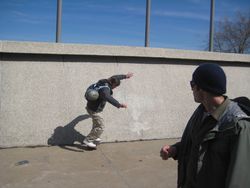
Scouting Skateboard Sites
Scouting Skateboard Sites
Actions:
Description:
Skateboarder and landscape architect Mathieu Robichaud takes participants on a guided walk, analysing the skateboarding potential of urban spaces. Robichaud, of the firm Bloom Paysage, specialises in the design of skate parks. Inspired by the exhibition Actions: What You Can Do With the City (2008), the CCA hosts a series of workshops devoted to public actions in urban(...)
Skateboarder and landscape architect Mathieu Robichaud takes participants on a guided walk, analysing the skateboarding potential of urban spaces. Robichaud, of the firm Bloom Paysage, specialises in the design of skate parks. Inspired by the exhibition Actions: What You Can Do With the City (2008), the CCA hosts a series of workshops devoted to public actions in urban(...)
Date:
11 April 2009
11 April 2009
Title:
Scouting Skateboard Sites
Actions:
Description:
Skateboarder and landscape architect Mathieu Robichaud takes participants on a guided walk, analysing the skateboarding potential of urban spaces. Robichaud, of the firm Bloom Paysage, specialises in the design of skate parks. Inspired by the exhibition Actions: What You Can Do With the City (2008), the CCA hosts a series of workshops devoted to public actions in urban(...)
Scouting Skateboard Sites
Actions:
Description:
Skateboarder and landscape architect Mathieu Robichaud takes participants on a guided walk, analysing the skateboarding potential of urban spaces. Robichaud, of the firm Bloom Paysage, specialises in the design of skate parks. Inspired by the exhibition Actions: What You Can Do With the City (2008), the CCA hosts a series of workshops devoted to public actions in urban(...)
Form:
events
events
Date:
11 April 2009
11 April 2009


