


12622 Results
Form:
archives
Level of archival description:
Fonds
archives
Level of archival description:
Fonds
Reference number:
AP175
Synopsis:
UNStudio Erasmus Bridge project records, 1990-1996, documents the design, conception and construction process for the Erasmus Bridge in Rotterdam, Netherlands. The records consist largely of textual records and technical drawings material in addition to born-digital material and two models.
AP175
Synopsis:
UNStudio Erasmus Bridge project records, 1990-1996, documents the design, conception and construction process for the Erasmus Bridge in Rotterdam, Netherlands. The records consist largely of textual records and technical drawings material in addition to born-digital material and two models.
People:
Date:
1990-1996
1990-1996
Title:
UNStudio Erasmus Bridge project records
Actions:
AP175
Synopsis:
UNStudio Erasmus Bridge project records, 1990-1996, documents the design, conception and construction process for the Erasmus Bridge in Rotterdam, Netherlands. The records consist largely of textual records and technical drawings material in addition to born-digital material and two models.
UNStudio Erasmus Bridge project records
Actions:
AP175
Synopsis:
UNStudio Erasmus Bridge project records, 1990-1996, documents the design, conception and construction process for the Erasmus Bridge in Rotterdam, Netherlands. The records consist largely of textual records and technical drawings material in addition to born-digital material and two models.
Form:
archives
Level of archival description:
Fonds
archives
Level of archival description:
Fonds
Date:
1990-1996
1990-1996
People:
Form:
archives
Level of archival description:
Fonds
archives
Level of archival description:
Fonds
Reference number:
AP154
Synopsis:
The Pasanella + Klein Stolzman + Berg collection documents selected projects of the architect Giovanni Pasanella and of firms of which he was a principal, namely, Merz & Pasanella, Pasanella + Klein, and Pasanella + Klein Stolzman + Berg.
AP154
Synopsis:
The Pasanella + Klein Stolzman + Berg collection documents selected projects of the architect Giovanni Pasanella and of firms of which he was a principal, namely, Merz & Pasanella, Pasanella + Klein, and Pasanella + Klein Stolzman + Berg.
People:
Date:
1955-2007
1955-2007
Title:
Pasanella + Klein Stolzman + Berg collection
Actions:
AP154
Synopsis:
The Pasanella + Klein Stolzman + Berg collection documents selected projects of the architect Giovanni Pasanella and of firms of which he was a principal, namely, Merz & Pasanella, Pasanella + Klein, and Pasanella + Klein Stolzman + Berg.
Pasanella + Klein Stolzman + Berg collection
Actions:
AP154
Synopsis:
The Pasanella + Klein Stolzman + Berg collection documents selected projects of the architect Giovanni Pasanella and of firms of which he was a principal, namely, Merz & Pasanella, Pasanella + Klein, and Pasanella + Klein Stolzman + Berg.
Form:
archives
Level of archival description:
Fonds
archives
Level of archival description:
Fonds
Date:
1955-2007
1955-2007
People:
Level of archival description:
Project
Project
Reference number:
AP178.S1.1979.PR02
Description:
The project series documents the 1979 design entry for the Görlitzer Bad swimming pool. While the records were held in the office’s archives this project was assigned the number 48/70; in the past the office identified the project as number 159. The office assigned the date 1979 for this project. This project was submitted to the International Architectural Exhibition Berlin competition (International Bauaustellung, IBA, circa 1979-1987), an urban renewal strategy for West Berlin, Germany. Siza would later submit proposals to the IBA for Block 70 and 89 (Fränkelufer residential complex), Block 121 (Bonjour Tristesse), Block 11-12 (Kottbusser Damm), Monument to Gestapo victims Prinz- Albrecht-Palais, and a proposal for the Kulturforum. The Görlitzer Bad swimming pool was Siza's first international project and first competition. Preceding the IBA competition, Siza attended the 1976 International Design Zentrum (IDZ) symposium in Berlin, "Stadtstruktur-Stadtgestalt". Brigitte Fleck, responsible for national and international architecture competitions for the Senate of Berlin (1971-1985), invited Siza to participate in the IBA competition to design the swimming pool for Kreuzberg. Fleck had heard of Siza’s participation in the IDZ symposium and became interested in Siza’s work with the Servicio Ambulatorio de Apio Lokal (SAAL). By this time Siza’s work with SAAL had been published in the December 1976 and March 1978 publications of the Lotus International Quarterly Architectural Review (numbers 13 and 18). Fleck felt that Siza's work with SAAL would be relevant to the IBA. In 1979, Siza entered his design for the Görlitzer Bad swimming pool to be built on a vacant area on the east side of Kreuzberg. The design for the pool was strongly opposed by the public because the dome over the main swimming pool was said to resemble a mosque. This area of Kreuzberg was largely populated by Turkish Muslims and there was hostility towards this immigrant community. Although Siza’s entry went through the first round of the IBA competition, it did not win the competition and was only awarded a special prize. The project series contains sketches and studies, as well as conceptual and design development drawings of elevations, site plans, and floor plans. Documentation for the competition includes site plans for the competition and a strata plan. The photographs, negatives, contact sheets, and slides mostly document the model and drawings for the project.
AP178.S1.1979.PR02
Description:
The project series documents the 1979 design entry for the Görlitzer Bad swimming pool. While the records were held in the office’s archives this project was assigned the number 48/70; in the past the office identified the project as number 159. The office assigned the date 1979 for this project. This project was submitted to the International Architectural Exhibition Berlin competition (International Bauaustellung, IBA, circa 1979-1987), an urban renewal strategy for West Berlin, Germany. Siza would later submit proposals to the IBA for Block 70 and 89 (Fränkelufer residential complex), Block 121 (Bonjour Tristesse), Block 11-12 (Kottbusser Damm), Monument to Gestapo victims Prinz- Albrecht-Palais, and a proposal for the Kulturforum. The Görlitzer Bad swimming pool was Siza's first international project and first competition. Preceding the IBA competition, Siza attended the 1976 International Design Zentrum (IDZ) symposium in Berlin, "Stadtstruktur-Stadtgestalt". Brigitte Fleck, responsible for national and international architecture competitions for the Senate of Berlin (1971-1985), invited Siza to participate in the IBA competition to design the swimming pool for Kreuzberg. Fleck had heard of Siza’s participation in the IDZ symposium and became interested in Siza’s work with the Servicio Ambulatorio de Apio Lokal (SAAL). By this time Siza’s work with SAAL had been published in the December 1976 and March 1978 publications of the Lotus International Quarterly Architectural Review (numbers 13 and 18). Fleck felt that Siza's work with SAAL would be relevant to the IBA. In 1979, Siza entered his design for the Görlitzer Bad swimming pool to be built on a vacant area on the east side of Kreuzberg. The design for the pool was strongly opposed by the public because the dome over the main swimming pool was said to resemble a mosque. This area of Kreuzberg was largely populated by Turkish Muslims and there was hostility towards this immigrant community. Although Siza’s entry went through the first round of the IBA competition, it did not win the competition and was only awarded a special prize. The project series contains sketches and studies, as well as conceptual and design development drawings of elevations, site plans, and floor plans. Documentation for the competition includes site plans for the competition and a strata plan. The photographs, negatives, contact sheets, and slides mostly document the model and drawings for the project.
People:
Date:
1978-1979
1978-1979
Title:
Piscina de "Görlitzer Bad" Kreuzberg, Berlim Oeste [Görlitzer Bad swimming pool], Berlin, Germany (1978-1979)
Actions:
AP178.S1.1979.PR02
Description:
The project series documents the 1979 design entry for the Görlitzer Bad swimming pool. While the records were held in the office’s archives this project was assigned the number 48/70; in the past the office identified the project as number 159. The office assigned the date 1979 for this project. This project was submitted to the International Architectural Exhibition Berlin competition (International Bauaustellung, IBA, circa 1979-1987), an urban renewal strategy for West Berlin, Germany. Siza would later submit proposals to the IBA for Block 70 and 89 (Fränkelufer residential complex), Block 121 (Bonjour Tristesse), Block 11-12 (Kottbusser Damm), Monument to Gestapo victims Prinz- Albrecht-Palais, and a proposal for the Kulturforum. The Görlitzer Bad swimming pool was Siza's first international project and first competition. Preceding the IBA competition, Siza attended the 1976 International Design Zentrum (IDZ) symposium in Berlin, "Stadtstruktur-Stadtgestalt". Brigitte Fleck, responsible for national and international architecture competitions for the Senate of Berlin (1971-1985), invited Siza to participate in the IBA competition to design the swimming pool for Kreuzberg. Fleck had heard of Siza’s participation in the IDZ symposium and became interested in Siza’s work with the Servicio Ambulatorio de Apio Lokal (SAAL). By this time Siza’s work with SAAL had been published in the December 1976 and March 1978 publications of the Lotus International Quarterly Architectural Review (numbers 13 and 18). Fleck felt that Siza's work with SAAL would be relevant to the IBA. In 1979, Siza entered his design for the Görlitzer Bad swimming pool to be built on a vacant area on the east side of Kreuzberg. The design for the pool was strongly opposed by the public because the dome over the main swimming pool was said to resemble a mosque. This area of Kreuzberg was largely populated by Turkish Muslims and there was hostility towards this immigrant community. Although Siza’s entry went through the first round of the IBA competition, it did not win the competition and was only awarded a special prize. The project series contains sketches and studies, as well as conceptual and design development drawings of elevations, site plans, and floor plans. Documentation for the competition includes site plans for the competition and a strata plan. The photographs, negatives, contact sheets, and slides mostly document the model and drawings for the project.
Piscina de "Görlitzer Bad" Kreuzberg, Berlim Oeste [Görlitzer Bad swimming pool], Berlin, Germany (1978-1979)
Actions:
AP178.S1.1979.PR02
Description:
The project series documents the 1979 design entry for the Görlitzer Bad swimming pool. While the records were held in the office’s archives this project was assigned the number 48/70; in the past the office identified the project as number 159. The office assigned the date 1979 for this project. This project was submitted to the International Architectural Exhibition Berlin competition (International Bauaustellung, IBA, circa 1979-1987), an urban renewal strategy for West Berlin, Germany. Siza would later submit proposals to the IBA for Block 70 and 89 (Fränkelufer residential complex), Block 121 (Bonjour Tristesse), Block 11-12 (Kottbusser Damm), Monument to Gestapo victims Prinz- Albrecht-Palais, and a proposal for the Kulturforum. The Görlitzer Bad swimming pool was Siza's first international project and first competition. Preceding the IBA competition, Siza attended the 1976 International Design Zentrum (IDZ) symposium in Berlin, "Stadtstruktur-Stadtgestalt". Brigitte Fleck, responsible for national and international architecture competitions for the Senate of Berlin (1971-1985), invited Siza to participate in the IBA competition to design the swimming pool for Kreuzberg. Fleck had heard of Siza’s participation in the IDZ symposium and became interested in Siza’s work with the Servicio Ambulatorio de Apio Lokal (SAAL). By this time Siza’s work with SAAL had been published in the December 1976 and March 1978 publications of the Lotus International Quarterly Architectural Review (numbers 13 and 18). Fleck felt that Siza's work with SAAL would be relevant to the IBA. In 1979, Siza entered his design for the Görlitzer Bad swimming pool to be built on a vacant area on the east side of Kreuzberg. The design for the pool was strongly opposed by the public because the dome over the main swimming pool was said to resemble a mosque. This area of Kreuzberg was largely populated by Turkish Muslims and there was hostility towards this immigrant community. Although Siza’s entry went through the first round of the IBA competition, it did not win the competition and was only awarded a special prize. The project series contains sketches and studies, as well as conceptual and design development drawings of elevations, site plans, and floor plans. Documentation for the competition includes site plans for the competition and a strata plan. The photographs, negatives, contact sheets, and slides mostly document the model and drawings for the project.
Level of archival description:
Project
Project
Date:
1978-1979
1978-1979
People:
Level of archival description:
Sub-series
Sub-series
Title:
Dead projects
Dead projects
Actions:
Reference number:
AP140.S2.SS2
Description:
Sub-series documents "dead projects", by the successive firms of Stirling and Gowan; James Stirling and Partner; James Stirling, Michael Wilford, and Associates; and Michael Wilford and Partners. These projects are those which did not lead to commissions, or the production of drawings, but were preliminary contacts or negotiations between clients and competition organizers and the architectural firms. Most of these projects were for locations in the United States, but also include locations in the United Kingdom, Germany, Australia, Italy, Spain, Portugal, Iran, France, Netherlands, Saudi Arabia, the Soviet Union, Canada, Austria and Switzerland. Material in this sub-series was produced between 1963 and probably 2002. Sub-series contains textual records, such as notes, proposals, correspondence with clients or consultants, reports, building programs, contracts or agreements. It also contains maps of sites and cadastral plans used as reference, and site plans.
AP140.S2.SS2
Description:
Sub-series documents "dead projects", by the successive firms of Stirling and Gowan; James Stirling and Partner; James Stirling, Michael Wilford, and Associates; and Michael Wilford and Partners. These projects are those which did not lead to commissions, or the production of drawings, but were preliminary contacts or negotiations between clients and competition organizers and the architectural firms. Most of these projects were for locations in the United States, but also include locations in the United Kingdom, Germany, Australia, Italy, Spain, Portugal, Iran, France, Netherlands, Saudi Arabia, the Soviet Union, Canada, Austria and Switzerland. Material in this sub-series was produced between 1963 and probably 2002. Sub-series contains textual records, such as notes, proposals, correspondence with clients or consultants, reports, building programs, contracts or agreements. It also contains maps of sites and cadastral plans used as reference, and site plans.
People:
Date:
circa 1963-2002
circa 1963-2002
Title:
Dead projects
Actions:
AP140.S2.SS2
Description:
Sub-series documents "dead projects", by the successive firms of Stirling and Gowan; James Stirling and Partner; James Stirling, Michael Wilford, and Associates; and Michael Wilford and Partners. These projects are those which did not lead to commissions, or the production of drawings, but were preliminary contacts or negotiations between clients and competition organizers and the architectural firms. Most of these projects were for locations in the United States, but also include locations in the United Kingdom, Germany, Australia, Italy, Spain, Portugal, Iran, France, Netherlands, Saudi Arabia, the Soviet Union, Canada, Austria and Switzerland. Material in this sub-series was produced between 1963 and probably 2002. Sub-series contains textual records, such as notes, proposals, correspondence with clients or consultants, reports, building programs, contracts or agreements. It also contains maps of sites and cadastral plans used as reference, and site plans.
Dead projects
Actions:
AP140.S2.SS2
Description:
Sub-series documents "dead projects", by the successive firms of Stirling and Gowan; James Stirling and Partner; James Stirling, Michael Wilford, and Associates; and Michael Wilford and Partners. These projects are those which did not lead to commissions, or the production of drawings, but were preliminary contacts or negotiations between clients and competition organizers and the architectural firms. Most of these projects were for locations in the United States, but also include locations in the United Kingdom, Germany, Australia, Italy, Spain, Portugal, Iran, France, Netherlands, Saudi Arabia, the Soviet Union, Canada, Austria and Switzerland. Material in this sub-series was produced between 1963 and probably 2002. Sub-series contains textual records, such as notes, proposals, correspondence with clients or consultants, reports, building programs, contracts or agreements. It also contains maps of sites and cadastral plans used as reference, and site plans.
Level of archival description:
Sub-Series 2
Sub-Series 2
Date:
circa 1963-2002
circa 1963-2002
People:
Level of archival description:
Project
Project
Actions:
Reference number:
AP018.S1.1980.PR11
Description:
This project series documents a feasibility study for the new National Gallery of Canada in Ottawa, Ontario from 1980-1982. The office identified the project number as 8011. In 1977, Parkin Architects Planners won a limited architectural competition for their design of the new National Gallery of Canada. The selected site for the competition, next to the Ottawa River, was controversial due to its uneven ground and lack of access to main streets in Ottawa. This project consisted of a feasibility study to use the existing Memorial Buildings in Ottawa as the site of the new National Gallery of Canada. These buildings, originally built in 1954 as federal offices, were between 4-6 storeys with 70,000 square feet of space, excluding parking levels. The project is recorded through drawings, photographs and textual records dating from 1980-1982. The majority of the drawings are reprographic copies of building sections, floor plans and area calculations. The textual records include correspondence, conference reports, interoffice letters, financial records and the feasibility report and design scheme documentation.
AP018.S1.1980.PR11
Description:
This project series documents a feasibility study for the new National Gallery of Canada in Ottawa, Ontario from 1980-1982. The office identified the project number as 8011. In 1977, Parkin Architects Planners won a limited architectural competition for their design of the new National Gallery of Canada. The selected site for the competition, next to the Ottawa River, was controversial due to its uneven ground and lack of access to main streets in Ottawa. This project consisted of a feasibility study to use the existing Memorial Buildings in Ottawa as the site of the new National Gallery of Canada. These buildings, originally built in 1954 as federal offices, were between 4-6 storeys with 70,000 square feet of space, excluding parking levels. The project is recorded through drawings, photographs and textual records dating from 1980-1982. The majority of the drawings are reprographic copies of building sections, floor plans and area calculations. The textual records include correspondence, conference reports, interoffice letters, financial records and the feasibility report and design scheme documentation.
People:
Date:
1980-1982
1980-1982
Title:
National Gallery of Canada, East - West Memorial Buildings Feasibility Study, Ottawa, Ontario (1980-1982)
Actions:
AP018.S1.1980.PR11
Description:
This project series documents a feasibility study for the new National Gallery of Canada in Ottawa, Ontario from 1980-1982. The office identified the project number as 8011. In 1977, Parkin Architects Planners won a limited architectural competition for their design of the new National Gallery of Canada. The selected site for the competition, next to the Ottawa River, was controversial due to its uneven ground and lack of access to main streets in Ottawa. This project consisted of a feasibility study to use the existing Memorial Buildings in Ottawa as the site of the new National Gallery of Canada. These buildings, originally built in 1954 as federal offices, were between 4-6 storeys with 70,000 square feet of space, excluding parking levels. The project is recorded through drawings, photographs and textual records dating from 1980-1982. The majority of the drawings are reprographic copies of building sections, floor plans and area calculations. The textual records include correspondence, conference reports, interoffice letters, financial records and the feasibility report and design scheme documentation.
National Gallery of Canada, East - West Memorial Buildings Feasibility Study, Ottawa, Ontario (1980-1982)
Actions:
AP018.S1.1980.PR11
Description:
This project series documents a feasibility study for the new National Gallery of Canada in Ottawa, Ontario from 1980-1982. The office identified the project number as 8011. In 1977, Parkin Architects Planners won a limited architectural competition for their design of the new National Gallery of Canada. The selected site for the competition, next to the Ottawa River, was controversial due to its uneven ground and lack of access to main streets in Ottawa. This project consisted of a feasibility study to use the existing Memorial Buildings in Ottawa as the site of the new National Gallery of Canada. These buildings, originally built in 1954 as federal offices, were between 4-6 storeys with 70,000 square feet of space, excluding parking levels. The project is recorded through drawings, photographs and textual records dating from 1980-1982. The majority of the drawings are reprographic copies of building sections, floor plans and area calculations. The textual records include correspondence, conference reports, interoffice letters, financial records and the feasibility report and design scheme documentation.
Level of archival description:
Project
Project
Date:
1980-1982
1980-1982
People:
Level of archival description:
Project
Project
Reference number:
AP178.S1.1988.PR01
Description:
This project series documents the Centro Cultural de la Defensa in Madrid, Spain. While the records were held in the office’s archives this project was assigned the number 50/80. The office assigned the date 1988 to this project. An architectural competition was held for the construction of a cultural center and museum for the Ministry of Defense. Seven architects were invited for the first phase of the competition. Four architects, including Fancisco Javier Sainz de Oiza, Lluis Clotet Ballus, Juan Navarro Baldeweg, and Álvaro Siza were selected for the second and final phase. The L-shaped building proposed by Siza included a museum, library, archives, research center, auditoriums, restaurants and bookstores. Siza won the competition but the building was not realized. Documenting this project are sketches, presentation drawings and photographs of model. Textual materials include project documentation, correspondence and articles on the competition.
AP178.S1.1988.PR01
Description:
This project series documents the Centro Cultural de la Defensa in Madrid, Spain. While the records were held in the office’s archives this project was assigned the number 50/80. The office assigned the date 1988 to this project. An architectural competition was held for the construction of a cultural center and museum for the Ministry of Defense. Seven architects were invited for the first phase of the competition. Four architects, including Fancisco Javier Sainz de Oiza, Lluis Clotet Ballus, Juan Navarro Baldeweg, and Álvaro Siza were selected for the second and final phase. The L-shaped building proposed by Siza included a museum, library, archives, research center, auditoriums, restaurants and bookstores. Siza won the competition but the building was not realized. Documenting this project are sketches, presentation drawings and photographs of model. Textual materials include project documentation, correspondence and articles on the competition.
People:
Date:
1988-1990
1988-1990
Title:
Centro Cultural de la Defensa - 1º Fase - 2º Fase [La Defensa Cultural Centre, first and second phases], Madrid, Spain (1988)
Actions:
AP178.S1.1988.PR01
Description:
This project series documents the Centro Cultural de la Defensa in Madrid, Spain. While the records were held in the office’s archives this project was assigned the number 50/80. The office assigned the date 1988 to this project. An architectural competition was held for the construction of a cultural center and museum for the Ministry of Defense. Seven architects were invited for the first phase of the competition. Four architects, including Fancisco Javier Sainz de Oiza, Lluis Clotet Ballus, Juan Navarro Baldeweg, and Álvaro Siza were selected for the second and final phase. The L-shaped building proposed by Siza included a museum, library, archives, research center, auditoriums, restaurants and bookstores. Siza won the competition but the building was not realized. Documenting this project are sketches, presentation drawings and photographs of model. Textual materials include project documentation, correspondence and articles on the competition.
Centro Cultural de la Defensa - 1º Fase - 2º Fase [La Defensa Cultural Centre, first and second phases], Madrid, Spain (1988)
Actions:
AP178.S1.1988.PR01
Description:
This project series documents the Centro Cultural de la Defensa in Madrid, Spain. While the records were held in the office’s archives this project was assigned the number 50/80. The office assigned the date 1988 to this project. An architectural competition was held for the construction of a cultural center and museum for the Ministry of Defense. Seven architects were invited for the first phase of the competition. Four architects, including Fancisco Javier Sainz de Oiza, Lluis Clotet Ballus, Juan Navarro Baldeweg, and Álvaro Siza were selected for the second and final phase. The L-shaped building proposed by Siza included a museum, library, archives, research center, auditoriums, restaurants and bookstores. Siza won the competition but the building was not realized. Documenting this project are sketches, presentation drawings and photographs of model. Textual materials include project documentation, correspondence and articles on the competition.
Level of archival description:
Project
Project
Date:
1988-1990
1988-1990
People:
Level of archival description:
Project
Project
Reference number:
AP056.S1.2000.PR08
Description:
This project series documents buildings for Concordia University's downtown campus in Montréal from 2000-2009. The office identified the project number as 0004. This project eventually became known as Le Quartier Concordia. This project was the winning submission of an architectural competition by Kuwabara Payne McKenna Blumberg Architects, in joint-venture with Fichten Soiferman et Associés Architectes, to design an integrated, vertical campus to revitalize and reinvent the University. This project consisted of three interconnected high-rise buildings on either side of Montreal's Guy Street, below De Maisonneuve Boulevard, to rehouse three important faculties: Visual Arts, Engineering and Computer Science, and the John Molson School of Business. These three buildings had glazed curtain wall exteriors with copper-coloured metal lines that created visual consistency inside and outside of all three buildings. Large art installations were also included on the façades. Triple-height atriums on the ground floors of the Engineering Building and the John Molson building added welcoming, public areas to the campus, and connected pedestrians to the Guy-Concordia metro station below. The tops of these two buildings featured massive north-south canopies that pointed from Montreal's Mont Royal down to the St. Lawrence River. The shorter Visual Arts building was directly connected to the Engineering building and today they are known together as the EV Building. The building interiors, comprised largely of stone tiles and concrete, featured large, multi-storey spiral staircases in a nod to the famous exterior spiral stairs of Montreal homes.[1] The Engineering and Visual Arts buildings were completed in 2005 and the John Molson building in 2009. Recladding of the exterior of another campus building to match these was completed in 2011.[2] It should be noted that these project materials were donated to the CCA part way through the project's realization. The project is recorded through drawings and textual records dating from 2000-2003. The drawings are mostly originals but reprographic copies and printouts of CAD drawings are also included. The drawings consist of sketches, digital renderings, plans, elevations, sections, perspectives, details and construction drawings. The textual records are arranged within the drawings and consist of research. [1]Contributions from Phyllis Lambert et al., The Architecture of Kuwabara, Payne, McKenna, Blumberg (Boston, MA: Birkhäuser-Publishers for Architecture, 2004), 180. [2]"Le Quartier Concordia." KPMB. Accessed July 11, 2019. http://www.kpmb.com/project/concordia-university-john-molson-school-of-business/
AP056.S1.2000.PR08
Description:
This project series documents buildings for Concordia University's downtown campus in Montréal from 2000-2009. The office identified the project number as 0004. This project eventually became known as Le Quartier Concordia. This project was the winning submission of an architectural competition by Kuwabara Payne McKenna Blumberg Architects, in joint-venture with Fichten Soiferman et Associés Architectes, to design an integrated, vertical campus to revitalize and reinvent the University. This project consisted of three interconnected high-rise buildings on either side of Montreal's Guy Street, below De Maisonneuve Boulevard, to rehouse three important faculties: Visual Arts, Engineering and Computer Science, and the John Molson School of Business. These three buildings had glazed curtain wall exteriors with copper-coloured metal lines that created visual consistency inside and outside of all three buildings. Large art installations were also included on the façades. Triple-height atriums on the ground floors of the Engineering Building and the John Molson building added welcoming, public areas to the campus, and connected pedestrians to the Guy-Concordia metro station below. The tops of these two buildings featured massive north-south canopies that pointed from Montreal's Mont Royal down to the St. Lawrence River. The shorter Visual Arts building was directly connected to the Engineering building and today they are known together as the EV Building. The building interiors, comprised largely of stone tiles and concrete, featured large, multi-storey spiral staircases in a nod to the famous exterior spiral stairs of Montreal homes.[1] The Engineering and Visual Arts buildings were completed in 2005 and the John Molson building in 2009. Recladding of the exterior of another campus building to match these was completed in 2011.[2] It should be noted that these project materials were donated to the CCA part way through the project's realization. The project is recorded through drawings and textual records dating from 2000-2003. The drawings are mostly originals but reprographic copies and printouts of CAD drawings are also included. The drawings consist of sketches, digital renderings, plans, elevations, sections, perspectives, details and construction drawings. The textual records are arranged within the drawings and consist of research. [1]Contributions from Phyllis Lambert et al., The Architecture of Kuwabara, Payne, McKenna, Blumberg (Boston, MA: Birkhäuser-Publishers for Architecture, 2004), 180. [2]"Le Quartier Concordia." KPMB. Accessed July 11, 2019. http://www.kpmb.com/project/concordia-university-john-molson-school-of-business/
People:
Date:
2000-2003
2000-2003
Title:
Concordia University, Montréal (2000-2009)
Actions:
AP056.S1.2000.PR08
Description:
This project series documents buildings for Concordia University's downtown campus in Montréal from 2000-2009. The office identified the project number as 0004. This project eventually became known as Le Quartier Concordia. This project was the winning submission of an architectural competition by Kuwabara Payne McKenna Blumberg Architects, in joint-venture with Fichten Soiferman et Associés Architectes, to design an integrated, vertical campus to revitalize and reinvent the University. This project consisted of three interconnected high-rise buildings on either side of Montreal's Guy Street, below De Maisonneuve Boulevard, to rehouse three important faculties: Visual Arts, Engineering and Computer Science, and the John Molson School of Business. These three buildings had glazed curtain wall exteriors with copper-coloured metal lines that created visual consistency inside and outside of all three buildings. Large art installations were also included on the façades. Triple-height atriums on the ground floors of the Engineering Building and the John Molson building added welcoming, public areas to the campus, and connected pedestrians to the Guy-Concordia metro station below. The tops of these two buildings featured massive north-south canopies that pointed from Montreal's Mont Royal down to the St. Lawrence River. The shorter Visual Arts building was directly connected to the Engineering building and today they are known together as the EV Building. The building interiors, comprised largely of stone tiles and concrete, featured large, multi-storey spiral staircases in a nod to the famous exterior spiral stairs of Montreal homes.[1] The Engineering and Visual Arts buildings were completed in 2005 and the John Molson building in 2009. Recladding of the exterior of another campus building to match these was completed in 2011.[2] It should be noted that these project materials were donated to the CCA part way through the project's realization. The project is recorded through drawings and textual records dating from 2000-2003. The drawings are mostly originals but reprographic copies and printouts of CAD drawings are also included. The drawings consist of sketches, digital renderings, plans, elevations, sections, perspectives, details and construction drawings. The textual records are arranged within the drawings and consist of research. [1]Contributions from Phyllis Lambert et al., The Architecture of Kuwabara, Payne, McKenna, Blumberg (Boston, MA: Birkhäuser-Publishers for Architecture, 2004), 180. [2]"Le Quartier Concordia." KPMB. Accessed July 11, 2019. http://www.kpmb.com/project/concordia-university-john-molson-school-of-business/
Concordia University, Montréal (2000-2009)
Actions:
AP056.S1.2000.PR08
Description:
This project series documents buildings for Concordia University's downtown campus in Montréal from 2000-2009. The office identified the project number as 0004. This project eventually became known as Le Quartier Concordia. This project was the winning submission of an architectural competition by Kuwabara Payne McKenna Blumberg Architects, in joint-venture with Fichten Soiferman et Associés Architectes, to design an integrated, vertical campus to revitalize and reinvent the University. This project consisted of three interconnected high-rise buildings on either side of Montreal's Guy Street, below De Maisonneuve Boulevard, to rehouse three important faculties: Visual Arts, Engineering and Computer Science, and the John Molson School of Business. These three buildings had glazed curtain wall exteriors with copper-coloured metal lines that created visual consistency inside and outside of all three buildings. Large art installations were also included on the façades. Triple-height atriums on the ground floors of the Engineering Building and the John Molson building added welcoming, public areas to the campus, and connected pedestrians to the Guy-Concordia metro station below. The tops of these two buildings featured massive north-south canopies that pointed from Montreal's Mont Royal down to the St. Lawrence River. The shorter Visual Arts building was directly connected to the Engineering building and today they are known together as the EV Building. The building interiors, comprised largely of stone tiles and concrete, featured large, multi-storey spiral staircases in a nod to the famous exterior spiral stairs of Montreal homes.[1] The Engineering and Visual Arts buildings were completed in 2005 and the John Molson building in 2009. Recladding of the exterior of another campus building to match these was completed in 2011.[2] It should be noted that these project materials were donated to the CCA part way through the project's realization. The project is recorded through drawings and textual records dating from 2000-2003. The drawings are mostly originals but reprographic copies and printouts of CAD drawings are also included. The drawings consist of sketches, digital renderings, plans, elevations, sections, perspectives, details and construction drawings. The textual records are arranged within the drawings and consist of research. [1]Contributions from Phyllis Lambert et al., The Architecture of Kuwabara, Payne, McKenna, Blumberg (Boston, MA: Birkhäuser-Publishers for Architecture, 2004), 180. [2]"Le Quartier Concordia." KPMB. Accessed July 11, 2019. http://www.kpmb.com/project/concordia-university-john-molson-school-of-business/
Level of archival description:
Project
Project
Date:
2000-2003
2000-2003
People:
Form:
drawings
drawings
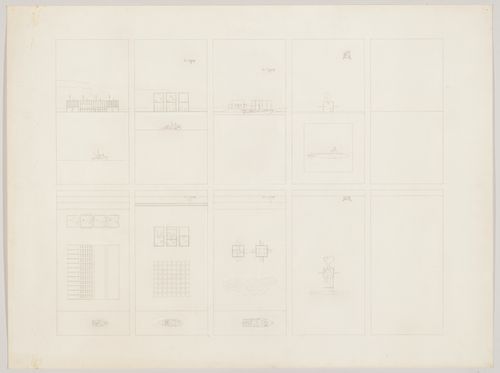
Reference number:
DR1998:0092:002:006
Description:
Robert Butscher was the draughtsman of this presentation drawing. The drawing, along with the drawing DR1998:0092:002:006 in this file, were done as part of a Third Year Architecture analysis project at Cooper Union School of Architecture. As part of the project, he read a great many of the novels written by the authors represented by the five sets of structures. The drawings were based on measurements taken from the presentation model. They were completed in 1980 and gifted to John Hejduk by Butscher to use in his Masque of Medusa book.
DR1998:0092:002:006
Description:
Robert Butscher was the draughtsman of this presentation drawing. The drawing, along with the drawing DR1998:0092:002:006 in this file, were done as part of a Third Year Architecture analysis project at Cooper Union School of Architecture. As part of the project, he read a great many of the novels written by the authors represented by the five sets of structures. The drawings were based on measurements taken from the presentation model. They were completed in 1980 and gifted to John Hejduk by Butscher to use in his Masque of Medusa book.
People:
Date:
1974-1979
1974-1979
Title:
Plans and elevations for The Silent Witnesses
Actions:
DR1998:0092:002:006
Description:
Robert Butscher was the draughtsman of this presentation drawing. The drawing, along with the drawing DR1998:0092:002:006 in this file, were done as part of a Third Year Architecture analysis project at Cooper Union School of Architecture. As part of the project, he read a great many of the novels written by the authors represented by the five sets of structures. The drawings were based on measurements taken from the presentation model. They were completed in 1980 and gifted to John Hejduk by Butscher to use in his Masque of Medusa book.
Plans and elevations for The Silent Witnesses
Actions:
DR1998:0092:002:006
Description:
Robert Butscher was the draughtsman of this presentation drawing. The drawing, along with the drawing DR1998:0092:002:006 in this file, were done as part of a Third Year Architecture analysis project at Cooper Union School of Architecture. As part of the project, he read a great many of the novels written by the authors represented by the five sets of structures. The drawings were based on measurements taken from the presentation model. They were completed in 1980 and gifted to John Hejduk by Butscher to use in his Masque of Medusa book.
Form:
drawings
drawings
Date:
1974-1979
1974-1979
People:
Level of archival description:
Project
Project
Reference number:
AP075.S1.1993.PR01
Description:
Project series documents Cornelia Hahn Oberlnader's landscape project for the C. K. Choi Building of the Institute of Asian Research at the University of British Columbia, Vancouver. Oberlander worked on this project from 1993-1995 with architectural firm Matsuzaki Wright Architects. The project consisted in creating a environmentally responsible building as well as for the landscape design. In this idea, Oberlander's landscape design only included native plans that need little maintenance, to avoid the usage of pesticides, and allow the use of organic fertilizers. She also selected trees valued as excellent absorbers of air polluants for the planting on the street edge. [1] The project was completed in 1995. The project series includes sketches design development drawings, including landscape plans, landscape details and sections, presentation drawings, working drawings, such as site plans, grading plans, and planting details, and building construction drawings used as reference.The project is also documented through concept notes by Oberlander, correspondence with architects, clients and consultants, documents related to plant selection, specifications, financial documents, and some press clippings and promotional material about the project. The project series also includes photographs of the landscaping work. Sources: [1] Herrington, Susan. Cornelia Hahn Oberlander: Making the Modern Landscape, University of Virginia Press, 2014, 304 pages, p. 184.
AP075.S1.1993.PR01
Description:
Project series documents Cornelia Hahn Oberlnader's landscape project for the C. K. Choi Building of the Institute of Asian Research at the University of British Columbia, Vancouver. Oberlander worked on this project from 1993-1995 with architectural firm Matsuzaki Wright Architects. The project consisted in creating a environmentally responsible building as well as for the landscape design. In this idea, Oberlander's landscape design only included native plans that need little maintenance, to avoid the usage of pesticides, and allow the use of organic fertilizers. She also selected trees valued as excellent absorbers of air polluants for the planting on the street edge. [1] The project was completed in 1995. The project series includes sketches design development drawings, including landscape plans, landscape details and sections, presentation drawings, working drawings, such as site plans, grading plans, and planting details, and building construction drawings used as reference.The project is also documented through concept notes by Oberlander, correspondence with architects, clients and consultants, documents related to plant selection, specifications, financial documents, and some press clippings and promotional material about the project. The project series also includes photographs of the landscaping work. Sources: [1] Herrington, Susan. Cornelia Hahn Oberlander: Making the Modern Landscape, University of Virginia Press, 2014, 304 pages, p. 184.
People:
Date:
1991-2001
1991-2001
Title:
C. K. Choi Institute of Asian Research, University of British Columbia, Vancouver, British Columbia (1993-1996)
Actions:
AP075.S1.1993.PR01
Description:
Project series documents Cornelia Hahn Oberlnader's landscape project for the C. K. Choi Building of the Institute of Asian Research at the University of British Columbia, Vancouver. Oberlander worked on this project from 1993-1995 with architectural firm Matsuzaki Wright Architects. The project consisted in creating a environmentally responsible building as well as for the landscape design. In this idea, Oberlander's landscape design only included native plans that need little maintenance, to avoid the usage of pesticides, and allow the use of organic fertilizers. She also selected trees valued as excellent absorbers of air polluants for the planting on the street edge. [1] The project was completed in 1995. The project series includes sketches design development drawings, including landscape plans, landscape details and sections, presentation drawings, working drawings, such as site plans, grading plans, and planting details, and building construction drawings used as reference.The project is also documented through concept notes by Oberlander, correspondence with architects, clients and consultants, documents related to plant selection, specifications, financial documents, and some press clippings and promotional material about the project. The project series also includes photographs of the landscaping work. Sources: [1] Herrington, Susan. Cornelia Hahn Oberlander: Making the Modern Landscape, University of Virginia Press, 2014, 304 pages, p. 184.
C. K. Choi Institute of Asian Research, University of British Columbia, Vancouver, British Columbia (1993-1996)
Actions:
AP075.S1.1993.PR01
Description:
Project series documents Cornelia Hahn Oberlnader's landscape project for the C. K. Choi Building of the Institute of Asian Research at the University of British Columbia, Vancouver. Oberlander worked on this project from 1993-1995 with architectural firm Matsuzaki Wright Architects. The project consisted in creating a environmentally responsible building as well as for the landscape design. In this idea, Oberlander's landscape design only included native plans that need little maintenance, to avoid the usage of pesticides, and allow the use of organic fertilizers. She also selected trees valued as excellent absorbers of air polluants for the planting on the street edge. [1] The project was completed in 1995. The project series includes sketches design development drawings, including landscape plans, landscape details and sections, presentation drawings, working drawings, such as site plans, grading plans, and planting details, and building construction drawings used as reference.The project is also documented through concept notes by Oberlander, correspondence with architects, clients and consultants, documents related to plant selection, specifications, financial documents, and some press clippings and promotional material about the project. The project series also includes photographs of the landscaping work. Sources: [1] Herrington, Susan. Cornelia Hahn Oberlander: Making the Modern Landscape, University of Virginia Press, 2014, 304 pages, p. 184.
Level of archival description:
Project
Project
Date:
1991-2001
1991-2001
People:
Level of archival description:
Series
Series
Title:
Academic works
Academic works
Actions:
Reference number:
AP169.S3
Description:
Series 3, Academic works, 1995 - 2011, relates to Bernard Cache’s work as a scholar and author. This series includes born-digital material and chiefly dates from 1999 to 2007. Cache pursued and academic career, teaching and lecturing at many universities while also publishing books and articles. His area of interest revolves around computational architecture, geometrics, history of geometric, stereotomy, engineering and philosophy. These records depict his investment in the study of the relation between ancient theory and the field of computational architecture drawings with CAD or BIM software. His work concentrates on prominent figures such as Greek mathematician Euclid to Roman architect Vitruvius and German painter and theorist Albrecht Dürer. Materials in this series reflect Bernard Cache’s work as a scholar. This includes notes for his articles and lectures as well as drafts for different lectures and texts. It also contains syllabi and planning materials for classes given by Cache on Non-Standard Design and Production in Architecture. The series holds a significant amount of images used for presentation or as examples during those lectures and classes (in JPEG and BMP formats). Those images are for the most part derived from CAD original drawings in TopSolid.
AP169.S3
Description:
Series 3, Academic works, 1995 - 2011, relates to Bernard Cache’s work as a scholar and author. This series includes born-digital material and chiefly dates from 1999 to 2007. Cache pursued and academic career, teaching and lecturing at many universities while also publishing books and articles. His area of interest revolves around computational architecture, geometrics, history of geometric, stereotomy, engineering and philosophy. These records depict his investment in the study of the relation between ancient theory and the field of computational architecture drawings with CAD or BIM software. His work concentrates on prominent figures such as Greek mathematician Euclid to Roman architect Vitruvius and German painter and theorist Albrecht Dürer. Materials in this series reflect Bernard Cache’s work as a scholar. This includes notes for his articles and lectures as well as drafts for different lectures and texts. It also contains syllabi and planning materials for classes given by Cache on Non-Standard Design and Production in Architecture. The series holds a significant amount of images used for presentation or as examples during those lectures and classes (in JPEG and BMP formats). Those images are for the most part derived from CAD original drawings in TopSolid.
People:
Date:
1995-2011
1995-2011
Title:
Academic works
Actions:
AP169.S3
Description:
Series 3, Academic works, 1995 - 2011, relates to Bernard Cache’s work as a scholar and author. This series includes born-digital material and chiefly dates from 1999 to 2007. Cache pursued and academic career, teaching and lecturing at many universities while also publishing books and articles. His area of interest revolves around computational architecture, geometrics, history of geometric, stereotomy, engineering and philosophy. These records depict his investment in the study of the relation between ancient theory and the field of computational architecture drawings with CAD or BIM software. His work concentrates on prominent figures such as Greek mathematician Euclid to Roman architect Vitruvius and German painter and theorist Albrecht Dürer. Materials in this series reflect Bernard Cache’s work as a scholar. This includes notes for his articles and lectures as well as drafts for different lectures and texts. It also contains syllabi and planning materials for classes given by Cache on Non-Standard Design and Production in Architecture. The series holds a significant amount of images used for presentation or as examples during those lectures and classes (in JPEG and BMP formats). Those images are for the most part derived from CAD original drawings in TopSolid.
Academic works
Actions:
AP169.S3
Description:
Series 3, Academic works, 1995 - 2011, relates to Bernard Cache’s work as a scholar and author. This series includes born-digital material and chiefly dates from 1999 to 2007. Cache pursued and academic career, teaching and lecturing at many universities while also publishing books and articles. His area of interest revolves around computational architecture, geometrics, history of geometric, stereotomy, engineering and philosophy. These records depict his investment in the study of the relation between ancient theory and the field of computational architecture drawings with CAD or BIM software. His work concentrates on prominent figures such as Greek mathematician Euclid to Roman architect Vitruvius and German painter and theorist Albrecht Dürer. Materials in this series reflect Bernard Cache’s work as a scholar. This includes notes for his articles and lectures as well as drafts for different lectures and texts. It also contains syllabi and planning materials for classes given by Cache on Non-Standard Design and Production in Architecture. The series holds a significant amount of images used for presentation or as examples during those lectures and classes (in JPEG and BMP formats). Those images are for the most part derived from CAD original drawings in TopSolid.
Level of archival description:
Series
Series
Date:
1995-2011
1995-2011
People:


