


35831 Results
Form:
exhibitions
exhibitions

Form:
exhibitions
exhibitions
Date:
January 2018 to
September 2018
January 2018 to
September 2018
Form:
exhibitions
exhibitions
Actions:
Description:
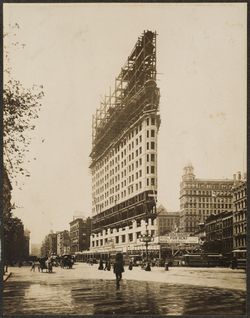
Architects of the Image: Photography in the Heroic Age of Construction explores the relationships between camera images and the making of large-scale architectural and engineering structures that stirred public imagination in the first hundred years of photography. The exhibition is predicated on the notion of the photographer as architect, an analogy that suggests(...)
Architects of the Image: Photography in the Heroic Age of Construction explores the relationships between camera images and the making of large-scale architectural and engineering structures that stirred public imagination in the first hundred years of photography. The exhibition is predicated on the notion of the photographer as architect, an analogy that suggests(...)
Date:
11 October 1995 to 4 February 1996
11 October 1995 to 4 February 1996
Title:
Architects of the Image: Photography in the Heroic Age of Construction
Actions:
Description:
Architects of the Image: Photography in the Heroic Age of Construction explores the relationships between camera images and the making of large-scale architectural and engineering structures that stirred public imagination in the first hundred years of photography. The exhibition is predicated on the notion of the photographer as architect, an analogy that suggests(...)
Architects of the Image: Photography in the Heroic Age of Construction
Actions:
Description:
Architects of the Image: Photography in the Heroic Age of Construction explores the relationships between camera images and the making of large-scale architectural and engineering structures that stirred public imagination in the first hundred years of photography. The exhibition is predicated on the notion of the photographer as architect, an analogy that suggests(...)
Form:
exhibitions
exhibitions
Date:
11 October 1995 to
4 February 1996
11 October 1995 to
4 February 1996
Form:
drawings
drawings

Actions:
Reference number:
DR1974:0002:013:001-008
Description:
- This album contains large rendered drawings executed by Hubert Rohault de Fleury between 1800 and 1802 for architectural competitions held at the École Spéciale de Peinture, Sculpture et Architecture. These include renderings submitted by him for the 1800 Grand Prix programme for an "École Nationale des Beaux-Arts" (DR1974:0002:013:002 and DR1974:0002:013:008), for which he won a "deuxième Grand Prix", and for the 1801 Grand Prix Programme for "Un forum ou place public dédié à la Paix" (DR1974:0002:013:001 and DR1974:0002:013:007). David Le Roy, professor of architectural theory at the École, has signed and dated all four drawings on the verso, which indicates that the sheets were blank before being completed "en loge" (Levine, 99 and Perouse de Montclos, 11). Drawings DR1974:0002:013:004, DR1974:0002:013:005 (front and rear elevations for the same building), and DR1974:0002:013:006 are probably renderings for either a Grand Prix competition or a "projet rendu". The subject matter depicted in drawings DR1974:0002:013:004 - DR1974:0002:013:006 remains unclear. Bergdoll suggests that the drawings may be for Grand Prix programmes, including a "Ministère des Relations Extérieures" and a warehouse (Bergdoll, "HUBERT ... ", 1985), however, the former is depicted in DR1974:0002:013:007 and is therefore part of the larger 1801 Grand Prix programme for "Un forum ou place dédié à la Paix" (1801). A warehouse complex was never chosen as a Grand Prix programme during 1800-1802, Hubert's student years at the École (Macmillan). A recent Master's thesis suggests that Hubert Rohault de Fleury may have begun his studies at the École des Beaux-Arts in 1798 rather than 1800 (Amouroux, 3), in which case the unidentified drawings could be for the Grand Prix competitions held in 1798 and 1799 for a "Bourse pour une ville maritime" and an "Élysée ou cimetière public". The drawing for a fountain in honour of General Desaix, place Thionville (DR1974:0002:013:003) is possibly an entry for a "Prix d'émulation", in which monuments were a favorite category (Jacques, 61).
DR1974:0002:013:001-008
Description:
- This album contains large rendered drawings executed by Hubert Rohault de Fleury between 1800 and 1802 for architectural competitions held at the École Spéciale de Peinture, Sculpture et Architecture. These include renderings submitted by him for the 1800 Grand Prix programme for an "École Nationale des Beaux-Arts" (DR1974:0002:013:002 and DR1974:0002:013:008), for which he won a "deuxième Grand Prix", and for the 1801 Grand Prix Programme for "Un forum ou place public dédié à la Paix" (DR1974:0002:013:001 and DR1974:0002:013:007). David Le Roy, professor of architectural theory at the École, has signed and dated all four drawings on the verso, which indicates that the sheets were blank before being completed "en loge" (Levine, 99 and Perouse de Montclos, 11). Drawings DR1974:0002:013:004, DR1974:0002:013:005 (front and rear elevations for the same building), and DR1974:0002:013:006 are probably renderings for either a Grand Prix competition or a "projet rendu". The subject matter depicted in drawings DR1974:0002:013:004 - DR1974:0002:013:006 remains unclear. Bergdoll suggests that the drawings may be for Grand Prix programmes, including a "Ministère des Relations Extérieures" and a warehouse (Bergdoll, "HUBERT ... ", 1985), however, the former is depicted in DR1974:0002:013:007 and is therefore part of the larger 1801 Grand Prix programme for "Un forum ou place dédié à la Paix" (1801). A warehouse complex was never chosen as a Grand Prix programme during 1800-1802, Hubert's student years at the École (Macmillan). A recent Master's thesis suggests that Hubert Rohault de Fleury may have begun his studies at the École des Beaux-Arts in 1798 rather than 1800 (Amouroux, 3), in which case the unidentified drawings could be for the Grand Prix competitions held in 1798 and 1799 for a "Bourse pour une ville maritime" and an "Élysée ou cimetière public". The drawing for a fountain in honour of General Desaix, place Thionville (DR1974:0002:013:003) is possibly an entry for a "Prix d'émulation", in which monuments were a favorite category (Jacques, 61).
People:
Subject:
architecture
architecture
Date:
1800-1802
1800-1802
Title:
Album of student drawings for architectural competitions held at the École spéciale de peinture, sculpture et architecture, Paris
Actions:
DR1974:0002:013:001-008
Description:
- This album contains large rendered drawings executed by Hubert Rohault de Fleury between 1800 and 1802 for architectural competitions held at the École Spéciale de Peinture, Sculpture et Architecture. These include renderings submitted by him for the 1800 Grand Prix programme for an "École Nationale des Beaux-Arts" (DR1974:0002:013:002 and DR1974:0002:013:008), for which he won a "deuxième Grand Prix", and for the 1801 Grand Prix Programme for "Un forum ou place public dédié à la Paix" (DR1974:0002:013:001 and DR1974:0002:013:007). David Le Roy, professor of architectural theory at the École, has signed and dated all four drawings on the verso, which indicates that the sheets were blank before being completed "en loge" (Levine, 99 and Perouse de Montclos, 11). Drawings DR1974:0002:013:004, DR1974:0002:013:005 (front and rear elevations for the same building), and DR1974:0002:013:006 are probably renderings for either a Grand Prix competition or a "projet rendu". The subject matter depicted in drawings DR1974:0002:013:004 - DR1974:0002:013:006 remains unclear. Bergdoll suggests that the drawings may be for Grand Prix programmes, including a "Ministère des Relations Extérieures" and a warehouse (Bergdoll, "HUBERT ... ", 1985), however, the former is depicted in DR1974:0002:013:007 and is therefore part of the larger 1801 Grand Prix programme for "Un forum ou place dédié à la Paix" (1801). A warehouse complex was never chosen as a Grand Prix programme during 1800-1802, Hubert's student years at the École (Macmillan). A recent Master's thesis suggests that Hubert Rohault de Fleury may have begun his studies at the École des Beaux-Arts in 1798 rather than 1800 (Amouroux, 3), in which case the unidentified drawings could be for the Grand Prix competitions held in 1798 and 1799 for a "Bourse pour une ville maritime" and an "Élysée ou cimetière public". The drawing for a fountain in honour of General Desaix, place Thionville (DR1974:0002:013:003) is possibly an entry for a "Prix d'émulation", in which monuments were a favorite category (Jacques, 61).
Album of student drawings for architectural competitions held at the École spéciale de peinture, sculpture et architecture, Paris
Actions:
DR1974:0002:013:001-008
Description:
- This album contains large rendered drawings executed by Hubert Rohault de Fleury between 1800 and 1802 for architectural competitions held at the École Spéciale de Peinture, Sculpture et Architecture. These include renderings submitted by him for the 1800 Grand Prix programme for an "École Nationale des Beaux-Arts" (DR1974:0002:013:002 and DR1974:0002:013:008), for which he won a "deuxième Grand Prix", and for the 1801 Grand Prix Programme for "Un forum ou place public dédié à la Paix" (DR1974:0002:013:001 and DR1974:0002:013:007). David Le Roy, professor of architectural theory at the École, has signed and dated all four drawings on the verso, which indicates that the sheets were blank before being completed "en loge" (Levine, 99 and Perouse de Montclos, 11). Drawings DR1974:0002:013:004, DR1974:0002:013:005 (front and rear elevations for the same building), and DR1974:0002:013:006 are probably renderings for either a Grand Prix competition or a "projet rendu". The subject matter depicted in drawings DR1974:0002:013:004 - DR1974:0002:013:006 remains unclear. Bergdoll suggests that the drawings may be for Grand Prix programmes, including a "Ministère des Relations Extérieures" and a warehouse (Bergdoll, "HUBERT ... ", 1985), however, the former is depicted in DR1974:0002:013:007 and is therefore part of the larger 1801 Grand Prix programme for "Un forum ou place dédié à la Paix" (1801). A warehouse complex was never chosen as a Grand Prix programme during 1800-1802, Hubert's student years at the École (Macmillan). A recent Master's thesis suggests that Hubert Rohault de Fleury may have begun his studies at the École des Beaux-Arts in 1798 rather than 1800 (Amouroux, 3), in which case the unidentified drawings could be for the Grand Prix competitions held in 1798 and 1799 for a "Bourse pour une ville maritime" and an "Élysée ou cimetière public". The drawing for a fountain in honour of General Desaix, place Thionville (DR1974:0002:013:003) is possibly an entry for a "Prix d'émulation", in which monuments were a favorite category (Jacques, 61).
Form:
drawings
drawings
Date:
1800-1802
1800-1802
People:
Subject:
architecture
architecture
Form:
photographs
photographs

Actions:
Reference number:
PH1997:0053
Description:
- The series "Running Fence 1997" focuses "on the first 14 miles of the border fence that separates the United States and Mexico, beginning at the Pacific Ocean and ending in the Otay Mountains.... [It] analyzes the "idea" of the border and explores its iconography, the border being a subject that is of extreme importance to the public as the world proceeds towards greater globalization. [Geoffrey] James has written of the project: "[The border fence] was built by the US Army Corps of Engineers in 1994, out of recycled metal landing strip - the most visible symbol of what is known as Operation Gatekeeper. Because the steel sheets are placed in the ground so that their ridges run horizontally, a man can hop over the fence with ease; and no Mexican child ever seems to be impeded from retrieving a soccer ball from US territory. The real barrier to illegal immigration from Mexico into the USA is less visible: hundreds of buried sensors linked to a central computer, nightscopes, helicopters and Border Patrol Agents in white Broncos."" (Evans).
PH1997:0053
Description:
- The series "Running Fence 1997" focuses "on the first 14 miles of the border fence that separates the United States and Mexico, beginning at the Pacific Ocean and ending in the Otay Mountains.... [It] analyzes the "idea" of the border and explores its iconography, the border being a subject that is of extreme importance to the public as the world proceeds towards greater globalization. [Geoffrey] James has written of the project: "[The border fence] was built by the US Army Corps of Engineers in 1994, out of recycled metal landing strip - the most visible symbol of what is known as Operation Gatekeeper. Because the steel sheets are placed in the ground so that their ridges run horizontally, a man can hop over the fence with ease; and no Mexican child ever seems to be impeded from retrieving a soccer ball from US territory. The real barrier to illegal immigration from Mexico into the USA is less visible: hundreds of buried sensors linked to a central computer, nightscopes, helicopters and Border Patrol Agents in white Broncos."" (Evans).
People:
Subject:
architecture, engineering
architecture, engineering
Date:
1997
1997
Title:
View of 24-hour border crossing supplies tent showing partial view of United States-Mexico border fence, San Diego County, California, United States, and Avenida Internacional, Tijuana, Baja California, Mexico
Actions:
PH1997:0053
Description:
- The series "Running Fence 1997" focuses "on the first 14 miles of the border fence that separates the United States and Mexico, beginning at the Pacific Ocean and ending in the Otay Mountains.... [It] analyzes the "idea" of the border and explores its iconography, the border being a subject that is of extreme importance to the public as the world proceeds towards greater globalization. [Geoffrey] James has written of the project: "[The border fence] was built by the US Army Corps of Engineers in 1994, out of recycled metal landing strip - the most visible symbol of what is known as Operation Gatekeeper. Because the steel sheets are placed in the ground so that their ridges run horizontally, a man can hop over the fence with ease; and no Mexican child ever seems to be impeded from retrieving a soccer ball from US territory. The real barrier to illegal immigration from Mexico into the USA is less visible: hundreds of buried sensors linked to a central computer, nightscopes, helicopters and Border Patrol Agents in white Broncos."" (Evans).
View of 24-hour border crossing supplies tent showing partial view of United States-Mexico border fence, San Diego County, California, United States, and Avenida Internacional, Tijuana, Baja California, Mexico
Actions:
PH1997:0053
Description:
- The series "Running Fence 1997" focuses "on the first 14 miles of the border fence that separates the United States and Mexico, beginning at the Pacific Ocean and ending in the Otay Mountains.... [It] analyzes the "idea" of the border and explores its iconography, the border being a subject that is of extreme importance to the public as the world proceeds towards greater globalization. [Geoffrey] James has written of the project: "[The border fence] was built by the US Army Corps of Engineers in 1994, out of recycled metal landing strip - the most visible symbol of what is known as Operation Gatekeeper. Because the steel sheets are placed in the ground so that their ridges run horizontally, a man can hop over the fence with ease; and no Mexican child ever seems to be impeded from retrieving a soccer ball from US territory. The real barrier to illegal immigration from Mexico into the USA is less visible: hundreds of buried sensors linked to a central computer, nightscopes, helicopters and Border Patrol Agents in white Broncos."" (Evans).
Form:
photographs
photographs
Date:
1997
1997
People:
Subject:
architecture, engineering
architecture, engineering
Form:
photographs
photographs

Actions:
Reference number:
PH1997:0054
Description:
The series "Running Fence 1997" focuses "on the first 14 miles of the border fence that separates the United States and Mexico, beginning at the Pacific Ocean and ending in the Otay Mountains.... [It] analyzes the "idea" of the border and explores its iconography, the border being a subject that is of extreme importance to the public as the world proceeds towards greater globalization. [Geoffrey] James has written of the project: "[The border fence] was built by the US Army Corps of Engineers in 1994, out of recycled metal landing strip - the most visible symbol of what is known as Operation Gatekeeper. Because the steel sheets are placed in the ground so that their ridges run horizontally, a man can hop over the fence with ease; and no Mexican child ever seems to be impeded from retrieving a soccer ball from US territory. The real barrier to illegal immigration from Mexico into the USA is less visible: hundreds of buried sensors linked to a central computer, nightscopes, helicopters and Border Patrol Agents in white Broncos."" (Evans).
PH1997:0054
Description:
The series "Running Fence 1997" focuses "on the first 14 miles of the border fence that separates the United States and Mexico, beginning at the Pacific Ocean and ending in the Otay Mountains.... [It] analyzes the "idea" of the border and explores its iconography, the border being a subject that is of extreme importance to the public as the world proceeds towards greater globalization. [Geoffrey] James has written of the project: "[The border fence] was built by the US Army Corps of Engineers in 1994, out of recycled metal landing strip - the most visible symbol of what is known as Operation Gatekeeper. Because the steel sheets are placed in the ground so that their ridges run horizontally, a man can hop over the fence with ease; and no Mexican child ever seems to be impeded from retrieving a soccer ball from US territory. The real barrier to illegal immigration from Mexico into the USA is less visible: hundreds of buried sensors linked to a central computer, nightscopes, helicopters and Border Patrol Agents in white Broncos."" (Evans).
People:
Subject:
architecture, engineering
architecture, engineering
Date:
1997
1997
Title:
View of dirt road and dwelling showing a partial view of United States-Mexico border fence, San Diego County, California, United States and Colonia Libertad, Tijuana, Baja California, Mexico
Actions:
PH1997:0054
Description:
The series "Running Fence 1997" focuses "on the first 14 miles of the border fence that separates the United States and Mexico, beginning at the Pacific Ocean and ending in the Otay Mountains.... [It] analyzes the "idea" of the border and explores its iconography, the border being a subject that is of extreme importance to the public as the world proceeds towards greater globalization. [Geoffrey] James has written of the project: "[The border fence] was built by the US Army Corps of Engineers in 1994, out of recycled metal landing strip - the most visible symbol of what is known as Operation Gatekeeper. Because the steel sheets are placed in the ground so that their ridges run horizontally, a man can hop over the fence with ease; and no Mexican child ever seems to be impeded from retrieving a soccer ball from US territory. The real barrier to illegal immigration from Mexico into the USA is less visible: hundreds of buried sensors linked to a central computer, nightscopes, helicopters and Border Patrol Agents in white Broncos."" (Evans).
View of dirt road and dwelling showing a partial view of United States-Mexico border fence, San Diego County, California, United States and Colonia Libertad, Tijuana, Baja California, Mexico
Actions:
PH1997:0054
Description:
The series "Running Fence 1997" focuses "on the first 14 miles of the border fence that separates the United States and Mexico, beginning at the Pacific Ocean and ending in the Otay Mountains.... [It] analyzes the "idea" of the border and explores its iconography, the border being a subject that is of extreme importance to the public as the world proceeds towards greater globalization. [Geoffrey] James has written of the project: "[The border fence] was built by the US Army Corps of Engineers in 1994, out of recycled metal landing strip - the most visible symbol of what is known as Operation Gatekeeper. Because the steel sheets are placed in the ground so that their ridges run horizontally, a man can hop over the fence with ease; and no Mexican child ever seems to be impeded from retrieving a soccer ball from US territory. The real barrier to illegal immigration from Mexico into the USA is less visible: hundreds of buried sensors linked to a central computer, nightscopes, helicopters and Border Patrol Agents in white Broncos."" (Evans).
Form:
photographs
photographs
Date:
1997
1997
People:
Subject:
architecture, engineering
architecture, engineering
Form:
photographs
photographs

Actions:
Reference number:
PH1997:0055
Description:
- The series "Running Fence 1997" focuses "on the first 14 miles of the border fence that separates the United States and Mexico, beginning at the Pacific Ocean and ending in the Otay Mountains.... [It] analyzes the "idea" of the border and explores its iconography, the border being a subject that is of extreme importance to the public as the world proceeds towards greater globalization. [Geoffrey] James has written of the project: "[The border fence] was built by the US Army Corps of Engineers in 1994, out of recycled metal landing strip - the most visible symbol of what is known as Operation Gatekeeper. Because the steel sheets are placed in the ground so that their ridges run horizontally, a man can hop over the fence with ease; and no Mexican child ever seems to be impeded from retrieving a soccer ball from US territory. The real barrier to illegal immigration from Mexico into the USA is less visible: hundreds of buried sensors linked to a central computer, nightscopes, helicopters and Border Patrol Agents in white Broncos."" (Evans).
PH1997:0055
Description:
- The series "Running Fence 1997" focuses "on the first 14 miles of the border fence that separates the United States and Mexico, beginning at the Pacific Ocean and ending in the Otay Mountains.... [It] analyzes the "idea" of the border and explores its iconography, the border being a subject that is of extreme importance to the public as the world proceeds towards greater globalization. [Geoffrey] James has written of the project: "[The border fence] was built by the US Army Corps of Engineers in 1994, out of recycled metal landing strip - the most visible symbol of what is known as Operation Gatekeeper. Because the steel sheets are placed in the ground so that their ridges run horizontally, a man can hop over the fence with ease; and no Mexican child ever seems to be impeded from retrieving a soccer ball from US territory. The real barrier to illegal immigration from Mexico into the USA is less visible: hundreds of buried sensors linked to a central computer, nightscopes, helicopters and Border Patrol Agents in white Broncos."" (Evans).
People:
Subject:
architecture, engineering, topographic
architecture, engineering, topographic
Date:
1997
1997
Title:
Partial view of the United States-Mexico border fence with plants in the foreground, San Diego County, California, United States, and Colonia Libertad, Tijuana, Baja California, Mexico
Actions:
PH1997:0055
Description:
- The series "Running Fence 1997" focuses "on the first 14 miles of the border fence that separates the United States and Mexico, beginning at the Pacific Ocean and ending in the Otay Mountains.... [It] analyzes the "idea" of the border and explores its iconography, the border being a subject that is of extreme importance to the public as the world proceeds towards greater globalization. [Geoffrey] James has written of the project: "[The border fence] was built by the US Army Corps of Engineers in 1994, out of recycled metal landing strip - the most visible symbol of what is known as Operation Gatekeeper. Because the steel sheets are placed in the ground so that their ridges run horizontally, a man can hop over the fence with ease; and no Mexican child ever seems to be impeded from retrieving a soccer ball from US territory. The real barrier to illegal immigration from Mexico into the USA is less visible: hundreds of buried sensors linked to a central computer, nightscopes, helicopters and Border Patrol Agents in white Broncos."" (Evans).
Partial view of the United States-Mexico border fence with plants in the foreground, San Diego County, California, United States, and Colonia Libertad, Tijuana, Baja California, Mexico
Actions:
PH1997:0055
Description:
- The series "Running Fence 1997" focuses "on the first 14 miles of the border fence that separates the United States and Mexico, beginning at the Pacific Ocean and ending in the Otay Mountains.... [It] analyzes the "idea" of the border and explores its iconography, the border being a subject that is of extreme importance to the public as the world proceeds towards greater globalization. [Geoffrey] James has written of the project: "[The border fence] was built by the US Army Corps of Engineers in 1994, out of recycled metal landing strip - the most visible symbol of what is known as Operation Gatekeeper. Because the steel sheets are placed in the ground so that their ridges run horizontally, a man can hop over the fence with ease; and no Mexican child ever seems to be impeded from retrieving a soccer ball from US territory. The real barrier to illegal immigration from Mexico into the USA is less visible: hundreds of buried sensors linked to a central computer, nightscopes, helicopters and Border Patrol Agents in white Broncos."" (Evans).
Form:
photographs
photographs
Date:
1997
1997
People:
Subject:
architecture, engineering, topographic
architecture, engineering, topographic
Form:
photographs
photographs

Actions:
Reference number:
PH1997:0056
Description:
- The series "Running Fence 1997" focuses "on the first 14 miles of the border fence that separates the United States and Mexico, beginning at the Pacific Ocean and ending in the Otay Mountains.... [It] analyzes the "idea" of the border and explores its iconography, the border being a subject that is of extreme importance to the public as the world proceeds towards greater globalization. [Geoffrey] James has written of the project: "[The border fence] was built by the US Army Corps of Engineers in 1994, out of recycled metal landing strip - the most visible symbol of what is known as Operation Gatekeeper. Because the steel sheets are placed in the ground so that their ridges run horizontally, a man can hop over the fence with ease; and no Mexican child ever seems to be impeded from retrieving a soccer ball from US territory. The real barrier to illegal immigration from Mexico into the USA is less visible: hundreds of buried sensors linked to a central computer, nightscopes, helicopters and Border Patrol Agents in white Broncos."" (Evans).
PH1997:0056
Description:
- The series "Running Fence 1997" focuses "on the first 14 miles of the border fence that separates the United States and Mexico, beginning at the Pacific Ocean and ending in the Otay Mountains.... [It] analyzes the "idea" of the border and explores its iconography, the border being a subject that is of extreme importance to the public as the world proceeds towards greater globalization. [Geoffrey] James has written of the project: "[The border fence] was built by the US Army Corps of Engineers in 1994, out of recycled metal landing strip - the most visible symbol of what is known as Operation Gatekeeper. Because the steel sheets are placed in the ground so that their ridges run horizontally, a man can hop over the fence with ease; and no Mexican child ever seems to be impeded from retrieving a soccer ball from US territory. The real barrier to illegal immigration from Mexico into the USA is less visible: hundreds of buried sensors linked to a central computer, nightscopes, helicopters and Border Patrol Agents in white Broncos."" (Evans).
People:
Subject:
architecture, engineering
architecture, engineering
Date:
1997
1997
Title:
View of a restaurant with the Mexico-United States border fence on the left, Colonia Libertad, Tijuana, Mexico
Actions:
PH1997:0056
Description:
- The series "Running Fence 1997" focuses "on the first 14 miles of the border fence that separates the United States and Mexico, beginning at the Pacific Ocean and ending in the Otay Mountains.... [It] analyzes the "idea" of the border and explores its iconography, the border being a subject that is of extreme importance to the public as the world proceeds towards greater globalization. [Geoffrey] James has written of the project: "[The border fence] was built by the US Army Corps of Engineers in 1994, out of recycled metal landing strip - the most visible symbol of what is known as Operation Gatekeeper. Because the steel sheets are placed in the ground so that their ridges run horizontally, a man can hop over the fence with ease; and no Mexican child ever seems to be impeded from retrieving a soccer ball from US territory. The real barrier to illegal immigration from Mexico into the USA is less visible: hundreds of buried sensors linked to a central computer, nightscopes, helicopters and Border Patrol Agents in white Broncos."" (Evans).
View of a restaurant with the Mexico-United States border fence on the left, Colonia Libertad, Tijuana, Mexico
Actions:
PH1997:0056
Description:
- The series "Running Fence 1997" focuses "on the first 14 miles of the border fence that separates the United States and Mexico, beginning at the Pacific Ocean and ending in the Otay Mountains.... [It] analyzes the "idea" of the border and explores its iconography, the border being a subject that is of extreme importance to the public as the world proceeds towards greater globalization. [Geoffrey] James has written of the project: "[The border fence] was built by the US Army Corps of Engineers in 1994, out of recycled metal landing strip - the most visible symbol of what is known as Operation Gatekeeper. Because the steel sheets are placed in the ground so that their ridges run horizontally, a man can hop over the fence with ease; and no Mexican child ever seems to be impeded from retrieving a soccer ball from US territory. The real barrier to illegal immigration from Mexico into the USA is less visible: hundreds of buried sensors linked to a central computer, nightscopes, helicopters and Border Patrol Agents in white Broncos."" (Evans).
Form:
photographs
photographs
Date:
1997
1997
People:
Subject:
architecture, engineering
architecture, engineering
Form:
photographs
photographs
Actions:
Reference number:
PH1997:0057
Description:
- The series "Running Fence 1997" focuses "on the first 14 miles of the border fence that separates the United States and Mexico, beginning at the Pacific Ocean and ending in the Otay Mountains.... [It] analyzes the "idea" of the border and explores its iconography, the border being a subject that is of extreme importance to the public as the world proceeds towards greater globalization. [Geoffrey] James has written of the project: "[The border fence] was built by the US Army Corps of Engineers in 1994, out of recycled metal landing strip - the most visible symbol of what is known as Operation Gatekeeper. Because the steel sheets are placed in the ground so that their ridges run horizontally, a man can hop over the fence with ease; and no Mexican child ever seems to be impeded from retrieving a soccer ball from US territory. The real barrier to illegal immigration from Mexico into the USA is less visible: hundreds of buried sensors linked to a central computer, nightscopes, helicopters and Border Patrol Agents in white Broncos."" (Evans).
PH1997:0057
Description:
- The series "Running Fence 1997" focuses "on the first 14 miles of the border fence that separates the United States and Mexico, beginning at the Pacific Ocean and ending in the Otay Mountains.... [It] analyzes the "idea" of the border and explores its iconography, the border being a subject that is of extreme importance to the public as the world proceeds towards greater globalization. [Geoffrey] James has written of the project: "[The border fence] was built by the US Army Corps of Engineers in 1994, out of recycled metal landing strip - the most visible symbol of what is known as Operation Gatekeeper. Because the steel sheets are placed in the ground so that their ridges run horizontally, a man can hop over the fence with ease; and no Mexican child ever seems to be impeded from retrieving a soccer ball from US territory. The real barrier to illegal immigration from Mexico into the USA is less visible: hundreds of buried sensors linked to a central computer, nightscopes, helicopters and Border Patrol Agents in white Broncos."" (Evans).
People:
Subject:
architecture, engineering
architecture, engineering
Date:
1997
1997
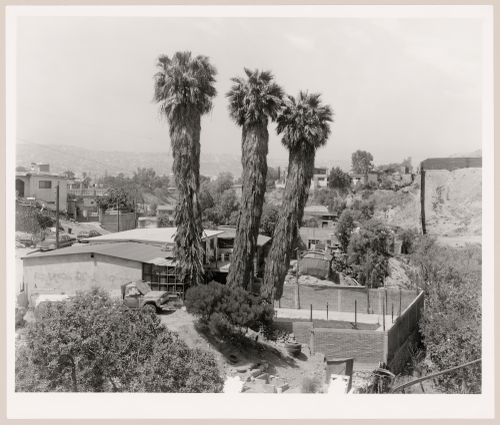
Title:
View of Colonia Libertad with trees and houses in the foreground and showing a partial view of the United States-Mexico border fence in the centre right, San Diego County, California, United States, and Colonia Libertad, Tijuana, Baja California, Mexico
Actions:
PH1997:0057
Description:
- The series "Running Fence 1997" focuses "on the first 14 miles of the border fence that separates the United States and Mexico, beginning at the Pacific Ocean and ending in the Otay Mountains.... [It] analyzes the "idea" of the border and explores its iconography, the border being a subject that is of extreme importance to the public as the world proceeds towards greater globalization. [Geoffrey] James has written of the project: "[The border fence] was built by the US Army Corps of Engineers in 1994, out of recycled metal landing strip - the most visible symbol of what is known as Operation Gatekeeper. Because the steel sheets are placed in the ground so that their ridges run horizontally, a man can hop over the fence with ease; and no Mexican child ever seems to be impeded from retrieving a soccer ball from US territory. The real barrier to illegal immigration from Mexico into the USA is less visible: hundreds of buried sensors linked to a central computer, nightscopes, helicopters and Border Patrol Agents in white Broncos."" (Evans).
View of Colonia Libertad with trees and houses in the foreground and showing a partial view of the United States-Mexico border fence in the centre right, San Diego County, California, United States, and Colonia Libertad, Tijuana, Baja California, Mexico
Actions:
PH1997:0057
Description:
- The series "Running Fence 1997" focuses "on the first 14 miles of the border fence that separates the United States and Mexico, beginning at the Pacific Ocean and ending in the Otay Mountains.... [It] analyzes the "idea" of the border and explores its iconography, the border being a subject that is of extreme importance to the public as the world proceeds towards greater globalization. [Geoffrey] James has written of the project: "[The border fence] was built by the US Army Corps of Engineers in 1994, out of recycled metal landing strip - the most visible symbol of what is known as Operation Gatekeeper. Because the steel sheets are placed in the ground so that their ridges run horizontally, a man can hop over the fence with ease; and no Mexican child ever seems to be impeded from retrieving a soccer ball from US territory. The real barrier to illegal immigration from Mexico into the USA is less visible: hundreds of buried sensors linked to a central computer, nightscopes, helicopters and Border Patrol Agents in white Broncos."" (Evans).
Form:
photographs
photographs
Date:
1997
1997
People:
Subject:
architecture, engineering
architecture, engineering
Form:
photographs
photographs
Actions:
Reference number:
PH1997:0058
Description:
- The series "Running Fence 1997" focuses "on the first 14 miles of the border fence that separates the United States and Mexico, beginning at the Pacific Ocean and ending in the Otay Mountains.... [It] analyzes the "idea" of the border and explores its iconography, the border being a subject that is of extreme importance to the public as the world proceeds towards greater globalization. [Geoffrey] James has written of the project: "[The border fence] was built by the US Army Corps of Engineers in 1994, out of recycled metal landing strip - the most visible symbol of what is known as Operation Gatekeeper. Because the steel sheets are placed in the ground so that their ridges run horizontally, a man can hop over the fence with ease; and no Mexican child ever seems to be impeded from retrieving a soccer ball from US territory. The real barrier to illegal immigration from Mexico into the USA is less visible: hundreds of buried sensors linked to a central computer, nightscopes, helicopters and Border Patrol Agents in white Broncos."" (Evans).
PH1997:0058
Description:
- The series "Running Fence 1997" focuses "on the first 14 miles of the border fence that separates the United States and Mexico, beginning at the Pacific Ocean and ending in the Otay Mountains.... [It] analyzes the "idea" of the border and explores its iconography, the border being a subject that is of extreme importance to the public as the world proceeds towards greater globalization. [Geoffrey] James has written of the project: "[The border fence] was built by the US Army Corps of Engineers in 1994, out of recycled metal landing strip - the most visible symbol of what is known as Operation Gatekeeper. Because the steel sheets are placed in the ground so that their ridges run horizontally, a man can hop over the fence with ease; and no Mexican child ever seems to be impeded from retrieving a soccer ball from US territory. The real barrier to illegal immigration from Mexico into the USA is less visible: hundreds of buried sensors linked to a central computer, nightscopes, helicopters and Border Patrol Agents in white Broncos."" (Evans).
People:
Subject:
architecture, engineering
architecture, engineering
Date:
1997
1997
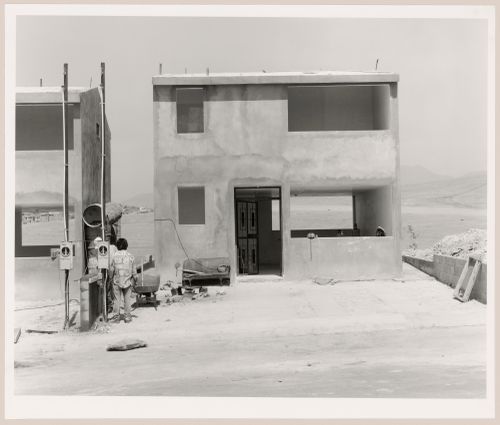
Title:
View of houses under construction, Mesa de Otay, Tijuana, Baja California, Mexico
Actions:
PH1997:0058
Description:
- The series "Running Fence 1997" focuses "on the first 14 miles of the border fence that separates the United States and Mexico, beginning at the Pacific Ocean and ending in the Otay Mountains.... [It] analyzes the "idea" of the border and explores its iconography, the border being a subject that is of extreme importance to the public as the world proceeds towards greater globalization. [Geoffrey] James has written of the project: "[The border fence] was built by the US Army Corps of Engineers in 1994, out of recycled metal landing strip - the most visible symbol of what is known as Operation Gatekeeper. Because the steel sheets are placed in the ground so that their ridges run horizontally, a man can hop over the fence with ease; and no Mexican child ever seems to be impeded from retrieving a soccer ball from US territory. The real barrier to illegal immigration from Mexico into the USA is less visible: hundreds of buried sensors linked to a central computer, nightscopes, helicopters and Border Patrol Agents in white Broncos."" (Evans).
View of houses under construction, Mesa de Otay, Tijuana, Baja California, Mexico
Actions:
PH1997:0058
Description:
- The series "Running Fence 1997" focuses "on the first 14 miles of the border fence that separates the United States and Mexico, beginning at the Pacific Ocean and ending in the Otay Mountains.... [It] analyzes the "idea" of the border and explores its iconography, the border being a subject that is of extreme importance to the public as the world proceeds towards greater globalization. [Geoffrey] James has written of the project: "[The border fence] was built by the US Army Corps of Engineers in 1994, out of recycled metal landing strip - the most visible symbol of what is known as Operation Gatekeeper. Because the steel sheets are placed in the ground so that their ridges run horizontally, a man can hop over the fence with ease; and no Mexican child ever seems to be impeded from retrieving a soccer ball from US territory. The real barrier to illegal immigration from Mexico into the USA is less visible: hundreds of buried sensors linked to a central computer, nightscopes, helicopters and Border Patrol Agents in white Broncos."" (Evans).
Form:
photographs
photographs
Date:
1997
1997
People:
Subject:
architecture, engineering
architecture, engineering
Form:
photographs
photographs
Actions:
Reference number:
PH1997:0059
Description:
- The series "Running Fence 1997" focuses "on the first 14 miles of the border fence that separates the United States and Mexico, beginning at the Pacific Ocean and ending in the Otay Mountains.... [It] analyzes the "idea" of the border and explores its iconography, the border being a subject that is of extreme importance to the public as the world proceeds towards greater globalization. [Geoffrey] James has written of the project: "[The border fence] was built by the US Army Corps of Engineers in 1994, out of recycled metal landing strip - the most visible symbol of what is known as Operation Gatekeeper. Because the steel sheets are placed in the ground so that their ridges run horizontally, a man can hop over the fence with ease; and no Mexican child ever seems to be impeded from retrieving a soccer ball from US territory. The real barrier to illegal immigration from Mexico into the USA is less visible: hundreds of buried sensors linked to a central computer, nightscopes, helicopters and Border Patrol Agents in white Broncos."" (Evans).
PH1997:0059
Description:
- The series "Running Fence 1997" focuses "on the first 14 miles of the border fence that separates the United States and Mexico, beginning at the Pacific Ocean and ending in the Otay Mountains.... [It] analyzes the "idea" of the border and explores its iconography, the border being a subject that is of extreme importance to the public as the world proceeds towards greater globalization. [Geoffrey] James has written of the project: "[The border fence] was built by the US Army Corps of Engineers in 1994, out of recycled metal landing strip - the most visible symbol of what is known as Operation Gatekeeper. Because the steel sheets are placed in the ground so that their ridges run horizontally, a man can hop over the fence with ease; and no Mexican child ever seems to be impeded from retrieving a soccer ball from US territory. The real barrier to illegal immigration from Mexico into the USA is less visible: hundreds of buried sensors linked to a central computer, nightscopes, helicopters and Border Patrol Agents in white Broncos."" (Evans).
People:
Subject:
architecture, engineering, topographic
architecture, engineering, topographic
Date:
1997
1997
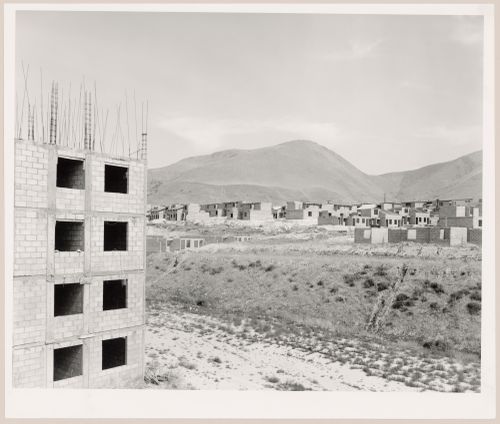
Title:
View of an industrial park under construction with a partially completed building in the foreground and partially completed houses and mountains in the background, Mesa de Otay, Tijuana, Baja California, Mexico
Actions:
PH1997:0059
Description:
- The series "Running Fence 1997" focuses "on the first 14 miles of the border fence that separates the United States and Mexico, beginning at the Pacific Ocean and ending in the Otay Mountains.... [It] analyzes the "idea" of the border and explores its iconography, the border being a subject that is of extreme importance to the public as the world proceeds towards greater globalization. [Geoffrey] James has written of the project: "[The border fence] was built by the US Army Corps of Engineers in 1994, out of recycled metal landing strip - the most visible symbol of what is known as Operation Gatekeeper. Because the steel sheets are placed in the ground so that their ridges run horizontally, a man can hop over the fence with ease; and no Mexican child ever seems to be impeded from retrieving a soccer ball from US territory. The real barrier to illegal immigration from Mexico into the USA is less visible: hundreds of buried sensors linked to a central computer, nightscopes, helicopters and Border Patrol Agents in white Broncos."" (Evans).
View of an industrial park under construction with a partially completed building in the foreground and partially completed houses and mountains in the background, Mesa de Otay, Tijuana, Baja California, Mexico
Actions:
PH1997:0059
Description:
- The series "Running Fence 1997" focuses "on the first 14 miles of the border fence that separates the United States and Mexico, beginning at the Pacific Ocean and ending in the Otay Mountains.... [It] analyzes the "idea" of the border and explores its iconography, the border being a subject that is of extreme importance to the public as the world proceeds towards greater globalization. [Geoffrey] James has written of the project: "[The border fence] was built by the US Army Corps of Engineers in 1994, out of recycled metal landing strip - the most visible symbol of what is known as Operation Gatekeeper. Because the steel sheets are placed in the ground so that their ridges run horizontally, a man can hop over the fence with ease; and no Mexican child ever seems to be impeded from retrieving a soccer ball from US territory. The real barrier to illegal immigration from Mexico into the USA is less visible: hundreds of buried sensors linked to a central computer, nightscopes, helicopters and Border Patrol Agents in white Broncos."" (Evans).
Form:
photographs
photographs
Date:
1997
1997
People:
Subject:
architecture, engineering, topographic
architecture, engineering, topographic


