


1165 Results
Form:
books
books
Actions:
Price:
$37.95
(available to order)
Summary:
The idea of fashion under socialism conjures up images of babushka headscarves and black market blue jeans. And yet, as Djurdja Bartlett shows in this groundbreaking book, the socialist East had an intimate relationship with fashion. Official antagonism—which cast fashion as frivolous and antirevolutionary—eventually gave way to grudging acceptance and creeping(...)
$37.95
(available to order)
Summary:
The idea of fashion under socialism conjures up images of babushka headscarves and black market blue jeans. And yet, as Djurdja Bartlett shows in this groundbreaking book, the socialist East had an intimate relationship with fashion. Official antagonism—which cast fashion as frivolous and antirevolutionary—eventually gave way to grudging acceptance and creeping(...)
Title:
Fashion East : the spectre that haunted socialism
Actions:
Price:
$37.95
(available to order)
Summary:
The idea of fashion under socialism conjures up images of babushka headscarves and black market blue jeans. And yet, as Djurdja Bartlett shows in this groundbreaking book, the socialist East had an intimate relationship with fashion. Official antagonism—which cast fashion as frivolous and antirevolutionary—eventually gave way to grudging acceptance and creeping consumerism. Bartlett outlines three phases in socialist fashion, and illustrates them with abundant images from magazines of the period: postrevolutionary utopian dress, official state-sanctioned socialist fashion, and samizdat-style everyday fashion. Utopian dress, ranging from the geometric abstraction of the constructivists under Bolshevism in the Soviet Union to the no-frills desexualized uniform of a factory worker in Czechoslovakia, reflected the revolutionary urge for a clean break with the past. The highly centralized socialist fashion system, part of Stalinist industrialization, offered official prototypes of high fashion that were never available in stores—mythical images of smart and luxurious dresses that symbolized the economic progress that socialist regimes dreamed of. Everyday fashion, starting in the 1950s, was an unofficial, do-it-yourself enterprise: Western fashions obtained through semiclandestine channels or sewn at home. The state tolerated the demand for Western fashion, promising the burgeoning middle class consumer goods in exchange for political loyalty. Bartlett traces the progress of socialist fashion in the Soviet Union, Czechoslovakia, Hungary, East Germany, Poland, and Yugoslavia, drawing on state-sponsored socialist women’s magazines, etiquette books, socialist manuals on dress, private archives, and her own interviews with designers, fashion editors, and other key figures. Fashion, she suggests, with all its ephemerality and dynamism, was in perpetual conflict with the socialist regimes’ fear of change and need for control. It was, to echo the famous first sentence from the Communist Manifesto, the spectre that haunted socialism until the end.
Fashion East : the spectre that haunted socialism
Actions:
Price:
$37.95
(available to order)
Summary:
The idea of fashion under socialism conjures up images of babushka headscarves and black market blue jeans. And yet, as Djurdja Bartlett shows in this groundbreaking book, the socialist East had an intimate relationship with fashion. Official antagonism—which cast fashion as frivolous and antirevolutionary—eventually gave way to grudging acceptance and creeping consumerism. Bartlett outlines three phases in socialist fashion, and illustrates them with abundant images from magazines of the period: postrevolutionary utopian dress, official state-sanctioned socialist fashion, and samizdat-style everyday fashion. Utopian dress, ranging from the geometric abstraction of the constructivists under Bolshevism in the Soviet Union to the no-frills desexualized uniform of a factory worker in Czechoslovakia, reflected the revolutionary urge for a clean break with the past. The highly centralized socialist fashion system, part of Stalinist industrialization, offered official prototypes of high fashion that were never available in stores—mythical images of smart and luxurious dresses that symbolized the economic progress that socialist regimes dreamed of. Everyday fashion, starting in the 1950s, was an unofficial, do-it-yourself enterprise: Western fashions obtained through semiclandestine channels or sewn at home. The state tolerated the demand for Western fashion, promising the burgeoning middle class consumer goods in exchange for political loyalty. Bartlett traces the progress of socialist fashion in the Soviet Union, Czechoslovakia, Hungary, East Germany, Poland, and Yugoslavia, drawing on state-sponsored socialist women’s magazines, etiquette books, socialist manuals on dress, private archives, and her own interviews with designers, fashion editors, and other key figures. Fashion, she suggests, with all its ephemerality and dynamism, was in perpetual conflict with the socialist regimes’ fear of change and need for control. It was, to echo the famous first sentence from the Communist Manifesto, the spectre that haunted socialism until the end.
Form:
books
books
Publication:
October 2010
October 2010
Subject:
Fashion Design
Fashion Design
Form:
books
books
Title:
The coming insurrection
The coming insurrection
Actions:
Price:
$19.95
(available to order)
Summary:
The Coming Insurrection is an eloquent call to arms arising from the recent waves of social contestation in France and Europe. Written by the anonymous Invisible Committee in the vein of Guy Debord — and with comparable elegance — it has been proclaimed a manual for terrorism by the French government (who recently arrested its alleged authors). One of its members more(...)
$19.95
(available to order)
Summary:
The Coming Insurrection is an eloquent call to arms arising from the recent waves of social contestation in France and Europe. Written by the anonymous Invisible Committee in the vein of Guy Debord — and with comparable elegance — it has been proclaimed a manual for terrorism by the French government (who recently arrested its alleged authors). One of its members more(...)
Title:
The coming insurrection
Actions:
Price:
$19.95
(available to order)
Summary:
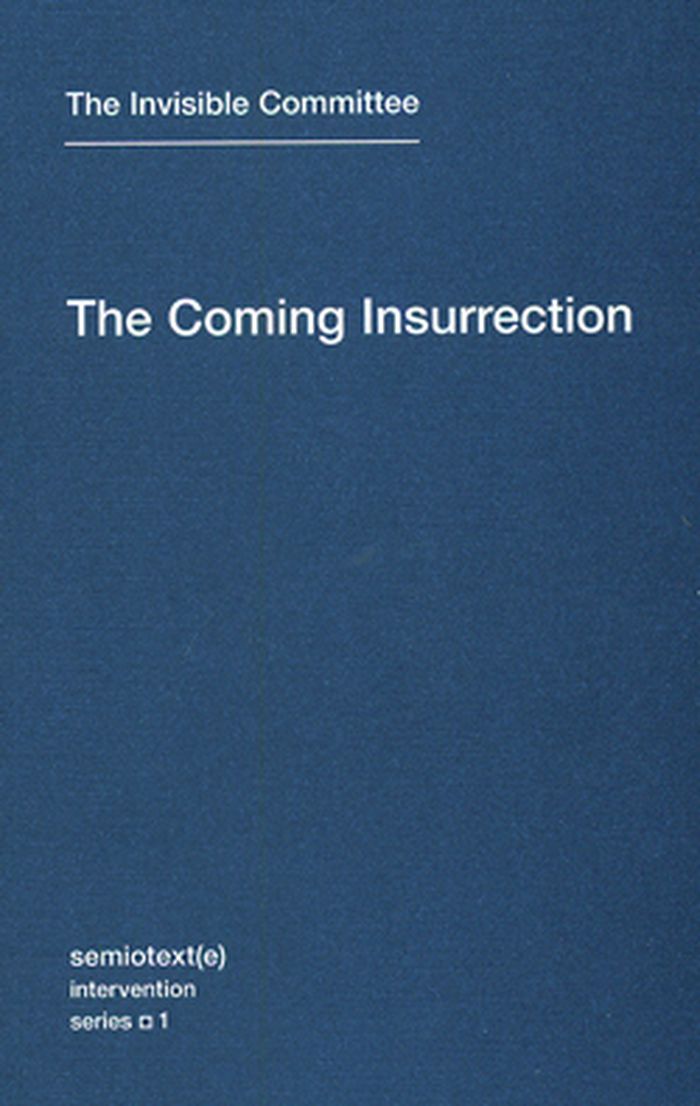
The Coming Insurrection is an eloquent call to arms arising from the recent waves of social contestation in France and Europe. Written by the anonymous Invisible Committee in the vein of Guy Debord — and with comparable elegance — it has been proclaimed a manual for terrorism by the French government (who recently arrested its alleged authors). One of its members more adequately described the group as "the name given to a collective voice bent on denouncing contemporary cynicism and reality." The Coming Insurrection is a strategic prescription for an emergent war-machine to "spread anarchy and live communism." Written in the wake of the riots that erupted throughout the Paris suburbs in the fall of 2005 and presaging more recent riots and general strikes in France and Greece, The Coming Insurrection articulates a rejection of the official Left and its reformist agenda, aligning itself instead with the younger, wilder forms of resistance that have emerged in Europe around recent struggles against immigration control and the "war on terror." Hot-wired to the movement of '77 in Italy, its preferred historical reference point, The Coming Insurrection formulates an ethics that takes as its starting point theft, sabotage, the refusal to work, and the elaboration of collective, self-organized forms-of-life. It is a philosophical statement that addresses the growing number of those — in France, in the United States, and elsewhere — who refuse the idea that theory, politics, and life are separate realms.
The coming insurrection
Actions:
Price:
$19.95
(available to order)
Summary:
The Coming Insurrection is an eloquent call to arms arising from the recent waves of social contestation in France and Europe. Written by the anonymous Invisible Committee in the vein of Guy Debord — and with comparable elegance — it has been proclaimed a manual for terrorism by the French government (who recently arrested its alleged authors). One of its members more adequately described the group as "the name given to a collective voice bent on denouncing contemporary cynicism and reality." The Coming Insurrection is a strategic prescription for an emergent war-machine to "spread anarchy and live communism." Written in the wake of the riots that erupted throughout the Paris suburbs in the fall of 2005 and presaging more recent riots and general strikes in France and Greece, The Coming Insurrection articulates a rejection of the official Left and its reformist agenda, aligning itself instead with the younger, wilder forms of resistance that have emerged in Europe around recent struggles against immigration control and the "war on terror." Hot-wired to the movement of '77 in Italy, its preferred historical reference point, The Coming Insurrection formulates an ethics that takes as its starting point theft, sabotage, the refusal to work, and the elaboration of collective, self-organized forms-of-life. It is a philosophical statement that addresses the growing number of those — in France, in the United States, and elsewhere — who refuse the idea that theory, politics, and life are separate realms.
Form:
books
books
Publication:
November 2012
November 2012
Subject:
Social
Social
Form:
books
books

Actions:
Price:
$40.00
(available to order)
Summary:
One of Spain’s most prominent and innovative artists, Joan Fontcuberta is best known for exploring the interstices between art, science, and illusion. Where science reaches its limits in his works, the imagination frequently finds a creative space in which to flourish. In "Landscapes without memory", Fontcuberta has co-opted a piece of computer software originally(...)
$40.00
(available to order)
Summary:
One of Spain’s most prominent and innovative artists, Joan Fontcuberta is best known for exploring the interstices between art, science, and illusion. Where science reaches its limits in his works, the imagination frequently finds a creative space in which to flourish. In "Landscapes without memory", Fontcuberta has co-opted a piece of computer software originally(...)
Subject:
Photography monographs
Photography monographs
Publication:
January 1900, New York
January 1900, New York
Title:
Joan Fontcuberta : landscapes without memory
Actions:
Price:
$40.00
(available to order)
Summary:
One of Spain’s most prominent and innovative artists, Joan Fontcuberta is best known for exploring the interstices between art, science, and illusion. Where science reaches its limits in his works, the imagination frequently finds a creative space in which to flourish. In "Landscapes without memory", Fontcuberta has co-opted a piece of computer software originally designed for military or scientific use in rendering three-dimensional images of landscapes. The software enables the user to build photo-realistic models based on information scanned from two-dimensional sources—usually satellite surveys or cartographic data. The result gives the user the illusion of navigating in three dimensions which had previously been visualized only as a flat image. With this widely available “freeware” as his starting point, Fontcuberta has created the two series that constitute his "Landscapes without memory". In the “Landscapes of landscapes” series, Fontcuberta feeds the software fragments of pictures by Turner, Cézanne, Dalí, Stieglitz, Weston, and others, forcing the program to interpret a variety of landscape masterworks as “real.” The contours and tones of these painted and photographic landscapes are transformed into three-dimensional mountains, rivers, valleys, and clouds. The vocabulary of art is thus transmuted into that of cartography. In the “Bodyscapes” series, Fontcuberta uses the same software to reinterpret photographs depicting fragments of his own body. The result? A wild, baroque, virtual- fantasy world. While referring to the contemporary exchange between illusion, nature, culture, and technology, "Landscapes without memory" also makes a pointed gesture aimed at fooling that epitome of machine rationalism: the computer.
Joan Fontcuberta : landscapes without memory
Actions:
Price:
$40.00
(available to order)
Summary:
One of Spain’s most prominent and innovative artists, Joan Fontcuberta is best known for exploring the interstices between art, science, and illusion. Where science reaches its limits in his works, the imagination frequently finds a creative space in which to flourish. In "Landscapes without memory", Fontcuberta has co-opted a piece of computer software originally designed for military or scientific use in rendering three-dimensional images of landscapes. The software enables the user to build photo-realistic models based on information scanned from two-dimensional sources—usually satellite surveys or cartographic data. The result gives the user the illusion of navigating in three dimensions which had previously been visualized only as a flat image. With this widely available “freeware” as his starting point, Fontcuberta has created the two series that constitute his "Landscapes without memory". In the “Landscapes of landscapes” series, Fontcuberta feeds the software fragments of pictures by Turner, Cézanne, Dalí, Stieglitz, Weston, and others, forcing the program to interpret a variety of landscape masterworks as “real.” The contours and tones of these painted and photographic landscapes are transformed into three-dimensional mountains, rivers, valleys, and clouds. The vocabulary of art is thus transmuted into that of cartography. In the “Bodyscapes” series, Fontcuberta uses the same software to reinterpret photographs depicting fragments of his own body. The result? A wild, baroque, virtual- fantasy world. While referring to the contemporary exchange between illusion, nature, culture, and technology, "Landscapes without memory" also makes a pointed gesture aimed at fooling that epitome of machine rationalism: the computer.
Form:
books
books
Publication:
January 1900, New York
January 1900, New York
Subject:
Photography monographs
Photography monographs
Form:
books
books
Actions:
Price:
$46.95
(available in store)
Summary:
With its head office in Munich, the architecture studio HildundK, consisting of Andreas Hild and Dionys Ottl, bases its design activities as a whole on a single premise: to produce modern architecture without the latter entering into conflict with the urban setting, historical tradition, local craftsmanship and, of course, the needs of users. Its projects are articulated(...)
$46.95
(available in store)
Summary:
With its head office in Munich, the architecture studio HildundK, consisting of Andreas Hild and Dionys Ottl, bases its design activities as a whole on a single premise: to produce modern architecture without the latter entering into conflict with the urban setting, historical tradition, local craftsmanship and, of course, the needs of users. Its projects are articulated(...)
Subject:
Architecture Monographs
Architecture Monographs
Publication:
July 2007, Barcelona
July 2007, Barcelona
Title:
2 G 42 : Hildundk, Obra recent work
Actions:
Price:
$46.95
(available in store)
Summary:
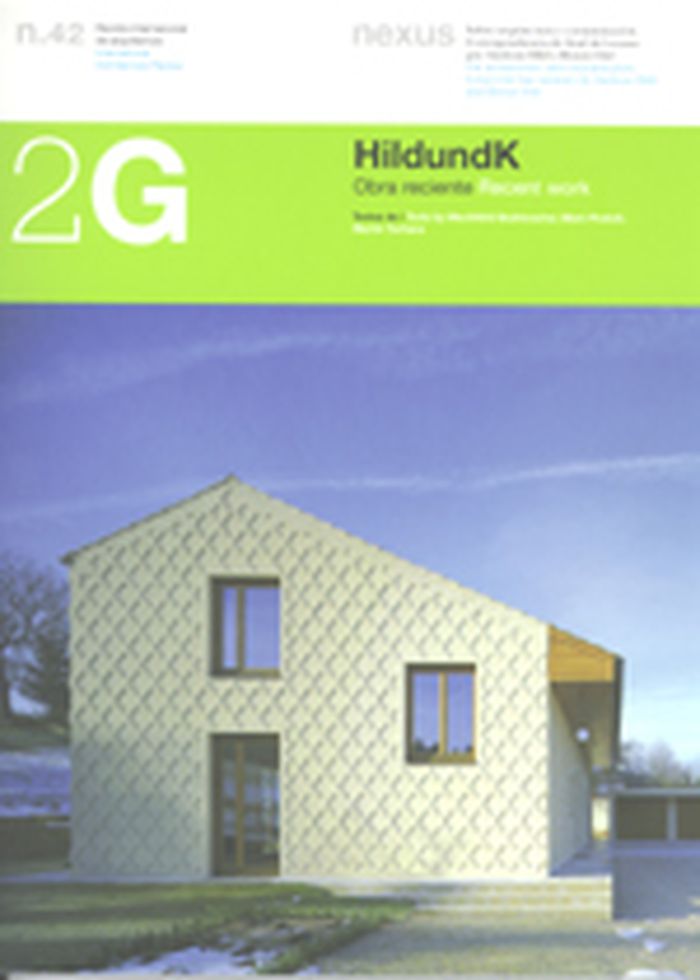
With its head office in Munich, the architecture studio HildundK, consisting of Andreas Hild and Dionys Ottl, bases its design activities as a whole on a single premise: to produce modern architecture without the latter entering into conflict with the urban setting, historical tradition, local craftsmanship and, of course, the needs of users. Its projects are articulated around three fundamental types of intervention. The first consists of taking some datum or other of the surroundings, in particular the city of Munich, its history and building tradition, as a point of departure. The resonance of the context enables their constructed buildings to have an evocative power that goes beyond the formal. In fact, theirs is a way of doing things that is deliberately at odds with the notion of form as a starting point. Secondly, they tackle the issue of ornamentation as a basic part of their project designs by linking it to the artisanal decorative traditions of the region. Lastly, and without losing a proximity to the simplicity of traditional buildings and their decoration, they incorporate a tremendous sensitivity towards materials and contemporary technical conditions. In the last analysis, HildundK hope their architecture is understood by its users, that its cultural contents communicate and connect the public with the discipline of architecture by providing a response to their requirements. To quote Mechthild Stuhlmacher, author of one of the introductory texts: Andreas Hild and Dionys Ottl regard it as imperative to escape from an architectural discourse that is purely internal. In their view architecture must also be comprehensible to the layman if it is to survive as a discipline.
2 G 42 : Hildundk, Obra recent work
Actions:
Price:
$46.95
(available in store)
Summary:
With its head office in Munich, the architecture studio HildundK, consisting of Andreas Hild and Dionys Ottl, bases its design activities as a whole on a single premise: to produce modern architecture without the latter entering into conflict with the urban setting, historical tradition, local craftsmanship and, of course, the needs of users. Its projects are articulated around three fundamental types of intervention. The first consists of taking some datum or other of the surroundings, in particular the city of Munich, its history and building tradition, as a point of departure. The resonance of the context enables their constructed buildings to have an evocative power that goes beyond the formal. In fact, theirs is a way of doing things that is deliberately at odds with the notion of form as a starting point. Secondly, they tackle the issue of ornamentation as a basic part of their project designs by linking it to the artisanal decorative traditions of the region. Lastly, and without losing a proximity to the simplicity of traditional buildings and their decoration, they incorporate a tremendous sensitivity towards materials and contemporary technical conditions. In the last analysis, HildundK hope their architecture is understood by its users, that its cultural contents communicate and connect the public with the discipline of architecture by providing a response to their requirements. To quote Mechthild Stuhlmacher, author of one of the introductory texts: Andreas Hild and Dionys Ottl regard it as imperative to escape from an architectural discourse that is purely internal. In their view architecture must also be comprehensible to the layman if it is to survive as a discipline.
Form:
books
books
Publication:
July 2007, Barcelona
July 2007, Barcelona
Subject:
Architecture Monographs
Architecture Monographs
Form:
books
books
Title:
Orte der Adoleszenz
Orte der Adoleszenz
Actions:
Price:
$21.95
(available in store)
Summary:
Three places of growing up – the Institution for the Blind at Regensburg, the Cantonal School Rychenberg / Winterthur and the Lecture Hall, Zittau – three concepts for a school environment. A different framework determines the progam and the utilization of each respective building type. Realization of the projects with their specific requirements was preceded by an open(...)
$21.95
(available in store)
Summary:
Three places of growing up – the Institution for the Blind at Regensburg, the Cantonal School Rychenberg / Winterthur and the Lecture Hall, Zittau – three concepts for a school environment. A different framework determines the progam and the utilization of each respective building type. Realization of the projects with their specific requirements was preceded by an open(...)
Subject:
small format
small format
Publication:
January 2007, Berlin
January 2007, Berlin
Title:
Orte der Adoleszenz
Actions:
Price:
$21.95
(available in store)
Summary:
Three places of growing up – the Institution for the Blind at Regensburg, the Cantonal School Rychenberg / Winterthur and the Lecture Hall, Zittau – three concepts for a school environment. A different framework determines the progam and the utilization of each respective building type. Realization of the projects with their specific requirements was preceded by an open competition. Award winners are young offices realizing their first big project with this commission. The works of these young architects are displayed in this exhibition for the first time. The Institution for the Blind by Georg Scheel Wetzel Architekten : a partial or complete loss of the sense of sight determined the layout of the complex. In order to enable children to find their way in the building, a strong focus lies on the senses of touch and hearing. Hence, the building is organized on a single floor and the choice of materials underlines the haptic experience of the interior and outer spaces. Apart from the school rooms, the building also provides units of accommodation for stays up to several days. The Cantonal School Rychenberg / Winterthur by Haberland Architekten,,an extension of the building erected in 1960 – 63 by Eric Lanter and a continuation of the Corbusian composition, at the same time utilizes exposed concrete for its façades. All functions are accommodated within an elongated construction consisting of a base and a cube placed above it. Situated off the existing buildings, the base is accessible from the slope and serves as terrace and recess area. It contains class rooms as well as a multi-use sports gym with weights and gymnastics facilities. The cube accommodates a media center and music rooms and is situated between the main building and the hall. The Lecture Hall in Zittau by Tilmann Bock Norbert Sachs Architekten marks the beginnings of a new location for higher education. The new campus center consists of one large and three smaller lecture halls and is completed by two seminar rooms. The lecture hall building is characterized by a fluid spatial movement and accessibility. Starting from the central campus place, the foyer opens up the internal room plan moving past accesses to the lecture halls and a mezzanine toward the upper floor. The open theater on the roof terrace may be used as "open air" lecture hall or as event space for the university.
Orte der Adoleszenz
Actions:
Price:
$21.95
(available in store)
Summary:
Three places of growing up – the Institution for the Blind at Regensburg, the Cantonal School Rychenberg / Winterthur and the Lecture Hall, Zittau – three concepts for a school environment. A different framework determines the progam and the utilization of each respective building type. Realization of the projects with their specific requirements was preceded by an open competition. Award winners are young offices realizing their first big project with this commission. The works of these young architects are displayed in this exhibition for the first time. The Institution for the Blind by Georg Scheel Wetzel Architekten : a partial or complete loss of the sense of sight determined the layout of the complex. In order to enable children to find their way in the building, a strong focus lies on the senses of touch and hearing. Hence, the building is organized on a single floor and the choice of materials underlines the haptic experience of the interior and outer spaces. Apart from the school rooms, the building also provides units of accommodation for stays up to several days. The Cantonal School Rychenberg / Winterthur by Haberland Architekten,,an extension of the building erected in 1960 – 63 by Eric Lanter and a continuation of the Corbusian composition, at the same time utilizes exposed concrete for its façades. All functions are accommodated within an elongated construction consisting of a base and a cube placed above it. Situated off the existing buildings, the base is accessible from the slope and serves as terrace and recess area. It contains class rooms as well as a multi-use sports gym with weights and gymnastics facilities. The cube accommodates a media center and music rooms and is situated between the main building and the hall. The Lecture Hall in Zittau by Tilmann Bock Norbert Sachs Architekten marks the beginnings of a new location for higher education. The new campus center consists of one large and three smaller lecture halls and is completed by two seminar rooms. The lecture hall building is characterized by a fluid spatial movement and accessibility. Starting from the central campus place, the foyer opens up the internal room plan moving past accesses to the lecture halls and a mezzanine toward the upper floor. The open theater on the roof terrace may be used as "open air" lecture hall or as event space for the university.
Form:
books
books
Publication:
January 2007, Berlin
January 2007, Berlin
Subject:
small format
small format


