


44140 Results
Form:
drawings, textual records
drawings, textual records
Actions:
Reference number:
DR1999:0350
Description:
documents include miscellaneous drawings, curtain wall, calculation sheets, finishes, drywall, ceramic tile, equipment, toilet partitions, drywall, trade catalogue, fireproofing. Also blueprints: furnishings, equipment, elevators, conveying system, granite, site work, structural, plumbing, lavatories, beams, elevators, coffee stations, ductwork, cellar, equipment file.
DR1999:0350
Description:
documents include miscellaneous drawings, curtain wall, calculation sheets, finishes, drywall, ceramic tile, equipment, toilet partitions, drywall, trade catalogue, fireproofing. Also blueprints: furnishings, equipment, elevators, conveying system, granite, site work, structural, plumbing, lavatories, beams, elevators, coffee stations, ductwork, cellar, equipment file.
People:
Title:
Miscellaneous drawings, curtain wall, calculation sheets
Actions:
DR1999:0350
Description:
documents include miscellaneous drawings, curtain wall, calculation sheets, finishes, drywall, ceramic tile, equipment, toilet partitions, drywall, trade catalogue, fireproofing. Also blueprints: furnishings, equipment, elevators, conveying system, granite, site work, structural, plumbing, lavatories, beams, elevators, coffee stations, ductwork, cellar, equipment file.
Miscellaneous drawings, curtain wall, calculation sheets
Actions:
DR1999:0350
Description:
documents include miscellaneous drawings, curtain wall, calculation sheets, finishes, drywall, ceramic tile, equipment, toilet partitions, drywall, trade catalogue, fireproofing. Also blueprints: furnishings, equipment, elevators, conveying system, granite, site work, structural, plumbing, lavatories, beams, elevators, coffee stations, ductwork, cellar, equipment file.
Form:
drawings, textual records
drawings, textual records
People:
Form:
drawings, photographs
drawings, photographs
Reference number:
ARCH270251
Description:
This ring binder contains material related to the design and construction of the Glass Station. It includes panoramic images of the Glass Station canopy under construction. It also contains 2 photographic prints of wireframe images of the canopy, overlayed with translucent sheets that have notations for page layout. There are 7 colour transparencies: an aerial view of the built work, 2 views of the built work from a neighboring building, and 4 views taken near the gas station pumps while the service station was open. Thirteen slides contain views of the built work, computer-generated bird's-eye perspectives of the project and wireframes of the canopy. There are 3 presentation drawings (elevation, plans, details), one with captions in English. There are 19 colour photographic prints dated January 1992 with views a model being tested in a laboratory. There are 2 photocopies of published articles about the project. There are also 6 reduced copies of presentation drawings (details and a site plan).
ARCH270251
Description:
This ring binder contains material related to the design and construction of the Glass Station. It includes panoramic images of the Glass Station canopy under construction. It also contains 2 photographic prints of wireframe images of the canopy, overlayed with translucent sheets that have notations for page layout. There are 7 colour transparencies: an aerial view of the built work, 2 views of the built work from a neighboring building, and 4 views taken near the gas station pumps while the service station was open. Thirteen slides contain views of the built work, computer-generated bird's-eye perspectives of the project and wireframes of the canopy. There are 3 presentation drawings (elevation, plans, details), one with captions in English. There are 19 colour photographic prints dated January 1992 with views a model being tested in a laboratory. There are 2 photocopies of published articles about the project. There are also 6 reduced copies of presentation drawings (details and a site plan).
People:
Date:
1992-1994?
1992-1994?
Title:
Ring binder containing material related to the design and construction of the Glass Station, Oguni, Japan
Actions:
ARCH270251
Description:
This ring binder contains material related to the design and construction of the Glass Station. It includes panoramic images of the Glass Station canopy under construction. It also contains 2 photographic prints of wireframe images of the canopy, overlayed with translucent sheets that have notations for page layout. There are 7 colour transparencies: an aerial view of the built work, 2 views of the built work from a neighboring building, and 4 views taken near the gas station pumps while the service station was open. Thirteen slides contain views of the built work, computer-generated bird's-eye perspectives of the project and wireframes of the canopy. There are 3 presentation drawings (elevation, plans, details), one with captions in English. There are 19 colour photographic prints dated January 1992 with views a model being tested in a laboratory. There are 2 photocopies of published articles about the project. There are also 6 reduced copies of presentation drawings (details and a site plan).
Ring binder containing material related to the design and construction of the Glass Station, Oguni, Japan
Actions:
ARCH270251
Description:
This ring binder contains material related to the design and construction of the Glass Station. It includes panoramic images of the Glass Station canopy under construction. It also contains 2 photographic prints of wireframe images of the canopy, overlayed with translucent sheets that have notations for page layout. There are 7 colour transparencies: an aerial view of the built work, 2 views of the built work from a neighboring building, and 4 views taken near the gas station pumps while the service station was open. Thirteen slides contain views of the built work, computer-generated bird's-eye perspectives of the project and wireframes of the canopy. There are 3 presentation drawings (elevation, plans, details), one with captions in English. There are 19 colour photographic prints dated January 1992 with views a model being tested in a laboratory. There are 2 photocopies of published articles about the project. There are also 6 reduced copies of presentation drawings (details and a site plan).
Form:
drawings, photographs
drawings, photographs
Date:
1992-1994?
1992-1994?
People:
Level of archival description:
Sub-series
Sub-series
Reference number:
AP207.S3.SS06
Description:
The sub-series documents a publication entitled "Gianni Pettena: Opere 2001/2018" which appears to be an unfinished publication about Gianni Pettena's projects from 2001 to 2018. The work doesn't appear to have been published. The sub-series contains a digital version of the publication, with pictures for each projects and a small description in Italian and English.
AP207.S3.SS06
Description:
The sub-series documents a publication entitled "Gianni Pettena: Opere 2001/2018" which appears to be an unfinished publication about Gianni Pettena's projects from 2001 to 2018. The work doesn't appear to have been published. The sub-series contains a digital version of the publication, with pictures for each projects and a small description in Italian and English.
People:
Date:
2018
2018
Title:
Gianni Pettena: Opere 2001/2018 (circa 2001-2018)
Actions:
AP207.S3.SS06
Description:
The sub-series documents a publication entitled "Gianni Pettena: Opere 2001/2018" which appears to be an unfinished publication about Gianni Pettena's projects from 2001 to 2018. The work doesn't appear to have been published. The sub-series contains a digital version of the publication, with pictures for each projects and a small description in Italian and English.
Gianni Pettena: Opere 2001/2018 (circa 2001-2018)
Actions:
AP207.S3.SS06
Description:
The sub-series documents a publication entitled "Gianni Pettena: Opere 2001/2018" which appears to be an unfinished publication about Gianni Pettena's projects from 2001 to 2018. The work doesn't appear to have been published. The sub-series contains a digital version of the publication, with pictures for each projects and a small description in Italian and English.
Level of archival description:
Subseries
Subseries
Date:
2018
2018
People:
Form:
archives
Level of archival description:
Fonds
archives
Level of archival description:
Fonds
Reference number:
AP184
Synopsis:
The Asymptote Architecture New York Stock Exchange project records, 1990 - 2009, document the firm’s work on three major projects for the New York Stock Exchange (NYSE), in collaboration with the Securities Industry Automation Corporation (SIAC): the Three Dimensional Trading Floor (3DTF), MarkeTrac/OrderTrac, and the Advanced Trading Floor Operations Center. The majority of the records date from 1998 to 2004, and include textual, born-digital, audiovisual and over-sized materials.
AP184
Synopsis:
The Asymptote Architecture New York Stock Exchange project records, 1990 - 2009, document the firm’s work on three major projects for the New York Stock Exchange (NYSE), in collaboration with the Securities Industry Automation Corporation (SIAC): the Three Dimensional Trading Floor (3DTF), MarkeTrac/OrderTrac, and the Advanced Trading Floor Operations Center. The majority of the records date from 1998 to 2004, and include textual, born-digital, audiovisual and over-sized materials.
People:
Date:
1991-2009
1991-2009
Title:
Asymptote Architecture New York Stock Exchange project records
Actions:
AP184
Synopsis:
The Asymptote Architecture New York Stock Exchange project records, 1990 - 2009, document the firm’s work on three major projects for the New York Stock Exchange (NYSE), in collaboration with the Securities Industry Automation Corporation (SIAC): the Three Dimensional Trading Floor (3DTF), MarkeTrac/OrderTrac, and the Advanced Trading Floor Operations Center. The majority of the records date from 1998 to 2004, and include textual, born-digital, audiovisual and over-sized materials.
Asymptote Architecture New York Stock Exchange project records
Actions:
AP184
Synopsis:
The Asymptote Architecture New York Stock Exchange project records, 1990 - 2009, document the firm’s work on three major projects for the New York Stock Exchange (NYSE), in collaboration with the Securities Industry Automation Corporation (SIAC): the Three Dimensional Trading Floor (3DTF), MarkeTrac/OrderTrac, and the Advanced Trading Floor Operations Center. The majority of the records date from 1998 to 2004, and include textual, born-digital, audiovisual and over-sized materials.
Form:
archives
Level of archival description:
Fonds
archives
Level of archival description:
Fonds
Date:
1991-2009
1991-2009
People:
Level of archival description:
Series
Series
Title:
Hans and Wassili Luckhardt
Hans and Wassili Luckhardt
Actions:
Reference number:
AP162.S6
Description:
Series documents the contribution of architects Hans Luckhardt and Wasilli Luckhardt to the correspondence circle of Die gläserne Kette, with each writing under the pseudonyms Angkor and Zachen respectively. Born in Berlin in 1880, Hans Luckhardt studied architecture at the Technische Hochschule at Karlsruhe, Germany. In 1919, he joined the Novembergruppe, an exhibiting group of painters, sculptors, architects and musicians, and the Arbeitsrat für Kunst, lead by Bruno Taut. These two groups merged in November 1919. The same year, Luckhardt exhibitied his work at the Ausstellung für unbekannte Architekten and contributed to the organization of the Neues Bauen exhibition the next year. In 1921, Hans Luckhardt began his working collaboration with his brother Wassili. Born in Berlin in 1989, Wassili Luckhardt studied archictecture at the Technische Hochschule at Berlin-Charlottenburg and at the Technische Hochschule in Dresden. He undertook his military service from 1914 to 1918. Like his brother Hans, Wasilli joined the Novembergruppeand the Arbeitsrat für Kunst in 1919 and exhibited his work at the Ausstellung für unbekannte Architekten. During their collaboration, the Luckhardt brothers worked on designs for private commisions and competition schemes including some for Berlin and Hanover (1951-1952). Hans Luckhardt died in 1954 in Bad Wiessee. Wassili Luckhardt continued his work as an architect on various architectural projects. He died in 1972 in Berlin. (Source: Ian Boyd Whyte, Bruno Taut and the Architecture of Activism. Cambridge: Cambridge University Press, 1982) The series comprises part of the correspondence of Hans and Wasilli Luckhardt to the Die gläserne Kette circle, along with related drawings and photographs. The series also includes a photograph of a architectural model for a project by the Luckhart brothers.
AP162.S6
Description:
Series documents the contribution of architects Hans Luckhardt and Wasilli Luckhardt to the correspondence circle of Die gläserne Kette, with each writing under the pseudonyms Angkor and Zachen respectively. Born in Berlin in 1880, Hans Luckhardt studied architecture at the Technische Hochschule at Karlsruhe, Germany. In 1919, he joined the Novembergruppe, an exhibiting group of painters, sculptors, architects and musicians, and the Arbeitsrat für Kunst, lead by Bruno Taut. These two groups merged in November 1919. The same year, Luckhardt exhibitied his work at the Ausstellung für unbekannte Architekten and contributed to the organization of the Neues Bauen exhibition the next year. In 1921, Hans Luckhardt began his working collaboration with his brother Wassili. Born in Berlin in 1989, Wassili Luckhardt studied archictecture at the Technische Hochschule at Berlin-Charlottenburg and at the Technische Hochschule in Dresden. He undertook his military service from 1914 to 1918. Like his brother Hans, Wasilli joined the Novembergruppeand the Arbeitsrat für Kunst in 1919 and exhibited his work at the Ausstellung für unbekannte Architekten. During their collaboration, the Luckhardt brothers worked on designs for private commisions and competition schemes including some for Berlin and Hanover (1951-1952). Hans Luckhardt died in 1954 in Bad Wiessee. Wassili Luckhardt continued his work as an architect on various architectural projects. He died in 1972 in Berlin. (Source: Ian Boyd Whyte, Bruno Taut and the Architecture of Activism. Cambridge: Cambridge University Press, 1982) The series comprises part of the correspondence of Hans and Wasilli Luckhardt to the Die gläserne Kette circle, along with related drawings and photographs. The series also includes a photograph of a architectural model for a project by the Luckhart brothers.
People:
Date:
1919-1920
1919-1920
Title:
Hans and Wassili Luckhardt
Actions:
AP162.S6
Description:
Series documents the contribution of architects Hans Luckhardt and Wasilli Luckhardt to the correspondence circle of Die gläserne Kette, with each writing under the pseudonyms Angkor and Zachen respectively. Born in Berlin in 1880, Hans Luckhardt studied architecture at the Technische Hochschule at Karlsruhe, Germany. In 1919, he joined the Novembergruppe, an exhibiting group of painters, sculptors, architects and musicians, and the Arbeitsrat für Kunst, lead by Bruno Taut. These two groups merged in November 1919. The same year, Luckhardt exhibitied his work at the Ausstellung für unbekannte Architekten and contributed to the organization of the Neues Bauen exhibition the next year. In 1921, Hans Luckhardt began his working collaboration with his brother Wassili. Born in Berlin in 1989, Wassili Luckhardt studied archictecture at the Technische Hochschule at Berlin-Charlottenburg and at the Technische Hochschule in Dresden. He undertook his military service from 1914 to 1918. Like his brother Hans, Wasilli joined the Novembergruppeand the Arbeitsrat für Kunst in 1919 and exhibited his work at the Ausstellung für unbekannte Architekten. During their collaboration, the Luckhardt brothers worked on designs for private commisions and competition schemes including some for Berlin and Hanover (1951-1952). Hans Luckhardt died in 1954 in Bad Wiessee. Wassili Luckhardt continued his work as an architect on various architectural projects. He died in 1972 in Berlin. (Source: Ian Boyd Whyte, Bruno Taut and the Architecture of Activism. Cambridge: Cambridge University Press, 1982) The series comprises part of the correspondence of Hans and Wasilli Luckhardt to the Die gläserne Kette circle, along with related drawings and photographs. The series also includes a photograph of a architectural model for a project by the Luckhart brothers.
Hans and Wassili Luckhardt
Actions:
AP162.S6
Description:
Series documents the contribution of architects Hans Luckhardt and Wasilli Luckhardt to the correspondence circle of Die gläserne Kette, with each writing under the pseudonyms Angkor and Zachen respectively. Born in Berlin in 1880, Hans Luckhardt studied architecture at the Technische Hochschule at Karlsruhe, Germany. In 1919, he joined the Novembergruppe, an exhibiting group of painters, sculptors, architects and musicians, and the Arbeitsrat für Kunst, lead by Bruno Taut. These two groups merged in November 1919. The same year, Luckhardt exhibitied his work at the Ausstellung für unbekannte Architekten and contributed to the organization of the Neues Bauen exhibition the next year. In 1921, Hans Luckhardt began his working collaboration with his brother Wassili. Born in Berlin in 1989, Wassili Luckhardt studied archictecture at the Technische Hochschule at Berlin-Charlottenburg and at the Technische Hochschule in Dresden. He undertook his military service from 1914 to 1918. Like his brother Hans, Wasilli joined the Novembergruppeand the Arbeitsrat für Kunst in 1919 and exhibited his work at the Ausstellung für unbekannte Architekten. During their collaboration, the Luckhardt brothers worked on designs for private commisions and competition schemes including some for Berlin and Hanover (1951-1952). Hans Luckhardt died in 1954 in Bad Wiessee. Wassili Luckhardt continued his work as an architect on various architectural projects. He died in 1972 in Berlin. (Source: Ian Boyd Whyte, Bruno Taut and the Architecture of Activism. Cambridge: Cambridge University Press, 1982) The series comprises part of the correspondence of Hans and Wasilli Luckhardt to the Die gläserne Kette circle, along with related drawings and photographs. The series also includes a photograph of a architectural model for a project by the Luckhart brothers.
Level of archival description:
series
series
Date:
1919-1920
1919-1920
People:
Level of archival description:
Project
Project
Reference number:
AP178.S1.2002.PR06
Description:
This project series documents the Parque de Pedras Salgadas in Pedras Salgadas, Portugal. While the records were held in the office’s archives this project was assigned the number 50/00. The office assigned the date 2002 to this project. The project consisted of extensive work to the spa resort located in Pedras Salgadas Park for owner VMPS - Águas & Turismo, S.A, part of Unicer (now Super Bock Group). The work included the demolition of many buildings, the restauration and alterations of others and the construction of new buildings. Work on the Hotel Avelames, the thermal spa, the public pools and the Casa de Chá were the primary focus of the site for Siza. These four components of the project were divided by the office, with the Hotel Avelames, spa and Casa de Chá arranged together under AP178.S1.2002.PR06.SS1 and the public pools arranged under AP178.S1.2002.PR06.SS2. Architect Luís Rebelo de Andrade also constructed eco-houses and treehouses on the site later on. This project was realized in tandem with a similar project by Siza, the Parque de Vidago (AP178.S1.2002.PR05), also owned by Unicer. For this reason, the materials for both projects are mixed together. A large number of materials for this project can be found in project subseries AP178.S1.2002.PR05.SS1. These files have been identified at the file level in the Parque de Vidago project subseries.
AP178.S1.2002.PR06
Description:
This project series documents the Parque de Pedras Salgadas in Pedras Salgadas, Portugal. While the records were held in the office’s archives this project was assigned the number 50/00. The office assigned the date 2002 to this project. The project consisted of extensive work to the spa resort located in Pedras Salgadas Park for owner VMPS - Águas & Turismo, S.A, part of Unicer (now Super Bock Group). The work included the demolition of many buildings, the restauration and alterations of others and the construction of new buildings. Work on the Hotel Avelames, the thermal spa, the public pools and the Casa de Chá were the primary focus of the site for Siza. These four components of the project were divided by the office, with the Hotel Avelames, spa and Casa de Chá arranged together under AP178.S1.2002.PR06.SS1 and the public pools arranged under AP178.S1.2002.PR06.SS2. Architect Luís Rebelo de Andrade also constructed eco-houses and treehouses on the site later on. This project was realized in tandem with a similar project by Siza, the Parque de Vidago (AP178.S1.2002.PR05), also owned by Unicer. For this reason, the materials for both projects are mixed together. A large number of materials for this project can be found in project subseries AP178.S1.2002.PR05.SS1. These files have been identified at the file level in the Parque de Vidago project subseries.
People:
Date:
2002-2010
2002-2010
Title:
Parque de Pedras Salgadas, Pedras Salgadas, Portugal (2002-2010)
Actions:
AP178.S1.2002.PR06
Description:
This project series documents the Parque de Pedras Salgadas in Pedras Salgadas, Portugal. While the records were held in the office’s archives this project was assigned the number 50/00. The office assigned the date 2002 to this project. The project consisted of extensive work to the spa resort located in Pedras Salgadas Park for owner VMPS - Águas & Turismo, S.A, part of Unicer (now Super Bock Group). The work included the demolition of many buildings, the restauration and alterations of others and the construction of new buildings. Work on the Hotel Avelames, the thermal spa, the public pools and the Casa de Chá were the primary focus of the site for Siza. These four components of the project were divided by the office, with the Hotel Avelames, spa and Casa de Chá arranged together under AP178.S1.2002.PR06.SS1 and the public pools arranged under AP178.S1.2002.PR06.SS2. Architect Luís Rebelo de Andrade also constructed eco-houses and treehouses on the site later on. This project was realized in tandem with a similar project by Siza, the Parque de Vidago (AP178.S1.2002.PR05), also owned by Unicer. For this reason, the materials for both projects are mixed together. A large number of materials for this project can be found in project subseries AP178.S1.2002.PR05.SS1. These files have been identified at the file level in the Parque de Vidago project subseries.
Parque de Pedras Salgadas, Pedras Salgadas, Portugal (2002-2010)
Actions:
AP178.S1.2002.PR06
Description:
This project series documents the Parque de Pedras Salgadas in Pedras Salgadas, Portugal. While the records were held in the office’s archives this project was assigned the number 50/00. The office assigned the date 2002 to this project. The project consisted of extensive work to the spa resort located in Pedras Salgadas Park for owner VMPS - Águas & Turismo, S.A, part of Unicer (now Super Bock Group). The work included the demolition of many buildings, the restauration and alterations of others and the construction of new buildings. Work on the Hotel Avelames, the thermal spa, the public pools and the Casa de Chá were the primary focus of the site for Siza. These four components of the project were divided by the office, with the Hotel Avelames, spa and Casa de Chá arranged together under AP178.S1.2002.PR06.SS1 and the public pools arranged under AP178.S1.2002.PR06.SS2. Architect Luís Rebelo de Andrade also constructed eco-houses and treehouses on the site later on. This project was realized in tandem with a similar project by Siza, the Parque de Vidago (AP178.S1.2002.PR05), also owned by Unicer. For this reason, the materials for both projects are mixed together. A large number of materials for this project can be found in project subseries AP178.S1.2002.PR05.SS1. These files have been identified at the file level in the Parque de Vidago project subseries.
Level of archival description:
Project
Project
Date:
2002-2010
2002-2010
People:
Form:
works of art
works of art
Reference number:
DR1988:0437:024
Description:
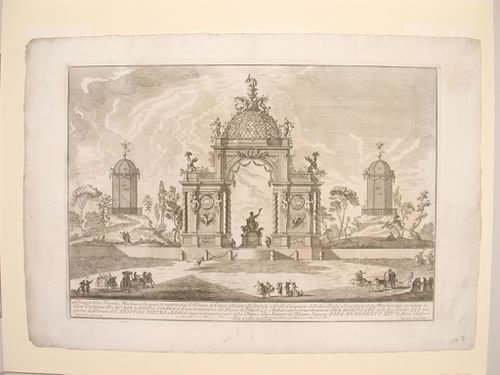
- This etching for a fireworks construction or macchina is in the form of a temple dedicated to the goddess Ceres. The central pavilion, an archway with two porticoes on both sides, is surmounted by a lattice work dome and there are two lattice gazebos on both sides of the temple.
DR1988:0437:024
Description:
- This etching for a fireworks construction or macchina is in the form of a temple dedicated to the goddess Ceres. The central pavilion, an archway with two porticoes on both sides, is surmounted by a lattice work dome and there are two lattice gazebos on both sides of the temple.
People:
Subject:
temporary architecture
temporary architecture
Date:
printed 1756
printed 1756
Title:
Etching of Posi's design for the "seconda macchina" of 1756
Actions:
DR1988:0437:024
Description:
- This etching for a fireworks construction or macchina is in the form of a temple dedicated to the goddess Ceres. The central pavilion, an archway with two porticoes on both sides, is surmounted by a lattice work dome and there are two lattice gazebos on both sides of the temple.
Etching of Posi's design for the "seconda macchina" of 1756
Actions:
DR1988:0437:024
Description:
- This etching for a fireworks construction or macchina is in the form of a temple dedicated to the goddess Ceres. The central pavilion, an archway with two porticoes on both sides, is surmounted by a lattice work dome and there are two lattice gazebos on both sides of the temple.
Form:
works of art
works of art
Date:
printed 1756
printed 1756
People:
Subject:
temporary architecture
temporary architecture
Form:
textual records
Quantity:
59 file
textual records
Quantity:
59 file
Title:
ANY Conference posters
ANY Conference posters
Actions:
Reference number:
ARCH242096
Description:
ANY Conference posters: Anyone (4) Anywhere (3) Anyway (5) Anyplace (3) Anywise (13) Anybody (5) Anymore (1) In ANY Event posters: The Real World and Seaside (6) Electrotecture (7) Architecture and the Feminine: Mop-up Work (12) 8 Critics on 8 Buildings (1)
ARCH242096
Description:
ANY Conference posters: Anyone (4) Anywhere (3) Anyway (5) Anyplace (3) Anywise (13) Anybody (5) Anymore (1) In ANY Event posters: The Real World and Seaside (6) Electrotecture (7) Architecture and the Feminine: Mop-up Work (12) 8 Critics on 8 Buildings (1)
People:
Date:
1991-1999
1991-1999
Title:
ANY Conference posters
Actions:
ARCH242096
Description:
ANY Conference posters: Anyone (4) Anywhere (3) Anyway (5) Anyplace (3) Anywise (13) Anybody (5) Anymore (1) In ANY Event posters: The Real World and Seaside (6) Electrotecture (7) Architecture and the Feminine: Mop-up Work (12) 8 Critics on 8 Buildings (1)
ANY Conference posters
Actions:
ARCH242096
Description:
ANY Conference posters: Anyone (4) Anywhere (3) Anyway (5) Anyplace (3) Anywise (13) Anybody (5) Anymore (1) In ANY Event posters: The Real World and Seaside (6) Electrotecture (7) Architecture and the Feminine: Mop-up Work (12) 8 Critics on 8 Buildings (1)
Form:
textual records
Quantity:
59 file
textual records
Quantity:
59 file
Date:
1991-1999
1991-1999
People:
Form:
photographs
photographs
Reference number:
ARCH276568
Description:
Slide binder labeled, "Early work to 1980." Includes: Canadian Pavilion Expo '70, Man in the Community theme Pavilion Expo '67, Sikh Temple, Museum of Anthropology, King's Landing, Three Block Project, Robson Square, Vancouver Art Gallery, B.C. Place, Eglington Subway Station and others.
ARCH276568
Description:
Slide binder labeled, "Early work to 1980." Includes: Canadian Pavilion Expo '70, Man in the Community theme Pavilion Expo '67, Sikh Temple, Museum of Anthropology, King's Landing, Three Block Project, Robson Square, Vancouver Art Gallery, B.C. Place, Eglington Subway Station and others.
People:
Date:
before 1980
before 1980
Title:
Documentation slides of various projects
Actions:
ARCH276568
Description:
Slide binder labeled, "Early work to 1980." Includes: Canadian Pavilion Expo '70, Man in the Community theme Pavilion Expo '67, Sikh Temple, Museum of Anthropology, King's Landing, Three Block Project, Robson Square, Vancouver Art Gallery, B.C. Place, Eglington Subway Station and others.
Documentation slides of various projects
Actions:
ARCH276568
Description:
Slide binder labeled, "Early work to 1980." Includes: Canadian Pavilion Expo '70, Man in the Community theme Pavilion Expo '67, Sikh Temple, Museum of Anthropology, King's Landing, Three Block Project, Robson Square, Vancouver Art Gallery, B.C. Place, Eglington Subway Station and others.
Form:
photographs
photographs
Date:
before 1980
before 1980
People:
Level of archival description:
Project
Project
Actions:
Reference number:
AP075.S1.2003.PR05
Description:
Project series documents Cornelia Hahn Oberlander's project of a green roof built as a demonstration at the Great Northern Way Campus of the British Columbia Institute of Technology, in Vancouver. Oberlander worked in this project in the early 2000s. The project was led by the Green Roof Research Facility to study performance of green roofs. The project series contains photographs of roof during installation of equipment, a work plan, specifications for the landscaping, correspondence, including with client, consultants, contractors, and suppliers, plant lists, roofing system plan with plants layout. The project series also includes an article on the Green Roof Research Facility project.
AP075.S1.2003.PR05
Description:
Project series documents Cornelia Hahn Oberlander's project of a green roof built as a demonstration at the Great Northern Way Campus of the British Columbia Institute of Technology, in Vancouver. Oberlander worked in this project in the early 2000s. The project was led by the Green Roof Research Facility to study performance of green roofs. The project series contains photographs of roof during installation of equipment, a work plan, specifications for the landscaping, correspondence, including with client, consultants, contractors, and suppliers, plant lists, roofing system plan with plants layout. The project series also includes an article on the Green Roof Research Facility project.
People:
Date:
2002-2003
2002-2003
Title:
British Columbia Institute of Technology Green Roof, Vancouver, British Columbia (2003)
Actions:
AP075.S1.2003.PR05
Description:
Project series documents Cornelia Hahn Oberlander's project of a green roof built as a demonstration at the Great Northern Way Campus of the British Columbia Institute of Technology, in Vancouver. Oberlander worked in this project in the early 2000s. The project was led by the Green Roof Research Facility to study performance of green roofs. The project series contains photographs of roof during installation of equipment, a work plan, specifications for the landscaping, correspondence, including with client, consultants, contractors, and suppliers, plant lists, roofing system plan with plants layout. The project series also includes an article on the Green Roof Research Facility project.
British Columbia Institute of Technology Green Roof, Vancouver, British Columbia (2003)
Actions:
AP075.S1.2003.PR05
Description:
Project series documents Cornelia Hahn Oberlander's project of a green roof built as a demonstration at the Great Northern Way Campus of the British Columbia Institute of Technology, in Vancouver. Oberlander worked in this project in the early 2000s. The project was led by the Green Roof Research Facility to study performance of green roofs. The project series contains photographs of roof during installation of equipment, a work plan, specifications for the landscaping, correspondence, including with client, consultants, contractors, and suppliers, plant lists, roofing system plan with plants layout. The project series also includes an article on the Green Roof Research Facility project.
Level of archival description:
Project
Project
Date:
2002-2003
2002-2003
People:


