


1307 Results
Form:
books
books
Actions:
Price:
$38.00
(available in store)
Summary:
''Common Treasures'' is a new series of books about the challenges faced by rural communities, written by people who are working on the ground and in the fields. Each volume gathers the very best essays about climate adaptation, food production and land use, and presents them as alternatives to the prevailing political discourse. This anthology, the second in the(...)
Subject:
Architectural Theory
Architectural Theory
Publication:
February 2026
February 2026
Title:
Common treasures. Vol.2: Housing, planning & construction
Actions:
Price:
$38.00
(available in store)
Summary:
''Common Treasures'' is a new series of books about the challenges faced by rural communities, written by people who are working on the ground and in the fields. Each volume gathers the very best essays about climate adaptation, food production and land use, and presents them as alternatives to the prevailing political discourse. This anthology, the second in the ''Common Treasures'' project, developed from a series of conversations between the architecture collective Assemble and the arts organisation Common Ground. It takes as its premise the idea that approaches to housing that are grounded in greater levels of community ownership, management and maintenance have the potential to empower communities, overcome the opposition to local development and create conditions in which skilled rural workers are part of stronger local networks of industry and agriculture. Housing built by, for and with the people who live in it makes characterful neighbourhoods that last well, are able to be maintained by their residents and facilitate investment in local labour, materials and skilled workmanship. The contributors to this anthology share their work to overcome the many obstacles to this way of working, and offer a vision which is grounded, imaginative and hopeful.
Form:
books
books
Publication:
February 2026
February 2026
Subject:
Architectural Theory
Architectural Theory
Form:
books
books
Title:
Italy and the Grand Tour
Italy and the Grand Tour
Actions:
Price:
$52.50
(available to order)
Summary:
For members of the social elite in eighteenth-century England, extended travel for pleasure came to be considered part of an ideal education as well as an important symbol of social status. Italy, and especially Rome—a fashionable, exciting, and comfortable city—became the focus of such early tourists’ interest. In this distinctive book, historian Jeremy Black recreates(...)
Title:
Italy and the Grand Tour
Actions:
Price:
$52.50
(available to order)
Summary:
For members of the social elite in eighteenth-century England, extended travel for pleasure came to be considered part of an ideal education as well as an important symbol of social status. Italy, and especially Rome—a fashionable, exciting, and comfortable city—became the focus of such early tourists’ interest. In this distinctive book, historian Jeremy Black recreates the actual tourist experiences of those who traveled to Italy on a Grand Tour. Relying on the private diaries and personal letters of travelers, rather than on the self-conscious accounts of literary travelers who wrote for wider audiences, the book presents a fresh and authentic picture of how British tourists experienced Italy, its landscapes, women, food, music, Catholicism, and more. Using material from archives across Britain and a generous selection of illustrations, the book highlights the discrepancy between the idealized view of the Grand Tour and its reality: what people were meant to do was not necessarily what they did, what the guide books described as splendid was not always so perceived. Black discusses what Italian experiences meant to British visitors, and he considers the effects of tourism on British culture during this most exciting of centuries.
Form:
books
books
Publication:
January 1900, New Haven
January 1900, New Haven
Subject:
History until 1900
History until 1900
Form:
books
books
Actions:
Price:
$34.00
(available to order)
Summary:
"Regeneration" offers a visionary new approach to climate change, one that weaves justice, climate, biodiversity, equity, and human dignity into a seamless tapestry of action, policy, and transformation that can end the climate crisis in one generation. It is the first book to describe and define the burgeoning regeneration movement spreading rapidly throughout the(...)
Title:
Regeneration: ending the climate crisis in one generation
Actions:
Price:
$34.00
(available to order)
Summary:
"Regeneration" offers a visionary new approach to climate change, one that weaves justice, climate, biodiversity, equity, and human dignity into a seamless tapestry of action, policy, and transformation that can end the climate crisis in one generation. It is the first book to describe and define the burgeoning regeneration movement spreading rapidly throughout the world. "Regeneration" describes how an inclusive movement can engage the majority of humanity to save the world from the threat of global warming, with climate solutions that directly serve our children, the poor, and the excluded. This means we must address current human needs, not future existential threats, real as they are, with initiatives that include but go well beyond solar, electric vehicles, and tree planting to include such solutions as the fifteen-minute city, bioregions, azolla fern, food localization, fire ecology, decommodification, forests as farms, and the number one solution for the world: electrifying everything. Paul Hawken and the nonprofit Regeneration Organization are launching a series of initiatives to accompany the book, including a streaming video series, curriculum, podcasts, teaching videos, and climate action software. "Regeneration" is the inspiring and necessary guide to inform the rapidly spreading climate movement.
Form:
books
books
Publication:
September 2021
September 2021
Subject:
Environment and environmental theory
Environment and environmental theory
Form:
books
books
Title:
Gordon Matta-Clark
Gordon Matta-Clark
Actions:
Price:
$99.95
(available to order)
Summary:
Born in New York and trained in architecture, Gordon Matta-Clark is most famous for his slicing through façades, walls and floors of derelict buildings. This ‘deconstructing’ gesture, provocative and extreme, turns architecture into astonishing sculptures, where the mass of the building is entwined with the light and air that penetrate it. Matta-Clark’s interventions are(...)
Subject:
Contemporary Art Monographs
Contemporary Art Monographs
Publication:
April 2003, London
April 2003, London
Title:
Gordon Matta-Clark
Actions:
Price:
$99.95
(available to order)
Summary:
Born in New York and trained in architecture, Gordon Matta-Clark is most famous for his slicing through façades, walls and floors of derelict buildings. This ‘deconstructing’ gesture, provocative and extreme, turns architecture into astonishing sculptures, where the mass of the building is entwined with the light and air that penetrate it. Matta-Clark’s interventions are always grounded in social or political convictions. Some of his projects include opening a restaurant (Food, 1971)in the then-neglected district of SoHo in New York, purchasing at auction fractions of unusable urban land in New York (Reality Properties: Fake Estates, 1973), dispensing oxygen to passersby in the streets of New York from a self-made cart (Fresh Air Cart, 1972), and other visionary urban projects that he conceived as a founding member of the New York-based Anarchitecture group. His practice remains one of the most unique, unequalled, and hugely influential of the past decades. A richly documented essay by Professor Thomas Crow presents new perspectives on the work of the artist. Also included are original essays by Judith Russi Kirshner and Christian Kravagna, as well as a ‘Documents’ section composed of key unpublished and hard-to-find essays and interviews, compiled by editor Corinne Diserens.
Form:
books
books
Publication:
April 2003, London
April 2003, London
Subject:
Contemporary Art Monographs
Contemporary Art Monographs
Form:
books
books
Actions:
Price:
$53.95
(available to order)
Summary:
With his astounding building cuts and intersects, Gordon Matta-Clark (1943-1978) opened up elegant geometries in the very structures that seem most substantial and most authoritative in urban existence, revealing the alienations of the urban fabric as convenient fictions and allowing life to flow into the most inhospitable and self-contained of buildings. One of his(...)
Publication:
November 2011
November 2011
Title:
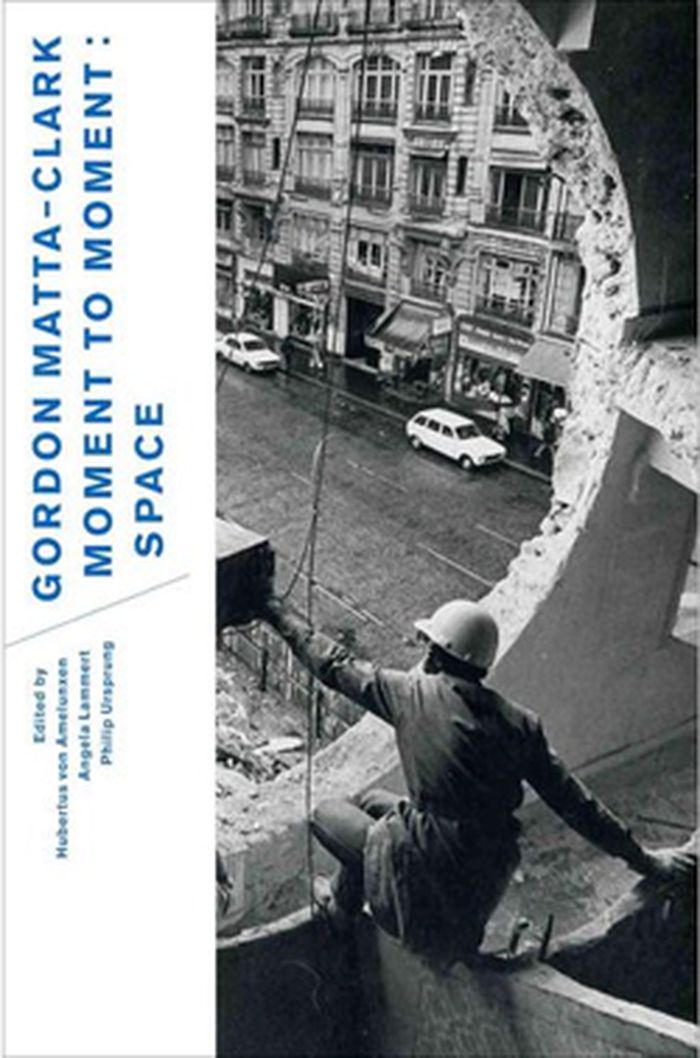
Gordon Matta-Clark, moment to moment : space
Actions:
Price:
$53.95
(available to order)
Summary:
With his astounding building cuts and intersects, Gordon Matta-Clark (1943-1978) opened up elegant geometries in the very structures that seem most substantial and most authoritative in urban existence, revealing the alienations of the urban fabric as convenient fictions and allowing life to flow into the most inhospitable and self-contained of buildings. One of his favorite responses to a work came from a Parisian concierge: “I see the purpose for that hole - it is an experiment in bringing light and air into spaces that never had enough of either.” Throughout his all-too-brief career, Matta-Clark undertook civic aeration on many fronts, cofounding the now legendary Food Restaurant in 1971, buying up empty lots in Queens and evolving his theory of “anarchitecture” in films, photomontages and numerous writings and drawings. Anarchitecture redefined negative space in art as a political act, distinguishing itself from architecture by imagining a cure for its most pernicious effects. Gordon Matta-Clark : Moment to Moment offers a comprehensive overview of this courageous and liberating artist with a wealth of documentation and reproductions from across Matta-Clark's oeuvre, as well as critical commentary from Philip Ursprung, Angela Lammert, Hubertus von Amelunxen, Dan Graham and others.
Form:
books
books
Publication:
November 2011
November 2011
Form:
books
books
Actions:
Price:
$42.00
(available to order)
Summary:
In The Hoarders, Scott Herring provides an in-depth examination of how modern hoarders came into being, from their onset in the late 1930s to the present day. He finds that both the idea of organization and the role of the clutterologist are deeply ingrained in our culture, and that there is a fine line between clutter and deviance in America. Herring introduces us to(...)
Title:
The hoarders : material deviance in Modern American cutlure
Actions:
Price:
$42.00
(available to order)
Summary:
In The Hoarders, Scott Herring provides an in-depth examination of how modern hoarders came into being, from their onset in the late 1930s to the present day. He finds that both the idea of organization and the role of the clutterologist are deeply ingrained in our culture, and that there is a fine line between clutter and deviance in America. Herring introduces us to Jill, whose countertops are piled high with decaying food and whose cabinets are overrun with purchases, while the fly strips hanging from her ceiling are arguably more fly than strip. When Jill spots a decomposing pumpkin about to be jettisoned, she stops, seeing in the rotting, squalid vegetable a special treasure. “I’ve never seen one quite like this before,” she says, and looks to see if any seeds remain. It is from moments like these that Herring builds his questions: What counts as an acceptable material life—and who decides? Is hoarding some sort of inherent deviation of the mind, or a recent historical phenomenon grounded in changing material cultures? Herring opts for the latter, explaining that hoarders attract attention not because they are mentally ill but because they challenge normal modes of material relations.
Form:
books
books
Publication:
September 2014
September 2014
Subject:
Critical Theory
Critical Theory
Form:
books
books
Title:
Inverted world
Inverted world
Actions:
Price:
$16.95
(available to order)
Summary:
The city is winched along tracks through a devastated land full of hostile tribes. Rails must be freshly laid ahead of the city and carefully removed in its wake. Rivers and mountains present nearly insurmountable challenges to the ingenuity of the city’s engineers. But if the city does not move, it will fall farther and farther behind the “optimum” into the crushing(...)
Title:
Inverted world
Actions:
Price:
$16.95
(available to order)
Summary:
The city is winched along tracks through a devastated land full of hostile tribes. Rails must be freshly laid ahead of the city and carefully removed in its wake. Rivers and mountains present nearly insurmountable challenges to the ingenuity of the city’s engineers. But if the city does not move, it will fall farther and farther behind the “optimum” into the crushing gravitational field that has transformed life on Earth. The only alternative to progress is death. The secret directorate that governs the city makes sure that its inhabitants know nothing of this. Raised in common in crèches, nurtured on synthetic food, prevented above all from venturing outside the closed circuit of the city, they are carefully sheltered from the dire necessities that have come to define human existence. And yet the city is in crisis. The people are growing restive, the population is dwindling, and the rulers know that, for all their efforts, slowly but surely the city is slipping ever farther behind the optimum. Helward Mann is a member of the city’s elite. Better than anyone, he knows how tenuous is the city’s continued existence. But the world—he is about to discover—is infinitely stranger than the strange world he believes he knows so well.
Form:
books
books
Publication:
July 2008, New York
July 2008, New York
Subject:
Architectural Theory
Architectural Theory
Form:
books
books
Price:
$67.50
(available to order)
Summary:
This engaging and well illustrated book takes us back to the domestic world of the landed gentry in seventeenth-century England. Relating countless stories and case histories drawn from a wide range of primary sources, the book describes the physical environment, staffing, and functioning of gentry households, the inhabitants and their activities, and the role of(...)
Title:
The World of the Country House in Seventeenth-Century England
Actions:
Price:
$67.50
(available to order)
Summary:
This engaging and well illustrated book takes us back to the domestic world of the landed gentry in seventeenth-century England. Relating countless stories and case histories drawn from a wide range of primary sources, the book describes the physical environment, staffing, and functioning of gentry households, the inhabitants and their activities, and the role of these houses in the social and economic life of their localities. J. T. Cliffe begins by exploring the exterior and inter-ior of houses and the outbuildings, parks, and gardens that surrounded them. He then investigates the people who lived in the country houses and the relationships between them. He provides colorful details about the responsibilities of the squire and his wife; the duties, remuneration, food, clothing, accommodation, and treatment of servants; and the special duties of estate stewards, coachmen, chaplains, and tutors. Cliffe explains various aspects of housekeeping, such as the tradition of hospitality and the factors militating against it. He also discusses other kinds of activity: religious practices; outdoor sports and indoor pastimes, including music and billiards; and such intellectual pursuits as antiquarian research, poetry, and scientific experiments. He concludes with a fascinating survey of scandal in the world of the gentry, telling of domestic strife, financial disaster, lunacy, and other disasters that marred this idyllic existence.
Form:
books
books
Publication:
August 1999, New Haven
August 1999, New Haven
Subject:
History until 1900
History until 1900
Form:
books
books
Actions:
Price:
$31.50
(available to order)
Summary:
A manifesto for a radically different philosophy and practice of manufacture and environmentalism. "Reduce, reuse, recycle" urge environmentalists; in other words, do more with less in order to minimize damage. As William McDonough and Michael Braungart argue in their provocative, visionary book, however, this approach perpetuates a one-way, "cradle to grave"(...)
Subject:
Green Architecture
Green Architecture
Publication:
January 1900, New York
January 1900, New York
Title:
Cradle to cradle : remaking the way we make things
Actions:
Price:
$31.50
(available to order)
Summary:
A manifesto for a radically different philosophy and practice of manufacture and environmentalism. "Reduce, reuse, recycle" urge environmentalists; in other words, do more with less in order to minimize damage. As William McDonough and Michael Braungart argue in their provocative, visionary book, however, this approach perpetuates a one-way, "cradle to grave" manufacturing model that dates to the industrial revolution and casts off as much as 90 percent of the materials it uses as waste, much of it toxic. Why not challenge the notion that human industry must inevitably damage the natural world, they ask. In fact, why not take nature itself as our model? A tree produces thousands of blossoms in order to create another tree, yet we do not consider its abundance wasteful but safe, beautiful, and highly effective; hence, "waste equals food" is the first principle the book sets forth. Products might be designed so that, after their useful life, they provide nourishment for something new-either as "biological nutrients" that safely re-enter the environment or as "technical nutrients" that circulate within closed-loop industrial cycles, without being "downcycled" into low-grade uses (as most "recyclables" now are). Elaborating their principles from experience (re)designing everything from carpeting to corporate campuses, the authors make an exciting and viable case for change.
Form:
books
books
Publication:
January 1900, New York
January 1900, New York
Subject:
Green Architecture
Green Architecture
Form:
books
books

Actions:
Price:
$31.99
(available to order)
Summary:
Mary Siisip Geniusz has spent more than thirty years working with, living with, and using the Anishinaabe teachings, recipes, and botanical information she shares in ''Plants have so much to give us, all we have to do is ask''. Geniusz gained much of the knowledge she writes about from her years as an oshkaabewis, a traditionally trained apprentice, and as friend to the(...)
Title:
Plants have so much to give us, all we have to do is ask: Anishinaabe botanical teachings
Actions:
Price:
$31.99
(available to order)
Summary:
Mary Siisip Geniusz has spent more than thirty years working with, living with, and using the Anishinaabe teachings, recipes, and botanical information she shares in ''Plants have so much to give us, all we have to do is ask''. Geniusz gained much of the knowledge she writes about from her years as an oshkaabewis, a traditionally trained apprentice, and as friend to the late Keewaydinoquay, an Anishinaabe medicine woman from the Leelanau Peninsula in Michigan and a scholar, teacher, and practitioner in the field of native ethnobotany. Keewaydinoquay published little in her lifetime, yet Geniusz has carried on her legacy by making this body of knowledge accessible to a broader audience. Geniusz teaches the ways she was taught-through stories. Sharing the traditional stories she learned at Keewaydinoquay's side as well as stories from other American Indian traditions and her own experiences, Geniusz brings the plants to life with narratives that explain their uses, meaning, and history. Stories such as "Naanabozho and the Squeaky-Voice Plant" place the plants in cultural context and illustrate the belief in plants as cognizant beings. Covering a wide range of plants, from conifers to cattails to medicinal uses of yarrow, mullein, and dandelion, she explains how we can work with those beings to create food, simple medicines, and practical botanical tools.
Form:
books
books
Publication:
April 2015
April 2015
Subject:
Fauna and flora
Fauna and flora


