


26977 Results
Level of archival description:
Project
Project
Actions:
Reference number:
AP018.S1.1980.PR15
Description:
This project series documents additions and alterations to the Beaverbrook Art Gallery in Fredericton, New Brunswick from 1981-1986. The office identified this project as 8018. The Beaverbrook Art Gallery, located beside the St. John River, was designed by Neil Stewart in 1956. The additions and alterations to the original design consisted of the addition of an east wing to the existing structure as well as upgrades to mechanical and electrical systems. A feasibility study was conducted and two schemes were proposed for the project. The project is recorded through textual records, drawings, and site and construction photographs. The feasibility study is recorded through reprographic copies of drawings. The textual records show client correspondence, site planning, contractor and consultant work, construction and associated shop drawings. Textual documents also record a lawsuit brought against the firm by project consultants ADI Limited following construction.
AP018.S1.1980.PR15
Description:
This project series documents additions and alterations to the Beaverbrook Art Gallery in Fredericton, New Brunswick from 1981-1986. The office identified this project as 8018. The Beaverbrook Art Gallery, located beside the St. John River, was designed by Neil Stewart in 1956. The additions and alterations to the original design consisted of the addition of an east wing to the existing structure as well as upgrades to mechanical and electrical systems. A feasibility study was conducted and two schemes were proposed for the project. The project is recorded through textual records, drawings, and site and construction photographs. The feasibility study is recorded through reprographic copies of drawings. The textual records show client correspondence, site planning, contractor and consultant work, construction and associated shop drawings. Textual documents also record a lawsuit brought against the firm by project consultants ADI Limited following construction.
People:
Date:
1980-1986
1980-1986
Title:
Beaverbrook Art Gallery, Additions and Alterations, Fredericton, New Brunswick (1980-1983)
Actions:
AP018.S1.1980.PR15
Description:
This project series documents additions and alterations to the Beaverbrook Art Gallery in Fredericton, New Brunswick from 1981-1986. The office identified this project as 8018. The Beaverbrook Art Gallery, located beside the St. John River, was designed by Neil Stewart in 1956. The additions and alterations to the original design consisted of the addition of an east wing to the existing structure as well as upgrades to mechanical and electrical systems. A feasibility study was conducted and two schemes were proposed for the project. The project is recorded through textual records, drawings, and site and construction photographs. The feasibility study is recorded through reprographic copies of drawings. The textual records show client correspondence, site planning, contractor and consultant work, construction and associated shop drawings. Textual documents also record a lawsuit brought against the firm by project consultants ADI Limited following construction.
Beaverbrook Art Gallery, Additions and Alterations, Fredericton, New Brunswick (1980-1983)
Actions:
AP018.S1.1980.PR15
Description:
This project series documents additions and alterations to the Beaverbrook Art Gallery in Fredericton, New Brunswick from 1981-1986. The office identified this project as 8018. The Beaverbrook Art Gallery, located beside the St. John River, was designed by Neil Stewart in 1956. The additions and alterations to the original design consisted of the addition of an east wing to the existing structure as well as upgrades to mechanical and electrical systems. A feasibility study was conducted and two schemes were proposed for the project. The project is recorded through textual records, drawings, and site and construction photographs. The feasibility study is recorded through reprographic copies of drawings. The textual records show client correspondence, site planning, contractor and consultant work, construction and associated shop drawings. Textual documents also record a lawsuit brought against the firm by project consultants ADI Limited following construction.
Level of archival description:
Project
Project
Date:
1980-1986
1980-1986
People:
Form:
articles
articles
Title:
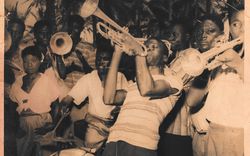
The Modernizing Beat
The Modernizing Beat
Actions:
Dele Adeyemo rereads the production of space of a modernizing Ghana through highlife
Title:
The Modernizing Beat
Dele Adeyemo rereads the production of space of a modernizing Ghana through highlife
Actions:
The Modernizing Beat
Dele Adeyemo rereads the production of space of a modernizing Ghana through highlife
Actions:
Form:
photographs
photographs
![View of the Saihoden [West Treasure House], Geku [Outer Shrine], Ise Daijingu (also known as Ise Jingu [Ise Shrine]), Ise-shi, Japan](/img-collection/sHVYXsabCfYsl5fKT2Tu_B07UYg=/500x377/753.jpg)
Actions:
Reference number:
PH1986:1173
Description:
- The titles of a published identical image, "Ise Jingu East Treasury Façade" and "East Treasury, Outer Shrine" are inaccurate, as the structure shown is the West Treasure House. Part of the south gateway of the innermost fence [mizugaki] is visible at left ('Ise Jingu', p. x, pl. 94; 'Ise: Prototype of Japanese Architecture', p. 129).
PH1986:1173
Description:
- The titles of a published identical image, "Ise Jingu East Treasury Façade" and "East Treasury, Outer Shrine" are inaccurate, as the structure shown is the West Treasure House. Part of the south gateway of the innermost fence [mizugaki] is visible at left ('Ise Jingu', p. x, pl. 94; 'Ise: Prototype of Japanese Architecture', p. 129).
People:
Subject:
architecture
architecture
Date:
1953 or 1960
1953 or 1960
Title:
View of the Saihoden [West Treasure House], Geku [Outer Shrine], Ise Daijingu (also known as Ise Jingu [Ise Shrine]), Ise-shi, Japan
Actions:
PH1986:1173
Description:
- The titles of a published identical image, "Ise Jingu East Treasury Façade" and "East Treasury, Outer Shrine" are inaccurate, as the structure shown is the West Treasure House. Part of the south gateway of the innermost fence [mizugaki] is visible at left ('Ise Jingu', p. x, pl. 94; 'Ise: Prototype of Japanese Architecture', p. 129).
View of the Saihoden [West Treasure House], Geku [Outer Shrine], Ise Daijingu (also known as Ise Jingu [Ise Shrine]), Ise-shi, Japan
Actions:
PH1986:1173
Description:
- The titles of a published identical image, "Ise Jingu East Treasury Façade" and "East Treasury, Outer Shrine" are inaccurate, as the structure shown is the West Treasure House. Part of the south gateway of the innermost fence [mizugaki] is visible at left ('Ise Jingu', p. x, pl. 94; 'Ise: Prototype of Japanese Architecture', p. 129).
Form:
photographs
photographs
Date:
1953 or 1960
1953 or 1960
People:
Subject:
architecture
architecture
Form:
photographs
photographs
Title:
Stereograph of Horton House, San Diego, California, United States of America (demolished 1905)
Stereograph of Horton House, San Diego, California, United States of America (demolished 1905)
Actions:
Reference number:
PH1984:0977:429
Description:
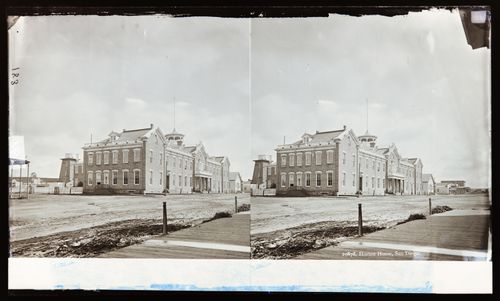
View of Horton House situated on an unpaved road with wooden board walks, pictured from across the street. Horton House was a two-story, hip roof brick building with a cupola structure on top that served as a hotel, which opened in 1870 and was demolished in 1905 to make way for the new U.S. Grant Hotel.
PH1984:0977:429
Description:
View of Horton House situated on an unpaved road with wooden board walks, pictured from across the street. Horton House was a two-story, hip roof brick building with a cupola structure on top that served as a hotel, which opened in 1870 and was demolished in 1905 to make way for the new U.S. Grant Hotel.
People:
Date:
ca. 1870-1885
ca. 1870-1885
Title:
Stereograph of Horton House, San Diego, California, United States of America (demolished 1905)
Actions:
PH1984:0977:429
Description:
View of Horton House situated on an unpaved road with wooden board walks, pictured from across the street. Horton House was a two-story, hip roof brick building with a cupola structure on top that served as a hotel, which opened in 1870 and was demolished in 1905 to make way for the new U.S. Grant Hotel.
Stereograph of Horton House, San Diego, California, United States of America (demolished 1905)
Actions:
PH1984:0977:429
Description:
View of Horton House situated on an unpaved road with wooden board walks, pictured from across the street. Horton House was a two-story, hip roof brick building with a cupola structure on top that served as a hotel, which opened in 1870 and was demolished in 1905 to make way for the new U.S. Grant Hotel.
Form:
photographs
photographs
Date:
ca. 1870-1885
ca. 1870-1885
People:
Level of archival description:
Project
Project
Title:
Citlin
Citlin
Reference number:
AP144.S2.D144
Description:
File documents a contribution to an exhibition hosted by the Aedes Galerie in Berlin, Germany, entitled "Berlin - Denkmal oder Denkmodell?". Price's contribution is centred around the concept of four "Annual Portals", monumental (but disassemblable and movable) structures which are apparently meant to guide the long-term flow of citizens' urban activities as they live in and eventually leave the city. Material in this file was produced in 1979 and between 1987 and 1988, but predominantly in 1988. File contains conceptual drawings, presentation panels, models, photographic materials and textual records.
AP144.S2.D144
Description:
File documents a contribution to an exhibition hosted by the Aedes Galerie in Berlin, Germany, entitled "Berlin - Denkmal oder Denkmodell?". Price's contribution is centred around the concept of four "Annual Portals", monumental (but disassemblable and movable) structures which are apparently meant to guide the long-term flow of citizens' urban activities as they live in and eventually leave the city. Material in this file was produced in 1979 and between 1987 and 1988, but predominantly in 1988. File contains conceptual drawings, presentation panels, models, photographic materials and textual records.
People:
Date:
1979, 1987-1988, predominant 1988
1979, 1987-1988, predominant 1988
Title:
Citlin
Actions:
AP144.S2.D144
Description:
File documents a contribution to an exhibition hosted by the Aedes Galerie in Berlin, Germany, entitled "Berlin - Denkmal oder Denkmodell?". Price's contribution is centred around the concept of four "Annual Portals", monumental (but disassemblable and movable) structures which are apparently meant to guide the long-term flow of citizens' urban activities as they live in and eventually leave the city. Material in this file was produced in 1979 and between 1987 and 1988, but predominantly in 1988. File contains conceptual drawings, presentation panels, models, photographic materials and textual records.
Citlin
Actions:
AP144.S2.D144
Description:
File documents a contribution to an exhibition hosted by the Aedes Galerie in Berlin, Germany, entitled "Berlin - Denkmal oder Denkmodell?". Price's contribution is centred around the concept of four "Annual Portals", monumental (but disassemblable and movable) structures which are apparently meant to guide the long-term flow of citizens' urban activities as they live in and eventually leave the city. Material in this file was produced in 1979 and between 1987 and 1988, but predominantly in 1988. File contains conceptual drawings, presentation panels, models, photographic materials and textual records.
Level of archival description:
File 144
File 144
Date:
1979, 1987-1988, predominant 1988
1979, 1987-1988, predominant 1988
People:
Level of archival description:
Series
Series
Title:
Architectural projects
Architectural projects
Reference number:
AP187.S1
Description:
This series documents fifty of Günter Günschel's architectural projects. Material in this file was produced between 1943 and 2006. Günschel's projects are mainly conceptual. However, he did craft a few models and realised small scale structures, mainly for his dome projects. Only a few projects were designed for specific geographic locations. Most of these were located in Germany, but there was also one for France and one for the United States. Documenting the series are conceptual sketches and drawings, stats, black-and-white photographs, photomontages, and a few textual records.
AP187.S1
Description:
This series documents fifty of Günter Günschel's architectural projects. Material in this file was produced between 1943 and 2006. Günschel's projects are mainly conceptual. However, he did craft a few models and realised small scale structures, mainly for his dome projects. Only a few projects were designed for specific geographic locations. Most of these were located in Germany, but there was also one for France and one for the United States. Documenting the series are conceptual sketches and drawings, stats, black-and-white photographs, photomontages, and a few textual records.
People:
Date:
1943-2006
1943-2006
Title:
Architectural projects
Actions:
AP187.S1
Description:
This series documents fifty of Günter Günschel's architectural projects. Material in this file was produced between 1943 and 2006. Günschel's projects are mainly conceptual. However, he did craft a few models and realised small scale structures, mainly for his dome projects. Only a few projects were designed for specific geographic locations. Most of these were located in Germany, but there was also one for France and one for the United States. Documenting the series are conceptual sketches and drawings, stats, black-and-white photographs, photomontages, and a few textual records.
Architectural projects
Actions:
AP187.S1
Description:
This series documents fifty of Günter Günschel's architectural projects. Material in this file was produced between 1943 and 2006. Günschel's projects are mainly conceptual. However, he did craft a few models and realised small scale structures, mainly for his dome projects. Only a few projects were designed for specific geographic locations. Most of these were located in Germany, but there was also one for France and one for the United States. Documenting the series are conceptual sketches and drawings, stats, black-and-white photographs, photomontages, and a few textual records.
Level of archival description:
Series
Series
Date:
1943-2006
1943-2006
People:
Level of archival description:
Project
Project
Title:
Red Line (1972)
Red Line (1972)
Reference number:
AP207.S1.1972.PR04
Description:
The project series documents "Red Line", a performance that consisted in tracing a red line in the middle of the road with paint sprayer and compressor loaded on the back of a truck. The red line stretched across forty-five kilometres of road and traced the limits of the municipality of Salt Lake City. "The red line rendered visible the boundaries that structure our mental fields of perception and modify our understanding of space." [1] The performance was carried out in February and March 1972 with a group of students from the University of Utah, in Salt Lake City. The project series contains photographs of Pettena and his team at work tracing the red line, a drawing, and a map of the Salt Lake City municipality showing the trajectory of the line. Source: [1] Marco Scotini, editor. Non-conscious architecture: Gianni Pettena, Sternberg Press, 2018, 235 pages. p. 168.
AP207.S1.1972.PR04
Description:
The project series documents "Red Line", a performance that consisted in tracing a red line in the middle of the road with paint sprayer and compressor loaded on the back of a truck. The red line stretched across forty-five kilometres of road and traced the limits of the municipality of Salt Lake City. "The red line rendered visible the boundaries that structure our mental fields of perception and modify our understanding of space." [1] The performance was carried out in February and March 1972 with a group of students from the University of Utah, in Salt Lake City. The project series contains photographs of Pettena and his team at work tracing the red line, a drawing, and a map of the Salt Lake City municipality showing the trajectory of the line. Source: [1] Marco Scotini, editor. Non-conscious architecture: Gianni Pettena, Sternberg Press, 2018, 235 pages. p. 168.
People:
Date:
circa 1972-2015
circa 1972-2015
Title:
Red Line (1972)
Actions:
AP207.S1.1972.PR04
Description:
The project series documents "Red Line", a performance that consisted in tracing a red line in the middle of the road with paint sprayer and compressor loaded on the back of a truck. The red line stretched across forty-five kilometres of road and traced the limits of the municipality of Salt Lake City. "The red line rendered visible the boundaries that structure our mental fields of perception and modify our understanding of space." [1] The performance was carried out in February and March 1972 with a group of students from the University of Utah, in Salt Lake City. The project series contains photographs of Pettena and his team at work tracing the red line, a drawing, and a map of the Salt Lake City municipality showing the trajectory of the line. Source: [1] Marco Scotini, editor. Non-conscious architecture: Gianni Pettena, Sternberg Press, 2018, 235 pages. p. 168.
Red Line (1972)
Actions:
AP207.S1.1972.PR04
Description:
The project series documents "Red Line", a performance that consisted in tracing a red line in the middle of the road with paint sprayer and compressor loaded on the back of a truck. The red line stretched across forty-five kilometres of road and traced the limits of the municipality of Salt Lake City. "The red line rendered visible the boundaries that structure our mental fields of perception and modify our understanding of space." [1] The performance was carried out in February and March 1972 with a group of students from the University of Utah, in Salt Lake City. The project series contains photographs of Pettena and his team at work tracing the red line, a drawing, and a map of the Salt Lake City municipality showing the trajectory of the line. Source: [1] Marco Scotini, editor. Non-conscious architecture: Gianni Pettena, Sternberg Press, 2018, 235 pages. p. 168.
Level of archival description:
Project
Project
Date:
circa 1972-2015
circa 1972-2015
People:
Form:
drawings
drawings
Actions:
Reference number:
DR1962:0006
Description:
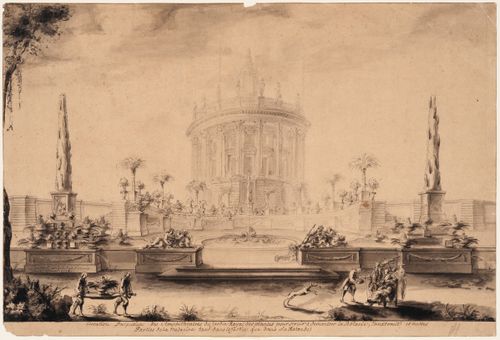
- DR1962:0006 shows a perspective view of a portion of a formal garden terrace laid out symmetrically before a three-storey circular structure. The terrace, which is approached on axis by two steps flanked by sculpted river allegories, is centred on a circular basin and backed by a wall surmounted by potted plants, mostly palm trees and pineapple plants; the middle section of the rear wall curves back concentric to the terrace basin. Beyond the terrace wall and on line with the steps and basin rises the circular structure. With its Corinthian peristyle, this structure has the form of an antique circular temple, such as the so-called "Temple of Vesta" at Tivoli (first century B.C.). Unlike such classical models, however, the columns of the peristyle are set on tall rusticated pedestals that flare outward as they descend to the ground, the entablature carries a balustrade topped by a series of sculpted figures, and the whole is crowned by a tall, slender lantern (although no dome is visible). Within the peristyle, the inner wall is opened regularly by two storeys of windows, each with its own frame and pediment. The overall effect of this structure is not dissimilar to that of James Gibb's Radcliffe Camera, Oxford (1739-49). - In the foreground of DR1962:0006 appear two groups of figures: that on the left consisting of two gardeners carrying a potted pineapple plant, and that on the right consisting of a seated woman attended by a man, a woman (the latter shading her mistress with a parasol), and a figure, apparently a physician, who offers the seated woman a bowl of fruit.
DR1962:0006
Description:
- DR1962:0006 shows a perspective view of a portion of a formal garden terrace laid out symmetrically before a three-storey circular structure. The terrace, which is approached on axis by two steps flanked by sculpted river allegories, is centred on a circular basin and backed by a wall surmounted by potted plants, mostly palm trees and pineapple plants; the middle section of the rear wall curves back concentric to the terrace basin. Beyond the terrace wall and on line with the steps and basin rises the circular structure. With its Corinthian peristyle, this structure has the form of an antique circular temple, such as the so-called "Temple of Vesta" at Tivoli (first century B.C.). Unlike such classical models, however, the columns of the peristyle are set on tall rusticated pedestals that flare outward as they descend to the ground, the entablature carries a balustrade topped by a series of sculpted figures, and the whole is crowned by a tall, slender lantern (although no dome is visible). Within the peristyle, the inner wall is opened regularly by two storeys of windows, each with its own frame and pediment. The overall effect of this structure is not dissimilar to that of James Gibb's Radcliffe Camera, Oxford (1739-49). - In the foreground of DR1962:0006 appear two groups of figures: that on the left consisting of two gardeners carrying a potted pineapple plant, and that on the right consisting of a seated woman attended by a man, a woman (the latter shading her mistress with a parasol), and a figure, apparently a physician, who offers the seated woman a bowl of fruit.
People:
Subject:
architecture, landscape architecture
architecture, landscape architecture
Date:
ca. 1744
ca. 1744
Title:
Project for a medical amphitheatre in the Jardin royal des plantes, Paris
Actions:
DR1962:0006
Description:
- DR1962:0006 shows a perspective view of a portion of a formal garden terrace laid out symmetrically before a three-storey circular structure. The terrace, which is approached on axis by two steps flanked by sculpted river allegories, is centred on a circular basin and backed by a wall surmounted by potted plants, mostly palm trees and pineapple plants; the middle section of the rear wall curves back concentric to the terrace basin. Beyond the terrace wall and on line with the steps and basin rises the circular structure. With its Corinthian peristyle, this structure has the form of an antique circular temple, such as the so-called "Temple of Vesta" at Tivoli (first century B.C.). Unlike such classical models, however, the columns of the peristyle are set on tall rusticated pedestals that flare outward as they descend to the ground, the entablature carries a balustrade topped by a series of sculpted figures, and the whole is crowned by a tall, slender lantern (although no dome is visible). Within the peristyle, the inner wall is opened regularly by two storeys of windows, each with its own frame and pediment. The overall effect of this structure is not dissimilar to that of James Gibb's Radcliffe Camera, Oxford (1739-49). - In the foreground of DR1962:0006 appear two groups of figures: that on the left consisting of two gardeners carrying a potted pineapple plant, and that on the right consisting of a seated woman attended by a man, a woman (the latter shading her mistress with a parasol), and a figure, apparently a physician, who offers the seated woman a bowl of fruit.
Project for a medical amphitheatre in the Jardin royal des plantes, Paris
Actions:
DR1962:0006
Description:
- DR1962:0006 shows a perspective view of a portion of a formal garden terrace laid out symmetrically before a three-storey circular structure. The terrace, which is approached on axis by two steps flanked by sculpted river allegories, is centred on a circular basin and backed by a wall surmounted by potted plants, mostly palm trees and pineapple plants; the middle section of the rear wall curves back concentric to the terrace basin. Beyond the terrace wall and on line with the steps and basin rises the circular structure. With its Corinthian peristyle, this structure has the form of an antique circular temple, such as the so-called "Temple of Vesta" at Tivoli (first century B.C.). Unlike such classical models, however, the columns of the peristyle are set on tall rusticated pedestals that flare outward as they descend to the ground, the entablature carries a balustrade topped by a series of sculpted figures, and the whole is crowned by a tall, slender lantern (although no dome is visible). Within the peristyle, the inner wall is opened regularly by two storeys of windows, each with its own frame and pediment. The overall effect of this structure is not dissimilar to that of James Gibb's Radcliffe Camera, Oxford (1739-49). - In the foreground of DR1962:0006 appear two groups of figures: that on the left consisting of two gardeners carrying a potted pineapple plant, and that on the right consisting of a seated woman attended by a man, a woman (the latter shading her mistress with a parasol), and a figure, apparently a physician, who offers the seated woman a bowl of fruit.
Form:
drawings
drawings
Date:
ca. 1744
ca. 1744
People:
Subject:
architecture, landscape architecture
architecture, landscape architecture
Level of archival description:
Project
Project
Reference number:
AP142.S1.D12
Description:
File documents an unsuccessful competition entry for the new Paganini Theater and the re-structuring of the Pilotta Square, in Parma, Italy. Material in this file was produced between 1964 and 1985. File contains several design development drawings and presentation drawings.
AP142.S1.D12
Description:
File documents an unsuccessful competition entry for the new Paganini Theater and the re-structuring of the Pilotta Square, in Parma, Italy. Material in this file was produced between 1964 and 1985. File contains several design development drawings and presentation drawings.
People:
Date:
1964-1985
1964-1985
Title:
Teatro e sistemazione della zona della Pilotta a Parma
Actions:
AP142.S1.D12
Description:
File documents an unsuccessful competition entry for the new Paganini Theater and the re-structuring of the Pilotta Square, in Parma, Italy. Material in this file was produced between 1964 and 1985. File contains several design development drawings and presentation drawings.
Teatro e sistemazione della zona della Pilotta a Parma
Actions:
AP142.S1.D12
Description:
File documents an unsuccessful competition entry for the new Paganini Theater and the re-structuring of the Pilotta Square, in Parma, Italy. Material in this file was produced between 1964 and 1985. File contains several design development drawings and presentation drawings.
Level of archival description:
File 12
File 12
Date:
1964-1985
1964-1985
People:
Level of archival description:
Project
Project
Actions:
Reference number:
AP207.S1.1986.PR01
Description:
The project series documents "Ombra", an installation presented for the first time at the Expo Arte of Galleria Speciale, in Bari, in 1986. It consists of an overcoat with flexible elements inserted in the lining of the fabric that form a structure to either create a seat for the wearer to sit on it or to stand on its own, if not worn. "So the multiplicity of roles, functions and subjects gives rise to an ambiguity, and a source of anxiety for he who, having conceived, made and “inhabited” it, perceives its more disquieting implications, those of an anomalous shadow, of another self that exists even in our absence." [1] The project series contains a sketch, photographs of the installation at the Galleria Speciale in 1986, a montage of film stills from Pettena's video explaining the installation, and digital versions of the installation film. Source: [1] Gianni Pettena website, https://www.giannipettena.it/italiano/opere-1/inst-armchair-1986/ (last accessed 11 December 2019).
AP207.S1.1986.PR01
Description:
The project series documents "Ombra", an installation presented for the first time at the Expo Arte of Galleria Speciale, in Bari, in 1986. It consists of an overcoat with flexible elements inserted in the lining of the fabric that form a structure to either create a seat for the wearer to sit on it or to stand on its own, if not worn. "So the multiplicity of roles, functions and subjects gives rise to an ambiguity, and a source of anxiety for he who, having conceived, made and “inhabited” it, perceives its more disquieting implications, those of an anomalous shadow, of another self that exists even in our absence." [1] The project series contains a sketch, photographs of the installation at the Galleria Speciale in 1986, a montage of film stills from Pettena's video explaining the installation, and digital versions of the installation film. Source: [1] Gianni Pettena website, https://www.giannipettena.it/italiano/opere-1/inst-armchair-1986/ (last accessed 11 December 2019).
People:
Date:
circa 1985-2015
circa 1985-2015
Title:
Ombra ["Shadow" Armchair] (1986)
Actions:
AP207.S1.1986.PR01
Description:
The project series documents "Ombra", an installation presented for the first time at the Expo Arte of Galleria Speciale, in Bari, in 1986. It consists of an overcoat with flexible elements inserted in the lining of the fabric that form a structure to either create a seat for the wearer to sit on it or to stand on its own, if not worn. "So the multiplicity of roles, functions and subjects gives rise to an ambiguity, and a source of anxiety for he who, having conceived, made and “inhabited” it, perceives its more disquieting implications, those of an anomalous shadow, of another self that exists even in our absence." [1] The project series contains a sketch, photographs of the installation at the Galleria Speciale in 1986, a montage of film stills from Pettena's video explaining the installation, and digital versions of the installation film. Source: [1] Gianni Pettena website, https://www.giannipettena.it/italiano/opere-1/inst-armchair-1986/ (last accessed 11 December 2019).
Ombra ["Shadow" Armchair] (1986)
Actions:
AP207.S1.1986.PR01
Description:
The project series documents "Ombra", an installation presented for the first time at the Expo Arte of Galleria Speciale, in Bari, in 1986. It consists of an overcoat with flexible elements inserted in the lining of the fabric that form a structure to either create a seat for the wearer to sit on it or to stand on its own, if not worn. "So the multiplicity of roles, functions and subjects gives rise to an ambiguity, and a source of anxiety for he who, having conceived, made and “inhabited” it, perceives its more disquieting implications, those of an anomalous shadow, of another self that exists even in our absence." [1] The project series contains a sketch, photographs of the installation at the Galleria Speciale in 1986, a montage of film stills from Pettena's video explaining the installation, and digital versions of the installation film. Source: [1] Gianni Pettena website, https://www.giannipettena.it/italiano/opere-1/inst-armchair-1986/ (last accessed 11 December 2019).
Level of archival description:
Project
Project
Date:
circa 1985-2015
circa 1985-2015
People:


