


12622 Results
Level of archival description:
Project
Project
Actions:
Reference number:
AP194.S1.1995.PR01
Description:
Project records consist of records documenting the three phases of the Synthetic Landscape project (1995-2000) as worked on by Johan Bettum and OCEAN North. The project was initially developed and submitted in 1995 for the Membrane Design International Competition held in Japan by the Taiyo Kogyo Corporation. The entry showcases a children’s playscape in the setting of Oslo’s Tøyen Park, joining both its urban surroundings and its natural landscape into a synthetic space. Afterwards, the project was exhibited at the Architecture Association (AA) in London, where Johan Bettum and Kivi Sotamaa met. This eventually led to Bettum and Sotamaa collaborating on projects, along with their respective OCEAN teams in Oslo and Helsinki. The Synthetic Landscape project continued as a research project, with a second phase in 1996 and a third phase which ran from 1997 through 2000 and integrated design methods (particle streaming, Channelling Systems) from the work made on the Töölö and Jyväskylä projects. In the third phase, a pavilion was also added to the setting. Aside from one drawing, all records for this project are in a digital format. Drawings and models from phase 1 show parts or the whole of a shell-like structure. A color scheme seems to be associated to the different components of the structure. A report on phases 1 and 2 discusses the use of synthetic and composite materials for the structure, explaining the concept for the site. Phase 2 textual records include a working plan, site charts and program. Additional drawings and models show an evolution in the shape of the landscape. Most records are related to the third phase of Synthetic Landscape. They are largely drawings and models showing textures and coloured grafts used in the design process, section and surfaces studies, as well as site plans. Other files of the third phase consist of animated renderings of Channelling Systems studies within the Synthetic Landscape topology, saved as Quicktime MOV files. Additionally, the third phase of Synthetic Landscape has files related to the FEM (finite element method) analysis process utilized in the project’s engineering. This particular section includes raster images showing vectorial drawings and data appearing to be surface studies. These were likely created with the software Mathematica. The bulk of textual documentation on the project’s scope and outcomes may be found in AP194.S1.1995.PR01.001 for phases 1 and 2, and in AP194.S1.1995.PR01.005 for phase 3. The latter file also contains documentation related to a grant application to The Research Council of Norway; a proposal for a conference and exhibition at the AA; and administrative records such as budgets, correspondence, invoices, progress reports, meeting agendas and minutes. For all project phases, records related to the design process consist of CAD models saved in a variety of modelling formats (iges, fmz, dgn, 3dm, dxf) as well as raster or vector images (tiff, jpeg, png, eps, pict, etc.). In some cases, only these raster or vector images of the original CAD drawings are present in the archive.
AP194.S1.1995.PR01
Description:
Project records consist of records documenting the three phases of the Synthetic Landscape project (1995-2000) as worked on by Johan Bettum and OCEAN North. The project was initially developed and submitted in 1995 for the Membrane Design International Competition held in Japan by the Taiyo Kogyo Corporation. The entry showcases a children’s playscape in the setting of Oslo’s Tøyen Park, joining both its urban surroundings and its natural landscape into a synthetic space. Afterwards, the project was exhibited at the Architecture Association (AA) in London, where Johan Bettum and Kivi Sotamaa met. This eventually led to Bettum and Sotamaa collaborating on projects, along with their respective OCEAN teams in Oslo and Helsinki. The Synthetic Landscape project continued as a research project, with a second phase in 1996 and a third phase which ran from 1997 through 2000 and integrated design methods (particle streaming, Channelling Systems) from the work made on the Töölö and Jyväskylä projects. In the third phase, a pavilion was also added to the setting. Aside from one drawing, all records for this project are in a digital format. Drawings and models from phase 1 show parts or the whole of a shell-like structure. A color scheme seems to be associated to the different components of the structure. A report on phases 1 and 2 discusses the use of synthetic and composite materials for the structure, explaining the concept for the site. Phase 2 textual records include a working plan, site charts and program. Additional drawings and models show an evolution in the shape of the landscape. Most records are related to the third phase of Synthetic Landscape. They are largely drawings and models showing textures and coloured grafts used in the design process, section and surfaces studies, as well as site plans. Other files of the third phase consist of animated renderings of Channelling Systems studies within the Synthetic Landscape topology, saved as Quicktime MOV files. Additionally, the third phase of Synthetic Landscape has files related to the FEM (finite element method) analysis process utilized in the project’s engineering. This particular section includes raster images showing vectorial drawings and data appearing to be surface studies. These were likely created with the software Mathematica. The bulk of textual documentation on the project’s scope and outcomes may be found in AP194.S1.1995.PR01.001 for phases 1 and 2, and in AP194.S1.1995.PR01.005 for phase 3. The latter file also contains documentation related to a grant application to The Research Council of Norway; a proposal for a conference and exhibition at the AA; and administrative records such as budgets, correspondence, invoices, progress reports, meeting agendas and minutes. For all project phases, records related to the design process consist of CAD models saved in a variety of modelling formats (iges, fmz, dgn, 3dm, dxf) as well as raster or vector images (tiff, jpeg, png, eps, pict, etc.). In some cases, only these raster or vector images of the original CAD drawings are present in the archive.
People:
Date:
1995-2000
1995-2000
Title:
Synthetic Landscape research project, Oslo, Norway (1995-2000)
Actions:
AP194.S1.1995.PR01
Description:
Project records consist of records documenting the three phases of the Synthetic Landscape project (1995-2000) as worked on by Johan Bettum and OCEAN North. The project was initially developed and submitted in 1995 for the Membrane Design International Competition held in Japan by the Taiyo Kogyo Corporation. The entry showcases a children’s playscape in the setting of Oslo’s Tøyen Park, joining both its urban surroundings and its natural landscape into a synthetic space. Afterwards, the project was exhibited at the Architecture Association (AA) in London, where Johan Bettum and Kivi Sotamaa met. This eventually led to Bettum and Sotamaa collaborating on projects, along with their respective OCEAN teams in Oslo and Helsinki. The Synthetic Landscape project continued as a research project, with a second phase in 1996 and a third phase which ran from 1997 through 2000 and integrated design methods (particle streaming, Channelling Systems) from the work made on the Töölö and Jyväskylä projects. In the third phase, a pavilion was also added to the setting. Aside from one drawing, all records for this project are in a digital format. Drawings and models from phase 1 show parts or the whole of a shell-like structure. A color scheme seems to be associated to the different components of the structure. A report on phases 1 and 2 discusses the use of synthetic and composite materials for the structure, explaining the concept for the site. Phase 2 textual records include a working plan, site charts and program. Additional drawings and models show an evolution in the shape of the landscape. Most records are related to the third phase of Synthetic Landscape. They are largely drawings and models showing textures and coloured grafts used in the design process, section and surfaces studies, as well as site plans. Other files of the third phase consist of animated renderings of Channelling Systems studies within the Synthetic Landscape topology, saved as Quicktime MOV files. Additionally, the third phase of Synthetic Landscape has files related to the FEM (finite element method) analysis process utilized in the project’s engineering. This particular section includes raster images showing vectorial drawings and data appearing to be surface studies. These were likely created with the software Mathematica. The bulk of textual documentation on the project’s scope and outcomes may be found in AP194.S1.1995.PR01.001 for phases 1 and 2, and in AP194.S1.1995.PR01.005 for phase 3. The latter file also contains documentation related to a grant application to The Research Council of Norway; a proposal for a conference and exhibition at the AA; and administrative records such as budgets, correspondence, invoices, progress reports, meeting agendas and minutes. For all project phases, records related to the design process consist of CAD models saved in a variety of modelling formats (iges, fmz, dgn, 3dm, dxf) as well as raster or vector images (tiff, jpeg, png, eps, pict, etc.). In some cases, only these raster or vector images of the original CAD drawings are present in the archive.
Synthetic Landscape research project, Oslo, Norway (1995-2000)
Actions:
AP194.S1.1995.PR01
Description:
Project records consist of records documenting the three phases of the Synthetic Landscape project (1995-2000) as worked on by Johan Bettum and OCEAN North. The project was initially developed and submitted in 1995 for the Membrane Design International Competition held in Japan by the Taiyo Kogyo Corporation. The entry showcases a children’s playscape in the setting of Oslo’s Tøyen Park, joining both its urban surroundings and its natural landscape into a synthetic space. Afterwards, the project was exhibited at the Architecture Association (AA) in London, where Johan Bettum and Kivi Sotamaa met. This eventually led to Bettum and Sotamaa collaborating on projects, along with their respective OCEAN teams in Oslo and Helsinki. The Synthetic Landscape project continued as a research project, with a second phase in 1996 and a third phase which ran from 1997 through 2000 and integrated design methods (particle streaming, Channelling Systems) from the work made on the Töölö and Jyväskylä projects. In the third phase, a pavilion was also added to the setting. Aside from one drawing, all records for this project are in a digital format. Drawings and models from phase 1 show parts or the whole of a shell-like structure. A color scheme seems to be associated to the different components of the structure. A report on phases 1 and 2 discusses the use of synthetic and composite materials for the structure, explaining the concept for the site. Phase 2 textual records include a working plan, site charts and program. Additional drawings and models show an evolution in the shape of the landscape. Most records are related to the third phase of Synthetic Landscape. They are largely drawings and models showing textures and coloured grafts used in the design process, section and surfaces studies, as well as site plans. Other files of the third phase consist of animated renderings of Channelling Systems studies within the Synthetic Landscape topology, saved as Quicktime MOV files. Additionally, the third phase of Synthetic Landscape has files related to the FEM (finite element method) analysis process utilized in the project’s engineering. This particular section includes raster images showing vectorial drawings and data appearing to be surface studies. These were likely created with the software Mathematica. The bulk of textual documentation on the project’s scope and outcomes may be found in AP194.S1.1995.PR01.001 for phases 1 and 2, and in AP194.S1.1995.PR01.005 for phase 3. The latter file also contains documentation related to a grant application to The Research Council of Norway; a proposal for a conference and exhibition at the AA; and administrative records such as budgets, correspondence, invoices, progress reports, meeting agendas and minutes. For all project phases, records related to the design process consist of CAD models saved in a variety of modelling formats (iges, fmz, dgn, 3dm, dxf) as well as raster or vector images (tiff, jpeg, png, eps, pict, etc.). In some cases, only these raster or vector images of the original CAD drawings are present in the archive.
Level of archival description:
Project
Project
Date:
1995-2000
1995-2000
People:
Level of archival description:
Sub-series
Sub-series
Title:
National Capital Commission
National Capital Commission
Actions:
Reference number:
AP058.S1.SS2
Description:
This subseries documents Blanche Lemco van Ginkel’s involvement as a member of the committee at the National Capital Commission (NCC). She was participating in the commission reorganization, the membership administration, the strategic overview of the commission, and the NCC planning policies for the National Capital Region. Through the NCC, Mrs. van Ginkel was an active member of the Advisory Committee on Design, where were discussed and studied National Capital Region’s issues of urban planning, architecture projects and other subjects of interest, among them the LeBreton Flats, Rideau Centre, Ottawa Airport, Carleton Rapid Transit, Greenbelt area, Gatineau Park, Mont-Bleu Municipal Sports Complex, Victoria Island, Cartier Square, Saint-Laurent Shopping Centre, solar heating, Chaudière Bridge, House of Commons TV and Broadcasting Operations Centre, Ottawa Health Science Centre, New Saudi Arabia Embassy, Ottawa Health Sciences Centre, Montcalm West/Tache project, National Gallery, Canlands project, Highway 16, Gatineau Rivers, federal land use, Parliamentary Precinct, etc. The subseries contains correspondence, agendas, brochures, papers, notes, reports, minutes, studies, memoranda, newsletters, and a few publications from the Senate and the House of Commons, dating from 1970 to 1983. It contains as well a few design development drawings of the Saudi Arabia Embassy and a reproduction map of Ottawa-Hull's waterfront.
AP058.S1.SS2
Description:
This subseries documents Blanche Lemco van Ginkel’s involvement as a member of the committee at the National Capital Commission (NCC). She was participating in the commission reorganization, the membership administration, the strategic overview of the commission, and the NCC planning policies for the National Capital Region. Through the NCC, Mrs. van Ginkel was an active member of the Advisory Committee on Design, where were discussed and studied National Capital Region’s issues of urban planning, architecture projects and other subjects of interest, among them the LeBreton Flats, Rideau Centre, Ottawa Airport, Carleton Rapid Transit, Greenbelt area, Gatineau Park, Mont-Bleu Municipal Sports Complex, Victoria Island, Cartier Square, Saint-Laurent Shopping Centre, solar heating, Chaudière Bridge, House of Commons TV and Broadcasting Operations Centre, Ottawa Health Science Centre, New Saudi Arabia Embassy, Ottawa Health Sciences Centre, Montcalm West/Tache project, National Gallery, Canlands project, Highway 16, Gatineau Rivers, federal land use, Parliamentary Precinct, etc. The subseries contains correspondence, agendas, brochures, papers, notes, reports, minutes, studies, memoranda, newsletters, and a few publications from the Senate and the House of Commons, dating from 1970 to 1983. It contains as well a few design development drawings of the Saudi Arabia Embassy and a reproduction map of Ottawa-Hull's waterfront.
People:
Date:
1970-1983
1970-1983
Title:
National Capital Commission
Actions:
AP058.S1.SS2
Description:
This subseries documents Blanche Lemco van Ginkel’s involvement as a member of the committee at the National Capital Commission (NCC). She was participating in the commission reorganization, the membership administration, the strategic overview of the commission, and the NCC planning policies for the National Capital Region. Through the NCC, Mrs. van Ginkel was an active member of the Advisory Committee on Design, where were discussed and studied National Capital Region’s issues of urban planning, architecture projects and other subjects of interest, among them the LeBreton Flats, Rideau Centre, Ottawa Airport, Carleton Rapid Transit, Greenbelt area, Gatineau Park, Mont-Bleu Municipal Sports Complex, Victoria Island, Cartier Square, Saint-Laurent Shopping Centre, solar heating, Chaudière Bridge, House of Commons TV and Broadcasting Operations Centre, Ottawa Health Science Centre, New Saudi Arabia Embassy, Ottawa Health Sciences Centre, Montcalm West/Tache project, National Gallery, Canlands project, Highway 16, Gatineau Rivers, federal land use, Parliamentary Precinct, etc. The subseries contains correspondence, agendas, brochures, papers, notes, reports, minutes, studies, memoranda, newsletters, and a few publications from the Senate and the House of Commons, dating from 1970 to 1983. It contains as well a few design development drawings of the Saudi Arabia Embassy and a reproduction map of Ottawa-Hull's waterfront.
National Capital Commission
Actions:
AP058.S1.SS2
Description:
This subseries documents Blanche Lemco van Ginkel’s involvement as a member of the committee at the National Capital Commission (NCC). She was participating in the commission reorganization, the membership administration, the strategic overview of the commission, and the NCC planning policies for the National Capital Region. Through the NCC, Mrs. van Ginkel was an active member of the Advisory Committee on Design, where were discussed and studied National Capital Region’s issues of urban planning, architecture projects and other subjects of interest, among them the LeBreton Flats, Rideau Centre, Ottawa Airport, Carleton Rapid Transit, Greenbelt area, Gatineau Park, Mont-Bleu Municipal Sports Complex, Victoria Island, Cartier Square, Saint-Laurent Shopping Centre, solar heating, Chaudière Bridge, House of Commons TV and Broadcasting Operations Centre, Ottawa Health Science Centre, New Saudi Arabia Embassy, Ottawa Health Sciences Centre, Montcalm West/Tache project, National Gallery, Canlands project, Highway 16, Gatineau Rivers, federal land use, Parliamentary Precinct, etc. The subseries contains correspondence, agendas, brochures, papers, notes, reports, minutes, studies, memoranda, newsletters, and a few publications from the Senate and the House of Commons, dating from 1970 to 1983. It contains as well a few design development drawings of the Saudi Arabia Embassy and a reproduction map of Ottawa-Hull's waterfront.
Level of archival description:
Subseries
Subseries
Date:
1970-1983
1970-1983
People:
Level of archival description:
Sub-series
Sub-series
Title:
Opera Houses
Opera Houses
Reference number:
CI001.S2.D3
Description:
Charles Rohault de Fleury's sustained involvement with the design of opera houses began with his appointment in 1846 as official architect of the existing Salle Le Pelletier, home to the *Paris Opera, and continued until an open competition was called in 1860 (Charles Garnier won this competition). During this period Rohault de Fleury submitted numerous proposals to replace theprovisional Salle Le Pelletier with a structure more appropriate to the grandeur and importance of France's national opera company. The CCA collection contains four projects related to his work for the Paris opera: two early projects (1846 and 1847) and one later one (1859) for a newopera house, and a portfolio of lithographs and drawings related to alterations and repairs to Salle Le Pelletier (1850-1854). The collection also includes Charles' earliest theatre project, a comprehensive plan for an opera house and surrounding infrastructure for the Theatre Royal Italien opera company (1838-1840), and an album containing drawings and prints of antique and contemporary theatres (1839-1854?). Charles' first project was for the Theatre Royal Italien opera company whose previous home, the Salle Favart, had burned down on the night of January 14 1838. The CCA collection contains an album of presentation drawings for a new theatre located on rue de la Paix with boutiques in the adjacent 'passages' (DR1974:0002:019:001-023). A second album consists of site plans including proposed 'maisons à loyers' (apartment buildings) and documents relating to the cost estimates and rental income for the entire project (DR1974:0002:036:001-016). The architectural style and interior arrangement of the theatre is heavily indebted to Francois Debret's Salle Le Pelletier. Charles' originality lies more in his conception of the social and economic role of the theatre in relation and integration, to its surrounding urban fabric. An explanation of the entire Theatre Royal Italien project, and Charles' role as architect in it, is found in two proposal letters (located in the Avery Library, Columbia University, NY) written by the entrepreneur Eugene Lecomte to the Minister of the Interior, Comte Duchatel, on May 15 and October 31 1839 (1). Charles' album of drawings at the CCA for the theatre and some of the cost and rental estimates are probably presentation copies directly related to the first letter, and most likely submitted to the Minister of the Interior. Charles' project was never executed, and the Italian opera company eventualy found a permanent home in the existing Salle Ventadour (1841). However, the inclusive nature of the Théâtre Royal Italien proposal, with its stress on urban development and contextuality, continued to play a seminal role in his later Paris Opera projects. Upon replacing Francois Debret as architect of Salle Le Pelletier in 1846, Charles proposed nine possible locations (site plans) for a new opera house for the Paris Opera (*Academie Royale de Musique) and, in the following year (1847) prepared a portfolio of drawings for the actual structure with an accompanying seven-page manuscript describing the project. Although executed in successive years, the site plans and 1847 drawings are conceptually related. Both components were undertaken in response to offical interest in a public competition that was never implemented (2)(3). The CCA has two sets of the nine site plans proposed in 1846 (DR1974:0002:036:001-016), one containing transfer lithographed site plans with a written analysis and cost estimate for each of the proposed locations, and the other with only the site plans (similar sets are located in the 'Archives Nationales' in France). They indicate that Charles, (heavily influenced by his Théâtre Royal Italien project) preferred the Rue de la Paix location (siteplan #3) for the new opera house. Although site plan number six, Boulevard des Capucines, was not favoured at this date, it is highly prophetic as it was the location officially chosen in 1860 for the new opera house. Apparently unique to the CCA collection is the 1847 manuscript and portfolio of drawings for the proposed opera house (DR1974:0002:036:001-016). The manuscript is both an indepth review of the requirements for a national opera house and a guide to his portfolio of drawings. Charles' conception and design continued to be strongly influenced by Debret's Salle Lepelletier, as well as his own Théâtre Italien project, and various antique and contemporary opera houses and theatres. Many of the French and Italian sources mentioned in the manuscript are collected in an album (DR1974:0002:010:001-048) as references for his own designs (4). As official architect of Salle Le pelletier, Charles was also responsible for repairs, restorations, and alterations to the existing structure. The drawings and transfer lithographs in the CCA collection (DR1974:0002:036:001-016) are primarily dated 1854, and relate to documented repair and restoration projects undertaken during this period (5)(6). The CCA collection has the presentation drawings and lithographs for the later 1859 project (DR1974:0002:027:001-027) for the Paris opera (*Theatre Imperiale de l'opera) that were sent to Achille Fould, the Minister of State. This project is probably a counterpart to a similiar one that he submitted to the Prefect of the Seine, Baron Haussmann, in the same year (7). Site plans show the opera house on an irregular polygonal site facing Boulevard des Capucines. The placement of the 'maisons à loyers' on the rear of the site reflects Charles' continued emphasis on integrating his opera projects into the surrounding urban context. In 1859, it appeared that Charles was favoured to build the new opera house. But late in the following year, a public competition was called in which Charles Garnier emerged as the victor. Although Charles did not build the final structure, his numerous projects, as exemplified in the CCA collection, were of prime importance in determining the location, configuration, and plan of the Place de l'Opera (8). * The 'Paris Opera' was France's national opera, and thus its name changed numerous times throughout its history according to altering perceptions of its role in French culture and/or changes in political regimes. For reasons of clarity, the national opera will be referred to as the Paris Opera. The names indicated in brackets with a star refer to the proper name of the opera company at the date of the project. (1) Eugene Le Comte, "Projet de Salle rue de la Paix, pour le Théâtre Royal Italien: Lettres à Monsieur le Ministre de l'Intérieur, en date des 15 mai et 31octobre 1839" (Paris: P. Dupont, 1839). (2) Christopher Curtis Mead, "Charles Garnier's Paris Opera and the Renaissance of Classicism in Nineteenth century French Architecture", 3 vols. (PhD thesis; Philadelphia: University of Pennsylvania, 1986), p. 234 and p. 956, fn. 30. (3) Monika Steinhauser, "Die Architektur des Pariser Oper" (Munich: Prestel Verlag, 1969), p. 45, fns. 143 and 144. (4) Barry Bergdoll, "Charles Rohault de Fleury: Part Three: Theatres and the Opera house", 'CCA Research Report', n.d., p. 3. (5) Larousse XIXth Century, s.v. "Rohault de Fleury, Charles". (6) Mead, p. 238. (7) Oeuvres de C. Rohault de Fleury, architecte" (Paris: Librarie centrale d'architecture, 1884).. (8) Macmillan, s.v. "Rohault de Fleury Familly".
CI001.S2.D3
Description:
Charles Rohault de Fleury's sustained involvement with the design of opera houses began with his appointment in 1846 as official architect of the existing Salle Le Pelletier, home to the *Paris Opera, and continued until an open competition was called in 1860 (Charles Garnier won this competition). During this period Rohault de Fleury submitted numerous proposals to replace theprovisional Salle Le Pelletier with a structure more appropriate to the grandeur and importance of France's national opera company. The CCA collection contains four projects related to his work for the Paris opera: two early projects (1846 and 1847) and one later one (1859) for a newopera house, and a portfolio of lithographs and drawings related to alterations and repairs to Salle Le Pelletier (1850-1854). The collection also includes Charles' earliest theatre project, a comprehensive plan for an opera house and surrounding infrastructure for the Theatre Royal Italien opera company (1838-1840), and an album containing drawings and prints of antique and contemporary theatres (1839-1854?). Charles' first project was for the Theatre Royal Italien opera company whose previous home, the Salle Favart, had burned down on the night of January 14 1838. The CCA collection contains an album of presentation drawings for a new theatre located on rue de la Paix with boutiques in the adjacent 'passages' (DR1974:0002:019:001-023). A second album consists of site plans including proposed 'maisons à loyers' (apartment buildings) and documents relating to the cost estimates and rental income for the entire project (DR1974:0002:036:001-016). The architectural style and interior arrangement of the theatre is heavily indebted to Francois Debret's Salle Le Pelletier. Charles' originality lies more in his conception of the social and economic role of the theatre in relation and integration, to its surrounding urban fabric. An explanation of the entire Theatre Royal Italien project, and Charles' role as architect in it, is found in two proposal letters (located in the Avery Library, Columbia University, NY) written by the entrepreneur Eugene Lecomte to the Minister of the Interior, Comte Duchatel, on May 15 and October 31 1839 (1). Charles' album of drawings at the CCA for the theatre and some of the cost and rental estimates are probably presentation copies directly related to the first letter, and most likely submitted to the Minister of the Interior. Charles' project was never executed, and the Italian opera company eventualy found a permanent home in the existing Salle Ventadour (1841). However, the inclusive nature of the Théâtre Royal Italien proposal, with its stress on urban development and contextuality, continued to play a seminal role in his later Paris Opera projects. Upon replacing Francois Debret as architect of Salle Le Pelletier in 1846, Charles proposed nine possible locations (site plans) for a new opera house for the Paris Opera (*Academie Royale de Musique) and, in the following year (1847) prepared a portfolio of drawings for the actual structure with an accompanying seven-page manuscript describing the project. Although executed in successive years, the site plans and 1847 drawings are conceptually related. Both components were undertaken in response to offical interest in a public competition that was never implemented (2)(3). The CCA has two sets of the nine site plans proposed in 1846 (DR1974:0002:036:001-016), one containing transfer lithographed site plans with a written analysis and cost estimate for each of the proposed locations, and the other with only the site plans (similar sets are located in the 'Archives Nationales' in France). They indicate that Charles, (heavily influenced by his Théâtre Royal Italien project) preferred the Rue de la Paix location (siteplan #3) for the new opera house. Although site plan number six, Boulevard des Capucines, was not favoured at this date, it is highly prophetic as it was the location officially chosen in 1860 for the new opera house. Apparently unique to the CCA collection is the 1847 manuscript and portfolio of drawings for the proposed opera house (DR1974:0002:036:001-016). The manuscript is both an indepth review of the requirements for a national opera house and a guide to his portfolio of drawings. Charles' conception and design continued to be strongly influenced by Debret's Salle Lepelletier, as well as his own Théâtre Italien project, and various antique and contemporary opera houses and theatres. Many of the French and Italian sources mentioned in the manuscript are collected in an album (DR1974:0002:010:001-048) as references for his own designs (4). As official architect of Salle Le pelletier, Charles was also responsible for repairs, restorations, and alterations to the existing structure. The drawings and transfer lithographs in the CCA collection (DR1974:0002:036:001-016) are primarily dated 1854, and relate to documented repair and restoration projects undertaken during this period (5)(6). The CCA collection has the presentation drawings and lithographs for the later 1859 project (DR1974:0002:027:001-027) for the Paris opera (*Theatre Imperiale de l'opera) that were sent to Achille Fould, the Minister of State. This project is probably a counterpart to a similiar one that he submitted to the Prefect of the Seine, Baron Haussmann, in the same year (7). Site plans show the opera house on an irregular polygonal site facing Boulevard des Capucines. The placement of the 'maisons à loyers' on the rear of the site reflects Charles' continued emphasis on integrating his opera projects into the surrounding urban context. In 1859, it appeared that Charles was favoured to build the new opera house. But late in the following year, a public competition was called in which Charles Garnier emerged as the victor. Although Charles did not build the final structure, his numerous projects, as exemplified in the CCA collection, were of prime importance in determining the location, configuration, and plan of the Place de l'Opera (8). * The 'Paris Opera' was France's national opera, and thus its name changed numerous times throughout its history according to altering perceptions of its role in French culture and/or changes in political regimes. For reasons of clarity, the national opera will be referred to as the Paris Opera. The names indicated in brackets with a star refer to the proper name of the opera company at the date of the project. (1) Eugene Le Comte, "Projet de Salle rue de la Paix, pour le Théâtre Royal Italien: Lettres à Monsieur le Ministre de l'Intérieur, en date des 15 mai et 31octobre 1839" (Paris: P. Dupont, 1839). (2) Christopher Curtis Mead, "Charles Garnier's Paris Opera and the Renaissance of Classicism in Nineteenth century French Architecture", 3 vols. (PhD thesis; Philadelphia: University of Pennsylvania, 1986), p. 234 and p. 956, fn. 30. (3) Monika Steinhauser, "Die Architektur des Pariser Oper" (Munich: Prestel Verlag, 1969), p. 45, fns. 143 and 144. (4) Barry Bergdoll, "Charles Rohault de Fleury: Part Three: Theatres and the Opera house", 'CCA Research Report', n.d., p. 3. (5) Larousse XIXth Century, s.v. "Rohault de Fleury, Charles". (6) Mead, p. 238. (7) Oeuvres de C. Rohault de Fleury, architecte" (Paris: Librarie centrale d'architecture, 1884).. (8) Macmillan, s.v. "Rohault de Fleury Familly".
People:
Date:
1717-1868
1717-1868
Title:
Opera Houses
CI001.S2.D3
Description:
Charles Rohault de Fleury's sustained involvement with the design of opera houses began with his appointment in 1846 as official architect of the existing Salle Le Pelletier, home to the *Paris Opera, and continued until an open competition was called in 1860 (Charles Garnier won this competition). During this period Rohault de Fleury submitted numerous proposals to replace theprovisional Salle Le Pelletier with a structure more appropriate to the grandeur and importance of France's national opera company. The CCA collection contains four projects related to his work for the Paris opera: two early projects (1846 and 1847) and one later one (1859) for a newopera house, and a portfolio of lithographs and drawings related to alterations and repairs to Salle Le Pelletier (1850-1854). The collection also includes Charles' earliest theatre project, a comprehensive plan for an opera house and surrounding infrastructure for the Theatre Royal Italien opera company (1838-1840), and an album containing drawings and prints of antique and contemporary theatres (1839-1854?). Charles' first project was for the Theatre Royal Italien opera company whose previous home, the Salle Favart, had burned down on the night of January 14 1838. The CCA collection contains an album of presentation drawings for a new theatre located on rue de la Paix with boutiques in the adjacent 'passages' (DR1974:0002:019:001-023). A second album consists of site plans including proposed 'maisons à loyers' (apartment buildings) and documents relating to the cost estimates and rental income for the entire project (DR1974:0002:036:001-016). The architectural style and interior arrangement of the theatre is heavily indebted to Francois Debret's Salle Le Pelletier. Charles' originality lies more in his conception of the social and economic role of the theatre in relation and integration, to its surrounding urban fabric. An explanation of the entire Theatre Royal Italien project, and Charles' role as architect in it, is found in two proposal letters (located in the Avery Library, Columbia University, NY) written by the entrepreneur Eugene Lecomte to the Minister of the Interior, Comte Duchatel, on May 15 and October 31 1839 (1). Charles' album of drawings at the CCA for the theatre and some of the cost and rental estimates are probably presentation copies directly related to the first letter, and most likely submitted to the Minister of the Interior. Charles' project was never executed, and the Italian opera company eventualy found a permanent home in the existing Salle Ventadour (1841). However, the inclusive nature of the Théâtre Royal Italien proposal, with its stress on urban development and contextuality, continued to play a seminal role in his later Paris Opera projects. Upon replacing Francois Debret as architect of Salle Le Pelletier in 1846, Charles proposed nine possible locations (site plans) for a new opera house for the Paris Opera (*Academie Royale de Musique) and, in the following year (1847) prepared a portfolio of drawings for the actual structure with an accompanying seven-page manuscript describing the project. Although executed in successive years, the site plans and 1847 drawings are conceptually related. Both components were undertaken in response to offical interest in a public competition that was never implemented (2)(3). The CCA has two sets of the nine site plans proposed in 1846 (DR1974:0002:036:001-016), one containing transfer lithographed site plans with a written analysis and cost estimate for each of the proposed locations, and the other with only the site plans (similar sets are located in the 'Archives Nationales' in France). They indicate that Charles, (heavily influenced by his Théâtre Royal Italien project) preferred the Rue de la Paix location (siteplan #3) for the new opera house. Although site plan number six, Boulevard des Capucines, was not favoured at this date, it is highly prophetic as it was the location officially chosen in 1860 for the new opera house. Apparently unique to the CCA collection is the 1847 manuscript and portfolio of drawings for the proposed opera house (DR1974:0002:036:001-016). The manuscript is both an indepth review of the requirements for a national opera house and a guide to his portfolio of drawings. Charles' conception and design continued to be strongly influenced by Debret's Salle Lepelletier, as well as his own Théâtre Italien project, and various antique and contemporary opera houses and theatres. Many of the French and Italian sources mentioned in the manuscript are collected in an album (DR1974:0002:010:001-048) as references for his own designs (4). As official architect of Salle Le pelletier, Charles was also responsible for repairs, restorations, and alterations to the existing structure. The drawings and transfer lithographs in the CCA collection (DR1974:0002:036:001-016) are primarily dated 1854, and relate to documented repair and restoration projects undertaken during this period (5)(6). The CCA collection has the presentation drawings and lithographs for the later 1859 project (DR1974:0002:027:001-027) for the Paris opera (*Theatre Imperiale de l'opera) that were sent to Achille Fould, the Minister of State. This project is probably a counterpart to a similiar one that he submitted to the Prefect of the Seine, Baron Haussmann, in the same year (7). Site plans show the opera house on an irregular polygonal site facing Boulevard des Capucines. The placement of the 'maisons à loyers' on the rear of the site reflects Charles' continued emphasis on integrating his opera projects into the surrounding urban context. In 1859, it appeared that Charles was favoured to build the new opera house. But late in the following year, a public competition was called in which Charles Garnier emerged as the victor. Although Charles did not build the final structure, his numerous projects, as exemplified in the CCA collection, were of prime importance in determining the location, configuration, and plan of the Place de l'Opera (8). * The 'Paris Opera' was France's national opera, and thus its name changed numerous times throughout its history according to altering perceptions of its role in French culture and/or changes in political regimes. For reasons of clarity, the national opera will be referred to as the Paris Opera. The names indicated in brackets with a star refer to the proper name of the opera company at the date of the project. (1) Eugene Le Comte, "Projet de Salle rue de la Paix, pour le Théâtre Royal Italien: Lettres à Monsieur le Ministre de l'Intérieur, en date des 15 mai et 31octobre 1839" (Paris: P. Dupont, 1839). (2) Christopher Curtis Mead, "Charles Garnier's Paris Opera and the Renaissance of Classicism in Nineteenth century French Architecture", 3 vols. (PhD thesis; Philadelphia: University of Pennsylvania, 1986), p. 234 and p. 956, fn. 30. (3) Monika Steinhauser, "Die Architektur des Pariser Oper" (Munich: Prestel Verlag, 1969), p. 45, fns. 143 and 144. (4) Barry Bergdoll, "Charles Rohault de Fleury: Part Three: Theatres and the Opera house", 'CCA Research Report', n.d., p. 3. (5) Larousse XIXth Century, s.v. "Rohault de Fleury, Charles". (6) Mead, p. 238. (7) Oeuvres de C. Rohault de Fleury, architecte" (Paris: Librarie centrale d'architecture, 1884).. (8) Macmillan, s.v. "Rohault de Fleury Familly".
Opera Houses
CI001.S2.D3
Description:
Charles Rohault de Fleury's sustained involvement with the design of opera houses began with his appointment in 1846 as official architect of the existing Salle Le Pelletier, home to the *Paris Opera, and continued until an open competition was called in 1860 (Charles Garnier won this competition). During this period Rohault de Fleury submitted numerous proposals to replace theprovisional Salle Le Pelletier with a structure more appropriate to the grandeur and importance of France's national opera company. The CCA collection contains four projects related to his work for the Paris opera: two early projects (1846 and 1847) and one later one (1859) for a newopera house, and a portfolio of lithographs and drawings related to alterations and repairs to Salle Le Pelletier (1850-1854). The collection also includes Charles' earliest theatre project, a comprehensive plan for an opera house and surrounding infrastructure for the Theatre Royal Italien opera company (1838-1840), and an album containing drawings and prints of antique and contemporary theatres (1839-1854?). Charles' first project was for the Theatre Royal Italien opera company whose previous home, the Salle Favart, had burned down on the night of January 14 1838. The CCA collection contains an album of presentation drawings for a new theatre located on rue de la Paix with boutiques in the adjacent 'passages' (DR1974:0002:019:001-023). A second album consists of site plans including proposed 'maisons à loyers' (apartment buildings) and documents relating to the cost estimates and rental income for the entire project (DR1974:0002:036:001-016). The architectural style and interior arrangement of the theatre is heavily indebted to Francois Debret's Salle Le Pelletier. Charles' originality lies more in his conception of the social and economic role of the theatre in relation and integration, to its surrounding urban fabric. An explanation of the entire Theatre Royal Italien project, and Charles' role as architect in it, is found in two proposal letters (located in the Avery Library, Columbia University, NY) written by the entrepreneur Eugene Lecomte to the Minister of the Interior, Comte Duchatel, on May 15 and October 31 1839 (1). Charles' album of drawings at the CCA for the theatre and some of the cost and rental estimates are probably presentation copies directly related to the first letter, and most likely submitted to the Minister of the Interior. Charles' project was never executed, and the Italian opera company eventualy found a permanent home in the existing Salle Ventadour (1841). However, the inclusive nature of the Théâtre Royal Italien proposal, with its stress on urban development and contextuality, continued to play a seminal role in his later Paris Opera projects. Upon replacing Francois Debret as architect of Salle Le Pelletier in 1846, Charles proposed nine possible locations (site plans) for a new opera house for the Paris Opera (*Academie Royale de Musique) and, in the following year (1847) prepared a portfolio of drawings for the actual structure with an accompanying seven-page manuscript describing the project. Although executed in successive years, the site plans and 1847 drawings are conceptually related. Both components were undertaken in response to offical interest in a public competition that was never implemented (2)(3). The CCA has two sets of the nine site plans proposed in 1846 (DR1974:0002:036:001-016), one containing transfer lithographed site plans with a written analysis and cost estimate for each of the proposed locations, and the other with only the site plans (similar sets are located in the 'Archives Nationales' in France). They indicate that Charles, (heavily influenced by his Théâtre Royal Italien project) preferred the Rue de la Paix location (siteplan #3) for the new opera house. Although site plan number six, Boulevard des Capucines, was not favoured at this date, it is highly prophetic as it was the location officially chosen in 1860 for the new opera house. Apparently unique to the CCA collection is the 1847 manuscript and portfolio of drawings for the proposed opera house (DR1974:0002:036:001-016). The manuscript is both an indepth review of the requirements for a national opera house and a guide to his portfolio of drawings. Charles' conception and design continued to be strongly influenced by Debret's Salle Lepelletier, as well as his own Théâtre Italien project, and various antique and contemporary opera houses and theatres. Many of the French and Italian sources mentioned in the manuscript are collected in an album (DR1974:0002:010:001-048) as references for his own designs (4). As official architect of Salle Le pelletier, Charles was also responsible for repairs, restorations, and alterations to the existing structure. The drawings and transfer lithographs in the CCA collection (DR1974:0002:036:001-016) are primarily dated 1854, and relate to documented repair and restoration projects undertaken during this period (5)(6). The CCA collection has the presentation drawings and lithographs for the later 1859 project (DR1974:0002:027:001-027) for the Paris opera (*Theatre Imperiale de l'opera) that were sent to Achille Fould, the Minister of State. This project is probably a counterpart to a similiar one that he submitted to the Prefect of the Seine, Baron Haussmann, in the same year (7). Site plans show the opera house on an irregular polygonal site facing Boulevard des Capucines. The placement of the 'maisons à loyers' on the rear of the site reflects Charles' continued emphasis on integrating his opera projects into the surrounding urban context. In 1859, it appeared that Charles was favoured to build the new opera house. But late in the following year, a public competition was called in which Charles Garnier emerged as the victor. Although Charles did not build the final structure, his numerous projects, as exemplified in the CCA collection, were of prime importance in determining the location, configuration, and plan of the Place de l'Opera (8). * The 'Paris Opera' was France's national opera, and thus its name changed numerous times throughout its history according to altering perceptions of its role in French culture and/or changes in political regimes. For reasons of clarity, the national opera will be referred to as the Paris Opera. The names indicated in brackets with a star refer to the proper name of the opera company at the date of the project. (1) Eugene Le Comte, "Projet de Salle rue de la Paix, pour le Théâtre Royal Italien: Lettres à Monsieur le Ministre de l'Intérieur, en date des 15 mai et 31octobre 1839" (Paris: P. Dupont, 1839). (2) Christopher Curtis Mead, "Charles Garnier's Paris Opera and the Renaissance of Classicism in Nineteenth century French Architecture", 3 vols. (PhD thesis; Philadelphia: University of Pennsylvania, 1986), p. 234 and p. 956, fn. 30. (3) Monika Steinhauser, "Die Architektur des Pariser Oper" (Munich: Prestel Verlag, 1969), p. 45, fns. 143 and 144. (4) Barry Bergdoll, "Charles Rohault de Fleury: Part Three: Theatres and the Opera house", 'CCA Research Report', n.d., p. 3. (5) Larousse XIXth Century, s.v. "Rohault de Fleury, Charles". (6) Mead, p. 238. (7) Oeuvres de C. Rohault de Fleury, architecte" (Paris: Librarie centrale d'architecture, 1884).. (8) Macmillan, s.v. "Rohault de Fleury Familly".
Level of archival description:
File 3
File 3
Date:
1717-1868
1717-1868
People:
Level of archival description:
Project
Project
Title:
Applausi [Applause] (1968)
Applausi [Applause] (1968)
Actions:
Reference number:
AP207.S1.1968.PR05
Description:
This project series documents Pettena's design for "Applausi", a suitcase split in half to create two flashing signs with the word "Applausi". The signs were designed for the music performance by Vittorio Gelmetti, "La descrittione del gran paese" a post-pop opera for which Pettena was also in charge of the scene direction. The performance was presented at the 6th Festival of Avant-Garde Music at the Teatro Biondo, in Palermo, in December 1968. The signs were placed on each side of the stage, toward the audience. "The text, together with others that indicated the piano, the singer and the cello, reminded the audience of the habits of an illiterate public participating in a televised show." [1] The "Applausi" signs were also presented in the exhibition "The living currency" in Varsaw, at the Teatr Dramatyczny in 2010, and at the 6th Berlin Biennale at the Hau1, Die lebende Münze, in 2010. The project series contains photographs of the 'Applausi' signs, a drawing of the sign, and a draft poster showing the display of the stage for Vittorio Gelmetti performance at the 6th Festival of Avant-Garde Music. The project series also includes photographs of the music performance, a video of Pettena and the sign at the Berlin Biennale in 2010, and project descriptions in English and Italian. Source: [1] Marco Scotini, editor. Non-conscious architecture: Gianni Pettena, Sternberg Press, 2018, 235 pages. p. 102.
AP207.S1.1968.PR05
Description:
This project series documents Pettena's design for "Applausi", a suitcase split in half to create two flashing signs with the word "Applausi". The signs were designed for the music performance by Vittorio Gelmetti, "La descrittione del gran paese" a post-pop opera for which Pettena was also in charge of the scene direction. The performance was presented at the 6th Festival of Avant-Garde Music at the Teatro Biondo, in Palermo, in December 1968. The signs were placed on each side of the stage, toward the audience. "The text, together with others that indicated the piano, the singer and the cello, reminded the audience of the habits of an illiterate public participating in a televised show." [1] The "Applausi" signs were also presented in the exhibition "The living currency" in Varsaw, at the Teatr Dramatyczny in 2010, and at the 6th Berlin Biennale at the Hau1, Die lebende Münze, in 2010. The project series contains photographs of the 'Applausi' signs, a drawing of the sign, and a draft poster showing the display of the stage for Vittorio Gelmetti performance at the 6th Festival of Avant-Garde Music. The project series also includes photographs of the music performance, a video of Pettena and the sign at the Berlin Biennale in 2010, and project descriptions in English and Italian. Source: [1] Marco Scotini, editor. Non-conscious architecture: Gianni Pettena, Sternberg Press, 2018, 235 pages. p. 102.
People:
Date:
circa 1968-2015
circa 1968-2015
Title:
Applausi [Applause] (1968)
Actions:
AP207.S1.1968.PR05
Description:
This project series documents Pettena's design for "Applausi", a suitcase split in half to create two flashing signs with the word "Applausi". The signs were designed for the music performance by Vittorio Gelmetti, "La descrittione del gran paese" a post-pop opera for which Pettena was also in charge of the scene direction. The performance was presented at the 6th Festival of Avant-Garde Music at the Teatro Biondo, in Palermo, in December 1968. The signs were placed on each side of the stage, toward the audience. "The text, together with others that indicated the piano, the singer and the cello, reminded the audience of the habits of an illiterate public participating in a televised show." [1] The "Applausi" signs were also presented in the exhibition "The living currency" in Varsaw, at the Teatr Dramatyczny in 2010, and at the 6th Berlin Biennale at the Hau1, Die lebende Münze, in 2010. The project series contains photographs of the 'Applausi' signs, a drawing of the sign, and a draft poster showing the display of the stage for Vittorio Gelmetti performance at the 6th Festival of Avant-Garde Music. The project series also includes photographs of the music performance, a video of Pettena and the sign at the Berlin Biennale in 2010, and project descriptions in English and Italian. Source: [1] Marco Scotini, editor. Non-conscious architecture: Gianni Pettena, Sternberg Press, 2018, 235 pages. p. 102.
Applausi [Applause] (1968)
Actions:
AP207.S1.1968.PR05
Description:
This project series documents Pettena's design for "Applausi", a suitcase split in half to create two flashing signs with the word "Applausi". The signs were designed for the music performance by Vittorio Gelmetti, "La descrittione del gran paese" a post-pop opera for which Pettena was also in charge of the scene direction. The performance was presented at the 6th Festival of Avant-Garde Music at the Teatro Biondo, in Palermo, in December 1968. The signs were placed on each side of the stage, toward the audience. "The text, together with others that indicated the piano, the singer and the cello, reminded the audience of the habits of an illiterate public participating in a televised show." [1] The "Applausi" signs were also presented in the exhibition "The living currency" in Varsaw, at the Teatr Dramatyczny in 2010, and at the 6th Berlin Biennale at the Hau1, Die lebende Münze, in 2010. The project series contains photographs of the 'Applausi' signs, a drawing of the sign, and a draft poster showing the display of the stage for Vittorio Gelmetti performance at the 6th Festival of Avant-Garde Music. The project series also includes photographs of the music performance, a video of Pettena and the sign at the Berlin Biennale in 2010, and project descriptions in English and Italian. Source: [1] Marco Scotini, editor. Non-conscious architecture: Gianni Pettena, Sternberg Press, 2018, 235 pages. p. 102.
Level of archival description:
Project
Project
Date:
circa 1968-2015
circa 1968-2015
People:
Level of archival description:
Project
Project
Reference number:
AP148.S1.1972.PR01
Description:
Project series documents Poli's research and design work on his major project about a peasant farmer named Zeno from Riparbella. This project, entitled "Zeno, una cultura autosufficiente," was presented at the 1978 Venice Biennale with Superstudio as "La Coscienza di Zeno (Zeno's consciousness)". The project also appears to have some overlap with another research project in which Poli and other members of Superstudio were involved: Culture materiale extraurbane. This involved research and the development of a course in the architecture programme at the University of Florence on research into traditional tools and other aspects of rural material culture. The research work on rural culture was published in the magazine Modo (no.7) in March 1978. The Zeno project reflects a major project in Poli's output, with work beginning on it in 1972 and into 1980. There are numerous narratives at work in this project. There is the narrative of Zeno's relationship to the small house built by his grandfather and in which he was born, and has always lived. Alongside this, is Poli's interest in Zeno's relationship to his tools, his clothes, all the material elements of his life in the only house he has ever known. The fictional narrative that Poli weaves into this project involves an imagined encounter between Zeno and astronaut Buzz Aldrin. Poli's fascination with Zeno's material culture extends into a comparison of these two men and their physical interactions with their worlds: both self-sufficient capsules of a kind. Material in this project includes a large number of drawings and collages depicting different domestic and working spaces and tools in Zeno's life. A number of these drawings feature artefacts, such as cloth pillowcases, metal pieces, and a rope. In addition, the project series includes a number of physical artefacts, such as tools and even Zeno's door. A notable element in this series is an artist book by Poli which features a catalogue or register of elements in Zeno's life, detailing everything about his spaces, his working days, and even the food he eats.
AP148.S1.1972.PR01
Description:
Project series documents Poli's research and design work on his major project about a peasant farmer named Zeno from Riparbella. This project, entitled "Zeno, una cultura autosufficiente," was presented at the 1978 Venice Biennale with Superstudio as "La Coscienza di Zeno (Zeno's consciousness)". The project also appears to have some overlap with another research project in which Poli and other members of Superstudio were involved: Culture materiale extraurbane. This involved research and the development of a course in the architecture programme at the University of Florence on research into traditional tools and other aspects of rural material culture. The research work on rural culture was published in the magazine Modo (no.7) in March 1978. The Zeno project reflects a major project in Poli's output, with work beginning on it in 1972 and into 1980. There are numerous narratives at work in this project. There is the narrative of Zeno's relationship to the small house built by his grandfather and in which he was born, and has always lived. Alongside this, is Poli's interest in Zeno's relationship to his tools, his clothes, all the material elements of his life in the only house he has ever known. The fictional narrative that Poli weaves into this project involves an imagined encounter between Zeno and astronaut Buzz Aldrin. Poli's fascination with Zeno's material culture extends into a comparison of these two men and their physical interactions with their worlds: both self-sufficient capsules of a kind. Material in this project includes a large number of drawings and collages depicting different domestic and working spaces and tools in Zeno's life. A number of these drawings feature artefacts, such as cloth pillowcases, metal pieces, and a rope. In addition, the project series includes a number of physical artefacts, such as tools and even Zeno's door. A notable element in this series is an artist book by Poli which features a catalogue or register of elements in Zeno's life, detailing everything about his spaces, his working days, and even the food he eats.
People:
Date:
1972-1980
1972-1980
Title:
Zeno, una cultura autosufficiente [Zeno, a self-sufficient culture] (1972-1980)
Actions:
AP148.S1.1972.PR01
Description:
Project series documents Poli's research and design work on his major project about a peasant farmer named Zeno from Riparbella. This project, entitled "Zeno, una cultura autosufficiente," was presented at the 1978 Venice Biennale with Superstudio as "La Coscienza di Zeno (Zeno's consciousness)". The project also appears to have some overlap with another research project in which Poli and other members of Superstudio were involved: Culture materiale extraurbane. This involved research and the development of a course in the architecture programme at the University of Florence on research into traditional tools and other aspects of rural material culture. The research work on rural culture was published in the magazine Modo (no.7) in March 1978. The Zeno project reflects a major project in Poli's output, with work beginning on it in 1972 and into 1980. There are numerous narratives at work in this project. There is the narrative of Zeno's relationship to the small house built by his grandfather and in which he was born, and has always lived. Alongside this, is Poli's interest in Zeno's relationship to his tools, his clothes, all the material elements of his life in the only house he has ever known. The fictional narrative that Poli weaves into this project involves an imagined encounter between Zeno and astronaut Buzz Aldrin. Poli's fascination with Zeno's material culture extends into a comparison of these two men and their physical interactions with their worlds: both self-sufficient capsules of a kind. Material in this project includes a large number of drawings and collages depicting different domestic and working spaces and tools in Zeno's life. A number of these drawings feature artefacts, such as cloth pillowcases, metal pieces, and a rope. In addition, the project series includes a number of physical artefacts, such as tools and even Zeno's door. A notable element in this series is an artist book by Poli which features a catalogue or register of elements in Zeno's life, detailing everything about his spaces, his working days, and even the food he eats.
Zeno, una cultura autosufficiente [Zeno, a self-sufficient culture] (1972-1980)
Actions:
AP148.S1.1972.PR01
Description:
Project series documents Poli's research and design work on his major project about a peasant farmer named Zeno from Riparbella. This project, entitled "Zeno, una cultura autosufficiente," was presented at the 1978 Venice Biennale with Superstudio as "La Coscienza di Zeno (Zeno's consciousness)". The project also appears to have some overlap with another research project in which Poli and other members of Superstudio were involved: Culture materiale extraurbane. This involved research and the development of a course in the architecture programme at the University of Florence on research into traditional tools and other aspects of rural material culture. The research work on rural culture was published in the magazine Modo (no.7) in March 1978. The Zeno project reflects a major project in Poli's output, with work beginning on it in 1972 and into 1980. There are numerous narratives at work in this project. There is the narrative of Zeno's relationship to the small house built by his grandfather and in which he was born, and has always lived. Alongside this, is Poli's interest in Zeno's relationship to his tools, his clothes, all the material elements of his life in the only house he has ever known. The fictional narrative that Poli weaves into this project involves an imagined encounter between Zeno and astronaut Buzz Aldrin. Poli's fascination with Zeno's material culture extends into a comparison of these two men and their physical interactions with their worlds: both self-sufficient capsules of a kind. Material in this project includes a large number of drawings and collages depicting different domestic and working spaces and tools in Zeno's life. A number of these drawings feature artefacts, such as cloth pillowcases, metal pieces, and a rope. In addition, the project series includes a number of physical artefacts, such as tools and even Zeno's door. A notable element in this series is an artist book by Poli which features a catalogue or register of elements in Zeno's life, detailing everything about his spaces, his working days, and even the food he eats.
Level of archival description:
Project
Project
Date:
1972-1980
1972-1980
People:
Form:
drawings
drawings
Actions:
Reference number:
DR1967:0012
Description:
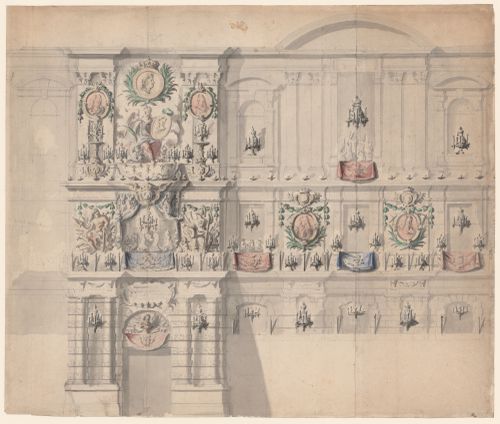
The drawing shows an elevation of the Porte Jean Goujon (now known as the Porte Barbet de Jouy) on the southern, quai-side façade of the Louvre, as well as part of the façade to the east of the portal. On the ground floor, candelabras line the windows and niches. The entry portal features a sculptural bust – likely a representation of Louis XIV – and a red banner with the king’s coat of arms. Above the portal’s tympanum is a large ovoid cartouche with faint script in black chalk that may read « Plate pour l’inscription, » indicating that the text had not yet been finalized at the time of the drawing’s creation. The heavily-decorated middle register features two over-life-size mythical and allegorical figures on either side of a balcony. To the left is Hercules, with his club, and to the right is an allegorical representation of Bellona. The balcony is hung with a blue tapestry woven with the king’s interlocking L monogram. Blue curtains with fleurs-de-lys hang over the balcony, revealing the revelers inside the building. These ornamental elements continue along the façade, which is hung with two large, circular portrait reliefs that likely show Louis XIV’s son, Grand Dauphin Louis, and grandson, Louis, the Duke of Burgundy, who was the father of the Duke of Brittany whose birth was being celebrated. Green watercolor paint is used to highlight the foliage festoons and palms that frame the portraits. On the top register of the portal is a seated allegorical figure holding a palm and a portrait, perhaps of the infant Louis, Duke of Brittany. Above her is a large, crowned medallion with the profile of Louis XIV in the guise of a Roman emperor surrounded by green palms. On either side of this central scene are large candelabras and circular portraits of the Grand Dauphin and the Duke of Burgundy. The architectural elements of the façade are carefully drawn in black chalk and faithfully render the architecture of the Louvre in the early eighteenth century.
DR1967:0012
Description:
The drawing shows an elevation of the Porte Jean Goujon (now known as the Porte Barbet de Jouy) on the southern, quai-side façade of the Louvre, as well as part of the façade to the east of the portal. On the ground floor, candelabras line the windows and niches. The entry portal features a sculptural bust – likely a representation of Louis XIV – and a red banner with the king’s coat of arms. Above the portal’s tympanum is a large ovoid cartouche with faint script in black chalk that may read « Plate pour l’inscription, » indicating that the text had not yet been finalized at the time of the drawing’s creation. The heavily-decorated middle register features two over-life-size mythical and allegorical figures on either side of a balcony. To the left is Hercules, with his club, and to the right is an allegorical representation of Bellona. The balcony is hung with a blue tapestry woven with the king’s interlocking L monogram. Blue curtains with fleurs-de-lys hang over the balcony, revealing the revelers inside the building. These ornamental elements continue along the façade, which is hung with two large, circular portrait reliefs that likely show Louis XIV’s son, Grand Dauphin Louis, and grandson, Louis, the Duke of Burgundy, who was the father of the Duke of Brittany whose birth was being celebrated. Green watercolor paint is used to highlight the foliage festoons and palms that frame the portraits. On the top register of the portal is a seated allegorical figure holding a palm and a portrait, perhaps of the infant Louis, Duke of Brittany. Above her is a large, crowned medallion with the profile of Louis XIV in the guise of a Roman emperor surrounded by green palms. On either side of this central scene are large candelabras and circular portraits of the Grand Dauphin and the Duke of Burgundy. The architectural elements of the façade are carefully drawn in black chalk and faithfully render the architecture of the Louvre in the early eighteenth century.
People:
Subject:
temporary architecture
temporary architecture
Date:
circa 1704
circa 1704
Title:
Design for ceremonial decorations at the Louvre
Actions:
DR1967:0012
Description:
The drawing shows an elevation of the Porte Jean Goujon (now known as the Porte Barbet de Jouy) on the southern, quai-side façade of the Louvre, as well as part of the façade to the east of the portal. On the ground floor, candelabras line the windows and niches. The entry portal features a sculptural bust – likely a representation of Louis XIV – and a red banner with the king’s coat of arms. Above the portal’s tympanum is a large ovoid cartouche with faint script in black chalk that may read « Plate pour l’inscription, » indicating that the text had not yet been finalized at the time of the drawing’s creation. The heavily-decorated middle register features two over-life-size mythical and allegorical figures on either side of a balcony. To the left is Hercules, with his club, and to the right is an allegorical representation of Bellona. The balcony is hung with a blue tapestry woven with the king’s interlocking L monogram. Blue curtains with fleurs-de-lys hang over the balcony, revealing the revelers inside the building. These ornamental elements continue along the façade, which is hung with two large, circular portrait reliefs that likely show Louis XIV’s son, Grand Dauphin Louis, and grandson, Louis, the Duke of Burgundy, who was the father of the Duke of Brittany whose birth was being celebrated. Green watercolor paint is used to highlight the foliage festoons and palms that frame the portraits. On the top register of the portal is a seated allegorical figure holding a palm and a portrait, perhaps of the infant Louis, Duke of Brittany. Above her is a large, crowned medallion with the profile of Louis XIV in the guise of a Roman emperor surrounded by green palms. On either side of this central scene are large candelabras and circular portraits of the Grand Dauphin and the Duke of Burgundy. The architectural elements of the façade are carefully drawn in black chalk and faithfully render the architecture of the Louvre in the early eighteenth century.
Design for ceremonial decorations at the Louvre
Actions:
DR1967:0012
Description:
The drawing shows an elevation of the Porte Jean Goujon (now known as the Porte Barbet de Jouy) on the southern, quai-side façade of the Louvre, as well as part of the façade to the east of the portal. On the ground floor, candelabras line the windows and niches. The entry portal features a sculptural bust – likely a representation of Louis XIV – and a red banner with the king’s coat of arms. Above the portal’s tympanum is a large ovoid cartouche with faint script in black chalk that may read « Plate pour l’inscription, » indicating that the text had not yet been finalized at the time of the drawing’s creation. The heavily-decorated middle register features two over-life-size mythical and allegorical figures on either side of a balcony. To the left is Hercules, with his club, and to the right is an allegorical representation of Bellona. The balcony is hung with a blue tapestry woven with the king’s interlocking L monogram. Blue curtains with fleurs-de-lys hang over the balcony, revealing the revelers inside the building. These ornamental elements continue along the façade, which is hung with two large, circular portrait reliefs that likely show Louis XIV’s son, Grand Dauphin Louis, and grandson, Louis, the Duke of Burgundy, who was the father of the Duke of Brittany whose birth was being celebrated. Green watercolor paint is used to highlight the foliage festoons and palms that frame the portraits. On the top register of the portal is a seated allegorical figure holding a palm and a portrait, perhaps of the infant Louis, Duke of Brittany. Above her is a large, crowned medallion with the profile of Louis XIV in the guise of a Roman emperor surrounded by green palms. On either side of this central scene are large candelabras and circular portraits of the Grand Dauphin and the Duke of Burgundy. The architectural elements of the façade are carefully drawn in black chalk and faithfully render the architecture of the Louvre in the early eighteenth century.
Form:
drawings
drawings
Date:
circa 1704
circa 1704
People:
Subject:
temporary architecture
temporary architecture
Level of archival description:
Project
Project
Reference number:
AP207.S1.1971.PR04
Description:
This project series documents Pettena's performance "Vestirsi Di Siede", also know in English as "Wearable Chairs". The performance was carried out between 3 pm and 5 pm on February 12, 1971, in the streets of Minneapolis by ten students of Pettena at the Minneapolis College of Art and Design. The students, each wearing a portable chair harnessed on their back, wandered around the city, either by foot or by bus, and than returned to the college. "In this performance, it was the body that activated and gave meaning to the object: the chair only taking on meaning when carried, otherwise, it became disjointed." [1] The chairs were then put on display at the Minneapolis Institute of Art. A second edition of the performance was also carried out with the students from Nuova Accademia di Belle Arti (NABA) in Milan, 2011, and an installation of the chairs was presented at the exhibition "Un art pauvre" at the Centre Pompidou in 2016. The project series contains photographs of the performance by the students of the Minneapolis College of Art and Design and photographs of the exhibit at the Minneapolis Institute of Art in 1971. It also contains three sketches for the chairs, a drawing of the performance and a statement about the perfomance. The project series also includes photographs of the performance of the NABA students in 2011. Source: [1] FRAC Centre-Val de Loire, http://www.frac-centre.fr/_en/art-and-architecture-collection/pettena-gianni/wearable-chairs-verstirsi-siede-317.html?authID=148&ensembleID=1286 (last accessed 11 November 2019)
AP207.S1.1971.PR04
Description:
This project series documents Pettena's performance "Vestirsi Di Siede", also know in English as "Wearable Chairs". The performance was carried out between 3 pm and 5 pm on February 12, 1971, in the streets of Minneapolis by ten students of Pettena at the Minneapolis College of Art and Design. The students, each wearing a portable chair harnessed on their back, wandered around the city, either by foot or by bus, and than returned to the college. "In this performance, it was the body that activated and gave meaning to the object: the chair only taking on meaning when carried, otherwise, it became disjointed." [1] The chairs were then put on display at the Minneapolis Institute of Art. A second edition of the performance was also carried out with the students from Nuova Accademia di Belle Arti (NABA) in Milan, 2011, and an installation of the chairs was presented at the exhibition "Un art pauvre" at the Centre Pompidou in 2016. The project series contains photographs of the performance by the students of the Minneapolis College of Art and Design and photographs of the exhibit at the Minneapolis Institute of Art in 1971. It also contains three sketches for the chairs, a drawing of the performance and a statement about the perfomance. The project series also includes photographs of the performance of the NABA students in 2011. Source: [1] FRAC Centre-Val de Loire, http://www.frac-centre.fr/_en/art-and-architecture-collection/pettena-gianni/wearable-chairs-verstirsi-siede-317.html?authID=148&ensembleID=1286 (last accessed 11 November 2019)
People:
Date:
1971-2017
1971-2017
Title:
Vestirsi Di Siede [Wearable Chairs] (1971)
Actions:
AP207.S1.1971.PR04
Description:
This project series documents Pettena's performance "Vestirsi Di Siede", also know in English as "Wearable Chairs". The performance was carried out between 3 pm and 5 pm on February 12, 1971, in the streets of Minneapolis by ten students of Pettena at the Minneapolis College of Art and Design. The students, each wearing a portable chair harnessed on their back, wandered around the city, either by foot or by bus, and than returned to the college. "In this performance, it was the body that activated and gave meaning to the object: the chair only taking on meaning when carried, otherwise, it became disjointed." [1] The chairs were then put on display at the Minneapolis Institute of Art. A second edition of the performance was also carried out with the students from Nuova Accademia di Belle Arti (NABA) in Milan, 2011, and an installation of the chairs was presented at the exhibition "Un art pauvre" at the Centre Pompidou in 2016. The project series contains photographs of the performance by the students of the Minneapolis College of Art and Design and photographs of the exhibit at the Minneapolis Institute of Art in 1971. It also contains three sketches for the chairs, a drawing of the performance and a statement about the perfomance. The project series also includes photographs of the performance of the NABA students in 2011. Source: [1] FRAC Centre-Val de Loire, http://www.frac-centre.fr/_en/art-and-architecture-collection/pettena-gianni/wearable-chairs-verstirsi-siede-317.html?authID=148&ensembleID=1286 (last accessed 11 November 2019)
Vestirsi Di Siede [Wearable Chairs] (1971)
Actions:
AP207.S1.1971.PR04
Description:
This project series documents Pettena's performance "Vestirsi Di Siede", also know in English as "Wearable Chairs". The performance was carried out between 3 pm and 5 pm on February 12, 1971, in the streets of Minneapolis by ten students of Pettena at the Minneapolis College of Art and Design. The students, each wearing a portable chair harnessed on their back, wandered around the city, either by foot or by bus, and than returned to the college. "In this performance, it was the body that activated and gave meaning to the object: the chair only taking on meaning when carried, otherwise, it became disjointed." [1] The chairs were then put on display at the Minneapolis Institute of Art. A second edition of the performance was also carried out with the students from Nuova Accademia di Belle Arti (NABA) in Milan, 2011, and an installation of the chairs was presented at the exhibition "Un art pauvre" at the Centre Pompidou in 2016. The project series contains photographs of the performance by the students of the Minneapolis College of Art and Design and photographs of the exhibit at the Minneapolis Institute of Art in 1971. It also contains three sketches for the chairs, a drawing of the performance and a statement about the perfomance. The project series also includes photographs of the performance of the NABA students in 2011. Source: [1] FRAC Centre-Val de Loire, http://www.frac-centre.fr/_en/art-and-architecture-collection/pettena-gianni/wearable-chairs-verstirsi-siede-317.html?authID=148&ensembleID=1286 (last accessed 11 November 2019)
Level of archival description:
Project
Project
Date:
1971-2017
1971-2017
People:
Form:
drawings
drawings
Title:
Design for a city-park gate
Design for a city-park gate
Actions:
Reference number:
DR1981:0034
Description:
- A rendered elevation (and a plan in the upper left corner) of a city-park gate comprised of a monumental central arch and lower lateral wings with fountains. The style of the architecture is Neo-Baroque. Set in a monochrome, wash-rendered park landscape with a vignette of an 18th-century horse-and-carriage in the left foreground, the line drawing of the gate is competent, although the shadow projections are incorrectly drawn.
DR1981:0034
Description:
- A rendered elevation (and a plan in the upper left corner) of a city-park gate comprised of a monumental central arch and lower lateral wings with fountains. The style of the architecture is Neo-Baroque. Set in a monochrome, wash-rendered park landscape with a vignette of an 18th-century horse-and-carriage in the left foreground, the line drawing of the gate is competent, although the shadow projections are incorrectly drawn.
People:
Subject:
architecture, landscape architecture
architecture, landscape architecture
Date:
late 19th century ?
late 19th century ?
Title:
Design for a city-park gate
Actions:
DR1981:0034
Description:
- A rendered elevation (and a plan in the upper left corner) of a city-park gate comprised of a monumental central arch and lower lateral wings with fountains. The style of the architecture is Neo-Baroque. Set in a monochrome, wash-rendered park landscape with a vignette of an 18th-century horse-and-carriage in the left foreground, the line drawing of the gate is competent, although the shadow projections are incorrectly drawn.
Design for a city-park gate
Actions:
DR1981:0034
Description:
- A rendered elevation (and a plan in the upper left corner) of a city-park gate comprised of a monumental central arch and lower lateral wings with fountains. The style of the architecture is Neo-Baroque. Set in a monochrome, wash-rendered park landscape with a vignette of an 18th-century horse-and-carriage in the left foreground, the line drawing of the gate is competent, although the shadow projections are incorrectly drawn.
Form:
drawings
drawings
Date:
late 19th century ?
late 19th century ?
People:
Subject:
architecture, landscape architecture
architecture, landscape architecture
Form:
exhibitions
exhibitions
Title:
Mies in America
Mies in America
Actions:
Description:
A profound thinker, painstaking artist, and one of the greatest architects in history, Ludwig Mies van der Rohe emigrated from Germany to the United States in 1938, when he was already in his fifties and one of the recognized masters of his profession. Transplanted from the Bauhaus (of which he was the last director) to a technical institute in Chicago, from the European(...)
A profound thinker, painstaking artist, and one of the greatest architects in history, Ludwig Mies van der Rohe emigrated from Germany to the United States in 1938, when he was already in his fifties and one of the recognized masters of his profession. Transplanted from the Bauhaus (of which he was the last director) to a technical institute in Chicago, from the European(...)
Location:
Main galleries
Main galleries
Date:
17 October 2001 to 20 January 2002
17 October 2001 to 20 January 2002
Title:
Mies in America
Actions:
Description:
A profound thinker, painstaking artist, and one of the greatest architects in history, Ludwig Mies van der Rohe emigrated from Germany to the United States in 1938, when he was already in his fifties and one of the recognized masters of his profession. Transplanted from the Bauhaus (of which he was the last director) to a technical institute in Chicago, from the European(...)
Mies in America
Actions:
Description:
A profound thinker, painstaking artist, and one of the greatest architects in history, Ludwig Mies van der Rohe emigrated from Germany to the United States in 1938, when he was already in his fifties and one of the recognized masters of his profession. Transplanted from the Bauhaus (of which he was the last director) to a technical institute in Chicago, from the European(...)
Form:
exhibitions
exhibitions
Date:
17 October 2001 to
20 January 2002
17 October 2001 to
20 January 2002
Location:
Main galleries
Main galleries
Level of archival description:
Project
Project
Reference number:
AP056.S1.1999.PR01
Description:
This project series documents the Canadian Embassy in Berlin, Germany from 1999-2005. The office identified the project number as 9903. This project consisted of a new embassy building for Canada in the reunified German capital located at the junction of Leipziger Platz and Potsdamer Platz. The embassy was built in joint venture with Gagnon Letellier Cyr Architects and Smith Carter Architects and Engineers. The firms were selected for the project by the Canadian Department of Foreign Affairs and International Trade after a national competition was held. The competition jury had chosen a different design, by architecture firm Saucier + Perrotte.[1] The embassy, built to follow the original octagonal wall of Leipziger Platz, had a stone exterior punched with windows, as dictated by the District Office of Central Berlin's guidelines.[2] It occupied the first four floors of the Leipziger Platz block and all floors of the Ebertstrasse block. Inside, the Focus Canada Centre off the Ebertstrasse entrance served as the central government information centre and included interactive kiosks. The Embassy Reception Hall, complete was an Inuksuk at its entrance, was a space that greeted guests and provided consular services. The Canada Lounge defined the ground floor and provided a space where visitors could engage with Canadian news through newspapers, radios and televisions. The cylindrical Great Timber Hall pierced through the embassy. This wood-lined space had a sky-light ceiling to allow natural light to flow inside and served as an executive meeting room and a space for special guests, entertainment, events and exhibits. Retail spaces were also provided along Vossstrasse and a residential component made up the upper floors of Leipziger Platz. The project is recorded through a model and drawings dating from 1998-2000. The large part of these drawings are sketches, but plans, elevations, sections, perspectives and details are also included. [1] Adele Weder, "A Berlin Chronicle," The Canadian Architect, June 20, 1999, 20-21. [2] "Canadian Embassy Berlin." KPMB. Accessed April 18, 2019. http://www.kpmb.com/project/canadian-embassy-berlin/
AP056.S1.1999.PR01
Description:
This project series documents the Canadian Embassy in Berlin, Germany from 1999-2005. The office identified the project number as 9903. This project consisted of a new embassy building for Canada in the reunified German capital located at the junction of Leipziger Platz and Potsdamer Platz. The embassy was built in joint venture with Gagnon Letellier Cyr Architects and Smith Carter Architects and Engineers. The firms were selected for the project by the Canadian Department of Foreign Affairs and International Trade after a national competition was held. The competition jury had chosen a different design, by architecture firm Saucier + Perrotte.[1] The embassy, built to follow the original octagonal wall of Leipziger Platz, had a stone exterior punched with windows, as dictated by the District Office of Central Berlin's guidelines.[2] It occupied the first four floors of the Leipziger Platz block and all floors of the Ebertstrasse block. Inside, the Focus Canada Centre off the Ebertstrasse entrance served as the central government information centre and included interactive kiosks. The Embassy Reception Hall, complete was an Inuksuk at its entrance, was a space that greeted guests and provided consular services. The Canada Lounge defined the ground floor and provided a space where visitors could engage with Canadian news through newspapers, radios and televisions. The cylindrical Great Timber Hall pierced through the embassy. This wood-lined space had a sky-light ceiling to allow natural light to flow inside and served as an executive meeting room and a space for special guests, entertainment, events and exhibits. Retail spaces were also provided along Vossstrasse and a residential component made up the upper floors of Leipziger Platz. The project is recorded through a model and drawings dating from 1998-2000. The large part of these drawings are sketches, but plans, elevations, sections, perspectives and details are also included. [1] Adele Weder, "A Berlin Chronicle," The Canadian Architect, June 20, 1999, 20-21. [2] "Canadian Embassy Berlin." KPMB. Accessed April 18, 2019. http://www.kpmb.com/project/canadian-embassy-berlin/
People:
Date:
1998-2000
1998-2000
Title:
Canadian Embassy, Berlin, Germany (1999-2005)
Actions:
AP056.S1.1999.PR01
Description:
This project series documents the Canadian Embassy in Berlin, Germany from 1999-2005. The office identified the project number as 9903. This project consisted of a new embassy building for Canada in the reunified German capital located at the junction of Leipziger Platz and Potsdamer Platz. The embassy was built in joint venture with Gagnon Letellier Cyr Architects and Smith Carter Architects and Engineers. The firms were selected for the project by the Canadian Department of Foreign Affairs and International Trade after a national competition was held. The competition jury had chosen a different design, by architecture firm Saucier + Perrotte.[1] The embassy, built to follow the original octagonal wall of Leipziger Platz, had a stone exterior punched with windows, as dictated by the District Office of Central Berlin's guidelines.[2] It occupied the first four floors of the Leipziger Platz block and all floors of the Ebertstrasse block. Inside, the Focus Canada Centre off the Ebertstrasse entrance served as the central government information centre and included interactive kiosks. The Embassy Reception Hall, complete was an Inuksuk at its entrance, was a space that greeted guests and provided consular services. The Canada Lounge defined the ground floor and provided a space where visitors could engage with Canadian news through newspapers, radios and televisions. The cylindrical Great Timber Hall pierced through the embassy. This wood-lined space had a sky-light ceiling to allow natural light to flow inside and served as an executive meeting room and a space for special guests, entertainment, events and exhibits. Retail spaces were also provided along Vossstrasse and a residential component made up the upper floors of Leipziger Platz. The project is recorded through a model and drawings dating from 1998-2000. The large part of these drawings are sketches, but plans, elevations, sections, perspectives and details are also included. [1] Adele Weder, "A Berlin Chronicle," The Canadian Architect, June 20, 1999, 20-21. [2] "Canadian Embassy Berlin." KPMB. Accessed April 18, 2019. http://www.kpmb.com/project/canadian-embassy-berlin/
Canadian Embassy, Berlin, Germany (1999-2005)
Actions:
AP056.S1.1999.PR01
Description:
This project series documents the Canadian Embassy in Berlin, Germany from 1999-2005. The office identified the project number as 9903. This project consisted of a new embassy building for Canada in the reunified German capital located at the junction of Leipziger Platz and Potsdamer Platz. The embassy was built in joint venture with Gagnon Letellier Cyr Architects and Smith Carter Architects and Engineers. The firms were selected for the project by the Canadian Department of Foreign Affairs and International Trade after a national competition was held. The competition jury had chosen a different design, by architecture firm Saucier + Perrotte.[1] The embassy, built to follow the original octagonal wall of Leipziger Platz, had a stone exterior punched with windows, as dictated by the District Office of Central Berlin's guidelines.[2] It occupied the first four floors of the Leipziger Platz block and all floors of the Ebertstrasse block. Inside, the Focus Canada Centre off the Ebertstrasse entrance served as the central government information centre and included interactive kiosks. The Embassy Reception Hall, complete was an Inuksuk at its entrance, was a space that greeted guests and provided consular services. The Canada Lounge defined the ground floor and provided a space where visitors could engage with Canadian news through newspapers, radios and televisions. The cylindrical Great Timber Hall pierced through the embassy. This wood-lined space had a sky-light ceiling to allow natural light to flow inside and served as an executive meeting room and a space for special guests, entertainment, events and exhibits. Retail spaces were also provided along Vossstrasse and a residential component made up the upper floors of Leipziger Platz. The project is recorded through a model and drawings dating from 1998-2000. The large part of these drawings are sketches, but plans, elevations, sections, perspectives and details are also included. [1] Adele Weder, "A Berlin Chronicle," The Canadian Architect, June 20, 1999, 20-21. [2] "Canadian Embassy Berlin." KPMB. Accessed April 18, 2019. http://www.kpmb.com/project/canadian-embassy-berlin/
Level of archival description:
Project
Project
Date:
1998-2000
1998-2000
People:


