


1979 Results
Form:
audio
audio
Description:
1 online resource.
Author:
Subject:
Publication:
[Place of publication not identified] : Secession, 2025.
[Place of publication not identified] : Secession, 2025.
Title:
Artists: Beatriz Santiago Muñoz in conversation with Bettina Spörr.
Actions:
Description:
1 online resource.
Artists: Beatriz Santiago Muñoz in conversation with Bettina Spörr.
Actions:
Description:
1 online resource.
Form:
audio
audio
Publication:
[Place of publication not identified] : Secession, 2025.
[Place of publication not identified] : Secession, 2025.
Author:
Subject:
Form:
journals and magazines
journals and magazines
Actions:
Price:
$44.95
(available to order)
Summary:
Building plots are becoming scarce, housing costs are soaring, and apartments in new developments are shrinking. Properties long considered unsuitable or uneconomical for building are now being developed, and residential units are increasingly stacked – side by side and on top of each other – into ever-larger blocks. Standardisation and industrial prefabrication seem(...)
Title:
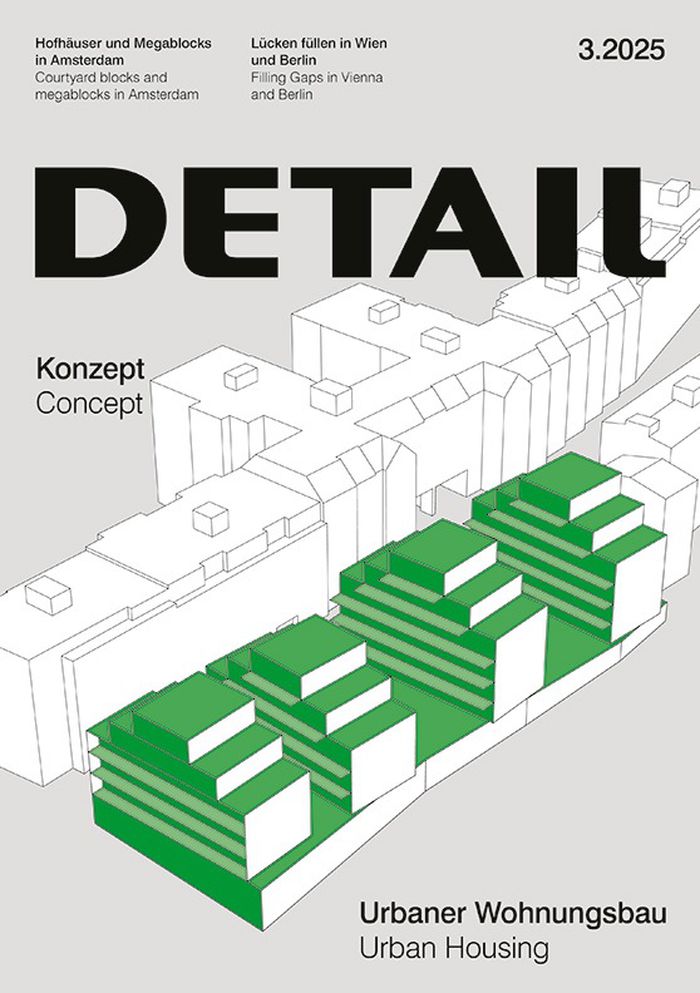
Detail 03 2025: Urban housing
Actions:
Price:
$44.95
(available to order)
Summary:
Building plots are becoming scarce, housing costs are soaring, and apartments in new developments are shrinking. Properties long considered unsuitable or uneconomical for building are now being developed, and residential units are increasingly stacked – side by side and on top of each other – into ever-larger blocks. Standardisation and industrial prefabrication seem indespensible. The March issue presents outstanding housing projects in Amsterdam, Barcelona, Brooklyn, Brussels, Frankfurt, and Vienna, showcasing innovative responses to urban challenges.
Form:
journals and magazines
journals and magazines
Publication:
March 2025
March 2025
Subject:
Magazines
Magazines
Form:
journals and magazines
journals and magazines
Actions:
Price:
$44.95
(available to order)
Summary:
Around 75 % of residential buildings in Germany are made of masonry – a trend likely mirrored across Europe, such as in the southern regions and the UK. This enduring preference reflects growing confidence in solid construction and provides the impetus for dedicating this issue of Detail to the topic. There are many reasons to opt for brick, including local building(...)
Title:
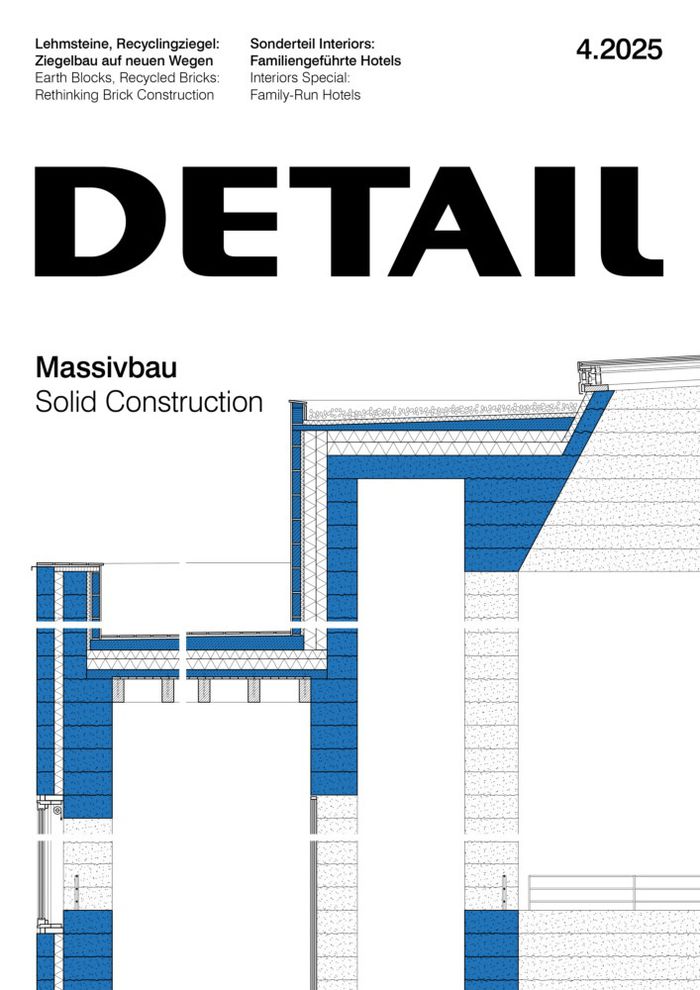
Detail 4 2025: Solid construction
Actions:
Price:
$44.95
(available to order)
Summary:
Around 75 % of residential buildings in Germany are made of masonry – a trend likely mirrored across Europe, such as in the southern regions and the UK. This enduring preference reflects growing confidence in solid construction and provides the impetus for dedicating this issue of Detail to the topic. There are many reasons to opt for brick, including local building traditions. In Limerick, Ireland, Níall McLaughlin Architects designed a brick exhibition building celebrating rugby, the national sport. In Berlin, nearby brick cemetery structures inspired the facade colour of a foundation centre. Using single-coloured exposed concrete and two brick types, AFF Architekten made a bold red statement in the cityscape.
Form:
journals and magazines
journals and magazines
Publication:
April 2025
April 2025
Subject:
Magazines
Magazines
Form:
books
books

Title:
Log 63: winter/spring 2025
Log 63: winter/spring 2025
Actions:
Price:
$25.00
(available in store)
Summary:
In Log 63, poet Emily Stewart walks around Graz and thinks of "Doreen Massey’s notion of 'throwntogetherness,' a term she uses to gather the multifarious threads of what it means to think speculatively in space and time." In a sense, this open issue of Log is an example of that throwntogetherness, with threads connecting ideas and voices, across time and space, on a range(...)
Title:
Log 63: winter/spring 2025
Actions:
Price:
$25.00
(available in store)
Summary:
In Log 63, poet Emily Stewart walks around Graz and thinks of "Doreen Massey’s notion of 'throwntogetherness,' a term she uses to gather the multifarious threads of what it means to think speculatively in space and time." In a sense, this open issue of Log is an example of that throwntogetherness, with threads connecting ideas and voices, across time and space, on a range of concerns in and about architecture today.
Form:
books
books
Publication:
March 2025
March 2025
Subject:
Magazines
Magazines
Form:
books
books
Actions:
Price:
$52.00
(available in store)
Summary:
The cradle-to-cradle principle envisions buildings returning to the natural cycle after use. In practice, however, most are only partially composed of natural or compostable materials. One notable exception is Florian Nagler’s Garden House, winner of the Detail Award, which closely follows this principle. Another route is the reuse or refurbishment of components from(...)
Title:
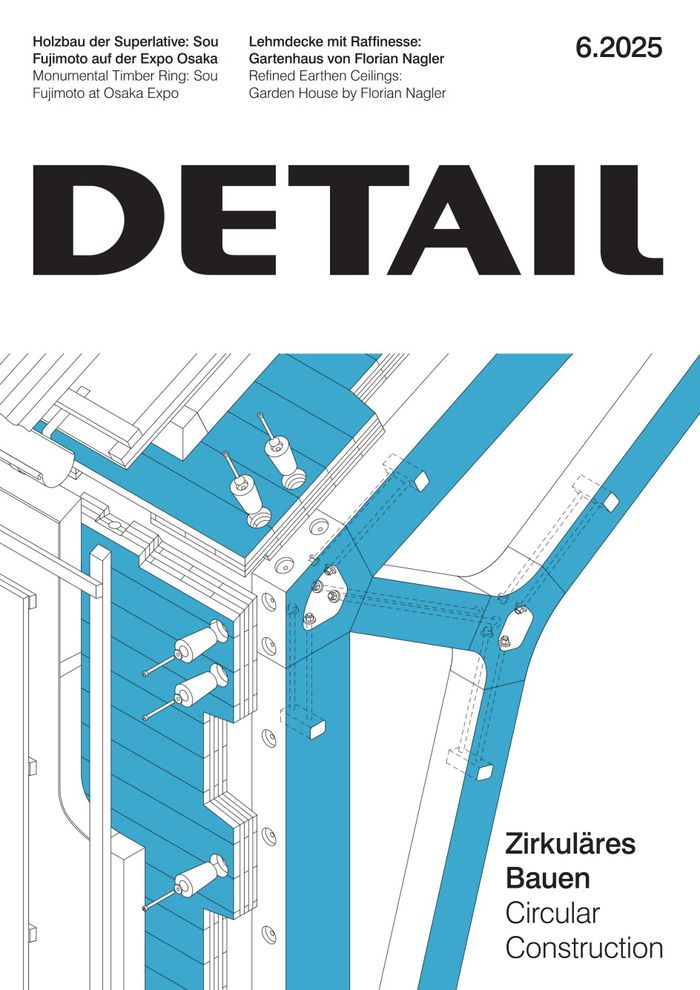
Detail 6 2025 : Circular construction
Actions:
Price:
$52.00
(available in store)
Summary:
The cradle-to-cradle principle envisions buildings returning to the natural cycle after use. In practice, however, most are only partially composed of natural or compostable materials. One notable exception is Florian Nagler’s Garden House, winner of the Detail Award, which closely follows this principle. Another route is the reuse or refurbishment of components from demolished buildings. But this, too, is complex – components are often scarce and costly to extract and and make fit for new applications. To facilitate recycling, some structures are being designed for disassembly. Yet even timber joints fixed with screws can prove difficult to undo after years in place. A research group in Arles sees itself as a recycler of remnants, developing new materials from construction debris and agricultural waste: sunflower stalks become acoustic panels, while rice straw from cultivation is turned into insulation. The team also experiments with local resources: in nearby salt pans, salt crystallises on metal racks to form tiles, while algae are used to make lamps, vases, and wall finishes. Architecture made from rubble, clad in salt, rice, and seaweed – a compelling vision of the future. Perhaps the most promising path lies in combining these diverse strategies.
Form:
books
books
Publication:
June 2025
June 2025
Subject:
Magazines
Magazines
Form:
journals and magazines
journals and magazines

Title:
Anima issue 3, spring 2025
Anima issue 3, spring 2025
Actions:
Price:
$30.00
(available in store)
Summary:
This is the third issue of Anima, and it has a new format and look, thanks to Cabinet Milano. They have worked hard to create a magazine that offers substance as well as a striking graphic identity. In this edition, Dalia Al-Dujaili writes about the essential role that design and architecture play in the struggle of the Palestinian people to protect their identity from(...)
Title:
Anima issue 3, spring 2025
Actions:
Price:
$30.00
(available in store)
Summary:
This is the third issue of Anima, and it has a new format and look, thanks to Cabinet Milano. They have worked hard to create a magazine that offers substance as well as a striking graphic identity. In this edition, Dalia Al-Dujaili writes about the essential role that design and architecture play in the struggle of the Palestinian people to protect their identity from erasure. She speaks to designer and architect Lara Salous, artist Jordan Nassar, and brothers Yousef and Elias Anastas, who are partners at AAU ANASTAS, and co-founders of Local Industries, Radio alHara and The Wonder Cabinet.
Form:
journals and magazines
journals and magazines
Publication:
June 2025
June 2025
Subject:
Magazines
Magazines
Form:
journals and magazines
journals and magazines
Actions:
Price:
$52.00
(available in store)
Summary:
We humans long for daylight, a view of greenery, and a sense of connection. Yet today, transparent building envelopes seem less in demand. Instead of granting views in and out, we create retreats. What forms of transparency remain desirable amid social uncertainty and urban densification? And do transparent or translucent envelopes still make sense when contemporary(...)
Title:
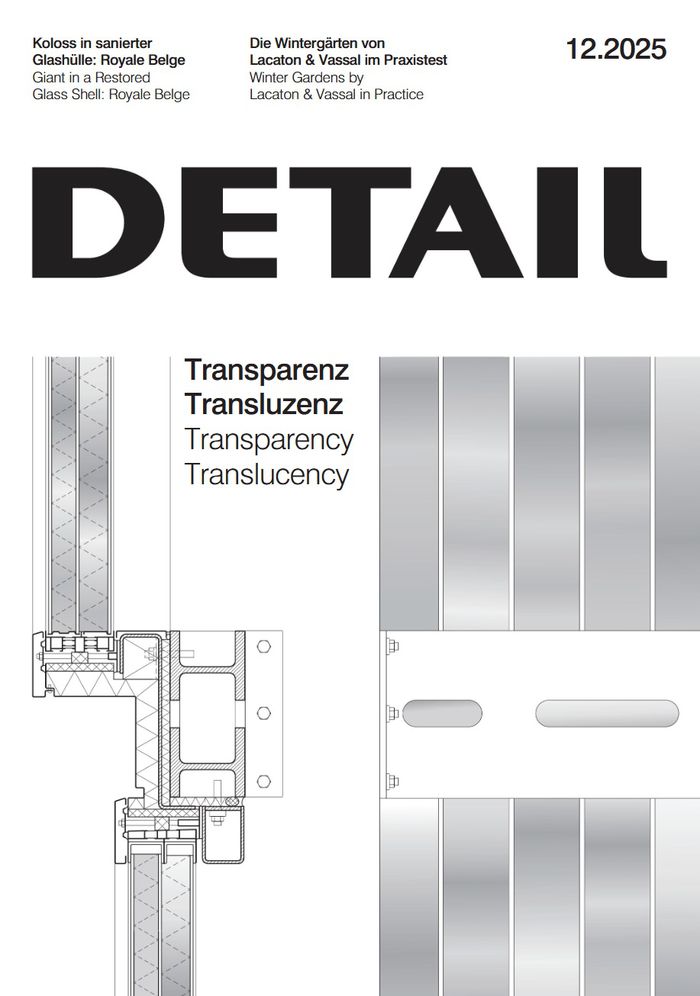
Detail 12 2025 : Transparency translucency
Actions:
Price:
$52.00
(available in store)
Summary:
We humans long for daylight, a view of greenery, and a sense of connection. Yet today, transparent building envelopes seem less in demand. Instead of granting views in and out, we create retreats. What forms of transparency remain desirable amid social uncertainty and urban densification? And do transparent or translucent envelopes still make sense when contemporary energy concepts are applied? Light, air, and sun are no longer universally welcome. The spaces behind the climate envelope must be protected from solar gains and heat loss. Limited opening ratios, smart building technology, and algorithm-driven facade design have become the norm. In such scenarios, people are treated as disruptive elements, better kept passive. Anne Lacaton and Jean-Philippe Vassal show that another way is possible. Working with 51N4E in Brussels, Lacaton & Vassal recently extended a residential block in the Peterbos district using their familiar approach: adding new winter gardens. Transparent and translucent sliding panels alternate, while curtains provide shade or privacy when needed. The result is adaptable space that responds to changing conditions – yet always leaves the final decision to the human user. A drawn curtain can create a sense of withdrawal, but it can just as easily be opened again
Form:
journals and magazines
journals and magazines
Publication:
December 2025
December 2025
Subject:
Magazines
Magazines
Form:
audio
audio
Title:
Aural Fragmentation
Aural Fragmentation
Actions:
Description:
1 online resource (1 audio file)
Subject:
Publication:
Storefront for Art and Architecture 2025
Storefront for Art and Architecture 2025
Form:
audio
audio
Publication:
Storefront for Art and Architecture 2025
Storefront for Art and Architecture 2025
Subject:
Form:
books
books
Actions:
Holdings:
Description:
344 pages : illustrations (some color), maps, plans ; 24 x 31 cm
Description:
344 pages : illustrations (some color), maps, plans ; 24 x 31 cm
Author:
Subject:
Publication:
New York : Orion Press, [1967]
New York : Orion Press, [1967]
Title:
The radiant city : elements of a doctrine of urbanism to be used as the basis of our machine-age civilization / Le Corbusier.
Actions:
Holdings:
Description:
344 pages : illustrations (some color), maps, plans ; 24 x 31 cm
The radiant city : elements of a doctrine of urbanism to be used as the basis of our machine-age civilization / Le Corbusier.
Actions:
Holdings:
Description:
344 pages : illustrations (some color), maps, plans ; 24 x 31 cm
Form:
books
books
Publication:
New York : Orion Press, [1967]
New York : Orion Press, [1967]
Author:
Subject:
Form:
books
books
Actions:
Holdings:
Description:
272 pages : illustrations (some colour) ; 28 cm
Description:
272 pages : illustrations (some colour) ; 28 cm
Author:
Subject:
Publication:
New Haven ; London : Yale University Press : published in association with the National Trust, [2025], ©2025
New Haven ; London : Yale University Press : published in association with the National Trust, [2025], ©2025
Title:
Standen : Philip Webb, Morris & Co. and the creation of an arts and crafts home / Anne Stutchbury, Tessa Wild, Stephen Ponder and Alice M. Strickland.
Actions:
Holdings:
Description:
272 pages : illustrations (some colour) ; 28 cm
Standen : Philip Webb, Morris & Co. and the creation of an arts and crafts home / Anne Stutchbury, Tessa Wild, Stephen Ponder and Alice M. Strickland.
Actions:
Holdings:
Description:
272 pages : illustrations (some colour) ; 28 cm
Form:
books
books
Publication:
New Haven ; London : Yale University Press : published in association with the National Trust, [2025], ©2025
New Haven ; London : Yale University Press : published in association with the National Trust, [2025], ©2025
Author:
Subject:


