


44145 Results
Level of archival description:
Project
Project
Reference number:
AP148.S1.1970.PR02
Description:
The project series documents Poli's work on the Interplanetary Architecture project, which was also made into a film by Superstudio directed by Alessandro Poli (the film is not included in the fonds). The project reflects Poli's deep fascination with the moon landing in 1969. Poli uses this major media event as a catalyst for thinking about a new approach to architecture and tools for design, including the idea that film and the movie camera should become part of the toolset. The project also seems to be in some way a response to Epoch magazine's challenge for a "Primo concorso di architettura nello spazio" (the first architectural competition in space), and includes much imagery and textual references to a new road or architectural links between the earth and other planets, including an earth moon highway. In his storyboard, Poli also makes reference to his earlier Piper project, and some imagery features wheels and an amusement park. The Interplanetary Architecture project was exhibited by Superstudio in Rome in 1972 and featured in "Casabella" magazine in April 1972 (no. 364). The project was also featured in the 2010 CCA exhibition "Other Space Odysseys". In the accompanying CCA publication, Poli describes this project as "a voyage off earthbound routes in quest of architecture unfettered by the urban nightmare, by induced needs or by planning as the only tool for regulating and solving the world's problems" (Poli quoted in Borasi and Zardini, 2010, 110). Poli's work on this project is deeply tied to the Zeno project, which was also featured in this exhibition and is included in this fonds (see AP148.S1.1972.PR01). For the Zeno project, Poli envisioned a dialogue between astronaut Buzz Aldrin and an Italian peasant, Zeno of Riparbella. Poli felt that these two shared a similarity in that both their homes were isolated capsules, one that provided a lens from which to see the rest of the world and understand their place in it. The material in the series includes numerous photomontages and collages of astronauts in space, as well as drawings of plantery shapes and structures. There are also texts, some of which include calculations of distances and diameters of planets, as well as notebooks and sketchbooks, many of which Poli included in a folder he entitled "Storyboard." The series also includes an unsent letter from Poli to Adolfo Natalini which describes how, after the moon landing, everything - the planet, the moon, the stars - is architecture, and that this will necessitate the need for new design tools, such as the movie camera. Some works are signed Alessandro Poli-Superstudio. Source cited: Giovanna Borasi and Mirko Zardini, eds., Other Space Odysseys, Montreal and Baden: Canadian Centre for Architecture/Lars Müller Publishers, 2010.
AP148.S1.1970.PR02
Description:
The project series documents Poli's work on the Interplanetary Architecture project, which was also made into a film by Superstudio directed by Alessandro Poli (the film is not included in the fonds). The project reflects Poli's deep fascination with the moon landing in 1969. Poli uses this major media event as a catalyst for thinking about a new approach to architecture and tools for design, including the idea that film and the movie camera should become part of the toolset. The project also seems to be in some way a response to Epoch magazine's challenge for a "Primo concorso di architettura nello spazio" (the first architectural competition in space), and includes much imagery and textual references to a new road or architectural links between the earth and other planets, including an earth moon highway. In his storyboard, Poli also makes reference to his earlier Piper project, and some imagery features wheels and an amusement park. The Interplanetary Architecture project was exhibited by Superstudio in Rome in 1972 and featured in "Casabella" magazine in April 1972 (no. 364). The project was also featured in the 2010 CCA exhibition "Other Space Odysseys". In the accompanying CCA publication, Poli describes this project as "a voyage off earthbound routes in quest of architecture unfettered by the urban nightmare, by induced needs or by planning as the only tool for regulating and solving the world's problems" (Poli quoted in Borasi and Zardini, 2010, 110). Poli's work on this project is deeply tied to the Zeno project, which was also featured in this exhibition and is included in this fonds (see AP148.S1.1972.PR01). For the Zeno project, Poli envisioned a dialogue between astronaut Buzz Aldrin and an Italian peasant, Zeno of Riparbella. Poli felt that these two shared a similarity in that both their homes were isolated capsules, one that provided a lens from which to see the rest of the world and understand their place in it. The material in the series includes numerous photomontages and collages of astronauts in space, as well as drawings of plantery shapes and structures. There are also texts, some of which include calculations of distances and diameters of planets, as well as notebooks and sketchbooks, many of which Poli included in a folder he entitled "Storyboard." The series also includes an unsent letter from Poli to Adolfo Natalini which describes how, after the moon landing, everything - the planet, the moon, the stars - is architecture, and that this will necessitate the need for new design tools, such as the movie camera. Some works are signed Alessandro Poli-Superstudio. Source cited: Giovanna Borasi and Mirko Zardini, eds., Other Space Odysseys, Montreal and Baden: Canadian Centre for Architecture/Lars Müller Publishers, 2010.
People:
Date:
1969-1971
1969-1971
Title:
Architettura Interplanetaria [Interplanetary Architecture] (1970-1971)
Actions:
AP148.S1.1970.PR02
Description:
The project series documents Poli's work on the Interplanetary Architecture project, which was also made into a film by Superstudio directed by Alessandro Poli (the film is not included in the fonds). The project reflects Poli's deep fascination with the moon landing in 1969. Poli uses this major media event as a catalyst for thinking about a new approach to architecture and tools for design, including the idea that film and the movie camera should become part of the toolset. The project also seems to be in some way a response to Epoch magazine's challenge for a "Primo concorso di architettura nello spazio" (the first architectural competition in space), and includes much imagery and textual references to a new road or architectural links between the earth and other planets, including an earth moon highway. In his storyboard, Poli also makes reference to his earlier Piper project, and some imagery features wheels and an amusement park. The Interplanetary Architecture project was exhibited by Superstudio in Rome in 1972 and featured in "Casabella" magazine in April 1972 (no. 364). The project was also featured in the 2010 CCA exhibition "Other Space Odysseys". In the accompanying CCA publication, Poli describes this project as "a voyage off earthbound routes in quest of architecture unfettered by the urban nightmare, by induced needs or by planning as the only tool for regulating and solving the world's problems" (Poli quoted in Borasi and Zardini, 2010, 110). Poli's work on this project is deeply tied to the Zeno project, which was also featured in this exhibition and is included in this fonds (see AP148.S1.1972.PR01). For the Zeno project, Poli envisioned a dialogue between astronaut Buzz Aldrin and an Italian peasant, Zeno of Riparbella. Poli felt that these two shared a similarity in that both their homes were isolated capsules, one that provided a lens from which to see the rest of the world and understand their place in it. The material in the series includes numerous photomontages and collages of astronauts in space, as well as drawings of plantery shapes and structures. There are also texts, some of which include calculations of distances and diameters of planets, as well as notebooks and sketchbooks, many of which Poli included in a folder he entitled "Storyboard." The series also includes an unsent letter from Poli to Adolfo Natalini which describes how, after the moon landing, everything - the planet, the moon, the stars - is architecture, and that this will necessitate the need for new design tools, such as the movie camera. Some works are signed Alessandro Poli-Superstudio. Source cited: Giovanna Borasi and Mirko Zardini, eds., Other Space Odysseys, Montreal and Baden: Canadian Centre for Architecture/Lars Müller Publishers, 2010.
Architettura Interplanetaria [Interplanetary Architecture] (1970-1971)
Actions:
AP148.S1.1970.PR02
Description:
The project series documents Poli's work on the Interplanetary Architecture project, which was also made into a film by Superstudio directed by Alessandro Poli (the film is not included in the fonds). The project reflects Poli's deep fascination with the moon landing in 1969. Poli uses this major media event as a catalyst for thinking about a new approach to architecture and tools for design, including the idea that film and the movie camera should become part of the toolset. The project also seems to be in some way a response to Epoch magazine's challenge for a "Primo concorso di architettura nello spazio" (the first architectural competition in space), and includes much imagery and textual references to a new road or architectural links between the earth and other planets, including an earth moon highway. In his storyboard, Poli also makes reference to his earlier Piper project, and some imagery features wheels and an amusement park. The Interplanetary Architecture project was exhibited by Superstudio in Rome in 1972 and featured in "Casabella" magazine in April 1972 (no. 364). The project was also featured in the 2010 CCA exhibition "Other Space Odysseys". In the accompanying CCA publication, Poli describes this project as "a voyage off earthbound routes in quest of architecture unfettered by the urban nightmare, by induced needs or by planning as the only tool for regulating and solving the world's problems" (Poli quoted in Borasi and Zardini, 2010, 110). Poli's work on this project is deeply tied to the Zeno project, which was also featured in this exhibition and is included in this fonds (see AP148.S1.1972.PR01). For the Zeno project, Poli envisioned a dialogue between astronaut Buzz Aldrin and an Italian peasant, Zeno of Riparbella. Poli felt that these two shared a similarity in that both their homes were isolated capsules, one that provided a lens from which to see the rest of the world and understand their place in it. The material in the series includes numerous photomontages and collages of astronauts in space, as well as drawings of plantery shapes and structures. There are also texts, some of which include calculations of distances and diameters of planets, as well as notebooks and sketchbooks, many of which Poli included in a folder he entitled "Storyboard." The series also includes an unsent letter from Poli to Adolfo Natalini which describes how, after the moon landing, everything - the planet, the moon, the stars - is architecture, and that this will necessitate the need for new design tools, such as the movie camera. Some works are signed Alessandro Poli-Superstudio. Source cited: Giovanna Borasi and Mirko Zardini, eds., Other Space Odysseys, Montreal and Baden: Canadian Centre for Architecture/Lars Müller Publishers, 2010.
Level of archival description:
Project
Project
Date:
1969-1971
1969-1971
People:
Level of archival description:
Project
Project
Reference number:
AP075.S1.1983.PR01
Description:
Project series documents Cornelia Hahn Oberlander's design for the interior and exterior landscape of National Gallery of Canada in Ottawa. Oberlander worked on this project from 1983-1995 with architects Moshe Safdie and John C. Parkin. Oberlander's overall concept for the landscaping was based on the building organizational pattern of a city. She created "a pathway system that connected the front of the National Gallery to Nepean Point behind the gallery." [1] Oberlander landscape design includes the design of three exterior area and a courtyard. Each space is design in relations to the art displayed in the immediate indoor gallery: the Taiga Garden "flanks the gallery's interior glass-and-concrete collonade that leads to the Canadian and Aboriginal Art galleries." [2]; the Minimalist Courtyard relates to the modern art collection gallery; the zigzag-shaped pathway passes between the National War Museum and the new gallery; and interior courtyard links the restored ninetheeth-century Rideau Chapel relocated inside the National Gallery and provides and church-like atmosphere. The project series contains textual records, including specifications, correspondence, documentation, financial documents, plant lists, press clippings about the project, and Oberlander's concept development notes. The project is also recorded through photographic materials, such as slides and photographs of the construction of the building and the landscape work and the photographs of the completed project. The project series also includes conceptual drawings, design develepment drawings, working drawings and presentation drawings, including landscape plans, planting plans, grading and irrigation plans and building plans used as reference. Source: [1] Herrington, Susan. Cornelia Hahn Oberlander: Making the Modern Landscape, University of Virginia Press, 2014, 304 pages, p. 165. [2] Herrington, Susan. Cornelia Hahn Oberlander: Making the Modern Landscape, University of Virginia Press, 2014, 304 pages, p. 166.
AP075.S1.1983.PR01
Description:
Project series documents Cornelia Hahn Oberlander's design for the interior and exterior landscape of National Gallery of Canada in Ottawa. Oberlander worked on this project from 1983-1995 with architects Moshe Safdie and John C. Parkin. Oberlander's overall concept for the landscaping was based on the building organizational pattern of a city. She created "a pathway system that connected the front of the National Gallery to Nepean Point behind the gallery." [1] Oberlander landscape design includes the design of three exterior area and a courtyard. Each space is design in relations to the art displayed in the immediate indoor gallery: the Taiga Garden "flanks the gallery's interior glass-and-concrete collonade that leads to the Canadian and Aboriginal Art galleries." [2]; the Minimalist Courtyard relates to the modern art collection gallery; the zigzag-shaped pathway passes between the National War Museum and the new gallery; and interior courtyard links the restored ninetheeth-century Rideau Chapel relocated inside the National Gallery and provides and church-like atmosphere. The project series contains textual records, including specifications, correspondence, documentation, financial documents, plant lists, press clippings about the project, and Oberlander's concept development notes. The project is also recorded through photographic materials, such as slides and photographs of the construction of the building and the landscape work and the photographs of the completed project. The project series also includes conceptual drawings, design develepment drawings, working drawings and presentation drawings, including landscape plans, planting plans, grading and irrigation plans and building plans used as reference. Source: [1] Herrington, Susan. Cornelia Hahn Oberlander: Making the Modern Landscape, University of Virginia Press, 2014, 304 pages, p. 165. [2] Herrington, Susan. Cornelia Hahn Oberlander: Making the Modern Landscape, University of Virginia Press, 2014, 304 pages, p. 166.
People:
Date:
1983-2005
1983-2005
Title:
National Gallery of Canada, Ottawa, Ontario (1983-1990)
Actions:
AP075.S1.1983.PR01
Description:
Project series documents Cornelia Hahn Oberlander's design for the interior and exterior landscape of National Gallery of Canada in Ottawa. Oberlander worked on this project from 1983-1995 with architects Moshe Safdie and John C. Parkin. Oberlander's overall concept for the landscaping was based on the building organizational pattern of a city. She created "a pathway system that connected the front of the National Gallery to Nepean Point behind the gallery." [1] Oberlander landscape design includes the design of three exterior area and a courtyard. Each space is design in relations to the art displayed in the immediate indoor gallery: the Taiga Garden "flanks the gallery's interior glass-and-concrete collonade that leads to the Canadian and Aboriginal Art galleries." [2]; the Minimalist Courtyard relates to the modern art collection gallery; the zigzag-shaped pathway passes between the National War Museum and the new gallery; and interior courtyard links the restored ninetheeth-century Rideau Chapel relocated inside the National Gallery and provides and church-like atmosphere. The project series contains textual records, including specifications, correspondence, documentation, financial documents, plant lists, press clippings about the project, and Oberlander's concept development notes. The project is also recorded through photographic materials, such as slides and photographs of the construction of the building and the landscape work and the photographs of the completed project. The project series also includes conceptual drawings, design develepment drawings, working drawings and presentation drawings, including landscape plans, planting plans, grading and irrigation plans and building plans used as reference. Source: [1] Herrington, Susan. Cornelia Hahn Oberlander: Making the Modern Landscape, University of Virginia Press, 2014, 304 pages, p. 165. [2] Herrington, Susan. Cornelia Hahn Oberlander: Making the Modern Landscape, University of Virginia Press, 2014, 304 pages, p. 166.
National Gallery of Canada, Ottawa, Ontario (1983-1990)
Actions:
AP075.S1.1983.PR01
Description:
Project series documents Cornelia Hahn Oberlander's design for the interior and exterior landscape of National Gallery of Canada in Ottawa. Oberlander worked on this project from 1983-1995 with architects Moshe Safdie and John C. Parkin. Oberlander's overall concept for the landscaping was based on the building organizational pattern of a city. She created "a pathway system that connected the front of the National Gallery to Nepean Point behind the gallery." [1] Oberlander landscape design includes the design of three exterior area and a courtyard. Each space is design in relations to the art displayed in the immediate indoor gallery: the Taiga Garden "flanks the gallery's interior glass-and-concrete collonade that leads to the Canadian and Aboriginal Art galleries." [2]; the Minimalist Courtyard relates to the modern art collection gallery; the zigzag-shaped pathway passes between the National War Museum and the new gallery; and interior courtyard links the restored ninetheeth-century Rideau Chapel relocated inside the National Gallery and provides and church-like atmosphere. The project series contains textual records, including specifications, correspondence, documentation, financial documents, plant lists, press clippings about the project, and Oberlander's concept development notes. The project is also recorded through photographic materials, such as slides and photographs of the construction of the building and the landscape work and the photographs of the completed project. The project series also includes conceptual drawings, design develepment drawings, working drawings and presentation drawings, including landscape plans, planting plans, grading and irrigation plans and building plans used as reference. Source: [1] Herrington, Susan. Cornelia Hahn Oberlander: Making the Modern Landscape, University of Virginia Press, 2014, 304 pages, p. 165. [2] Herrington, Susan. Cornelia Hahn Oberlander: Making the Modern Landscape, University of Virginia Press, 2014, 304 pages, p. 166.
Level of archival description:
Project
Project
Date:
1983-2005
1983-2005
People:
Level of archival description:
Project
Project
Actions:
Reference number:
AP075.S1.2012.PR01
Description:
Project series documents Cornelia Hahn Oberlander's various landscaping projects for Lester B. Pearson College in Victoria, British Columbia. In the early 2000s, Oberlander worked on a project for the revitalization of the landscape scheme of the administration building of the College. Also in the early 2000s, she worked on the landscape planning for the GreenHome Project, a project of transforming the Calgary House into an ecological and sustainable building. This project was in collaboration with Matsuzaki and Associates and students of the college. Orberlander also worked on the renewal of master plan and the installation of a green roof in 2012 with DA Architects + Planners. The project series also includes Oberlander's project for the Calgary House Courtyard improvements in 2016 with Enns Gauthier Landscape Architects. The project series contains predominantly documents related to the 2012 renewal of the college master plan. It includes perspective drawings, landscape details and sections, irrigation plans, planting plans and grading plans. The project is also documented through correspondence with client and architects, project presentation and proposals, financial documents, documentation and products catalogs and research material on the college, including a digital version of a promotional video. The project series also includes correspondence with client, photographs and documentation related to the landscape sheme project for the administration building of 2000 and correspondence, documentation and project presentation for the GreenHome project of 2003. The project series also comprises documents related to the improvements of the Calgary House Courtyard of 2016, such as correspondence with architects and financial documents.
AP075.S1.2012.PR01
Description:
Project series documents Cornelia Hahn Oberlander's various landscaping projects for Lester B. Pearson College in Victoria, British Columbia. In the early 2000s, Oberlander worked on a project for the revitalization of the landscape scheme of the administration building of the College. Also in the early 2000s, she worked on the landscape planning for the GreenHome Project, a project of transforming the Calgary House into an ecological and sustainable building. This project was in collaboration with Matsuzaki and Associates and students of the college. Orberlander also worked on the renewal of master plan and the installation of a green roof in 2012 with DA Architects + Planners. The project series also includes Oberlander's project for the Calgary House Courtyard improvements in 2016 with Enns Gauthier Landscape Architects. The project series contains predominantly documents related to the 2012 renewal of the college master plan. It includes perspective drawings, landscape details and sections, irrigation plans, planting plans and grading plans. The project is also documented through correspondence with client and architects, project presentation and proposals, financial documents, documentation and products catalogs and research material on the college, including a digital version of a promotional video. The project series also includes correspondence with client, photographs and documentation related to the landscape sheme project for the administration building of 2000 and correspondence, documentation and project presentation for the GreenHome project of 2003. The project series also comprises documents related to the improvements of the Calgary House Courtyard of 2016, such as correspondence with architects and financial documents.
People:
Date:
1997-2016
1997-2016
Title:
Lester B. Pearson College, Victoria, British Columbia (2012)
Actions:
AP075.S1.2012.PR01
Description:
Project series documents Cornelia Hahn Oberlander's various landscaping projects for Lester B. Pearson College in Victoria, British Columbia. In the early 2000s, Oberlander worked on a project for the revitalization of the landscape scheme of the administration building of the College. Also in the early 2000s, she worked on the landscape planning for the GreenHome Project, a project of transforming the Calgary House into an ecological and sustainable building. This project was in collaboration with Matsuzaki and Associates and students of the college. Orberlander also worked on the renewal of master plan and the installation of a green roof in 2012 with DA Architects + Planners. The project series also includes Oberlander's project for the Calgary House Courtyard improvements in 2016 with Enns Gauthier Landscape Architects. The project series contains predominantly documents related to the 2012 renewal of the college master plan. It includes perspective drawings, landscape details and sections, irrigation plans, planting plans and grading plans. The project is also documented through correspondence with client and architects, project presentation and proposals, financial documents, documentation and products catalogs and research material on the college, including a digital version of a promotional video. The project series also includes correspondence with client, photographs and documentation related to the landscape sheme project for the administration building of 2000 and correspondence, documentation and project presentation for the GreenHome project of 2003. The project series also comprises documents related to the improvements of the Calgary House Courtyard of 2016, such as correspondence with architects and financial documents.
Lester B. Pearson College, Victoria, British Columbia (2012)
Actions:
AP075.S1.2012.PR01
Description:
Project series documents Cornelia Hahn Oberlander's various landscaping projects for Lester B. Pearson College in Victoria, British Columbia. In the early 2000s, Oberlander worked on a project for the revitalization of the landscape scheme of the administration building of the College. Also in the early 2000s, she worked on the landscape planning for the GreenHome Project, a project of transforming the Calgary House into an ecological and sustainable building. This project was in collaboration with Matsuzaki and Associates and students of the college. Orberlander also worked on the renewal of master plan and the installation of a green roof in 2012 with DA Architects + Planners. The project series also includes Oberlander's project for the Calgary House Courtyard improvements in 2016 with Enns Gauthier Landscape Architects. The project series contains predominantly documents related to the 2012 renewal of the college master plan. It includes perspective drawings, landscape details and sections, irrigation plans, planting plans and grading plans. The project is also documented through correspondence with client and architects, project presentation and proposals, financial documents, documentation and products catalogs and research material on the college, including a digital version of a promotional video. The project series also includes correspondence with client, photographs and documentation related to the landscape sheme project for the administration building of 2000 and correspondence, documentation and project presentation for the GreenHome project of 2003. The project series also comprises documents related to the improvements of the Calgary House Courtyard of 2016, such as correspondence with architects and financial documents.
Level of archival description:
Project
Project
Date:
1997-2016
1997-2016
People:
Level of archival description:
Project
Project
Title:
Place Victoria
Place Victoria
Actions:
Reference number:
AP027.S1.D24
Description:
Preliminary sketches for the proposed environment of Place Victoria in Montréal with special reference to University Street and Victoria Square. Note: As consultants on the Place Victoria project, we worked principally with Luigi Moretti, architect, on context and vehicular access. Van Ginkel Associates also executed a study of Victoria Square for the Montréal City Planning Department.
AP027.S1.D24
Description:
Preliminary sketches for the proposed environment of Place Victoria in Montréal with special reference to University Street and Victoria Square. Note: As consultants on the Place Victoria project, we worked principally with Luigi Moretti, architect, on context and vehicular access. Van Ginkel Associates also executed a study of Victoria Square for the Montréal City Planning Department.
People:
Subject:
urban planning
urban planning
Date:
1963
1963
Title:
Place Victoria
Actions:
AP027.S1.D24
Description:
Preliminary sketches for the proposed environment of Place Victoria in Montréal with special reference to University Street and Victoria Square. Note: As consultants on the Place Victoria project, we worked principally with Luigi Moretti, architect, on context and vehicular access. Van Ginkel Associates also executed a study of Victoria Square for the Montréal City Planning Department.
Place Victoria
Actions:
AP027.S1.D24
Description:
Preliminary sketches for the proposed environment of Place Victoria in Montréal with special reference to University Street and Victoria Square. Note: As consultants on the Place Victoria project, we worked principally with Luigi Moretti, architect, on context and vehicular access. Van Ginkel Associates also executed a study of Victoria Square for the Montréal City Planning Department.
Level of archival description:
File 24
File 24
Date:
1963
1963
People:
Subject:
urban planning
urban planning
Level of archival description:
Project
Project
Actions:
Reference number:
AP164.S1.2004.D17
Description:
The project series documents the design for an auditorium for the University of Puerto Rico, in San Juan, Puerto Rico. The firm identified this project as number 194. Abalos & Herreros worked with Jens Richter and RVMD Group. Documenting the project are conceptual, design development and presentation drawings, cartographic, digital, graphic and reference materials, correspondence, agreements, and notes.
AP164.S1.2004.D17
Description:
The project series documents the design for an auditorium for the University of Puerto Rico, in San Juan, Puerto Rico. The firm identified this project as number 194. Abalos & Herreros worked with Jens Richter and RVMD Group. Documenting the project are conceptual, design development and presentation drawings, cartographic, digital, graphic and reference materials, correspondence, agreements, and notes.
People:
Date:
2004-2006
2004-2006
Title:
Auditorium, University of Puerto Rico, San Juan, Puerto Rico (2004)
Actions:
AP164.S1.2004.D17
Description:
The project series documents the design for an auditorium for the University of Puerto Rico, in San Juan, Puerto Rico. The firm identified this project as number 194. Abalos & Herreros worked with Jens Richter and RVMD Group. Documenting the project are conceptual, design development and presentation drawings, cartographic, digital, graphic and reference materials, correspondence, agreements, and notes.
Auditorium, University of Puerto Rico, San Juan, Puerto Rico (2004)
Actions:
AP164.S1.2004.D17
Description:
The project series documents the design for an auditorium for the University of Puerto Rico, in San Juan, Puerto Rico. The firm identified this project as number 194. Abalos & Herreros worked with Jens Richter and RVMD Group. Documenting the project are conceptual, design development and presentation drawings, cartographic, digital, graphic and reference materials, correspondence, agreements, and notes.
Level of archival description:
Project
Project
Date:
2004-2006
2004-2006
People:
Level of archival description:
Project
Project
Actions:
Reference number:
AP180.S1.1991.PR01
Description:
This project series documents Riva's realized redesign for the Negozio IB Office, in Padua, Italy. Riva worked on this project in 1991. The project consisted of the transformation of a warehouse space into a furniture showroom for IB Office. The project is recorded through design development drawings, including floor plans, elevations, sections, furnishing details, and structural details.
AP180.S1.1991.PR01
Description:
This project series documents Riva's realized redesign for the Negozio IB Office, in Padua, Italy. Riva worked on this project in 1991. The project consisted of the transformation of a warehouse space into a furniture showroom for IB Office. The project is recorded through design development drawings, including floor plans, elevations, sections, furnishing details, and structural details.
People:
Date:
1991
1991
Title:
Negozio IB Office [IB Office store], Padua, Italy (1991)
Actions:
AP180.S1.1991.PR01
Description:
This project series documents Riva's realized redesign for the Negozio IB Office, in Padua, Italy. Riva worked on this project in 1991. The project consisted of the transformation of a warehouse space into a furniture showroom for IB Office. The project is recorded through design development drawings, including floor plans, elevations, sections, furnishing details, and structural details.
Negozio IB Office [IB Office store], Padua, Italy (1991)
Actions:
AP180.S1.1991.PR01
Description:
This project series documents Riva's realized redesign for the Negozio IB Office, in Padua, Italy. Riva worked on this project in 1991. The project consisted of the transformation of a warehouse space into a furniture showroom for IB Office. The project is recorded through design development drawings, including floor plans, elevations, sections, furnishing details, and structural details.
Level of archival description:
Project
Project
Date:
1991
1991
People:
Level of archival description:
Project
Project
Actions:
Reference number:
AP180.S1.1998.PR02
Description:
This project series documents an unrealized design for the Piazza Santa Maria al Castello, a public square in front of the church Santa Maria di Castello in Alessandria, Italy. Riva worked on this project in 1998. The project is recorded through design development drawings, including elevations of the buildings surrounding the piazza, sections, and floor and site plans.
AP180.S1.1998.PR02
Description:
This project series documents an unrealized design for the Piazza Santa Maria al Castello, a public square in front of the church Santa Maria di Castello in Alessandria, Italy. Riva worked on this project in 1998. The project is recorded through design development drawings, including elevations of the buildings surrounding the piazza, sections, and floor and site plans.
People:
Date:
1998
1998
Title:
Piazza Santa Maria di Castello, Alessandria, Italy (1998)
Actions:
AP180.S1.1998.PR02
Description:
This project series documents an unrealized design for the Piazza Santa Maria al Castello, a public square in front of the church Santa Maria di Castello in Alessandria, Italy. Riva worked on this project in 1998. The project is recorded through design development drawings, including elevations of the buildings surrounding the piazza, sections, and floor and site plans.
Piazza Santa Maria di Castello, Alessandria, Italy (1998)
Actions:
AP180.S1.1998.PR02
Description:
This project series documents an unrealized design for the Piazza Santa Maria al Castello, a public square in front of the church Santa Maria di Castello in Alessandria, Italy. Riva worked on this project in 1998. The project is recorded through design development drawings, including elevations of the buildings surrounding the piazza, sections, and floor and site plans.
Level of archival description:
Project
Project
Date:
1998
1998
People:
Level of archival description:
Project
Project
Actions:
Reference number:
AP180.S1.1962.PR03
Description:
This project series documents a commission for an unrealized project for the Casa Berrini e Paietta, a two-storey residence for the Berrini-Paietta Family, in Taino, Italy. Riva worked on this project from 1963-1964. The project series contains design development drawings, including interior and exterior elevations, sections, floor plans, and furnishing details.
AP180.S1.1962.PR03
Description:
This project series documents a commission for an unrealized project for the Casa Berrini e Paietta, a two-storey residence for the Berrini-Paietta Family, in Taino, Italy. Riva worked on this project from 1963-1964. The project series contains design development drawings, including interior and exterior elevations, sections, floor plans, and furnishing details.
People:
Date:
1963
1963
Title:
Casa Berrini e Paietta [Berrini and Paietta House], Taino, Italy (1962)
Actions:
AP180.S1.1962.PR03
Description:
This project series documents a commission for an unrealized project for the Casa Berrini e Paietta, a two-storey residence for the Berrini-Paietta Family, in Taino, Italy. Riva worked on this project from 1963-1964. The project series contains design development drawings, including interior and exterior elevations, sections, floor plans, and furnishing details.
Casa Berrini e Paietta [Berrini and Paietta House], Taino, Italy (1962)
Actions:
AP180.S1.1962.PR03
Description:
This project series documents a commission for an unrealized project for the Casa Berrini e Paietta, a two-storey residence for the Berrini-Paietta Family, in Taino, Italy. Riva worked on this project from 1963-1964. The project series contains design development drawings, including interior and exterior elevations, sections, floor plans, and furnishing details.
Level of archival description:
Project
Project
Date:
1963
1963
People:
Form:
drawings
drawings
Actions:
Reference number:
DR1988:0335
Description:
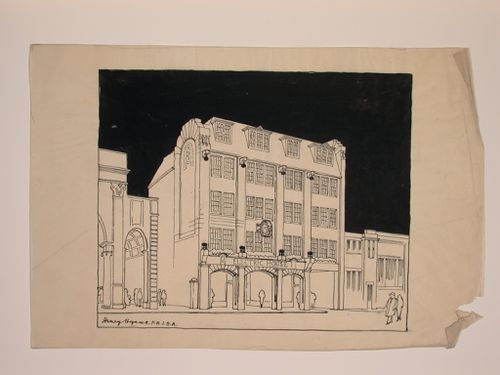
- This work is part of an incomplete group of possibly working reprographic copies for Electric House, Battersea Borough, designed by the borough architect, Henry Hyams. The group also includes some reprographic copies which may have been used for publication purposes. - The style of many of these drawings and reprographic copies by Henry Hyams (DR1988:0332 - DR1988:0414) suggests that they were possibly for periodical illustrations. Hyams contributed articles to the periodicals 'The Builder' and 'The Architect'. Two objects in the CCA collections can be linked to the article "Music in Stone" published prior to 1926 in 'The Architect'; a reprographic copy (DR1988:0357) and a drawing (DR1988:0364) (Who's Who in Architecture, 161).
DR1988:0335
Description:
- This work is part of an incomplete group of possibly working reprographic copies for Electric House, Battersea Borough, designed by the borough architect, Henry Hyams. The group also includes some reprographic copies which may have been used for publication purposes. - The style of many of these drawings and reprographic copies by Henry Hyams (DR1988:0332 - DR1988:0414) suggests that they were possibly for periodical illustrations. Hyams contributed articles to the periodicals 'The Builder' and 'The Architect'. Two objects in the CCA collections can be linked to the article "Music in Stone" published prior to 1926 in 'The Architect'; a reprographic copy (DR1988:0357) and a drawing (DR1988:0364) (Who's Who in Architecture, 161).
People:
Subject:
architecture
architecture
Date:
late 1926 or 1927
late 1926 or 1927
Title:
Perspectival view showing street façade of Electric House, Battersea Borough
Actions:
DR1988:0335
Description:
- This work is part of an incomplete group of possibly working reprographic copies for Electric House, Battersea Borough, designed by the borough architect, Henry Hyams. The group also includes some reprographic copies which may have been used for publication purposes. - The style of many of these drawings and reprographic copies by Henry Hyams (DR1988:0332 - DR1988:0414) suggests that they were possibly for periodical illustrations. Hyams contributed articles to the periodicals 'The Builder' and 'The Architect'. Two objects in the CCA collections can be linked to the article "Music in Stone" published prior to 1926 in 'The Architect'; a reprographic copy (DR1988:0357) and a drawing (DR1988:0364) (Who's Who in Architecture, 161).
Perspectival view showing street façade of Electric House, Battersea Borough
Actions:
DR1988:0335
Description:
- This work is part of an incomplete group of possibly working reprographic copies for Electric House, Battersea Borough, designed by the borough architect, Henry Hyams. The group also includes some reprographic copies which may have been used for publication purposes. - The style of many of these drawings and reprographic copies by Henry Hyams (DR1988:0332 - DR1988:0414) suggests that they were possibly for periodical illustrations. Hyams contributed articles to the periodicals 'The Builder' and 'The Architect'. Two objects in the CCA collections can be linked to the article "Music in Stone" published prior to 1926 in 'The Architect'; a reprographic copy (DR1988:0357) and a drawing (DR1988:0364) (Who's Who in Architecture, 161).
Form:
drawings
drawings
Date:
late 1926 or 1927
late 1926 or 1927
People:
Subject:
architecture
architecture
Form:
drawings
drawings
Actions:
Reference number:
DR1988:0336
Description:
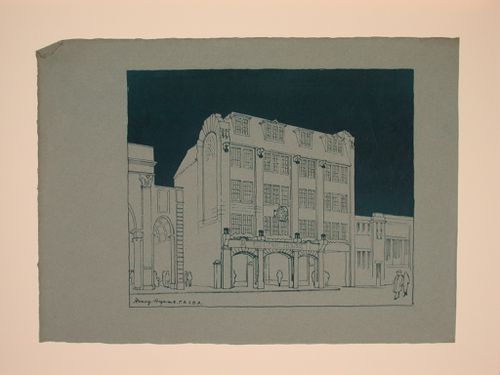
- This work is part of an incomplete group of possibly working reprographic copies for Electric House, Battersea Borough, designed by the borough architect, Henry Hyams. The group also includes some reprographic copies which may have been used for publication purposes. - The style of many of these drawings and reprographic copies by Henry Hyams (DR1988:0332 - DR1988:0414) suggests that they were possibly for periodical illustrations. Hyams contributed articles to the periodicals 'The Builder' and 'The Architect'. Two objects in the CCA collections can be linked to the article "Music in Stone" published prior to 1926 in 'The Architect'; a reprographic copy (DR1988:0357) and a drawing (DR1988:0364) (Who's Who in Architecture, 161).
DR1988:0336
Description:
- This work is part of an incomplete group of possibly working reprographic copies for Electric House, Battersea Borough, designed by the borough architect, Henry Hyams. The group also includes some reprographic copies which may have been used for publication purposes. - The style of many of these drawings and reprographic copies by Henry Hyams (DR1988:0332 - DR1988:0414) suggests that they were possibly for periodical illustrations. Hyams contributed articles to the periodicals 'The Builder' and 'The Architect'. Two objects in the CCA collections can be linked to the article "Music in Stone" published prior to 1926 in 'The Architect'; a reprographic copy (DR1988:0357) and a drawing (DR1988:0364) (Who's Who in Architecture, 161).
People:
Subject:
architecture
architecture
Date:
printed late 1926 or 1927
printed late 1926 or 1927
Title:
Perspectival view showing street façade of Electric House, Battersea Borough
Actions:
DR1988:0336
Description:
- This work is part of an incomplete group of possibly working reprographic copies for Electric House, Battersea Borough, designed by the borough architect, Henry Hyams. The group also includes some reprographic copies which may have been used for publication purposes. - The style of many of these drawings and reprographic copies by Henry Hyams (DR1988:0332 - DR1988:0414) suggests that they were possibly for periodical illustrations. Hyams contributed articles to the periodicals 'The Builder' and 'The Architect'. Two objects in the CCA collections can be linked to the article "Music in Stone" published prior to 1926 in 'The Architect'; a reprographic copy (DR1988:0357) and a drawing (DR1988:0364) (Who's Who in Architecture, 161).
Perspectival view showing street façade of Electric House, Battersea Borough
Actions:
DR1988:0336
Description:
- This work is part of an incomplete group of possibly working reprographic copies for Electric House, Battersea Borough, designed by the borough architect, Henry Hyams. The group also includes some reprographic copies which may have been used for publication purposes. - The style of many of these drawings and reprographic copies by Henry Hyams (DR1988:0332 - DR1988:0414) suggests that they were possibly for periodical illustrations. Hyams contributed articles to the periodicals 'The Builder' and 'The Architect'. Two objects in the CCA collections can be linked to the article "Music in Stone" published prior to 1926 in 'The Architect'; a reprographic copy (DR1988:0357) and a drawing (DR1988:0364) (Who's Who in Architecture, 161).
Form:
drawings
drawings
Date:
printed late 1926 or 1927
printed late 1926 or 1927
People:
Subject:
architecture
architecture


