


archives
Level of archival description:
Fonds
PGL architectes fonds
AP014
Synopsis:
Le fonds PGL architectes, 1959 – 1994, témoigne des activités de la firme d’architecture montréalaise, Papineau Gérin-Lajoie Le Blanc architectes, autant que ses sociétés affiliées et firmes remplaçantes. La majorité du fonds comprend des documents qui représentent 70 projets architecturaux, incluant des projets entrepris à travers le Québec, à Ottawa, à de multiples endroits au Nunavut, ainsi que des projets internationaux. Le fonds met en évidence la participation du PGL dans la construction d'infrastructure coloniale au Nunavik et au Nunavut, y compris les travaux sur des écoles associées avec des foyers fédéraux, qui sont reconnus comme faisant partie du système des pensionnats autochtones du Canada. De plus, le fonds documente l’utilisation des panneaux de fibre de verre modulaires employés par PGL. Pour la plupart, les documents dans ce fonds se composent des dessins, des documents photographiques, et des documents textuels. _____________________________________________________________________________________________________________ The PGL architectes fonds, 1959 - 1994, documents the work and activities of the Montréal-based architecture firm, Papineau Gérin-Lajoie Le Blanc architectes, and its successor and affiliate companies. The records within this fonds represent 70 architectural projects undertaken by the firm, which include projects throughout Québec, Ottawa, and various locations in Nunavut, as well as some international projects. The fonds offers evidence of PGL’s participation in the construction of colonial infrastructure in Nunavik and Nunavut, including work on schools that are connected to Federal Hostels which are recognised as part of Canada's Indian Residential School system. The fonds also contains records documenting PGL’s use of modular, fiberglass-reinforced plastic panels in construction. The records within this fonds largely consist of drawings, photographic materials, and textual records.
1959 - 1994
PGL architectes fonds
Actions:
AP014
Synopsis:
Le fonds PGL architectes, 1959 – 1994, témoigne des activités de la firme d’architecture montréalaise, Papineau Gérin-Lajoie Le Blanc architectes, autant que ses sociétés affiliées et firmes remplaçantes. La majorité du fonds comprend des documents qui représentent 70 projets architecturaux, incluant des projets entrepris à travers le Québec, à Ottawa, à de multiples endroits au Nunavut, ainsi que des projets internationaux. Le fonds met en évidence la participation du PGL dans la construction d'infrastructure coloniale au Nunavik et au Nunavut, y compris les travaux sur des écoles associées avec des foyers fédéraux, qui sont reconnus comme faisant partie du système des pensionnats autochtones du Canada. De plus, le fonds documente l’utilisation des panneaux de fibre de verre modulaires employés par PGL. Pour la plupart, les documents dans ce fonds se composent des dessins, des documents photographiques, et des documents textuels. _____________________________________________________________________________________________________________ The PGL architectes fonds, 1959 - 1994, documents the work and activities of the Montréal-based architecture firm, Papineau Gérin-Lajoie Le Blanc architectes, and its successor and affiliate companies. The records within this fonds represent 70 architectural projects undertaken by the firm, which include projects throughout Québec, Ottawa, and various locations in Nunavut, as well as some international projects. The fonds offers evidence of PGL’s participation in the construction of colonial infrastructure in Nunavik and Nunavut, including work on schools that are connected to Federal Hostels which are recognised as part of Canada's Indian Residential School system. The fonds also contains records documenting PGL’s use of modular, fiberglass-reinforced plastic panels in construction. The records within this fonds largely consist of drawings, photographic materials, and textual records.
archives
Level of archival description:
Fonds
1959 - 1994
events

Second Nature
As part of the exhibition It’s All Happening So Fast, an interactive workshop is offered to cegep and university groups in order to explore the complex and contradictory relationships that Canada maintains with the environment. By taking a stand and speaking on behalf of entities motivated by a multiplicity of interests—ecosystems, architecture, ethics, economic systems,(...)
26 January 2017 to 7 April 2017
Second Nature
Actions:
Description:
As part of the exhibition It’s All Happening So Fast, an interactive workshop is offered to cegep and university groups in order to explore the complex and contradictory relationships that Canada maintains with the environment. By taking a stand and speaking on behalf of entities motivated by a multiplicity of interests—ecosystems, architecture, ethics, economic systems,(...)
events
26 January 2017 to
7 April 2017
events

Learning from... Montréal
Lance Blomgren uses his 2009 book Walkups—a novella set entirely within Montréal’s row house apartment buildings—as a springboard for an analysis of the discursive plane of fictional architecture. Looking at works by John Hejduk, Ilya Kabakov, Alice Aycock and others, Blomgren argues that contemporary modes of speculative architecture offer a vital, if ethically fraught,(...)
Paul-Desmarais Theatre
2 May 2013 , 7pm
Learning from... Montréal
Actions:
Description:
Lance Blomgren uses his 2009 book Walkups—a novella set entirely within Montréal’s row house apartment buildings—as a springboard for an analysis of the discursive plane of fictional architecture. Looking at works by John Hejduk, Ilya Kabakov, Alice Aycock and others, Blomgren argues that contemporary modes of speculative architecture offer a vital, if ethically fraught,(...)
events
2 May 2013
7pm
Paul-Desmarais Theatre
exhibitions
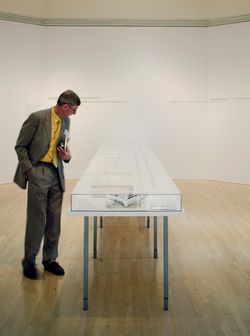
Learning from… Ruscha and Venturi Scott Brown, 1962–1977 examines the relationship between the seminal illustrated books by artist Edward Ruscha and architects Robert Venturi and Denise Scott Brown that deal with the architecture and urbanism of the everyday in Los Angeles and Las Vegas during the 1960s and 1970s. Ruscha’s Every Building on the Sunset Strip and Venturi(...)
Octagonal gallery
31 March 2004 to 30 May 2004
Learning from… Ruscha and Venturi Scott Brown, 1962–1977
Actions:
Description:
Learning from… Ruscha and Venturi Scott Brown, 1962–1977 examines the relationship between the seminal illustrated books by artist Edward Ruscha and architects Robert Venturi and Denise Scott Brown that deal with the architecture and urbanism of the everyday in Los Angeles and Las Vegas during the 1960s and 1970s. Ruscha’s Every Building on the Sunset Strip and Venturi(...)
exhibitions
31 March 2004 to
30 May 2004
Octagonal gallery
archives
Level of archival description:
Fonds
AP171
Synopsis:
This fonds documents the professional practice and activities of the Foreign Office Architects between 1989 and 2011, with a primary focus on their architectural projects. The documents in the fonds include drawings and plans, photographic materials, presentation panels, models, textual records, and digital files relating to 192 projects and international exhibitions . Additionally, the fonds includes material relating to publications, office activities, and research.
circa 1983-2011
Foreign Office Architects fonds
Actions:
AP171
Synopsis:
This fonds documents the professional practice and activities of the Foreign Office Architects between 1989 and 2011, with a primary focus on their architectural projects. The documents in the fonds include drawings and plans, photographic materials, presentation panels, models, textual records, and digital files relating to 192 projects and international exhibitions . Additionally, the fonds includes material relating to publications, office activities, and research.
archives
Level of archival description:
Fonds
circa 1983-2011
Sub-series
Opera Houses
CI001.S2.D3
Description:
Charles Rohault de Fleury's sustained involvement with the design of opera houses began with his appointment in 1846 as official architect of the existing Salle Le Pelletier, home to the *Paris Opera, and continued until an open competition was called in 1860 (Charles Garnier won this competition). During this period Rohault de Fleury submitted numerous proposals to replace theprovisional Salle Le Pelletier with a structure more appropriate to the grandeur and importance of France's national opera company. The CCA collection contains four projects related to his work for the Paris opera: two early projects (1846 and 1847) and one later one (1859) for a newopera house, and a portfolio of lithographs and drawings related to alterations and repairs to Salle Le Pelletier (1850-1854). The collection also includes Charles' earliest theatre project, a comprehensive plan for an opera house and surrounding infrastructure for the Theatre Royal Italien opera company (1838-1840), and an album containing drawings and prints of antique and contemporary theatres (1839-1854?). Charles' first project was for the Theatre Royal Italien opera company whose previous home, the Salle Favart, had burned down on the night of January 14 1838. The CCA collection contains an album of presentation drawings for a new theatre located on rue de la Paix with boutiques in the adjacent 'passages' (DR1974:0002:019:001-023). A second album consists of site plans including proposed 'maisons à loyers' (apartment buildings) and documents relating to the cost estimates and rental income for the entire project (DR1974:0002:036:001-016). The architectural style and interior arrangement of the theatre is heavily indebted to Francois Debret's Salle Le Pelletier. Charles' originality lies more in his conception of the social and economic role of the theatre in relation and integration, to its surrounding urban fabric. An explanation of the entire Theatre Royal Italien project, and Charles' role as architect in it, is found in two proposal letters (located in the Avery Library, Columbia University, NY) written by the entrepreneur Eugene Lecomte to the Minister of the Interior, Comte Duchatel, on May 15 and October 31 1839 (1). Charles' album of drawings at the CCA for the theatre and some of the cost and rental estimates are probably presentation copies directly related to the first letter, and most likely submitted to the Minister of the Interior. Charles' project was never executed, and the Italian opera company eventualy found a permanent home in the existing Salle Ventadour (1841). However, the inclusive nature of the Théâtre Royal Italien proposal, with its stress on urban development and contextuality, continued to play a seminal role in his later Paris Opera projects. Upon replacing Francois Debret as architect of Salle Le Pelletier in 1846, Charles proposed nine possible locations (site plans) for a new opera house for the Paris Opera (*Academie Royale de Musique) and, in the following year (1847) prepared a portfolio of drawings for the actual structure with an accompanying seven-page manuscript describing the project. Although executed in successive years, the site plans and 1847 drawings are conceptually related. Both components were undertaken in response to offical interest in a public competition that was never implemented (2)(3). The CCA has two sets of the nine site plans proposed in 1846 (DR1974:0002:036:001-016), one containing transfer lithographed site plans with a written analysis and cost estimate for each of the proposed locations, and the other with only the site plans (similar sets are located in the 'Archives Nationales' in France). They indicate that Charles, (heavily influenced by his Théâtre Royal Italien project) preferred the Rue de la Paix location (siteplan #3) for the new opera house. Although site plan number six, Boulevard des Capucines, was not favoured at this date, it is highly prophetic as it was the location officially chosen in 1860 for the new opera house. Apparently unique to the CCA collection is the 1847 manuscript and portfolio of drawings for the proposed opera house (DR1974:0002:036:001-016). The manuscript is both an indepth review of the requirements for a national opera house and a guide to his portfolio of drawings. Charles' conception and design continued to be strongly influenced by Debret's Salle Lepelletier, as well as his own Théâtre Italien project, and various antique and contemporary opera houses and theatres. Many of the French and Italian sources mentioned in the manuscript are collected in an album (DR1974:0002:010:001-048) as references for his own designs (4). As official architect of Salle Le pelletier, Charles was also responsible for repairs, restorations, and alterations to the existing structure. The drawings and transfer lithographs in the CCA collection (DR1974:0002:036:001-016) are primarily dated 1854, and relate to documented repair and restoration projects undertaken during this period (5)(6). The CCA collection has the presentation drawings and lithographs for the later 1859 project (DR1974:0002:027:001-027) for the Paris opera (*Theatre Imperiale de l'opera) that were sent to Achille Fould, the Minister of State. This project is probably a counterpart to a similiar one that he submitted to the Prefect of the Seine, Baron Haussmann, in the same year (7). Site plans show the opera house on an irregular polygonal site facing Boulevard des Capucines. The placement of the 'maisons à loyers' on the rear of the site reflects Charles' continued emphasis on integrating his opera projects into the surrounding urban context. In 1859, it appeared that Charles was favoured to build the new opera house. But late in the following year, a public competition was called in which Charles Garnier emerged as the victor. Although Charles did not build the final structure, his numerous projects, as exemplified in the CCA collection, were of prime importance in determining the location, configuration, and plan of the Place de l'Opera (8). * The 'Paris Opera' was France's national opera, and thus its name changed numerous times throughout its history according to altering perceptions of its role in French culture and/or changes in political regimes. For reasons of clarity, the national opera will be referred to as the Paris Opera. The names indicated in brackets with a star refer to the proper name of the opera company at the date of the project. (1) Eugene Le Comte, "Projet de Salle rue de la Paix, pour le Théâtre Royal Italien: Lettres à Monsieur le Ministre de l'Intérieur, en date des 15 mai et 31octobre 1839" (Paris: P. Dupont, 1839). (2) Christopher Curtis Mead, "Charles Garnier's Paris Opera and the Renaissance of Classicism in Nineteenth century French Architecture", 3 vols. (PhD thesis; Philadelphia: University of Pennsylvania, 1986), p. 234 and p. 956, fn. 30. (3) Monika Steinhauser, "Die Architektur des Pariser Oper" (Munich: Prestel Verlag, 1969), p. 45, fns. 143 and 144. (4) Barry Bergdoll, "Charles Rohault de Fleury: Part Three: Theatres and the Opera house", 'CCA Research Report', n.d., p. 3. (5) Larousse XIXth Century, s.v. "Rohault de Fleury, Charles". (6) Mead, p. 238. (7) Oeuvres de C. Rohault de Fleury, architecte" (Paris: Librarie centrale d'architecture, 1884).. (8) Macmillan, s.v. "Rohault de Fleury Familly".
1717-1868
Opera Houses
CI001.S2.D3
Description:
Charles Rohault de Fleury's sustained involvement with the design of opera houses began with his appointment in 1846 as official architect of the existing Salle Le Pelletier, home to the *Paris Opera, and continued until an open competition was called in 1860 (Charles Garnier won this competition). During this period Rohault de Fleury submitted numerous proposals to replace theprovisional Salle Le Pelletier with a structure more appropriate to the grandeur and importance of France's national opera company. The CCA collection contains four projects related to his work for the Paris opera: two early projects (1846 and 1847) and one later one (1859) for a newopera house, and a portfolio of lithographs and drawings related to alterations and repairs to Salle Le Pelletier (1850-1854). The collection also includes Charles' earliest theatre project, a comprehensive plan for an opera house and surrounding infrastructure for the Theatre Royal Italien opera company (1838-1840), and an album containing drawings and prints of antique and contemporary theatres (1839-1854?). Charles' first project was for the Theatre Royal Italien opera company whose previous home, the Salle Favart, had burned down on the night of January 14 1838. The CCA collection contains an album of presentation drawings for a new theatre located on rue de la Paix with boutiques in the adjacent 'passages' (DR1974:0002:019:001-023). A second album consists of site plans including proposed 'maisons à loyers' (apartment buildings) and documents relating to the cost estimates and rental income for the entire project (DR1974:0002:036:001-016). The architectural style and interior arrangement of the theatre is heavily indebted to Francois Debret's Salle Le Pelletier. Charles' originality lies more in his conception of the social and economic role of the theatre in relation and integration, to its surrounding urban fabric. An explanation of the entire Theatre Royal Italien project, and Charles' role as architect in it, is found in two proposal letters (located in the Avery Library, Columbia University, NY) written by the entrepreneur Eugene Lecomte to the Minister of the Interior, Comte Duchatel, on May 15 and October 31 1839 (1). Charles' album of drawings at the CCA for the theatre and some of the cost and rental estimates are probably presentation copies directly related to the first letter, and most likely submitted to the Minister of the Interior. Charles' project was never executed, and the Italian opera company eventualy found a permanent home in the existing Salle Ventadour (1841). However, the inclusive nature of the Théâtre Royal Italien proposal, with its stress on urban development and contextuality, continued to play a seminal role in his later Paris Opera projects. Upon replacing Francois Debret as architect of Salle Le Pelletier in 1846, Charles proposed nine possible locations (site plans) for a new opera house for the Paris Opera (*Academie Royale de Musique) and, in the following year (1847) prepared a portfolio of drawings for the actual structure with an accompanying seven-page manuscript describing the project. Although executed in successive years, the site plans and 1847 drawings are conceptually related. Both components were undertaken in response to offical interest in a public competition that was never implemented (2)(3). The CCA has two sets of the nine site plans proposed in 1846 (DR1974:0002:036:001-016), one containing transfer lithographed site plans with a written analysis and cost estimate for each of the proposed locations, and the other with only the site plans (similar sets are located in the 'Archives Nationales' in France). They indicate that Charles, (heavily influenced by his Théâtre Royal Italien project) preferred the Rue de la Paix location (siteplan #3) for the new opera house. Although site plan number six, Boulevard des Capucines, was not favoured at this date, it is highly prophetic as it was the location officially chosen in 1860 for the new opera house. Apparently unique to the CCA collection is the 1847 manuscript and portfolio of drawings for the proposed opera house (DR1974:0002:036:001-016). The manuscript is both an indepth review of the requirements for a national opera house and a guide to his portfolio of drawings. Charles' conception and design continued to be strongly influenced by Debret's Salle Lepelletier, as well as his own Théâtre Italien project, and various antique and contemporary opera houses and theatres. Many of the French and Italian sources mentioned in the manuscript are collected in an album (DR1974:0002:010:001-048) as references for his own designs (4). As official architect of Salle Le pelletier, Charles was also responsible for repairs, restorations, and alterations to the existing structure. The drawings and transfer lithographs in the CCA collection (DR1974:0002:036:001-016) are primarily dated 1854, and relate to documented repair and restoration projects undertaken during this period (5)(6). The CCA collection has the presentation drawings and lithographs for the later 1859 project (DR1974:0002:027:001-027) for the Paris opera (*Theatre Imperiale de l'opera) that were sent to Achille Fould, the Minister of State. This project is probably a counterpart to a similiar one that he submitted to the Prefect of the Seine, Baron Haussmann, in the same year (7). Site plans show the opera house on an irregular polygonal site facing Boulevard des Capucines. The placement of the 'maisons à loyers' on the rear of the site reflects Charles' continued emphasis on integrating his opera projects into the surrounding urban context. In 1859, it appeared that Charles was favoured to build the new opera house. But late in the following year, a public competition was called in which Charles Garnier emerged as the victor. Although Charles did not build the final structure, his numerous projects, as exemplified in the CCA collection, were of prime importance in determining the location, configuration, and plan of the Place de l'Opera (8). * The 'Paris Opera' was France's national opera, and thus its name changed numerous times throughout its history according to altering perceptions of its role in French culture and/or changes in political regimes. For reasons of clarity, the national opera will be referred to as the Paris Opera. The names indicated in brackets with a star refer to the proper name of the opera company at the date of the project. (1) Eugene Le Comte, "Projet de Salle rue de la Paix, pour le Théâtre Royal Italien: Lettres à Monsieur le Ministre de l'Intérieur, en date des 15 mai et 31octobre 1839" (Paris: P. Dupont, 1839). (2) Christopher Curtis Mead, "Charles Garnier's Paris Opera and the Renaissance of Classicism in Nineteenth century French Architecture", 3 vols. (PhD thesis; Philadelphia: University of Pennsylvania, 1986), p. 234 and p. 956, fn. 30. (3) Monika Steinhauser, "Die Architektur des Pariser Oper" (Munich: Prestel Verlag, 1969), p. 45, fns. 143 and 144. (4) Barry Bergdoll, "Charles Rohault de Fleury: Part Three: Theatres and the Opera house", 'CCA Research Report', n.d., p. 3. (5) Larousse XIXth Century, s.v. "Rohault de Fleury, Charles". (6) Mead, p. 238. (7) Oeuvres de C. Rohault de Fleury, architecte" (Paris: Librarie centrale d'architecture, 1884).. (8) Macmillan, s.v. "Rohault de Fleury Familly".
File 3
1717-1868
events
Materiality of Parkour
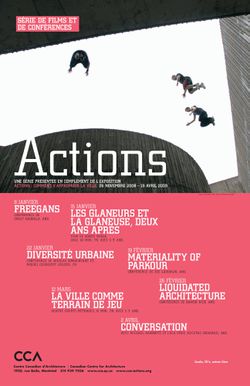
Engineer, artist, and theoretician Zoe Laughlin presents the new functions of existing materials in public spaces in relation to parkour, an activity which reinterprets the urban landscape. Her ideas focus on the materiality of daily life: how matter behaves, its sensorial qualities, and how people react to it. A member of the Division of Engineering’s Materials Research(...)
Paul Desmarais Theatre
19 February 2009
Materiality of Parkour
Actions:
Description:
Engineer, artist, and theoretician Zoe Laughlin presents the new functions of existing materials in public spaces in relation to parkour, an activity which reinterprets the urban landscape. Her ideas focus on the materiality of daily life: how matter behaves, its sensorial qualities, and how people react to it. A member of the Division of Engineering’s Materials Research(...)
events
19 February 2009
Paul Desmarais Theatre
archives
Level of archival description:
Fonds
Bauhaus in America fonds
AP217
Synopsis:
The Bauhaus in America fonds, circa 1930 – 2011, documents the research and production activities that went into producing the documentary film Bauhaus in America (1995) directed by Judith Pearlman. Material in the fonds consists of research in the form of photographs, textual records, publications, and ephemera from institutions in Germany and the United States. The fonds also contains film, video, and audio recordings that were used for preliminary research and compiled into the finished film. The recordings are primarily interviews with Bauhaus-related individuals. There is also material related to publishing activities based on the research for the film.
circa 1930 - 2011
Bauhaus in America fonds
Actions:
AP217
Synopsis:
The Bauhaus in America fonds, circa 1930 – 2011, documents the research and production activities that went into producing the documentary film Bauhaus in America (1995) directed by Judith Pearlman. Material in the fonds consists of research in the form of photographs, textual records, publications, and ephemera from institutions in Germany and the United States. The fonds also contains film, video, and audio recordings that were used for preliminary research and compiled into the finished film. The recordings are primarily interviews with Bauhaus-related individuals. There is also material related to publishing activities based on the research for the film.
archives
Level of archival description:
Fonds
circa 1930 - 2011
webpages
This project, by the CCA’s 2022-2023 Emerging Curator Clarissa Lim Kye Lee, engages with collectives in the Malay Archipelago with aims of developing a shared toolkit for art and cultural workers globally. Through a series of workshops held in Kuala Lumpur, Malaysia in 2024, this project looks to Malaysian collective ecologies and their relationship to their urban environments for ways to reinscribe a concern for the social in contemporary art and architecture.
Making Mamak: Collective Ecologies of Urban Space
Actions:
Summary:
This project, by the CCA’s 2022-2023 Emerging Curator Clarissa Lim Kye Lee, engages with collectives in the Malay Archipelago with aims of developing a shared toolkit for art and cultural workers globally. Through a series of workshops held in Kuala Lumpur, Malaysia in 2024, this project looks to Malaysian collective ecologies and their relationship to their urban environments for ways to reinscribe a concern for the social in contemporary art and architecture.
webpages
exhibitions
As they fill their sketchbooks with both texts and images, architects capture initial reactions to sites; record impressions and make drawings as they travel; organise work to be done; articulate design concepts and pose solutions; draft essays, lectures, and letters; write research notes; and copy inspirational passages from their readings. The Architect’s Sketchbook:(...)
Hall cases
26 February 1992 to 24 May 1992
The Architect's Sketchbook: Current Practice
Actions:
Description:
As they fill their sketchbooks with both texts and images, architects capture initial reactions to sites; record impressions and make drawings as they travel; organise work to be done; articulate design concepts and pose solutions; draft essays, lectures, and letters; write research notes; and copy inspirational passages from their readings. The Architect’s Sketchbook:(...)
exhibitions
26 February 1992 to
24 May 1992
Hall cases


