


44145 Results
Level of archival description:
Project
Project
Title:
Tasmania Beach Party, Hobart
Tasmania Beach Party, Hobart
Actions:
Reference number:
AP144.S2.D11
Description:
File documents an experimental project undertaken as part of the AASA Convention of Creativity hosted in Hobart, Australia. Three diagrammatic plans document how people worked on the beach site during a three hour period. Annotated versions of these drawings were published in "The First Installment in the Cedric Price Series." 'Architectural Design'. vol. 40, (October 1970), 511. Material in this file was produced in 1968. File contains schematic drawings.
AP144.S2.D11
Description:
File documents an experimental project undertaken as part of the AASA Convention of Creativity hosted in Hobart, Australia. Three diagrammatic plans document how people worked on the beach site during a three hour period. Annotated versions of these drawings were published in "The First Installment in the Cedric Price Series." 'Architectural Design'. vol. 40, (October 1970), 511. Material in this file was produced in 1968. File contains schematic drawings.
People:
Date:
[1968]
[1968]
Title:
Tasmania Beach Party, Hobart
Actions:
AP144.S2.D11
Description:
File documents an experimental project undertaken as part of the AASA Convention of Creativity hosted in Hobart, Australia. Three diagrammatic plans document how people worked on the beach site during a three hour period. Annotated versions of these drawings were published in "The First Installment in the Cedric Price Series." 'Architectural Design'. vol. 40, (October 1970), 511. Material in this file was produced in 1968. File contains schematic drawings.
Tasmania Beach Party, Hobart
Actions:
AP144.S2.D11
Description:
File documents an experimental project undertaken as part of the AASA Convention of Creativity hosted in Hobart, Australia. Three diagrammatic plans document how people worked on the beach site during a three hour period. Annotated versions of these drawings were published in "The First Installment in the Cedric Price Series." 'Architectural Design'. vol. 40, (October 1970), 511. Material in this file was produced in 1968. File contains schematic drawings.
Level of archival description:
File 11
File 11
Date:
[1968]
[1968]
People:
Level of archival description:
Project
Project
Actions:
Reference number:
AP180.S1.1964.PR01
Description:
This project series documents Umberto Riva's realized redesign for the interior spaces of the Casa della cultura. Riva worked on this project in 1964. The Casa della cultura is a cultural centre that offers courses and seminars, as well as holds debates on cultural and political topics. The centre is located on via Borgogna in Milan, Italy. The project series contains floor plans, interior sections, and details, including furnishing details and details for signage letters.
AP180.S1.1964.PR01
Description:
This project series documents Umberto Riva's realized redesign for the interior spaces of the Casa della cultura. Riva worked on this project in 1964. The Casa della cultura is a cultural centre that offers courses and seminars, as well as holds debates on cultural and political topics. The centre is located on via Borgogna in Milan, Italy. The project series contains floor plans, interior sections, and details, including furnishing details and details for signage letters.
People:
Date:
1964
1964
Title:
Casa della cultura [Cultural centre], Milan, Italy (1964)
Actions:
AP180.S1.1964.PR01
Description:
This project series documents Umberto Riva's realized redesign for the interior spaces of the Casa della cultura. Riva worked on this project in 1964. The Casa della cultura is a cultural centre that offers courses and seminars, as well as holds debates on cultural and political topics. The centre is located on via Borgogna in Milan, Italy. The project series contains floor plans, interior sections, and details, including furnishing details and details for signage letters.
Casa della cultura [Cultural centre], Milan, Italy (1964)
Actions:
AP180.S1.1964.PR01
Description:
This project series documents Umberto Riva's realized redesign for the interior spaces of the Casa della cultura. Riva worked on this project in 1964. The Casa della cultura is a cultural centre that offers courses and seminars, as well as holds debates on cultural and political topics. The centre is located on via Borgogna in Milan, Italy. The project series contains floor plans, interior sections, and details, including furnishing details and details for signage letters.
Level of archival description:
Project
Project
Date:
1964
1964
People:
Level of archival description:
Project
Project
Reference number:
AP180.S1.1975.PR03
Description:
This project series documents Casa per vacanze, a built three-storey vacation house for the Ferrario Family located on the outskirts of Varese, in Osmate, Italy. Riva worked on this project in 1975. The project series contains studies and design development drawings, including floor plans, elevations, sections, furnishing details, and a site plan. A file (AP180.S1.1975.PR03.002) arranged in this project series contains three drawings of an early version of the project.
AP180.S1.1975.PR03
Description:
This project series documents Casa per vacanze, a built three-storey vacation house for the Ferrario Family located on the outskirts of Varese, in Osmate, Italy. Riva worked on this project in 1975. The project series contains studies and design development drawings, including floor plans, elevations, sections, furnishing details, and a site plan. A file (AP180.S1.1975.PR03.002) arranged in this project series contains three drawings of an early version of the project.
People:
Date:
1975
1975
Title:
Casa per vacanze Ferrario [Ferrario vacation house], Osmate, Italy (1975)
Actions:
AP180.S1.1975.PR03
Description:
This project series documents Casa per vacanze, a built three-storey vacation house for the Ferrario Family located on the outskirts of Varese, in Osmate, Italy. Riva worked on this project in 1975. The project series contains studies and design development drawings, including floor plans, elevations, sections, furnishing details, and a site plan. A file (AP180.S1.1975.PR03.002) arranged in this project series contains three drawings of an early version of the project.
Casa per vacanze Ferrario [Ferrario vacation house], Osmate, Italy (1975)
Actions:
AP180.S1.1975.PR03
Description:
This project series documents Casa per vacanze, a built three-storey vacation house for the Ferrario Family located on the outskirts of Varese, in Osmate, Italy. Riva worked on this project in 1975. The project series contains studies and design development drawings, including floor plans, elevations, sections, furnishing details, and a site plan. A file (AP180.S1.1975.PR03.002) arranged in this project series contains three drawings of an early version of the project.
Level of archival description:
Project
Project
Date:
1975
1975
People:
Level of archival description:
Project
Project
Title:
Proposta sistemazione [Redesign proposal] Pietà Rondanini, Castello Sforzesco, Milan, Italy (2000s)
Proposta sistemazione [Redesign proposal] Pietà Rondanini, Castello Sforzesco, Milan, Italy (2000s)
Actions:
Reference number:
AP180.S1.2000.PR02
Description:
This project series documents an unrealized proposal for the redesign of the exhibition space for the Pietà Rondanini by Michelangelo at Castello Sforzesco in Milan, Italy. Riva worked on this project in 1999 in collaboration with Alessandro Scandurra for the international design competition organized by the City of Milan. Architect Álvaro Siza won the competition, but his project was never realized. The project is solely recorded through perspective drawings of the interior exhibition space and three sketches for floor plans.
AP180.S1.2000.PR02
Description:
This project series documents an unrealized proposal for the redesign of the exhibition space for the Pietà Rondanini by Michelangelo at Castello Sforzesco in Milan, Italy. Riva worked on this project in 1999 in collaboration with Alessandro Scandurra for the international design competition organized by the City of Milan. Architect Álvaro Siza won the competition, but his project was never realized. The project is solely recorded through perspective drawings of the interior exhibition space and three sketches for floor plans.
People:
Date:
2000
2000
Title:
Proposta sistemazione [Redesign proposal] Pietà Rondanini, Castello Sforzesco, Milan, Italy (2000s)
Actions:
AP180.S1.2000.PR02
Description:
This project series documents an unrealized proposal for the redesign of the exhibition space for the Pietà Rondanini by Michelangelo at Castello Sforzesco in Milan, Italy. Riva worked on this project in 1999 in collaboration with Alessandro Scandurra for the international design competition organized by the City of Milan. Architect Álvaro Siza won the competition, but his project was never realized. The project is solely recorded through perspective drawings of the interior exhibition space and three sketches for floor plans.
Proposta sistemazione [Redesign proposal] Pietà Rondanini, Castello Sforzesco, Milan, Italy (2000s)
Actions:
AP180.S1.2000.PR02
Description:
This project series documents an unrealized proposal for the redesign of the exhibition space for the Pietà Rondanini by Michelangelo at Castello Sforzesco in Milan, Italy. Riva worked on this project in 1999 in collaboration with Alessandro Scandurra for the international design competition organized by the City of Milan. Architect Álvaro Siza won the competition, but his project was never realized. The project is solely recorded through perspective drawings of the interior exhibition space and three sketches for floor plans.
Level of archival description:
Project
Project
Date:
2000
2000
People:
Form:
events
events

Title:
Do Not Come Any Closer
Do Not Come Any Closer
Actions:
Description:
Since 1997 Czech artist Barbora Šlapetová has made several expeditions to remote settlements in the jungles of Papua New Guinea with her colleague Lukáš Rittstein. The documentation of such visits and the dialogues they have prompted, including one with Czech premier Vaclav Havel, yielded books such as Why the Night is Black and Do Not Come Any Closer and several(...)
Since 1997 Czech artist Barbora Šlapetová has made several expeditions to remote settlements in the jungles of Papua New Guinea with her colleague Lukáš Rittstein. The documentation of such visits and the dialogues they have prompted, including one with Czech premier Vaclav Havel, yielded books such as Why the Night is Black and Do Not Come Any Closer and several(...)
Location:
Paul-Desmarais Theatre
Paul-Desmarais Theatre
Date:
29 November 2012 , 7pm
29 November 2012 , 7pm
Title:
Do Not Come Any Closer
Actions:
Description:
Since 1997 Czech artist Barbora Šlapetová has made several expeditions to remote settlements in the jungles of Papua New Guinea with her colleague Lukáš Rittstein. The documentation of such visits and the dialogues they have prompted, including one with Czech premier Vaclav Havel, yielded books such as Why the Night is Black and Do Not Come Any Closer and several(...)
Do Not Come Any Closer
Actions:
Description:
Since 1997 Czech artist Barbora Šlapetová has made several expeditions to remote settlements in the jungles of Papua New Guinea with her colleague Lukáš Rittstein. The documentation of such visits and the dialogues they have prompted, including one with Czech premier Vaclav Havel, yielded books such as Why the Night is Black and Do Not Come Any Closer and several(...)
Form:
events
events
Date:
29 November 2012
7pm
29 November 2012
7pm
Location:
Paul-Desmarais Theatre
Paul-Desmarais Theatre
Form:
articles
articles
Title:
Domestic Monument
Domestic Monument
Actions:
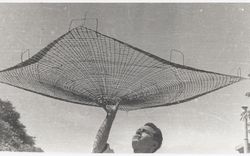
Mauricio Pezo and Sofia von Ellrichshausen reflect on the Amancio Williams archive
Title:
Domestic Monument
Mauricio Pezo and Sofia von Ellrichshausen reflect on the Amancio Williams archive
Actions:
Domestic Monument
Mauricio Pezo and Sofia von Ellrichshausen reflect on the Amancio Williams archive
Actions:
Level of archival description:
Series
Series
Title:
Hans Scharoun
Hans Scharoun
Reference number:
AP162.S7
Description:
Series documents the contribution of architect Hans Scharoun to the correspondence circle of Die gläserne Kette, with Scharoun writing under the pseudonym Hannes. Born in 1893 in Bremen, Germany, Scharoun studied archictecture at the Technische Hochschule at Berlin-Charlottenburg between 1912 and 1914. From 1915 to 1918 he worked on a military commission for the rebuilding of East Prussia. In 1919, he joined the Arbeitsrat für Kunst led by Bruno Taut. From 1919 to 1925 he worked independently, taking on private and public commissions as well as architectural projects for exhibitions. He taught at the Akademie für Kunst und Gewerbe in Breslau from 1925 to 1932, and at the Technische Universität Berlin as a town planning professor from 1946 to 1958. In 1956, he won the first prize of the competition for the Philharmonie concert hall in West Berlin. He died in Berlin in 1972. (Source: Ian Boyd Whyte, Bruno Taut and the Architecture of Activism. Cambridge: Cambridge University Press, 1982) The series comprises part of the correspondence of Hans Scharoun to the Die gläserne Kette circle and related drawings.
AP162.S7
Description:
Series documents the contribution of architect Hans Scharoun to the correspondence circle of Die gläserne Kette, with Scharoun writing under the pseudonym Hannes. Born in 1893 in Bremen, Germany, Scharoun studied archictecture at the Technische Hochschule at Berlin-Charlottenburg between 1912 and 1914. From 1915 to 1918 he worked on a military commission for the rebuilding of East Prussia. In 1919, he joined the Arbeitsrat für Kunst led by Bruno Taut. From 1919 to 1925 he worked independently, taking on private and public commissions as well as architectural projects for exhibitions. He taught at the Akademie für Kunst und Gewerbe in Breslau from 1925 to 1932, and at the Technische Universität Berlin as a town planning professor from 1946 to 1958. In 1956, he won the first prize of the competition for the Philharmonie concert hall in West Berlin. He died in Berlin in 1972. (Source: Ian Boyd Whyte, Bruno Taut and the Architecture of Activism. Cambridge: Cambridge University Press, 1982) The series comprises part of the correspondence of Hans Scharoun to the Die gläserne Kette circle and related drawings.
People:
Date:
between 1919 and 1920
between 1919 and 1920
Title:
Hans Scharoun
Actions:
AP162.S7
Description:
Series documents the contribution of architect Hans Scharoun to the correspondence circle of Die gläserne Kette, with Scharoun writing under the pseudonym Hannes. Born in 1893 in Bremen, Germany, Scharoun studied archictecture at the Technische Hochschule at Berlin-Charlottenburg between 1912 and 1914. From 1915 to 1918 he worked on a military commission for the rebuilding of East Prussia. In 1919, he joined the Arbeitsrat für Kunst led by Bruno Taut. From 1919 to 1925 he worked independently, taking on private and public commissions as well as architectural projects for exhibitions. He taught at the Akademie für Kunst und Gewerbe in Breslau from 1925 to 1932, and at the Technische Universität Berlin as a town planning professor from 1946 to 1958. In 1956, he won the first prize of the competition for the Philharmonie concert hall in West Berlin. He died in Berlin in 1972. (Source: Ian Boyd Whyte, Bruno Taut and the Architecture of Activism. Cambridge: Cambridge University Press, 1982) The series comprises part of the correspondence of Hans Scharoun to the Die gläserne Kette circle and related drawings.
Hans Scharoun
Actions:
AP162.S7
Description:
Series documents the contribution of architect Hans Scharoun to the correspondence circle of Die gläserne Kette, with Scharoun writing under the pseudonym Hannes. Born in 1893 in Bremen, Germany, Scharoun studied archictecture at the Technische Hochschule at Berlin-Charlottenburg between 1912 and 1914. From 1915 to 1918 he worked on a military commission for the rebuilding of East Prussia. In 1919, he joined the Arbeitsrat für Kunst led by Bruno Taut. From 1919 to 1925 he worked independently, taking on private and public commissions as well as architectural projects for exhibitions. He taught at the Akademie für Kunst und Gewerbe in Breslau from 1925 to 1932, and at the Technische Universität Berlin as a town planning professor from 1946 to 1958. In 1956, he won the first prize of the competition for the Philharmonie concert hall in West Berlin. He died in Berlin in 1972. (Source: Ian Boyd Whyte, Bruno Taut and the Architecture of Activism. Cambridge: Cambridge University Press, 1982) The series comprises part of the correspondence of Hans Scharoun to the Die gläserne Kette circle and related drawings.
Level of archival description:
series
series
Date:
between 1919 and 1920
between 1919 and 1920
People:
Form:
drawings
drawings
Reference number:
DR1988:0358
Description:
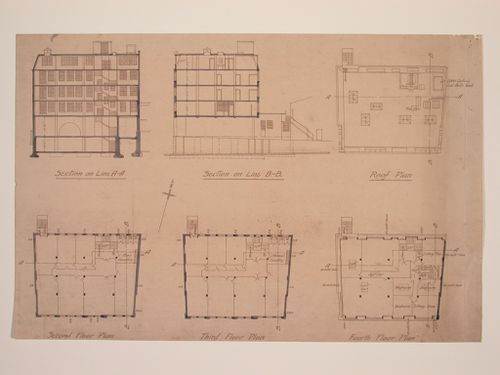
- Comparison with DR1988:0359, 'Plans and Elevations for Electric House ...', identifies these projections as sections and plans for Electric House. - This work is part of an incomplete group of possibly working reprographic copies for Electric House, Battersea Borough, designed by the borough architect, Henry Hyams. The group also includes some reprographic copies which may have been used for publication purposes. - The style of many of these drawings and reprographic copies by Henry Hyams (DR1988:0332 - DR1988:0414) suggests that they were possibly for periodical illustrations. Hyams contributed articles to the periodicals 'The Builder' and 'The Architect'. Two objects in the CCA collections can be directly linked to an article published prior to 1926 in 'The Architect'; a reprographic copy (DR1988:0357) and a drawing (DR1988:0364) (Who's Who in Architecture, 161).
DR1988:0358
Description:
- Comparison with DR1988:0359, 'Plans and Elevations for Electric House ...', identifies these projections as sections and plans for Electric House. - This work is part of an incomplete group of possibly working reprographic copies for Electric House, Battersea Borough, designed by the borough architect, Henry Hyams. The group also includes some reprographic copies which may have been used for publication purposes. - The style of many of these drawings and reprographic copies by Henry Hyams (DR1988:0332 - DR1988:0414) suggests that they were possibly for periodical illustrations. Hyams contributed articles to the periodicals 'The Builder' and 'The Architect'. Two objects in the CCA collections can be directly linked to an article published prior to 1926 in 'The Architect'; a reprographic copy (DR1988:0357) and a drawing (DR1988:0364) (Who's Who in Architecture, 161).
People:
Subject:
architecture
architecture
Date:
printed late 1926 or 1927
printed late 1926 or 1927
Title:
Sections and floor plans for Electric House, Battersea Borough
Actions:
DR1988:0358
Description:
- Comparison with DR1988:0359, 'Plans and Elevations for Electric House ...', identifies these projections as sections and plans for Electric House. - This work is part of an incomplete group of possibly working reprographic copies for Electric House, Battersea Borough, designed by the borough architect, Henry Hyams. The group also includes some reprographic copies which may have been used for publication purposes. - The style of many of these drawings and reprographic copies by Henry Hyams (DR1988:0332 - DR1988:0414) suggests that they were possibly for periodical illustrations. Hyams contributed articles to the periodicals 'The Builder' and 'The Architect'. Two objects in the CCA collections can be directly linked to an article published prior to 1926 in 'The Architect'; a reprographic copy (DR1988:0357) and a drawing (DR1988:0364) (Who's Who in Architecture, 161).
Sections and floor plans for Electric House, Battersea Borough
Actions:
DR1988:0358
Description:
- Comparison with DR1988:0359, 'Plans and Elevations for Electric House ...', identifies these projections as sections and plans for Electric House. - This work is part of an incomplete group of possibly working reprographic copies for Electric House, Battersea Borough, designed by the borough architect, Henry Hyams. The group also includes some reprographic copies which may have been used for publication purposes. - The style of many of these drawings and reprographic copies by Henry Hyams (DR1988:0332 - DR1988:0414) suggests that they were possibly for periodical illustrations. Hyams contributed articles to the periodicals 'The Builder' and 'The Architect'. Two objects in the CCA collections can be directly linked to an article published prior to 1926 in 'The Architect'; a reprographic copy (DR1988:0357) and a drawing (DR1988:0364) (Who's Who in Architecture, 161).
Form:
drawings
drawings
Date:
printed late 1926 or 1927
printed late 1926 or 1927
People:
Subject:
architecture
architecture
Form:
drawings
drawings
Actions:
Reference number:
DR1988:0410
Description:
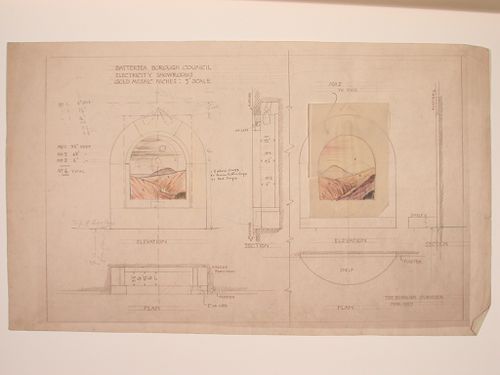
- This reprographic copy shows two elevations for onyx mosaics designed to be backlit. The onyx landscapes are rendered in coloured pencil. - This work is part of an incomplete group of possibly working reprographic copies for Electric House, Battersea Borough, designed by the borough architect, Henry Hyams. The group also includes some reprographic copies which may have been used for publication purposes. - The style of many of these drawings and reprographic copies by Henry Hyams (DR1988:0332 - DR1988:0414) suggests that they were possibly for periodical illustrations. Hyams contributed articles to the periodicals 'The Builder' and 'The Architect'. Two objects in the CCA collections can be directly linked to an article published prior to 1926 in 'The Architect'; a reprographic copy (DR1988:0357) and a drawing (DR1988:0364) (Who's Who in Architecture, 161).
DR1988:0410
Description:
- This reprographic copy shows two elevations for onyx mosaics designed to be backlit. The onyx landscapes are rendered in coloured pencil. - This work is part of an incomplete group of possibly working reprographic copies for Electric House, Battersea Borough, designed by the borough architect, Henry Hyams. The group also includes some reprographic copies which may have been used for publication purposes. - The style of many of these drawings and reprographic copies by Henry Hyams (DR1988:0332 - DR1988:0414) suggests that they were possibly for periodical illustrations. Hyams contributed articles to the periodicals 'The Builder' and 'The Architect'. Two objects in the CCA collections can be directly linked to an article published prior to 1926 in 'The Architect'; a reprographic copy (DR1988:0357) and a drawing (DR1988:0364) (Who's Who in Architecture, 161).
People:
Subject:
interior design
interior design
Date:
printed March 1927
printed March 1927
Title:
Elevations for onyx niches for showrooms, Electric House, Battersea Borough
Actions:
DR1988:0410
Description:
- This reprographic copy shows two elevations for onyx mosaics designed to be backlit. The onyx landscapes are rendered in coloured pencil. - This work is part of an incomplete group of possibly working reprographic copies for Electric House, Battersea Borough, designed by the borough architect, Henry Hyams. The group also includes some reprographic copies which may have been used for publication purposes. - The style of many of these drawings and reprographic copies by Henry Hyams (DR1988:0332 - DR1988:0414) suggests that they were possibly for periodical illustrations. Hyams contributed articles to the periodicals 'The Builder' and 'The Architect'. Two objects in the CCA collections can be directly linked to an article published prior to 1926 in 'The Architect'; a reprographic copy (DR1988:0357) and a drawing (DR1988:0364) (Who's Who in Architecture, 161).
Elevations for onyx niches for showrooms, Electric House, Battersea Borough
Actions:
DR1988:0410
Description:
- This reprographic copy shows two elevations for onyx mosaics designed to be backlit. The onyx landscapes are rendered in coloured pencil. - This work is part of an incomplete group of possibly working reprographic copies for Electric House, Battersea Borough, designed by the borough architect, Henry Hyams. The group also includes some reprographic copies which may have been used for publication purposes. - The style of many of these drawings and reprographic copies by Henry Hyams (DR1988:0332 - DR1988:0414) suggests that they were possibly for periodical illustrations. Hyams contributed articles to the periodicals 'The Builder' and 'The Architect'. Two objects in the CCA collections can be directly linked to an article published prior to 1926 in 'The Architect'; a reprographic copy (DR1988:0357) and a drawing (DR1988:0364) (Who's Who in Architecture, 161).
Form:
drawings
drawings
Date:
printed March 1927
printed March 1927
People:
Subject:
interior design
interior design
Form:
photographs
photographs
Actions:
Reference number:
PH1997:0048:001-072
Description:
- This album was advertised in Hugh Pagan Limited, cat. no. 29, item 70, with the following description: "Students of British architecture of the period around 1900 will be amazed to discover this really very extensive record by a French architectural photographer of seaside villas, boarding houses and so on built in the closing years of the nineteenth century in and around Margate and Hastings. The absence of captions and explanatory text makes detective work necessary as regards exact locations and architects, but as there is no remotely comparable British publication of this date devoted to this kind of house, M.Lévy deserves the warmest appreciation for his zeal. NUC records a copy at Princeton only, and there was no copy of this title in the Weinreb firm's Small English House catalogue of 1977."
PH1997:0048:001-072
Description:
- This album was advertised in Hugh Pagan Limited, cat. no. 29, item 70, with the following description: "Students of British architecture of the period around 1900 will be amazed to discover this really very extensive record by a French architectural photographer of seaside villas, boarding houses and so on built in the closing years of the nineteenth century in and around Margate and Hastings. The absence of captions and explanatory text makes detective work necessary as regards exact locations and architects, but as there is no remotely comparable British publication of this date devoted to this kind of house, M.Lévy deserves the warmest appreciation for his zeal. NUC records a copy at Princeton only, and there was no copy of this title in the Weinreb firm's Small English House catalogue of 1977."
People:
Subject:
architecture
architecture
Date:
published ca. 1902
published ca. 1902
Title:
Portfolio of views of English Cottages on the South Coast of England, at Birchington, Margate, Hastings, and various other towns
Actions:
PH1997:0048:001-072
Description:
- This album was advertised in Hugh Pagan Limited, cat. no. 29, item 70, with the following description: "Students of British architecture of the period around 1900 will be amazed to discover this really very extensive record by a French architectural photographer of seaside villas, boarding houses and so on built in the closing years of the nineteenth century in and around Margate and Hastings. The absence of captions and explanatory text makes detective work necessary as regards exact locations and architects, but as there is no remotely comparable British publication of this date devoted to this kind of house, M.Lévy deserves the warmest appreciation for his zeal. NUC records a copy at Princeton only, and there was no copy of this title in the Weinreb firm's Small English House catalogue of 1977."
Portfolio of views of English Cottages on the South Coast of England, at Birchington, Margate, Hastings, and various other towns
Actions:
PH1997:0048:001-072
Description:
- This album was advertised in Hugh Pagan Limited, cat. no. 29, item 70, with the following description: "Students of British architecture of the period around 1900 will be amazed to discover this really very extensive record by a French architectural photographer of seaside villas, boarding houses and so on built in the closing years of the nineteenth century in and around Margate and Hastings. The absence of captions and explanatory text makes detective work necessary as regards exact locations and architects, but as there is no remotely comparable British publication of this date devoted to this kind of house, M.Lévy deserves the warmest appreciation for his zeal. NUC records a copy at Princeton only, and there was no copy of this title in the Weinreb firm's Small English House catalogue of 1977."
Form:
photographs
photographs
Date:
published ca. 1902
published ca. 1902
People:
Subject:
architecture
architecture


