


1998 Results
Form:
books
books
Actions:
Price:
$21.00
(available to order)
Summary:
For nearly twenty years now, Blair Kamin of the "Chicago Tribune" has explored how architecture captures our imagination and engages our deepest emotions. A winner of the Pulitzer Prize for criticism and writer of the widely read "Cityscapes" blog, Kamin treats his subjects not only as works of art but also as symbols of the cultural and political forces that inspire(...)
Title:
Terror and wonder : architecture in a tumultuous age
Actions:
Price:
$21.00
(available to order)
Summary:
For nearly twenty years now, Blair Kamin of the "Chicago Tribune" has explored how architecture captures our imagination and engages our deepest emotions. A winner of the Pulitzer Prize for criticism and writer of the widely read "Cityscapes" blog, Kamin treats his subjects not only as works of art but also as symbols of the cultural and political forces that inspire them. Terror and Wonder gathers the best of Kamin's writings from the past decade along with new reflections on an era framed by the destruction of the World Trade Center and the opening of the world's tallest skyscraper. Assessing ordinary commercial structures as well as head-turning designs by some of the world's leading architects, Kamin paints a sweeping but finely textured portrait of a tumultuous age torn between the conflicting mandates of architectural spectacle and sustainability. For Kamin, the story of our built environment over the past ten years is, in tangible ways, the story of the decade itself. Terror and Wonder considers how architecture has been central to the main events and crosscurrents in American life since 2001: the devastating and debilitating consequences of 9/11 and Hurricane Katrina; the real estate boom and bust; the use of over-the-top cultural designs as engines of civic renewal; new challenges in saving old buildings; the unlikely rise of energy-saving, green architecture; and growing concern over our nation's crumbling infrastructure.
Form:
books
books
Publication:
September 2011
September 2011
Subject:
Architectural Theory
Architectural Theory
Form:
books
books
Actions:
Price:
$43.95
(available to order)
Summary:
Why do we have such extraordinarily powerful responses toward the images and pictures we see in everyday life? Why do we behave as if pictures were alive, possessing the power to influence us, to demand things from us, to persuade us, seduce us, or even lead us astray? According to W. J. T. Mitchell, we need to reckon with images not just as inert objects that convey(...)
Title:
What do pictures want? : the lives and loves of images
Actions:
Price:
$43.95
(available to order)
Summary:
Why do we have such extraordinarily powerful responses toward the images and pictures we see in everyday life? Why do we behave as if pictures were alive, possessing the power to influence us, to demand things from us, to persuade us, seduce us, or even lead us astray? According to W. J. T. Mitchell, we need to reckon with images not just as inert objects that convey meaning but as animated beings with desires, needs, appetites, demands, and drives of their own. "What Do Pictures Want?" explores this idea and highlights Mitchell's innovative and profoundly influential thinking on picture theory and the lives and loves of images. Ranging across the visual arts, literature, and mass media, Mitchell applies characteristically brilliant and wry analyses to Byzantine icons and cyberpunk films, racial stereotypes and public monuments, ancient idols and modern clones, offensive images and found objects, American photography and aboriginal painting. Opening new vistas in iconology and the emergent field of visual culture, he also considers the importance of Dolly the Sheep - who, as a clone, fulfills the ancient dream of creating a living image - and the destruction of the World Trade Center on 9/11, which, among other things, signifies a new and virulent form of iconoclasm. "What Do Pictures Want?" offers an immensely rich and suggestive account of the interplay between the visible and the readable. A work by one of our leading theorists of visual representation, it will be a touchstone for art historians, literary critics, anthropologists, and philosophers alike.
Form:
books
books
Publication:
June 2005, Chicago
June 2005, Chicago
Subject:
Architectural Theory
Architectural Theory
Form:
journals and magazines
journals and magazines
Actions:
Price:
$32.95
(available to order)
Summary:
“Transparency is overrated,” Jacques Herzog asserted roughly a year ago at the opening of the Vitra Schaudepot in Weil am Rhein. Is that really the case? In the present issue, we explore this topic and take stock of the present situation. Admittedly, the emblematic character of transparent architecture has lost much of its relevance since the post-war years – its charisma(...)
Title:
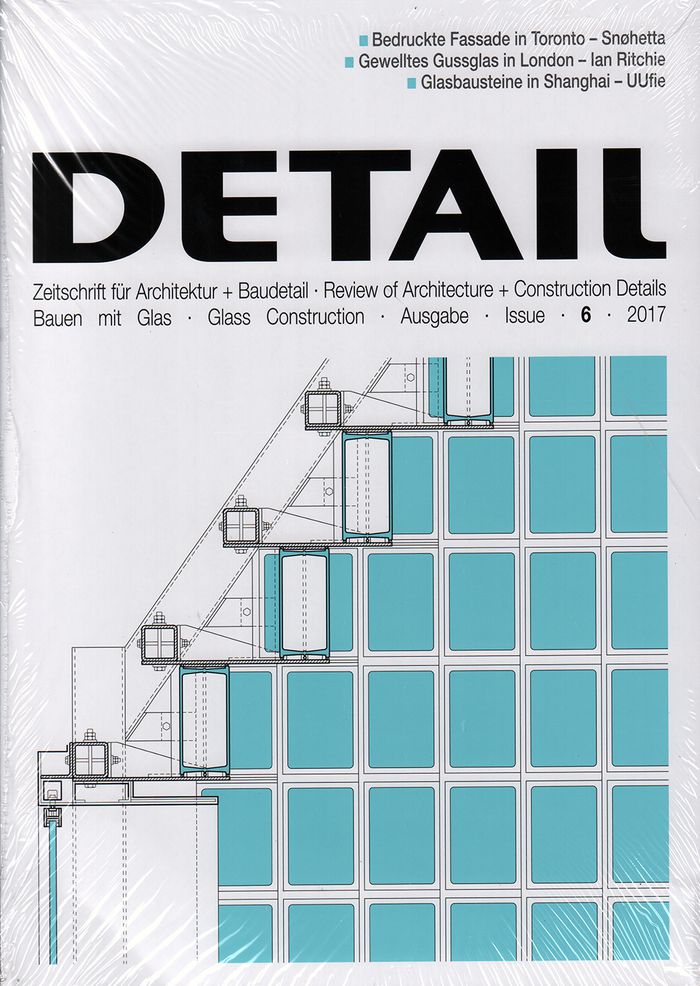
Detail 6 2017: glass construction
Actions:
Price:
$32.95
(available to order)
Summary:
“Transparency is overrated,” Jacques Herzog asserted roughly a year ago at the opening of the Vitra Schaudepot in Weil am Rhein. Is that really the case? In the present issue, we explore this topic and take stock of the present situation. Admittedly, the emblematic character of transparent architecture has lost much of its relevance since the post-war years – its charisma as a symbol of democracy. Yet buildings of glass are far more varied today, and their architecture is in many ways unique. In this issue of Detail, Heide Wessely has selected some groundbreaking schemes. With its printed-glass facade, the Ryerson University structure in Toronto by Snøhetta offers students variously lighted internal spaces, which they, in turn, can use for different study scenarios. With pivoting, printed-glass louvres, the facade of the bank in Nantes by AIA Associés responds to insolation to create a climatic buffer zone. The thermally insulated cast-glass elements in the outer skin of the Sainsbury Wellcome Centre in London by Ian Ritchie Architects screen the interior of the research institute from the street, while allowing diffused, non-glare light into the working spaces. In contrast, the glass pavilion in Manchester and the glazed atrium in Baker Street, London, are functional and restrained extensions to existing buildings. The Discussion section in this issue explores the potential of glass in the many housing towers that are springing up in cities today; and in his Technology article, Kars Haarhuis takes a look at innovative hybrid structures in which concrete or steel are combined with glass in a load-bearing form.
Form:
journals and magazines
journals and magazines
Publication:
June 2017
June 2017
Subject:
Magazines
Magazines
Form:
books
books
Title:
Overlook : exploring the internal fringes of America with the Center for land use interpretation
Overlook : exploring the internal fringes of America with the Center for land use interpretation
Actions:
Price:
$42.00
(available to order)
Summary:
The Center for land use interpretation is a research-based educational organization that produces public programs about the built landscape of the United States from its sites in Los Angeles, Utah and the Mojave desert, with an upstate New York location opening in 2006. The Center’s aim is to increase and diffuse information about how the nation’s lands are apportioned,(...)
Title:
Overlook : exploring the internal fringes of America with the Center for land use interpretation
Actions:
Price:
$42.00
(available to order)
Summary:
The Center for land use interpretation is a research-based educational organization that produces public programs about the built landscape of the United States from its sites in Los Angeles, Utah and the Mojave desert, with an upstate New York location opening in 2006. The Center’s aim is to increase and diffuse information about how the nation’s lands are apportioned, utilized and perceived. Recent examples of their work include a two-day "Tour of the monuments of the great American void" by bus and the exhibit "Immersed remains: towns submerged in America". This book takes readers on a tour through the strangely unfamiliar land that Americans live in, demonstrating that we can understand ourselves by examining the clues on display all around us, often clearly visible but ignored. Each chapter explores a different topic, from an in-depth look at Ohio ("the most all-American state"); through scale shifts in model landscapes, exemplified in the three largest hydraulic models in the world; and law-enforcement training environments that "simulate" public space. Readers can dive into the hidden and enchanting world of show caves, where America is on display underground; and come up into the Great Basin, a zone covering most of Nevada, and portions of Utah, California, Oregon, Idaho and Mexico, whose network of watersheds has no outlet to the ocean. Following lines and edges, through cities, suburbs, small towns and wide-open spaces, the Center guides us upstream, toward the heart of another America - the same, but different.
Form:
books
books
Publication:
June 2006, New York
June 2006, New York
Subject:
Land Art
Land Art
Form:
books
books
Price:
$55.00
(available to order)
Summary:
This is a volume on Light Art, the current in contemporary art that uses artificial light as its primary expressive instrument. In the first section an extensive introductory essay by Amnon Barzel underlines how practically interrupted study into the chromatic values of light have been part of the history of art from its very beginnings right through to the most(...)
Subject:
Contemporary Art Monographs
Contemporary Art Monographs
Publication:
July 2006, 2005
July 2006, 2005
Title:
Light art
Actions:
Price:
$55.00
(available to order)
Summary:
This is a volume on Light Art, the current in contemporary art that uses artificial light as its primary expressive instrument. In the first section an extensive introductory essay by Amnon Barzel underlines how practically interrupted study into the chromatic values of light have been part of the history of art from its very beginnings right through to the most recent developments, recalling the experiences of Caravaggio and de La Tour regarding internal light and the expressionists for external light, thus underlining how the invention of artificial light has enriched the light-art relationship opening a fascinating new chapter, inaugurated by the experiments carried out from the fifties by artists such as Fontana, Flavin, Merz and others. A text by Paolo Targetti follows dealing with the fundamental role played by the relationship between art and industry in contemporary art. Consuelo de Gara conducts an extended interview of James Turrell, the US artist unanimously considered the greatest master of Light Art. The second section is devoted to the Targetti Light Art Collection, one of the most prestigious collections in the world dealing with artificial light. The images and description of each of the works which make up the collection are accompanied by a retrospective critical text on the artists who created them. Among the artists presented are some of considerable fame including Olafur Eliasson, Gilberto Zorio, Anne and Patrick Poirier, Fabrizio Plessi and Hidetoshi Nagasawa as well as young up-and-coming talents, winners of the first four editions of the International Targetti Light Art Prize.
Form:
books
books
Publication:
July 2006, 2005
July 2006, 2005
Subject:
Contemporary Art Monographs
Contemporary Art Monographs
Form:
books
books
Actions:
Price:
$42.00
(available in store)
Summary:
The focus of this issue of icamprint is on the 'market' for private archives. After all, collecting and managing the documentation of architecture history to conform to academic and scientific standards is a complex business, and a core task for most icam members. In this context, whether or not the 'originals' by star architects have an artistic value on the market is(...)
Title:
icam print 02 december 2007 International confederation of architectural museums
Actions:
Price:
$42.00
(available in store)
Summary:
The focus of this issue of icamprint is on the 'market' for private archives. After all, collecting and managing the documentation of architecture history to conform to academic and scientific standards is a complex business, and a core task for most icam members. In this context, whether or not the 'originals' by star architects have an artistic value on the market is only superficially a decisive issue. If one considers the lengths taken by the custodian's of Le Corbusier's estate to secure a suitable new home for what is without doubt a painting of artistic note, and so a market value and with it a place in an art history context, then it is worth waiting to see the place conceded on the art market one day to project-related sketches and drawings by contemporary star architects. The whole history of the conception and realisation of important works of architecture within a context of culture history ought to feature more prominently in the collection policy of icam members to ensure its suitability for research purposes. It remains to be seen what price is attributed to these comprehensive documents, these convolutes, in the competition between private collectors. This notwithstanding, the 'market' for collecting is just as crucial to icam members as the continuing debate on 'originals', and safeguarding them in times of digital architecture production. icamprint will focus increasingly on these and related issues, opening the discussion to all of the member institutions, to develop into an indispensable medium providing orientation on key issues for all icam members.
Form:
books
books
Publication:
October 2007, Vienna
October 2007, Vienna
Subject:
Museology
Museology
Form:
books
books
Price:
$73.95
(available to order)
Summary:
Cities have contributed for centuries to the promotion of some of humanity’s greatest ideas, we must now urgently include them as among the principal players in the environmental debate and at the forefront of any policy tackling and countering – possibly reversing - climate change. Nevertheless, even today one of the most significant technologies capable of absorbing CO2(...)
Subject:
Architecture Monographs
Architecture Monographs
Publication:
April 2022
April 2022
Title:
Green obsession: trees towards cities, humans towards forests
Actions:
Price:
$73.95
(available to order)
Summary:
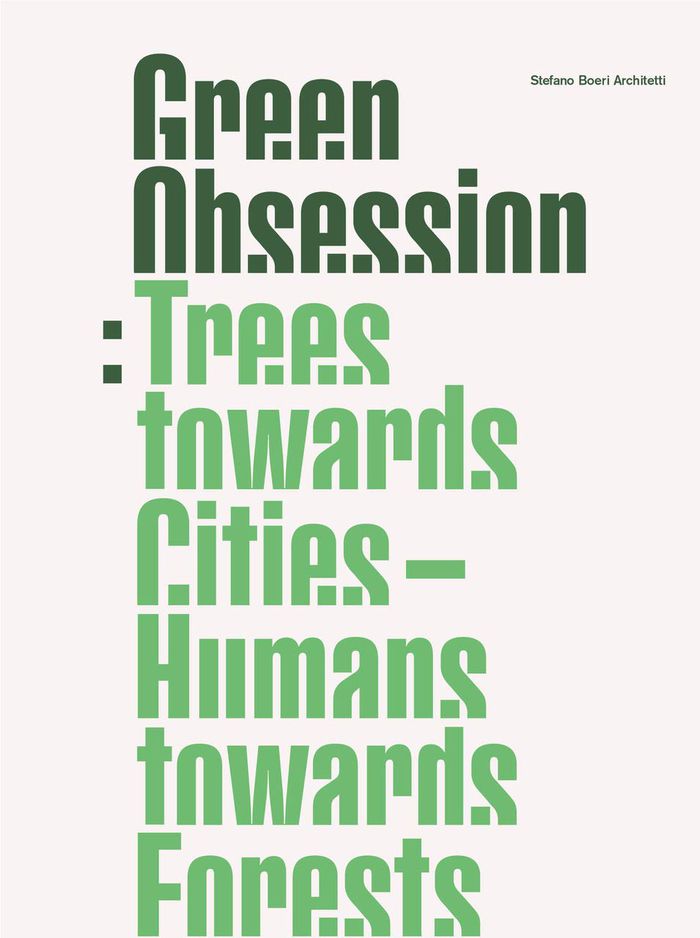
Cities have contributed for centuries to the promotion of some of humanity’s greatest ideas, we must now urgently include them as among the principal players in the environmental debate and at the forefront of any policy tackling and countering – possibly reversing - climate change. Nevertheless, even today one of the most significant technologies capable of absorbing CO2 and restoring our environment is photosynthesis. Planting trees, in addition to protecting existing natural areas and biodiversity, together with de-carbonization, renewable energies, digitalization, smart mobility and the circular economy could be the set of strategies necessary to tackle climate change. Today the effects of the Anthropocene age are ever more visible, changing our environment and affecting every species that lives within it. ''Green obsession'' offers a path to be taken, a hard but still necessary paradigm shift – even for architecture and urbanism – that aims to give a voice to this much needed ecological transition. This book aims to unveil the processes and the complexity involved in the search for a new kind of urbanism, while raising questions and opening old wounds related to the relationship between the human species and Nature and finally putting these fragments together to create a portrait of our era. We need to conceive cities as new green catalysts. Now more than ever, it is essential to act together as separate individuals and professionals, joining the cause as members of the global community with a shared environmental strategy. We all have to open the era of a new alliance between Nature and City.
Form:
books
books
Publication:
April 2022
April 2022
Subject:
Architecture Monographs
Architecture Monographs
Form:
audio
audio
Actions:
Description:
1 online resource.
Author:
Subject:
Publication:
[Place of publication not identified] : Junior Aspirin Records, 2017.
[Place of publication not identified] : Junior Aspirin Records, 2017.
Form:
audio
audio
Publication:
[Place of publication not identified] : Junior Aspirin Records, 2017.
[Place of publication not identified] : Junior Aspirin Records, 2017.
Author:
Subject:
Form:
books
books

Actions:
Price:
$39.95
(available to order)
Summary:
As we spend more and more of our time staring at the screens of movies, televisions, computers, and handheld devices--"windows" full of moving images, texts, and icons--how the world is framed has become as important as what is in the frame. In The Virtual Window, Anne Friedberg examines the window as metaphor, as architectural component, and as an opening to the(...)
Title:
The virtual window : from Alberti to Microsoft
Actions:
Price:
$39.95
(available to order)
Summary:
As we spend more and more of our time staring at the screens of movies, televisions, computers, and handheld devices--"windows" full of moving images, texts, and icons--how the world is framed has become as important as what is in the frame. In The Virtual Window, Anne Friedberg examines the window as metaphor, as architectural component, and as an opening to the dematerialized reality we see on the screen. In De pictura (1435), Leon Battista Alberti famously instructed painters to consider the frame of the painting as an open window. Taking Alberti's metaphor as her starting point, Friedberg tracks shifts in the perspectival paradigm as she gives us histories of the architectural window, developments in glass and transparency, and the emerging apparatuses of photography, cinema, television, and digital imaging. Single-point perspective--Alberti's metaphorical window--has long been challenged by modern painting, modern architecture, and moving-image technologies. And yet, notes Friedberg, for most of the twentieth century the dominant form of the moving image was a single image in a single frame. The fractured modernism exemplified by cubist painting, for example, remained largely confined to experimental, avant-garde work. On the computer screen, however, where multiple "windows" coexist and overlap, perspective may have met its end. In this wide-ranging book, Friedberg considers such topics as the framed view of the camera obscura, Le Corbusier's mandates for the architectural window, Eisenstein's opinions on the shape of the movie screen, and the multiple images and nested windows commonly displayed on screens today. The Virtual Window proposes a new logic of visuality, framed and virtual: an architecture not only of space but of time.
Form:
books
books
Publication:
January 2006, Cambridge
January 2006, Cambridge
Subject:
Architectural Theory
Architectural Theory
Form:
books
books
Title:
Reflections on democracy and urban form: Provocations from a panel at Harvard's Graduate School
Reflections on democracy and urban form: Provocations from a panel at Harvard's Graduate School
Actions:
Price:
$24.95
(available in store)
Summary:
This book builds on conversations that took place in the Fall of 2024 at Harvard’s Graduate School of Design marking the release of the book ''Democracy and Urban Form'', a co-publication by Harvard Design Press and Sternberg Press. The original book showcased a series of six lectures that the sociologist Richard Sennett gave under the same name at the GSD in the fall of(...)
Title:
Reflections on democracy and urban form: Provocations from a panel at Harvard's Graduate School
Actions:
Price:
$24.95
(available in store)
Summary:
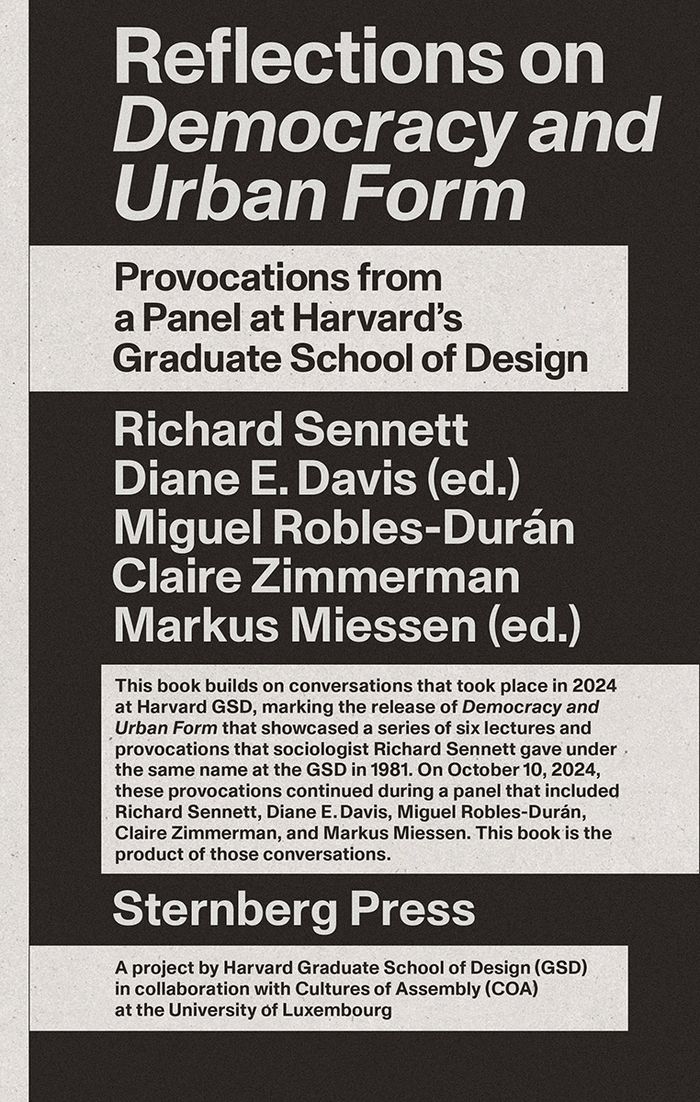
This book builds on conversations that took place in the Fall of 2024 at Harvard’s Graduate School of Design marking the release of the book ''Democracy and Urban Form'', a co-publication by Harvard Design Press and Sternberg Press. The original book showcased a series of six lectures that the sociologist Richard Sennett gave under the same name at the GSD in the fall of 1981. The original lectures, which happened more than forty years ago, addressed a much different political climate. Even so, Richard’s core insights into the connections between democracy and justice, matters of architecture and urban design, the growth of cities, cosmopolitanism, inclusion, free speech, and other related matters remain just as relevant today. In the spirit of reflecting on these urgencies, the GSD invited the political philosopher Michael Sandel to deliver a lecture that drew on themes from the new edition of his book ''Democracy’s Discontent''. In his opening talk, which took place on the evening of Wednesday, October 9, Sandel encouraged the audience to consider what might account for the polarization that imperils democracy today, as well as what might be done about it? Beyond analyzing the forces that were about to decide the 2024 election, he proposed a bold project of civic renewal to reimagine the economy and empower citizens as participants in a shared public life. On Thursday, October 10, these provocations continued during a panel discussion that included Richard Sennett, Diane Davis, Claire Zimmerman, Markus Miessen, and Miguel Robles-Durán. All reflected on Sandel’s talk, as well as on the state of democracy as it related more specifically to architecture and the design and planning of cities and metropolitan regions.
Form:
books
books
Publication:
August 2026
August 2026
Subject:
Urban Theory
Urban Theory


