


890 Results
Form:
exhibitions
exhibitions
Form:
exhibitions
exhibitions
Date:
September 2018 to
March 2019
September 2018 to
March 2019
Level of archival description:
Project
Project
Title:
Carbon Tower (2001)
Carbon Tower (2001)
Reference number:
AP174.S1.2001.D1
Description:
This project file documents an unbuilt design by Testa & Weiser for Carbon Tower (2001), a forty-storey building made almost entirely of carbon fibre. The project was developed in parallel with scripting software designed while Peter Testa and Devyn Weiser co-directed the Emergent Design Group at MIT. "The tower consists of an interdependent set of parts: floor plates hang from a diagrid structure of bundled fibres reinforced by two double-helix covered ramps, which are run in and out of the structure and are themselves made of strands woven at a finer scale. A thin composite skin—glass would be too heavy—wraps the tower’s parts together. A collaboration with Arup in 2002 allowed Testa & Weiser to simplify the scheme even further, by moving all core elements, from elevators to structural supports, to the tower’s perimeter. To take full advantage of the flexibility and energy efficiency of composite materials, Testa & Weiser also imagined that the carbon fibre structures would be formed on site through a process called pultrusion."[1] The file contains a large number of digital files documenting the conceptual and design development of the project; consultation with Arup Consulting Engineers, New York; research on composite materials; fabrication of 3D printed physical models by 3D Systems and Windform; and exhibition of the project at several museums and galleries, including the Museum of Contemporary Art, Los Angeles and the Cooper-Hewitt Smithsonian Design Museum, New York. Also contained in the file are 56 paper drawings (including some sketches done on top of printed computer-aided designs) and two 3D printed physical models produced by 3D Systems. Sources: [1] Canadian Centre for Architecture. Archaeology of the Digital 12: Testa & Weiser, Carbon Tower, ed. Greg Lynn (2015), ISBN 978-1-927071-25-0.
AP174.S1.2001.D1
Description:
This project file documents an unbuilt design by Testa & Weiser for Carbon Tower (2001), a forty-storey building made almost entirely of carbon fibre. The project was developed in parallel with scripting software designed while Peter Testa and Devyn Weiser co-directed the Emergent Design Group at MIT. "The tower consists of an interdependent set of parts: floor plates hang from a diagrid structure of bundled fibres reinforced by two double-helix covered ramps, which are run in and out of the structure and are themselves made of strands woven at a finer scale. A thin composite skin—glass would be too heavy—wraps the tower’s parts together. A collaboration with Arup in 2002 allowed Testa & Weiser to simplify the scheme even further, by moving all core elements, from elevators to structural supports, to the tower’s perimeter. To take full advantage of the flexibility and energy efficiency of composite materials, Testa & Weiser also imagined that the carbon fibre structures would be formed on site through a process called pultrusion."[1] The file contains a large number of digital files documenting the conceptual and design development of the project; consultation with Arup Consulting Engineers, New York; research on composite materials; fabrication of 3D printed physical models by 3D Systems and Windform; and exhibition of the project at several museums and galleries, including the Museum of Contemporary Art, Los Angeles and the Cooper-Hewitt Smithsonian Design Museum, New York. Also contained in the file are 56 paper drawings (including some sketches done on top of printed computer-aided designs) and two 3D printed physical models produced by 3D Systems. Sources: [1] Canadian Centre for Architecture. Archaeology of the Digital 12: Testa & Weiser, Carbon Tower, ed. Greg Lynn (2015), ISBN 978-1-927071-25-0.
People:
Date:
2002-2014
2002-2014
Title:
Carbon Tower (2001)
Actions:
AP174.S1.2001.D1
Description:
This project file documents an unbuilt design by Testa & Weiser for Carbon Tower (2001), a forty-storey building made almost entirely of carbon fibre. The project was developed in parallel with scripting software designed while Peter Testa and Devyn Weiser co-directed the Emergent Design Group at MIT. "The tower consists of an interdependent set of parts: floor plates hang from a diagrid structure of bundled fibres reinforced by two double-helix covered ramps, which are run in and out of the structure and are themselves made of strands woven at a finer scale. A thin composite skin—glass would be too heavy—wraps the tower’s parts together. A collaboration with Arup in 2002 allowed Testa & Weiser to simplify the scheme even further, by moving all core elements, from elevators to structural supports, to the tower’s perimeter. To take full advantage of the flexibility and energy efficiency of composite materials, Testa & Weiser also imagined that the carbon fibre structures would be formed on site through a process called pultrusion."[1] The file contains a large number of digital files documenting the conceptual and design development of the project; consultation with Arup Consulting Engineers, New York; research on composite materials; fabrication of 3D printed physical models by 3D Systems and Windform; and exhibition of the project at several museums and galleries, including the Museum of Contemporary Art, Los Angeles and the Cooper-Hewitt Smithsonian Design Museum, New York. Also contained in the file are 56 paper drawings (including some sketches done on top of printed computer-aided designs) and two 3D printed physical models produced by 3D Systems. Sources: [1] Canadian Centre for Architecture. Archaeology of the Digital 12: Testa & Weiser, Carbon Tower, ed. Greg Lynn (2015), ISBN 978-1-927071-25-0.
Carbon Tower (2001)
Actions:
AP174.S1.2001.D1
Description:
This project file documents an unbuilt design by Testa & Weiser for Carbon Tower (2001), a forty-storey building made almost entirely of carbon fibre. The project was developed in parallel with scripting software designed while Peter Testa and Devyn Weiser co-directed the Emergent Design Group at MIT. "The tower consists of an interdependent set of parts: floor plates hang from a diagrid structure of bundled fibres reinforced by two double-helix covered ramps, which are run in and out of the structure and are themselves made of strands woven at a finer scale. A thin composite skin—glass would be too heavy—wraps the tower’s parts together. A collaboration with Arup in 2002 allowed Testa & Weiser to simplify the scheme even further, by moving all core elements, from elevators to structural supports, to the tower’s perimeter. To take full advantage of the flexibility and energy efficiency of composite materials, Testa & Weiser also imagined that the carbon fibre structures would be formed on site through a process called pultrusion."[1] The file contains a large number of digital files documenting the conceptual and design development of the project; consultation with Arup Consulting Engineers, New York; research on composite materials; fabrication of 3D printed physical models by 3D Systems and Windform; and exhibition of the project at several museums and galleries, including the Museum of Contemporary Art, Los Angeles and the Cooper-Hewitt Smithsonian Design Museum, New York. Also contained in the file are 56 paper drawings (including some sketches done on top of printed computer-aided designs) and two 3D printed physical models produced by 3D Systems. Sources: [1] Canadian Centre for Architecture. Archaeology of the Digital 12: Testa & Weiser, Carbon Tower, ed. Greg Lynn (2015), ISBN 978-1-927071-25-0.
Level of archival description:
Project
Project
Date:
2002-2014
2002-2014
People:
Level of archival description:
Project
Project
Actions:
Reference number:
AP194.S1.1997.PR02
Description:
Project records document the design process for OCEAN North’s competition entry for the Jyväskylä Music and Arts Centre in 1997. The project was titled Terra Cultura by OCEAN North. The competition was to create a multi-usage space that would include a venue for the symphonic orchestra, a music school, exhibition spaces and the possibility to host a variety of small cultural events in the Finnish city of Jyväskylä. The proposed site is in the center of the town, across the street from the Jyväskylä city church and its park, and nearby buildings designed by Alvar Aalto. OCEAN North’s concept presents a topological surface as an extension of the surrounding urban scape with two masses that would host the formal functions of the building (concert hall, music school, exhibition halls). The two volumes, or raised blocks, are divided along a diagonal elevated space, which is the extension of the ground’s topological surface filled and dubbed “Liquid Flow Space” by the design team. In their interview with Greg Lynn, Johan Bettum and Kivi Sotamaa mentioned that the idea for Jyväskylä was that it was a cloud. To reach this goal, the team used CAD software to trace streams of particles as a modelling approach. The masses of linear elements that were generated were further deconstructed and turned into “peels” and rearranged to create the masses of the building. Physical models were also used to test and further what had emerged from the digital design process, with results being fed back into the digital drawings. During the process, Bettum also brought in the idea of the internalisation of the outside, taking inspiration from the Centre Georges Pompidou. Digital records document the creative process with raster and vector images, CAD drawings and models, and few digital textual records describing the project and the program charts. Drawings and models show site and building plans, perspectives and sections; particles streaming and resulting linear masses; peels and sections identified per color; and renderings of aerials, perspectives and elevation views. OCEAN North seems to have mostly used Microstation for modelling, although there are a few files created with form*Z and 3D Studio. Some of the raster images might have been created with these software as well, showing a given stage of the design process and including renderings. There are also screen captures showing the top, front, left and perspective views of 3D models. Adobe Photoshop and Illustrator were also used to create and modify drawings and diagrams. Program charts were created in Microsoft Excel. Sources: Softspace: from a representation of form to a simulation of space, Edited by Sean Lally and Jessica Young. London, New York: Routledge, 2007. Greg Lynn, ed. Archaeology of the Digital 17: OCEAN North, Jyväskylä Music and Arts Centre, Montréal: Canadian Centre for Architecture, 2017. ePub.
AP194.S1.1997.PR02
Description:
Project records document the design process for OCEAN North’s competition entry for the Jyväskylä Music and Arts Centre in 1997. The project was titled Terra Cultura by OCEAN North. The competition was to create a multi-usage space that would include a venue for the symphonic orchestra, a music school, exhibition spaces and the possibility to host a variety of small cultural events in the Finnish city of Jyväskylä. The proposed site is in the center of the town, across the street from the Jyväskylä city church and its park, and nearby buildings designed by Alvar Aalto. OCEAN North’s concept presents a topological surface as an extension of the surrounding urban scape with two masses that would host the formal functions of the building (concert hall, music school, exhibition halls). The two volumes, or raised blocks, are divided along a diagonal elevated space, which is the extension of the ground’s topological surface filled and dubbed “Liquid Flow Space” by the design team. In their interview with Greg Lynn, Johan Bettum and Kivi Sotamaa mentioned that the idea for Jyväskylä was that it was a cloud. To reach this goal, the team used CAD software to trace streams of particles as a modelling approach. The masses of linear elements that were generated were further deconstructed and turned into “peels” and rearranged to create the masses of the building. Physical models were also used to test and further what had emerged from the digital design process, with results being fed back into the digital drawings. During the process, Bettum also brought in the idea of the internalisation of the outside, taking inspiration from the Centre Georges Pompidou. Digital records document the creative process with raster and vector images, CAD drawings and models, and few digital textual records describing the project and the program charts. Drawings and models show site and building plans, perspectives and sections; particles streaming and resulting linear masses; peels and sections identified per color; and renderings of aerials, perspectives and elevation views. OCEAN North seems to have mostly used Microstation for modelling, although there are a few files created with form*Z and 3D Studio. Some of the raster images might have been created with these software as well, showing a given stage of the design process and including renderings. There are also screen captures showing the top, front, left and perspective views of 3D models. Adobe Photoshop and Illustrator were also used to create and modify drawings and diagrams. Program charts were created in Microsoft Excel. Sources: Softspace: from a representation of form to a simulation of space, Edited by Sean Lally and Jessica Young. London, New York: Routledge, 2007. Greg Lynn, ed. Archaeology of the Digital 17: OCEAN North, Jyväskylä Music and Arts Centre, Montréal: Canadian Centre for Architecture, 2017. ePub.
People:
Date:
1997-1998
1997-1998
Title:
Terra Cultura – Jyväskylä Music and Arts Centre, international competition entry, Jyväskylä, Finland (1997)
Actions:
AP194.S1.1997.PR02
Description:
Project records document the design process for OCEAN North’s competition entry for the Jyväskylä Music and Arts Centre in 1997. The project was titled Terra Cultura by OCEAN North. The competition was to create a multi-usage space that would include a venue for the symphonic orchestra, a music school, exhibition spaces and the possibility to host a variety of small cultural events in the Finnish city of Jyväskylä. The proposed site is in the center of the town, across the street from the Jyväskylä city church and its park, and nearby buildings designed by Alvar Aalto. OCEAN North’s concept presents a topological surface as an extension of the surrounding urban scape with two masses that would host the formal functions of the building (concert hall, music school, exhibition halls). The two volumes, or raised blocks, are divided along a diagonal elevated space, which is the extension of the ground’s topological surface filled and dubbed “Liquid Flow Space” by the design team. In their interview with Greg Lynn, Johan Bettum and Kivi Sotamaa mentioned that the idea for Jyväskylä was that it was a cloud. To reach this goal, the team used CAD software to trace streams of particles as a modelling approach. The masses of linear elements that were generated were further deconstructed and turned into “peels” and rearranged to create the masses of the building. Physical models were also used to test and further what had emerged from the digital design process, with results being fed back into the digital drawings. During the process, Bettum also brought in the idea of the internalisation of the outside, taking inspiration from the Centre Georges Pompidou. Digital records document the creative process with raster and vector images, CAD drawings and models, and few digital textual records describing the project and the program charts. Drawings and models show site and building plans, perspectives and sections; particles streaming and resulting linear masses; peels and sections identified per color; and renderings of aerials, perspectives and elevation views. OCEAN North seems to have mostly used Microstation for modelling, although there are a few files created with form*Z and 3D Studio. Some of the raster images might have been created with these software as well, showing a given stage of the design process and including renderings. There are also screen captures showing the top, front, left and perspective views of 3D models. Adobe Photoshop and Illustrator were also used to create and modify drawings and diagrams. Program charts were created in Microsoft Excel. Sources: Softspace: from a representation of form to a simulation of space, Edited by Sean Lally and Jessica Young. London, New York: Routledge, 2007. Greg Lynn, ed. Archaeology of the Digital 17: OCEAN North, Jyväskylä Music and Arts Centre, Montréal: Canadian Centre for Architecture, 2017. ePub.
Terra Cultura – Jyväskylä Music and Arts Centre, international competition entry, Jyväskylä, Finland (1997)
Actions:
AP194.S1.1997.PR02
Description:
Project records document the design process for OCEAN North’s competition entry for the Jyväskylä Music and Arts Centre in 1997. The project was titled Terra Cultura by OCEAN North. The competition was to create a multi-usage space that would include a venue for the symphonic orchestra, a music school, exhibition spaces and the possibility to host a variety of small cultural events in the Finnish city of Jyväskylä. The proposed site is in the center of the town, across the street from the Jyväskylä city church and its park, and nearby buildings designed by Alvar Aalto. OCEAN North’s concept presents a topological surface as an extension of the surrounding urban scape with two masses that would host the formal functions of the building (concert hall, music school, exhibition halls). The two volumes, or raised blocks, are divided along a diagonal elevated space, which is the extension of the ground’s topological surface filled and dubbed “Liquid Flow Space” by the design team. In their interview with Greg Lynn, Johan Bettum and Kivi Sotamaa mentioned that the idea for Jyväskylä was that it was a cloud. To reach this goal, the team used CAD software to trace streams of particles as a modelling approach. The masses of linear elements that were generated were further deconstructed and turned into “peels” and rearranged to create the masses of the building. Physical models were also used to test and further what had emerged from the digital design process, with results being fed back into the digital drawings. During the process, Bettum also brought in the idea of the internalisation of the outside, taking inspiration from the Centre Georges Pompidou. Digital records document the creative process with raster and vector images, CAD drawings and models, and few digital textual records describing the project and the program charts. Drawings and models show site and building plans, perspectives and sections; particles streaming and resulting linear masses; peels and sections identified per color; and renderings of aerials, perspectives and elevation views. OCEAN North seems to have mostly used Microstation for modelling, although there are a few files created with form*Z and 3D Studio. Some of the raster images might have been created with these software as well, showing a given stage of the design process and including renderings. There are also screen captures showing the top, front, left and perspective views of 3D models. Adobe Photoshop and Illustrator were also used to create and modify drawings and diagrams. Program charts were created in Microsoft Excel. Sources: Softspace: from a representation of form to a simulation of space, Edited by Sean Lally and Jessica Young. London, New York: Routledge, 2007. Greg Lynn, ed. Archaeology of the Digital 17: OCEAN North, Jyväskylä Music and Arts Centre, Montréal: Canadian Centre for Architecture, 2017. ePub.
Level of archival description:
Project
Project
Date:
1997-1998
1997-1998
People:
Form:
drawings
drawings
Actions:
Reference number:
DR1988:0352
Description:
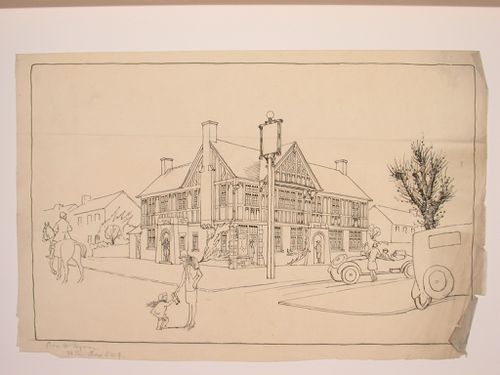
- This drawing shows a three-storey Tudor Revival building viewed from the street corner. The number of entrances, along with the post for a sign (which is blank) suggest that this building is an inn, or possibly a clubhouse. - The style of many of these drawings and reprographic copies by Henry Hyams (DR1988:0332 - DR1988:0414) suggests that they were possibly for periodical illustrations. Hyams contributed articles to the periodicals 'The Builder' and 'The Architect'. Two objects in the CCA collections can be linked to the article "Music in Stone" published prior to 1926 in 'The Architect'; a reprographic copy (DR1988:0357) and a drawing (DR1988:0364) (Who's Who in Architecture, 161).
DR1988:0352
Description:
- This drawing shows a three-storey Tudor Revival building viewed from the street corner. The number of entrances, along with the post for a sign (which is blank) suggest that this building is an inn, or possibly a clubhouse. - The style of many of these drawings and reprographic copies by Henry Hyams (DR1988:0332 - DR1988:0414) suggests that they were possibly for periodical illustrations. Hyams contributed articles to the periodicals 'The Builder' and 'The Architect'. Two objects in the CCA collections can be linked to the article "Music in Stone" published prior to 1926 in 'The Architect'; a reprographic copy (DR1988:0357) and a drawing (DR1988:0364) (Who's Who in Architecture, 161).
People:
Subject:
architecture
architecture
Date:
1920s or 1930s
1920s or 1930s
Title:
Perspectival view showing a Tudor Revival building, probably an inn or a clubhouse
Actions:
DR1988:0352
Description:
- This drawing shows a three-storey Tudor Revival building viewed from the street corner. The number of entrances, along with the post for a sign (which is blank) suggest that this building is an inn, or possibly a clubhouse. - The style of many of these drawings and reprographic copies by Henry Hyams (DR1988:0332 - DR1988:0414) suggests that they were possibly for periodical illustrations. Hyams contributed articles to the periodicals 'The Builder' and 'The Architect'. Two objects in the CCA collections can be linked to the article "Music in Stone" published prior to 1926 in 'The Architect'; a reprographic copy (DR1988:0357) and a drawing (DR1988:0364) (Who's Who in Architecture, 161).
Perspectival view showing a Tudor Revival building, probably an inn or a clubhouse
Actions:
DR1988:0352
Description:
- This drawing shows a three-storey Tudor Revival building viewed from the street corner. The number of entrances, along with the post for a sign (which is blank) suggest that this building is an inn, or possibly a clubhouse. - The style of many of these drawings and reprographic copies by Henry Hyams (DR1988:0332 - DR1988:0414) suggests that they were possibly for periodical illustrations. Hyams contributed articles to the periodicals 'The Builder' and 'The Architect'. Two objects in the CCA collections can be linked to the article "Music in Stone" published prior to 1926 in 'The Architect'; a reprographic copy (DR1988:0357) and a drawing (DR1988:0364) (Who's Who in Architecture, 161).
Form:
drawings
drawings
Date:
1920s or 1930s
1920s or 1930s
People:
Subject:
architecture
architecture
Form:
drawings
drawings
Actions:
Reference number:
DR1988:0353
Description:
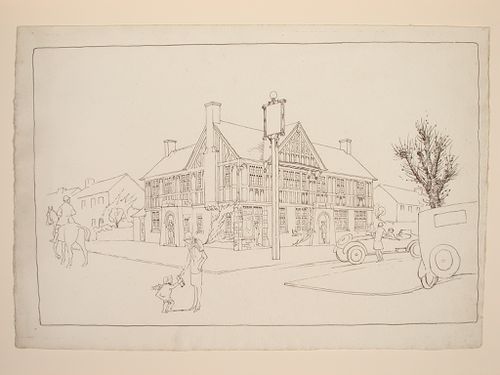
- This reprographic copy shows a three-storey Tudor Revival building viewed from the street corner. The number of entrances, along with the post for a sign (which is blank) suggest that this building is an inn, or possibly a clubhouse. - The style of many of these drawings and reprographic copies by Henry Hyams (DR1988:0332 - DR1988:0414) suggests that they were possibly for periodical illustrations. Hyams contributed articles to the periodicals 'The Builder' and 'The Architect'. Two objects in the CCA collections can be linked to the article "Music in Stone" published prior to 1926 in 'The Architect'; a reprographic copy (DR1988:0357) and a drawing (DR1988:0364) (Who's Who in Architecture, 161).
DR1988:0353
Description:
- This reprographic copy shows a three-storey Tudor Revival building viewed from the street corner. The number of entrances, along with the post for a sign (which is blank) suggest that this building is an inn, or possibly a clubhouse. - The style of many of these drawings and reprographic copies by Henry Hyams (DR1988:0332 - DR1988:0414) suggests that they were possibly for periodical illustrations. Hyams contributed articles to the periodicals 'The Builder' and 'The Architect'. Two objects in the CCA collections can be linked to the article "Music in Stone" published prior to 1926 in 'The Architect'; a reprographic copy (DR1988:0357) and a drawing (DR1988:0364) (Who's Who in Architecture, 161).
People:
Subject:
architecture
architecture
Date:
1920s or 1930s
1920s or 1930s
Title:
Perspectival view showing a Tudor Revival building, probably an inn or a clubhouse
Actions:
DR1988:0353
Description:
- This reprographic copy shows a three-storey Tudor Revival building viewed from the street corner. The number of entrances, along with the post for a sign (which is blank) suggest that this building is an inn, or possibly a clubhouse. - The style of many of these drawings and reprographic copies by Henry Hyams (DR1988:0332 - DR1988:0414) suggests that they were possibly for periodical illustrations. Hyams contributed articles to the periodicals 'The Builder' and 'The Architect'. Two objects in the CCA collections can be linked to the article "Music in Stone" published prior to 1926 in 'The Architect'; a reprographic copy (DR1988:0357) and a drawing (DR1988:0364) (Who's Who in Architecture, 161).
Perspectival view showing a Tudor Revival building, probably an inn or a clubhouse
Actions:
DR1988:0353
Description:
- This reprographic copy shows a three-storey Tudor Revival building viewed from the street corner. The number of entrances, along with the post for a sign (which is blank) suggest that this building is an inn, or possibly a clubhouse. - The style of many of these drawings and reprographic copies by Henry Hyams (DR1988:0332 - DR1988:0414) suggests that they were possibly for periodical illustrations. Hyams contributed articles to the periodicals 'The Builder' and 'The Architect'. Two objects in the CCA collections can be linked to the article "Music in Stone" published prior to 1926 in 'The Architect'; a reprographic copy (DR1988:0357) and a drawing (DR1988:0364) (Who's Who in Architecture, 161).
Form:
drawings
drawings
Date:
1920s or 1930s
1920s or 1930s
People:
Subject:
architecture
architecture
Form:
events
events
Actions:
Description:
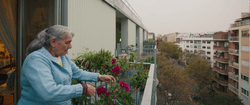
Where—and how—do we want to live as we grow older? Will our neighborhoods, our buildings, our cities be able to meet our needs? The evening begins with a screening of the documentary Where We Grow Older (CCA, 2023, 30 min), which explores how architecture and urban planning can respond to the challenges of an aging population. The screening will be followed by a(...)
Where—and how—do we want to live as we grow older? Will our neighborhoods, our buildings, our cities be able to meet our needs? The evening begins with a screening of the documentary Where We Grow Older (CCA, 2023, 30 min), which explores how architecture and urban planning can respond to the challenges of an aging population. The screening will be followed by a(...)
Location:
Paul-Desmarais Theatre
Paul-Desmarais Theatre
Date:
5 February 2026, 6pm
5 February 2026, 6pm
Title:
Film and conversation: Where Will We Grow Older?
Actions:
Description:
Where—and how—do we want to live as we grow older? Will our neighborhoods, our buildings, our cities be able to meet our needs? The evening begins with a screening of the documentary Where We Grow Older (CCA, 2023, 30 min), which explores how architecture and urban planning can respond to the challenges of an aging population. The screening will be followed by a(...)
Film and conversation: Where Will We Grow Older?
Actions:
Description:
Where—and how—do we want to live as we grow older? Will our neighborhoods, our buildings, our cities be able to meet our needs? The evening begins with a screening of the documentary Where We Grow Older (CCA, 2023, 30 min), which explores how architecture and urban planning can respond to the challenges of an aging population. The screening will be followed by a(...)
Form:
events
events
Date:
5 February 2026
6pm
5 February 2026
6pm
Location:
Paul-Desmarais Theatre
Paul-Desmarais Theatre
Form:
drawings
drawings
Actions:
Reference number:
DR2012:0012:047:035
Description:
A planimetric map of downtown Montréal, Québec titled "Boul. Réné-Lévesque de la Rue du Fort à la Rue St. Marc. Nature des travaux: Réaménagement du mail central et reconstruction de trottoirs, là où requis". Translated, "Boulevard Réné-Lévesque from Rue du Fort to Rue St. Marc. The nature of the work is the renovation of the central mall and the reconstruction of sidewalks, where required." The roll is labelled "CCA median/ contract drawings July 2004", but contains only one item.
DR2012:0012:047:035
Description:
A planimetric map of downtown Montréal, Québec titled "Boul. Réné-Lévesque de la Rue du Fort à la Rue St. Marc. Nature des travaux: Réaménagement du mail central et reconstruction de trottoirs, là où requis". Translated, "Boulevard Réné-Lévesque from Rue du Fort to Rue St. Marc. The nature of the work is the renovation of the central mall and the reconstruction of sidewalks, where required." The roll is labelled "CCA median/ contract drawings July 2004", but contains only one item.
People:
Date:
circa 1987-1995
circa 1987-1995
Title:
Planimetric map of downtown Montréal
Actions:
DR2012:0012:047:035
Description:
A planimetric map of downtown Montréal, Québec titled "Boul. Réné-Lévesque de la Rue du Fort à la Rue St. Marc. Nature des travaux: Réaménagement du mail central et reconstruction de trottoirs, là où requis". Translated, "Boulevard Réné-Lévesque from Rue du Fort to Rue St. Marc. The nature of the work is the renovation of the central mall and the reconstruction of sidewalks, where required." The roll is labelled "CCA median/ contract drawings July 2004", but contains only one item.
Planimetric map of downtown Montréal
Actions:
DR2012:0012:047:035
Description:
A planimetric map of downtown Montréal, Québec titled "Boul. Réné-Lévesque de la Rue du Fort à la Rue St. Marc. Nature des travaux: Réaménagement du mail central et reconstruction de trottoirs, là où requis". Translated, "Boulevard Réné-Lévesque from Rue du Fort to Rue St. Marc. The nature of the work is the renovation of the central mall and the reconstruction of sidewalks, where required." The roll is labelled "CCA median/ contract drawings July 2004", but contains only one item.
Form:
drawings
drawings
Date:
circa 1987-1995
circa 1987-1995
People:
Form:
drawings
drawings
Title:
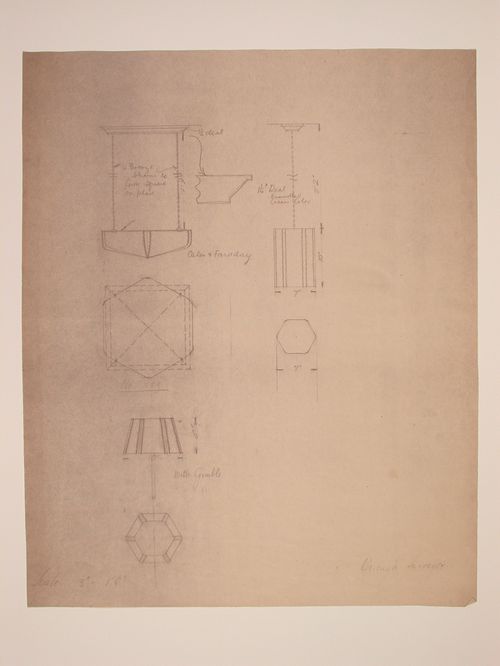
Elevations, plans and a section for three lamps, probably for Electric House, Battersea Borough
Elevations, plans and a section for three lamps, probably for Electric House, Battersea Borough
Actions:
Reference number:
DR1988:0384
Description:
- This reprographic copy shows three lighting fixtures: one lamp and two pendant light fixtures suspended from the ceiling by bronze chains. The designs are probably for Electric House; the CCA collection contains similar designs for showroom light fixtures for Electric House, DR1988:0386 and DR1988:0396, which, like this print, are signed by the Borough Surveyor. - This work is part of an incomplete group of possibly working reprographic copies for Electric House, Battersea Borough, designed by the borough architect, Henry Hyams. The group also includes some reprographic copies which may have been used for publication purposes. - The style of many of these drawings and reprographic copies by Henry Hyams (DR1988:0332 - DR1988:0414) suggests that they were possibly for periodical illustrations. Hyams contributed articles to the periodicals 'The Builder' and 'The Architect'. Two objects in the CCA collections can be directly linked to an article published prior to 1926 in 'The Architect'; a reprographic copy (DR1988:0357) and a drawing (DR1988:0364) (Who's Who in Architecture, 161).
DR1988:0384
Description:
- This reprographic copy shows three lighting fixtures: one lamp and two pendant light fixtures suspended from the ceiling by bronze chains. The designs are probably for Electric House; the CCA collection contains similar designs for showroom light fixtures for Electric House, DR1988:0386 and DR1988:0396, which, like this print, are signed by the Borough Surveyor. - This work is part of an incomplete group of possibly working reprographic copies for Electric House, Battersea Borough, designed by the borough architect, Henry Hyams. The group also includes some reprographic copies which may have been used for publication purposes. - The style of many of these drawings and reprographic copies by Henry Hyams (DR1988:0332 - DR1988:0414) suggests that they were possibly for periodical illustrations. Hyams contributed articles to the periodicals 'The Builder' and 'The Architect'. Two objects in the CCA collections can be directly linked to an article published prior to 1926 in 'The Architect'; a reprographic copy (DR1988:0357) and a drawing (DR1988:0364) (Who's Who in Architecture, 161).
People:
Subject:
interior design
interior design
Date:
printed late 1926 or 1927
printed late 1926 or 1927
Title:
Elevations, plans and a section for three lamps, probably for Electric House, Battersea Borough
Actions:
DR1988:0384
Description:
- This reprographic copy shows three lighting fixtures: one lamp and two pendant light fixtures suspended from the ceiling by bronze chains. The designs are probably for Electric House; the CCA collection contains similar designs for showroom light fixtures for Electric House, DR1988:0386 and DR1988:0396, which, like this print, are signed by the Borough Surveyor. - This work is part of an incomplete group of possibly working reprographic copies for Electric House, Battersea Borough, designed by the borough architect, Henry Hyams. The group also includes some reprographic copies which may have been used for publication purposes. - The style of many of these drawings and reprographic copies by Henry Hyams (DR1988:0332 - DR1988:0414) suggests that they were possibly for periodical illustrations. Hyams contributed articles to the periodicals 'The Builder' and 'The Architect'. Two objects in the CCA collections can be directly linked to an article published prior to 1926 in 'The Architect'; a reprographic copy (DR1988:0357) and a drawing (DR1988:0364) (Who's Who in Architecture, 161).
Elevations, plans and a section for three lamps, probably for Electric House, Battersea Borough
Actions:
DR1988:0384
Description:
- This reprographic copy shows three lighting fixtures: one lamp and two pendant light fixtures suspended from the ceiling by bronze chains. The designs are probably for Electric House; the CCA collection contains similar designs for showroom light fixtures for Electric House, DR1988:0386 and DR1988:0396, which, like this print, are signed by the Borough Surveyor. - This work is part of an incomplete group of possibly working reprographic copies for Electric House, Battersea Borough, designed by the borough architect, Henry Hyams. The group also includes some reprographic copies which may have been used for publication purposes. - The style of many of these drawings and reprographic copies by Henry Hyams (DR1988:0332 - DR1988:0414) suggests that they were possibly for periodical illustrations. Hyams contributed articles to the periodicals 'The Builder' and 'The Architect'. Two objects in the CCA collections can be directly linked to an article published prior to 1926 in 'The Architect'; a reprographic copy (DR1988:0357) and a drawing (DR1988:0364) (Who's Who in Architecture, 161).
Form:
drawings
drawings
Date:
printed late 1926 or 1927
printed late 1926 or 1927
People:
Subject:
interior design
interior design
Form:
archives
Level of archival description:
Fonds
archives
Level of archival description:
Fonds
Title:
Richard Henriquez fonds
Richard Henriquez fonds
Actions:
Reference number:
AP059
Synopsis:
The Richard Henriquez fonds, 1962-2002, documents the professional career of architect and urban designer Richard G. Henriquez. More specifically, the fonds documents Henriquez’s architectural training at the University of Manitoba, his early career as an architect in Jamaica, and his career as a principal at the architectural firm Henriquez Partners Architects. The fonds contains approximately 8935 drawings (including reprographic copies), 106 panels, 100 photographs, 31 l.m textual records, 5 offset printing plates and 1 model.
AP059
Synopsis:
The Richard Henriquez fonds, 1962-2002, documents the professional career of architect and urban designer Richard G. Henriquez. More specifically, the fonds documents Henriquez’s architectural training at the University of Manitoba, his early career as an architect in Jamaica, and his career as a principal at the architectural firm Henriquez Partners Architects. The fonds contains approximately 8935 drawings (including reprographic copies), 106 panels, 100 photographs, 31 l.m textual records, 5 offset printing plates and 1 model.
People:
Date:
1962-2002
1962-2002
Title:
Richard Henriquez fonds
Actions:
AP059
Synopsis:
The Richard Henriquez fonds, 1962-2002, documents the professional career of architect and urban designer Richard G. Henriquez. More specifically, the fonds documents Henriquez’s architectural training at the University of Manitoba, his early career as an architect in Jamaica, and his career as a principal at the architectural firm Henriquez Partners Architects. The fonds contains approximately 8935 drawings (including reprographic copies), 106 panels, 100 photographs, 31 l.m textual records, 5 offset printing plates and 1 model.
Richard Henriquez fonds
Actions:
AP059
Synopsis:
The Richard Henriquez fonds, 1962-2002, documents the professional career of architect and urban designer Richard G. Henriquez. More specifically, the fonds documents Henriquez’s architectural training at the University of Manitoba, his early career as an architect in Jamaica, and his career as a principal at the architectural firm Henriquez Partners Architects. The fonds contains approximately 8935 drawings (including reprographic copies), 106 panels, 100 photographs, 31 l.m textual records, 5 offset printing plates and 1 model.
Form:
archives
Level of archival description:
Fonds
archives
Level of archival description:
Fonds
Date:
1962-2002
1962-2002
People:
Form:
drawings
drawings
Reference number:
DR1988:0383
Description:
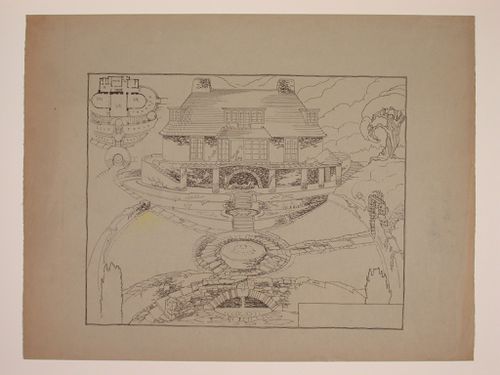
- This reprographic copy shows a small country house, with a series of ponds and fountains descending down from the main terrace. There is a small sketch plan at the upper left, which shows the layout of the rooms on the main floor and the levels of the garden terraces. - The style of many of these drawings and reprographic copies by Henry Hyams (DR1988:0332 - DR1988:0414) suggests that they were possibly for periodical illustrations. Hyams contributed articles to the periodicals 'The Builder' and 'The Architect'. Two objects in the CCA collections can be linked to the article "Music in Stone" published prior to 1926 in 'The Architect'; a reprographic copy (DR1988:0357) and a drawing (DR1988:0364) (Who's Who in Architecture, 161).
DR1988:0383
Description:
- This reprographic copy shows a small country house, with a series of ponds and fountains descending down from the main terrace. There is a small sketch plan at the upper left, which shows the layout of the rooms on the main floor and the levels of the garden terraces. - The style of many of these drawings and reprographic copies by Henry Hyams (DR1988:0332 - DR1988:0414) suggests that they were possibly for periodical illustrations. Hyams contributed articles to the periodicals 'The Builder' and 'The Architect'. Two objects in the CCA collections can be linked to the article "Music in Stone" published prior to 1926 in 'The Architect'; a reprographic copy (DR1988:0357) and a drawing (DR1988:0364) (Who's Who in Architecture, 161).
People:
Subject:
architecture, landscape architecture
architecture, landscape architecture
Date:
printed in the 1920s or 1930s
printed in the 1920s or 1930s
Title:
Perspectival view and plan showing a small country house and garden
Actions:
DR1988:0383
Description:
- This reprographic copy shows a small country house, with a series of ponds and fountains descending down from the main terrace. There is a small sketch plan at the upper left, which shows the layout of the rooms on the main floor and the levels of the garden terraces. - The style of many of these drawings and reprographic copies by Henry Hyams (DR1988:0332 - DR1988:0414) suggests that they were possibly for periodical illustrations. Hyams contributed articles to the periodicals 'The Builder' and 'The Architect'. Two objects in the CCA collections can be linked to the article "Music in Stone" published prior to 1926 in 'The Architect'; a reprographic copy (DR1988:0357) and a drawing (DR1988:0364) (Who's Who in Architecture, 161).
Perspectival view and plan showing a small country house and garden
Actions:
DR1988:0383
Description:
- This reprographic copy shows a small country house, with a series of ponds and fountains descending down from the main terrace. There is a small sketch plan at the upper left, which shows the layout of the rooms on the main floor and the levels of the garden terraces. - The style of many of these drawings and reprographic copies by Henry Hyams (DR1988:0332 - DR1988:0414) suggests that they were possibly for periodical illustrations. Hyams contributed articles to the periodicals 'The Builder' and 'The Architect'. Two objects in the CCA collections can be linked to the article "Music in Stone" published prior to 1926 in 'The Architect'; a reprographic copy (DR1988:0357) and a drawing (DR1988:0364) (Who's Who in Architecture, 161).
Form:
drawings
drawings
Date:
printed in the 1920s or 1930s
printed in the 1920s or 1930s
People:
Subject:
architecture, landscape architecture
architecture, landscape architecture


