


2580 Results
Level of archival description:
Series
Series
Actions:
Reference number:
AP193.S2
Description:
Series 2, I’ve heard about and Hypnosis chamber, 2004-2006, relates to the conception of the urban structure “I’ve heard about”. The records contain algorithmically-generated images, renderings, pictures of models and exhibitions. There are also photographs of the contour crafting process, 3D models and animated renderings illustrating the construction process of the structure. The project is a conceptual, unbuilt project that is meant to be a habitable organism, an adaptive landscape in a constant state of evolution. By means of transitory scenarios in which the operational mode is entropy and uncertainty, it develops open algorithms based on growth scripts permeable not only to human expressions, but also to the most discrete data such as the chemical emissions (for example due to stress or anxiety) of those who inhabit it. The chemical information is harvested through nanoreceptors feeding the VIAB machine with information. This biostructure becomes the visible part of human contingencies and their negotiation in real time. The structure is conceptualized to be in constant construction through the VIAB machine which is also a constituent of the structure itself. It secretes fiber cement, shaping the landscape where it is located and through which it moves. It generates the reticular structure using a process modelled on contour crafting. The VIAB machine was developed with Robotics Research Lab of the University of Southern California and takes its name from the terms viability and variability. R&Sie(n) considers that due to its mode of emergence “I’ve heard about” fabrication is not subjugated to any political power. Hypnosis chamber is a component of “I’ve heard about”. It consists of an indoor chamber, which was realized as a full-scale sample constructed through automated machinery. The chamber is situated as a part of the whole urban structure presented by “I’ve heard about,” and its goal is to immerse the audience into the project, into a fictional environment only reachable by hypnosis. In this context, hypnosis is a way to help citizens escape from their social condition and experience the new condition of citizenship imagined in “I’ve heard about”, where democracy is re-evaluated as a process of self-determination. Both parts of the projects were shown in contemporary art museums. First at Musée d’art de la ville de Paris in Paris (2005), the Hypnotic chamber is permanently on view at Towada Art Center in Towanda, Japan. AP193.S4 contains a video orienting the project into François Roche theoretical stance, research as speculation, that can be summarize as the use of technological tools to take a critical and political position through esthetic in order to open new lines of thoughts. AP193.S4 contains an updated version of the VIAB machine
AP193.S2
Description:
Series 2, I’ve heard about and Hypnosis chamber, 2004-2006, relates to the conception of the urban structure “I’ve heard about”. The records contain algorithmically-generated images, renderings, pictures of models and exhibitions. There are also photographs of the contour crafting process, 3D models and animated renderings illustrating the construction process of the structure. The project is a conceptual, unbuilt project that is meant to be a habitable organism, an adaptive landscape in a constant state of evolution. By means of transitory scenarios in which the operational mode is entropy and uncertainty, it develops open algorithms based on growth scripts permeable not only to human expressions, but also to the most discrete data such as the chemical emissions (for example due to stress or anxiety) of those who inhabit it. The chemical information is harvested through nanoreceptors feeding the VIAB machine with information. This biostructure becomes the visible part of human contingencies and their negotiation in real time. The structure is conceptualized to be in constant construction through the VIAB machine which is also a constituent of the structure itself. It secretes fiber cement, shaping the landscape where it is located and through which it moves. It generates the reticular structure using a process modelled on contour crafting. The VIAB machine was developed with Robotics Research Lab of the University of Southern California and takes its name from the terms viability and variability. R&Sie(n) considers that due to its mode of emergence “I’ve heard about” fabrication is not subjugated to any political power. Hypnosis chamber is a component of “I’ve heard about”. It consists of an indoor chamber, which was realized as a full-scale sample constructed through automated machinery. The chamber is situated as a part of the whole urban structure presented by “I’ve heard about,” and its goal is to immerse the audience into the project, into a fictional environment only reachable by hypnosis. In this context, hypnosis is a way to help citizens escape from their social condition and experience the new condition of citizenship imagined in “I’ve heard about”, where democracy is re-evaluated as a process of self-determination. Both parts of the projects were shown in contemporary art museums. First at Musée d’art de la ville de Paris in Paris (2005), the Hypnotic chamber is permanently on view at Towada Art Center in Towanda, Japan. AP193.S4 contains a video orienting the project into François Roche theoretical stance, research as speculation, that can be summarize as the use of technological tools to take a critical and political position through esthetic in order to open new lines of thoughts. AP193.S4 contains an updated version of the VIAB machine
People:
Date:
2004-2006
2004-2006
Title:
I’ve heard about and Hypnosis chamber
Actions:
AP193.S2
Description:
Series 2, I’ve heard about and Hypnosis chamber, 2004-2006, relates to the conception of the urban structure “I’ve heard about”. The records contain algorithmically-generated images, renderings, pictures of models and exhibitions. There are also photographs of the contour crafting process, 3D models and animated renderings illustrating the construction process of the structure. The project is a conceptual, unbuilt project that is meant to be a habitable organism, an adaptive landscape in a constant state of evolution. By means of transitory scenarios in which the operational mode is entropy and uncertainty, it develops open algorithms based on growth scripts permeable not only to human expressions, but also to the most discrete data such as the chemical emissions (for example due to stress or anxiety) of those who inhabit it. The chemical information is harvested through nanoreceptors feeding the VIAB machine with information. This biostructure becomes the visible part of human contingencies and their negotiation in real time. The structure is conceptualized to be in constant construction through the VIAB machine which is also a constituent of the structure itself. It secretes fiber cement, shaping the landscape where it is located and through which it moves. It generates the reticular structure using a process modelled on contour crafting. The VIAB machine was developed with Robotics Research Lab of the University of Southern California and takes its name from the terms viability and variability. R&Sie(n) considers that due to its mode of emergence “I’ve heard about” fabrication is not subjugated to any political power. Hypnosis chamber is a component of “I’ve heard about”. It consists of an indoor chamber, which was realized as a full-scale sample constructed through automated machinery. The chamber is situated as a part of the whole urban structure presented by “I’ve heard about,” and its goal is to immerse the audience into the project, into a fictional environment only reachable by hypnosis. In this context, hypnosis is a way to help citizens escape from their social condition and experience the new condition of citizenship imagined in “I’ve heard about”, where democracy is re-evaluated as a process of self-determination. Both parts of the projects were shown in contemporary art museums. First at Musée d’art de la ville de Paris in Paris (2005), the Hypnotic chamber is permanently on view at Towada Art Center in Towanda, Japan. AP193.S4 contains a video orienting the project into François Roche theoretical stance, research as speculation, that can be summarize as the use of technological tools to take a critical and political position through esthetic in order to open new lines of thoughts. AP193.S4 contains an updated version of the VIAB machine
I’ve heard about and Hypnosis chamber
Actions:
AP193.S2
Description:
Series 2, I’ve heard about and Hypnosis chamber, 2004-2006, relates to the conception of the urban structure “I’ve heard about”. The records contain algorithmically-generated images, renderings, pictures of models and exhibitions. There are also photographs of the contour crafting process, 3D models and animated renderings illustrating the construction process of the structure. The project is a conceptual, unbuilt project that is meant to be a habitable organism, an adaptive landscape in a constant state of evolution. By means of transitory scenarios in which the operational mode is entropy and uncertainty, it develops open algorithms based on growth scripts permeable not only to human expressions, but also to the most discrete data such as the chemical emissions (for example due to stress or anxiety) of those who inhabit it. The chemical information is harvested through nanoreceptors feeding the VIAB machine with information. This biostructure becomes the visible part of human contingencies and their negotiation in real time. The structure is conceptualized to be in constant construction through the VIAB machine which is also a constituent of the structure itself. It secretes fiber cement, shaping the landscape where it is located and through which it moves. It generates the reticular structure using a process modelled on contour crafting. The VIAB machine was developed with Robotics Research Lab of the University of Southern California and takes its name from the terms viability and variability. R&Sie(n) considers that due to its mode of emergence “I’ve heard about” fabrication is not subjugated to any political power. Hypnosis chamber is a component of “I’ve heard about”. It consists of an indoor chamber, which was realized as a full-scale sample constructed through automated machinery. The chamber is situated as a part of the whole urban structure presented by “I’ve heard about,” and its goal is to immerse the audience into the project, into a fictional environment only reachable by hypnosis. In this context, hypnosis is a way to help citizens escape from their social condition and experience the new condition of citizenship imagined in “I’ve heard about”, where democracy is re-evaluated as a process of self-determination. Both parts of the projects were shown in contemporary art museums. First at Musée d’art de la ville de Paris in Paris (2005), the Hypnotic chamber is permanently on view at Towada Art Center in Towanda, Japan. AP193.S4 contains a video orienting the project into François Roche theoretical stance, research as speculation, that can be summarize as the use of technological tools to take a critical and political position through esthetic in order to open new lines of thoughts. AP193.S4 contains an updated version of the VIAB machine
Level of archival description:
Series
Series
Date:
2004-2006
2004-2006
People:
Form:
drawings
Quantity:
14 File
drawings
Quantity:
14 File
Actions:
Reference number:
ARCH23458
Description:
plans, sections, elevations of substation, digester house, blow pit, screen room, bleacher room, mill room, machine room, shipping room and train shed, steam plant
ARCH23458
Description:
plans, sections, elevations of substation, digester house, blow pit, screen room, bleacher room, mill room, machine room, shipping room and train shed, steam plant
People:
Title:
Plans, sections, elevations of substation, digester house, blow pit, screen room
Actions:
ARCH23458
Description:
plans, sections, elevations of substation, digester house, blow pit, screen room, bleacher room, mill room, machine room, shipping room and train shed, steam plant
Plans, sections, elevations of substation, digester house, blow pit, screen room
Actions:
ARCH23458
Description:
plans, sections, elevations of substation, digester house, blow pit, screen room, bleacher room, mill room, machine room, shipping room and train shed, steam plant
Form:
drawings
Quantity:
14 File
drawings
Quantity:
14 File
People:
Form:
photographs
photographs

Title:
View of the Haight family mausoleum and cemetery at 370 Main Street, Goshen, New York, United States
View of the Haight family mausoleum and cemetery at 370 Main Street, Goshen, New York, United States
Actions:
Reference number:
PH1984:0977:354
Description:
Side view of the mausoleum. Presumedly, the dry plates used to produce the image were one of the first samples of machine-coated plates manufactured by George Eastman.
PH1984:0977:354
Description:
Side view of the mausoleum. Presumedly, the dry plates used to produce the image were one of the first samples of machine-coated plates manufactured by George Eastman.
People:
Date:
ca. 1880
ca. 1880
Title:
View of the Haight family mausoleum and cemetery at 370 Main Street, Goshen, New York, United States
Actions:
PH1984:0977:354
Description:
Side view of the mausoleum. Presumedly, the dry plates used to produce the image were one of the first samples of machine-coated plates manufactured by George Eastman.
View of the Haight family mausoleum and cemetery at 370 Main Street, Goshen, New York, United States
Actions:
PH1984:0977:354
Description:
Side view of the mausoleum. Presumedly, the dry plates used to produce the image were one of the first samples of machine-coated plates manufactured by George Eastman.
Form:
photographs
photographs
Date:
ca. 1880
ca. 1880
People:
Form:
photographs
photographs
Actions:
Reference number:
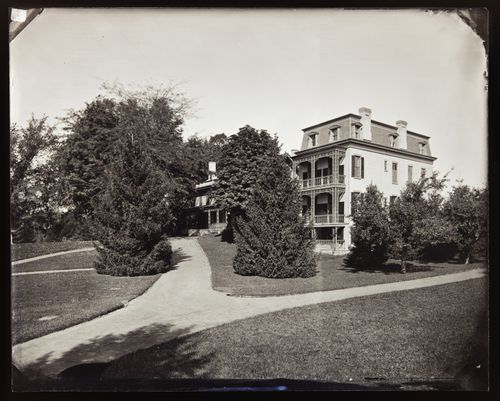
PH1984:0977:349
Description:
The private home of Edward Anthony. Presumedly, the dry plates used to produce the image were one of the first samples of machine-coated plates manufactured by George Eastman.
PH1984:0977:349
Description:
The private home of Edward Anthony. Presumedly, the dry plates used to produce the image were one of the first samples of machine-coated plates manufactured by George Eastman.
People:
Date:
ca. 1880
ca. 1880
Title:
View of Edward Anthony's summer house, Alexandria Bay, New York, United States of America
Actions:
PH1984:0977:349
Description:
The private home of Edward Anthony. Presumedly, the dry plates used to produce the image were one of the first samples of machine-coated plates manufactured by George Eastman.
View of Edward Anthony's summer house, Alexandria Bay, New York, United States of America
Actions:
PH1984:0977:349
Description:
The private home of Edward Anthony. Presumedly, the dry plates used to produce the image were one of the first samples of machine-coated plates manufactured by George Eastman.
Form:
photographs
photographs
Date:
ca. 1880
ca. 1880
People:
Form:
photographs
photographs
Actions:
Reference number:
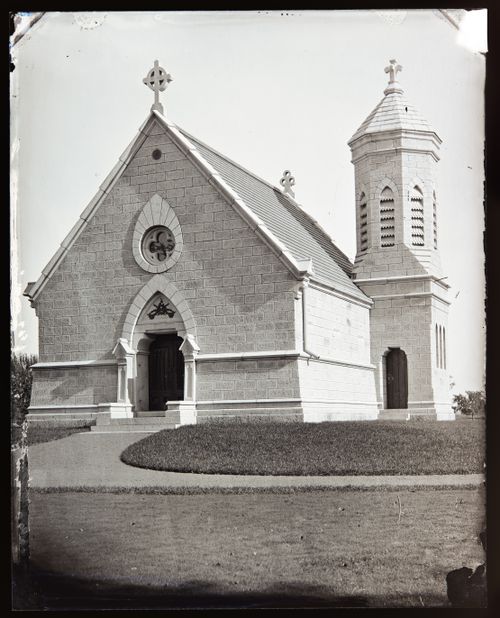
PH1984:0977:353
Description:
Front view of the mausoleum building. Presumedly, the dry plates used to produce the image were one of the first samples of machine-coated plates manufactured by George Eastman.
PH1984:0977:353
Description:
Front view of the mausoleum building. Presumedly, the dry plates used to produce the image were one of the first samples of machine-coated plates manufactured by George Eastman.
People:
Date:
ca. 1880
ca. 1880
Title:
View of the Haight family mausoleum at 370 Main Street, Goshen, New York, United States
Actions:
PH1984:0977:353
Description:
Front view of the mausoleum building. Presumedly, the dry plates used to produce the image were one of the first samples of machine-coated plates manufactured by George Eastman.
View of the Haight family mausoleum at 370 Main Street, Goshen, New York, United States
Actions:
PH1984:0977:353
Description:
Front view of the mausoleum building. Presumedly, the dry plates used to produce the image were one of the first samples of machine-coated plates manufactured by George Eastman.
Form:
photographs
photographs
Date:
ca. 1880
ca. 1880
People:
Form:
drawings
drawings
Title:
Détails mécaniques
Détails mécaniques
Actions:
Reference number:
ARCH7859
Description:
Détails mécaniques : disposition de l'équipement de réfrigération, magasins et autres détails non identifiés. Plan de l'emplacement proposé pour l'équipement de réfrigération (dessin 116371-10) / Canadian Ice Machine Company.
ARCH7859
Description:
Détails mécaniques : disposition de l'équipement de réfrigération, magasins et autres détails non identifiés. Plan de l'emplacement proposé pour l'équipement de réfrigération (dessin 116371-10) / Canadian Ice Machine Company.
People:
Date:
1927-1931
1927-1931
Title:
Détails mécaniques
Actions:
ARCH7859
Description:
Détails mécaniques : disposition de l'équipement de réfrigération, magasins et autres détails non identifiés. Plan de l'emplacement proposé pour l'équipement de réfrigération (dessin 116371-10) / Canadian Ice Machine Company.
Détails mécaniques
Actions:
ARCH7859
Description:
Détails mécaniques : disposition de l'équipement de réfrigération, magasins et autres détails non identifiés. Plan de l'emplacement proposé pour l'équipement de réfrigération (dessin 116371-10) / Canadian Ice Machine Company.
Form:
drawings
drawings
Date:
1927-1931
1927-1931
People:
Form:
textual records
textual records
Title:
Factures
Factures
Actions:
Reference number:
ARCH258252
Description:
Factures dans dossiers dites « Reçus divers », « Henri Morgan » (vêtements), « comptes constructiore », « comptes fournitures », « Underwood & Remington » (machine à écrire), « Renouf et Déom » (livres), « reçus céramique », « auto réparations comptes ».
ARCH258252
Description:
Factures dans dossiers dites « Reçus divers », « Henri Morgan » (vêtements), « comptes constructiore », « comptes fournitures », « Underwood & Remington » (machine à écrire), « Renouf et Déom » (livres), « reçus céramique », « auto réparations comptes ».
People:
Date:
1928-1943
1928-1943
Title:
Factures
Actions:
ARCH258252
Description:
Factures dans dossiers dites « Reçus divers », « Henri Morgan » (vêtements), « comptes constructiore », « comptes fournitures », « Underwood & Remington » (machine à écrire), « Renouf et Déom » (livres), « reçus céramique », « auto réparations comptes ».
Factures
Actions:
ARCH258252
Description:
Factures dans dossiers dites « Reçus divers », « Henri Morgan » (vêtements), « comptes constructiore », « comptes fournitures », « Underwood & Remington » (machine à écrire), « Renouf et Déom » (livres), « reçus céramique », « auto réparations comptes ».
Form:
textual records
textual records
Date:
1928-1943
1928-1943
People:
Form:
drawings
Quantity:
20 File
drawings
Quantity:
20 File
Title:
General Offices
General Offices
Actions:
Reference number:
ARCH41037
Description:
General Offices; stairs, sketch of basement, vestibules, proposed alterations, contraction joints: spandrels for several buildings: Signal and Seamanship school; stairs, expansion joints: soundings for Barracks Building, foundations for machine shop
ARCH41037
Description:
General Offices; stairs, sketch of basement, vestibules, proposed alterations, contraction joints: spandrels for several buildings: Signal and Seamanship school; stairs, expansion joints: soundings for Barracks Building, foundations for machine shop
People:
Title:
General Offices
Actions:
ARCH41037
Description:
General Offices; stairs, sketch of basement, vestibules, proposed alterations, contraction joints: spandrels for several buildings: Signal and Seamanship school; stairs, expansion joints: soundings for Barracks Building, foundations for machine shop
General Offices
Actions:
ARCH41037
Description:
General Offices; stairs, sketch of basement, vestibules, proposed alterations, contraction joints: spandrels for several buildings: Signal and Seamanship school; stairs, expansion joints: soundings for Barracks Building, foundations for machine shop
Form:
drawings
Quantity:
20 File
drawings
Quantity:
20 File
People:
Form:
photographs
photographs

Title:
View of the Haight family mausoleum and cemetery at 370 Main Street, Goshen, New York, United States
View of the Haight family mausoleum and cemetery at 370 Main Street, Goshen, New York, United States
Actions:
Reference number:
PH1984:0977:352
Description:
Front view of the mausoleum with path in the foreground. Presumedly, the dry plates used to produce the image were one of the first samples of machine-coated plates manufactured by George Eastman.
PH1984:0977:352
Description:
Front view of the mausoleum with path in the foreground. Presumedly, the dry plates used to produce the image were one of the first samples of machine-coated plates manufactured by George Eastman.
People:
Date:
ca. 1880
ca. 1880
Title:
View of the Haight family mausoleum and cemetery at 370 Main Street, Goshen, New York, United States
Actions:
PH1984:0977:352
Description:
Front view of the mausoleum with path in the foreground. Presumedly, the dry plates used to produce the image were one of the first samples of machine-coated plates manufactured by George Eastman.
View of the Haight family mausoleum and cemetery at 370 Main Street, Goshen, New York, United States
Actions:
PH1984:0977:352
Description:
Front view of the mausoleum with path in the foreground. Presumedly, the dry plates used to produce the image were one of the first samples of machine-coated plates manufactured by George Eastman.
Form:
photographs
photographs
Date:
ca. 1880
ca. 1880
People:
Form:
photographs
photographs

Actions:
Reference number:
PH1984:0977:351
Description:
Front view of mausoleum with fencing and paths in front. Presumedly, the dry plates used to produce the image were one of the first samples of machine-coated plates manufactured by George Eastman.
PH1984:0977:351
Description:
Front view of mausoleum with fencing and paths in front. Presumedly, the dry plates used to produce the image were one of the first samples of machine-coated plates manufactured by George Eastman.
People:
Date:
ca. 1880
ca. 1880
Title:
View of the Haight family mausoleum and cemetery grounds at 370 Main Street, Goshen, New York, United States
Actions:
PH1984:0977:351
Description:
Front view of mausoleum with fencing and paths in front. Presumedly, the dry plates used to produce the image were one of the first samples of machine-coated plates manufactured by George Eastman.
View of the Haight family mausoleum and cemetery grounds at 370 Main Street, Goshen, New York, United States
Actions:
PH1984:0977:351
Description:
Front view of mausoleum with fencing and paths in front. Presumedly, the dry plates used to produce the image were one of the first samples of machine-coated plates manufactured by George Eastman.
Form:
photographs
photographs
Date:
ca. 1880
ca. 1880
People:


