


33566 Results
Level of archival description:
Sub-series
Sub-series
Reference number:
CI001.S2.D5
Description:
Charles Rohault de Fleury was architect for the Muséum national d'histoire naturelle from 1833 to 1862. His work for the Muséum is represented in the CCA collection by a diverse group of prints and drawings. In addition to documenting his built and unbuilt projects, the inclusion of prints and drawings of museum and zoo buildings by other architects record, if only partially, the resources available to Charles in designing his buildings. This reference material provides insight into the influences on Charles' work as well as the nature of the design process itself. His built works, with the exception of the 1854 addition to the greenhouses, are illustrated in a book of prints with a brief accompanying text - "Muséum d'histoire naturelle: serres chaudes, galeries de minéralogie, etc. etc." (published 1837) (DR1974:0002:004:001; a second copy is held by the CCA library) (1). While prints are included for the Galerie de minéralogie et de géologie, the monkey house and the reservoirs, the majority of the prints are of the greenhouses (serres chaudes) begun 1833 (2). Known for their technological innovations in iron construction, these greenhouses utilized the first multi-storey load-bearing cast-iron façades for the central pavilions as well as space frame roof structures and prefabricated parts. This structural system is well documented in the prints in the CCA collection. The design was apparently inspired by the English greenhouses - a plate of which are included in the book - that Charles saw on a tour of England. The use of prestressed beams and curved roofs in the lateral wings attest to this influence. Charles' greenhouses, in turn, influenced the design of other greenhouses in Europe especially those at the Jardins Botanique in Liège and Ghent, Belgium (3). Although Joseph Paxton saw the greenhouses in 1833, it is unclear if they had an impact on the design of the Crystal Palace constructed 1850-1851 (4). The innovations of Charles' greenhouses continued to be acknowledged into the 20th century. Giedion in "Space, Time and Architecture", while erroneously attributing them to Rouhault (5)(6), refers to the greenhouses as "the prototype of all large iron-framed conservatories" (7). In addition to the greenhouses for the Muséum, the CCA collection includes three proposals (dated 1841) for a private greenhouse designed by Charles Rohault de Fleury (DR1974:0002:002:008 - DR1974:0002:002:013). The designs utilize the same curved roofs as the wings of the greenhouses at the Muséum combined with classically detailed stonework. An different aspect of Charles' work for the Muséum national d'histoire naturelle is represented in the album of unexecuted proposals -the only design drawings for the Muséum in the collection - for a Galerie de zoologie (DR1974:0002:024:001-079). Building on the typology of his earlier classical Galerie de minéralogie et de géologie (constructed 1833 -1841), the proposals, which date from between 1838 and 1862, illustrate a gradual enrichment of Charles' classical architectural vocabulary (8). They vary in their spatial configurations and façade treatments ranging from austere colonnaded designs with little ornament to more elaborate ones with richly encrusted facades, complex rooflines and more dramatic interior spaces characteristic of the Second Empire. The majority of the proposals consist of preliminary drawings illustrating the essential formal, spatial and ornamental aspects of the building. One proposal, dated January 1846, is substantially more developed than the others; in addition to general plans, sections and elevations, more detailed drawings are included for the layout of spaces, the elaboration of the facades, the configuration of the structure and even the designs for the specimen display cases. It is also worth noting that this album includes several plans outlining Rohault de Fleury's ideas for the overall development of the Muséum national d'histoire naturelle. In 1846, an album of prints of the Museo di fiscia e storia naturelle in Florence (DR1974:0002:005:001-018) was presented to Charles by the Grand Duke of Tuscany in response to his request for tracings of that building. These prints were probably used as reference material for the design of the new Galerie de zoologie described above. The portfolio of record drawings (ca. 1862) of the zoos in Antwerp, Brussels, Marseille and Amsterdam (DR1974:0002:018:001-027) is probably a dummy for a publication on zoological gardens as well as background documentation for the renovation and expansion of the zoo at the Muséum national d'histoire naturelle in Paris. Both drawings of the facilities for the animals and visitors and general plans of the zoological gardens are included. The Paris zoo project was apparently never undertaken. (1) These prints were reused in the "Oeuvre de C. Rohault de Fleury, architecte" (published 1884) (DR1974:0002:029:001-044). (2) Rohault de Fleury's greenhouses were destroyed in the Prussian bombardments of 1870. The greenhouses, which now stand in their place, are similar in layout and appearance to the original design, but their structural system is different. (3) John Hix, 'The Glass House' (Cambridge, Mass.: The MIT Press, 1981), p. 115. (4) Ibid., p. 115. (5) This error has been repeated by other authors including Henry-Russell Hitchcock, 'Architecture: Nineteenth and Twentieth Centuries' (Baltimore, Maryland: Penguin Books, 1968), p. 120. (6) Leonardo Benevolo, 'History of Modern Architecture' Volume 1: The tradition of modern architecture (Cambridge, Mass.: The M.I.T. Press, 1971), p. 22. (7) Sigfried Giedion, 'Space, Time and Architecture; the growth of a new tradition' (Cambridge: Harvard University Press, 1941), p. 181. (8) Barry Bergdoll, "Charles Rohault de Fleury: Part two: Muséum d'Histoire Naturelle and Studies on analogous Constructions in Europe", 'CCA Research Report", n.d., p. 1.
CI001.S2.D5
Description:
Charles Rohault de Fleury was architect for the Muséum national d'histoire naturelle from 1833 to 1862. His work for the Muséum is represented in the CCA collection by a diverse group of prints and drawings. In addition to documenting his built and unbuilt projects, the inclusion of prints and drawings of museum and zoo buildings by other architects record, if only partially, the resources available to Charles in designing his buildings. This reference material provides insight into the influences on Charles' work as well as the nature of the design process itself. His built works, with the exception of the 1854 addition to the greenhouses, are illustrated in a book of prints with a brief accompanying text - "Muséum d'histoire naturelle: serres chaudes, galeries de minéralogie, etc. etc." (published 1837) (DR1974:0002:004:001; a second copy is held by the CCA library) (1). While prints are included for the Galerie de minéralogie et de géologie, the monkey house and the reservoirs, the majority of the prints are of the greenhouses (serres chaudes) begun 1833 (2). Known for their technological innovations in iron construction, these greenhouses utilized the first multi-storey load-bearing cast-iron façades for the central pavilions as well as space frame roof structures and prefabricated parts. This structural system is well documented in the prints in the CCA collection. The design was apparently inspired by the English greenhouses - a plate of which are included in the book - that Charles saw on a tour of England. The use of prestressed beams and curved roofs in the lateral wings attest to this influence. Charles' greenhouses, in turn, influenced the design of other greenhouses in Europe especially those at the Jardins Botanique in Liège and Ghent, Belgium (3). Although Joseph Paxton saw the greenhouses in 1833, it is unclear if they had an impact on the design of the Crystal Palace constructed 1850-1851 (4). The innovations of Charles' greenhouses continued to be acknowledged into the 20th century. Giedion in "Space, Time and Architecture", while erroneously attributing them to Rouhault (5)(6), refers to the greenhouses as "the prototype of all large iron-framed conservatories" (7). In addition to the greenhouses for the Muséum, the CCA collection includes three proposals (dated 1841) for a private greenhouse designed by Charles Rohault de Fleury (DR1974:0002:002:008 - DR1974:0002:002:013). The designs utilize the same curved roofs as the wings of the greenhouses at the Muséum combined with classically detailed stonework. An different aspect of Charles' work for the Muséum national d'histoire naturelle is represented in the album of unexecuted proposals -the only design drawings for the Muséum in the collection - for a Galerie de zoologie (DR1974:0002:024:001-079). Building on the typology of his earlier classical Galerie de minéralogie et de géologie (constructed 1833 -1841), the proposals, which date from between 1838 and 1862, illustrate a gradual enrichment of Charles' classical architectural vocabulary (8). They vary in their spatial configurations and façade treatments ranging from austere colonnaded designs with little ornament to more elaborate ones with richly encrusted facades, complex rooflines and more dramatic interior spaces characteristic of the Second Empire. The majority of the proposals consist of preliminary drawings illustrating the essential formal, spatial and ornamental aspects of the building. One proposal, dated January 1846, is substantially more developed than the others; in addition to general plans, sections and elevations, more detailed drawings are included for the layout of spaces, the elaboration of the facades, the configuration of the structure and even the designs for the specimen display cases. It is also worth noting that this album includes several plans outlining Rohault de Fleury's ideas for the overall development of the Muséum national d'histoire naturelle. In 1846, an album of prints of the Museo di fiscia e storia naturelle in Florence (DR1974:0002:005:001-018) was presented to Charles by the Grand Duke of Tuscany in response to his request for tracings of that building. These prints were probably used as reference material for the design of the new Galerie de zoologie described above. The portfolio of record drawings (ca. 1862) of the zoos in Antwerp, Brussels, Marseille and Amsterdam (DR1974:0002:018:001-027) is probably a dummy for a publication on zoological gardens as well as background documentation for the renovation and expansion of the zoo at the Muséum national d'histoire naturelle in Paris. Both drawings of the facilities for the animals and visitors and general plans of the zoological gardens are included. The Paris zoo project was apparently never undertaken. (1) These prints were reused in the "Oeuvre de C. Rohault de Fleury, architecte" (published 1884) (DR1974:0002:029:001-044). (2) Rohault de Fleury's greenhouses were destroyed in the Prussian bombardments of 1870. The greenhouses, which now stand in their place, are similar in layout and appearance to the original design, but their structural system is different. (3) John Hix, 'The Glass House' (Cambridge, Mass.: The MIT Press, 1981), p. 115. (4) Ibid., p. 115. (5) This error has been repeated by other authors including Henry-Russell Hitchcock, 'Architecture: Nineteenth and Twentieth Centuries' (Baltimore, Maryland: Penguin Books, 1968), p. 120. (6) Leonardo Benevolo, 'History of Modern Architecture' Volume 1: The tradition of modern architecture (Cambridge, Mass.: The M.I.T. Press, 1971), p. 22. (7) Sigfried Giedion, 'Space, Time and Architecture; the growth of a new tradition' (Cambridge: Harvard University Press, 1941), p. 181. (8) Barry Bergdoll, "Charles Rohault de Fleury: Part two: Muséum d'Histoire Naturelle and Studies on analogous Constructions in Europe", 'CCA Research Report", n.d., p. 1.
People:
Date:
[1837-ca. 1862]
[1837-ca. 1862]
Title:
Muséum nationale d'histoire naturelle
CI001.S2.D5
Description:
Charles Rohault de Fleury was architect for the Muséum national d'histoire naturelle from 1833 to 1862. His work for the Muséum is represented in the CCA collection by a diverse group of prints and drawings. In addition to documenting his built and unbuilt projects, the inclusion of prints and drawings of museum and zoo buildings by other architects record, if only partially, the resources available to Charles in designing his buildings. This reference material provides insight into the influences on Charles' work as well as the nature of the design process itself. His built works, with the exception of the 1854 addition to the greenhouses, are illustrated in a book of prints with a brief accompanying text - "Muséum d'histoire naturelle: serres chaudes, galeries de minéralogie, etc. etc." (published 1837) (DR1974:0002:004:001; a second copy is held by the CCA library) (1). While prints are included for the Galerie de minéralogie et de géologie, the monkey house and the reservoirs, the majority of the prints are of the greenhouses (serres chaudes) begun 1833 (2). Known for their technological innovations in iron construction, these greenhouses utilized the first multi-storey load-bearing cast-iron façades for the central pavilions as well as space frame roof structures and prefabricated parts. This structural system is well documented in the prints in the CCA collection. The design was apparently inspired by the English greenhouses - a plate of which are included in the book - that Charles saw on a tour of England. The use of prestressed beams and curved roofs in the lateral wings attest to this influence. Charles' greenhouses, in turn, influenced the design of other greenhouses in Europe especially those at the Jardins Botanique in Liège and Ghent, Belgium (3). Although Joseph Paxton saw the greenhouses in 1833, it is unclear if they had an impact on the design of the Crystal Palace constructed 1850-1851 (4). The innovations of Charles' greenhouses continued to be acknowledged into the 20th century. Giedion in "Space, Time and Architecture", while erroneously attributing them to Rouhault (5)(6), refers to the greenhouses as "the prototype of all large iron-framed conservatories" (7). In addition to the greenhouses for the Muséum, the CCA collection includes three proposals (dated 1841) for a private greenhouse designed by Charles Rohault de Fleury (DR1974:0002:002:008 - DR1974:0002:002:013). The designs utilize the same curved roofs as the wings of the greenhouses at the Muséum combined with classically detailed stonework. An different aspect of Charles' work for the Muséum national d'histoire naturelle is represented in the album of unexecuted proposals -the only design drawings for the Muséum in the collection - for a Galerie de zoologie (DR1974:0002:024:001-079). Building on the typology of his earlier classical Galerie de minéralogie et de géologie (constructed 1833 -1841), the proposals, which date from between 1838 and 1862, illustrate a gradual enrichment of Charles' classical architectural vocabulary (8). They vary in their spatial configurations and façade treatments ranging from austere colonnaded designs with little ornament to more elaborate ones with richly encrusted facades, complex rooflines and more dramatic interior spaces characteristic of the Second Empire. The majority of the proposals consist of preliminary drawings illustrating the essential formal, spatial and ornamental aspects of the building. One proposal, dated January 1846, is substantially more developed than the others; in addition to general plans, sections and elevations, more detailed drawings are included for the layout of spaces, the elaboration of the facades, the configuration of the structure and even the designs for the specimen display cases. It is also worth noting that this album includes several plans outlining Rohault de Fleury's ideas for the overall development of the Muséum national d'histoire naturelle. In 1846, an album of prints of the Museo di fiscia e storia naturelle in Florence (DR1974:0002:005:001-018) was presented to Charles by the Grand Duke of Tuscany in response to his request for tracings of that building. These prints were probably used as reference material for the design of the new Galerie de zoologie described above. The portfolio of record drawings (ca. 1862) of the zoos in Antwerp, Brussels, Marseille and Amsterdam (DR1974:0002:018:001-027) is probably a dummy for a publication on zoological gardens as well as background documentation for the renovation and expansion of the zoo at the Muséum national d'histoire naturelle in Paris. Both drawings of the facilities for the animals and visitors and general plans of the zoological gardens are included. The Paris zoo project was apparently never undertaken. (1) These prints were reused in the "Oeuvre de C. Rohault de Fleury, architecte" (published 1884) (DR1974:0002:029:001-044). (2) Rohault de Fleury's greenhouses were destroyed in the Prussian bombardments of 1870. The greenhouses, which now stand in their place, are similar in layout and appearance to the original design, but their structural system is different. (3) John Hix, 'The Glass House' (Cambridge, Mass.: The MIT Press, 1981), p. 115. (4) Ibid., p. 115. (5) This error has been repeated by other authors including Henry-Russell Hitchcock, 'Architecture: Nineteenth and Twentieth Centuries' (Baltimore, Maryland: Penguin Books, 1968), p. 120. (6) Leonardo Benevolo, 'History of Modern Architecture' Volume 1: The tradition of modern architecture (Cambridge, Mass.: The M.I.T. Press, 1971), p. 22. (7) Sigfried Giedion, 'Space, Time and Architecture; the growth of a new tradition' (Cambridge: Harvard University Press, 1941), p. 181. (8) Barry Bergdoll, "Charles Rohault de Fleury: Part two: Muséum d'Histoire Naturelle and Studies on analogous Constructions in Europe", 'CCA Research Report", n.d., p. 1.
Muséum nationale d'histoire naturelle
CI001.S2.D5
Description:
Charles Rohault de Fleury was architect for the Muséum national d'histoire naturelle from 1833 to 1862. His work for the Muséum is represented in the CCA collection by a diverse group of prints and drawings. In addition to documenting his built and unbuilt projects, the inclusion of prints and drawings of museum and zoo buildings by other architects record, if only partially, the resources available to Charles in designing his buildings. This reference material provides insight into the influences on Charles' work as well as the nature of the design process itself. His built works, with the exception of the 1854 addition to the greenhouses, are illustrated in a book of prints with a brief accompanying text - "Muséum d'histoire naturelle: serres chaudes, galeries de minéralogie, etc. etc." (published 1837) (DR1974:0002:004:001; a second copy is held by the CCA library) (1). While prints are included for the Galerie de minéralogie et de géologie, the monkey house and the reservoirs, the majority of the prints are of the greenhouses (serres chaudes) begun 1833 (2). Known for their technological innovations in iron construction, these greenhouses utilized the first multi-storey load-bearing cast-iron façades for the central pavilions as well as space frame roof structures and prefabricated parts. This structural system is well documented in the prints in the CCA collection. The design was apparently inspired by the English greenhouses - a plate of which are included in the book - that Charles saw on a tour of England. The use of prestressed beams and curved roofs in the lateral wings attest to this influence. Charles' greenhouses, in turn, influenced the design of other greenhouses in Europe especially those at the Jardins Botanique in Liège and Ghent, Belgium (3). Although Joseph Paxton saw the greenhouses in 1833, it is unclear if they had an impact on the design of the Crystal Palace constructed 1850-1851 (4). The innovations of Charles' greenhouses continued to be acknowledged into the 20th century. Giedion in "Space, Time and Architecture", while erroneously attributing them to Rouhault (5)(6), refers to the greenhouses as "the prototype of all large iron-framed conservatories" (7). In addition to the greenhouses for the Muséum, the CCA collection includes three proposals (dated 1841) for a private greenhouse designed by Charles Rohault de Fleury (DR1974:0002:002:008 - DR1974:0002:002:013). The designs utilize the same curved roofs as the wings of the greenhouses at the Muséum combined with classically detailed stonework. An different aspect of Charles' work for the Muséum national d'histoire naturelle is represented in the album of unexecuted proposals -the only design drawings for the Muséum in the collection - for a Galerie de zoologie (DR1974:0002:024:001-079). Building on the typology of his earlier classical Galerie de minéralogie et de géologie (constructed 1833 -1841), the proposals, which date from between 1838 and 1862, illustrate a gradual enrichment of Charles' classical architectural vocabulary (8). They vary in their spatial configurations and façade treatments ranging from austere colonnaded designs with little ornament to more elaborate ones with richly encrusted facades, complex rooflines and more dramatic interior spaces characteristic of the Second Empire. The majority of the proposals consist of preliminary drawings illustrating the essential formal, spatial and ornamental aspects of the building. One proposal, dated January 1846, is substantially more developed than the others; in addition to general plans, sections and elevations, more detailed drawings are included for the layout of spaces, the elaboration of the facades, the configuration of the structure and even the designs for the specimen display cases. It is also worth noting that this album includes several plans outlining Rohault de Fleury's ideas for the overall development of the Muséum national d'histoire naturelle. In 1846, an album of prints of the Museo di fiscia e storia naturelle in Florence (DR1974:0002:005:001-018) was presented to Charles by the Grand Duke of Tuscany in response to his request for tracings of that building. These prints were probably used as reference material for the design of the new Galerie de zoologie described above. The portfolio of record drawings (ca. 1862) of the zoos in Antwerp, Brussels, Marseille and Amsterdam (DR1974:0002:018:001-027) is probably a dummy for a publication on zoological gardens as well as background documentation for the renovation and expansion of the zoo at the Muséum national d'histoire naturelle in Paris. Both drawings of the facilities for the animals and visitors and general plans of the zoological gardens are included. The Paris zoo project was apparently never undertaken. (1) These prints were reused in the "Oeuvre de C. Rohault de Fleury, architecte" (published 1884) (DR1974:0002:029:001-044). (2) Rohault de Fleury's greenhouses were destroyed in the Prussian bombardments of 1870. The greenhouses, which now stand in their place, are similar in layout and appearance to the original design, but their structural system is different. (3) John Hix, 'The Glass House' (Cambridge, Mass.: The MIT Press, 1981), p. 115. (4) Ibid., p. 115. (5) This error has been repeated by other authors including Henry-Russell Hitchcock, 'Architecture: Nineteenth and Twentieth Centuries' (Baltimore, Maryland: Penguin Books, 1968), p. 120. (6) Leonardo Benevolo, 'History of Modern Architecture' Volume 1: The tradition of modern architecture (Cambridge, Mass.: The M.I.T. Press, 1971), p. 22. (7) Sigfried Giedion, 'Space, Time and Architecture; the growth of a new tradition' (Cambridge: Harvard University Press, 1941), p. 181. (8) Barry Bergdoll, "Charles Rohault de Fleury: Part two: Muséum d'Histoire Naturelle and Studies on analogous Constructions in Europe", 'CCA Research Report", n.d., p. 1.
Level of archival description:
File 5
File 5
Date:
[1837-ca. 1862]
[1837-ca. 1862]
People:
Level of archival description:
Project
Project
Reference number:
AP143.S4.D8
Description:
File documents an executed project for a private gallery for the display and study of antique toys entitled Barenholtz Pavilion and also known as House I. The project was built as an addition to the existing residence of Mr. and Mrs. Bernard Barenholtz on the corner of Rosedale Road and Galbreath Drive, Princeton, New Jersey. The architect of Mr. and Mrs. Bernard's residence is unknown. Material in this file was produced in 1967 and 1968. Eisenman explores the permutations of architectural elements at the basis of House I in over 300 conceptual sketches (DR1994:0129:001-339). Furniture and display layouts for the antique toys are also part of this group (DR1994:0129:276-282). There is an apparently complete set of nineteen working drawings for the addition, which consists of a two-storey gallery with display areas for toys on the first and second floors, and an entertainment area with fireplace, bar and restroom on the first floor (DR1994:0129:405-423). Eleven design development drawings are not by Eisenman; they were perhaps produced by Michael Erdman, whose name appears on the title block of some of the working drawings but whose role in this project has not been determined (DR1994:0129:340-350). File contains conceptual drawings, design development drawings, presentation drawings, working drawings, publication drawings, photographic materials, and textual records. Conceptual drawings include plans, axonometrics, elevations, sections, furniture layouts, and details. Design development drawings include plans, elevations, and site plans. Manuscripts include load calculations with bending moment diagrams. Presentation drawings include elevations, sections, and axonometrics. Publication drawings include axonometrics. Working drawings include site plans, plans, elevations, sections, and details. Textual records include notes, some illustrated. Photographic materials include views of a model and drawing.
AP143.S4.D8
Description:
File documents an executed project for a private gallery for the display and study of antique toys entitled Barenholtz Pavilion and also known as House I. The project was built as an addition to the existing residence of Mr. and Mrs. Bernard Barenholtz on the corner of Rosedale Road and Galbreath Drive, Princeton, New Jersey. The architect of Mr. and Mrs. Bernard's residence is unknown. Material in this file was produced in 1967 and 1968. Eisenman explores the permutations of architectural elements at the basis of House I in over 300 conceptual sketches (DR1994:0129:001-339). Furniture and display layouts for the antique toys are also part of this group (DR1994:0129:276-282). There is an apparently complete set of nineteen working drawings for the addition, which consists of a two-storey gallery with display areas for toys on the first and second floors, and an entertainment area with fireplace, bar and restroom on the first floor (DR1994:0129:405-423). Eleven design development drawings are not by Eisenman; they were perhaps produced by Michael Erdman, whose name appears on the title block of some of the working drawings but whose role in this project has not been determined (DR1994:0129:340-350). File contains conceptual drawings, design development drawings, presentation drawings, working drawings, publication drawings, photographic materials, and textual records. Conceptual drawings include plans, axonometrics, elevations, sections, furniture layouts, and details. Design development drawings include plans, elevations, and site plans. Manuscripts include load calculations with bending moment diagrams. Presentation drawings include elevations, sections, and axonometrics. Publication drawings include axonometrics. Working drawings include site plans, plans, elevations, sections, and details. Textual records include notes, some illustrated. Photographic materials include views of a model and drawing.
People:
Date:
1967-1968
1967-1968
Title:
Barenholtz Pavilion (House I)
Actions:
AP143.S4.D8
Description:
File documents an executed project for a private gallery for the display and study of antique toys entitled Barenholtz Pavilion and also known as House I. The project was built as an addition to the existing residence of Mr. and Mrs. Bernard Barenholtz on the corner of Rosedale Road and Galbreath Drive, Princeton, New Jersey. The architect of Mr. and Mrs. Bernard's residence is unknown. Material in this file was produced in 1967 and 1968. Eisenman explores the permutations of architectural elements at the basis of House I in over 300 conceptual sketches (DR1994:0129:001-339). Furniture and display layouts for the antique toys are also part of this group (DR1994:0129:276-282). There is an apparently complete set of nineteen working drawings for the addition, which consists of a two-storey gallery with display areas for toys on the first and second floors, and an entertainment area with fireplace, bar and restroom on the first floor (DR1994:0129:405-423). Eleven design development drawings are not by Eisenman; they were perhaps produced by Michael Erdman, whose name appears on the title block of some of the working drawings but whose role in this project has not been determined (DR1994:0129:340-350). File contains conceptual drawings, design development drawings, presentation drawings, working drawings, publication drawings, photographic materials, and textual records. Conceptual drawings include plans, axonometrics, elevations, sections, furniture layouts, and details. Design development drawings include plans, elevations, and site plans. Manuscripts include load calculations with bending moment diagrams. Presentation drawings include elevations, sections, and axonometrics. Publication drawings include axonometrics. Working drawings include site plans, plans, elevations, sections, and details. Textual records include notes, some illustrated. Photographic materials include views of a model and drawing.
Barenholtz Pavilion (House I)
Actions:
AP143.S4.D8
Description:
File documents an executed project for a private gallery for the display and study of antique toys entitled Barenholtz Pavilion and also known as House I. The project was built as an addition to the existing residence of Mr. and Mrs. Bernard Barenholtz on the corner of Rosedale Road and Galbreath Drive, Princeton, New Jersey. The architect of Mr. and Mrs. Bernard's residence is unknown. Material in this file was produced in 1967 and 1968. Eisenman explores the permutations of architectural elements at the basis of House I in over 300 conceptual sketches (DR1994:0129:001-339). Furniture and display layouts for the antique toys are also part of this group (DR1994:0129:276-282). There is an apparently complete set of nineteen working drawings for the addition, which consists of a two-storey gallery with display areas for toys on the first and second floors, and an entertainment area with fireplace, bar and restroom on the first floor (DR1994:0129:405-423). Eleven design development drawings are not by Eisenman; they were perhaps produced by Michael Erdman, whose name appears on the title block of some of the working drawings but whose role in this project has not been determined (DR1994:0129:340-350). File contains conceptual drawings, design development drawings, presentation drawings, working drawings, publication drawings, photographic materials, and textual records. Conceptual drawings include plans, axonometrics, elevations, sections, furniture layouts, and details. Design development drawings include plans, elevations, and site plans. Manuscripts include load calculations with bending moment diagrams. Presentation drawings include elevations, sections, and axonometrics. Publication drawings include axonometrics. Working drawings include site plans, plans, elevations, sections, and details. Textual records include notes, some illustrated. Photographic materials include views of a model and drawing.
Level of archival description:
File 8
File 8
Date:
1967-1968
1967-1968
People:
Level of archival description:
Project
Project
Actions:
Reference number:
AP056.S1.1986.PR02
Description:
This project series documents an addition and renovations to Woodsworth College at the University of Toronto from 1986-1991. The office identified the project number as 18603. Before this work, the existing property consisted of four Victorian houses: the main College building at 119 St. George Street that had a large drill hall connected to the back, a house next to the drill hall, the Centre for Industrial Relations located at 121 St. Georges Street, and the Media Centre located at 123 St. Georges Street. This project consisted of interior renovations to the houses and the addition of an L-shaped building at the back of the property that connected to the drill hall and turned at the corner of the property towards the Media Centre house. This created a central courtyard in the centre of the property, between all the buildings. The new building was two storeys with an arcade toward the courtyard, a red brick facade and sheet metal roofing. This housed audio-visual rooms, editing rooms, offices and a workroom in the basement, classrooms and meeting rooms on the ground floor, and faculty offices, lounges and administrative areas on the second floor. A new entry tower and hall were constructed for the main College building. This building consisted of mechanical and electrical rooms in the basement, student spaces and administrative offices on the ground floor, and administrative offices and meeting rooms on the second and third floors. Barton Myers Associates worked as the consulting architects on this project. The project is recorded through drawings and photographic materials dating from 1986-1991. The drawings include sketches, drawings for the project model, sections, floor and site plans, elevations, details, axonometric drawings, perspectives, and structural drawings. There are a large number of detail drawings for furnishings and architectural elements. The photographic materials consist of aerial views and photographs of the finished project.
AP056.S1.1986.PR02
Description:
This project series documents an addition and renovations to Woodsworth College at the University of Toronto from 1986-1991. The office identified the project number as 18603. Before this work, the existing property consisted of four Victorian houses: the main College building at 119 St. George Street that had a large drill hall connected to the back, a house next to the drill hall, the Centre for Industrial Relations located at 121 St. Georges Street, and the Media Centre located at 123 St. Georges Street. This project consisted of interior renovations to the houses and the addition of an L-shaped building at the back of the property that connected to the drill hall and turned at the corner of the property towards the Media Centre house. This created a central courtyard in the centre of the property, between all the buildings. The new building was two storeys with an arcade toward the courtyard, a red brick facade and sheet metal roofing. This housed audio-visual rooms, editing rooms, offices and a workroom in the basement, classrooms and meeting rooms on the ground floor, and faculty offices, lounges and administrative areas on the second floor. A new entry tower and hall were constructed for the main College building. This building consisted of mechanical and electrical rooms in the basement, student spaces and administrative offices on the ground floor, and administrative offices and meeting rooms on the second and third floors. Barton Myers Associates worked as the consulting architects on this project. The project is recorded through drawings and photographic materials dating from 1986-1991. The drawings include sketches, drawings for the project model, sections, floor and site plans, elevations, details, axonometric drawings, perspectives, and structural drawings. There are a large number of detail drawings for furnishings and architectural elements. The photographic materials consist of aerial views and photographs of the finished project.
People:
Date:
1986-1991
1986-1991
Title:
Woodsworth College, University of Toronto (1986-1991)
Actions:
AP056.S1.1986.PR02
Description:
This project series documents an addition and renovations to Woodsworth College at the University of Toronto from 1986-1991. The office identified the project number as 18603. Before this work, the existing property consisted of four Victorian houses: the main College building at 119 St. George Street that had a large drill hall connected to the back, a house next to the drill hall, the Centre for Industrial Relations located at 121 St. Georges Street, and the Media Centre located at 123 St. Georges Street. This project consisted of interior renovations to the houses and the addition of an L-shaped building at the back of the property that connected to the drill hall and turned at the corner of the property towards the Media Centre house. This created a central courtyard in the centre of the property, between all the buildings. The new building was two storeys with an arcade toward the courtyard, a red brick facade and sheet metal roofing. This housed audio-visual rooms, editing rooms, offices and a workroom in the basement, classrooms and meeting rooms on the ground floor, and faculty offices, lounges and administrative areas on the second floor. A new entry tower and hall were constructed for the main College building. This building consisted of mechanical and electrical rooms in the basement, student spaces and administrative offices on the ground floor, and administrative offices and meeting rooms on the second and third floors. Barton Myers Associates worked as the consulting architects on this project. The project is recorded through drawings and photographic materials dating from 1986-1991. The drawings include sketches, drawings for the project model, sections, floor and site plans, elevations, details, axonometric drawings, perspectives, and structural drawings. There are a large number of detail drawings for furnishings and architectural elements. The photographic materials consist of aerial views and photographs of the finished project.
Woodsworth College, University of Toronto (1986-1991)
Actions:
AP056.S1.1986.PR02
Description:
This project series documents an addition and renovations to Woodsworth College at the University of Toronto from 1986-1991. The office identified the project number as 18603. Before this work, the existing property consisted of four Victorian houses: the main College building at 119 St. George Street that had a large drill hall connected to the back, a house next to the drill hall, the Centre for Industrial Relations located at 121 St. Georges Street, and the Media Centre located at 123 St. Georges Street. This project consisted of interior renovations to the houses and the addition of an L-shaped building at the back of the property that connected to the drill hall and turned at the corner of the property towards the Media Centre house. This created a central courtyard in the centre of the property, between all the buildings. The new building was two storeys with an arcade toward the courtyard, a red brick facade and sheet metal roofing. This housed audio-visual rooms, editing rooms, offices and a workroom in the basement, classrooms and meeting rooms on the ground floor, and faculty offices, lounges and administrative areas on the second floor. A new entry tower and hall were constructed for the main College building. This building consisted of mechanical and electrical rooms in the basement, student spaces and administrative offices on the ground floor, and administrative offices and meeting rooms on the second and third floors. Barton Myers Associates worked as the consulting architects on this project. The project is recorded through drawings and photographic materials dating from 1986-1991. The drawings include sketches, drawings for the project model, sections, floor and site plans, elevations, details, axonometric drawings, perspectives, and structural drawings. There are a large number of detail drawings for furnishings and architectural elements. The photographic materials consist of aerial views and photographs of the finished project.
Level of archival description:
Project
Project
Date:
1986-1991
1986-1991
People:
Level of archival description:
Project
Project
Reference number:
AP018.S1.1972.PR08
Description:
This project series documents the second stage of the expansion of the Art Gallery of Ontario (AGO) in Toronto from 1972-1977. The office identified the project number as 7208. This project consisted of the expansion of the AGO that began in 1972. It was Stage II of the expansion program, which began in 1969 with Stage I. Most prominent in this project was the extension of the gallery’s west side to reach Beverley Street. This wing housed the new Education and Extension (E&E) branch galleries and educational facilities, and a two-storey reference library. The library included a 10,000 square foot reading room and an audiovisual library. This stage also proposed an extension to the south of the main gallery, directly east of the Grange mansion, that would connect the AGO to the neighbouring Ontario College of Art. It should be noted that while AGO project contracts were originally given to John B. Parkin Associates, John C. Parkin continued the project under his new firm, Parkin Architects Planners, after parting ways with partner John B. Parkin in 1971. The project is recorded through drawings, photographs, and textual records dating from 1971-1983. The majority of the drawings are reprographic copies of detail drawings arranged with the textual records, although original drawings of details are also present within the textual records. Large drawings housed separately show both the design development and construction of the project. There are also presentation boards showing floor plan schemes. The textual records include contractor and client correspondence, meeting reports, specifications, project notebooks, tender documents, contract data, consultancy records, site reports, certificates of payment and other financial documentation, change orders, supplementary instructions, deficiency lists, detail planning records, and studies. Box AP018.S1.1972.PR08.001 contains an index to the textual records, which was created by the office.
AP018.S1.1972.PR08
Description:
This project series documents the second stage of the expansion of the Art Gallery of Ontario (AGO) in Toronto from 1972-1977. The office identified the project number as 7208. This project consisted of the expansion of the AGO that began in 1972. It was Stage II of the expansion program, which began in 1969 with Stage I. Most prominent in this project was the extension of the gallery’s west side to reach Beverley Street. This wing housed the new Education and Extension (E&E) branch galleries and educational facilities, and a two-storey reference library. The library included a 10,000 square foot reading room and an audiovisual library. This stage also proposed an extension to the south of the main gallery, directly east of the Grange mansion, that would connect the AGO to the neighbouring Ontario College of Art. It should be noted that while AGO project contracts were originally given to John B. Parkin Associates, John C. Parkin continued the project under his new firm, Parkin Architects Planners, after parting ways with partner John B. Parkin in 1971. The project is recorded through drawings, photographs, and textual records dating from 1971-1983. The majority of the drawings are reprographic copies of detail drawings arranged with the textual records, although original drawings of details are also present within the textual records. Large drawings housed separately show both the design development and construction of the project. There are also presentation boards showing floor plan schemes. The textual records include contractor and client correspondence, meeting reports, specifications, project notebooks, tender documents, contract data, consultancy records, site reports, certificates of payment and other financial documentation, change orders, supplementary instructions, deficiency lists, detail planning records, and studies. Box AP018.S1.1972.PR08.001 contains an index to the textual records, which was created by the office.
People:
Date:
1971-1983
1971-1983
Title:
Art Gallery of Ontario, Stage II Expansion, Toronto (1978)
Actions:
AP018.S1.1972.PR08
Description:
This project series documents the second stage of the expansion of the Art Gallery of Ontario (AGO) in Toronto from 1972-1977. The office identified the project number as 7208. This project consisted of the expansion of the AGO that began in 1972. It was Stage II of the expansion program, which began in 1969 with Stage I. Most prominent in this project was the extension of the gallery’s west side to reach Beverley Street. This wing housed the new Education and Extension (E&E) branch galleries and educational facilities, and a two-storey reference library. The library included a 10,000 square foot reading room and an audiovisual library. This stage also proposed an extension to the south of the main gallery, directly east of the Grange mansion, that would connect the AGO to the neighbouring Ontario College of Art. It should be noted that while AGO project contracts were originally given to John B. Parkin Associates, John C. Parkin continued the project under his new firm, Parkin Architects Planners, after parting ways with partner John B. Parkin in 1971. The project is recorded through drawings, photographs, and textual records dating from 1971-1983. The majority of the drawings are reprographic copies of detail drawings arranged with the textual records, although original drawings of details are also present within the textual records. Large drawings housed separately show both the design development and construction of the project. There are also presentation boards showing floor plan schemes. The textual records include contractor and client correspondence, meeting reports, specifications, project notebooks, tender documents, contract data, consultancy records, site reports, certificates of payment and other financial documentation, change orders, supplementary instructions, deficiency lists, detail planning records, and studies. Box AP018.S1.1972.PR08.001 contains an index to the textual records, which was created by the office.
Art Gallery of Ontario, Stage II Expansion, Toronto (1978)
Actions:
AP018.S1.1972.PR08
Description:
This project series documents the second stage of the expansion of the Art Gallery of Ontario (AGO) in Toronto from 1972-1977. The office identified the project number as 7208. This project consisted of the expansion of the AGO that began in 1972. It was Stage II of the expansion program, which began in 1969 with Stage I. Most prominent in this project was the extension of the gallery’s west side to reach Beverley Street. This wing housed the new Education and Extension (E&E) branch galleries and educational facilities, and a two-storey reference library. The library included a 10,000 square foot reading room and an audiovisual library. This stage also proposed an extension to the south of the main gallery, directly east of the Grange mansion, that would connect the AGO to the neighbouring Ontario College of Art. It should be noted that while AGO project contracts were originally given to John B. Parkin Associates, John C. Parkin continued the project under his new firm, Parkin Architects Planners, after parting ways with partner John B. Parkin in 1971. The project is recorded through drawings, photographs, and textual records dating from 1971-1983. The majority of the drawings are reprographic copies of detail drawings arranged with the textual records, although original drawings of details are also present within the textual records. Large drawings housed separately show both the design development and construction of the project. There are also presentation boards showing floor plan schemes. The textual records include contractor and client correspondence, meeting reports, specifications, project notebooks, tender documents, contract data, consultancy records, site reports, certificates of payment and other financial documentation, change orders, supplementary instructions, deficiency lists, detail planning records, and studies. Box AP018.S1.1972.PR08.001 contains an index to the textual records, which was created by the office.
Level of archival description:
Project
Project
Date:
1971-1983
1971-1983
People:
Level of archival description:
Project
Project
Actions:
Reference number:
AP018.S1.1974.PR22
Description:
This project series documents the design and construction of the medical clinic building at the Etobicoke General Hospital site in Etobicoke, Ontario from 1974-1980. The office identified the project number as 7428. At the same time that Parkin Architects Planners was constructing the Etobicoke General Hospital, they began working on this project, an adjacent medical clinic that would be attached to the hospital via tunnel. This project consisted of an 80 suite medical centre with a proposed space of 65,000 square feet including the building’s basement. The building shared architectural unity with the neighbouring hospital but was built at a distance in order to allow for future expansions of the hospital. In the project materials, the building is also referred to as the Professional Building. A prominent part of this project was design work for the radiology department in the clinic. It should be noted when viewing textual records and drawings in this project series that many are entitled Rexdale Radiological Services Limited. This project originally began under a different project number assigned by the office, but was built under this project number after the building's location was changed. This original project is also described in the fonds (see project series AP018.S1.1972.PR14). The project is recorded through drawings, photographs and textual records dating from 1974-1980. A large part of the drawings show site plans, but elevations, sections, details and floor plans are also included. The photographs track the construction progress of the project. The textual records include correspondence, meeting minutes and reports, specifications, tender documents, change orders, supplementary instructions, design records, site reports and detail planning records. Box AP018.S1.1974.PR22.009 contains an index to the textual records, which was created by the office.
AP018.S1.1974.PR22
Description:
This project series documents the design and construction of the medical clinic building at the Etobicoke General Hospital site in Etobicoke, Ontario from 1974-1980. The office identified the project number as 7428. At the same time that Parkin Architects Planners was constructing the Etobicoke General Hospital, they began working on this project, an adjacent medical clinic that would be attached to the hospital via tunnel. This project consisted of an 80 suite medical centre with a proposed space of 65,000 square feet including the building’s basement. The building shared architectural unity with the neighbouring hospital but was built at a distance in order to allow for future expansions of the hospital. In the project materials, the building is also referred to as the Professional Building. A prominent part of this project was design work for the radiology department in the clinic. It should be noted when viewing textual records and drawings in this project series that many are entitled Rexdale Radiological Services Limited. This project originally began under a different project number assigned by the office, but was built under this project number after the building's location was changed. This original project is also described in the fonds (see project series AP018.S1.1972.PR14). The project is recorded through drawings, photographs and textual records dating from 1974-1980. A large part of the drawings show site plans, but elevations, sections, details and floor plans are also included. The photographs track the construction progress of the project. The textual records include correspondence, meeting minutes and reports, specifications, tender documents, change orders, supplementary instructions, design records, site reports and detail planning records. Box AP018.S1.1974.PR22.009 contains an index to the textual records, which was created by the office.
People:
Date:
1974-1980
1974-1980
Title:
Etobicoke General Hospital, Medical Clinic Building, Etobicoke Ontario (1974-1980)
Actions:
AP018.S1.1974.PR22
Description:
This project series documents the design and construction of the medical clinic building at the Etobicoke General Hospital site in Etobicoke, Ontario from 1974-1980. The office identified the project number as 7428. At the same time that Parkin Architects Planners was constructing the Etobicoke General Hospital, they began working on this project, an adjacent medical clinic that would be attached to the hospital via tunnel. This project consisted of an 80 suite medical centre with a proposed space of 65,000 square feet including the building’s basement. The building shared architectural unity with the neighbouring hospital but was built at a distance in order to allow for future expansions of the hospital. In the project materials, the building is also referred to as the Professional Building. A prominent part of this project was design work for the radiology department in the clinic. It should be noted when viewing textual records and drawings in this project series that many are entitled Rexdale Radiological Services Limited. This project originally began under a different project number assigned by the office, but was built under this project number after the building's location was changed. This original project is also described in the fonds (see project series AP018.S1.1972.PR14). The project is recorded through drawings, photographs and textual records dating from 1974-1980. A large part of the drawings show site plans, but elevations, sections, details and floor plans are also included. The photographs track the construction progress of the project. The textual records include correspondence, meeting minutes and reports, specifications, tender documents, change orders, supplementary instructions, design records, site reports and detail planning records. Box AP018.S1.1974.PR22.009 contains an index to the textual records, which was created by the office.
Etobicoke General Hospital, Medical Clinic Building, Etobicoke Ontario (1974-1980)
Actions:
AP018.S1.1974.PR22
Description:
This project series documents the design and construction of the medical clinic building at the Etobicoke General Hospital site in Etobicoke, Ontario from 1974-1980. The office identified the project number as 7428. At the same time that Parkin Architects Planners was constructing the Etobicoke General Hospital, they began working on this project, an adjacent medical clinic that would be attached to the hospital via tunnel. This project consisted of an 80 suite medical centre with a proposed space of 65,000 square feet including the building’s basement. The building shared architectural unity with the neighbouring hospital but was built at a distance in order to allow for future expansions of the hospital. In the project materials, the building is also referred to as the Professional Building. A prominent part of this project was design work for the radiology department in the clinic. It should be noted when viewing textual records and drawings in this project series that many are entitled Rexdale Radiological Services Limited. This project originally began under a different project number assigned by the office, but was built under this project number after the building's location was changed. This original project is also described in the fonds (see project series AP018.S1.1972.PR14). The project is recorded through drawings, photographs and textual records dating from 1974-1980. A large part of the drawings show site plans, but elevations, sections, details and floor plans are also included. The photographs track the construction progress of the project. The textual records include correspondence, meeting minutes and reports, specifications, tender documents, change orders, supplementary instructions, design records, site reports and detail planning records. Box AP018.S1.1974.PR22.009 contains an index to the textual records, which was created by the office.
Level of archival description:
Project
Project
Date:
1974-1980
1974-1980
People:
Level of archival description:
Project
Project
Actions:
Reference number:
AP056.S1.1991.PR07
Description:
This project series documents the master plan for the Royal Conservatory of Music in Toronto in 1991. The office identified the project number as 9107. This project consisted of long-range planning for renovations and additions to the music school, located in Victorian-era McMaster Hall on Bloor Street and originally built in 1881. This plan came in preparation of the Conservatory's separation from the University of Toronto in 1987. The program recognized the need for 73,450 square feet of space for the school to carry out its teaching, administrative, public, and performance duties. The building had a basement, six floors above grade and two levels of parking. The work was to focus around public spaces for socialization and to create grand spaces for the performance of music. Smaller teaching and practice rooms, along with administrative spaces, were also to be included. The plan proposed the restoration of McMaster Hall, the restoration of Memorial Hall to the east of the building as a 220-seat recital hall, the creation of a new enclosed courtyard surrounded by cloisters, and renovations to the South Pavilion as a cafe. A new West Wing was also proposed to accommodate teaching and practice areas, while a new East Wing would contain a 550-seat concert hall. These changes were to be carried out in phases, with 3 phases proposed as the most effecient and cost effective. The project is recorded through drawings, presentation paintings, a magazine, and textual records dating from 1991. The drawings include sketches, presentation drawings, plans, elevations and sections. The magazine is a special issue of the Canadian Architect Awards of Excellence, featuring this project, and the textual records present the complete project proposal.
AP056.S1.1991.PR07
Description:
This project series documents the master plan for the Royal Conservatory of Music in Toronto in 1991. The office identified the project number as 9107. This project consisted of long-range planning for renovations and additions to the music school, located in Victorian-era McMaster Hall on Bloor Street and originally built in 1881. This plan came in preparation of the Conservatory's separation from the University of Toronto in 1987. The program recognized the need for 73,450 square feet of space for the school to carry out its teaching, administrative, public, and performance duties. The building had a basement, six floors above grade and two levels of parking. The work was to focus around public spaces for socialization and to create grand spaces for the performance of music. Smaller teaching and practice rooms, along with administrative spaces, were also to be included. The plan proposed the restoration of McMaster Hall, the restoration of Memorial Hall to the east of the building as a 220-seat recital hall, the creation of a new enclosed courtyard surrounded by cloisters, and renovations to the South Pavilion as a cafe. A new West Wing was also proposed to accommodate teaching and practice areas, while a new East Wing would contain a 550-seat concert hall. These changes were to be carried out in phases, with 3 phases proposed as the most effecient and cost effective. The project is recorded through drawings, presentation paintings, a magazine, and textual records dating from 1991. The drawings include sketches, presentation drawings, plans, elevations and sections. The magazine is a special issue of the Canadian Architect Awards of Excellence, featuring this project, and the textual records present the complete project proposal.
People:
Date:
1991-1997
1991-1997
Title:
Royal Conservatory of Music, Master Plan, Toronto (1991)
Actions:
AP056.S1.1991.PR07
Description:
This project series documents the master plan for the Royal Conservatory of Music in Toronto in 1991. The office identified the project number as 9107. This project consisted of long-range planning for renovations and additions to the music school, located in Victorian-era McMaster Hall on Bloor Street and originally built in 1881. This plan came in preparation of the Conservatory's separation from the University of Toronto in 1987. The program recognized the need for 73,450 square feet of space for the school to carry out its teaching, administrative, public, and performance duties. The building had a basement, six floors above grade and two levels of parking. The work was to focus around public spaces for socialization and to create grand spaces for the performance of music. Smaller teaching and practice rooms, along with administrative spaces, were also to be included. The plan proposed the restoration of McMaster Hall, the restoration of Memorial Hall to the east of the building as a 220-seat recital hall, the creation of a new enclosed courtyard surrounded by cloisters, and renovations to the South Pavilion as a cafe. A new West Wing was also proposed to accommodate teaching and practice areas, while a new East Wing would contain a 550-seat concert hall. These changes were to be carried out in phases, with 3 phases proposed as the most effecient and cost effective. The project is recorded through drawings, presentation paintings, a magazine, and textual records dating from 1991. The drawings include sketches, presentation drawings, plans, elevations and sections. The magazine is a special issue of the Canadian Architect Awards of Excellence, featuring this project, and the textual records present the complete project proposal.
Royal Conservatory of Music, Master Plan, Toronto (1991)
Actions:
AP056.S1.1991.PR07
Description:
This project series documents the master plan for the Royal Conservatory of Music in Toronto in 1991. The office identified the project number as 9107. This project consisted of long-range planning for renovations and additions to the music school, located in Victorian-era McMaster Hall on Bloor Street and originally built in 1881. This plan came in preparation of the Conservatory's separation from the University of Toronto in 1987. The program recognized the need for 73,450 square feet of space for the school to carry out its teaching, administrative, public, and performance duties. The building had a basement, six floors above grade and two levels of parking. The work was to focus around public spaces for socialization and to create grand spaces for the performance of music. Smaller teaching and practice rooms, along with administrative spaces, were also to be included. The plan proposed the restoration of McMaster Hall, the restoration of Memorial Hall to the east of the building as a 220-seat recital hall, the creation of a new enclosed courtyard surrounded by cloisters, and renovations to the South Pavilion as a cafe. A new West Wing was also proposed to accommodate teaching and practice areas, while a new East Wing would contain a 550-seat concert hall. These changes were to be carried out in phases, with 3 phases proposed as the most effecient and cost effective. The project is recorded through drawings, presentation paintings, a magazine, and textual records dating from 1991. The drawings include sketches, presentation drawings, plans, elevations and sections. The magazine is a special issue of the Canadian Architect Awards of Excellence, featuring this project, and the textual records present the complete project proposal.
Level of archival description:
Project
Project
Date:
1991-1997
1991-1997
People:
Level of archival description:
Project
Project
Reference number:
AP075.S1.1983.PR01
Description:
Project series documents Cornelia Hahn Oberlander's design for the interior and exterior landscape of National Gallery of Canada in Ottawa. Oberlander worked on this project from 1983-1995 with architects Moshe Safdie and John C. Parkin. Oberlander's overall concept for the landscaping was based on the building organizational pattern of a city. She created "a pathway system that connected the front of the National Gallery to Nepean Point behind the gallery." [1] Oberlander landscape design includes the design of three exterior area and a courtyard. Each space is design in relations to the art displayed in the immediate indoor gallery: the Taiga Garden "flanks the gallery's interior glass-and-concrete collonade that leads to the Canadian and Aboriginal Art galleries." [2]; the Minimalist Courtyard relates to the modern art collection gallery; the zigzag-shaped pathway passes between the National War Museum and the new gallery; and interior courtyard links the restored ninetheeth-century Rideau Chapel relocated inside the National Gallery and provides and church-like atmosphere. The project series contains textual records, including specifications, correspondence, documentation, financial documents, plant lists, press clippings about the project, and Oberlander's concept development notes. The project is also recorded through photographic materials, such as slides and photographs of the construction of the building and the landscape work and the photographs of the completed project. The project series also includes conceptual drawings, design develepment drawings, working drawings and presentation drawings, including landscape plans, planting plans, grading and irrigation plans and building plans used as reference. Source: [1] Herrington, Susan. Cornelia Hahn Oberlander: Making the Modern Landscape, University of Virginia Press, 2014, 304 pages, p. 165. [2] Herrington, Susan. Cornelia Hahn Oberlander: Making the Modern Landscape, University of Virginia Press, 2014, 304 pages, p. 166.
AP075.S1.1983.PR01
Description:
Project series documents Cornelia Hahn Oberlander's design for the interior and exterior landscape of National Gallery of Canada in Ottawa. Oberlander worked on this project from 1983-1995 with architects Moshe Safdie and John C. Parkin. Oberlander's overall concept for the landscaping was based on the building organizational pattern of a city. She created "a pathway system that connected the front of the National Gallery to Nepean Point behind the gallery." [1] Oberlander landscape design includes the design of three exterior area and a courtyard. Each space is design in relations to the art displayed in the immediate indoor gallery: the Taiga Garden "flanks the gallery's interior glass-and-concrete collonade that leads to the Canadian and Aboriginal Art galleries." [2]; the Minimalist Courtyard relates to the modern art collection gallery; the zigzag-shaped pathway passes between the National War Museum and the new gallery; and interior courtyard links the restored ninetheeth-century Rideau Chapel relocated inside the National Gallery and provides and church-like atmosphere. The project series contains textual records, including specifications, correspondence, documentation, financial documents, plant lists, press clippings about the project, and Oberlander's concept development notes. The project is also recorded through photographic materials, such as slides and photographs of the construction of the building and the landscape work and the photographs of the completed project. The project series also includes conceptual drawings, design develepment drawings, working drawings and presentation drawings, including landscape plans, planting plans, grading and irrigation plans and building plans used as reference. Source: [1] Herrington, Susan. Cornelia Hahn Oberlander: Making the Modern Landscape, University of Virginia Press, 2014, 304 pages, p. 165. [2] Herrington, Susan. Cornelia Hahn Oberlander: Making the Modern Landscape, University of Virginia Press, 2014, 304 pages, p. 166.
People:
Date:
1983-2005
1983-2005
Title:
National Gallery of Canada, Ottawa, Ontario (1983-1990)
Actions:
AP075.S1.1983.PR01
Description:
Project series documents Cornelia Hahn Oberlander's design for the interior and exterior landscape of National Gallery of Canada in Ottawa. Oberlander worked on this project from 1983-1995 with architects Moshe Safdie and John C. Parkin. Oberlander's overall concept for the landscaping was based on the building organizational pattern of a city. She created "a pathway system that connected the front of the National Gallery to Nepean Point behind the gallery." [1] Oberlander landscape design includes the design of three exterior area and a courtyard. Each space is design in relations to the art displayed in the immediate indoor gallery: the Taiga Garden "flanks the gallery's interior glass-and-concrete collonade that leads to the Canadian and Aboriginal Art galleries." [2]; the Minimalist Courtyard relates to the modern art collection gallery; the zigzag-shaped pathway passes between the National War Museum and the new gallery; and interior courtyard links the restored ninetheeth-century Rideau Chapel relocated inside the National Gallery and provides and church-like atmosphere. The project series contains textual records, including specifications, correspondence, documentation, financial documents, plant lists, press clippings about the project, and Oberlander's concept development notes. The project is also recorded through photographic materials, such as slides and photographs of the construction of the building and the landscape work and the photographs of the completed project. The project series also includes conceptual drawings, design develepment drawings, working drawings and presentation drawings, including landscape plans, planting plans, grading and irrigation plans and building plans used as reference. Source: [1] Herrington, Susan. Cornelia Hahn Oberlander: Making the Modern Landscape, University of Virginia Press, 2014, 304 pages, p. 165. [2] Herrington, Susan. Cornelia Hahn Oberlander: Making the Modern Landscape, University of Virginia Press, 2014, 304 pages, p. 166.
National Gallery of Canada, Ottawa, Ontario (1983-1990)
Actions:
AP075.S1.1983.PR01
Description:
Project series documents Cornelia Hahn Oberlander's design for the interior and exterior landscape of National Gallery of Canada in Ottawa. Oberlander worked on this project from 1983-1995 with architects Moshe Safdie and John C. Parkin. Oberlander's overall concept for the landscaping was based on the building organizational pattern of a city. She created "a pathway system that connected the front of the National Gallery to Nepean Point behind the gallery." [1] Oberlander landscape design includes the design of three exterior area and a courtyard. Each space is design in relations to the art displayed in the immediate indoor gallery: the Taiga Garden "flanks the gallery's interior glass-and-concrete collonade that leads to the Canadian and Aboriginal Art galleries." [2]; the Minimalist Courtyard relates to the modern art collection gallery; the zigzag-shaped pathway passes between the National War Museum and the new gallery; and interior courtyard links the restored ninetheeth-century Rideau Chapel relocated inside the National Gallery and provides and church-like atmosphere. The project series contains textual records, including specifications, correspondence, documentation, financial documents, plant lists, press clippings about the project, and Oberlander's concept development notes. The project is also recorded through photographic materials, such as slides and photographs of the construction of the building and the landscape work and the photographs of the completed project. The project series also includes conceptual drawings, design develepment drawings, working drawings and presentation drawings, including landscape plans, planting plans, grading and irrigation plans and building plans used as reference. Source: [1] Herrington, Susan. Cornelia Hahn Oberlander: Making the Modern Landscape, University of Virginia Press, 2014, 304 pages, p. 165. [2] Herrington, Susan. Cornelia Hahn Oberlander: Making the Modern Landscape, University of Virginia Press, 2014, 304 pages, p. 166.
Level of archival description:
Project
Project
Date:
1983-2005
1983-2005
People:
Level of archival description:
Sub-series
Sub-series
Reference number:
AP178.S1.2002.PR05.SS1
Description:
This project subseries documents the Parque de Vidago Complexo Termal e Hotel Palace in Vidago, Portugal. While the records were held in the office’s archives this project was assigned the number 49/00. The office assigned the date 2002 to this project. The project consisted of major renovations to update and modernize the Vidago Palace Hotel, originally opened in 1910, and the addition of a new thermal spa. Architects José Pedro Lopes Vieira and Diogo Rosa Lã were responsible for the interior decoration of the Palace Hotel, while Siza designed the Spa. The full or partial demolition of some parts of the hotel and nearby buildings was necessary to maintain the original character of the resort. In contrast to the historic hotel, the new spa was contemporary and minimalist with marble interiors. It included pools, Turkish baths, treatment and relaxation rooms, a gym, bars and meditation area. This project subseries is documented through drawings, photographic materials, study models and textual records dating from 2002-2012. These materials primarily document the spa but documentation for the surrounding site, Palace Hotel, Fonte Salus (spring), gatehouse and Serralves exhibition space is also included. The drawings are largely reprographic copies of printed CAD drawings and include sketches, studies, plans, details, sections, elevations, demolition drawings and mechanical, electrical and structural drawings. The textual records include correspondence, meeting minutes, studies, building programs, furniture and spa equipment documentation, budgets and contracts. A large amount of documentation on various electrical, structural and mechanical systems is also included. The photographic materials are mostly printed digital photos showing buildings across the site, pre and post construction work and reference images. There are also a number of photos, postcards and brochures showing historical images of the hotel.
AP178.S1.2002.PR05.SS1
Description:
This project subseries documents the Parque de Vidago Complexo Termal e Hotel Palace in Vidago, Portugal. While the records were held in the office’s archives this project was assigned the number 49/00. The office assigned the date 2002 to this project. The project consisted of major renovations to update and modernize the Vidago Palace Hotel, originally opened in 1910, and the addition of a new thermal spa. Architects José Pedro Lopes Vieira and Diogo Rosa Lã were responsible for the interior decoration of the Palace Hotel, while Siza designed the Spa. The full or partial demolition of some parts of the hotel and nearby buildings was necessary to maintain the original character of the resort. In contrast to the historic hotel, the new spa was contemporary and minimalist with marble interiors. It included pools, Turkish baths, treatment and relaxation rooms, a gym, bars and meditation area. This project subseries is documented through drawings, photographic materials, study models and textual records dating from 2002-2012. These materials primarily document the spa but documentation for the surrounding site, Palace Hotel, Fonte Salus (spring), gatehouse and Serralves exhibition space is also included. The drawings are largely reprographic copies of printed CAD drawings and include sketches, studies, plans, details, sections, elevations, demolition drawings and mechanical, electrical and structural drawings. The textual records include correspondence, meeting minutes, studies, building programs, furniture and spa equipment documentation, budgets and contracts. A large amount of documentation on various electrical, structural and mechanical systems is also included. The photographic materials are mostly printed digital photos showing buildings across the site, pre and post construction work and reference images. There are also a number of photos, postcards and brochures showing historical images of the hotel.
People:
Date:
2002-2012
2002-2012
Title:
Parque de Vidago, Complexo Termal e Hotel Palace [Vidago Palace Hotel and Spa], Vidago, Portugal (2002)
Actions:
AP178.S1.2002.PR05.SS1
Description:
This project subseries documents the Parque de Vidago Complexo Termal e Hotel Palace in Vidago, Portugal. While the records were held in the office’s archives this project was assigned the number 49/00. The office assigned the date 2002 to this project. The project consisted of major renovations to update and modernize the Vidago Palace Hotel, originally opened in 1910, and the addition of a new thermal spa. Architects José Pedro Lopes Vieira and Diogo Rosa Lã were responsible for the interior decoration of the Palace Hotel, while Siza designed the Spa. The full or partial demolition of some parts of the hotel and nearby buildings was necessary to maintain the original character of the resort. In contrast to the historic hotel, the new spa was contemporary and minimalist with marble interiors. It included pools, Turkish baths, treatment and relaxation rooms, a gym, bars and meditation area. This project subseries is documented through drawings, photographic materials, study models and textual records dating from 2002-2012. These materials primarily document the spa but documentation for the surrounding site, Palace Hotel, Fonte Salus (spring), gatehouse and Serralves exhibition space is also included. The drawings are largely reprographic copies of printed CAD drawings and include sketches, studies, plans, details, sections, elevations, demolition drawings and mechanical, electrical and structural drawings. The textual records include correspondence, meeting minutes, studies, building programs, furniture and spa equipment documentation, budgets and contracts. A large amount of documentation on various electrical, structural and mechanical systems is also included. The photographic materials are mostly printed digital photos showing buildings across the site, pre and post construction work and reference images. There are also a number of photos, postcards and brochures showing historical images of the hotel.
Parque de Vidago, Complexo Termal e Hotel Palace [Vidago Palace Hotel and Spa], Vidago, Portugal (2002)
Actions:
AP178.S1.2002.PR05.SS1
Description:
This project subseries documents the Parque de Vidago Complexo Termal e Hotel Palace in Vidago, Portugal. While the records were held in the office’s archives this project was assigned the number 49/00. The office assigned the date 2002 to this project. The project consisted of major renovations to update and modernize the Vidago Palace Hotel, originally opened in 1910, and the addition of a new thermal spa. Architects José Pedro Lopes Vieira and Diogo Rosa Lã were responsible for the interior decoration of the Palace Hotel, while Siza designed the Spa. The full or partial demolition of some parts of the hotel and nearby buildings was necessary to maintain the original character of the resort. In contrast to the historic hotel, the new spa was contemporary and minimalist with marble interiors. It included pools, Turkish baths, treatment and relaxation rooms, a gym, bars and meditation area. This project subseries is documented through drawings, photographic materials, study models and textual records dating from 2002-2012. These materials primarily document the spa but documentation for the surrounding site, Palace Hotel, Fonte Salus (spring), gatehouse and Serralves exhibition space is also included. The drawings are largely reprographic copies of printed CAD drawings and include sketches, studies, plans, details, sections, elevations, demolition drawings and mechanical, electrical and structural drawings. The textual records include correspondence, meeting minutes, studies, building programs, furniture and spa equipment documentation, budgets and contracts. A large amount of documentation on various electrical, structural and mechanical systems is also included. The photographic materials are mostly printed digital photos showing buildings across the site, pre and post construction work and reference images. There are also a number of photos, postcards and brochures showing historical images of the hotel.
Level of archival description:
Project
Project
Date:
2002-2012
2002-2012
People:
Form:
archives
Level of archival description:
Fonds
archives
Level of archival description:
Fonds
Reference number:
AP103
Synopsis:
The IFCCA Prize Competition for the Design of Cities fonds primarily documents the activities involved in the organization and realization of the Prize Competition, as well as the most active years of the IFCCA. The fonds is made up of primarily of textual documents dating from 1992 to 2001. The Prize Competition challenged architects from around the world to rethink and redesign a site on the western edge of Manhattan, New York City, New York. Five finalists were chosen by a jury of well known figures in the architecture field, and given four months to complete their proposals. Peter Eisenman, Peter Eisenman Architects, New York City, was declared the winner on 28 June 1999. Two exhibitions of the work of the finalists, in New York City (1999, with an accompanying colloquium) and at the CCA in Montreal (2000-2001) followed the Prize Competition.
AP103
Synopsis:
The IFCCA Prize Competition for the Design of Cities fonds primarily documents the activities involved in the organization and realization of the Prize Competition, as well as the most active years of the IFCCA. The fonds is made up of primarily of textual documents dating from 1992 to 2001. The Prize Competition challenged architects from around the world to rethink and redesign a site on the western edge of Manhattan, New York City, New York. Five finalists were chosen by a jury of well known figures in the architecture field, and given four months to complete their proposals. Peter Eisenman, Peter Eisenman Architects, New York City, was declared the winner on 28 June 1999. Two exhibitions of the work of the finalists, in New York City (1999, with an accompanying colloquium) and at the CCA in Montreal (2000-2001) followed the Prize Competition.
People:
Date:
1992-2001, predominant 1996-2001
1992-2001, predominant 1996-2001
Title:
IFCCA Prize Competition for the Design of Cities fonds
Actions:
AP103
Synopsis:
The IFCCA Prize Competition for the Design of Cities fonds primarily documents the activities involved in the organization and realization of the Prize Competition, as well as the most active years of the IFCCA. The fonds is made up of primarily of textual documents dating from 1992 to 2001. The Prize Competition challenged architects from around the world to rethink and redesign a site on the western edge of Manhattan, New York City, New York. Five finalists were chosen by a jury of well known figures in the architecture field, and given four months to complete their proposals. Peter Eisenman, Peter Eisenman Architects, New York City, was declared the winner on 28 June 1999. Two exhibitions of the work of the finalists, in New York City (1999, with an accompanying colloquium) and at the CCA in Montreal (2000-2001) followed the Prize Competition.
IFCCA Prize Competition for the Design of Cities fonds
Actions:
AP103
Synopsis:
The IFCCA Prize Competition for the Design of Cities fonds primarily documents the activities involved in the organization and realization of the Prize Competition, as well as the most active years of the IFCCA. The fonds is made up of primarily of textual documents dating from 1992 to 2001. The Prize Competition challenged architects from around the world to rethink and redesign a site on the western edge of Manhattan, New York City, New York. Five finalists were chosen by a jury of well known figures in the architecture field, and given four months to complete their proposals. Peter Eisenman, Peter Eisenman Architects, New York City, was declared the winner on 28 June 1999. Two exhibitions of the work of the finalists, in New York City (1999, with an accompanying colloquium) and at the CCA in Montreal (2000-2001) followed the Prize Competition.
Form:
archives
Level of archival description:
Fonds
archives
Level of archival description:
Fonds
Date:
1992-2001, predominant 1996-2001
1992-2001, predominant 1996-2001
People:
Form:
drawings
drawings
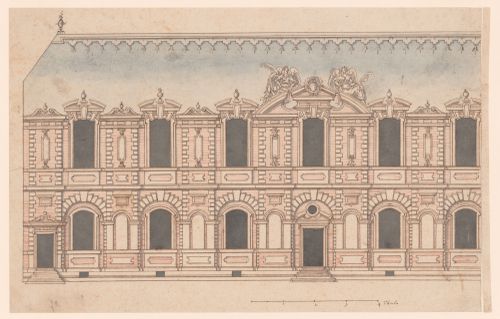
Title:
Elevation of a palace façade
Elevation of a palace façade
Actions:
Reference number:
DR1970:0003
Description:
This drawing shows an exterior of a residential building. The artist uses color to suggest the materials used in construction; blue-grey for the pitched slate roof, brown for masonry details and architectural sculpture, and red striations for brickwork. This combination of materials was common in early modern France, where a play on color and materiality enlivened the façades of well-known royal edifices including the chateaux of Fontainebleau and Saint-Germain-en-Laye. As with the construction technique that interwove stone with brick, the architectural style depicted in the drawing combines traditional French ideas about building with classicizing elements imported to France via Italian artists and architects as well as through printed translations of Vitruvius’s 'De architectura' and Sebastiano Serlio’s architectural treatise. The inclusion of masonry rustication and the decorative urns that punctuate the roofline suggest a knowledge of classicizing trends in architectural ornament and a familiarity with the œuvre of artists working in the circle of the first and second Écoles de Fontainebleau. The structure’s elongated form suggests a gallery and the organization of the façade borrows the combination of slightly protruding vertical bays and long horizontal registers that characterizes Pierre Lescot’s wing of the Louvre, a project that would have been well-known in court circles in the latter half of the sixteenth century. Similarly, the two winged allegorical figures flanking the central pediment are reminiscent of Jean Goujon’s sculptural additions to the Lescot wing. In the Canadian Centre for Architecture’s drawing both figures hold palms, but the artist omitted any further identifying attributes, perhaps – along with the empty niches – as an invitation for the patron to imagine his or her own thematic program for the project.
DR1970:0003
Description:
This drawing shows an exterior of a residential building. The artist uses color to suggest the materials used in construction; blue-grey for the pitched slate roof, brown for masonry details and architectural sculpture, and red striations for brickwork. This combination of materials was common in early modern France, where a play on color and materiality enlivened the façades of well-known royal edifices including the chateaux of Fontainebleau and Saint-Germain-en-Laye. As with the construction technique that interwove stone with brick, the architectural style depicted in the drawing combines traditional French ideas about building with classicizing elements imported to France via Italian artists and architects as well as through printed translations of Vitruvius’s 'De architectura' and Sebastiano Serlio’s architectural treatise. The inclusion of masonry rustication and the decorative urns that punctuate the roofline suggest a knowledge of classicizing trends in architectural ornament and a familiarity with the œuvre of artists working in the circle of the first and second Écoles de Fontainebleau. The structure’s elongated form suggests a gallery and the organization of the façade borrows the combination of slightly protruding vertical bays and long horizontal registers that characterizes Pierre Lescot’s wing of the Louvre, a project that would have been well-known in court circles in the latter half of the sixteenth century. Similarly, the two winged allegorical figures flanking the central pediment are reminiscent of Jean Goujon’s sculptural additions to the Lescot wing. In the Canadian Centre for Architecture’s drawing both figures hold palms, but the artist omitted any further identifying attributes, perhaps – along with the empty niches – as an invitation for the patron to imagine his or her own thematic program for the project.
People:
Date:
first quarter of the 16th century
first quarter of the 16th century
Title:
Elevation of a palace façade
Actions:
DR1970:0003
Description:
This drawing shows an exterior of a residential building. The artist uses color to suggest the materials used in construction; blue-grey for the pitched slate roof, brown for masonry details and architectural sculpture, and red striations for brickwork. This combination of materials was common in early modern France, where a play on color and materiality enlivened the façades of well-known royal edifices including the chateaux of Fontainebleau and Saint-Germain-en-Laye. As with the construction technique that interwove stone with brick, the architectural style depicted in the drawing combines traditional French ideas about building with classicizing elements imported to France via Italian artists and architects as well as through printed translations of Vitruvius’s 'De architectura' and Sebastiano Serlio’s architectural treatise. The inclusion of masonry rustication and the decorative urns that punctuate the roofline suggest a knowledge of classicizing trends in architectural ornament and a familiarity with the œuvre of artists working in the circle of the first and second Écoles de Fontainebleau. The structure’s elongated form suggests a gallery and the organization of the façade borrows the combination of slightly protruding vertical bays and long horizontal registers that characterizes Pierre Lescot’s wing of the Louvre, a project that would have been well-known in court circles in the latter half of the sixteenth century. Similarly, the two winged allegorical figures flanking the central pediment are reminiscent of Jean Goujon’s sculptural additions to the Lescot wing. In the Canadian Centre for Architecture’s drawing both figures hold palms, but the artist omitted any further identifying attributes, perhaps – along with the empty niches – as an invitation for the patron to imagine his or her own thematic program for the project.
Elevation of a palace façade
Actions:
DR1970:0003
Description:
This drawing shows an exterior of a residential building. The artist uses color to suggest the materials used in construction; blue-grey for the pitched slate roof, brown for masonry details and architectural sculpture, and red striations for brickwork. This combination of materials was common in early modern France, where a play on color and materiality enlivened the façades of well-known royal edifices including the chateaux of Fontainebleau and Saint-Germain-en-Laye. As with the construction technique that interwove stone with brick, the architectural style depicted in the drawing combines traditional French ideas about building with classicizing elements imported to France via Italian artists and architects as well as through printed translations of Vitruvius’s 'De architectura' and Sebastiano Serlio’s architectural treatise. The inclusion of masonry rustication and the decorative urns that punctuate the roofline suggest a knowledge of classicizing trends in architectural ornament and a familiarity with the œuvre of artists working in the circle of the first and second Écoles de Fontainebleau. The structure’s elongated form suggests a gallery and the organization of the façade borrows the combination of slightly protruding vertical bays and long horizontal registers that characterizes Pierre Lescot’s wing of the Louvre, a project that would have been well-known in court circles in the latter half of the sixteenth century. Similarly, the two winged allegorical figures flanking the central pediment are reminiscent of Jean Goujon’s sculptural additions to the Lescot wing. In the Canadian Centre for Architecture’s drawing both figures hold palms, but the artist omitted any further identifying attributes, perhaps – along with the empty niches – as an invitation for the patron to imagine his or her own thematic program for the project.
Form:
drawings
drawings
Date:
first quarter of the 16th century
first quarter of the 16th century
People:


