


33582 Results
Level of archival description:
Series
Series
Reference number:
AP185.S2
Description:
This project, 1994-2001, contains material related to the Ost/Kuttner Apartment, a built residential project in New York City. Described by its clients as “Cleopatra’s submarine,” the O/K Apartment converts two adjacent units in a pre-World War II building in New York into a single but divisible space. The Apartment is organized into areas defined less by their programmatic identity—bathroom, bedroom, living room—than by a series of undulating landscapes made up of custom, function-bridging forms, which KOL/MAC developed by digitally compositing cross-sections of everyday domestic objects. To produce the pieces, the architects worked intensively with contractors in a process directly informed by computer-aided fabrication in a variety of fields including ship-building, bobsled design, and stage design. The digital project records are largely in word processing formats, namely Microsoft Word for Mac and ClarisWorks, as well as images in TIF, JPEG, and Mac Pict image formats. There are also a large number of Microstation CAD drawings. There are two major groupings within the digital material: First, there is a body of video and still images. These consist of screen captures of renderings and other digital models. There are also images and HTML for a related website, a photograph viewer showing pictures of a built, physical model of the apartment. Of note, there are two videos which document the early construction of the Apartment, as well as the construction of the shower/bed. The second grouping consists of construction and design documentation. This consists of correspondence, invoices, and other word processing documents which show KOL/MAC’s work with the client, contractor, engineer, and other stakeholders. They also contain a large number of design files and images which document the evolving design of the Apartment. KOL/MAC versioned their working files at certain intervals, and each version represents a snapshot of the working files at a particular time. There is a substantial amount of duplication across these files. There is also a physical component to the records, including three material samples from the apartment, as well as 28 floorplans for the bid set, 6 floorplans, and 2 blueprints. There is also .3 linear meters of textual records which document KOL/MAC’s work with the client, contractor, and sub-contractor during construction.
AP185.S2
Description:
This project, 1994-2001, contains material related to the Ost/Kuttner Apartment, a built residential project in New York City. Described by its clients as “Cleopatra’s submarine,” the O/K Apartment converts two adjacent units in a pre-World War II building in New York into a single but divisible space. The Apartment is organized into areas defined less by their programmatic identity—bathroom, bedroom, living room—than by a series of undulating landscapes made up of custom, function-bridging forms, which KOL/MAC developed by digitally compositing cross-sections of everyday domestic objects. To produce the pieces, the architects worked intensively with contractors in a process directly informed by computer-aided fabrication in a variety of fields including ship-building, bobsled design, and stage design. The digital project records are largely in word processing formats, namely Microsoft Word for Mac and ClarisWorks, as well as images in TIF, JPEG, and Mac Pict image formats. There are also a large number of Microstation CAD drawings. There are two major groupings within the digital material: First, there is a body of video and still images. These consist of screen captures of renderings and other digital models. There are also images and HTML for a related website, a photograph viewer showing pictures of a built, physical model of the apartment. Of note, there are two videos which document the early construction of the Apartment, as well as the construction of the shower/bed. The second grouping consists of construction and design documentation. This consists of correspondence, invoices, and other word processing documents which show KOL/MAC’s work with the client, contractor, engineer, and other stakeholders. They also contain a large number of design files and images which document the evolving design of the Apartment. KOL/MAC versioned their working files at certain intervals, and each version represents a snapshot of the working files at a particular time. There is a substantial amount of duplication across these files. There is also a physical component to the records, including three material samples from the apartment, as well as 28 floorplans for the bid set, 6 floorplans, and 2 blueprints. There is also .3 linear meters of textual records which document KOL/MAC’s work with the client, contractor, and sub-contractor during construction.
People:
Date:
1994-2001
1994-2001
Title:
O/K Apartment (New York, N.Y.)
Actions:
AP185.S2
Description:
This project, 1994-2001, contains material related to the Ost/Kuttner Apartment, a built residential project in New York City. Described by its clients as “Cleopatra’s submarine,” the O/K Apartment converts two adjacent units in a pre-World War II building in New York into a single but divisible space. The Apartment is organized into areas defined less by their programmatic identity—bathroom, bedroom, living room—than by a series of undulating landscapes made up of custom, function-bridging forms, which KOL/MAC developed by digitally compositing cross-sections of everyday domestic objects. To produce the pieces, the architects worked intensively with contractors in a process directly informed by computer-aided fabrication in a variety of fields including ship-building, bobsled design, and stage design. The digital project records are largely in word processing formats, namely Microsoft Word for Mac and ClarisWorks, as well as images in TIF, JPEG, and Mac Pict image formats. There are also a large number of Microstation CAD drawings. There are two major groupings within the digital material: First, there is a body of video and still images. These consist of screen captures of renderings and other digital models. There are also images and HTML for a related website, a photograph viewer showing pictures of a built, physical model of the apartment. Of note, there are two videos which document the early construction of the Apartment, as well as the construction of the shower/bed. The second grouping consists of construction and design documentation. This consists of correspondence, invoices, and other word processing documents which show KOL/MAC’s work with the client, contractor, engineer, and other stakeholders. They also contain a large number of design files and images which document the evolving design of the Apartment. KOL/MAC versioned their working files at certain intervals, and each version represents a snapshot of the working files at a particular time. There is a substantial amount of duplication across these files. There is also a physical component to the records, including three material samples from the apartment, as well as 28 floorplans for the bid set, 6 floorplans, and 2 blueprints. There is also .3 linear meters of textual records which document KOL/MAC’s work with the client, contractor, and sub-contractor during construction.
O/K Apartment (New York, N.Y.)
Actions:
AP185.S2
Description:
This project, 1994-2001, contains material related to the Ost/Kuttner Apartment, a built residential project in New York City. Described by its clients as “Cleopatra’s submarine,” the O/K Apartment converts two adjacent units in a pre-World War II building in New York into a single but divisible space. The Apartment is organized into areas defined less by their programmatic identity—bathroom, bedroom, living room—than by a series of undulating landscapes made up of custom, function-bridging forms, which KOL/MAC developed by digitally compositing cross-sections of everyday domestic objects. To produce the pieces, the architects worked intensively with contractors in a process directly informed by computer-aided fabrication in a variety of fields including ship-building, bobsled design, and stage design. The digital project records are largely in word processing formats, namely Microsoft Word for Mac and ClarisWorks, as well as images in TIF, JPEG, and Mac Pict image formats. There are also a large number of Microstation CAD drawings. There are two major groupings within the digital material: First, there is a body of video and still images. These consist of screen captures of renderings and other digital models. There are also images and HTML for a related website, a photograph viewer showing pictures of a built, physical model of the apartment. Of note, there are two videos which document the early construction of the Apartment, as well as the construction of the shower/bed. The second grouping consists of construction and design documentation. This consists of correspondence, invoices, and other word processing documents which show KOL/MAC’s work with the client, contractor, engineer, and other stakeholders. They also contain a large number of design files and images which document the evolving design of the Apartment. KOL/MAC versioned their working files at certain intervals, and each version represents a snapshot of the working files at a particular time. There is a substantial amount of duplication across these files. There is also a physical component to the records, including three material samples from the apartment, as well as 28 floorplans for the bid set, 6 floorplans, and 2 blueprints. There is also .3 linear meters of textual records which document KOL/MAC’s work with the client, contractor, and sub-contractor during construction.
Level of archival description:
Series
Series
Date:
1994-2001
1994-2001
People:
Form:
drawings, textual records, works of art
Quantity:
2 album(s)
drawings, textual records, works of art
Quantity:
2 album(s)
Actions:
Reference number:
DR1974:0002:037:001-031
Description:
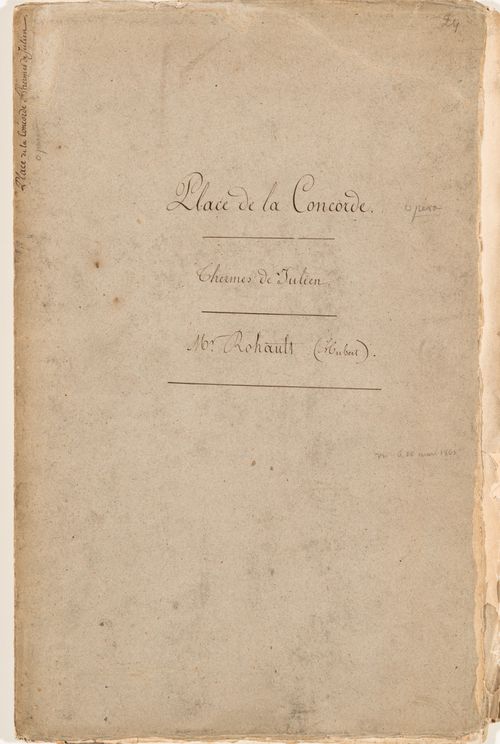
- This album contains drawings, prints and manuscripts chiefly related to two projects: the restoration of the Thermes de Julien and the development of the place de la Concorde, then known as place Louis XV. The ruins of the baths are documented in five drawings by Hubert Rohault de Fleury. The portfolio of manuscripts includes letters from the "Préfecture du Départment de la Seine" appointing Hubert Rohault de Fleury and Etienne Goddes to direct the restoration of the baths, a report by Rohault de Fleury and Goddes, and subsequent letters. The report includes a description of the baths, historical research, suggestions for earth removal and the purchase of adjacent buildings to be demolished. Both proposals made by Hubert Rohault de Fleury to the "Ministre de l'interior" for place Louis XV include central fountains and streets bisecting the square into four quadrants, each with fenced lawns and central fountains. One proposal shows the outer corner of each quadrant bordered by colonnades and loggias overlooking the "jardins des Tuileries", while the other proposal shows promenades bordered by a row of sculptures (DR1974:0002:037:004 - DR1974:0002:037:013). Also by Hubert Rohault de Fleury are several sketches for urban squares and five sketches for fountains, probably for place Louis XV (DR1974:0002:037:003, DR1974:0002:037:014 R/V - DR1974:0002:037:018 R/V). Projects by other architects for place Louis XV in the album include: a print by an unknown engraver of a project by Poyet for place Louis XV, including an opera house; engravings by Ollivier and Hibon of plans and fountains for place Louis XVI by Destouches and by Lusson; a lithograph by Roux of an obelisk with a fountain, probably a proposal for the base of the obelisk from Luxor. - Material unrelated to the Thermes de Julien and place Louis XV in this album includes one sheet of sketches of plans and elevations of unidentified buildings (DR1974:0002:037:001:045 R/V) and a plan showing the location of trees on the edge of place du Cirque Olympique, Paris (DR1974:0002:037:025). In addition to place Louis XVI, the engravings by Hibon and Ollivier depict a fountain for the ville de Toulouse designed by either Etienne Jacques or Etienne Jules Tierry and details of the acanthus foliage finial of the "Lanterne de Démosthénes", often known as the Choragic monument of Lysicrates, Greece (DR1974:0002:037:020 and DR1974:0002:037:021).
DR1974:0002:037:001-031
Description:
- This album contains drawings, prints and manuscripts chiefly related to two projects: the restoration of the Thermes de Julien and the development of the place de la Concorde, then known as place Louis XV. The ruins of the baths are documented in five drawings by Hubert Rohault de Fleury. The portfolio of manuscripts includes letters from the "Préfecture du Départment de la Seine" appointing Hubert Rohault de Fleury and Etienne Goddes to direct the restoration of the baths, a report by Rohault de Fleury and Goddes, and subsequent letters. The report includes a description of the baths, historical research, suggestions for earth removal and the purchase of adjacent buildings to be demolished. Both proposals made by Hubert Rohault de Fleury to the "Ministre de l'interior" for place Louis XV include central fountains and streets bisecting the square into four quadrants, each with fenced lawns and central fountains. One proposal shows the outer corner of each quadrant bordered by colonnades and loggias overlooking the "jardins des Tuileries", while the other proposal shows promenades bordered by a row of sculptures (DR1974:0002:037:004 - DR1974:0002:037:013). Also by Hubert Rohault de Fleury are several sketches for urban squares and five sketches for fountains, probably for place Louis XV (DR1974:0002:037:003, DR1974:0002:037:014 R/V - DR1974:0002:037:018 R/V). Projects by other architects for place Louis XV in the album include: a print by an unknown engraver of a project by Poyet for place Louis XV, including an opera house; engravings by Ollivier and Hibon of plans and fountains for place Louis XVI by Destouches and by Lusson; a lithograph by Roux of an obelisk with a fountain, probably a proposal for the base of the obelisk from Luxor. - Material unrelated to the Thermes de Julien and place Louis XV in this album includes one sheet of sketches of plans and elevations of unidentified buildings (DR1974:0002:037:001:045 R/V) and a plan showing the location of trees on the edge of place du Cirque Olympique, Paris (DR1974:0002:037:025). In addition to place Louis XVI, the engravings by Hibon and Ollivier depict a fountain for the ville de Toulouse designed by either Etienne Jacques or Etienne Jules Tierry and details of the acanthus foliage finial of the "Lanterne de Démosthénes", often known as the Choragic monument of Lysicrates, Greece (DR1974:0002:037:020 and DR1974:0002:037:021).
People:
Subject:
architecture, urban planning
architecture, urban planning
Date:
1754-1875
1754-1875
Title:
Album of drawings, prints and documents for place de la Concorde and the restoration of the Thermes de Julien, Paris
Actions:
DR1974:0002:037:001-031
Description:
- This album contains drawings, prints and manuscripts chiefly related to two projects: the restoration of the Thermes de Julien and the development of the place de la Concorde, then known as place Louis XV. The ruins of the baths are documented in five drawings by Hubert Rohault de Fleury. The portfolio of manuscripts includes letters from the "Préfecture du Départment de la Seine" appointing Hubert Rohault de Fleury and Etienne Goddes to direct the restoration of the baths, a report by Rohault de Fleury and Goddes, and subsequent letters. The report includes a description of the baths, historical research, suggestions for earth removal and the purchase of adjacent buildings to be demolished. Both proposals made by Hubert Rohault de Fleury to the "Ministre de l'interior" for place Louis XV include central fountains and streets bisecting the square into four quadrants, each with fenced lawns and central fountains. One proposal shows the outer corner of each quadrant bordered by colonnades and loggias overlooking the "jardins des Tuileries", while the other proposal shows promenades bordered by a row of sculptures (DR1974:0002:037:004 - DR1974:0002:037:013). Also by Hubert Rohault de Fleury are several sketches for urban squares and five sketches for fountains, probably for place Louis XV (DR1974:0002:037:003, DR1974:0002:037:014 R/V - DR1974:0002:037:018 R/V). Projects by other architects for place Louis XV in the album include: a print by an unknown engraver of a project by Poyet for place Louis XV, including an opera house; engravings by Ollivier and Hibon of plans and fountains for place Louis XVI by Destouches and by Lusson; a lithograph by Roux of an obelisk with a fountain, probably a proposal for the base of the obelisk from Luxor. - Material unrelated to the Thermes de Julien and place Louis XV in this album includes one sheet of sketches of plans and elevations of unidentified buildings (DR1974:0002:037:001:045 R/V) and a plan showing the location of trees on the edge of place du Cirque Olympique, Paris (DR1974:0002:037:025). In addition to place Louis XVI, the engravings by Hibon and Ollivier depict a fountain for the ville de Toulouse designed by either Etienne Jacques or Etienne Jules Tierry and details of the acanthus foliage finial of the "Lanterne de Démosthénes", often known as the Choragic monument of Lysicrates, Greece (DR1974:0002:037:020 and DR1974:0002:037:021).
Album of drawings, prints and documents for place de la Concorde and the restoration of the Thermes de Julien, Paris
Actions:
DR1974:0002:037:001-031
Description:
- This album contains drawings, prints and manuscripts chiefly related to two projects: the restoration of the Thermes de Julien and the development of the place de la Concorde, then known as place Louis XV. The ruins of the baths are documented in five drawings by Hubert Rohault de Fleury. The portfolio of manuscripts includes letters from the "Préfecture du Départment de la Seine" appointing Hubert Rohault de Fleury and Etienne Goddes to direct the restoration of the baths, a report by Rohault de Fleury and Goddes, and subsequent letters. The report includes a description of the baths, historical research, suggestions for earth removal and the purchase of adjacent buildings to be demolished. Both proposals made by Hubert Rohault de Fleury to the "Ministre de l'interior" for place Louis XV include central fountains and streets bisecting the square into four quadrants, each with fenced lawns and central fountains. One proposal shows the outer corner of each quadrant bordered by colonnades and loggias overlooking the "jardins des Tuileries", while the other proposal shows promenades bordered by a row of sculptures (DR1974:0002:037:004 - DR1974:0002:037:013). Also by Hubert Rohault de Fleury are several sketches for urban squares and five sketches for fountains, probably for place Louis XV (DR1974:0002:037:003, DR1974:0002:037:014 R/V - DR1974:0002:037:018 R/V). Projects by other architects for place Louis XV in the album include: a print by an unknown engraver of a project by Poyet for place Louis XV, including an opera house; engravings by Ollivier and Hibon of plans and fountains for place Louis XVI by Destouches and by Lusson; a lithograph by Roux of an obelisk with a fountain, probably a proposal for the base of the obelisk from Luxor. - Material unrelated to the Thermes de Julien and place Louis XV in this album includes one sheet of sketches of plans and elevations of unidentified buildings (DR1974:0002:037:001:045 R/V) and a plan showing the location of trees on the edge of place du Cirque Olympique, Paris (DR1974:0002:037:025). In addition to place Louis XVI, the engravings by Hibon and Ollivier depict a fountain for the ville de Toulouse designed by either Etienne Jacques or Etienne Jules Tierry and details of the acanthus foliage finial of the "Lanterne de Démosthénes", often known as the Choragic monument of Lysicrates, Greece (DR1974:0002:037:020 and DR1974:0002:037:021).
Form:
drawings, textual records, works of art
Quantity:
2 album(s)
drawings, textual records, works of art
Quantity:
2 album(s)
Date:
1754-1875
1754-1875
People:
Subject:
architecture, urban planning
architecture, urban planning
Form:
photographs
photographs
Actions:
Reference number:
PH1981:0803:001-040
Description:
Portfolio of photographs has a title page and a list of plates on verso of title page: Table générale des planches I. Villas maritimes - Architectes 1. Villa au bord de la mer, à Elberon - McKim, Mead & White 2. Villa au bord de la mer, à Elberon - V.C. Taylor 3. Villa au bord de la mer, Newport - G.B. Post 4. Villa au bord de la mer, Newport - Peabody et Stearns 5. Villa au bord de la mer, Bar Harbour - Rotch et Tilden 7. Villa au bord de la mer, Bar Harbour - Rotch et Tilden II. Maisons de campagne 8. Maison de campagne, à Orange - P.J. Boticher 9. Maison de campagne, à Orange - P.J. Boticher 10. Maison de campagne, à Orange - P.J. Boticher 11. Maison de campagne, à Orange - P.J. Boticher 12. Maison de campagne, Hartford - G. Keller 13. Maison de campagne, Hartford - T.C. Withers 14. Maison de campagne, Hartford - Kimball et Wisedell 15. Maison de campagne, Hartford - Kimball et Wisedell 16. Maison de campagne, Brookline - C.S. Luce 17. Maison de campagne, Brookline - Peabody et Stearns 18. Maison de campagne, Brookline - Peabody et Stearns 19. Maison de campagne, Brookline - S.E. Toby 20. Maison de campagne, Brookline - E.A.P. Newcomb 21. Maison de campagne, à Jamaica-Plain - W.R. Emerson 22. Maison de campagne, à Jamaica-Plain - W.R. Emerson 23. Maison de campagne, Détroit - Mason et Rice 24. Maison de campagne, W. Scott et Cie. 25. Maison de campagne, Buffalo - J.-L. Silsbee 26. Maison de campagne, Buffalo - J.-L. Silsbee 27. Maison de campagne, Buffalo - J.-L. Silsbee 28. Maison de campagne, Chicago - Cobb et Frost 29. Maison de campagne, Chicago - J.J. Flanders 30. Maison de campagne, Dorcester - Cabot et Chandler 31. Maison de campagne, Milwaukee - Cabot et Chandler 32. Maison de campagne, Cleveland - Peabody et Stearns 33. Maison de campagne, Rochester - J.G. Cutter 34. Maison de campagne, Walnut-Hills - Bruce Price 35. Hôtel privé suburbain, à Chicago - Bruce Price 36. Hôtel privé suburbain, à Chicago - Peabody et Stearns 37. Petite maison de campagne, à Chicago III Dépendances 38. Maison de garde, à North-Easton - H.H. Richardson 39. Maison de garde, à North-Easton - H.H. Richardson 40. Loge de gardien, à Newport - H.H. Richardson
PH1981:0803:001-040
Description:
Portfolio of photographs has a title page and a list of plates on verso of title page: Table générale des planches I. Villas maritimes - Architectes 1. Villa au bord de la mer, à Elberon - McKim, Mead & White 2. Villa au bord de la mer, à Elberon - V.C. Taylor 3. Villa au bord de la mer, Newport - G.B. Post 4. Villa au bord de la mer, Newport - Peabody et Stearns 5. Villa au bord de la mer, Bar Harbour - Rotch et Tilden 7. Villa au bord de la mer, Bar Harbour - Rotch et Tilden II. Maisons de campagne 8. Maison de campagne, à Orange - P.J. Boticher 9. Maison de campagne, à Orange - P.J. Boticher 10. Maison de campagne, à Orange - P.J. Boticher 11. Maison de campagne, à Orange - P.J. Boticher 12. Maison de campagne, Hartford - G. Keller 13. Maison de campagne, Hartford - T.C. Withers 14. Maison de campagne, Hartford - Kimball et Wisedell 15. Maison de campagne, Hartford - Kimball et Wisedell 16. Maison de campagne, Brookline - C.S. Luce 17. Maison de campagne, Brookline - Peabody et Stearns 18. Maison de campagne, Brookline - Peabody et Stearns 19. Maison de campagne, Brookline - S.E. Toby 20. Maison de campagne, Brookline - E.A.P. Newcomb 21. Maison de campagne, à Jamaica-Plain - W.R. Emerson 22. Maison de campagne, à Jamaica-Plain - W.R. Emerson 23. Maison de campagne, Détroit - Mason et Rice 24. Maison de campagne, W. Scott et Cie. 25. Maison de campagne, Buffalo - J.-L. Silsbee 26. Maison de campagne, Buffalo - J.-L. Silsbee 27. Maison de campagne, Buffalo - J.-L. Silsbee 28. Maison de campagne, Chicago - Cobb et Frost 29. Maison de campagne, Chicago - J.J. Flanders 30. Maison de campagne, Dorcester - Cabot et Chandler 31. Maison de campagne, Milwaukee - Cabot et Chandler 32. Maison de campagne, Cleveland - Peabody et Stearns 33. Maison de campagne, Rochester - J.G. Cutter 34. Maison de campagne, Walnut-Hills - Bruce Price 35. Hôtel privé suburbain, à Chicago - Bruce Price 36. Hôtel privé suburbain, à Chicago - Peabody et Stearns 37. Petite maison de campagne, à Chicago III Dépendances 38. Maison de garde, à North-Easton - H.H. Richardson 39. Maison de garde, à North-Easton - H.H. Richardson 40. Loge de gardien, à Newport - H.H. Richardson
People:
Subject:
architecture
architecture
Date:
early 1886
early 1886
Title:
Architecture Américaine, Troisième Série: Habitations Suburbaines: Villas, Maisons de Campagne, Cottages, Dépendances
Actions:
PH1981:0803:001-040
Description:
Portfolio of photographs has a title page and a list of plates on verso of title page: Table générale des planches I. Villas maritimes - Architectes 1. Villa au bord de la mer, à Elberon - McKim, Mead & White 2. Villa au bord de la mer, à Elberon - V.C. Taylor 3. Villa au bord de la mer, Newport - G.B. Post 4. Villa au bord de la mer, Newport - Peabody et Stearns 5. Villa au bord de la mer, Bar Harbour - Rotch et Tilden 7. Villa au bord de la mer, Bar Harbour - Rotch et Tilden II. Maisons de campagne 8. Maison de campagne, à Orange - P.J. Boticher 9. Maison de campagne, à Orange - P.J. Boticher 10. Maison de campagne, à Orange - P.J. Boticher 11. Maison de campagne, à Orange - P.J. Boticher 12. Maison de campagne, Hartford - G. Keller 13. Maison de campagne, Hartford - T.C. Withers 14. Maison de campagne, Hartford - Kimball et Wisedell 15. Maison de campagne, Hartford - Kimball et Wisedell 16. Maison de campagne, Brookline - C.S. Luce 17. Maison de campagne, Brookline - Peabody et Stearns 18. Maison de campagne, Brookline - Peabody et Stearns 19. Maison de campagne, Brookline - S.E. Toby 20. Maison de campagne, Brookline - E.A.P. Newcomb 21. Maison de campagne, à Jamaica-Plain - W.R. Emerson 22. Maison de campagne, à Jamaica-Plain - W.R. Emerson 23. Maison de campagne, Détroit - Mason et Rice 24. Maison de campagne, W. Scott et Cie. 25. Maison de campagne, Buffalo - J.-L. Silsbee 26. Maison de campagne, Buffalo - J.-L. Silsbee 27. Maison de campagne, Buffalo - J.-L. Silsbee 28. Maison de campagne, Chicago - Cobb et Frost 29. Maison de campagne, Chicago - J.J. Flanders 30. Maison de campagne, Dorcester - Cabot et Chandler 31. Maison de campagne, Milwaukee - Cabot et Chandler 32. Maison de campagne, Cleveland - Peabody et Stearns 33. Maison de campagne, Rochester - J.G. Cutter 34. Maison de campagne, Walnut-Hills - Bruce Price 35. Hôtel privé suburbain, à Chicago - Bruce Price 36. Hôtel privé suburbain, à Chicago - Peabody et Stearns 37. Petite maison de campagne, à Chicago III Dépendances 38. Maison de garde, à North-Easton - H.H. Richardson 39. Maison de garde, à North-Easton - H.H. Richardson 40. Loge de gardien, à Newport - H.H. Richardson
Architecture Américaine, Troisième Série: Habitations Suburbaines: Villas, Maisons de Campagne, Cottages, Dépendances
Actions:
PH1981:0803:001-040
Description:
Portfolio of photographs has a title page and a list of plates on verso of title page: Table générale des planches I. Villas maritimes - Architectes 1. Villa au bord de la mer, à Elberon - McKim, Mead & White 2. Villa au bord de la mer, à Elberon - V.C. Taylor 3. Villa au bord de la mer, Newport - G.B. Post 4. Villa au bord de la mer, Newport - Peabody et Stearns 5. Villa au bord de la mer, Bar Harbour - Rotch et Tilden 7. Villa au bord de la mer, Bar Harbour - Rotch et Tilden II. Maisons de campagne 8. Maison de campagne, à Orange - P.J. Boticher 9. Maison de campagne, à Orange - P.J. Boticher 10. Maison de campagne, à Orange - P.J. Boticher 11. Maison de campagne, à Orange - P.J. Boticher 12. Maison de campagne, Hartford - G. Keller 13. Maison de campagne, Hartford - T.C. Withers 14. Maison de campagne, Hartford - Kimball et Wisedell 15. Maison de campagne, Hartford - Kimball et Wisedell 16. Maison de campagne, Brookline - C.S. Luce 17. Maison de campagne, Brookline - Peabody et Stearns 18. Maison de campagne, Brookline - Peabody et Stearns 19. Maison de campagne, Brookline - S.E. Toby 20. Maison de campagne, Brookline - E.A.P. Newcomb 21. Maison de campagne, à Jamaica-Plain - W.R. Emerson 22. Maison de campagne, à Jamaica-Plain - W.R. Emerson 23. Maison de campagne, Détroit - Mason et Rice 24. Maison de campagne, W. Scott et Cie. 25. Maison de campagne, Buffalo - J.-L. Silsbee 26. Maison de campagne, Buffalo - J.-L. Silsbee 27. Maison de campagne, Buffalo - J.-L. Silsbee 28. Maison de campagne, Chicago - Cobb et Frost 29. Maison de campagne, Chicago - J.J. Flanders 30. Maison de campagne, Dorcester - Cabot et Chandler 31. Maison de campagne, Milwaukee - Cabot et Chandler 32. Maison de campagne, Cleveland - Peabody et Stearns 33. Maison de campagne, Rochester - J.G. Cutter 34. Maison de campagne, Walnut-Hills - Bruce Price 35. Hôtel privé suburbain, à Chicago - Bruce Price 36. Hôtel privé suburbain, à Chicago - Peabody et Stearns 37. Petite maison de campagne, à Chicago III Dépendances 38. Maison de garde, à North-Easton - H.H. Richardson 39. Maison de garde, à North-Easton - H.H. Richardson 40. Loge de gardien, à Newport - H.H. Richardson
Form:
photographs
photographs
Date:
early 1886
early 1886
People:
Subject:
architecture
architecture
Form:
archives
Level of archival description:
Fonds
archives
Level of archival description:
Fonds
Title:
Ross & Macdonald fonds
Ross & Macdonald fonds
Reference number:
AP013
Synopsis:
The Ross & Macdonald fonds is comprised of documents concerning the work of six successive architectural firms: Ross & MacFarlane (1905-1912), Ross & Macdonald (1913-1944), Ross & Ross (1944-1946), Ross, Patterson, Townsend & Heughan (1946-1950), Ross, Patterson, Townsend & Fish (1950-1958), and Ross, Fish, Duschenes & Barrett (1958-1976). The greatest concentration of work was produced in Montreal where each of the firms maintained their head office, but there were also a large number of works executed in New Brunswick and Nova Scotia. The fonds contains 27 884 drawings (24 294 originals plus 3 590 reproductions), 236 photographs, and 18.6 metres of textual documents.
AP013
Synopsis:
The Ross & Macdonald fonds is comprised of documents concerning the work of six successive architectural firms: Ross & MacFarlane (1905-1912), Ross & Macdonald (1913-1944), Ross & Ross (1944-1946), Ross, Patterson, Townsend & Heughan (1946-1950), Ross, Patterson, Townsend & Fish (1950-1958), and Ross, Fish, Duschenes & Barrett (1958-1976). The greatest concentration of work was produced in Montreal where each of the firms maintained their head office, but there were also a large number of works executed in New Brunswick and Nova Scotia. The fonds contains 27 884 drawings (24 294 originals plus 3 590 reproductions), 236 photographs, and 18.6 metres of textual documents.
People:
Date:
1902-1982
1902-1982
Title:
Ross & Macdonald fonds
Actions:
AP013
Synopsis:
The Ross & Macdonald fonds is comprised of documents concerning the work of six successive architectural firms: Ross & MacFarlane (1905-1912), Ross & Macdonald (1913-1944), Ross & Ross (1944-1946), Ross, Patterson, Townsend & Heughan (1946-1950), Ross, Patterson, Townsend & Fish (1950-1958), and Ross, Fish, Duschenes & Barrett (1958-1976). The greatest concentration of work was produced in Montreal where each of the firms maintained their head office, but there were also a large number of works executed in New Brunswick and Nova Scotia. The fonds contains 27 884 drawings (24 294 originals plus 3 590 reproductions), 236 photographs, and 18.6 metres of textual documents.
Ross & Macdonald fonds
Actions:
AP013
Synopsis:
The Ross & Macdonald fonds is comprised of documents concerning the work of six successive architectural firms: Ross & MacFarlane (1905-1912), Ross & Macdonald (1913-1944), Ross & Ross (1944-1946), Ross, Patterson, Townsend & Heughan (1946-1950), Ross, Patterson, Townsend & Fish (1950-1958), and Ross, Fish, Duschenes & Barrett (1958-1976). The greatest concentration of work was produced in Montreal where each of the firms maintained their head office, but there were also a large number of works executed in New Brunswick and Nova Scotia. The fonds contains 27 884 drawings (24 294 originals plus 3 590 reproductions), 236 photographs, and 18.6 metres of textual documents.
Form:
archives
Level of archival description:
Fonds
archives
Level of archival description:
Fonds
Date:
1902-1982
1902-1982
People:
Level of archival description:
Project
Project
Title:
Lightweight Enclosures Unit
Lightweight Enclosures Unit
Reference number:
AP144.S2.D79
Description:
File documents the work of the Lightweight Enclosures Unit (LEU) which was set up by Frank Newby and Cedric Price after their completion of a UK government research programme into air structures in 1969 (see Air Structures Research AP144.S2.D63). The work of LEU included research and design into the social, economic and structural development of lightweight enclosures. The LEU published a bibliography for the industry on air structures in 1972 titled 'Air Structures Bibliography, B0001-0069 and B0070-0119. It also helped produce the report BS6661:1986 'Design, construction and maintenance of single-skin air supported structures', and reviewed lightweight enclosures in AD 8/71, p 465. LEU was commissioned to write 'Air Support Structures: BSI Draft for Development Code of Practice' (DD50). This work is documented in DOE Air Structure (AP144.S2.D91). Frank Newby continued to work on the review of DD50 up until the 1980s. Material in this file was produced between 1956 and 1993. Group DR2004:1356 contains a 1973 drawing attributed to Pierre Martin for S.A.S. (Lausanne). Group DR2004:1353 contains reference drawings by architect Rurik Ekstrom, for Antioch Pneumatic Campus, Columbia Maryland (1972). Group DR2004:0132 contains material that relates to 'Air Structures' a conference on Antioch Campus in Columbia, Maryland, US May 22-34, 1973. DR2004:0135 contains publications by Frei Otto and the Institute of Lightweight Structures at the University of Stuttgart, and a transcript of an Air Structures Lecture, presented in Maryland, possibly by Cedric Price. DR2004:0137, DR2004:0139, and DR2004:0141 contain materials that relate to DD50 'Draft for Development: Air Supported Structures' for British Standards Institution, 1976 (see DOE Air Structure AP144.S2.D91). DR2004:0142 contains papers from the 'International Symposium on Pneumatic Structures' - Delft, 1972. DR2004:0145 contains material on 'Pneuma Jam'. DR2004:0146 contains material that relates to Christo (1973 projects). Group DR2004:0127 contains material that relates to Christo and his project, Valley Curtain. The group DR2004:0159 contains materials from the following manufacturers: Kurashiki Rayon Co., Ltd; Krupp Universalbau; Kleyer; Kellbro Construction Ltd; AEI; Norris Brothers Limited; Kaltenbach; Irvin Industries Ltd; Gotthard; Graydon; Gourock; Goodyear; Firestone; Environmental Structures; English Electric; Dynamit Nobel; Dunlop; Williaam Cox; Cidair; Birdair Structures Inc.; Frankenstein Beaufort; Barracuda; Air-Tech Industries, Inc.; Air Inflatable Products Company; Airco; M.L. Aviation; M.U.S.T.; Plasteco Milano; P.N. Structures; Polydrom; Peter Potter Ltd; RFD-GQ limited; RP Structures Ltd; Scanhover; Seattle Tent & Awning Company; Sheltair; Stromeyer; C.F. Taylor; O. Van Den Buys; and John Edgington & Co. Ltd. File contains conceptual drawings, reference drawings, photographic materials, a poster, and textual records.
AP144.S2.D79
Description:
File documents the work of the Lightweight Enclosures Unit (LEU) which was set up by Frank Newby and Cedric Price after their completion of a UK government research programme into air structures in 1969 (see Air Structures Research AP144.S2.D63). The work of LEU included research and design into the social, economic and structural development of lightweight enclosures. The LEU published a bibliography for the industry on air structures in 1972 titled 'Air Structures Bibliography, B0001-0069 and B0070-0119. It also helped produce the report BS6661:1986 'Design, construction and maintenance of single-skin air supported structures', and reviewed lightweight enclosures in AD 8/71, p 465. LEU was commissioned to write 'Air Support Structures: BSI Draft for Development Code of Practice' (DD50). This work is documented in DOE Air Structure (AP144.S2.D91). Frank Newby continued to work on the review of DD50 up until the 1980s. Material in this file was produced between 1956 and 1993. Group DR2004:1356 contains a 1973 drawing attributed to Pierre Martin for S.A.S. (Lausanne). Group DR2004:1353 contains reference drawings by architect Rurik Ekstrom, for Antioch Pneumatic Campus, Columbia Maryland (1972). Group DR2004:0132 contains material that relates to 'Air Structures' a conference on Antioch Campus in Columbia, Maryland, US May 22-34, 1973. DR2004:0135 contains publications by Frei Otto and the Institute of Lightweight Structures at the University of Stuttgart, and a transcript of an Air Structures Lecture, presented in Maryland, possibly by Cedric Price. DR2004:0137, DR2004:0139, and DR2004:0141 contain materials that relate to DD50 'Draft for Development: Air Supported Structures' for British Standards Institution, 1976 (see DOE Air Structure AP144.S2.D91). DR2004:0142 contains papers from the 'International Symposium on Pneumatic Structures' - Delft, 1972. DR2004:0145 contains material on 'Pneuma Jam'. DR2004:0146 contains material that relates to Christo (1973 projects). Group DR2004:0127 contains material that relates to Christo and his project, Valley Curtain. The group DR2004:0159 contains materials from the following manufacturers: Kurashiki Rayon Co., Ltd; Krupp Universalbau; Kleyer; Kellbro Construction Ltd; AEI; Norris Brothers Limited; Kaltenbach; Irvin Industries Ltd; Gotthard; Graydon; Gourock; Goodyear; Firestone; Environmental Structures; English Electric; Dynamit Nobel; Dunlop; Williaam Cox; Cidair; Birdair Structures Inc.; Frankenstein Beaufort; Barracuda; Air-Tech Industries, Inc.; Air Inflatable Products Company; Airco; M.L. Aviation; M.U.S.T.; Plasteco Milano; P.N. Structures; Polydrom; Peter Potter Ltd; RFD-GQ limited; RP Structures Ltd; Scanhover; Seattle Tent & Awning Company; Sheltair; Stromeyer; C.F. Taylor; O. Van Den Buys; and John Edgington & Co. Ltd. File contains conceptual drawings, reference drawings, photographic materials, a poster, and textual records.
People:
Date:
1956-1995, predominant 1969-1986
1956-1995, predominant 1969-1986
Title:
Lightweight Enclosures Unit
Actions:
AP144.S2.D79
Description:
File documents the work of the Lightweight Enclosures Unit (LEU) which was set up by Frank Newby and Cedric Price after their completion of a UK government research programme into air structures in 1969 (see Air Structures Research AP144.S2.D63). The work of LEU included research and design into the social, economic and structural development of lightweight enclosures. The LEU published a bibliography for the industry on air structures in 1972 titled 'Air Structures Bibliography, B0001-0069 and B0070-0119. It also helped produce the report BS6661:1986 'Design, construction and maintenance of single-skin air supported structures', and reviewed lightweight enclosures in AD 8/71, p 465. LEU was commissioned to write 'Air Support Structures: BSI Draft for Development Code of Practice' (DD50). This work is documented in DOE Air Structure (AP144.S2.D91). Frank Newby continued to work on the review of DD50 up until the 1980s. Material in this file was produced between 1956 and 1993. Group DR2004:1356 contains a 1973 drawing attributed to Pierre Martin for S.A.S. (Lausanne). Group DR2004:1353 contains reference drawings by architect Rurik Ekstrom, for Antioch Pneumatic Campus, Columbia Maryland (1972). Group DR2004:0132 contains material that relates to 'Air Structures' a conference on Antioch Campus in Columbia, Maryland, US May 22-34, 1973. DR2004:0135 contains publications by Frei Otto and the Institute of Lightweight Structures at the University of Stuttgart, and a transcript of an Air Structures Lecture, presented in Maryland, possibly by Cedric Price. DR2004:0137, DR2004:0139, and DR2004:0141 contain materials that relate to DD50 'Draft for Development: Air Supported Structures' for British Standards Institution, 1976 (see DOE Air Structure AP144.S2.D91). DR2004:0142 contains papers from the 'International Symposium on Pneumatic Structures' - Delft, 1972. DR2004:0145 contains material on 'Pneuma Jam'. DR2004:0146 contains material that relates to Christo (1973 projects). Group DR2004:0127 contains material that relates to Christo and his project, Valley Curtain. The group DR2004:0159 contains materials from the following manufacturers: Kurashiki Rayon Co., Ltd; Krupp Universalbau; Kleyer; Kellbro Construction Ltd; AEI; Norris Brothers Limited; Kaltenbach; Irvin Industries Ltd; Gotthard; Graydon; Gourock; Goodyear; Firestone; Environmental Structures; English Electric; Dynamit Nobel; Dunlop; Williaam Cox; Cidair; Birdair Structures Inc.; Frankenstein Beaufort; Barracuda; Air-Tech Industries, Inc.; Air Inflatable Products Company; Airco; M.L. Aviation; M.U.S.T.; Plasteco Milano; P.N. Structures; Polydrom; Peter Potter Ltd; RFD-GQ limited; RP Structures Ltd; Scanhover; Seattle Tent & Awning Company; Sheltair; Stromeyer; C.F. Taylor; O. Van Den Buys; and John Edgington & Co. Ltd. File contains conceptual drawings, reference drawings, photographic materials, a poster, and textual records.
Lightweight Enclosures Unit
Actions:
AP144.S2.D79
Description:
File documents the work of the Lightweight Enclosures Unit (LEU) which was set up by Frank Newby and Cedric Price after their completion of a UK government research programme into air structures in 1969 (see Air Structures Research AP144.S2.D63). The work of LEU included research and design into the social, economic and structural development of lightweight enclosures. The LEU published a bibliography for the industry on air structures in 1972 titled 'Air Structures Bibliography, B0001-0069 and B0070-0119. It also helped produce the report BS6661:1986 'Design, construction and maintenance of single-skin air supported structures', and reviewed lightweight enclosures in AD 8/71, p 465. LEU was commissioned to write 'Air Support Structures: BSI Draft for Development Code of Practice' (DD50). This work is documented in DOE Air Structure (AP144.S2.D91). Frank Newby continued to work on the review of DD50 up until the 1980s. Material in this file was produced between 1956 and 1993. Group DR2004:1356 contains a 1973 drawing attributed to Pierre Martin for S.A.S. (Lausanne). Group DR2004:1353 contains reference drawings by architect Rurik Ekstrom, for Antioch Pneumatic Campus, Columbia Maryland (1972). Group DR2004:0132 contains material that relates to 'Air Structures' a conference on Antioch Campus in Columbia, Maryland, US May 22-34, 1973. DR2004:0135 contains publications by Frei Otto and the Institute of Lightweight Structures at the University of Stuttgart, and a transcript of an Air Structures Lecture, presented in Maryland, possibly by Cedric Price. DR2004:0137, DR2004:0139, and DR2004:0141 contain materials that relate to DD50 'Draft for Development: Air Supported Structures' for British Standards Institution, 1976 (see DOE Air Structure AP144.S2.D91). DR2004:0142 contains papers from the 'International Symposium on Pneumatic Structures' - Delft, 1972. DR2004:0145 contains material on 'Pneuma Jam'. DR2004:0146 contains material that relates to Christo (1973 projects). Group DR2004:0127 contains material that relates to Christo and his project, Valley Curtain. The group DR2004:0159 contains materials from the following manufacturers: Kurashiki Rayon Co., Ltd; Krupp Universalbau; Kleyer; Kellbro Construction Ltd; AEI; Norris Brothers Limited; Kaltenbach; Irvin Industries Ltd; Gotthard; Graydon; Gourock; Goodyear; Firestone; Environmental Structures; English Electric; Dynamit Nobel; Dunlop; Williaam Cox; Cidair; Birdair Structures Inc.; Frankenstein Beaufort; Barracuda; Air-Tech Industries, Inc.; Air Inflatable Products Company; Airco; M.L. Aviation; M.U.S.T.; Plasteco Milano; P.N. Structures; Polydrom; Peter Potter Ltd; RFD-GQ limited; RP Structures Ltd; Scanhover; Seattle Tent & Awning Company; Sheltair; Stromeyer; C.F. Taylor; O. Van Den Buys; and John Edgington & Co. Ltd. File contains conceptual drawings, reference drawings, photographic materials, a poster, and textual records.
Level of archival description:
File 79
File 79
Date:
1956-1995, predominant 1969-1986
1956-1995, predominant 1969-1986
People:
Level of archival description:
Project
Project
Reference number:
AP143.S4.D106
Description:
In 1993, the CCA invited Peter Eisenman to design an installation for the exhibition 'Cities of Artificial Excavation: The Work of Peter Eisenman, 1978-1988'. The exhibition was presented at the CCA from 2 March to 29 May 1994. The drawings and models of this group document the development of Eisenman's installation design from late 1993 through March 1994, as well as the various processes used by the architect in his investigation of the 'Cities of Artificial Excavation'. Material in this file was produced between 1993 and 1994. File contains conceptual drawings, design development drawings, installation drawings, measured drawings, presentation drawings, publication drawings, record drawings, textual records, and models. Documents by Eisenman's office include material for schemes A and B, the first and second proposals for the installation, as well as material for the exhibition installation. Material for scheme A includes conceptual drawings (DR1994:0030:001-005), hardline design development drawings (DR1994:0030:006-011), design development computer-aided drawings (DR1994:0030:012-027), and fully developed drawings (DR1994:0030:028-034). Material for scheme B, a design which is closer to the final project, includes hardline drawings (DR1994:0030:035-044) and computer-aided drawings (DR1994:0030:045-069). Material for the exhibition installation includes: computer-aided drawings (DR1994:0030:070-196), which were generated to construct models for the installation, notably a preliminary model (DR1994:0035) and the final model (DR1994:0036), which was used for planning the exhibition layout; hardline drawings which are the final drawings for the installation (DR1994:0030:262-265); a preliminary exhibition layout (DR1994:0030:280); and Iris colour prints of computer-aided conceptual axonometrics (DR1994:0030:281-282). Three working models show different stages of the design development (DR1994:0031 - DR1994:0034). File contains photographs of the completed installation by Richard Pare (DR1994:0037:001-028), fragments of the installation preserved after its demolition (DR1994:0038:001-0028) and paint samples (DR1994:0038:035-037). File contains Cities of Artificial Excavation exhibition Catalogue Cover Design layouts and trial proofs. This group of material by Eisenman's office includes freehand drawings and collages for early proposals for the cover (DR1994:0029:001-003), ink drawings on Mylar of the floor plans of the four principal projects presented in the exhibition traced from diazotypes (diazotypes: DR1994:0029:014-019; ink drawings: DR1994:0029:004-010), and Iris colour prints of computer-aided drawings which Eisenman's staff used to test different colour schemes (DR1994:0029:020-030). Offset prints for the cover proposing different colour schemes were used to select the cover design used for publication (DR1994:0029:036-039).
AP143.S4.D106
Description:
In 1993, the CCA invited Peter Eisenman to design an installation for the exhibition 'Cities of Artificial Excavation: The Work of Peter Eisenman, 1978-1988'. The exhibition was presented at the CCA from 2 March to 29 May 1994. The drawings and models of this group document the development of Eisenman's installation design from late 1993 through March 1994, as well as the various processes used by the architect in his investigation of the 'Cities of Artificial Excavation'. Material in this file was produced between 1993 and 1994. File contains conceptual drawings, design development drawings, installation drawings, measured drawings, presentation drawings, publication drawings, record drawings, textual records, and models. Documents by Eisenman's office include material for schemes A and B, the first and second proposals for the installation, as well as material for the exhibition installation. Material for scheme A includes conceptual drawings (DR1994:0030:001-005), hardline design development drawings (DR1994:0030:006-011), design development computer-aided drawings (DR1994:0030:012-027), and fully developed drawings (DR1994:0030:028-034). Material for scheme B, a design which is closer to the final project, includes hardline drawings (DR1994:0030:035-044) and computer-aided drawings (DR1994:0030:045-069). Material for the exhibition installation includes: computer-aided drawings (DR1994:0030:070-196), which were generated to construct models for the installation, notably a preliminary model (DR1994:0035) and the final model (DR1994:0036), which was used for planning the exhibition layout; hardline drawings which are the final drawings for the installation (DR1994:0030:262-265); a preliminary exhibition layout (DR1994:0030:280); and Iris colour prints of computer-aided conceptual axonometrics (DR1994:0030:281-282). Three working models show different stages of the design development (DR1994:0031 - DR1994:0034). File contains photographs of the completed installation by Richard Pare (DR1994:0037:001-028), fragments of the installation preserved after its demolition (DR1994:0038:001-0028) and paint samples (DR1994:0038:035-037). File contains Cities of Artificial Excavation exhibition Catalogue Cover Design layouts and trial proofs. This group of material by Eisenman's office includes freehand drawings and collages for early proposals for the cover (DR1994:0029:001-003), ink drawings on Mylar of the floor plans of the four principal projects presented in the exhibition traced from diazotypes (diazotypes: DR1994:0029:014-019; ink drawings: DR1994:0029:004-010), and Iris colour prints of computer-aided drawings which Eisenman's staff used to test different colour schemes (DR1994:0029:020-030). Offset prints for the cover proposing different colour schemes were used to select the cover design used for publication (DR1994:0029:036-039).
People:
Date:
1993-1994
1993-1994
Title:
Cities of Artificial Excavation: The Work of Peter Eisenman, 1978-1988 (1994)
Actions:
AP143.S4.D106
Description:
In 1993, the CCA invited Peter Eisenman to design an installation for the exhibition 'Cities of Artificial Excavation: The Work of Peter Eisenman, 1978-1988'. The exhibition was presented at the CCA from 2 March to 29 May 1994. The drawings and models of this group document the development of Eisenman's installation design from late 1993 through March 1994, as well as the various processes used by the architect in his investigation of the 'Cities of Artificial Excavation'. Material in this file was produced between 1993 and 1994. File contains conceptual drawings, design development drawings, installation drawings, measured drawings, presentation drawings, publication drawings, record drawings, textual records, and models. Documents by Eisenman's office include material for schemes A and B, the first and second proposals for the installation, as well as material for the exhibition installation. Material for scheme A includes conceptual drawings (DR1994:0030:001-005), hardline design development drawings (DR1994:0030:006-011), design development computer-aided drawings (DR1994:0030:012-027), and fully developed drawings (DR1994:0030:028-034). Material for scheme B, a design which is closer to the final project, includes hardline drawings (DR1994:0030:035-044) and computer-aided drawings (DR1994:0030:045-069). Material for the exhibition installation includes: computer-aided drawings (DR1994:0030:070-196), which were generated to construct models for the installation, notably a preliminary model (DR1994:0035) and the final model (DR1994:0036), which was used for planning the exhibition layout; hardline drawings which are the final drawings for the installation (DR1994:0030:262-265); a preliminary exhibition layout (DR1994:0030:280); and Iris colour prints of computer-aided conceptual axonometrics (DR1994:0030:281-282). Three working models show different stages of the design development (DR1994:0031 - DR1994:0034). File contains photographs of the completed installation by Richard Pare (DR1994:0037:001-028), fragments of the installation preserved after its demolition (DR1994:0038:001-0028) and paint samples (DR1994:0038:035-037). File contains Cities of Artificial Excavation exhibition Catalogue Cover Design layouts and trial proofs. This group of material by Eisenman's office includes freehand drawings and collages for early proposals for the cover (DR1994:0029:001-003), ink drawings on Mylar of the floor plans of the four principal projects presented in the exhibition traced from diazotypes (diazotypes: DR1994:0029:014-019; ink drawings: DR1994:0029:004-010), and Iris colour prints of computer-aided drawings which Eisenman's staff used to test different colour schemes (DR1994:0029:020-030). Offset prints for the cover proposing different colour schemes were used to select the cover design used for publication (DR1994:0029:036-039).
Cities of Artificial Excavation: The Work of Peter Eisenman, 1978-1988 (1994)
Actions:
AP143.S4.D106
Description:
In 1993, the CCA invited Peter Eisenman to design an installation for the exhibition 'Cities of Artificial Excavation: The Work of Peter Eisenman, 1978-1988'. The exhibition was presented at the CCA from 2 March to 29 May 1994. The drawings and models of this group document the development of Eisenman's installation design from late 1993 through March 1994, as well as the various processes used by the architect in his investigation of the 'Cities of Artificial Excavation'. Material in this file was produced between 1993 and 1994. File contains conceptual drawings, design development drawings, installation drawings, measured drawings, presentation drawings, publication drawings, record drawings, textual records, and models. Documents by Eisenman's office include material for schemes A and B, the first and second proposals for the installation, as well as material for the exhibition installation. Material for scheme A includes conceptual drawings (DR1994:0030:001-005), hardline design development drawings (DR1994:0030:006-011), design development computer-aided drawings (DR1994:0030:012-027), and fully developed drawings (DR1994:0030:028-034). Material for scheme B, a design which is closer to the final project, includes hardline drawings (DR1994:0030:035-044) and computer-aided drawings (DR1994:0030:045-069). Material for the exhibition installation includes: computer-aided drawings (DR1994:0030:070-196), which were generated to construct models for the installation, notably a preliminary model (DR1994:0035) and the final model (DR1994:0036), which was used for planning the exhibition layout; hardline drawings which are the final drawings for the installation (DR1994:0030:262-265); a preliminary exhibition layout (DR1994:0030:280); and Iris colour prints of computer-aided conceptual axonometrics (DR1994:0030:281-282). Three working models show different stages of the design development (DR1994:0031 - DR1994:0034). File contains photographs of the completed installation by Richard Pare (DR1994:0037:001-028), fragments of the installation preserved after its demolition (DR1994:0038:001-0028) and paint samples (DR1994:0038:035-037). File contains Cities of Artificial Excavation exhibition Catalogue Cover Design layouts and trial proofs. This group of material by Eisenman's office includes freehand drawings and collages for early proposals for the cover (DR1994:0029:001-003), ink drawings on Mylar of the floor plans of the four principal projects presented in the exhibition traced from diazotypes (diazotypes: DR1994:0029:014-019; ink drawings: DR1994:0029:004-010), and Iris colour prints of computer-aided drawings which Eisenman's staff used to test different colour schemes (DR1994:0029:020-030). Offset prints for the cover proposing different colour schemes were used to select the cover design used for publication (DR1994:0029:036-039).
Level of archival description:
File 106
File 106
Date:
1993-1994
1993-1994
People:
Level of archival description:
Series
Series
Title:
Projects
Projects
Reference number:
AP144.S2
Description:
Series documents Cedric Price's projects from his early work in the late 1950s to work dating from the time he founded his own practice in 1960 until 2000. Material includes numerous competition entries, planning and building projects, transportation-related projects, exhibitions, conceptual projects, furniture and interior designs, and monuments, follies, and decorations. Some projects also reflect his teaching, research, lecture and publication activities. Price also worked on several competition juries (see projects Musique, Elephant). Many of Cedric Price's projects in the series are unexecuted. Significant unrealized projects from the 1960s and 1970s include Fun Palace (1961-1974), Potteries Thinkbelt (1963-1967), Oxford Corner House (1965-1966), and Generator (1976-1980). Significant built projects from the same period include the New Aviary (1960-1966), his first major realized project (with Lord Snowdon and Frank Newby), and Inter-Action Centre (1971-1979). Other realized projects include an office building (BTDB Computer, 1968-1973) and restaurant (Blackpool Project, 1971-1975). Planning projects from the 1960s and 1970s include Potteries Thinkbelt, Detroit Think Grid (1969-1971) and Rice University's design charette, Atom (1967). In the 1980s and 1990s, Cedric Price worked on several building proposals including greenhouses (Serre, Serre (2)), museums, galleries, and pavilions (Trafalgar, Pertpavs, Snake), a railway station (Strate (2)), a cultural centre (Tiff), houses (Perthut, Castel), a bus station (Walsall), an aviary (CP Aviary) and office buildings (Domain, Berlin). Planning projects from the same time include parks and cultural complexes, (Parc, South Bank), urban areas, (Strate, Stratton, IFPRI, Haven, Mills), university campuses (Frankfurt, Unibad, Bedford), and rural areas (Stark, Arkage). Transportation-related projects include railways (Strate, Control, Rink), roadways (Stratton) and pedestrian links (Magnet, Halmag, South Bank). Only a few of his projects from that period were executed and those include the renovation projects Congress and SAS 29; a mobile market stall design for Westminster City Council (Westal) for which prototypes were built; a coffee cup design (Crowbar); and building conversion projects Gatard and Juke. Exhibition projects in the series include some devoted to Cedric Price's works (AA Exhibition, Aedes, AFX, Afella), some designed by him (Strike, Food for the Future, Topolski/Waterloo, Ashmole, Mean, AFX), as well as projects designed for exhibition (Citlin, Castel). The series also contains self-financed research and client-less projects, which form a significant part of Cedric Price's practice. Undertaken in anticipation of future clients or new planning needs, they include research into air structures and lightweight enclosures as well as integrated construction and transportation solutions (Trucksafe Air Portable Dock Ahoy), and housing research. South Bank, Magnet, and Duck Land represent a few of the client-less projects. The material in this series documents Cedric Price's work in the United Kingdom, in particular England (the Greater London area, and other areas) and Scotland, Germany, France, Austria, Australia, Japan, the United Arab Emirates, and the United States and other locations such as Canada, Nigeria, and Norway. Major clients include J. Lyons & Co. (Oxford Corner House), David Keddie (Two Tree Island, Southend Roof), Howard Gilman (Generator), British Railways (Strate and Strate (2), and others), the McAlpine family , particularly Alistair McAlpine, and their company Sir Robert McAlpine & Sons Ltd. (McAppy, Perthut, Trafalgar, Pertpavs, Ashmole, Perth, Obeliq, McVance); Établissement Public du Parc de la Villette (Parc, Serre, Serre (2), Musique) and the Canadian Centre for Architecture (IFPRI, Mean). He collaborated with several architects and engineers during the course of his career, his closest association being with engineer Frank Newby and quantity surveyor Douglas Smith. Some of his other collaborators include engineer Max Fordham (Strate (2), Tiff, Berlin), engineering firms Scott Wilson Kirkpatrick and Partners (Stratton, Rink, Control), and Sir Frederick Snow & Partners (South Bank), cybernetician Gordon Pask (Kawasaki/Japnet), architectural firm YRM/Yorke Rosenberg Mardall (Unibad), and architect Richard Rogers (Marman). He also collaborated with members of Archigram on the Trondheim Competition, (1972-1974), and with John and Julia Frazer who provided the computer modelling for Generator. David Price, Cedric Price's brother was the model maker for several projects. The series contains conceptual drawings, design development drawings, reference drawings and maps, presentation drawings (particularly for competitions), and working drawings. A significant amount of textual records are included, especially for projects involving a large amount of research or publicity (Air Structures, Lightweight Enclosures, South Bank, CP Aviary, Stratton), for executed projects, and for the larger unrealized projects like Fun Palace and Generator. Also includes photographic materials of project sites and models. Some models included in the series are made from durable materials (wood, metal, plastic), while others are in-office constructions made out of paper, cardboard and Fome-Cor (TM). Of particular note are the 11 models for Magnet, and a full-size prototype of a market stall for Westal. Series also contains publication layouts, including material for the "Cedric Price Supplement", 'Architectural Design' vols. 40- 42 (1970-1972). Changes in office practice are noted around 1971, evident in the Blackpool Project and later, including the adoption of the metric system, and the creation of working and detail drawings on A4 size paper and filed with textual records (e.g. approximately 300 such drawings are included in the textual records for Blackpool Project). At the same time fewer preamble drawings that relate to site sensing, progress and life-cycle graphs and tables are created for the projects (a common feature from the 1960s), although project progress tables are still used. Of particular interest is material in the Early Work and Miscellaneous Records file (AP144.S2.D1) that relates to office work methods and programmes.
AP144.S2
Description:
Series documents Cedric Price's projects from his early work in the late 1950s to work dating from the time he founded his own practice in 1960 until 2000. Material includes numerous competition entries, planning and building projects, transportation-related projects, exhibitions, conceptual projects, furniture and interior designs, and monuments, follies, and decorations. Some projects also reflect his teaching, research, lecture and publication activities. Price also worked on several competition juries (see projects Musique, Elephant). Many of Cedric Price's projects in the series are unexecuted. Significant unrealized projects from the 1960s and 1970s include Fun Palace (1961-1974), Potteries Thinkbelt (1963-1967), Oxford Corner House (1965-1966), and Generator (1976-1980). Significant built projects from the same period include the New Aviary (1960-1966), his first major realized project (with Lord Snowdon and Frank Newby), and Inter-Action Centre (1971-1979). Other realized projects include an office building (BTDB Computer, 1968-1973) and restaurant (Blackpool Project, 1971-1975). Planning projects from the 1960s and 1970s include Potteries Thinkbelt, Detroit Think Grid (1969-1971) and Rice University's design charette, Atom (1967). In the 1980s and 1990s, Cedric Price worked on several building proposals including greenhouses (Serre, Serre (2)), museums, galleries, and pavilions (Trafalgar, Pertpavs, Snake), a railway station (Strate (2)), a cultural centre (Tiff), houses (Perthut, Castel), a bus station (Walsall), an aviary (CP Aviary) and office buildings (Domain, Berlin). Planning projects from the same time include parks and cultural complexes, (Parc, South Bank), urban areas, (Strate, Stratton, IFPRI, Haven, Mills), university campuses (Frankfurt, Unibad, Bedford), and rural areas (Stark, Arkage). Transportation-related projects include railways (Strate, Control, Rink), roadways (Stratton) and pedestrian links (Magnet, Halmag, South Bank). Only a few of his projects from that period were executed and those include the renovation projects Congress and SAS 29; a mobile market stall design for Westminster City Council (Westal) for which prototypes were built; a coffee cup design (Crowbar); and building conversion projects Gatard and Juke. Exhibition projects in the series include some devoted to Cedric Price's works (AA Exhibition, Aedes, AFX, Afella), some designed by him (Strike, Food for the Future, Topolski/Waterloo, Ashmole, Mean, AFX), as well as projects designed for exhibition (Citlin, Castel). The series also contains self-financed research and client-less projects, which form a significant part of Cedric Price's practice. Undertaken in anticipation of future clients or new planning needs, they include research into air structures and lightweight enclosures as well as integrated construction and transportation solutions (Trucksafe Air Portable Dock Ahoy), and housing research. South Bank, Magnet, and Duck Land represent a few of the client-less projects. The material in this series documents Cedric Price's work in the United Kingdom, in particular England (the Greater London area, and other areas) and Scotland, Germany, France, Austria, Australia, Japan, the United Arab Emirates, and the United States and other locations such as Canada, Nigeria, and Norway. Major clients include J. Lyons & Co. (Oxford Corner House), David Keddie (Two Tree Island, Southend Roof), Howard Gilman (Generator), British Railways (Strate and Strate (2), and others), the McAlpine family , particularly Alistair McAlpine, and their company Sir Robert McAlpine & Sons Ltd. (McAppy, Perthut, Trafalgar, Pertpavs, Ashmole, Perth, Obeliq, McVance); Établissement Public du Parc de la Villette (Parc, Serre, Serre (2), Musique) and the Canadian Centre for Architecture (IFPRI, Mean). He collaborated with several architects and engineers during the course of his career, his closest association being with engineer Frank Newby and quantity surveyor Douglas Smith. Some of his other collaborators include engineer Max Fordham (Strate (2), Tiff, Berlin), engineering firms Scott Wilson Kirkpatrick and Partners (Stratton, Rink, Control), and Sir Frederick Snow & Partners (South Bank), cybernetician Gordon Pask (Kawasaki/Japnet), architectural firm YRM/Yorke Rosenberg Mardall (Unibad), and architect Richard Rogers (Marman). He also collaborated with members of Archigram on the Trondheim Competition, (1972-1974), and with John and Julia Frazer who provided the computer modelling for Generator. David Price, Cedric Price's brother was the model maker for several projects. The series contains conceptual drawings, design development drawings, reference drawings and maps, presentation drawings (particularly for competitions), and working drawings. A significant amount of textual records are included, especially for projects involving a large amount of research or publicity (Air Structures, Lightweight Enclosures, South Bank, CP Aviary, Stratton), for executed projects, and for the larger unrealized projects like Fun Palace and Generator. Also includes photographic materials of project sites and models. Some models included in the series are made from durable materials (wood, metal, plastic), while others are in-office constructions made out of paper, cardboard and Fome-Cor (TM). Of particular note are the 11 models for Magnet, and a full-size prototype of a market stall for Westal. Series also contains publication layouts, including material for the "Cedric Price Supplement", 'Architectural Design' vols. 40- 42 (1970-1972). Changes in office practice are noted around 1971, evident in the Blackpool Project and later, including the adoption of the metric system, and the creation of working and detail drawings on A4 size paper and filed with textual records (e.g. approximately 300 such drawings are included in the textual records for Blackpool Project). At the same time fewer preamble drawings that relate to site sensing, progress and life-cycle graphs and tables are created for the projects (a common feature from the 1960s), although project progress tables are still used. Of particular interest is material in the Early Work and Miscellaneous Records file (AP144.S2.D1) that relates to office work methods and programmes.
People:
Date:
1903-2003, predominant 1960-2000
1903-2003, predominant 1960-2000
Title:
Projects
Actions:
AP144.S2
Description:
Series documents Cedric Price's projects from his early work in the late 1950s to work dating from the time he founded his own practice in 1960 until 2000. Material includes numerous competition entries, planning and building projects, transportation-related projects, exhibitions, conceptual projects, furniture and interior designs, and monuments, follies, and decorations. Some projects also reflect his teaching, research, lecture and publication activities. Price also worked on several competition juries (see projects Musique, Elephant). Many of Cedric Price's projects in the series are unexecuted. Significant unrealized projects from the 1960s and 1970s include Fun Palace (1961-1974), Potteries Thinkbelt (1963-1967), Oxford Corner House (1965-1966), and Generator (1976-1980). Significant built projects from the same period include the New Aviary (1960-1966), his first major realized project (with Lord Snowdon and Frank Newby), and Inter-Action Centre (1971-1979). Other realized projects include an office building (BTDB Computer, 1968-1973) and restaurant (Blackpool Project, 1971-1975). Planning projects from the 1960s and 1970s include Potteries Thinkbelt, Detroit Think Grid (1969-1971) and Rice University's design charette, Atom (1967). In the 1980s and 1990s, Cedric Price worked on several building proposals including greenhouses (Serre, Serre (2)), museums, galleries, and pavilions (Trafalgar, Pertpavs, Snake), a railway station (Strate (2)), a cultural centre (Tiff), houses (Perthut, Castel), a bus station (Walsall), an aviary (CP Aviary) and office buildings (Domain, Berlin). Planning projects from the same time include parks and cultural complexes, (Parc, South Bank), urban areas, (Strate, Stratton, IFPRI, Haven, Mills), university campuses (Frankfurt, Unibad, Bedford), and rural areas (Stark, Arkage). Transportation-related projects include railways (Strate, Control, Rink), roadways (Stratton) and pedestrian links (Magnet, Halmag, South Bank). Only a few of his projects from that period were executed and those include the renovation projects Congress and SAS 29; a mobile market stall design for Westminster City Council (Westal) for which prototypes were built; a coffee cup design (Crowbar); and building conversion projects Gatard and Juke. Exhibition projects in the series include some devoted to Cedric Price's works (AA Exhibition, Aedes, AFX, Afella), some designed by him (Strike, Food for the Future, Topolski/Waterloo, Ashmole, Mean, AFX), as well as projects designed for exhibition (Citlin, Castel). The series also contains self-financed research and client-less projects, which form a significant part of Cedric Price's practice. Undertaken in anticipation of future clients or new planning needs, they include research into air structures and lightweight enclosures as well as integrated construction and transportation solutions (Trucksafe Air Portable Dock Ahoy), and housing research. South Bank, Magnet, and Duck Land represent a few of the client-less projects. The material in this series documents Cedric Price's work in the United Kingdom, in particular England (the Greater London area, and other areas) and Scotland, Germany, France, Austria, Australia, Japan, the United Arab Emirates, and the United States and other locations such as Canada, Nigeria, and Norway. Major clients include J. Lyons & Co. (Oxford Corner House), David Keddie (Two Tree Island, Southend Roof), Howard Gilman (Generator), British Railways (Strate and Strate (2), and others), the McAlpine family , particularly Alistair McAlpine, and their company Sir Robert McAlpine & Sons Ltd. (McAppy, Perthut, Trafalgar, Pertpavs, Ashmole, Perth, Obeliq, McVance); Établissement Public du Parc de la Villette (Parc, Serre, Serre (2), Musique) and the Canadian Centre for Architecture (IFPRI, Mean). He collaborated with several architects and engineers during the course of his career, his closest association being with engineer Frank Newby and quantity surveyor Douglas Smith. Some of his other collaborators include engineer Max Fordham (Strate (2), Tiff, Berlin), engineering firms Scott Wilson Kirkpatrick and Partners (Stratton, Rink, Control), and Sir Frederick Snow & Partners (South Bank), cybernetician Gordon Pask (Kawasaki/Japnet), architectural firm YRM/Yorke Rosenberg Mardall (Unibad), and architect Richard Rogers (Marman). He also collaborated with members of Archigram on the Trondheim Competition, (1972-1974), and with John and Julia Frazer who provided the computer modelling for Generator. David Price, Cedric Price's brother was the model maker for several projects. The series contains conceptual drawings, design development drawings, reference drawings and maps, presentation drawings (particularly for competitions), and working drawings. A significant amount of textual records are included, especially for projects involving a large amount of research or publicity (Air Structures, Lightweight Enclosures, South Bank, CP Aviary, Stratton), for executed projects, and for the larger unrealized projects like Fun Palace and Generator. Also includes photographic materials of project sites and models. Some models included in the series are made from durable materials (wood, metal, plastic), while others are in-office constructions made out of paper, cardboard and Fome-Cor (TM). Of particular note are the 11 models for Magnet, and a full-size prototype of a market stall for Westal. Series also contains publication layouts, including material for the "Cedric Price Supplement", 'Architectural Design' vols. 40- 42 (1970-1972). Changes in office practice are noted around 1971, evident in the Blackpool Project and later, including the adoption of the metric system, and the creation of working and detail drawings on A4 size paper and filed with textual records (e.g. approximately 300 such drawings are included in the textual records for Blackpool Project). At the same time fewer preamble drawings that relate to site sensing, progress and life-cycle graphs and tables are created for the projects (a common feature from the 1960s), although project progress tables are still used. Of particular interest is material in the Early Work and Miscellaneous Records file (AP144.S2.D1) that relates to office work methods and programmes.
Projects
Actions:
AP144.S2
Description:
Series documents Cedric Price's projects from his early work in the late 1950s to work dating from the time he founded his own practice in 1960 until 2000. Material includes numerous competition entries, planning and building projects, transportation-related projects, exhibitions, conceptual projects, furniture and interior designs, and monuments, follies, and decorations. Some projects also reflect his teaching, research, lecture and publication activities. Price also worked on several competition juries (see projects Musique, Elephant). Many of Cedric Price's projects in the series are unexecuted. Significant unrealized projects from the 1960s and 1970s include Fun Palace (1961-1974), Potteries Thinkbelt (1963-1967), Oxford Corner House (1965-1966), and Generator (1976-1980). Significant built projects from the same period include the New Aviary (1960-1966), his first major realized project (with Lord Snowdon and Frank Newby), and Inter-Action Centre (1971-1979). Other realized projects include an office building (BTDB Computer, 1968-1973) and restaurant (Blackpool Project, 1971-1975). Planning projects from the 1960s and 1970s include Potteries Thinkbelt, Detroit Think Grid (1969-1971) and Rice University's design charette, Atom (1967). In the 1980s and 1990s, Cedric Price worked on several building proposals including greenhouses (Serre, Serre (2)), museums, galleries, and pavilions (Trafalgar, Pertpavs, Snake), a railway station (Strate (2)), a cultural centre (Tiff), houses (Perthut, Castel), a bus station (Walsall), an aviary (CP Aviary) and office buildings (Domain, Berlin). Planning projects from the same time include parks and cultural complexes, (Parc, South Bank), urban areas, (Strate, Stratton, IFPRI, Haven, Mills), university campuses (Frankfurt, Unibad, Bedford), and rural areas (Stark, Arkage). Transportation-related projects include railways (Strate, Control, Rink), roadways (Stratton) and pedestrian links (Magnet, Halmag, South Bank). Only a few of his projects from that period were executed and those include the renovation projects Congress and SAS 29; a mobile market stall design for Westminster City Council (Westal) for which prototypes were built; a coffee cup design (Crowbar); and building conversion projects Gatard and Juke. Exhibition projects in the series include some devoted to Cedric Price's works (AA Exhibition, Aedes, AFX, Afella), some designed by him (Strike, Food for the Future, Topolski/Waterloo, Ashmole, Mean, AFX), as well as projects designed for exhibition (Citlin, Castel). The series also contains self-financed research and client-less projects, which form a significant part of Cedric Price's practice. Undertaken in anticipation of future clients or new planning needs, they include research into air structures and lightweight enclosures as well as integrated construction and transportation solutions (Trucksafe Air Portable Dock Ahoy), and housing research. South Bank, Magnet, and Duck Land represent a few of the client-less projects. The material in this series documents Cedric Price's work in the United Kingdom, in particular England (the Greater London area, and other areas) and Scotland, Germany, France, Austria, Australia, Japan, the United Arab Emirates, and the United States and other locations such as Canada, Nigeria, and Norway. Major clients include J. Lyons & Co. (Oxford Corner House), David Keddie (Two Tree Island, Southend Roof), Howard Gilman (Generator), British Railways (Strate and Strate (2), and others), the McAlpine family , particularly Alistair McAlpine, and their company Sir Robert McAlpine & Sons Ltd. (McAppy, Perthut, Trafalgar, Pertpavs, Ashmole, Perth, Obeliq, McVance); Établissement Public du Parc de la Villette (Parc, Serre, Serre (2), Musique) and the Canadian Centre for Architecture (IFPRI, Mean). He collaborated with several architects and engineers during the course of his career, his closest association being with engineer Frank Newby and quantity surveyor Douglas Smith. Some of his other collaborators include engineer Max Fordham (Strate (2), Tiff, Berlin), engineering firms Scott Wilson Kirkpatrick and Partners (Stratton, Rink, Control), and Sir Frederick Snow & Partners (South Bank), cybernetician Gordon Pask (Kawasaki/Japnet), architectural firm YRM/Yorke Rosenberg Mardall (Unibad), and architect Richard Rogers (Marman). He also collaborated with members of Archigram on the Trondheim Competition, (1972-1974), and with John and Julia Frazer who provided the computer modelling for Generator. David Price, Cedric Price's brother was the model maker for several projects. The series contains conceptual drawings, design development drawings, reference drawings and maps, presentation drawings (particularly for competitions), and working drawings. A significant amount of textual records are included, especially for projects involving a large amount of research or publicity (Air Structures, Lightweight Enclosures, South Bank, CP Aviary, Stratton), for executed projects, and for the larger unrealized projects like Fun Palace and Generator. Also includes photographic materials of project sites and models. Some models included in the series are made from durable materials (wood, metal, plastic), while others are in-office constructions made out of paper, cardboard and Fome-Cor (TM). Of particular note are the 11 models for Magnet, and a full-size prototype of a market stall for Westal. Series also contains publication layouts, including material for the "Cedric Price Supplement", 'Architectural Design' vols. 40- 42 (1970-1972). Changes in office practice are noted around 1971, evident in the Blackpool Project and later, including the adoption of the metric system, and the creation of working and detail drawings on A4 size paper and filed with textual records (e.g. approximately 300 such drawings are included in the textual records for Blackpool Project). At the same time fewer preamble drawings that relate to site sensing, progress and life-cycle graphs and tables are created for the projects (a common feature from the 1960s), although project progress tables are still used. Of particular interest is material in the Early Work and Miscellaneous Records file (AP144.S2.D1) that relates to office work methods and programmes.
Level of archival description:
Series
Series
Date:
1903-2003, predominant 1960-2000
1903-2003, predominant 1960-2000
People:
Level of archival description:
Project
Project
Reference number:
AP178.S1.1988.PR07
Description:
This project series documents the Reconstrução do Chiado in Lisbon, Portugal. The office's archives identified this project as 58/80. The office assigned the dates 1988-1998 for this project. Chiado is a historic district in the center of Lisbon, Portugal, and a linchpin between the Baixa Pombalina and the Bairro Alto Hill. After a devastating earthquake in 1755, the city was rebuilt and reorganized by military architects and engineers. The Pombaline style, specific to Lisbon, includes pre-fabricated anti-seismic structure and sober style. On August 25, 1988, a fire started in one of the oldest department stores of Lisbon, the Grandella building, damaging partially or totally seventeen buildings, between the Rua Do Carmo, Rua Nova do Almada and Rua Garret. Álvaro Siza was selected by the mayor of Lisbon, Nuno Krus Abecasis, to reorganize and rebuild the district. After public consultations, it was decided to maintain the historic image of the Chiado by restoring the façades and ornamentations. Adjustments by Siza include introducing residential and cultural functions to the district, with the exception of the Grandes Armazéns building and the Grandella building, which had their own program. As Siza said himself: "It’s not about drawing a new section of the city, but rather just introducing corrections and adjustments, reinforce the whole city." Siza started to work on the layout plan in January 1989 and presented it to the municipal authorities of Lisbon in April 1990. The reconstruction of the Chiado had several goals, but there were two general concepts behind his plan. The aesthetic aspect of the program included restorations of buildings to reinstitute the historical spirit of the district. The spatial reorganization, in a really Siza way, focused on finding architectural solutions that would bring more functionality to the city. The idea was to think of the reconstruction in relation with the urban revitalization of the Baixa Pombalina and to maintain as much as possible the patrimonial value of the district. Siza's intentions were to stimulate the commercial and residential functions of the district, which was on the decline over the last years prior to the fire. Some of the measures taken were: improving the traffic fluidity; creating parking spaces for the future residents and shopkeepers, improving the access to stores and others facilities, creating a staired passageway between Rua do Crucifixo and Rua Nova do Almada, and a pedestrian passageway between the rear of those buildings giving onto Rua Garret and Rua Do Carmo. They also studied the integration of a subway station to the district. Municipal authorities decided to rebuild or restore the original facades, reorganize the interior and improve the safety of the buildings. The biggest challenge was to convert the Grandes Armazéns do Chiado into a hotel and rebuild the Grandella with its original 20th century façade, while rethinking the interior division(s?) in order to add different functions to the building, including offices and leisure and cultural facilities. The reconstruction plan was divided into six distinct blocks: Bloco A, Bloco B, Bloco C, Bloco D, Bloco E, and Bloco F. Each Block includes several buildings and each was individually numbered. The first three blocks (A, B, C) were the most damaged, and required massive work, stonework, technical and mechanical work, replacing doors and windows, as well as repainting, repaving, and restoring decorative elements. Reconstruction for Blocks D, E, and F, which are less documented in the fonds, focused on making changes that complemented the neighboring building. Siza also worked specifically on the Edifício Castro e Melo, Câmara Chaves, Edifício Leonel, Edifício Grandella, and Recuperaçäo do Edifício dos Grandes Armazéns. The rest of the buildings were restored by other architects and firms. "Chiado" is often referring to two different things: the districts between the Baixa Pombalina and the Bairro Alto Hill, as well as a building, also known as the Hotel do Chiado. To avoid confusion, in this finding aid the term "Chiado" is always referring to the district, and the Chiado building will be referred to as the Grandes Armazéns do Chiado building. To fully understand the nature of the project, it is important to comprehend the reconstruction of the Chiado as a whole project, rather than as individual components. Siza himself saw the Chiado as one big building. Bloco A (plots 7,8,9,10,11 and 20) Bloco B (plots 12, 13, 14/15 and 16) Bloco C (plots 2, 3 and 6) Bloco D (plots 4 and 5) Bloco E (plots 1,17,18 and 19) This project series includes eleven subseries : Subseries 1) AP178.S1.1988.PR07.SS1 Master plans and exterior spaces, Reconstruction of Chiado, 2) AP178.S1.1988.PR07.SS2 Bloco A, 3) AP178.S1.1988.PR07.SS3 Edificio Camara Chaves building, 4) AP178.S1.1988.PR07.SS4 Edifício Castro e Melo, 5) AP178.S1.1988.PR07.SS5 Bloco B, 6) AP178.S1.1988.PR07.SS6– Bloco, B Chiado, Edifício Leonel, Lisboa, Portugal (1988-1998), 7) AP178.S1.1988.PR07.SS7 Bloco C, 8) AP178.S1.1988.PR07.SS8 - Bloco C, Chiado, Recuperaçäo do Edifício Grandella, 9) AP178.S1.1988.PR07.SS9 - Bloco C, Chiado, Recuperaçäo do Edifício dos Grandes Armazéns, 10) AP178.S1.1988.PR07.SS10 Ligacao Pedonal do Patio B, 11) AP178.S1.1988.PR07.SS11 Chiado, Estação de Metropolitano Baixa Chiado. It is important to note that the project AP178.S1.1994.PR08 Renovação do Elevador de Santa Justa, Chiado, 1994 is also related to the Reconstruction of the Chiado. All documentation for this project series, including the project subseries, has been kept together to maintain the office's arrangement.
AP178.S1.1988.PR07
Description:
This project series documents the Reconstrução do Chiado in Lisbon, Portugal. The office's archives identified this project as 58/80. The office assigned the dates 1988-1998 for this project. Chiado is a historic district in the center of Lisbon, Portugal, and a linchpin between the Baixa Pombalina and the Bairro Alto Hill. After a devastating earthquake in 1755, the city was rebuilt and reorganized by military architects and engineers. The Pombaline style, specific to Lisbon, includes pre-fabricated anti-seismic structure and sober style. On August 25, 1988, a fire started in one of the oldest department stores of Lisbon, the Grandella building, damaging partially or totally seventeen buildings, between the Rua Do Carmo, Rua Nova do Almada and Rua Garret. Álvaro Siza was selected by the mayor of Lisbon, Nuno Krus Abecasis, to reorganize and rebuild the district. After public consultations, it was decided to maintain the historic image of the Chiado by restoring the façades and ornamentations. Adjustments by Siza include introducing residential and cultural functions to the district, with the exception of the Grandes Armazéns building and the Grandella building, which had their own program. As Siza said himself: "It’s not about drawing a new section of the city, but rather just introducing corrections and adjustments, reinforce the whole city." Siza started to work on the layout plan in January 1989 and presented it to the municipal authorities of Lisbon in April 1990. The reconstruction of the Chiado had several goals, but there were two general concepts behind his plan. The aesthetic aspect of the program included restorations of buildings to reinstitute the historical spirit of the district. The spatial reorganization, in a really Siza way, focused on finding architectural solutions that would bring more functionality to the city. The idea was to think of the reconstruction in relation with the urban revitalization of the Baixa Pombalina and to maintain as much as possible the patrimonial value of the district. Siza's intentions were to stimulate the commercial and residential functions of the district, which was on the decline over the last years prior to the fire. Some of the measures taken were: improving the traffic fluidity; creating parking spaces for the future residents and shopkeepers, improving the access to stores and others facilities, creating a staired passageway between Rua do Crucifixo and Rua Nova do Almada, and a pedestrian passageway between the rear of those buildings giving onto Rua Garret and Rua Do Carmo. They also studied the integration of a subway station to the district. Municipal authorities decided to rebuild or restore the original facades, reorganize the interior and improve the safety of the buildings. The biggest challenge was to convert the Grandes Armazéns do Chiado into a hotel and rebuild the Grandella with its original 20th century façade, while rethinking the interior division(s?) in order to add different functions to the building, including offices and leisure and cultural facilities. The reconstruction plan was divided into six distinct blocks: Bloco A, Bloco B, Bloco C, Bloco D, Bloco E, and Bloco F. Each Block includes several buildings and each was individually numbered. The first three blocks (A, B, C) were the most damaged, and required massive work, stonework, technical and mechanical work, replacing doors and windows, as well as repainting, repaving, and restoring decorative elements. Reconstruction for Blocks D, E, and F, which are less documented in the fonds, focused on making changes that complemented the neighboring building. Siza also worked specifically on the Edifício Castro e Melo, Câmara Chaves, Edifício Leonel, Edifício Grandella, and Recuperaçäo do Edifício dos Grandes Armazéns. The rest of the buildings were restored by other architects and firms. "Chiado" is often referring to two different things: the districts between the Baixa Pombalina and the Bairro Alto Hill, as well as a building, also known as the Hotel do Chiado. To avoid confusion, in this finding aid the term "Chiado" is always referring to the district, and the Chiado building will be referred to as the Grandes Armazéns do Chiado building. To fully understand the nature of the project, it is important to comprehend the reconstruction of the Chiado as a whole project, rather than as individual components. Siza himself saw the Chiado as one big building. Bloco A (plots 7,8,9,10,11 and 20) Bloco B (plots 12, 13, 14/15 and 16) Bloco C (plots 2, 3 and 6) Bloco D (plots 4 and 5) Bloco E (plots 1,17,18 and 19) This project series includes eleven subseries : Subseries 1) AP178.S1.1988.PR07.SS1 Master plans and exterior spaces, Reconstruction of Chiado, 2) AP178.S1.1988.PR07.SS2 Bloco A, 3) AP178.S1.1988.PR07.SS3 Edificio Camara Chaves building, 4) AP178.S1.1988.PR07.SS4 Edifício Castro e Melo, 5) AP178.S1.1988.PR07.SS5 Bloco B, 6) AP178.S1.1988.PR07.SS6– Bloco, B Chiado, Edifício Leonel, Lisboa, Portugal (1988-1998), 7) AP178.S1.1988.PR07.SS7 Bloco C, 8) AP178.S1.1988.PR07.SS8 - Bloco C, Chiado, Recuperaçäo do Edifício Grandella, 9) AP178.S1.1988.PR07.SS9 - Bloco C, Chiado, Recuperaçäo do Edifício dos Grandes Armazéns, 10) AP178.S1.1988.PR07.SS10 Ligacao Pedonal do Patio B, 11) AP178.S1.1988.PR07.SS11 Chiado, Estação de Metropolitano Baixa Chiado. It is important to note that the project AP178.S1.1994.PR08 Renovação do Elevador de Santa Justa, Chiado, 1994 is also related to the Reconstruction of the Chiado. All documentation for this project series, including the project subseries, has been kept together to maintain the office's arrangement.
People:
Date:
1942-2012
1942-2012
Title:
Reconstrução do Chiado [Reconstruction of the Chiado area], Lisbon, Portugal (1988-1998)
Actions:
AP178.S1.1988.PR07
Description:
This project series documents the Reconstrução do Chiado in Lisbon, Portugal. The office's archives identified this project as 58/80. The office assigned the dates 1988-1998 for this project. Chiado is a historic district in the center of Lisbon, Portugal, and a linchpin between the Baixa Pombalina and the Bairro Alto Hill. After a devastating earthquake in 1755, the city was rebuilt and reorganized by military architects and engineers. The Pombaline style, specific to Lisbon, includes pre-fabricated anti-seismic structure and sober style. On August 25, 1988, a fire started in one of the oldest department stores of Lisbon, the Grandella building, damaging partially or totally seventeen buildings, between the Rua Do Carmo, Rua Nova do Almada and Rua Garret. Álvaro Siza was selected by the mayor of Lisbon, Nuno Krus Abecasis, to reorganize and rebuild the district. After public consultations, it was decided to maintain the historic image of the Chiado by restoring the façades and ornamentations. Adjustments by Siza include introducing residential and cultural functions to the district, with the exception of the Grandes Armazéns building and the Grandella building, which had their own program. As Siza said himself: "It’s not about drawing a new section of the city, but rather just introducing corrections and adjustments, reinforce the whole city." Siza started to work on the layout plan in January 1989 and presented it to the municipal authorities of Lisbon in April 1990. The reconstruction of the Chiado had several goals, but there were two general concepts behind his plan. The aesthetic aspect of the program included restorations of buildings to reinstitute the historical spirit of the district. The spatial reorganization, in a really Siza way, focused on finding architectural solutions that would bring more functionality to the city. The idea was to think of the reconstruction in relation with the urban revitalization of the Baixa Pombalina and to maintain as much as possible the patrimonial value of the district. Siza's intentions were to stimulate the commercial and residential functions of the district, which was on the decline over the last years prior to the fire. Some of the measures taken were: improving the traffic fluidity; creating parking spaces for the future residents and shopkeepers, improving the access to stores and others facilities, creating a staired passageway between Rua do Crucifixo and Rua Nova do Almada, and a pedestrian passageway between the rear of those buildings giving onto Rua Garret and Rua Do Carmo. They also studied the integration of a subway station to the district. Municipal authorities decided to rebuild or restore the original facades, reorganize the interior and improve the safety of the buildings. The biggest challenge was to convert the Grandes Armazéns do Chiado into a hotel and rebuild the Grandella with its original 20th century façade, while rethinking the interior division(s?) in order to add different functions to the building, including offices and leisure and cultural facilities. The reconstruction plan was divided into six distinct blocks: Bloco A, Bloco B, Bloco C, Bloco D, Bloco E, and Bloco F. Each Block includes several buildings and each was individually numbered. The first three blocks (A, B, C) were the most damaged, and required massive work, stonework, technical and mechanical work, replacing doors and windows, as well as repainting, repaving, and restoring decorative elements. Reconstruction for Blocks D, E, and F, which are less documented in the fonds, focused on making changes that complemented the neighboring building. Siza also worked specifically on the Edifício Castro e Melo, Câmara Chaves, Edifício Leonel, Edifício Grandella, and Recuperaçäo do Edifício dos Grandes Armazéns. The rest of the buildings were restored by other architects and firms. "Chiado" is often referring to two different things: the districts between the Baixa Pombalina and the Bairro Alto Hill, as well as a building, also known as the Hotel do Chiado. To avoid confusion, in this finding aid the term "Chiado" is always referring to the district, and the Chiado building will be referred to as the Grandes Armazéns do Chiado building. To fully understand the nature of the project, it is important to comprehend the reconstruction of the Chiado as a whole project, rather than as individual components. Siza himself saw the Chiado as one big building. Bloco A (plots 7,8,9,10,11 and 20) Bloco B (plots 12, 13, 14/15 and 16) Bloco C (plots 2, 3 and 6) Bloco D (plots 4 and 5) Bloco E (plots 1,17,18 and 19) This project series includes eleven subseries : Subseries 1) AP178.S1.1988.PR07.SS1 Master plans and exterior spaces, Reconstruction of Chiado, 2) AP178.S1.1988.PR07.SS2 Bloco A, 3) AP178.S1.1988.PR07.SS3 Edificio Camara Chaves building, 4) AP178.S1.1988.PR07.SS4 Edifício Castro e Melo, 5) AP178.S1.1988.PR07.SS5 Bloco B, 6) AP178.S1.1988.PR07.SS6– Bloco, B Chiado, Edifício Leonel, Lisboa, Portugal (1988-1998), 7) AP178.S1.1988.PR07.SS7 Bloco C, 8) AP178.S1.1988.PR07.SS8 - Bloco C, Chiado, Recuperaçäo do Edifício Grandella, 9) AP178.S1.1988.PR07.SS9 - Bloco C, Chiado, Recuperaçäo do Edifício dos Grandes Armazéns, 10) AP178.S1.1988.PR07.SS10 Ligacao Pedonal do Patio B, 11) AP178.S1.1988.PR07.SS11 Chiado, Estação de Metropolitano Baixa Chiado. It is important to note that the project AP178.S1.1994.PR08 Renovação do Elevador de Santa Justa, Chiado, 1994 is also related to the Reconstruction of the Chiado. All documentation for this project series, including the project subseries, has been kept together to maintain the office's arrangement.
Reconstrução do Chiado [Reconstruction of the Chiado area], Lisbon, Portugal (1988-1998)
Actions:
AP178.S1.1988.PR07
Description:
This project series documents the Reconstrução do Chiado in Lisbon, Portugal. The office's archives identified this project as 58/80. The office assigned the dates 1988-1998 for this project. Chiado is a historic district in the center of Lisbon, Portugal, and a linchpin between the Baixa Pombalina and the Bairro Alto Hill. After a devastating earthquake in 1755, the city was rebuilt and reorganized by military architects and engineers. The Pombaline style, specific to Lisbon, includes pre-fabricated anti-seismic structure and sober style. On August 25, 1988, a fire started in one of the oldest department stores of Lisbon, the Grandella building, damaging partially or totally seventeen buildings, between the Rua Do Carmo, Rua Nova do Almada and Rua Garret. Álvaro Siza was selected by the mayor of Lisbon, Nuno Krus Abecasis, to reorganize and rebuild the district. After public consultations, it was decided to maintain the historic image of the Chiado by restoring the façades and ornamentations. Adjustments by Siza include introducing residential and cultural functions to the district, with the exception of the Grandes Armazéns building and the Grandella building, which had their own program. As Siza said himself: "It’s not about drawing a new section of the city, but rather just introducing corrections and adjustments, reinforce the whole city." Siza started to work on the layout plan in January 1989 and presented it to the municipal authorities of Lisbon in April 1990. The reconstruction of the Chiado had several goals, but there were two general concepts behind his plan. The aesthetic aspect of the program included restorations of buildings to reinstitute the historical spirit of the district. The spatial reorganization, in a really Siza way, focused on finding architectural solutions that would bring more functionality to the city. The idea was to think of the reconstruction in relation with the urban revitalization of the Baixa Pombalina and to maintain as much as possible the patrimonial value of the district. Siza's intentions were to stimulate the commercial and residential functions of the district, which was on the decline over the last years prior to the fire. Some of the measures taken were: improving the traffic fluidity; creating parking spaces for the future residents and shopkeepers, improving the access to stores and others facilities, creating a staired passageway between Rua do Crucifixo and Rua Nova do Almada, and a pedestrian passageway between the rear of those buildings giving onto Rua Garret and Rua Do Carmo. They also studied the integration of a subway station to the district. Municipal authorities decided to rebuild or restore the original facades, reorganize the interior and improve the safety of the buildings. The biggest challenge was to convert the Grandes Armazéns do Chiado into a hotel and rebuild the Grandella with its original 20th century façade, while rethinking the interior division(s?) in order to add different functions to the building, including offices and leisure and cultural facilities. The reconstruction plan was divided into six distinct blocks: Bloco A, Bloco B, Bloco C, Bloco D, Bloco E, and Bloco F. Each Block includes several buildings and each was individually numbered. The first three blocks (A, B, C) were the most damaged, and required massive work, stonework, technical and mechanical work, replacing doors and windows, as well as repainting, repaving, and restoring decorative elements. Reconstruction for Blocks D, E, and F, which are less documented in the fonds, focused on making changes that complemented the neighboring building. Siza also worked specifically on the Edifício Castro e Melo, Câmara Chaves, Edifício Leonel, Edifício Grandella, and Recuperaçäo do Edifício dos Grandes Armazéns. The rest of the buildings were restored by other architects and firms. "Chiado" is often referring to two different things: the districts between the Baixa Pombalina and the Bairro Alto Hill, as well as a building, also known as the Hotel do Chiado. To avoid confusion, in this finding aid the term "Chiado" is always referring to the district, and the Chiado building will be referred to as the Grandes Armazéns do Chiado building. To fully understand the nature of the project, it is important to comprehend the reconstruction of the Chiado as a whole project, rather than as individual components. Siza himself saw the Chiado as one big building. Bloco A (plots 7,8,9,10,11 and 20) Bloco B (plots 12, 13, 14/15 and 16) Bloco C (plots 2, 3 and 6) Bloco D (plots 4 and 5) Bloco E (plots 1,17,18 and 19) This project series includes eleven subseries : Subseries 1) AP178.S1.1988.PR07.SS1 Master plans and exterior spaces, Reconstruction of Chiado, 2) AP178.S1.1988.PR07.SS2 Bloco A, 3) AP178.S1.1988.PR07.SS3 Edificio Camara Chaves building, 4) AP178.S1.1988.PR07.SS4 Edifício Castro e Melo, 5) AP178.S1.1988.PR07.SS5 Bloco B, 6) AP178.S1.1988.PR07.SS6– Bloco, B Chiado, Edifício Leonel, Lisboa, Portugal (1988-1998), 7) AP178.S1.1988.PR07.SS7 Bloco C, 8) AP178.S1.1988.PR07.SS8 - Bloco C, Chiado, Recuperaçäo do Edifício Grandella, 9) AP178.S1.1988.PR07.SS9 - Bloco C, Chiado, Recuperaçäo do Edifício dos Grandes Armazéns, 10) AP178.S1.1988.PR07.SS10 Ligacao Pedonal do Patio B, 11) AP178.S1.1988.PR07.SS11 Chiado, Estação de Metropolitano Baixa Chiado. It is important to note that the project AP178.S1.1994.PR08 Renovação do Elevador de Santa Justa, Chiado, 1994 is also related to the Reconstruction of the Chiado. All documentation for this project series, including the project subseries, has been kept together to maintain the office's arrangement.
Level of archival description:
Project
Project
Date:
1942-2012
1942-2012
People:
Form:
photographs
photographs
Actions:
Reference number:
PH1979:0614:001-050
Description:
Portfolio of cyanotypes showing dwelling houses, private houses, trade houses, fire station etc., in Paris, Lille, Roubaix and Neuilly, France List of plates (Table des Planches) as follows: Nos. - Architectes 1. - Maison à loyer, Rue Rembrandt MM. A.-G. Rives 2. - - - du Luxembourg - G. Bousson 3. - - - Dulong - D. Evrard 4. - - - de Courcelles - E. Mizard 5. - - Quai Voltaire - F. Delmas 6. - - Rue du Louvre - Dionis du Séjour 7. - - Rue de Sèvres - H. Duray 8. - - Rond-Point Bugeaud - G. Morice 9. - - Rue Decamps - M. Yvon 10. - Maison privée, Rue Eugène Flachat - CH. Girault 11. - Maison à loyer, Rue Alphonse de Neuville - G. Massa 12. - - Avenue du Bois de Boulogne C. Michel 13. - - Place d'Italie - V. Rich 14. - - Rue Sédillot - E. Arnaud 15. - - - de Siam - A. Laplanche 16. - - Léon Gambetta, à Lille - L. Six 17.- - - Alphonse de Neuville - E. Georgé 18. - - - de Clichy - A. Le Voisvenel 19. - - Boulevard de Clichy (vestibule) E. Deloeuvre 20. - Maison privée, Avenue de Paris, à Roubaix Dupire - Rozan 21. - Maison de Commerce, Rue Montmartre - Harouard 22. - Caserne de Sapeurs-Pompiers, Rue Jean-Jacques Rousseau - E. Perronne 23. - Maison à loyer, Rue Alphonse Poitevin - A. Sevat 24. - - - de la Pompe - A. -G. Rives 25. - - - Decamps - M. Yvon 26. - - - du Général Henrion Berthier, à Neuilly - Gridaine 27. - - - du Montparnasse - J. Breasson 28. - - - de Chartres, à Neuilly - A. Lasneret 29. - - - de Courcelles (vestibule) E. Mizard 30. - Maison privée, Rue de Lota - F. Delmas 31. - Maison à loyer, Avenue des Champs-Élysées A. Durville 32. - - Rue Vernet - P. Sédille 33. - - - Pierre Charron - A. Lemoux 34. - - - Réaumur - Lebas et Dupard 35. - - - Marguerite - Leroux et Bitner 36. - Chambre de Commerce, Rue Feydeau - J. Lisch 37. - Maison à loyer, Rue de Courcelles - P. Wallon 38. - - - Margueritte - E. Compand 39. - Grille, Avenue du Bois de Boulogne - Guérinot 40. - Maison privée, Place des États-Unis - CH. Girault 41. - Maison à loyer, Rue de Courcelles - E. Mizard 42. - - - d'Abbeville - G. Massa 43. - - - Ampère - M. Yvon 44. - Société des Ingénieurs Civils de France, Rue Blanche - F. Delmas 45. - Maison à loyer, Rue St-Placide - E. Perronne 46. - - Avenue de la République - X. Schoellkopf 47. - - Rue de Mogador - Ch. des Anges 48. - - Avenue Malakoff - Plumet 49. - - Rue Croix-des-Petits-Champs - CH. Breffendille 50. - Maisons privées, à Lille - Guetton, Hainez et Santerre
PH1979:0614:001-050
Description:
Portfolio of cyanotypes showing dwelling houses, private houses, trade houses, fire station etc., in Paris, Lille, Roubaix and Neuilly, France List of plates (Table des Planches) as follows: Nos. - Architectes 1. - Maison à loyer, Rue Rembrandt MM. A.-G. Rives 2. - - - du Luxembourg - G. Bousson 3. - - - Dulong - D. Evrard 4. - - - de Courcelles - E. Mizard 5. - - Quai Voltaire - F. Delmas 6. - - Rue du Louvre - Dionis du Séjour 7. - - Rue de Sèvres - H. Duray 8. - - Rond-Point Bugeaud - G. Morice 9. - - Rue Decamps - M. Yvon 10. - Maison privée, Rue Eugène Flachat - CH. Girault 11. - Maison à loyer, Rue Alphonse de Neuville - G. Massa 12. - - Avenue du Bois de Boulogne C. Michel 13. - - Place d'Italie - V. Rich 14. - - Rue Sédillot - E. Arnaud 15. - - - de Siam - A. Laplanche 16. - - Léon Gambetta, à Lille - L. Six 17.- - - Alphonse de Neuville - E. Georgé 18. - - - de Clichy - A. Le Voisvenel 19. - - Boulevard de Clichy (vestibule) E. Deloeuvre 20. - Maison privée, Avenue de Paris, à Roubaix Dupire - Rozan 21. - Maison de Commerce, Rue Montmartre - Harouard 22. - Caserne de Sapeurs-Pompiers, Rue Jean-Jacques Rousseau - E. Perronne 23. - Maison à loyer, Rue Alphonse Poitevin - A. Sevat 24. - - - de la Pompe - A. -G. Rives 25. - - - Decamps - M. Yvon 26. - - - du Général Henrion Berthier, à Neuilly - Gridaine 27. - - - du Montparnasse - J. Breasson 28. - - - de Chartres, à Neuilly - A. Lasneret 29. - - - de Courcelles (vestibule) E. Mizard 30. - Maison privée, Rue de Lota - F. Delmas 31. - Maison à loyer, Avenue des Champs-Élysées A. Durville 32. - - Rue Vernet - P. Sédille 33. - - - Pierre Charron - A. Lemoux 34. - - - Réaumur - Lebas et Dupard 35. - - - Marguerite - Leroux et Bitner 36. - Chambre de Commerce, Rue Feydeau - J. Lisch 37. - Maison à loyer, Rue de Courcelles - P. Wallon 38. - - - Margueritte - E. Compand 39. - Grille, Avenue du Bois de Boulogne - Guérinot 40. - Maison privée, Place des États-Unis - CH. Girault 41. - Maison à loyer, Rue de Courcelles - E. Mizard 42. - - - d'Abbeville - G. Massa 43. - - - Ampère - M. Yvon 44. - Société des Ingénieurs Civils de France, Rue Blanche - F. Delmas 45. - Maison à loyer, Rue St-Placide - E. Perronne 46. - - Avenue de la République - X. Schoellkopf 47. - - Rue de Mogador - Ch. des Anges 48. - - Avenue Malakoff - Plumet 49. - - Rue Croix-des-Petits-Champs - CH. Breffendille 50. - Maisons privées, à Lille - Guetton, Hainez et Santerre
People:
Subject:
architecture
architecture
Date:
ca. 1885
ca. 1885
Title:
Album photographique. Les Constructions Nouvelles
Actions:
PH1979:0614:001-050
Description:
Portfolio of cyanotypes showing dwelling houses, private houses, trade houses, fire station etc., in Paris, Lille, Roubaix and Neuilly, France List of plates (Table des Planches) as follows: Nos. - Architectes 1. - Maison à loyer, Rue Rembrandt MM. A.-G. Rives 2. - - - du Luxembourg - G. Bousson 3. - - - Dulong - D. Evrard 4. - - - de Courcelles - E. Mizard 5. - - Quai Voltaire - F. Delmas 6. - - Rue du Louvre - Dionis du Séjour 7. - - Rue de Sèvres - H. Duray 8. - - Rond-Point Bugeaud - G. Morice 9. - - Rue Decamps - M. Yvon 10. - Maison privée, Rue Eugène Flachat - CH. Girault 11. - Maison à loyer, Rue Alphonse de Neuville - G. Massa 12. - - Avenue du Bois de Boulogne C. Michel 13. - - Place d'Italie - V. Rich 14. - - Rue Sédillot - E. Arnaud 15. - - - de Siam - A. Laplanche 16. - - Léon Gambetta, à Lille - L. Six 17.- - - Alphonse de Neuville - E. Georgé 18. - - - de Clichy - A. Le Voisvenel 19. - - Boulevard de Clichy (vestibule) E. Deloeuvre 20. - Maison privée, Avenue de Paris, à Roubaix Dupire - Rozan 21. - Maison de Commerce, Rue Montmartre - Harouard 22. - Caserne de Sapeurs-Pompiers, Rue Jean-Jacques Rousseau - E. Perronne 23. - Maison à loyer, Rue Alphonse Poitevin - A. Sevat 24. - - - de la Pompe - A. -G. Rives 25. - - - Decamps - M. Yvon 26. - - - du Général Henrion Berthier, à Neuilly - Gridaine 27. - - - du Montparnasse - J. Breasson 28. - - - de Chartres, à Neuilly - A. Lasneret 29. - - - de Courcelles (vestibule) E. Mizard 30. - Maison privée, Rue de Lota - F. Delmas 31. - Maison à loyer, Avenue des Champs-Élysées A. Durville 32. - - Rue Vernet - P. Sédille 33. - - - Pierre Charron - A. Lemoux 34. - - - Réaumur - Lebas et Dupard 35. - - - Marguerite - Leroux et Bitner 36. - Chambre de Commerce, Rue Feydeau - J. Lisch 37. - Maison à loyer, Rue de Courcelles - P. Wallon 38. - - - Margueritte - E. Compand 39. - Grille, Avenue du Bois de Boulogne - Guérinot 40. - Maison privée, Place des États-Unis - CH. Girault 41. - Maison à loyer, Rue de Courcelles - E. Mizard 42. - - - d'Abbeville - G. Massa 43. - - - Ampère - M. Yvon 44. - Société des Ingénieurs Civils de France, Rue Blanche - F. Delmas 45. - Maison à loyer, Rue St-Placide - E. Perronne 46. - - Avenue de la République - X. Schoellkopf 47. - - Rue de Mogador - Ch. des Anges 48. - - Avenue Malakoff - Plumet 49. - - Rue Croix-des-Petits-Champs - CH. Breffendille 50. - Maisons privées, à Lille - Guetton, Hainez et Santerre
Album photographique. Les Constructions Nouvelles
Actions:
PH1979:0614:001-050
Description:
Portfolio of cyanotypes showing dwelling houses, private houses, trade houses, fire station etc., in Paris, Lille, Roubaix and Neuilly, France List of plates (Table des Planches) as follows: Nos. - Architectes 1. - Maison à loyer, Rue Rembrandt MM. A.-G. Rives 2. - - - du Luxembourg - G. Bousson 3. - - - Dulong - D. Evrard 4. - - - de Courcelles - E. Mizard 5. - - Quai Voltaire - F. Delmas 6. - - Rue du Louvre - Dionis du Séjour 7. - - Rue de Sèvres - H. Duray 8. - - Rond-Point Bugeaud - G. Morice 9. - - Rue Decamps - M. Yvon 10. - Maison privée, Rue Eugène Flachat - CH. Girault 11. - Maison à loyer, Rue Alphonse de Neuville - G. Massa 12. - - Avenue du Bois de Boulogne C. Michel 13. - - Place d'Italie - V. Rich 14. - - Rue Sédillot - E. Arnaud 15. - - - de Siam - A. Laplanche 16. - - Léon Gambetta, à Lille - L. Six 17.- - - Alphonse de Neuville - E. Georgé 18. - - - de Clichy - A. Le Voisvenel 19. - - Boulevard de Clichy (vestibule) E. Deloeuvre 20. - Maison privée, Avenue de Paris, à Roubaix Dupire - Rozan 21. - Maison de Commerce, Rue Montmartre - Harouard 22. - Caserne de Sapeurs-Pompiers, Rue Jean-Jacques Rousseau - E. Perronne 23. - Maison à loyer, Rue Alphonse Poitevin - A. Sevat 24. - - - de la Pompe - A. -G. Rives 25. - - - Decamps - M. Yvon 26. - - - du Général Henrion Berthier, à Neuilly - Gridaine 27. - - - du Montparnasse - J. Breasson 28. - - - de Chartres, à Neuilly - A. Lasneret 29. - - - de Courcelles (vestibule) E. Mizard 30. - Maison privée, Rue de Lota - F. Delmas 31. - Maison à loyer, Avenue des Champs-Élysées A. Durville 32. - - Rue Vernet - P. Sédille 33. - - - Pierre Charron - A. Lemoux 34. - - - Réaumur - Lebas et Dupard 35. - - - Marguerite - Leroux et Bitner 36. - Chambre de Commerce, Rue Feydeau - J. Lisch 37. - Maison à loyer, Rue de Courcelles - P. Wallon 38. - - - Margueritte - E. Compand 39. - Grille, Avenue du Bois de Boulogne - Guérinot 40. - Maison privée, Place des États-Unis - CH. Girault 41. - Maison à loyer, Rue de Courcelles - E. Mizard 42. - - - d'Abbeville - G. Massa 43. - - - Ampère - M. Yvon 44. - Société des Ingénieurs Civils de France, Rue Blanche - F. Delmas 45. - Maison à loyer, Rue St-Placide - E. Perronne 46. - - Avenue de la République - X. Schoellkopf 47. - - Rue de Mogador - Ch. des Anges 48. - - Avenue Malakoff - Plumet 49. - - Rue Croix-des-Petits-Champs - CH. Breffendille 50. - Maisons privées, à Lille - Guetton, Hainez et Santerre
Form:
photographs
photographs
Date:
ca. 1885
ca. 1885
People:
Subject:
architecture
architecture
Title:
Le Nouvel Opéra de Paris par Charles Garnier. Monographie du Nouvel Opéra de Paris. Volume II
Le Nouvel Opéra de Paris par Charles Garnier. Monographie du Nouvel Opéra de Paris. Volume II
Actions:
Reference number:
PH1979:0162.06
Description:
This album has title pages (as follows): Le Nouvel Opéra de Paris par Charles Garnier. Architecte Membre de l'Institut. Volume II. Paris, Librairie Générale de l'Architecture et des travaux publics. Ducher et Cie Éditeurs. 51, rue des Écoles, 51, 1880. Monographie du Nouvel Opéra de Paris. Table des planches Volume II 1. - Plan et élévation du vestibule circulaire 2. - Vestibule après la descente à couvert 3. - Grand vestibule au rez-de-chaussée. - Entrée du public à pied 4. - Vestibules des Bureaux des billets 5. - Vestibules du Contrôle 6. - Grand Escalier d'honneur. - Dessous de la première rampe 7. - Grand Escalier d'honneur. - Coupe 8. - Grand Escalier d'honneur. - Vue perspective 9-10. - Grand Escalier d'honneur. - détails de la partie inférieure (chromo) 11-12. - Grand Escalier d'honneur. - Détails de la partie supérieure (chromo) 13. - Grand Escalier d'honneur. - Détails divers 14-15. - Avant-foyer. - Plan et élévation d'une porte (chromo) 16-17. - Avant-foyer. - Trumeaux, Tympans et Voûte (chromo) 18-19. - Avant-foyer. - Détails de la Voûte (chromo) 20-21. - Avant-foyer. - Pavements en Mosaïque (chromo) 22-23. - Grand foyer et salons octogonaux. Parquets (chromo) 24-25. - Grand foyer. - Détails d'une travée (chromo) 26-27. - Salons octogonaux. - Cheminée (chromo) 28-29. - Salons octogonaux. - Porte (chromo) 30. - Vestibule du glacier 31-32. - Loggia. - Détails d'une travée (chromo) 33-34. - Loggia. - Détails du plafond (chromo) 35. - Petits Salons aux extrémités du grand Foyer 36. - Petits Salons et grand Foyer. - Coupe et détails divers 37. - Galerie du glacier. - Détails 38-39. - Pavements en Mosaïque (chromo) 40-41. - Pavements en Mosaïque (chromo) 42-43. - Salle. - Loges d'avant-scène (chromo) 44-45. - Salle. - Voussures au-dessus des Loges d'avant-scène (chromo) 46-47. - Salle. - Voussure du plafond (chromo) 48-49. - Salle. - Plafond des quatrièmes loges (chromo) 50-51. - Foyer de la danse. - Élévation et plan (chromo) 52-53. - Foyer de la danse. - Plafond (chromo) 54. - Foyer du chant. - Coupes et détails 55. - Magasin des costumes. - Plans, coupes et détails 56. - Loges d'artistes. - Salle des choristes 57. - Bibliothèque circulaire. - Détails des vitrines 58. - Machinerie. - Dessous de la Scène 59. - Machinerie. - Corridors et magasins de Décors 60. - Machinerie. - Grils et comble de la Scène
PH1979:0162.06
Description:
This album has title pages (as follows): Le Nouvel Opéra de Paris par Charles Garnier. Architecte Membre de l'Institut. Volume II. Paris, Librairie Générale de l'Architecture et des travaux publics. Ducher et Cie Éditeurs. 51, rue des Écoles, 51, 1880. Monographie du Nouvel Opéra de Paris. Table des planches Volume II 1. - Plan et élévation du vestibule circulaire 2. - Vestibule après la descente à couvert 3. - Grand vestibule au rez-de-chaussée. - Entrée du public à pied 4. - Vestibules des Bureaux des billets 5. - Vestibules du Contrôle 6. - Grand Escalier d'honneur. - Dessous de la première rampe 7. - Grand Escalier d'honneur. - Coupe 8. - Grand Escalier d'honneur. - Vue perspective 9-10. - Grand Escalier d'honneur. - détails de la partie inférieure (chromo) 11-12. - Grand Escalier d'honneur. - Détails de la partie supérieure (chromo) 13. - Grand Escalier d'honneur. - Détails divers 14-15. - Avant-foyer. - Plan et élévation d'une porte (chromo) 16-17. - Avant-foyer. - Trumeaux, Tympans et Voûte (chromo) 18-19. - Avant-foyer. - Détails de la Voûte (chromo) 20-21. - Avant-foyer. - Pavements en Mosaïque (chromo) 22-23. - Grand foyer et salons octogonaux. Parquets (chromo) 24-25. - Grand foyer. - Détails d'une travée (chromo) 26-27. - Salons octogonaux. - Cheminée (chromo) 28-29. - Salons octogonaux. - Porte (chromo) 30. - Vestibule du glacier 31-32. - Loggia. - Détails d'une travée (chromo) 33-34. - Loggia. - Détails du plafond (chromo) 35. - Petits Salons aux extrémités du grand Foyer 36. - Petits Salons et grand Foyer. - Coupe et détails divers 37. - Galerie du glacier. - Détails 38-39. - Pavements en Mosaïque (chromo) 40-41. - Pavements en Mosaïque (chromo) 42-43. - Salle. - Loges d'avant-scène (chromo) 44-45. - Salle. - Voussures au-dessus des Loges d'avant-scène (chromo) 46-47. - Salle. - Voussure du plafond (chromo) 48-49. - Salle. - Plafond des quatrièmes loges (chromo) 50-51. - Foyer de la danse. - Élévation et plan (chromo) 52-53. - Foyer de la danse. - Plafond (chromo) 54. - Foyer du chant. - Coupes et détails 55. - Magasin des costumes. - Plans, coupes et détails 56. - Loges d'artistes. - Salle des choristes 57. - Bibliothèque circulaire. - Détails des vitrines 58. - Machinerie. - Dessous de la Scène 59. - Machinerie. - Corridors et magasins de Décors 60. - Machinerie. - Grils et comble de la Scène
People:
Date:
1880
1880
Title:
Le Nouvel Opéra de Paris par Charles Garnier. Monographie du Nouvel Opéra de Paris. Volume II
Actions:
PH1979:0162.06
Description:
This album has title pages (as follows): Le Nouvel Opéra de Paris par Charles Garnier. Architecte Membre de l'Institut. Volume II. Paris, Librairie Générale de l'Architecture et des travaux publics. Ducher et Cie Éditeurs. 51, rue des Écoles, 51, 1880. Monographie du Nouvel Opéra de Paris. Table des planches Volume II 1. - Plan et élévation du vestibule circulaire 2. - Vestibule après la descente à couvert 3. - Grand vestibule au rez-de-chaussée. - Entrée du public à pied 4. - Vestibules des Bureaux des billets 5. - Vestibules du Contrôle 6. - Grand Escalier d'honneur. - Dessous de la première rampe 7. - Grand Escalier d'honneur. - Coupe 8. - Grand Escalier d'honneur. - Vue perspective 9-10. - Grand Escalier d'honneur. - détails de la partie inférieure (chromo) 11-12. - Grand Escalier d'honneur. - Détails de la partie supérieure (chromo) 13. - Grand Escalier d'honneur. - Détails divers 14-15. - Avant-foyer. - Plan et élévation d'une porte (chromo) 16-17. - Avant-foyer. - Trumeaux, Tympans et Voûte (chromo) 18-19. - Avant-foyer. - Détails de la Voûte (chromo) 20-21. - Avant-foyer. - Pavements en Mosaïque (chromo) 22-23. - Grand foyer et salons octogonaux. Parquets (chromo) 24-25. - Grand foyer. - Détails d'une travée (chromo) 26-27. - Salons octogonaux. - Cheminée (chromo) 28-29. - Salons octogonaux. - Porte (chromo) 30. - Vestibule du glacier 31-32. - Loggia. - Détails d'une travée (chromo) 33-34. - Loggia. - Détails du plafond (chromo) 35. - Petits Salons aux extrémités du grand Foyer 36. - Petits Salons et grand Foyer. - Coupe et détails divers 37. - Galerie du glacier. - Détails 38-39. - Pavements en Mosaïque (chromo) 40-41. - Pavements en Mosaïque (chromo) 42-43. - Salle. - Loges d'avant-scène (chromo) 44-45. - Salle. - Voussures au-dessus des Loges d'avant-scène (chromo) 46-47. - Salle. - Voussure du plafond (chromo) 48-49. - Salle. - Plafond des quatrièmes loges (chromo) 50-51. - Foyer de la danse. - Élévation et plan (chromo) 52-53. - Foyer de la danse. - Plafond (chromo) 54. - Foyer du chant. - Coupes et détails 55. - Magasin des costumes. - Plans, coupes et détails 56. - Loges d'artistes. - Salle des choristes 57. - Bibliothèque circulaire. - Détails des vitrines 58. - Machinerie. - Dessous de la Scène 59. - Machinerie. - Corridors et magasins de Décors 60. - Machinerie. - Grils et comble de la Scène
Le Nouvel Opéra de Paris par Charles Garnier. Monographie du Nouvel Opéra de Paris. Volume II
Actions:
PH1979:0162.06
Description:
This album has title pages (as follows): Le Nouvel Opéra de Paris par Charles Garnier. Architecte Membre de l'Institut. Volume II. Paris, Librairie Générale de l'Architecture et des travaux publics. Ducher et Cie Éditeurs. 51, rue des Écoles, 51, 1880. Monographie du Nouvel Opéra de Paris. Table des planches Volume II 1. - Plan et élévation du vestibule circulaire 2. - Vestibule après la descente à couvert 3. - Grand vestibule au rez-de-chaussée. - Entrée du public à pied 4. - Vestibules des Bureaux des billets 5. - Vestibules du Contrôle 6. - Grand Escalier d'honneur. - Dessous de la première rampe 7. - Grand Escalier d'honneur. - Coupe 8. - Grand Escalier d'honneur. - Vue perspective 9-10. - Grand Escalier d'honneur. - détails de la partie inférieure (chromo) 11-12. - Grand Escalier d'honneur. - Détails de la partie supérieure (chromo) 13. - Grand Escalier d'honneur. - Détails divers 14-15. - Avant-foyer. - Plan et élévation d'une porte (chromo) 16-17. - Avant-foyer. - Trumeaux, Tympans et Voûte (chromo) 18-19. - Avant-foyer. - Détails de la Voûte (chromo) 20-21. - Avant-foyer. - Pavements en Mosaïque (chromo) 22-23. - Grand foyer et salons octogonaux. Parquets (chromo) 24-25. - Grand foyer. - Détails d'une travée (chromo) 26-27. - Salons octogonaux. - Cheminée (chromo) 28-29. - Salons octogonaux. - Porte (chromo) 30. - Vestibule du glacier 31-32. - Loggia. - Détails d'une travée (chromo) 33-34. - Loggia. - Détails du plafond (chromo) 35. - Petits Salons aux extrémités du grand Foyer 36. - Petits Salons et grand Foyer. - Coupe et détails divers 37. - Galerie du glacier. - Détails 38-39. - Pavements en Mosaïque (chromo) 40-41. - Pavements en Mosaïque (chromo) 42-43. - Salle. - Loges d'avant-scène (chromo) 44-45. - Salle. - Voussures au-dessus des Loges d'avant-scène (chromo) 46-47. - Salle. - Voussure du plafond (chromo) 48-49. - Salle. - Plafond des quatrièmes loges (chromo) 50-51. - Foyer de la danse. - Élévation et plan (chromo) 52-53. - Foyer de la danse. - Plafond (chromo) 54. - Foyer du chant. - Coupes et détails 55. - Magasin des costumes. - Plans, coupes et détails 56. - Loges d'artistes. - Salle des choristes 57. - Bibliothèque circulaire. - Détails des vitrines 58. - Machinerie. - Dessous de la Scène 59. - Machinerie. - Corridors et magasins de Décors 60. - Machinerie. - Grils et comble de la Scène
Date:
1880
1880
People:


