


4309 Results
Form:
drawings
drawings
Actions:
Reference number:
DR1974:0002:035:001-034
Description:
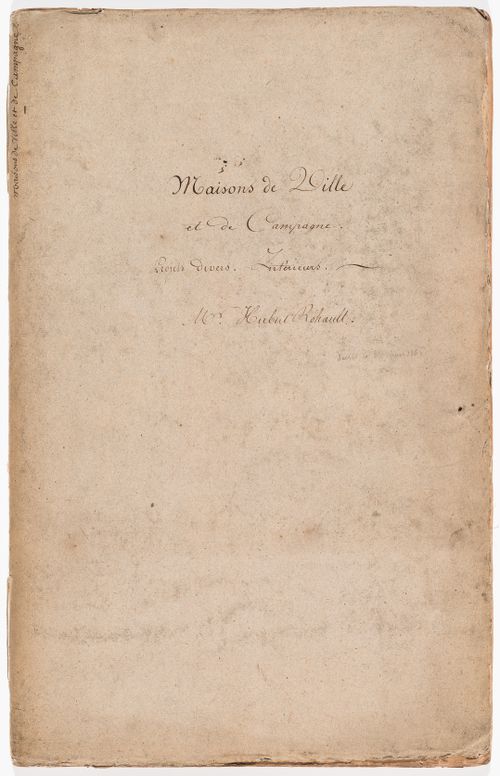
- This album consists primarily of preliminary and design development drawings for diverse projects - mostly domestic - from the early years of Hubert Rohault de Fleury's career. Some of the fifteen more finished drawings in wash and watercolour are probably presentation drawings. Many of the drawings are inscribed with illegible or partially legible notations concerning the project's location, client, date and other particulars. There are seven drawings for a house on rue d'Aguesseau, Paris, probably the Rohault de Fleury family residence (DR1974:0002:035:002 - DR1974:OOO2:035:006 R/V) and several drawings for a house for Rohault de Fleury's uncle on rue Saint-Romain, Paris (DR1974:0002:035:012 V). Several drawings are after plates published in Durand's "Précis des Leçons d'architecture données à l'école Royale Polytechnique (1802-1805)": plans on drawings DR1974:0002:035:011 V, DR1974:0002:035:012 R are adapted from plate 25 and combined with façades designed by Rohault de Fleury, and drawing DR1974:0002:035:013 R is based on an engraving by Charles-Pierre-Joseph Normand (pl. 23) of Hôtel Lathuille in Paris which was designed by Jean-Nicolas-Louis Durand (1788). Perspective sketches and plans are included for the restoration of a château in Rocheux [?] for M. le Trône (DR1974:0002:035:017 R) and for the renovation for the house at Domaine de la Vallée (DR1974:0002:035:020). The drawing for a country villa was executed in 1804, while Rohault de Fleury was in Rome studying at the French Academy (DR1974:0002:035:021 R). The conceptual drawing of a small "orchestre" and the elevations of a gallery and portico gate are inscribed "Jardin du Frascati", and are perhaps travel sketches or projects executed while Rohault de Fleury was in Rome (DR1974:0002:035:032 V, DR1974:002:035:033 R, and DR1974:0002:035:034). Also included in the album are two plans for part of the Passage du saumon in Paris (DR1974:0002:035:014 R), a plan, elevation and section for a rustic pavilion for M. Abrial (DR1974:0002:035:024 V), a plan for a shepherd's house in St. Cueufin [?] (DR1974:0002:035:021 V), a house for M. Quitton in Paris (DR1974:0002:035:026 - DR1974:0002:035:027), a section, elevation and plan for a sheepfold (DR1974:0002:035:033 V) and a perspective for a rustic cabin (DR1974:0002:035:034). The album also contains a number of drawings for Empire-style interior design projects: interior wall elevations, furniture drawings, and plans, elevations and perspectives for a bed alcove.
DR1974:0002:035:001-034
Description:
- This album consists primarily of preliminary and design development drawings for diverse projects - mostly domestic - from the early years of Hubert Rohault de Fleury's career. Some of the fifteen more finished drawings in wash and watercolour are probably presentation drawings. Many of the drawings are inscribed with illegible or partially legible notations concerning the project's location, client, date and other particulars. There are seven drawings for a house on rue d'Aguesseau, Paris, probably the Rohault de Fleury family residence (DR1974:0002:035:002 - DR1974:OOO2:035:006 R/V) and several drawings for a house for Rohault de Fleury's uncle on rue Saint-Romain, Paris (DR1974:0002:035:012 V). Several drawings are after plates published in Durand's "Précis des Leçons d'architecture données à l'école Royale Polytechnique (1802-1805)": plans on drawings DR1974:0002:035:011 V, DR1974:0002:035:012 R are adapted from plate 25 and combined with façades designed by Rohault de Fleury, and drawing DR1974:0002:035:013 R is based on an engraving by Charles-Pierre-Joseph Normand (pl. 23) of Hôtel Lathuille in Paris which was designed by Jean-Nicolas-Louis Durand (1788). Perspective sketches and plans are included for the restoration of a château in Rocheux [?] for M. le Trône (DR1974:0002:035:017 R) and for the renovation for the house at Domaine de la Vallée (DR1974:0002:035:020). The drawing for a country villa was executed in 1804, while Rohault de Fleury was in Rome studying at the French Academy (DR1974:0002:035:021 R). The conceptual drawing of a small "orchestre" and the elevations of a gallery and portico gate are inscribed "Jardin du Frascati", and are perhaps travel sketches or projects executed while Rohault de Fleury was in Rome (DR1974:0002:035:032 V, DR1974:002:035:033 R, and DR1974:0002:035:034). Also included in the album are two plans for part of the Passage du saumon in Paris (DR1974:0002:035:014 R), a plan, elevation and section for a rustic pavilion for M. Abrial (DR1974:0002:035:024 V), a plan for a shepherd's house in St. Cueufin [?] (DR1974:0002:035:021 V), a house for M. Quitton in Paris (DR1974:0002:035:026 - DR1974:0002:035:027), a section, elevation and plan for a sheepfold (DR1974:0002:035:033 V) and a perspective for a rustic cabin (DR1974:0002:035:034). The album also contains a number of drawings for Empire-style interior design projects: interior wall elevations, furniture drawings, and plans, elevations and perspectives for a bed alcove.
People:
Subject:
architecture, landscape architecture, interior design
architecture, landscape architecture, interior design
Date:
early 19th century
early 19th century
Title:
Album of drawings, mostly for French town and country houses, including some drawings for interiors and furniture, and one drawing for the Passage du saumon, Paris
Actions:
DR1974:0002:035:001-034
Description:
- This album consists primarily of preliminary and design development drawings for diverse projects - mostly domestic - from the early years of Hubert Rohault de Fleury's career. Some of the fifteen more finished drawings in wash and watercolour are probably presentation drawings. Many of the drawings are inscribed with illegible or partially legible notations concerning the project's location, client, date and other particulars. There are seven drawings for a house on rue d'Aguesseau, Paris, probably the Rohault de Fleury family residence (DR1974:0002:035:002 - DR1974:OOO2:035:006 R/V) and several drawings for a house for Rohault de Fleury's uncle on rue Saint-Romain, Paris (DR1974:0002:035:012 V). Several drawings are after plates published in Durand's "Précis des Leçons d'architecture données à l'école Royale Polytechnique (1802-1805)": plans on drawings DR1974:0002:035:011 V, DR1974:0002:035:012 R are adapted from plate 25 and combined with façades designed by Rohault de Fleury, and drawing DR1974:0002:035:013 R is based on an engraving by Charles-Pierre-Joseph Normand (pl. 23) of Hôtel Lathuille in Paris which was designed by Jean-Nicolas-Louis Durand (1788). Perspective sketches and plans are included for the restoration of a château in Rocheux [?] for M. le Trône (DR1974:0002:035:017 R) and for the renovation for the house at Domaine de la Vallée (DR1974:0002:035:020). The drawing for a country villa was executed in 1804, while Rohault de Fleury was in Rome studying at the French Academy (DR1974:0002:035:021 R). The conceptual drawing of a small "orchestre" and the elevations of a gallery and portico gate are inscribed "Jardin du Frascati", and are perhaps travel sketches or projects executed while Rohault de Fleury was in Rome (DR1974:0002:035:032 V, DR1974:002:035:033 R, and DR1974:0002:035:034). Also included in the album are two plans for part of the Passage du saumon in Paris (DR1974:0002:035:014 R), a plan, elevation and section for a rustic pavilion for M. Abrial (DR1974:0002:035:024 V), a plan for a shepherd's house in St. Cueufin [?] (DR1974:0002:035:021 V), a house for M. Quitton in Paris (DR1974:0002:035:026 - DR1974:0002:035:027), a section, elevation and plan for a sheepfold (DR1974:0002:035:033 V) and a perspective for a rustic cabin (DR1974:0002:035:034). The album also contains a number of drawings for Empire-style interior design projects: interior wall elevations, furniture drawings, and plans, elevations and perspectives for a bed alcove.
Album of drawings, mostly for French town and country houses, including some drawings for interiors and furniture, and one drawing for the Passage du saumon, Paris
Actions:
DR1974:0002:035:001-034
Description:
- This album consists primarily of preliminary and design development drawings for diverse projects - mostly domestic - from the early years of Hubert Rohault de Fleury's career. Some of the fifteen more finished drawings in wash and watercolour are probably presentation drawings. Many of the drawings are inscribed with illegible or partially legible notations concerning the project's location, client, date and other particulars. There are seven drawings for a house on rue d'Aguesseau, Paris, probably the Rohault de Fleury family residence (DR1974:0002:035:002 - DR1974:OOO2:035:006 R/V) and several drawings for a house for Rohault de Fleury's uncle on rue Saint-Romain, Paris (DR1974:0002:035:012 V). Several drawings are after plates published in Durand's "Précis des Leçons d'architecture données à l'école Royale Polytechnique (1802-1805)": plans on drawings DR1974:0002:035:011 V, DR1974:0002:035:012 R are adapted from plate 25 and combined with façades designed by Rohault de Fleury, and drawing DR1974:0002:035:013 R is based on an engraving by Charles-Pierre-Joseph Normand (pl. 23) of Hôtel Lathuille in Paris which was designed by Jean-Nicolas-Louis Durand (1788). Perspective sketches and plans are included for the restoration of a château in Rocheux [?] for M. le Trône (DR1974:0002:035:017 R) and for the renovation for the house at Domaine de la Vallée (DR1974:0002:035:020). The drawing for a country villa was executed in 1804, while Rohault de Fleury was in Rome studying at the French Academy (DR1974:0002:035:021 R). The conceptual drawing of a small "orchestre" and the elevations of a gallery and portico gate are inscribed "Jardin du Frascati", and are perhaps travel sketches or projects executed while Rohault de Fleury was in Rome (DR1974:0002:035:032 V, DR1974:002:035:033 R, and DR1974:0002:035:034). Also included in the album are two plans for part of the Passage du saumon in Paris (DR1974:0002:035:014 R), a plan, elevation and section for a rustic pavilion for M. Abrial (DR1974:0002:035:024 V), a plan for a shepherd's house in St. Cueufin [?] (DR1974:0002:035:021 V), a house for M. Quitton in Paris (DR1974:0002:035:026 - DR1974:0002:035:027), a section, elevation and plan for a sheepfold (DR1974:0002:035:033 V) and a perspective for a rustic cabin (DR1974:0002:035:034). The album also contains a number of drawings for Empire-style interior design projects: interior wall elevations, furniture drawings, and plans, elevations and perspectives for a bed alcove.
Form:
drawings
drawings
Date:
early 19th century
early 19th century
People:
Subject:
architecture, landscape architecture, interior design
architecture, landscape architecture, interior design
Form:
archives
Level of archival description:
Fonds
archives
Level of archival description:
Fonds
Title:
Bernard Tschumi fonds
Bernard Tschumi fonds
Actions:
Reference number:
AP214
Synopsis:
The Bernard Tschumi fonds, dating from approximately 1965-2015, documents the professional activities of Bernard Tschumi including Tschumi’s career in academia and his professional practice as an architect through approximately 75 projects dating from the late 1980s to 2012.
AP214
Synopsis:
The Bernard Tschumi fonds, dating from approximately 1965-2015, documents the professional activities of Bernard Tschumi including Tschumi’s career in academia and his professional practice as an architect through approximately 75 projects dating from the late 1980s to 2012.
People:
Date:
circa 1964-2015
circa 1964-2015
Title:
Bernard Tschumi fonds
Actions:
AP214
Synopsis:
The Bernard Tschumi fonds, dating from approximately 1965-2015, documents the professional activities of Bernard Tschumi including Tschumi’s career in academia and his professional practice as an architect through approximately 75 projects dating from the late 1980s to 2012.
Bernard Tschumi fonds
Actions:
AP214
Synopsis:
The Bernard Tschumi fonds, dating from approximately 1965-2015, documents the professional activities of Bernard Tschumi including Tschumi’s career in academia and his professional practice as an architect through approximately 75 projects dating from the late 1980s to 2012.
Form:
archives
Level of archival description:
Fonds
archives
Level of archival description:
Fonds
Date:
circa 1964-2015
circa 1964-2015
People:
Form:
archives
Level of archival description:
Fonds
archives
Level of archival description:
Fonds
Title:
Luc Laporte fonds
Luc Laporte fonds
Actions:
Reference number:
AP068
Synopsis:
Le Fond Luc Laporte documente les propositions et les réalisations issus de l'atelier de Luc Laporte pour le secteur est du Vieux-Port de Montréal.
AP068
Synopsis:
Le Fond Luc Laporte documente les propositions et les réalisations issus de l'atelier de Luc Laporte pour le secteur est du Vieux-Port de Montréal.
People:
Date:
1991-1993
1991-1993
Title:
Luc Laporte fonds
Actions:
AP068
Synopsis:
Le Fond Luc Laporte documente les propositions et les réalisations issus de l'atelier de Luc Laporte pour le secteur est du Vieux-Port de Montréal.
Luc Laporte fonds
Actions:
AP068
Synopsis:
Le Fond Luc Laporte documente les propositions et les réalisations issus de l'atelier de Luc Laporte pour le secteur est du Vieux-Port de Montréal.
Form:
archives
Level of archival description:
Fonds
archives
Level of archival description:
Fonds
Date:
1991-1993
1991-1993
People:
Form:
photographs
photographs
Title:
Harvard and its Surroundings
Harvard and its Surroundings
Actions:
Reference number:
PH1979:0604
Description:
This album comprises 102 pages of texts (descriptions of Harvard University and surroundings), a Key Plan of the vicinity of Harvard University, an Index, a List of Illustrations and an Introduction, 39 albertypes (collotypes, full pages), 28 engravings and 2 half-titles. The title page: Harvard and its Surroundings. Subscription Edition. Published by Moses King, Harvard College, Cambridge, Mass.; a presentation page: Harvard and its Surroundings. Subscription (fourth) edition by Moses King. Copiously illustrated with albertypes, and engravings. Cambridge. Moses King, Publisher, Harvard Square, 1882. Copyright, 1878, by Moses King. Copyright, 1880, by Charles W. Sever. Copyright, 1882, by Moses King. Designs by L.S. Ipsen; Sketches by H. M. Stephenson; University Press: John Wilson and Son, Cambridge. The illustrations are listed as follows: -Memorial Hall. - Dining Hall, Memorial Transept and Sanders Theatre -Harvard Hall. - Physical Laboratory and Lecture rooms -Massachusetts Hall. - Examinations Rooms -The Quadrance of Harvard College. Hollis, Stoughton, Holworthy, Thayer -Matthews Hall. - Dormitory -Dane Hall. - Law School -Wadsworth, or Old Presidents' House. - Dormitory -Grays Hall. - Dormitory -Boylston Hall. - Chemical Laboratory -Gore Hall. - The Universityé Library -Weld Hall. - Dormitory -Old President's Chair -University Hall. - Administration and Lecture Rooms -Sever Hall. - Lectures, Recitations and Examinations -Thayer Hall. - Dormitory -Appleton Chapel. - University House of Worship -Holden Chapel (engraving) -Holworthy Hall. - Dormitory -Stoughton Hall. - Dormitory -Hollis Hall. - Dormitory -Holmes House (engraving) -Hemenway Gymnasium -Interior of the Harvard (Hemenway) Gymnasium -Society Hall (engraving) -Lawrence Scientific School. - Laboratories Lecture and Workrooms -Divinity Hall. - Lecture Room, Library and Dormitory -Memorial Hall Transept (engraving) -Memorial Dining Hall. - The Students' Commons -Peabody Museum of American Archeology and Ethnology -Museum of Comparative Zoology. - Natural History Collections -Plan of Oxford Street -The Old Gymnasium -University Boat Club House -The President's House. - Residence of the Executive Officer -Dana House (engraving) -Holyoke House. - Shops and Dormitory -College House. - Post Office, Shops and Dormitory -Botanic Garden and Herbarium -The Astronomical Observatory -The Old Medical School. - Lectures, Laboratories, Museums, etc. -The Harvard Medical School. The New Building -Dental School. - Lecture and Workrooms and Laboratory -Bussey Institution. - School of Horticulture and Agriculture -Harvard Surroundings (engraving) -Old Mile Stone (engraving) -Felton Building, - Dormitory -Beck Hall, - Dormitory -Old Cambridge Baptist Church (engraving) -Moses King's Harvard-Square Publishing House -Hasty Pudding Club House (sketch by Cabot and Chandler: Architects: Boston) -Little's Block. - Shops and Dormitory -First Parish Church (engraving) -Christ Church (engraving) -Soldiers' Monument (engraving) -Shepard Memorial Church (engraving) -Washington Elm (engraving) -Waterhouse House (engraving) -Elmwood (engraving) -Fayerweather House (engraving) -Lee House (engraving) -Riedesel House (engraving) -Washington's Head-quarters, or Longfellow's Home (engraving) -Protestant Episcopal Theological School of Massachusetts (engraving) -Vassal House (engraving) -Brattle House (engraving) -New CIty Building (engraving) -Hicks House (engraving) -St. Paul's Church (engraving) -University Press John Wilson & Son
PH1979:0604
Description:
This album comprises 102 pages of texts (descriptions of Harvard University and surroundings), a Key Plan of the vicinity of Harvard University, an Index, a List of Illustrations and an Introduction, 39 albertypes (collotypes, full pages), 28 engravings and 2 half-titles. The title page: Harvard and its Surroundings. Subscription Edition. Published by Moses King, Harvard College, Cambridge, Mass.; a presentation page: Harvard and its Surroundings. Subscription (fourth) edition by Moses King. Copiously illustrated with albertypes, and engravings. Cambridge. Moses King, Publisher, Harvard Square, 1882. Copyright, 1878, by Moses King. Copyright, 1880, by Charles W. Sever. Copyright, 1882, by Moses King. Designs by L.S. Ipsen; Sketches by H. M. Stephenson; University Press: John Wilson and Son, Cambridge. The illustrations are listed as follows: -Memorial Hall. - Dining Hall, Memorial Transept and Sanders Theatre -Harvard Hall. - Physical Laboratory and Lecture rooms -Massachusetts Hall. - Examinations Rooms -The Quadrance of Harvard College. Hollis, Stoughton, Holworthy, Thayer -Matthews Hall. - Dormitory -Dane Hall. - Law School -Wadsworth, or Old Presidents' House. - Dormitory -Grays Hall. - Dormitory -Boylston Hall. - Chemical Laboratory -Gore Hall. - The Universityé Library -Weld Hall. - Dormitory -Old President's Chair -University Hall. - Administration and Lecture Rooms -Sever Hall. - Lectures, Recitations and Examinations -Thayer Hall. - Dormitory -Appleton Chapel. - University House of Worship -Holden Chapel (engraving) -Holworthy Hall. - Dormitory -Stoughton Hall. - Dormitory -Hollis Hall. - Dormitory -Holmes House (engraving) -Hemenway Gymnasium -Interior of the Harvard (Hemenway) Gymnasium -Society Hall (engraving) -Lawrence Scientific School. - Laboratories Lecture and Workrooms -Divinity Hall. - Lecture Room, Library and Dormitory -Memorial Hall Transept (engraving) -Memorial Dining Hall. - The Students' Commons -Peabody Museum of American Archeology and Ethnology -Museum of Comparative Zoology. - Natural History Collections -Plan of Oxford Street -The Old Gymnasium -University Boat Club House -The President's House. - Residence of the Executive Officer -Dana House (engraving) -Holyoke House. - Shops and Dormitory -College House. - Post Office, Shops and Dormitory -Botanic Garden and Herbarium -The Astronomical Observatory -The Old Medical School. - Lectures, Laboratories, Museums, etc. -The Harvard Medical School. The New Building -Dental School. - Lecture and Workrooms and Laboratory -Bussey Institution. - School of Horticulture and Agriculture -Harvard Surroundings (engraving) -Old Mile Stone (engraving) -Felton Building, - Dormitory -Beck Hall, - Dormitory -Old Cambridge Baptist Church (engraving) -Moses King's Harvard-Square Publishing House -Hasty Pudding Club House (sketch by Cabot and Chandler: Architects: Boston) -Little's Block. - Shops and Dormitory -First Parish Church (engraving) -Christ Church (engraving) -Soldiers' Monument (engraving) -Shepard Memorial Church (engraving) -Washington Elm (engraving) -Waterhouse House (engraving) -Elmwood (engraving) -Fayerweather House (engraving) -Lee House (engraving) -Riedesel House (engraving) -Washington's Head-quarters, or Longfellow's Home (engraving) -Protestant Episcopal Theological School of Massachusetts (engraving) -Vassal House (engraving) -Brattle House (engraving) -New CIty Building (engraving) -Hicks House (engraving) -St. Paul's Church (engraving) -University Press John Wilson & Son
People:
Subject:
architecture
architecture
Date:
1882
1882
Title:
Harvard and its Surroundings
Actions:
PH1979:0604
Description:
This album comprises 102 pages of texts (descriptions of Harvard University and surroundings), a Key Plan of the vicinity of Harvard University, an Index, a List of Illustrations and an Introduction, 39 albertypes (collotypes, full pages), 28 engravings and 2 half-titles. The title page: Harvard and its Surroundings. Subscription Edition. Published by Moses King, Harvard College, Cambridge, Mass.; a presentation page: Harvard and its Surroundings. Subscription (fourth) edition by Moses King. Copiously illustrated with albertypes, and engravings. Cambridge. Moses King, Publisher, Harvard Square, 1882. Copyright, 1878, by Moses King. Copyright, 1880, by Charles W. Sever. Copyright, 1882, by Moses King. Designs by L.S. Ipsen; Sketches by H. M. Stephenson; University Press: John Wilson and Son, Cambridge. The illustrations are listed as follows: -Memorial Hall. - Dining Hall, Memorial Transept and Sanders Theatre -Harvard Hall. - Physical Laboratory and Lecture rooms -Massachusetts Hall. - Examinations Rooms -The Quadrance of Harvard College. Hollis, Stoughton, Holworthy, Thayer -Matthews Hall. - Dormitory -Dane Hall. - Law School -Wadsworth, or Old Presidents' House. - Dormitory -Grays Hall. - Dormitory -Boylston Hall. - Chemical Laboratory -Gore Hall. - The Universityé Library -Weld Hall. - Dormitory -Old President's Chair -University Hall. - Administration and Lecture Rooms -Sever Hall. - Lectures, Recitations and Examinations -Thayer Hall. - Dormitory -Appleton Chapel. - University House of Worship -Holden Chapel (engraving) -Holworthy Hall. - Dormitory -Stoughton Hall. - Dormitory -Hollis Hall. - Dormitory -Holmes House (engraving) -Hemenway Gymnasium -Interior of the Harvard (Hemenway) Gymnasium -Society Hall (engraving) -Lawrence Scientific School. - Laboratories Lecture and Workrooms -Divinity Hall. - Lecture Room, Library and Dormitory -Memorial Hall Transept (engraving) -Memorial Dining Hall. - The Students' Commons -Peabody Museum of American Archeology and Ethnology -Museum of Comparative Zoology. - Natural History Collections -Plan of Oxford Street -The Old Gymnasium -University Boat Club House -The President's House. - Residence of the Executive Officer -Dana House (engraving) -Holyoke House. - Shops and Dormitory -College House. - Post Office, Shops and Dormitory -Botanic Garden and Herbarium -The Astronomical Observatory -The Old Medical School. - Lectures, Laboratories, Museums, etc. -The Harvard Medical School. The New Building -Dental School. - Lecture and Workrooms and Laboratory -Bussey Institution. - School of Horticulture and Agriculture -Harvard Surroundings (engraving) -Old Mile Stone (engraving) -Felton Building, - Dormitory -Beck Hall, - Dormitory -Old Cambridge Baptist Church (engraving) -Moses King's Harvard-Square Publishing House -Hasty Pudding Club House (sketch by Cabot and Chandler: Architects: Boston) -Little's Block. - Shops and Dormitory -First Parish Church (engraving) -Christ Church (engraving) -Soldiers' Monument (engraving) -Shepard Memorial Church (engraving) -Washington Elm (engraving) -Waterhouse House (engraving) -Elmwood (engraving) -Fayerweather House (engraving) -Lee House (engraving) -Riedesel House (engraving) -Washington's Head-quarters, or Longfellow's Home (engraving) -Protestant Episcopal Theological School of Massachusetts (engraving) -Vassal House (engraving) -Brattle House (engraving) -New CIty Building (engraving) -Hicks House (engraving) -St. Paul's Church (engraving) -University Press John Wilson & Son
Harvard and its Surroundings
Actions:
PH1979:0604
Description:
This album comprises 102 pages of texts (descriptions of Harvard University and surroundings), a Key Plan of the vicinity of Harvard University, an Index, a List of Illustrations and an Introduction, 39 albertypes (collotypes, full pages), 28 engravings and 2 half-titles. The title page: Harvard and its Surroundings. Subscription Edition. Published by Moses King, Harvard College, Cambridge, Mass.; a presentation page: Harvard and its Surroundings. Subscription (fourth) edition by Moses King. Copiously illustrated with albertypes, and engravings. Cambridge. Moses King, Publisher, Harvard Square, 1882. Copyright, 1878, by Moses King. Copyright, 1880, by Charles W. Sever. Copyright, 1882, by Moses King. Designs by L.S. Ipsen; Sketches by H. M. Stephenson; University Press: John Wilson and Son, Cambridge. The illustrations are listed as follows: -Memorial Hall. - Dining Hall, Memorial Transept and Sanders Theatre -Harvard Hall. - Physical Laboratory and Lecture rooms -Massachusetts Hall. - Examinations Rooms -The Quadrance of Harvard College. Hollis, Stoughton, Holworthy, Thayer -Matthews Hall. - Dormitory -Dane Hall. - Law School -Wadsworth, or Old Presidents' House. - Dormitory -Grays Hall. - Dormitory -Boylston Hall. - Chemical Laboratory -Gore Hall. - The Universityé Library -Weld Hall. - Dormitory -Old President's Chair -University Hall. - Administration and Lecture Rooms -Sever Hall. - Lectures, Recitations and Examinations -Thayer Hall. - Dormitory -Appleton Chapel. - University House of Worship -Holden Chapel (engraving) -Holworthy Hall. - Dormitory -Stoughton Hall. - Dormitory -Hollis Hall. - Dormitory -Holmes House (engraving) -Hemenway Gymnasium -Interior of the Harvard (Hemenway) Gymnasium -Society Hall (engraving) -Lawrence Scientific School. - Laboratories Lecture and Workrooms -Divinity Hall. - Lecture Room, Library and Dormitory -Memorial Hall Transept (engraving) -Memorial Dining Hall. - The Students' Commons -Peabody Museum of American Archeology and Ethnology -Museum of Comparative Zoology. - Natural History Collections -Plan of Oxford Street -The Old Gymnasium -University Boat Club House -The President's House. - Residence of the Executive Officer -Dana House (engraving) -Holyoke House. - Shops and Dormitory -College House. - Post Office, Shops and Dormitory -Botanic Garden and Herbarium -The Astronomical Observatory -The Old Medical School. - Lectures, Laboratories, Museums, etc. -The Harvard Medical School. The New Building -Dental School. - Lecture and Workrooms and Laboratory -Bussey Institution. - School of Horticulture and Agriculture -Harvard Surroundings (engraving) -Old Mile Stone (engraving) -Felton Building, - Dormitory -Beck Hall, - Dormitory -Old Cambridge Baptist Church (engraving) -Moses King's Harvard-Square Publishing House -Hasty Pudding Club House (sketch by Cabot and Chandler: Architects: Boston) -Little's Block. - Shops and Dormitory -First Parish Church (engraving) -Christ Church (engraving) -Soldiers' Monument (engraving) -Shepard Memorial Church (engraving) -Washington Elm (engraving) -Waterhouse House (engraving) -Elmwood (engraving) -Fayerweather House (engraving) -Lee House (engraving) -Riedesel House (engraving) -Washington's Head-quarters, or Longfellow's Home (engraving) -Protestant Episcopal Theological School of Massachusetts (engraving) -Vassal House (engraving) -Brattle House (engraving) -New CIty Building (engraving) -Hicks House (engraving) -St. Paul's Church (engraving) -University Press John Wilson & Son
Form:
photographs
photographs
Date:
1882
1882
People:
Subject:
architecture
architecture
Form:
archives
Level of archival description:
Fonds
archives
Level of archival description:
Fonds
Title:
John Bird fonds
John Bird fonds
Actions:
Reference number:
AP108
Synopsis:
The John Bird fonds documents the professional practice of the Westmount-based architect, and includes drawings and photographs of 24 architectural projects carried out in and around Montréal, Québec between 1954 and 1992. The fonds also contains a number of published articles that document John Bird's professional activities. Key projects that are represented include the Canadian Technical Tape Building, St. Laurent (1955-1963), Saint Gabriel's Church, Montréal (1959-1960), and Saint John Brebeuf Church, Lasalle (1962-1966). The fonds also includes numerous projects for Toronto-Dominion Bank buildings (1959-1992) as well as residential designs completed for the Central Mortgage and Housing Corporation (1956-1969).
AP108
Synopsis:
The John Bird fonds documents the professional practice of the Westmount-based architect, and includes drawings and photographs of 24 architectural projects carried out in and around Montréal, Québec between 1954 and 1992. The fonds also contains a number of published articles that document John Bird's professional activities. Key projects that are represented include the Canadian Technical Tape Building, St. Laurent (1955-1963), Saint Gabriel's Church, Montréal (1959-1960), and Saint John Brebeuf Church, Lasalle (1962-1966). The fonds also includes numerous projects for Toronto-Dominion Bank buildings (1959-1992) as well as residential designs completed for the Central Mortgage and Housing Corporation (1956-1969).
People:
Date:
1942 - 1992
1942 - 1992
Title:
John Bird fonds
Actions:
AP108
Synopsis:
The John Bird fonds documents the professional practice of the Westmount-based architect, and includes drawings and photographs of 24 architectural projects carried out in and around Montréal, Québec between 1954 and 1992. The fonds also contains a number of published articles that document John Bird's professional activities. Key projects that are represented include the Canadian Technical Tape Building, St. Laurent (1955-1963), Saint Gabriel's Church, Montréal (1959-1960), and Saint John Brebeuf Church, Lasalle (1962-1966). The fonds also includes numerous projects for Toronto-Dominion Bank buildings (1959-1992) as well as residential designs completed for the Central Mortgage and Housing Corporation (1956-1969).
John Bird fonds
Actions:
AP108
Synopsis:
The John Bird fonds documents the professional practice of the Westmount-based architect, and includes drawings and photographs of 24 architectural projects carried out in and around Montréal, Québec between 1954 and 1992. The fonds also contains a number of published articles that document John Bird's professional activities. Key projects that are represented include the Canadian Technical Tape Building, St. Laurent (1955-1963), Saint Gabriel's Church, Montréal (1959-1960), and Saint John Brebeuf Church, Lasalle (1962-1966). The fonds also includes numerous projects for Toronto-Dominion Bank buildings (1959-1992) as well as residential designs completed for the Central Mortgage and Housing Corporation (1956-1969).
Form:
archives
Level of archival description:
Fonds
archives
Level of archival description:
Fonds
Date:
1942 - 1992
1942 - 1992
People:
Level of archival description:
Project
Project
Reference number:
AP001.S6.1950.PR01
Description:
La construction de l’Université de Montréal s’est effectuée sur plusieurs années. Cormier est architecte en chef entre 1924 et 1947 et agit à titre d’architecte-conseil et d’ingénieur-conseil entre 1950 et 1961. Il semblait inévitable de diviser le cadre de classement en deux phases pour bien distinguer le rôle et l’implication de Cormier qui diffère durant ces deux périodes. La présence de deux plans d’ensembles très différents proposés en 1931 et 1961 appuie cette décision. En 1950, Cormier est nommé architecte-conseil et ingénieur-conseil pour la deuxième phase des travaux, alors que Ludger Venne agit à titre d’architecte pour le Centre social et les Résidences Étudiantes, Gaston Gagné pour la Polytechnique et Paul Lambert pour le Chalet de Sport. Tout en supervisant l’élaboration des bâtiments, Cormier soumet un nouveau plan d’ensemble pour la deuxième phase de construction de l’Université de Montréal. Celui-ci inclut un nouveau centre hospitalier, un bâtiment administratif, une porte monumentale, le HEC, un stade et une bibliothèque. Le projet sera cependant refusé par la direction de l’Université de Montréal, voyant le projet ambitieux et trop coûteux. Il quittera donc en 1962 son poste de consultant. Pour cette sous-série, il est important de distinguer deux types de documents. Il y a d’abord les dessins produits par Cormier et sa firme, incluant les nouveaux plans d’ensemble, le stade, le bâtiment administratif, la nouvelle bibliothèque, le centre hospitalier, la cafétéria, le gymnase et la piscine. Ces documents seront limités à des esquisses et des dessins de présentation, suite à la décision de la direction de l’UdeM de ne pas entreprendre ces projets. En second lieu, il y a les documents d’exécutions des autres architectes, comme Lambert et Venne, qui ont été utilisés et modifiés par Cormier à titre de consultant.
AP001.S6.1950.PR01
Description:
La construction de l’Université de Montréal s’est effectuée sur plusieurs années. Cormier est architecte en chef entre 1924 et 1947 et agit à titre d’architecte-conseil et d’ingénieur-conseil entre 1950 et 1961. Il semblait inévitable de diviser le cadre de classement en deux phases pour bien distinguer le rôle et l’implication de Cormier qui diffère durant ces deux périodes. La présence de deux plans d’ensembles très différents proposés en 1931 et 1961 appuie cette décision. En 1950, Cormier est nommé architecte-conseil et ingénieur-conseil pour la deuxième phase des travaux, alors que Ludger Venne agit à titre d’architecte pour le Centre social et les Résidences Étudiantes, Gaston Gagné pour la Polytechnique et Paul Lambert pour le Chalet de Sport. Tout en supervisant l’élaboration des bâtiments, Cormier soumet un nouveau plan d’ensemble pour la deuxième phase de construction de l’Université de Montréal. Celui-ci inclut un nouveau centre hospitalier, un bâtiment administratif, une porte monumentale, le HEC, un stade et une bibliothèque. Le projet sera cependant refusé par la direction de l’Université de Montréal, voyant le projet ambitieux et trop coûteux. Il quittera donc en 1962 son poste de consultant. Pour cette sous-série, il est important de distinguer deux types de documents. Il y a d’abord les dessins produits par Cormier et sa firme, incluant les nouveaux plans d’ensemble, le stade, le bâtiment administratif, la nouvelle bibliothèque, le centre hospitalier, la cafétéria, le gymnase et la piscine. Ces documents seront limités à des esquisses et des dessins de présentation, suite à la décision de la direction de l’UdeM de ne pas entreprendre ces projets. En second lieu, il y a les documents d’exécutions des autres architectes, comme Lambert et Venne, qui ont été utilisés et modifiés par Cormier à titre de consultant.
People:
Date:
1950 - 1962
1950 - 1962
Title:
Université de Montréal - Phase 2
Actions:
AP001.S6.1950.PR01
Description:
La construction de l’Université de Montréal s’est effectuée sur plusieurs années. Cormier est architecte en chef entre 1924 et 1947 et agit à titre d’architecte-conseil et d’ingénieur-conseil entre 1950 et 1961. Il semblait inévitable de diviser le cadre de classement en deux phases pour bien distinguer le rôle et l’implication de Cormier qui diffère durant ces deux périodes. La présence de deux plans d’ensembles très différents proposés en 1931 et 1961 appuie cette décision. En 1950, Cormier est nommé architecte-conseil et ingénieur-conseil pour la deuxième phase des travaux, alors que Ludger Venne agit à titre d’architecte pour le Centre social et les Résidences Étudiantes, Gaston Gagné pour la Polytechnique et Paul Lambert pour le Chalet de Sport. Tout en supervisant l’élaboration des bâtiments, Cormier soumet un nouveau plan d’ensemble pour la deuxième phase de construction de l’Université de Montréal. Celui-ci inclut un nouveau centre hospitalier, un bâtiment administratif, une porte monumentale, le HEC, un stade et une bibliothèque. Le projet sera cependant refusé par la direction de l’Université de Montréal, voyant le projet ambitieux et trop coûteux. Il quittera donc en 1962 son poste de consultant. Pour cette sous-série, il est important de distinguer deux types de documents. Il y a d’abord les dessins produits par Cormier et sa firme, incluant les nouveaux plans d’ensemble, le stade, le bâtiment administratif, la nouvelle bibliothèque, le centre hospitalier, la cafétéria, le gymnase et la piscine. Ces documents seront limités à des esquisses et des dessins de présentation, suite à la décision de la direction de l’UdeM de ne pas entreprendre ces projets. En second lieu, il y a les documents d’exécutions des autres architectes, comme Lambert et Venne, qui ont été utilisés et modifiés par Cormier à titre de consultant.
Université de Montréal - Phase 2
Actions:
AP001.S6.1950.PR01
Description:
La construction de l’Université de Montréal s’est effectuée sur plusieurs années. Cormier est architecte en chef entre 1924 et 1947 et agit à titre d’architecte-conseil et d’ingénieur-conseil entre 1950 et 1961. Il semblait inévitable de diviser le cadre de classement en deux phases pour bien distinguer le rôle et l’implication de Cormier qui diffère durant ces deux périodes. La présence de deux plans d’ensembles très différents proposés en 1931 et 1961 appuie cette décision. En 1950, Cormier est nommé architecte-conseil et ingénieur-conseil pour la deuxième phase des travaux, alors que Ludger Venne agit à titre d’architecte pour le Centre social et les Résidences Étudiantes, Gaston Gagné pour la Polytechnique et Paul Lambert pour le Chalet de Sport. Tout en supervisant l’élaboration des bâtiments, Cormier soumet un nouveau plan d’ensemble pour la deuxième phase de construction de l’Université de Montréal. Celui-ci inclut un nouveau centre hospitalier, un bâtiment administratif, une porte monumentale, le HEC, un stade et une bibliothèque. Le projet sera cependant refusé par la direction de l’Université de Montréal, voyant le projet ambitieux et trop coûteux. Il quittera donc en 1962 son poste de consultant. Pour cette sous-série, il est important de distinguer deux types de documents. Il y a d’abord les dessins produits par Cormier et sa firme, incluant les nouveaux plans d’ensemble, le stade, le bâtiment administratif, la nouvelle bibliothèque, le centre hospitalier, la cafétéria, le gymnase et la piscine. Ces documents seront limités à des esquisses et des dessins de présentation, suite à la décision de la direction de l’UdeM de ne pas entreprendre ces projets. En second lieu, il y a les documents d’exécutions des autres architectes, comme Lambert et Venne, qui ont été utilisés et modifiés par Cormier à titre de consultant.
Level of archival description:
Project
Project
Date:
1950 - 1962
1950 - 1962
People:
Level of archival description:
Series
Series
Title:
Projets et réalisations
Projets et réalisations
Reference number:
AP066.S2
Description:
Issue de la pratique professionnelle de Jacques Rousseau, cette série regroupe les documents illustrant quatre-vingt-trois projets et réalisations conçus, soit de façon autonome ou en collaboration, entre 1973 et 1997. Ces projets se distinguent autant par leur degré d'achèvement (de l'esquisse préliminaire au dessin de construction), par leur échelle (du mobilier au projet urbain), que par leur programme (commercial, domestique, social). Dans l'ensemble, tous les thèmes qui sont explorés, tels l'architecture du bar, le décor de la boutique, l'habitation individuelle et collective, le lieu de travail, et l'image publique des institutions, s'ancrent dans une pensée spéculative sur la ville comme processus de reconstruction et de refondation. Parmi les quatre-vingt-trois projets, vingt datent d'avant 1980, date à laquelle Jacques Rousseau est devenu membre de l'Ordre des architectes du Québec. Ces projets ont donc été réalisés soit pour le compte d'agences pour lesquelles Jacques Rousseau travaillait ou effectuait son stage professionnel, soit à titre officieux en offrant vraisemblablement ses services à ses connaissances. Dans ce dernier cas, il s'agit alors de projets de plus petite envergure pour des rénovations ou agrandissements de résidences. Par ailleurs, un certain nombre de nouveaux projets n'ont pas abouti et sont constitués seulement de dossiers préliminaires qui nous renseignent toutefois sur les démarches entreprises par l'architecte, parfois de sa propre initiative, pour amorcer des projets. La variété de ces derniers montre les multiples intérêts de Jacques Rousseau. Toutefois, trois d'entre eux émergent de sa pratique : l'architecture de bar et de restaurant, le logement collectif coopératif et la morphologie urbaine pour lesquels il consacre de nombreux projets et études. On trouvera aussi d'ailleurs dans la série 9 - Enseignement des documents relatifs à ses travaux sur la morphologie urbaine.
AP066.S2
Description:
Issue de la pratique professionnelle de Jacques Rousseau, cette série regroupe les documents illustrant quatre-vingt-trois projets et réalisations conçus, soit de façon autonome ou en collaboration, entre 1973 et 1997. Ces projets se distinguent autant par leur degré d'achèvement (de l'esquisse préliminaire au dessin de construction), par leur échelle (du mobilier au projet urbain), que par leur programme (commercial, domestique, social). Dans l'ensemble, tous les thèmes qui sont explorés, tels l'architecture du bar, le décor de la boutique, l'habitation individuelle et collective, le lieu de travail, et l'image publique des institutions, s'ancrent dans une pensée spéculative sur la ville comme processus de reconstruction et de refondation. Parmi les quatre-vingt-trois projets, vingt datent d'avant 1980, date à laquelle Jacques Rousseau est devenu membre de l'Ordre des architectes du Québec. Ces projets ont donc été réalisés soit pour le compte d'agences pour lesquelles Jacques Rousseau travaillait ou effectuait son stage professionnel, soit à titre officieux en offrant vraisemblablement ses services à ses connaissances. Dans ce dernier cas, il s'agit alors de projets de plus petite envergure pour des rénovations ou agrandissements de résidences. Par ailleurs, un certain nombre de nouveaux projets n'ont pas abouti et sont constitués seulement de dossiers préliminaires qui nous renseignent toutefois sur les démarches entreprises par l'architecte, parfois de sa propre initiative, pour amorcer des projets. La variété de ces derniers montre les multiples intérêts de Jacques Rousseau. Toutefois, trois d'entre eux émergent de sa pratique : l'architecture de bar et de restaurant, le logement collectif coopératif et la morphologie urbaine pour lesquels il consacre de nombreux projets et études. On trouvera aussi d'ailleurs dans la série 9 - Enseignement des documents relatifs à ses travaux sur la morphologie urbaine.
People:
Date:
1973-1997
1973-1997
Title:
Projets et réalisations
Actions:
AP066.S2
Description:
Issue de la pratique professionnelle de Jacques Rousseau, cette série regroupe les documents illustrant quatre-vingt-trois projets et réalisations conçus, soit de façon autonome ou en collaboration, entre 1973 et 1997. Ces projets se distinguent autant par leur degré d'achèvement (de l'esquisse préliminaire au dessin de construction), par leur échelle (du mobilier au projet urbain), que par leur programme (commercial, domestique, social). Dans l'ensemble, tous les thèmes qui sont explorés, tels l'architecture du bar, le décor de la boutique, l'habitation individuelle et collective, le lieu de travail, et l'image publique des institutions, s'ancrent dans une pensée spéculative sur la ville comme processus de reconstruction et de refondation. Parmi les quatre-vingt-trois projets, vingt datent d'avant 1980, date à laquelle Jacques Rousseau est devenu membre de l'Ordre des architectes du Québec. Ces projets ont donc été réalisés soit pour le compte d'agences pour lesquelles Jacques Rousseau travaillait ou effectuait son stage professionnel, soit à titre officieux en offrant vraisemblablement ses services à ses connaissances. Dans ce dernier cas, il s'agit alors de projets de plus petite envergure pour des rénovations ou agrandissements de résidences. Par ailleurs, un certain nombre de nouveaux projets n'ont pas abouti et sont constitués seulement de dossiers préliminaires qui nous renseignent toutefois sur les démarches entreprises par l'architecte, parfois de sa propre initiative, pour amorcer des projets. La variété de ces derniers montre les multiples intérêts de Jacques Rousseau. Toutefois, trois d'entre eux émergent de sa pratique : l'architecture de bar et de restaurant, le logement collectif coopératif et la morphologie urbaine pour lesquels il consacre de nombreux projets et études. On trouvera aussi d'ailleurs dans la série 9 - Enseignement des documents relatifs à ses travaux sur la morphologie urbaine.
Projets et réalisations
Actions:
AP066.S2
Description:
Issue de la pratique professionnelle de Jacques Rousseau, cette série regroupe les documents illustrant quatre-vingt-trois projets et réalisations conçus, soit de façon autonome ou en collaboration, entre 1973 et 1997. Ces projets se distinguent autant par leur degré d'achèvement (de l'esquisse préliminaire au dessin de construction), par leur échelle (du mobilier au projet urbain), que par leur programme (commercial, domestique, social). Dans l'ensemble, tous les thèmes qui sont explorés, tels l'architecture du bar, le décor de la boutique, l'habitation individuelle et collective, le lieu de travail, et l'image publique des institutions, s'ancrent dans une pensée spéculative sur la ville comme processus de reconstruction et de refondation. Parmi les quatre-vingt-trois projets, vingt datent d'avant 1980, date à laquelle Jacques Rousseau est devenu membre de l'Ordre des architectes du Québec. Ces projets ont donc été réalisés soit pour le compte d'agences pour lesquelles Jacques Rousseau travaillait ou effectuait son stage professionnel, soit à titre officieux en offrant vraisemblablement ses services à ses connaissances. Dans ce dernier cas, il s'agit alors de projets de plus petite envergure pour des rénovations ou agrandissements de résidences. Par ailleurs, un certain nombre de nouveaux projets n'ont pas abouti et sont constitués seulement de dossiers préliminaires qui nous renseignent toutefois sur les démarches entreprises par l'architecte, parfois de sa propre initiative, pour amorcer des projets. La variété de ces derniers montre les multiples intérêts de Jacques Rousseau. Toutefois, trois d'entre eux émergent de sa pratique : l'architecture de bar et de restaurant, le logement collectif coopératif et la morphologie urbaine pour lesquels il consacre de nombreux projets et études. On trouvera aussi d'ailleurs dans la série 9 - Enseignement des documents relatifs à ses travaux sur la morphologie urbaine.
Level of archival description:
Series
Series
Date:
1973-1997
1973-1997
People:
Reference number:
PH1979:0605
Description:
This 98-page book illustrated with 73 photogravures, shows a pictorial record of San Diego's built and natural environment including beaches (like La Jolla) and back country scenes, after photographs by Herve Friend. Title page: Picturesque San Diego with Historical and Descriptive Notes by Douglas Gunn. San Diego, California, July 1, 1887. Chicago: Knight & Leonard Co., Printers 1887. Photogravures: .001 Old Palm Trees, foot of Presidio Hill Frontispiece .002 Point Lonea, and Entrance to San Diego harbor - from Coronado Beach .003 Ruins of the Old Mission, San Diego .004 Old Mission of San Diego, from the Olive Grove .005 Scene of the Battle of San Pasqual, December 6th, 1846 .006 Mission San Luis Rey .007 Bell Tower, Pala Mission .008 San Diego, looking West - Point Loma in Right Distance .009 San Diego, looking Southwest - Coronado Beach opposite .010 San Diego, looking Southeast .011 City Water Front - Babcock & Story Wharves .012 City Water Front - Pacific Coast Steamship Co.'s Wharves .013 Country Court House, San Diego .014 Interior Consolidated National Bank, San Diego .015 The "Russ" Public School, San Diego .016 Morse-Pierce Building, corner Sixth and F streets, San Diego .017 St. Paul's Episcopal Church, San Diego .018 Residence of A.E. Horton .019 First National Bank, corner Fifth and E streets .020 Woolwine, Spring & Nerney's Abstract and Real Estate Office, cor. Fourth and D streets .021 The Dells, Chollas Valley - Suburbs of San Diego .022 Initial Monument, marking Mexican Boundary .023 Tia Juana - American side .024 Tia Juana - Mexican side .025 "Point of Rocks" - 1 .026 "Point of Rocks" - 2 .027 "Point of Rocks" - 3 .028 Hotel Del Coronado Beach, San Diego .029 The Caves, La Jolla .030 La Jolla Beach .031 Cathedral Rocks, La Jolla .032 "Ocean Beach" .033 Seaside View at Del Mar .034 Escondido - Old Ranch House and Orange Orchard .035 View on Linda Lake, El Cajon Valley, 15 miles from San Diego .036 The Hotel at Murietta .037 Temecula Canon - 1. "The Big Curve", C.S.R.R. .038 Temecula Canon - 2. .039 Temecula Canon - 3. .040 Santa Margarita Ranch House, from the Vineyard .041 Courtyard, Couts' Estate, Guajome .042 View near Entrance to Bear Valley .043 View in San Pasqual Valley - Bernardo River .044 "Eagle's Nest" - Agua Caliente Mountains .045 Santa Rosa Mountains, near Elsinore .046 View from "The Glen" - Agua Tibia and Pala in Distance .047 San Jacinto Mountain .048 The Cajon Mountain, from the Northeast .049 Public School (Banner District) near mouth of San Felipe Canon .050 Home and Orchard of John Mitchell, Fall Brook .051 Agua Tibia - The Pond .052 Orchard and Home of James Madison, Julian .053 View at Elsinore Lake, West Side .054 Home and Orchard of Chester Gunn, Julian .055 West in Poway Valley .056 San Diego River, North of El Cajon .057 Cuyamaca Lake - Storage Water of San Diego Flume Co. .058 Diverting Dam, San Diego River - San Diego Flume Co. .059 Upper Valley of the San Diego River - "Capitan Grande" .060 Falls (146 ft.) East Branch of San Diego River .061 Santa Isabel Creek .062 Falls of Pauma Creek .063 View near Farm of Hubert Howe Bancroft, Spring Valley .064 Water Works of San Diego Town and Land Company .065 Gedney's Orchard, Mesa Grande .066 Public School, Spencer Valley, near Julian .067 Orchard and Farm of B.S. Scheckler, Cottonwood .069 Campo .070 Entrance to Colorado Desert, mouth of Mountain Springs Canon .071 Mountain Scenery, Agua Caliente - Overlooking Warner's Ranch .072 Indian Village. Agua Caliente .073 Indian Village and Church at Pauma, Upper San Luis Rey Valley
PH1979:0605
Description:
This 98-page book illustrated with 73 photogravures, shows a pictorial record of San Diego's built and natural environment including beaches (like La Jolla) and back country scenes, after photographs by Herve Friend. Title page: Picturesque San Diego with Historical and Descriptive Notes by Douglas Gunn. San Diego, California, July 1, 1887. Chicago: Knight & Leonard Co., Printers 1887. Photogravures: .001 Old Palm Trees, foot of Presidio Hill Frontispiece .002 Point Lonea, and Entrance to San Diego harbor - from Coronado Beach .003 Ruins of the Old Mission, San Diego .004 Old Mission of San Diego, from the Olive Grove .005 Scene of the Battle of San Pasqual, December 6th, 1846 .006 Mission San Luis Rey .007 Bell Tower, Pala Mission .008 San Diego, looking West - Point Loma in Right Distance .009 San Diego, looking Southwest - Coronado Beach opposite .010 San Diego, looking Southeast .011 City Water Front - Babcock & Story Wharves .012 City Water Front - Pacific Coast Steamship Co.'s Wharves .013 Country Court House, San Diego .014 Interior Consolidated National Bank, San Diego .015 The "Russ" Public School, San Diego .016 Morse-Pierce Building, corner Sixth and F streets, San Diego .017 St. Paul's Episcopal Church, San Diego .018 Residence of A.E. Horton .019 First National Bank, corner Fifth and E streets .020 Woolwine, Spring & Nerney's Abstract and Real Estate Office, cor. Fourth and D streets .021 The Dells, Chollas Valley - Suburbs of San Diego .022 Initial Monument, marking Mexican Boundary .023 Tia Juana - American side .024 Tia Juana - Mexican side .025 "Point of Rocks" - 1 .026 "Point of Rocks" - 2 .027 "Point of Rocks" - 3 .028 Hotel Del Coronado Beach, San Diego .029 The Caves, La Jolla .030 La Jolla Beach .031 Cathedral Rocks, La Jolla .032 "Ocean Beach" .033 Seaside View at Del Mar .034 Escondido - Old Ranch House and Orange Orchard .035 View on Linda Lake, El Cajon Valley, 15 miles from San Diego .036 The Hotel at Murietta .037 Temecula Canon - 1. "The Big Curve", C.S.R.R. .038 Temecula Canon - 2. .039 Temecula Canon - 3. .040 Santa Margarita Ranch House, from the Vineyard .041 Courtyard, Couts' Estate, Guajome .042 View near Entrance to Bear Valley .043 View in San Pasqual Valley - Bernardo River .044 "Eagle's Nest" - Agua Caliente Mountains .045 Santa Rosa Mountains, near Elsinore .046 View from "The Glen" - Agua Tibia and Pala in Distance .047 San Jacinto Mountain .048 The Cajon Mountain, from the Northeast .049 Public School (Banner District) near mouth of San Felipe Canon .050 Home and Orchard of John Mitchell, Fall Brook .051 Agua Tibia - The Pond .052 Orchard and Home of James Madison, Julian .053 View at Elsinore Lake, West Side .054 Home and Orchard of Chester Gunn, Julian .055 West in Poway Valley .056 San Diego River, North of El Cajon .057 Cuyamaca Lake - Storage Water of San Diego Flume Co. .058 Diverting Dam, San Diego River - San Diego Flume Co. .059 Upper Valley of the San Diego River - "Capitan Grande" .060 Falls (146 ft.) East Branch of San Diego River .061 Santa Isabel Creek .062 Falls of Pauma Creek .063 View near Farm of Hubert Howe Bancroft, Spring Valley .064 Water Works of San Diego Town and Land Company .065 Gedney's Orchard, Mesa Grande .066 Public School, Spencer Valley, near Julian .067 Orchard and Farm of B.S. Scheckler, Cottonwood .069 Campo .070 Entrance to Colorado Desert, mouth of Mountain Springs Canon .071 Mountain Scenery, Agua Caliente - Overlooking Warner's Ranch .072 Indian Village. Agua Caliente .073 Indian Village and Church at Pauma, Upper San Luis Rey Valley
People:
Subject:
architecture
architecture
Date:
1887
1887
Title:
Picturesque San Diego with Historical and Descriptive Notes
Actions:
PH1979:0605
Description:
This 98-page book illustrated with 73 photogravures, shows a pictorial record of San Diego's built and natural environment including beaches (like La Jolla) and back country scenes, after photographs by Herve Friend. Title page: Picturesque San Diego with Historical and Descriptive Notes by Douglas Gunn. San Diego, California, July 1, 1887. Chicago: Knight & Leonard Co., Printers 1887. Photogravures: .001 Old Palm Trees, foot of Presidio Hill Frontispiece .002 Point Lonea, and Entrance to San Diego harbor - from Coronado Beach .003 Ruins of the Old Mission, San Diego .004 Old Mission of San Diego, from the Olive Grove .005 Scene of the Battle of San Pasqual, December 6th, 1846 .006 Mission San Luis Rey .007 Bell Tower, Pala Mission .008 San Diego, looking West - Point Loma in Right Distance .009 San Diego, looking Southwest - Coronado Beach opposite .010 San Diego, looking Southeast .011 City Water Front - Babcock & Story Wharves .012 City Water Front - Pacific Coast Steamship Co.'s Wharves .013 Country Court House, San Diego .014 Interior Consolidated National Bank, San Diego .015 The "Russ" Public School, San Diego .016 Morse-Pierce Building, corner Sixth and F streets, San Diego .017 St. Paul's Episcopal Church, San Diego .018 Residence of A.E. Horton .019 First National Bank, corner Fifth and E streets .020 Woolwine, Spring & Nerney's Abstract and Real Estate Office, cor. Fourth and D streets .021 The Dells, Chollas Valley - Suburbs of San Diego .022 Initial Monument, marking Mexican Boundary .023 Tia Juana - American side .024 Tia Juana - Mexican side .025 "Point of Rocks" - 1 .026 "Point of Rocks" - 2 .027 "Point of Rocks" - 3 .028 Hotel Del Coronado Beach, San Diego .029 The Caves, La Jolla .030 La Jolla Beach .031 Cathedral Rocks, La Jolla .032 "Ocean Beach" .033 Seaside View at Del Mar .034 Escondido - Old Ranch House and Orange Orchard .035 View on Linda Lake, El Cajon Valley, 15 miles from San Diego .036 The Hotel at Murietta .037 Temecula Canon - 1. "The Big Curve", C.S.R.R. .038 Temecula Canon - 2. .039 Temecula Canon - 3. .040 Santa Margarita Ranch House, from the Vineyard .041 Courtyard, Couts' Estate, Guajome .042 View near Entrance to Bear Valley .043 View in San Pasqual Valley - Bernardo River .044 "Eagle's Nest" - Agua Caliente Mountains .045 Santa Rosa Mountains, near Elsinore .046 View from "The Glen" - Agua Tibia and Pala in Distance .047 San Jacinto Mountain .048 The Cajon Mountain, from the Northeast .049 Public School (Banner District) near mouth of San Felipe Canon .050 Home and Orchard of John Mitchell, Fall Brook .051 Agua Tibia - The Pond .052 Orchard and Home of James Madison, Julian .053 View at Elsinore Lake, West Side .054 Home and Orchard of Chester Gunn, Julian .055 West in Poway Valley .056 San Diego River, North of El Cajon .057 Cuyamaca Lake - Storage Water of San Diego Flume Co. .058 Diverting Dam, San Diego River - San Diego Flume Co. .059 Upper Valley of the San Diego River - "Capitan Grande" .060 Falls (146 ft.) East Branch of San Diego River .061 Santa Isabel Creek .062 Falls of Pauma Creek .063 View near Farm of Hubert Howe Bancroft, Spring Valley .064 Water Works of San Diego Town and Land Company .065 Gedney's Orchard, Mesa Grande .066 Public School, Spencer Valley, near Julian .067 Orchard and Farm of B.S. Scheckler, Cottonwood .069 Campo .070 Entrance to Colorado Desert, mouth of Mountain Springs Canon .071 Mountain Scenery, Agua Caliente - Overlooking Warner's Ranch .072 Indian Village. Agua Caliente .073 Indian Village and Church at Pauma, Upper San Luis Rey Valley
Picturesque San Diego with Historical and Descriptive Notes
Actions:
PH1979:0605
Description:
This 98-page book illustrated with 73 photogravures, shows a pictorial record of San Diego's built and natural environment including beaches (like La Jolla) and back country scenes, after photographs by Herve Friend. Title page: Picturesque San Diego with Historical and Descriptive Notes by Douglas Gunn. San Diego, California, July 1, 1887. Chicago: Knight & Leonard Co., Printers 1887. Photogravures: .001 Old Palm Trees, foot of Presidio Hill Frontispiece .002 Point Lonea, and Entrance to San Diego harbor - from Coronado Beach .003 Ruins of the Old Mission, San Diego .004 Old Mission of San Diego, from the Olive Grove .005 Scene of the Battle of San Pasqual, December 6th, 1846 .006 Mission San Luis Rey .007 Bell Tower, Pala Mission .008 San Diego, looking West - Point Loma in Right Distance .009 San Diego, looking Southwest - Coronado Beach opposite .010 San Diego, looking Southeast .011 City Water Front - Babcock & Story Wharves .012 City Water Front - Pacific Coast Steamship Co.'s Wharves .013 Country Court House, San Diego .014 Interior Consolidated National Bank, San Diego .015 The "Russ" Public School, San Diego .016 Morse-Pierce Building, corner Sixth and F streets, San Diego .017 St. Paul's Episcopal Church, San Diego .018 Residence of A.E. Horton .019 First National Bank, corner Fifth and E streets .020 Woolwine, Spring & Nerney's Abstract and Real Estate Office, cor. Fourth and D streets .021 The Dells, Chollas Valley - Suburbs of San Diego .022 Initial Monument, marking Mexican Boundary .023 Tia Juana - American side .024 Tia Juana - Mexican side .025 "Point of Rocks" - 1 .026 "Point of Rocks" - 2 .027 "Point of Rocks" - 3 .028 Hotel Del Coronado Beach, San Diego .029 The Caves, La Jolla .030 La Jolla Beach .031 Cathedral Rocks, La Jolla .032 "Ocean Beach" .033 Seaside View at Del Mar .034 Escondido - Old Ranch House and Orange Orchard .035 View on Linda Lake, El Cajon Valley, 15 miles from San Diego .036 The Hotel at Murietta .037 Temecula Canon - 1. "The Big Curve", C.S.R.R. .038 Temecula Canon - 2. .039 Temecula Canon - 3. .040 Santa Margarita Ranch House, from the Vineyard .041 Courtyard, Couts' Estate, Guajome .042 View near Entrance to Bear Valley .043 View in San Pasqual Valley - Bernardo River .044 "Eagle's Nest" - Agua Caliente Mountains .045 Santa Rosa Mountains, near Elsinore .046 View from "The Glen" - Agua Tibia and Pala in Distance .047 San Jacinto Mountain .048 The Cajon Mountain, from the Northeast .049 Public School (Banner District) near mouth of San Felipe Canon .050 Home and Orchard of John Mitchell, Fall Brook .051 Agua Tibia - The Pond .052 Orchard and Home of James Madison, Julian .053 View at Elsinore Lake, West Side .054 Home and Orchard of Chester Gunn, Julian .055 West in Poway Valley .056 San Diego River, North of El Cajon .057 Cuyamaca Lake - Storage Water of San Diego Flume Co. .058 Diverting Dam, San Diego River - San Diego Flume Co. .059 Upper Valley of the San Diego River - "Capitan Grande" .060 Falls (146 ft.) East Branch of San Diego River .061 Santa Isabel Creek .062 Falls of Pauma Creek .063 View near Farm of Hubert Howe Bancroft, Spring Valley .064 Water Works of San Diego Town and Land Company .065 Gedney's Orchard, Mesa Grande .066 Public School, Spencer Valley, near Julian .067 Orchard and Farm of B.S. Scheckler, Cottonwood .069 Campo .070 Entrance to Colorado Desert, mouth of Mountain Springs Canon .071 Mountain Scenery, Agua Caliente - Overlooking Warner's Ranch .072 Indian Village. Agua Caliente .073 Indian Village and Church at Pauma, Upper San Luis Rey Valley
Date:
1887
1887
People:
Subject:
architecture
architecture
Form:
archives
Level of archival description:
Fonds
archives
Level of archival description:
Fonds
Title:
Pierre Jeanneret fonds
Pierre Jeanneret fonds
Reference number:
AP156
Synopsis:
Le Fonds Pierre Jeanneret documente la pratique professionnelle et la vie personnelle de l'architect Pierre Jeanneret de ses études et ses projets professionels en Europe à ses projets architecturaux à Chandigarh, en Inde. Les documents du Fonds consistent en des photographies, des dessins et des documents textuels relatifs à plus de 100 projets, principalement son travail pour le projet de la nouvelle ville de Chandigarh, en Inde, en 1951 à 1965. *** The Pierre Jeanneret fonds documents the professional practice and the personal life of architect Pierre Jeanneret from student and professional work in Europe to architectural projects in Chandigarh, India. The documents in the fonds consist of photographs, drawings and textual records relating to over 100 projects, predominantly his work for the project of the new city of Chandigarh, in India, in 1951 to 1965.
AP156
Synopsis:
Le Fonds Pierre Jeanneret documente la pratique professionnelle et la vie personnelle de l'architect Pierre Jeanneret de ses études et ses projets professionels en Europe à ses projets architecturaux à Chandigarh, en Inde. Les documents du Fonds consistent en des photographies, des dessins et des documents textuels relatifs à plus de 100 projets, principalement son travail pour le projet de la nouvelle ville de Chandigarh, en Inde, en 1951 à 1965. *** The Pierre Jeanneret fonds documents the professional practice and the personal life of architect Pierre Jeanneret from student and professional work in Europe to architectural projects in Chandigarh, India. The documents in the fonds consist of photographs, drawings and textual records relating to over 100 projects, predominantly his work for the project of the new city of Chandigarh, in India, in 1951 to 1965.
People:
Date:
1870s-2011
1870s-2011
Title:
Pierre Jeanneret fonds
Actions:
AP156
Synopsis:
Le Fonds Pierre Jeanneret documente la pratique professionnelle et la vie personnelle de l'architect Pierre Jeanneret de ses études et ses projets professionels en Europe à ses projets architecturaux à Chandigarh, en Inde. Les documents du Fonds consistent en des photographies, des dessins et des documents textuels relatifs à plus de 100 projets, principalement son travail pour le projet de la nouvelle ville de Chandigarh, en Inde, en 1951 à 1965. *** The Pierre Jeanneret fonds documents the professional practice and the personal life of architect Pierre Jeanneret from student and professional work in Europe to architectural projects in Chandigarh, India. The documents in the fonds consist of photographs, drawings and textual records relating to over 100 projects, predominantly his work for the project of the new city of Chandigarh, in India, in 1951 to 1965.
Pierre Jeanneret fonds
Actions:
AP156
Synopsis:
Le Fonds Pierre Jeanneret documente la pratique professionnelle et la vie personnelle de l'architect Pierre Jeanneret de ses études et ses projets professionels en Europe à ses projets architecturaux à Chandigarh, en Inde. Les documents du Fonds consistent en des photographies, des dessins et des documents textuels relatifs à plus de 100 projets, principalement son travail pour le projet de la nouvelle ville de Chandigarh, en Inde, en 1951 à 1965. *** The Pierre Jeanneret fonds documents the professional practice and the personal life of architect Pierre Jeanneret from student and professional work in Europe to architectural projects in Chandigarh, India. The documents in the fonds consist of photographs, drawings and textual records relating to over 100 projects, predominantly his work for the project of the new city of Chandigarh, in India, in 1951 to 1965.
Form:
archives
Level of archival description:
Fonds
archives
Level of archival description:
Fonds
Date:
1870s-2011
1870s-2011
People:
Form:
photographs
Quantity:
73 photograph(s)
photographs
Quantity:
73 photograph(s)
Actions:
Reference number:
PH1989:0012:001-073
Description:
- This group of photographs shows 38 views of buildings, 31 photographs of drawings and two photographs of models for buildings in the Soviet Union by Konstantin Melnikov, Ivan Leonidov, the Vesnin family and 25 other architects (PH1989:0012:001-073). Also included are a booklet for an exhibition of works by Melnikov (PH1989:0012:024) and a photograph of an exhibition poster for the 1925 Paris Exhibition of the Decorative Arts (PH1989:0012:023). The buildings represented include government buildings, clubs, residential buildings, and various other types of buildings including an exhibition pavilion, a bus garage, mechanized canteens, a school, and a stadium. There are also photographs of three drawings related to town planning. Four of the government buildings by Leonidov are documented by photographs of competition drawings. - The work of Konstantin Melnikov is represented by seven projects which were all constructed. Photographs of three clubs in Moscow include three photographs and one photograph of a drawing for the Rusakov Club, two photographs of the Burevestnik Factory Club, and a photograph of the Kauchuk Club (club for rubber industry workers). There are eight photographs of the Melnikov residence in Moscow, two of which show the house under construction. Documents related to exhibitions include three photographs, two photographs of drawings and a photograph of a poster for the Soviet Pavilion at the 1925 Paris Exhibition of the Decorative Arts, and a booklet for Melnikov's 1965 exhibition of architectural works, drawings and paintings in Moscow. There are two photographs of the Bakhmet'evski Bus Garage in Moscow. - The work of Ivan Leonidov is represented by one project for stairs for a government building (executed) and photographs of drawings for four architectural competitions for government buildings (all unexecuted), and one unexecuted project for housing. Documents for the five projects for government buildings include four photographs of the stairs to the Ordzhonikidze Sanatorium for the People's Commissariat for Heavy Industry (Narkomtyazhprom) in Kislovodsk; three photographs of drawings for a government office building competition in Alma-Ata; three photographs of drawings for the Film Studio competition (Moscow); three photographs of drawings for the Tsentrosoyuz (Centrosoiuz) Building competition (Moscow); and a photograph of a drawing for the Narkomtiazhprom Building (Building of Heavy Industry) competition (Moscow). There is also a photograph of a drawing for Kliuchiki Housing in Nizhnii Tagil (unexecuted). - The work of Aleksandr, Viktor, and Leonid Vesnin is represented by three unexecuted projects for government buildings in Moscow and one project for a club in Moscow (executed). Documents for the three projects for government buildings in Moscow include: three photographs of drawings for the Central Telegraph Office; a photograph of a drawing for the Palace of Labor; and a photograph of a drawing for the Leningrad Pravda Building. There are five photographs of the ZIL Palace of Culture (club for the Likhachev Automobile Plant workers) in Moscow. - The work of the 25 other architects includes government buildings, clubs, residential buildings, mechanized canteens, an experimental design for a school, a stadium, and photographs of drawings for town planning. Documents for the two government buildings (executed) include: five photographs of the Department of Industry and Planning (Gosprom) buildings in Kharkov, Soviet Union (now Ukraine), and a photograph of a drawing for the First Building of Lensovet (Leningrad Union) in Leningrad (now Saint Petersburg). The two clubs in Moscow are documented by one photograph of the Kozhevnikov (Tanner's) Union Club (unexecuted) and one of the Zuev Club (executed). The two residential buildings are documented by one photograph of the Narkomfin (People's Commissariat for Finance) Apartment Building in Moscow (executed) and one photograph of a drawing for the Airman's Planit (unexecuted). Documents for various other projects include: five photographs of drawings for three mechanized canteens in Leningrad (now Saint Petersburg), including the Vasileostrovskaya Mechanized canteen, Vyborgskaya Mechanized Canteen, and Volodarskaya Mechanized Canteen (all executed); three photographs of drawings for an experimental design for a single-storey school (unexecuted); one photograph of a Dinamo Stadium [?] in Moscow; two photographs of models, one for an "architecton" (Moscow) and one for a housing project with integral collective services in Moscow (both unexecuted). There are also two photographs of site plans for industrial housing and related services for the coal mining town of Bogoslovsk (executed ?) and one for the same subject in Mashinostroiteli [?] (executed ?).
PH1989:0012:001-073
Description:
- This group of photographs shows 38 views of buildings, 31 photographs of drawings and two photographs of models for buildings in the Soviet Union by Konstantin Melnikov, Ivan Leonidov, the Vesnin family and 25 other architects (PH1989:0012:001-073). Also included are a booklet for an exhibition of works by Melnikov (PH1989:0012:024) and a photograph of an exhibition poster for the 1925 Paris Exhibition of the Decorative Arts (PH1989:0012:023). The buildings represented include government buildings, clubs, residential buildings, and various other types of buildings including an exhibition pavilion, a bus garage, mechanized canteens, a school, and a stadium. There are also photographs of three drawings related to town planning. Four of the government buildings by Leonidov are documented by photographs of competition drawings. - The work of Konstantin Melnikov is represented by seven projects which were all constructed. Photographs of three clubs in Moscow include three photographs and one photograph of a drawing for the Rusakov Club, two photographs of the Burevestnik Factory Club, and a photograph of the Kauchuk Club (club for rubber industry workers). There are eight photographs of the Melnikov residence in Moscow, two of which show the house under construction. Documents related to exhibitions include three photographs, two photographs of drawings and a photograph of a poster for the Soviet Pavilion at the 1925 Paris Exhibition of the Decorative Arts, and a booklet for Melnikov's 1965 exhibition of architectural works, drawings and paintings in Moscow. There are two photographs of the Bakhmet'evski Bus Garage in Moscow. - The work of Ivan Leonidov is represented by one project for stairs for a government building (executed) and photographs of drawings for four architectural competitions for government buildings (all unexecuted), and one unexecuted project for housing. Documents for the five projects for government buildings include four photographs of the stairs to the Ordzhonikidze Sanatorium for the People's Commissariat for Heavy Industry (Narkomtyazhprom) in Kislovodsk; three photographs of drawings for a government office building competition in Alma-Ata; three photographs of drawings for the Film Studio competition (Moscow); three photographs of drawings for the Tsentrosoyuz (Centrosoiuz) Building competition (Moscow); and a photograph of a drawing for the Narkomtiazhprom Building (Building of Heavy Industry) competition (Moscow). There is also a photograph of a drawing for Kliuchiki Housing in Nizhnii Tagil (unexecuted). - The work of Aleksandr, Viktor, and Leonid Vesnin is represented by three unexecuted projects for government buildings in Moscow and one project for a club in Moscow (executed). Documents for the three projects for government buildings in Moscow include: three photographs of drawings for the Central Telegraph Office; a photograph of a drawing for the Palace of Labor; and a photograph of a drawing for the Leningrad Pravda Building. There are five photographs of the ZIL Palace of Culture (club for the Likhachev Automobile Plant workers) in Moscow. - The work of the 25 other architects includes government buildings, clubs, residential buildings, mechanized canteens, an experimental design for a school, a stadium, and photographs of drawings for town planning. Documents for the two government buildings (executed) include: five photographs of the Department of Industry and Planning (Gosprom) buildings in Kharkov, Soviet Union (now Ukraine), and a photograph of a drawing for the First Building of Lensovet (Leningrad Union) in Leningrad (now Saint Petersburg). The two clubs in Moscow are documented by one photograph of the Kozhevnikov (Tanner's) Union Club (unexecuted) and one of the Zuev Club (executed). The two residential buildings are documented by one photograph of the Narkomfin (People's Commissariat for Finance) Apartment Building in Moscow (executed) and one photograph of a drawing for the Airman's Planit (unexecuted). Documents for various other projects include: five photographs of drawings for three mechanized canteens in Leningrad (now Saint Petersburg), including the Vasileostrovskaya Mechanized canteen, Vyborgskaya Mechanized Canteen, and Volodarskaya Mechanized Canteen (all executed); three photographs of drawings for an experimental design for a single-storey school (unexecuted); one photograph of a Dinamo Stadium [?] in Moscow; two photographs of models, one for an "architecton" (Moscow) and one for a housing project with integral collective services in Moscow (both unexecuted). There are also two photographs of site plans for industrial housing and related services for the coal mining town of Bogoslovsk (executed ?) and one for the same subject in Mashinostroiteli [?] (executed ?).
People:
Subject:
architecture, portrait
architecture, portrait
Date:
1920-1965 or later
1920-1965 or later
Title:
Photographs of drawings, models and buildings designed by Melnikov, Leonidov, the Vesnin family and other architects, Paris, France and the Soviet Union (now in Kazakhstan, Russia, and Ukraine)
Actions:
PH1989:0012:001-073
Description:
- This group of photographs shows 38 views of buildings, 31 photographs of drawings and two photographs of models for buildings in the Soviet Union by Konstantin Melnikov, Ivan Leonidov, the Vesnin family and 25 other architects (PH1989:0012:001-073). Also included are a booklet for an exhibition of works by Melnikov (PH1989:0012:024) and a photograph of an exhibition poster for the 1925 Paris Exhibition of the Decorative Arts (PH1989:0012:023). The buildings represented include government buildings, clubs, residential buildings, and various other types of buildings including an exhibition pavilion, a bus garage, mechanized canteens, a school, and a stadium. There are also photographs of three drawings related to town planning. Four of the government buildings by Leonidov are documented by photographs of competition drawings. - The work of Konstantin Melnikov is represented by seven projects which were all constructed. Photographs of three clubs in Moscow include three photographs and one photograph of a drawing for the Rusakov Club, two photographs of the Burevestnik Factory Club, and a photograph of the Kauchuk Club (club for rubber industry workers). There are eight photographs of the Melnikov residence in Moscow, two of which show the house under construction. Documents related to exhibitions include three photographs, two photographs of drawings and a photograph of a poster for the Soviet Pavilion at the 1925 Paris Exhibition of the Decorative Arts, and a booklet for Melnikov's 1965 exhibition of architectural works, drawings and paintings in Moscow. There are two photographs of the Bakhmet'evski Bus Garage in Moscow. - The work of Ivan Leonidov is represented by one project for stairs for a government building (executed) and photographs of drawings for four architectural competitions for government buildings (all unexecuted), and one unexecuted project for housing. Documents for the five projects for government buildings include four photographs of the stairs to the Ordzhonikidze Sanatorium for the People's Commissariat for Heavy Industry (Narkomtyazhprom) in Kislovodsk; three photographs of drawings for a government office building competition in Alma-Ata; three photographs of drawings for the Film Studio competition (Moscow); three photographs of drawings for the Tsentrosoyuz (Centrosoiuz) Building competition (Moscow); and a photograph of a drawing for the Narkomtiazhprom Building (Building of Heavy Industry) competition (Moscow). There is also a photograph of a drawing for Kliuchiki Housing in Nizhnii Tagil (unexecuted). - The work of Aleksandr, Viktor, and Leonid Vesnin is represented by three unexecuted projects for government buildings in Moscow and one project for a club in Moscow (executed). Documents for the three projects for government buildings in Moscow include: three photographs of drawings for the Central Telegraph Office; a photograph of a drawing for the Palace of Labor; and a photograph of a drawing for the Leningrad Pravda Building. There are five photographs of the ZIL Palace of Culture (club for the Likhachev Automobile Plant workers) in Moscow. - The work of the 25 other architects includes government buildings, clubs, residential buildings, mechanized canteens, an experimental design for a school, a stadium, and photographs of drawings for town planning. Documents for the two government buildings (executed) include: five photographs of the Department of Industry and Planning (Gosprom) buildings in Kharkov, Soviet Union (now Ukraine), and a photograph of a drawing for the First Building of Lensovet (Leningrad Union) in Leningrad (now Saint Petersburg). The two clubs in Moscow are documented by one photograph of the Kozhevnikov (Tanner's) Union Club (unexecuted) and one of the Zuev Club (executed). The two residential buildings are documented by one photograph of the Narkomfin (People's Commissariat for Finance) Apartment Building in Moscow (executed) and one photograph of a drawing for the Airman's Planit (unexecuted). Documents for various other projects include: five photographs of drawings for three mechanized canteens in Leningrad (now Saint Petersburg), including the Vasileostrovskaya Mechanized canteen, Vyborgskaya Mechanized Canteen, and Volodarskaya Mechanized Canteen (all executed); three photographs of drawings for an experimental design for a single-storey school (unexecuted); one photograph of a Dinamo Stadium [?] in Moscow; two photographs of models, one for an "architecton" (Moscow) and one for a housing project with integral collective services in Moscow (both unexecuted). There are also two photographs of site plans for industrial housing and related services for the coal mining town of Bogoslovsk (executed ?) and one for the same subject in Mashinostroiteli [?] (executed ?).
Photographs of drawings, models and buildings designed by Melnikov, Leonidov, the Vesnin family and other architects, Paris, France and the Soviet Union (now in Kazakhstan, Russia, and Ukraine)
Actions:
PH1989:0012:001-073
Description:
- This group of photographs shows 38 views of buildings, 31 photographs of drawings and two photographs of models for buildings in the Soviet Union by Konstantin Melnikov, Ivan Leonidov, the Vesnin family and 25 other architects (PH1989:0012:001-073). Also included are a booklet for an exhibition of works by Melnikov (PH1989:0012:024) and a photograph of an exhibition poster for the 1925 Paris Exhibition of the Decorative Arts (PH1989:0012:023). The buildings represented include government buildings, clubs, residential buildings, and various other types of buildings including an exhibition pavilion, a bus garage, mechanized canteens, a school, and a stadium. There are also photographs of three drawings related to town planning. Four of the government buildings by Leonidov are documented by photographs of competition drawings. - The work of Konstantin Melnikov is represented by seven projects which were all constructed. Photographs of three clubs in Moscow include three photographs and one photograph of a drawing for the Rusakov Club, two photographs of the Burevestnik Factory Club, and a photograph of the Kauchuk Club (club for rubber industry workers). There are eight photographs of the Melnikov residence in Moscow, two of which show the house under construction. Documents related to exhibitions include three photographs, two photographs of drawings and a photograph of a poster for the Soviet Pavilion at the 1925 Paris Exhibition of the Decorative Arts, and a booklet for Melnikov's 1965 exhibition of architectural works, drawings and paintings in Moscow. There are two photographs of the Bakhmet'evski Bus Garage in Moscow. - The work of Ivan Leonidov is represented by one project for stairs for a government building (executed) and photographs of drawings for four architectural competitions for government buildings (all unexecuted), and one unexecuted project for housing. Documents for the five projects for government buildings include four photographs of the stairs to the Ordzhonikidze Sanatorium for the People's Commissariat for Heavy Industry (Narkomtyazhprom) in Kislovodsk; three photographs of drawings for a government office building competition in Alma-Ata; three photographs of drawings for the Film Studio competition (Moscow); three photographs of drawings for the Tsentrosoyuz (Centrosoiuz) Building competition (Moscow); and a photograph of a drawing for the Narkomtiazhprom Building (Building of Heavy Industry) competition (Moscow). There is also a photograph of a drawing for Kliuchiki Housing in Nizhnii Tagil (unexecuted). - The work of Aleksandr, Viktor, and Leonid Vesnin is represented by three unexecuted projects for government buildings in Moscow and one project for a club in Moscow (executed). Documents for the three projects for government buildings in Moscow include: three photographs of drawings for the Central Telegraph Office; a photograph of a drawing for the Palace of Labor; and a photograph of a drawing for the Leningrad Pravda Building. There are five photographs of the ZIL Palace of Culture (club for the Likhachev Automobile Plant workers) in Moscow. - The work of the 25 other architects includes government buildings, clubs, residential buildings, mechanized canteens, an experimental design for a school, a stadium, and photographs of drawings for town planning. Documents for the two government buildings (executed) include: five photographs of the Department of Industry and Planning (Gosprom) buildings in Kharkov, Soviet Union (now Ukraine), and a photograph of a drawing for the First Building of Lensovet (Leningrad Union) in Leningrad (now Saint Petersburg). The two clubs in Moscow are documented by one photograph of the Kozhevnikov (Tanner's) Union Club (unexecuted) and one of the Zuev Club (executed). The two residential buildings are documented by one photograph of the Narkomfin (People's Commissariat for Finance) Apartment Building in Moscow (executed) and one photograph of a drawing for the Airman's Planit (unexecuted). Documents for various other projects include: five photographs of drawings for three mechanized canteens in Leningrad (now Saint Petersburg), including the Vasileostrovskaya Mechanized canteen, Vyborgskaya Mechanized Canteen, and Volodarskaya Mechanized Canteen (all executed); three photographs of drawings for an experimental design for a single-storey school (unexecuted); one photograph of a Dinamo Stadium [?] in Moscow; two photographs of models, one for an "architecton" (Moscow) and one for a housing project with integral collective services in Moscow (both unexecuted). There are also two photographs of site plans for industrial housing and related services for the coal mining town of Bogoslovsk (executed ?) and one for the same subject in Mashinostroiteli [?] (executed ?).
Form:
photographs
Quantity:
73 photograph(s)
photographs
Quantity:
73 photograph(s)
Date:
1920-1965 or later
1920-1965 or later
People:
Subject:
architecture, portrait
architecture, portrait


