


1441 Results
Form:
photographs
photographs
Actions:
Reference number:
PH1980:1219:013
Description:
- This photograph is from book PH1980:1219:001-100, 'Architecture in Dharwar and Mysore', which has been disassembled for the CCA exhibition 'Traces of India: Photography, Architecture, and the Politics of Representation/Empreintes de l'Inde: Photographie, architecture et politiques de la représentation'.
PH1980:1219:013
Description:
- This photograph is from book PH1980:1219:001-100, 'Architecture in Dharwar and Mysore', which has been disassembled for the CCA exhibition 'Traces of India: Photography, Architecture, and the Politics of Representation/Empreintes de l'Inde: Photographie, architecture et politiques de la représentation'.
People:
Subject:
architecture, sculpture
architecture, sculpture
Date:
between 1854 and 1858
between 1854 and 1858
Title:
Partial view of a façade showing reliefs, Hoysalesvara Temple, Halebid, India
Actions:
PH1980:1219:013
Description:
- This photograph is from book PH1980:1219:001-100, 'Architecture in Dharwar and Mysore', which has been disassembled for the CCA exhibition 'Traces of India: Photography, Architecture, and the Politics of Representation/Empreintes de l'Inde: Photographie, architecture et politiques de la représentation'.
Partial view of a façade showing reliefs, Hoysalesvara Temple, Halebid, India
Actions:
PH1980:1219:013
Description:
- This photograph is from book PH1980:1219:001-100, 'Architecture in Dharwar and Mysore', which has been disassembled for the CCA exhibition 'Traces of India: Photography, Architecture, and the Politics of Representation/Empreintes de l'Inde: Photographie, architecture et politiques de la représentation'.
Form:
photographs
photographs
Date:
between 1854 and 1858
between 1854 and 1858
People:
Subject:
architecture, sculpture
architecture, sculpture
Form:
photographs
photographs
Actions:
Reference number:
PH1980:1219:019
Description:
- This photograph is from book PH1980:1219:001-100, 'Architecture in Dharwar and Mysore', which has been disassembled for the CCA exhibition 'Traces of India: Photography, Architecture, and the Politics of Representation/Empreintes de l'Inde: Photographie, architecture et politiques de la représentation'.
PH1980:1219:019
Description:
- This photograph is from book PH1980:1219:001-100, 'Architecture in Dharwar and Mysore', which has been disassembled for the CCA exhibition 'Traces of India: Photography, Architecture, and the Politics of Representation/Empreintes de l'Inde: Photographie, architecture et politiques de la représentation'.
People:
Subject:
architecture, sculpture
architecture, sculpture
Date:
between 1854 and 1858
between 1854 and 1858
Title:
Close-up view of reliefs on a façade, Hoysalesvara Temple, Halebid, India
Actions:
PH1980:1219:019
Description:
- This photograph is from book PH1980:1219:001-100, 'Architecture in Dharwar and Mysore', which has been disassembled for the CCA exhibition 'Traces of India: Photography, Architecture, and the Politics of Representation/Empreintes de l'Inde: Photographie, architecture et politiques de la représentation'.
Close-up view of reliefs on a façade, Hoysalesvara Temple, Halebid, India
Actions:
PH1980:1219:019
Description:
- This photograph is from book PH1980:1219:001-100, 'Architecture in Dharwar and Mysore', which has been disassembled for the CCA exhibition 'Traces of India: Photography, Architecture, and the Politics of Representation/Empreintes de l'Inde: Photographie, architecture et politiques de la représentation'.
Form:
photographs
photographs
Date:
between 1854 and 1858
between 1854 and 1858
People:
Subject:
architecture, sculpture
architecture, sculpture
Level of archival description:
Project
Project
Actions:
Reference number:
AP198.S1.1997.PR02
Description:
Project records document the design process for OCEAN North’s competition entry for the Jyväskylä Music and Arts Centre in 1997. The project was titled Terra Cultura by OCEAN North. The international competition called to create a multi-usage space that would include a venue for the symphonic orchestra, a music school, exhibition spaces, and the possibility to host a variety of small cultural events in the Finnish city of Jyväskylä. The proposed site is in the center of the town, across the street from the Jyväskylä city church and its park, and nearby buildings designed by Alvar Aalto. OCEAN North’s concept presents a topological surface as an extension of the surrounding urban scape with two masses that would host the formal functions of the building (concert hall, music school, exhibition halls). The two volumes, or raised blocks, are divided along a diagonal elevated space, which is the extension of the ground’s topological surface filled and dubbed “Liquid Flow Space” by the design team. In their interview with Greg Lynn, Johan Bettum and Kivi Sotamaa mentioned that the idea for Jyväskylä was that it was a cloud. Digital files, in particular, show the process to achieve the projected design. Drawings provide views of streamed particles and of resulting peels. They also include plans, elevations and axonometric views of the structure. Most files are raster or vector images, likely saved from CAD software. A few files are in CAD formats such as Microstation, 3D Studio and form*Z. Digital files also present sine wave analysis and resulting charts for each component of the program. The analysis and charts present the relationships between various components of the building’s program such as the Art Museum, the Concert Halls, the technical space, and the Common facilities. These files are raster images and spreadsheets. Photographs of the site in Jyväskylä and of models built by OCEAN North were digitized and are included with the digital working files. Physical drawings are chiefly floor plans for the building, but also include sections and sketches. Finally, project files include photographic prints of two built models. One of these models, a small model of the conceptual masses of the building structure, is itself in the archive. Photographs show the model in the context of a city scape model. The second model, not part of the archive at CCA, was built at a bigger scale and was an intricate cardboard and wooden stick structure. Sources: Softspace: from a representation of form to a simulation of space, Edited by Sean Lally and Jessica Young. London, New York: Routledge, 2007. Greg Lynn, ed. Archaeology of the Digital 17: OCEAN North, Jyväskylä Music and Arts Centre, Montréal: Canadian Centre for Architecture, 2017. ePub.
AP198.S1.1997.PR02
Description:
Project records document the design process for OCEAN North’s competition entry for the Jyväskylä Music and Arts Centre in 1997. The project was titled Terra Cultura by OCEAN North. The international competition called to create a multi-usage space that would include a venue for the symphonic orchestra, a music school, exhibition spaces, and the possibility to host a variety of small cultural events in the Finnish city of Jyväskylä. The proposed site is in the center of the town, across the street from the Jyväskylä city church and its park, and nearby buildings designed by Alvar Aalto. OCEAN North’s concept presents a topological surface as an extension of the surrounding urban scape with two masses that would host the formal functions of the building (concert hall, music school, exhibition halls). The two volumes, or raised blocks, are divided along a diagonal elevated space, which is the extension of the ground’s topological surface filled and dubbed “Liquid Flow Space” by the design team. In their interview with Greg Lynn, Johan Bettum and Kivi Sotamaa mentioned that the idea for Jyväskylä was that it was a cloud. Digital files, in particular, show the process to achieve the projected design. Drawings provide views of streamed particles and of resulting peels. They also include plans, elevations and axonometric views of the structure. Most files are raster or vector images, likely saved from CAD software. A few files are in CAD formats such as Microstation, 3D Studio and form*Z. Digital files also present sine wave analysis and resulting charts for each component of the program. The analysis and charts present the relationships between various components of the building’s program such as the Art Museum, the Concert Halls, the technical space, and the Common facilities. These files are raster images and spreadsheets. Photographs of the site in Jyväskylä and of models built by OCEAN North were digitized and are included with the digital working files. Physical drawings are chiefly floor plans for the building, but also include sections and sketches. Finally, project files include photographic prints of two built models. One of these models, a small model of the conceptual masses of the building structure, is itself in the archive. Photographs show the model in the context of a city scape model. The second model, not part of the archive at CCA, was built at a bigger scale and was an intricate cardboard and wooden stick structure. Sources: Softspace: from a representation of form to a simulation of space, Edited by Sean Lally and Jessica Young. London, New York: Routledge, 2007. Greg Lynn, ed. Archaeology of the Digital 17: OCEAN North, Jyväskylä Music and Arts Centre, Montréal: Canadian Centre for Architecture, 2017. ePub.
People:
Date:
1997
1997
Title:
Terra Cultura – Jyväskylä Music and Arts Centre, international competition entry
Actions:
AP198.S1.1997.PR02
Description:
Project records document the design process for OCEAN North’s competition entry for the Jyväskylä Music and Arts Centre in 1997. The project was titled Terra Cultura by OCEAN North. The international competition called to create a multi-usage space that would include a venue for the symphonic orchestra, a music school, exhibition spaces, and the possibility to host a variety of small cultural events in the Finnish city of Jyväskylä. The proposed site is in the center of the town, across the street from the Jyväskylä city church and its park, and nearby buildings designed by Alvar Aalto. OCEAN North’s concept presents a topological surface as an extension of the surrounding urban scape with two masses that would host the formal functions of the building (concert hall, music school, exhibition halls). The two volumes, or raised blocks, are divided along a diagonal elevated space, which is the extension of the ground’s topological surface filled and dubbed “Liquid Flow Space” by the design team. In their interview with Greg Lynn, Johan Bettum and Kivi Sotamaa mentioned that the idea for Jyväskylä was that it was a cloud. Digital files, in particular, show the process to achieve the projected design. Drawings provide views of streamed particles and of resulting peels. They also include plans, elevations and axonometric views of the structure. Most files are raster or vector images, likely saved from CAD software. A few files are in CAD formats such as Microstation, 3D Studio and form*Z. Digital files also present sine wave analysis and resulting charts for each component of the program. The analysis and charts present the relationships between various components of the building’s program such as the Art Museum, the Concert Halls, the technical space, and the Common facilities. These files are raster images and spreadsheets. Photographs of the site in Jyväskylä and of models built by OCEAN North were digitized and are included with the digital working files. Physical drawings are chiefly floor plans for the building, but also include sections and sketches. Finally, project files include photographic prints of two built models. One of these models, a small model of the conceptual masses of the building structure, is itself in the archive. Photographs show the model in the context of a city scape model. The second model, not part of the archive at CCA, was built at a bigger scale and was an intricate cardboard and wooden stick structure. Sources: Softspace: from a representation of form to a simulation of space, Edited by Sean Lally and Jessica Young. London, New York: Routledge, 2007. Greg Lynn, ed. Archaeology of the Digital 17: OCEAN North, Jyväskylä Music and Arts Centre, Montréal: Canadian Centre for Architecture, 2017. ePub.
Terra Cultura – Jyväskylä Music and Arts Centre, international competition entry
Actions:
AP198.S1.1997.PR02
Description:
Project records document the design process for OCEAN North’s competition entry for the Jyväskylä Music and Arts Centre in 1997. The project was titled Terra Cultura by OCEAN North. The international competition called to create a multi-usage space that would include a venue for the symphonic orchestra, a music school, exhibition spaces, and the possibility to host a variety of small cultural events in the Finnish city of Jyväskylä. The proposed site is in the center of the town, across the street from the Jyväskylä city church and its park, and nearby buildings designed by Alvar Aalto. OCEAN North’s concept presents a topological surface as an extension of the surrounding urban scape with two masses that would host the formal functions of the building (concert hall, music school, exhibition halls). The two volumes, or raised blocks, are divided along a diagonal elevated space, which is the extension of the ground’s topological surface filled and dubbed “Liquid Flow Space” by the design team. In their interview with Greg Lynn, Johan Bettum and Kivi Sotamaa mentioned that the idea for Jyväskylä was that it was a cloud. Digital files, in particular, show the process to achieve the projected design. Drawings provide views of streamed particles and of resulting peels. They also include plans, elevations and axonometric views of the structure. Most files are raster or vector images, likely saved from CAD software. A few files are in CAD formats such as Microstation, 3D Studio and form*Z. Digital files also present sine wave analysis and resulting charts for each component of the program. The analysis and charts present the relationships between various components of the building’s program such as the Art Museum, the Concert Halls, the technical space, and the Common facilities. These files are raster images and spreadsheets. Photographs of the site in Jyväskylä and of models built by OCEAN North were digitized and are included with the digital working files. Physical drawings are chiefly floor plans for the building, but also include sections and sketches. Finally, project files include photographic prints of two built models. One of these models, a small model of the conceptual masses of the building structure, is itself in the archive. Photographs show the model in the context of a city scape model. The second model, not part of the archive at CCA, was built at a bigger scale and was an intricate cardboard and wooden stick structure. Sources: Softspace: from a representation of form to a simulation of space, Edited by Sean Lally and Jessica Young. London, New York: Routledge, 2007. Greg Lynn, ed. Archaeology of the Digital 17: OCEAN North, Jyväskylä Music and Arts Centre, Montréal: Canadian Centre for Architecture, 2017. ePub.
Level of archival description:
Project
Project
Date:
1997
1997
People:
Form:
archives
Level of archival description:
Fonds
archives
Level of archival description:
Fonds
Title:
Ábalos & Herreros fonds
Ábalos & Herreros fonds
Reference number:
AP164
Synopsis:
The Ábalos&Herreros fonds documents the activities of the architectural firm Ábalos&Herreros, founded by architects Iñaki Ábalos and Juan Herreros. The archive primarily consists of drawings, photographic materials and textual documentation, and covers the existance of the firm from 1985 to 2008. The concentration of the firm's work was produced in the city of Madrid and the Community of Madrid where the firm maintained its head office. However, the archive also documents projects for other Spanish autonomous communities as well as for other countries such as Portugal, Germany, the United States, and Brazil.
AP164
Synopsis:
The Ábalos&Herreros fonds documents the activities of the architectural firm Ábalos&Herreros, founded by architects Iñaki Ábalos and Juan Herreros. The archive primarily consists of drawings, photographic materials and textual documentation, and covers the existance of the firm from 1985 to 2008. The concentration of the firm's work was produced in the city of Madrid and the Community of Madrid where the firm maintained its head office. However, the archive also documents projects for other Spanish autonomous communities as well as for other countries such as Portugal, Germany, the United States, and Brazil.
People:
Date:
1920-2009
1920-2009
Title:
Ábalos & Herreros fonds
Actions:
AP164
Synopsis:
The Ábalos&Herreros fonds documents the activities of the architectural firm Ábalos&Herreros, founded by architects Iñaki Ábalos and Juan Herreros. The archive primarily consists of drawings, photographic materials and textual documentation, and covers the existance of the firm from 1985 to 2008. The concentration of the firm's work was produced in the city of Madrid and the Community of Madrid where the firm maintained its head office. However, the archive also documents projects for other Spanish autonomous communities as well as for other countries such as Portugal, Germany, the United States, and Brazil.
Ábalos & Herreros fonds
Actions:
AP164
Synopsis:
The Ábalos&Herreros fonds documents the activities of the architectural firm Ábalos&Herreros, founded by architects Iñaki Ábalos and Juan Herreros. The archive primarily consists of drawings, photographic materials and textual documentation, and covers the existance of the firm from 1985 to 2008. The concentration of the firm's work was produced in the city of Madrid and the Community of Madrid where the firm maintained its head office. However, the archive also documents projects for other Spanish autonomous communities as well as for other countries such as Portugal, Germany, the United States, and Brazil.
Form:
archives
Level of archival description:
Fonds
archives
Level of archival description:
Fonds
Date:
1920-2009
1920-2009
People:
Form:
archives
Level of archival description:
Fonds
archives
Level of archival description:
Fonds
Title:
Richard Henriquez fonds
Richard Henriquez fonds
Actions:
Reference number:
AP059
Synopsis:
The Richard Henriquez fonds, 1962-2002, documents the professional career of architect and urban designer Richard G. Henriquez. More specifically, the fonds documents Henriquez’s architectural training at the University of Manitoba, his early career as an architect in Jamaica, and his career as a principal at the architectural firm Henriquez Partners Architects. The fonds contains approximately 8935 drawings (including reprographic copies), 106 panels, 100 photographs, 31 l.m textual records, 5 offset printing plates and 1 model.
AP059
Synopsis:
The Richard Henriquez fonds, 1962-2002, documents the professional career of architect and urban designer Richard G. Henriquez. More specifically, the fonds documents Henriquez’s architectural training at the University of Manitoba, his early career as an architect in Jamaica, and his career as a principal at the architectural firm Henriquez Partners Architects. The fonds contains approximately 8935 drawings (including reprographic copies), 106 panels, 100 photographs, 31 l.m textual records, 5 offset printing plates and 1 model.
People:
Date:
1962-2002
1962-2002
Title:
Richard Henriquez fonds
Actions:
AP059
Synopsis:
The Richard Henriquez fonds, 1962-2002, documents the professional career of architect and urban designer Richard G. Henriquez. More specifically, the fonds documents Henriquez’s architectural training at the University of Manitoba, his early career as an architect in Jamaica, and his career as a principal at the architectural firm Henriquez Partners Architects. The fonds contains approximately 8935 drawings (including reprographic copies), 106 panels, 100 photographs, 31 l.m textual records, 5 offset printing plates and 1 model.
Richard Henriquez fonds
Actions:
AP059
Synopsis:
The Richard Henriquez fonds, 1962-2002, documents the professional career of architect and urban designer Richard G. Henriquez. More specifically, the fonds documents Henriquez’s architectural training at the University of Manitoba, his early career as an architect in Jamaica, and his career as a principal at the architectural firm Henriquez Partners Architects. The fonds contains approximately 8935 drawings (including reprographic copies), 106 panels, 100 photographs, 31 l.m textual records, 5 offset printing plates and 1 model.
Form:
archives
Level of archival description:
Fonds
archives
Level of archival description:
Fonds
Date:
1962-2002
1962-2002
People:
Form:
textual records
textual records
Actions:
Reference number:
DR2021:0052:001-039
Description:
The papers in this collection are related to the participation of Barry Campbell in a project to create a 1:50 scale model for the Maison d'Artiste, an unbuilt project designed by architects Theo van Doesburg and Cor van Eesteren in 1923. The model, sponsored by lawyer Piet Sanders and Barry Campbell, was made by Frans Postma and was exhibited at the Stedelijk Museum De Lakenhal (2009-2010) and the Tate Modern (2010) as part of the exhibition "Van Doesburg and the International Avant Garde: Constructing a New World". In 2013, Barry Campbell, Frans Postma and Victor Veldhuijzen van Zanten donated the 1:50 model to Het Nieuwe Instituut/The New Institute in Rotterdam, the Netherlands (Piet Sanders, who died in September, 2012, was also named as a donor). A 1:75 scale model was made for each of the donors. Textual records in the collection include correspondence, a copy of the donor agreement, and a text by Bertus Mulder. Drawings include printouts of plans, elevations, sections, and perspectives. There are also photographs of drawings. Digital files consist of a panorama by Postma & Partner. The collection includes a printout of a photograph of Barry Campbell with the 1:50 model.
DR2021:0052:001-039
Description:
The papers in this collection are related to the participation of Barry Campbell in a project to create a 1:50 scale model for the Maison d'Artiste, an unbuilt project designed by architects Theo van Doesburg and Cor van Eesteren in 1923. The model, sponsored by lawyer Piet Sanders and Barry Campbell, was made by Frans Postma and was exhibited at the Stedelijk Museum De Lakenhal (2009-2010) and the Tate Modern (2010) as part of the exhibition "Van Doesburg and the International Avant Garde: Constructing a New World". In 2013, Barry Campbell, Frans Postma and Victor Veldhuijzen van Zanten donated the 1:50 model to Het Nieuwe Instituut/The New Institute in Rotterdam, the Netherlands (Piet Sanders, who died in September, 2012, was also named as a donor). A 1:75 scale model was made for each of the donors. Textual records in the collection include correspondence, a copy of the donor agreement, and a text by Bertus Mulder. Drawings include printouts of plans, elevations, sections, and perspectives. There are also photographs of drawings. Digital files consist of a panorama by Postma & Partner. The collection includes a printout of a photograph of Barry Campbell with the 1:50 model.
People:
Date:
2007-2013
2007-2013
Title:
Barry Campbell papers related to a 1:50 scale model for the Maison d'Artiste
Actions:
DR2021:0052:001-039
Description:
The papers in this collection are related to the participation of Barry Campbell in a project to create a 1:50 scale model for the Maison d'Artiste, an unbuilt project designed by architects Theo van Doesburg and Cor van Eesteren in 1923. The model, sponsored by lawyer Piet Sanders and Barry Campbell, was made by Frans Postma and was exhibited at the Stedelijk Museum De Lakenhal (2009-2010) and the Tate Modern (2010) as part of the exhibition "Van Doesburg and the International Avant Garde: Constructing a New World". In 2013, Barry Campbell, Frans Postma and Victor Veldhuijzen van Zanten donated the 1:50 model to Het Nieuwe Instituut/The New Institute in Rotterdam, the Netherlands (Piet Sanders, who died in September, 2012, was also named as a donor). A 1:75 scale model was made for each of the donors. Textual records in the collection include correspondence, a copy of the donor agreement, and a text by Bertus Mulder. Drawings include printouts of plans, elevations, sections, and perspectives. There are also photographs of drawings. Digital files consist of a panorama by Postma & Partner. The collection includes a printout of a photograph of Barry Campbell with the 1:50 model.
Barry Campbell papers related to a 1:50 scale model for the Maison d'Artiste
Actions:
DR2021:0052:001-039
Description:
The papers in this collection are related to the participation of Barry Campbell in a project to create a 1:50 scale model for the Maison d'Artiste, an unbuilt project designed by architects Theo van Doesburg and Cor van Eesteren in 1923. The model, sponsored by lawyer Piet Sanders and Barry Campbell, was made by Frans Postma and was exhibited at the Stedelijk Museum De Lakenhal (2009-2010) and the Tate Modern (2010) as part of the exhibition "Van Doesburg and the International Avant Garde: Constructing a New World". In 2013, Barry Campbell, Frans Postma and Victor Veldhuijzen van Zanten donated the 1:50 model to Het Nieuwe Instituut/The New Institute in Rotterdam, the Netherlands (Piet Sanders, who died in September, 2012, was also named as a donor). A 1:75 scale model was made for each of the donors. Textual records in the collection include correspondence, a copy of the donor agreement, and a text by Bertus Mulder. Drawings include printouts of plans, elevations, sections, and perspectives. There are also photographs of drawings. Digital files consist of a panorama by Postma & Partner. The collection includes a printout of a photograph of Barry Campbell with the 1:50 model.
Form:
textual records
textual records
Date:
2007-2013
2007-2013
People:
Form:
articles
articles
Title:
What We Know
What We Know
Actions:
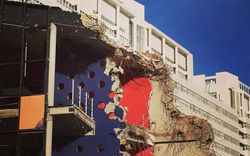
Felix McNamara writes to Christophe Van Gerrewey on the issue of demolition
Title:
What We Know
Felix McNamara writes to Christophe Van Gerrewey on the issue of demolition
Actions:
What We Know
Felix McNamara writes to Christophe Van Gerrewey on the issue of demolition
Actions:
Form:
drawings
drawings
Actions:
Reference number:
DR2012:0015:023:001-001
Description:
Ring binder containing notes and sketches (109 drawings) referring to the following events, locations, and/or projects: - Sable-Castelli exhibition, Toronto; - Cities on the move; - American city: Venice; - Assemblée nationale du Québec [National Assembly of Quebec]; - CCA garden; - Kansas City, Missouri; - One size fits all; - The parade of the engineers; - Stepping out; - Longueuil, Quebec; - Bodyworks.
DR2012:0015:023:001-001
Description:
Ring binder containing notes and sketches (109 drawings) referring to the following events, locations, and/or projects: - Sable-Castelli exhibition, Toronto; - Cities on the move; - American city: Venice; - Assemblée nationale du Québec [National Assembly of Quebec]; - CCA garden; - Kansas City, Missouri; - One size fits all; - The parade of the engineers; - Stepping out; - Longueuil, Quebec; - Bodyworks.
People:
Date:
1997-2010
1997-2010
Title:
Notes and sketches by Melvin Charney on his later works
Actions:
DR2012:0015:023:001-001
Description:
Ring binder containing notes and sketches (109 drawings) referring to the following events, locations, and/or projects: - Sable-Castelli exhibition, Toronto; - Cities on the move; - American city: Venice; - Assemblée nationale du Québec [National Assembly of Quebec]; - CCA garden; - Kansas City, Missouri; - One size fits all; - The parade of the engineers; - Stepping out; - Longueuil, Quebec; - Bodyworks.
Notes and sketches by Melvin Charney on his later works
Actions:
DR2012:0015:023:001-001
Description:
Ring binder containing notes and sketches (109 drawings) referring to the following events, locations, and/or projects: - Sable-Castelli exhibition, Toronto; - Cities on the move; - American city: Venice; - Assemblée nationale du Québec [National Assembly of Quebec]; - CCA garden; - Kansas City, Missouri; - One size fits all; - The parade of the engineers; - Stepping out; - Longueuil, Quebec; - Bodyworks.
Form:
drawings
drawings
Date:
1997-2010
1997-2010
People:
Form:
exhibitions
exhibitions
Form:
exhibitions
exhibitions
Date:
September 2018 to
March 2019
September 2018 to
March 2019
Form:
exhibitions
exhibitions

Form:
exhibitions
exhibitions
Date:
January 2018 to
September 2018
January 2018 to
September 2018


