


29901 Results
Form:
photographs
photographs
Reference number:
PH1980:1219:094
Description:
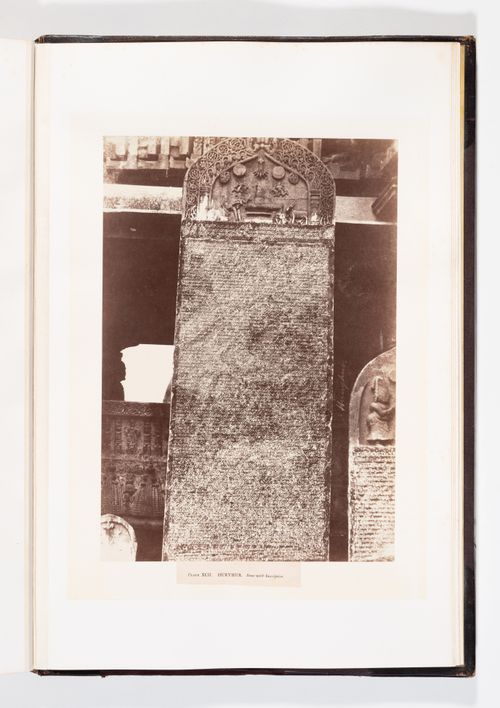
- This photograph is from book PH1980:1219:001-100, 'Architecture in Dharwar and Mysore', which has been disassembled for the CCA exhibition 'Traces of India: Photography, Architecture, and the Politics of Representation/Empreintes de l'Inde: Photographie, architecture et politiques de la représentation'.
PH1980:1219:094
Description:
- This photograph is from book PH1980:1219:001-100, 'Architecture in Dharwar and Mysore', which has been disassembled for the CCA exhibition 'Traces of India: Photography, Architecture, and the Politics of Representation/Empreintes de l'Inde: Photographie, architecture et politiques de la représentation'.
People:
Subject:
architecture, sculpture
architecture, sculpture
Date:
between 1854 and 1858
between 1854 and 1858
Title:
View of stone slabs showing inscriptions and reliefs, Harihara, India
Actions:
PH1980:1219:094
Description:
- This photograph is from book PH1980:1219:001-100, 'Architecture in Dharwar and Mysore', which has been disassembled for the CCA exhibition 'Traces of India: Photography, Architecture, and the Politics of Representation/Empreintes de l'Inde: Photographie, architecture et politiques de la représentation'.
View of stone slabs showing inscriptions and reliefs, Harihara, India
Actions:
PH1980:1219:094
Description:
- This photograph is from book PH1980:1219:001-100, 'Architecture in Dharwar and Mysore', which has been disassembled for the CCA exhibition 'Traces of India: Photography, Architecture, and the Politics of Representation/Empreintes de l'Inde: Photographie, architecture et politiques de la représentation'.
Form:
photographs
photographs
Date:
between 1854 and 1858
between 1854 and 1858
People:
Subject:
architecture, sculpture
architecture, sculpture
Form:
photographs
photographs
Actions:
Reference number:
PH1980:1219:100
Description:
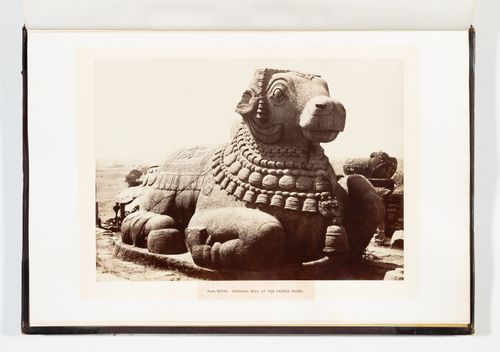
- This photograph is from book PH1980:1219:001-100, 'Architecture in Dharwar and Mysore', which has been disassembled for the CCA exhibition 'Traces of India: Photography, Architecture, and the Politics of Representation/Empreintes de l'Inde: Photographie, architecture et politiques de la représentation'.
PH1980:1219:100
Description:
- This photograph is from book PH1980:1219:001-100, 'Architecture in Dharwar and Mysore', which has been disassembled for the CCA exhibition 'Traces of India: Photography, Architecture, and the Politics of Representation/Empreintes de l'Inde: Photographie, architecture et politiques de la représentation'.
People:
Subject:
sculpture
sculpture
Date:
between 1854 and 1858
between 1854 and 1858
Title:
View of a Nandi, Chamundi Hill, near Mysore, India
Actions:
PH1980:1219:100
Description:
- This photograph is from book PH1980:1219:001-100, 'Architecture in Dharwar and Mysore', which has been disassembled for the CCA exhibition 'Traces of India: Photography, Architecture, and the Politics of Representation/Empreintes de l'Inde: Photographie, architecture et politiques de la représentation'.
View of a Nandi, Chamundi Hill, near Mysore, India
Actions:
PH1980:1219:100
Description:
- This photograph is from book PH1980:1219:001-100, 'Architecture in Dharwar and Mysore', which has been disassembled for the CCA exhibition 'Traces of India: Photography, Architecture, and the Politics of Representation/Empreintes de l'Inde: Photographie, architecture et politiques de la représentation'.
Form:
photographs
photographs
Date:
between 1854 and 1858
between 1854 and 1858
People:
Subject:
sculpture
sculpture
Form:
journals and magazines
journals and magazines
Actions:
Reference number:
PH2008:0037:017
Description:
Review by Judith Rodenbeck titled "Gordon Matta-Clark" (pp. 110-111) discusses the exhibition "Gordon Matta-Clark: You Are The Measure" held at the Whitney Museum of American Art from 22 February 2007 to 3 June 2007.
PH2008:0037:017
Description:
Review by Judith Rodenbeck titled "Gordon Matta-Clark" (pp. 110-111) discusses the exhibition "Gordon Matta-Clark: You Are The Measure" held at the Whitney Museum of American Art from 22 February 2007 to 3 June 2007.
People:
Date:
June 2007
June 2007
Title:
Modern Painters: The International Contemporary Art Magazine
Actions:
PH2008:0037:017
Description:
Review by Judith Rodenbeck titled "Gordon Matta-Clark" (pp. 110-111) discusses the exhibition "Gordon Matta-Clark: You Are The Measure" held at the Whitney Museum of American Art from 22 February 2007 to 3 June 2007.
Modern Painters: The International Contemporary Art Magazine
Actions:
PH2008:0037:017
Description:
Review by Judith Rodenbeck titled "Gordon Matta-Clark" (pp. 110-111) discusses the exhibition "Gordon Matta-Clark: You Are The Measure" held at the Whitney Museum of American Art from 22 February 2007 to 3 June 2007.
Form:
journals and magazines
journals and magazines
Date:
June 2007
June 2007
People:
Form:
drawings, textual records
Quantity:
57 textual record(s) and reprographic copy(ies)
drawings, textual records
Quantity:
57 textual record(s) and reprographic copy(ies)
Actions:
Reference number:
DR1997:0070:001-057
Description:
- Danforth's thesis included a written component. Danforth researched the history, function and program of the museum, modern art gallery or exhibition hall, taking suggestions from Mies van der Rohe and Walter Peterhans about which ones he should examine. The group of documents includes an incomplete draft of Danforth's written text, as well as research notes and illustrations of museums/exhibition spaces by architects including Schinkel (Altes Museum, Berlin), Le Corbusier (Pavillon des Temps Nouveaux, Paris and Palais de Tokyo, Paris), Henry van de Velde, and H.P. Berlage.
DR1997:0070:001-057
Description:
- Danforth's thesis included a written component. Danforth researched the history, function and program of the museum, modern art gallery or exhibition hall, taking suggestions from Mies van der Rohe and Walter Peterhans about which ones he should examine. The group of documents includes an incomplete draft of Danforth's written text, as well as research notes and illustrations of museums/exhibition spaces by architects including Schinkel (Altes Museum, Berlin), Le Corbusier (Pavillon des Temps Nouveaux, Paris and Palais de Tokyo, Paris), Henry van de Velde, and H.P. Berlage.
People:
Subject:
architecture, installation
architecture, installation
Date:
1940-1943
1940-1943
Title:
Research notes, draft text, and illustrations for a graduate thesis for a small museum, Department of Architecture, Illinois Institute of Technology
Actions:
DR1997:0070:001-057
Description:
- Danforth's thesis included a written component. Danforth researched the history, function and program of the museum, modern art gallery or exhibition hall, taking suggestions from Mies van der Rohe and Walter Peterhans about which ones he should examine. The group of documents includes an incomplete draft of Danforth's written text, as well as research notes and illustrations of museums/exhibition spaces by architects including Schinkel (Altes Museum, Berlin), Le Corbusier (Pavillon des Temps Nouveaux, Paris and Palais de Tokyo, Paris), Henry van de Velde, and H.P. Berlage.
Research notes, draft text, and illustrations for a graduate thesis for a small museum, Department of Architecture, Illinois Institute of Technology
Actions:
DR1997:0070:001-057
Description:
- Danforth's thesis included a written component. Danforth researched the history, function and program of the museum, modern art gallery or exhibition hall, taking suggestions from Mies van der Rohe and Walter Peterhans about which ones he should examine. The group of documents includes an incomplete draft of Danforth's written text, as well as research notes and illustrations of museums/exhibition spaces by architects including Schinkel (Altes Museum, Berlin), Le Corbusier (Pavillon des Temps Nouveaux, Paris and Palais de Tokyo, Paris), Henry van de Velde, and H.P. Berlage.
Form:
drawings, textual records
Quantity:
57 textual record(s) and reprographic copy(ies)
drawings, textual records
Quantity:
57 textual record(s) and reprographic copy(ies)
Date:
1940-1943
1940-1943
People:
Subject:
architecture, installation
architecture, installation
Actions:
Reference number:
PHCON2003:0005:130
Description:
Film was made for the 1989 Musée d'art contemporain de Montréal, Québec showing of the exhibition "Gordon Matta-Clark: A Retrospective", organized by, and also held at, the Museum of Contemporary Art in Chicago, Illinois. inscription: ABC News 20/20.
PHCON2003:0005:130
Description:
Film was made for the 1989 Musée d'art contemporain de Montréal, Québec showing of the exhibition "Gordon Matta-Clark: A Retrospective", organized by, and also held at, the Museum of Contemporary Art in Chicago, Illinois. inscription: ABC News 20/20.
People:
Date:
1989
1989
Title:
16mm film print of Matta-Clark retrospective at MAC in Montreal
Actions:
PHCON2003:0005:130
Description:
Film was made for the 1989 Musée d'art contemporain de Montréal, Québec showing of the exhibition "Gordon Matta-Clark: A Retrospective", organized by, and also held at, the Museum of Contemporary Art in Chicago, Illinois. inscription: ABC News 20/20.
16mm film print of Matta-Clark retrospective at MAC in Montreal
Actions:
PHCON2003:0005:130
Description:
Film was made for the 1989 Musée d'art contemporain de Montréal, Québec showing of the exhibition "Gordon Matta-Clark: A Retrospective", organized by, and also held at, the Museum of Contemporary Art in Chicago, Illinois. inscription: ABC News 20/20.
Date:
1989
1989
People:
Form:
textual records
textual records
Actions:
Reference number:
PH2007:0009
Description:
Genealogical table is drawn on the verso of a menu for a dinner held at the Savoy Restaurant, New York, on the 20 February 2007, in celebration of the opening of the exhibition "Gordon Matta-Clark: 'You Are the Measure'". The table was drawn for Mirko Zardini.
PH2007:0009
Description:
Genealogical table is drawn on the verso of a menu for a dinner held at the Savoy Restaurant, New York, on the 20 February 2007, in celebration of the opening of the exhibition "Gordon Matta-Clark: 'You Are the Measure'". The table was drawn for Mirko Zardini.
People:
Date:
20 February 2007
20 February 2007
Title:
Genealogical table of Roberto Matta
Actions:
PH2007:0009
Description:
Genealogical table is drawn on the verso of a menu for a dinner held at the Savoy Restaurant, New York, on the 20 February 2007, in celebration of the opening of the exhibition "Gordon Matta-Clark: 'You Are the Measure'". The table was drawn for Mirko Zardini.
Genealogical table of Roberto Matta
Actions:
PH2007:0009
Description:
Genealogical table is drawn on the verso of a menu for a dinner held at the Savoy Restaurant, New York, on the 20 February 2007, in celebration of the opening of the exhibition "Gordon Matta-Clark: 'You Are the Measure'". The table was drawn for Mirko Zardini.
Form:
textual records
textual records
Date:
20 February 2007
20 February 2007
People:
Level of archival description:
Series
Series
Actions:
Reference number:
AP179.S1
Description:
Series 1, Casa La Roca, Caracas, Venezuela, 1995 – 2001, documents the development of a project (unrealized) for a residential home situated among the hills at the southern edge of Caracas. The majority of records were produced between 1995 and 1997. The series consists of sketches, drawings and reprographic copies for the conceptual and design development phases of the project, a wood model and model pieces, photographs of the site, and textual records including correspondence and zoning records. The series also contains an oversized banner printed with an image of the model that was featured in the Fabrications exhibition at the Museum of Modern Art, New York, in 1998, as well as plans for the show. The digital material in this series consists of an animated rendering of the brick patio wall and photographs of the physical drawings and the model for Casa La Roca. The name of the project, Casa la Roca (in English, “the rock house”), is derived from a large mass of rock that occupies the back of the property. The design utilizes the presence of the rock, in combination with sliding glass doors and windows, to create an “outdoor room” that functions both as a living space and back yard. The design also incorporates the nature of the site through the use of materials such as terracotta block, brick, and tile.
AP179.S1
Description:
Series 1, Casa La Roca, Caracas, Venezuela, 1995 – 2001, documents the development of a project (unrealized) for a residential home situated among the hills at the southern edge of Caracas. The majority of records were produced between 1995 and 1997. The series consists of sketches, drawings and reprographic copies for the conceptual and design development phases of the project, a wood model and model pieces, photographs of the site, and textual records including correspondence and zoning records. The series also contains an oversized banner printed with an image of the model that was featured in the Fabrications exhibition at the Museum of Modern Art, New York, in 1998, as well as plans for the show. The digital material in this series consists of an animated rendering of the brick patio wall and photographs of the physical drawings and the model for Casa La Roca. The name of the project, Casa la Roca (in English, “the rock house”), is derived from a large mass of rock that occupies the back of the property. The design utilizes the presence of the rock, in combination with sliding glass doors and windows, to create an “outdoor room” that functions both as a living space and back yard. The design also incorporates the nature of the site through the use of materials such as terracotta block, brick, and tile.
People:
Date:
1995 - 2001
1995 - 2001
Title:
Casa La Roca, Caracas, Venezuela (1995 - 2001)
Actions:
AP179.S1
Description:
Series 1, Casa La Roca, Caracas, Venezuela, 1995 – 2001, documents the development of a project (unrealized) for a residential home situated among the hills at the southern edge of Caracas. The majority of records were produced between 1995 and 1997. The series consists of sketches, drawings and reprographic copies for the conceptual and design development phases of the project, a wood model and model pieces, photographs of the site, and textual records including correspondence and zoning records. The series also contains an oversized banner printed with an image of the model that was featured in the Fabrications exhibition at the Museum of Modern Art, New York, in 1998, as well as plans for the show. The digital material in this series consists of an animated rendering of the brick patio wall and photographs of the physical drawings and the model for Casa La Roca. The name of the project, Casa la Roca (in English, “the rock house”), is derived from a large mass of rock that occupies the back of the property. The design utilizes the presence of the rock, in combination with sliding glass doors and windows, to create an “outdoor room” that functions both as a living space and back yard. The design also incorporates the nature of the site through the use of materials such as terracotta block, brick, and tile.
Casa La Roca, Caracas, Venezuela (1995 - 2001)
Actions:
AP179.S1
Description:
Series 1, Casa La Roca, Caracas, Venezuela, 1995 – 2001, documents the development of a project (unrealized) for a residential home situated among the hills at the southern edge of Caracas. The majority of records were produced between 1995 and 1997. The series consists of sketches, drawings and reprographic copies for the conceptual and design development phases of the project, a wood model and model pieces, photographs of the site, and textual records including correspondence and zoning records. The series also contains an oversized banner printed with an image of the model that was featured in the Fabrications exhibition at the Museum of Modern Art, New York, in 1998, as well as plans for the show. The digital material in this series consists of an animated rendering of the brick patio wall and photographs of the physical drawings and the model for Casa La Roca. The name of the project, Casa la Roca (in English, “the rock house”), is derived from a large mass of rock that occupies the back of the property. The design utilizes the presence of the rock, in combination with sliding glass doors and windows, to create an “outdoor room” that functions both as a living space and back yard. The design also incorporates the nature of the site through the use of materials such as terracotta block, brick, and tile.
Level of archival description:
Series
Series
Date:
1995 - 2001
1995 - 2001
People:
Form:
drawings
Quantity:
29 conceptual drawing(s)
drawings
Quantity:
29 conceptual drawing(s)
Actions:
Reference number:
DR2004:0908
Description:
sketches, some with annotations, perspectives, site plans, sections, diagrams, elevations, axonometrics, maps, possibly presentation drawings, view of site with sketch overlay, reference drawings, view of drawing possibly from an exhibition, view of dock structures, and proposal document
DR2004:0908
Description:
sketches, some with annotations, perspectives, site plans, sections, diagrams, elevations, axonometrics, maps, possibly presentation drawings, view of site with sketch overlay, reference drawings, view of drawing possibly from an exhibition, view of dock structures, and proposal document
People:
Title:
Sketches, some with annotations, perspectives, site plans
Actions:
DR2004:0908
Description:
sketches, some with annotations, perspectives, site plans, sections, diagrams, elevations, axonometrics, maps, possibly presentation drawings, view of site with sketch overlay, reference drawings, view of drawing possibly from an exhibition, view of dock structures, and proposal document
Sketches, some with annotations, perspectives, site plans
Actions:
DR2004:0908
Description:
sketches, some with annotations, perspectives, site plans, sections, diagrams, elevations, axonometrics, maps, possibly presentation drawings, view of site with sketch overlay, reference drawings, view of drawing possibly from an exhibition, view of dock structures, and proposal document
Form:
drawings
Quantity:
29 conceptual drawing(s)
drawings
Quantity:
29 conceptual drawing(s)
People:
Form:
events
events
Title:
Rotor Deconstruction
Rotor Deconstruction
Actions:
Description:
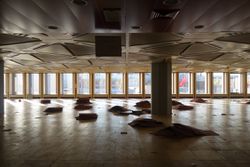
Maarten Gielen presents the work of Rotor, a group of architects, designers and other professionals interested in material flows in industry and construction, particularly in relation to resources, waste, use and reuse. Rotor disseminates creative strategies for salvage and waste reduction through workshops, publications, and exhibitions. Presented in conjunction with(...)
Maarten Gielen presents the work of Rotor, a group of architects, designers and other professionals interested in material flows in industry and construction, particularly in relation to resources, waste, use and reuse. Rotor disseminates creative strategies for salvage and waste reduction through workshops, publications, and exhibitions. Presented in conjunction with(...)
Date:
4 February 2016
4 February 2016
Title:
Rotor Deconstruction
Actions:
Description:
Maarten Gielen presents the work of Rotor, a group of architects, designers and other professionals interested in material flows in industry and construction, particularly in relation to resources, waste, use and reuse. Rotor disseminates creative strategies for salvage and waste reduction through workshops, publications, and exhibitions. Presented in conjunction with(...)
Rotor Deconstruction
Actions:
Description:
Maarten Gielen presents the work of Rotor, a group of architects, designers and other professionals interested in material flows in industry and construction, particularly in relation to resources, waste, use and reuse. Rotor disseminates creative strategies for salvage and waste reduction through workshops, publications, and exhibitions. Presented in conjunction with(...)
Form:
events
events
Date:
4 February 2016
4 February 2016
Form:
archives
Level of archival description:
Fonds
archives
Level of archival description:
Fonds
Actions:
Reference number:
AP194
Synopsis:
The Johan Bettum OCEAN North projects records, 1995-2000, consist of born-digital files and a physical drawing that document three projects by the OCEAN North collective: Synthetic Landscape (1995-2000), Jyväskylä Music and Arts Centre (competition, 1997), and Tölöö Football Stadium (competition, 1997). The archive also includes a small amount of additional born-digital reference materials on 11 projects from the collective, including the three projects mentioned above.
AP194
Synopsis:
The Johan Bettum OCEAN North projects records, 1995-2000, consist of born-digital files and a physical drawing that document three projects by the OCEAN North collective: Synthetic Landscape (1995-2000), Jyväskylä Music and Arts Centre (competition, 1997), and Tölöö Football Stadium (competition, 1997). The archive also includes a small amount of additional born-digital reference materials on 11 projects from the collective, including the three projects mentioned above.
People:
Date:
1995-2000
1995-2000
Title:
Johan Bettum OCEAN North project records
Actions:
AP194
Synopsis:
The Johan Bettum OCEAN North projects records, 1995-2000, consist of born-digital files and a physical drawing that document three projects by the OCEAN North collective: Synthetic Landscape (1995-2000), Jyväskylä Music and Arts Centre (competition, 1997), and Tölöö Football Stadium (competition, 1997). The archive also includes a small amount of additional born-digital reference materials on 11 projects from the collective, including the three projects mentioned above.
Johan Bettum OCEAN North project records
Actions:
AP194
Synopsis:
The Johan Bettum OCEAN North projects records, 1995-2000, consist of born-digital files and a physical drawing that document three projects by the OCEAN North collective: Synthetic Landscape (1995-2000), Jyväskylä Music and Arts Centre (competition, 1997), and Tölöö Football Stadium (competition, 1997). The archive also includes a small amount of additional born-digital reference materials on 11 projects from the collective, including the three projects mentioned above.
Form:
archives
Level of archival description:
Fonds
archives
Level of archival description:
Fonds
Date:
1995-2000
1995-2000
People:


