


1441 Results
Form:
drawings
drawings
Title:
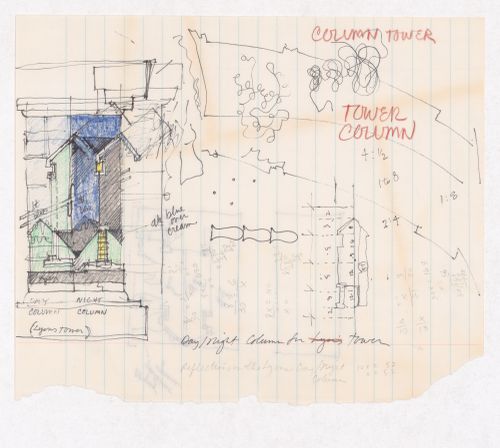
Column Tower / Tower Column
Column Tower / Tower Column
Actions:
Reference number:
DR2007:0017
Description:
Original sketch for "Lyons Tower" drawing; mixed media on lined paper, 6" x 8". The large final "Lyons Tower" drawing is in the CCA Collections. The realized Lyons Tower project, near Halifax, was published in Larry Richards Works, 1977-1980 (pp. 30-31) and in Domus no. 620, Septembre 1981, p.34. "Lyons Tower" was also exhibited in the 1981 Okanada exhibition in Berlin.
DR2007:0017
Description:
Original sketch for "Lyons Tower" drawing; mixed media on lined paper, 6" x 8". The large final "Lyons Tower" drawing is in the CCA Collections. The realized Lyons Tower project, near Halifax, was published in Larry Richards Works, 1977-1980 (pp. 30-31) and in Domus no. 620, Septembre 1981, p.34. "Lyons Tower" was also exhibited in the 1981 Okanada exhibition in Berlin.
People:
Date:
1979-1980
1979-1980
Title:
Column Tower / Tower Column
Actions:
DR2007:0017
Description:
Original sketch for "Lyons Tower" drawing; mixed media on lined paper, 6" x 8". The large final "Lyons Tower" drawing is in the CCA Collections. The realized Lyons Tower project, near Halifax, was published in Larry Richards Works, 1977-1980 (pp. 30-31) and in Domus no. 620, Septembre 1981, p.34. "Lyons Tower" was also exhibited in the 1981 Okanada exhibition in Berlin.
Column Tower / Tower Column
Actions:
DR2007:0017
Description:
Original sketch for "Lyons Tower" drawing; mixed media on lined paper, 6" x 8". The large final "Lyons Tower" drawing is in the CCA Collections. The realized Lyons Tower project, near Halifax, was published in Larry Richards Works, 1977-1980 (pp. 30-31) and in Domus no. 620, Septembre 1981, p.34. "Lyons Tower" was also exhibited in the 1981 Okanada exhibition in Berlin.
Form:
drawings
drawings
Date:
1979-1980
1979-1980
People:
Form:
archives
Level of archival description:
Fonds
archives
Level of archival description:
Fonds
Actions:
Reference number:
AP198
Synopsis:
The Kivi Sotamaa OCEAN North project records, 1997-2000, consist of born-digital files, drawings, photographs, and physical models that document two projects by the OCEAN North collective: Jyväskylä Music and Arts Centre (competition, 1997) and Tölöö Football Stadium (competition, 1997). The archive also includes born-digital reference materials on 14 projects from the collective, including the two projects mentioned above.
AP198
Synopsis:
The Kivi Sotamaa OCEAN North project records, 1997-2000, consist of born-digital files, drawings, photographs, and physical models that document two projects by the OCEAN North collective: Jyväskylä Music and Arts Centre (competition, 1997) and Tölöö Football Stadium (competition, 1997). The archive also includes born-digital reference materials on 14 projects from the collective, including the two projects mentioned above.
People:
Date:
1997-2000
1997-2000
Title:
Kivi Sotamaa OCEAN North project records
Actions:
AP198
Synopsis:
The Kivi Sotamaa OCEAN North project records, 1997-2000, consist of born-digital files, drawings, photographs, and physical models that document two projects by the OCEAN North collective: Jyväskylä Music and Arts Centre (competition, 1997) and Tölöö Football Stadium (competition, 1997). The archive also includes born-digital reference materials on 14 projects from the collective, including the two projects mentioned above.
Kivi Sotamaa OCEAN North project records
Actions:
AP198
Synopsis:
The Kivi Sotamaa OCEAN North project records, 1997-2000, consist of born-digital files, drawings, photographs, and physical models that document two projects by the OCEAN North collective: Jyväskylä Music and Arts Centre (competition, 1997) and Tölöö Football Stadium (competition, 1997). The archive also includes born-digital reference materials on 14 projects from the collective, including the two projects mentioned above.
Form:
archives
Level of archival description:
Fonds
archives
Level of archival description:
Fonds
Date:
1997-2000
1997-2000
People:
Form:
archives
Level of archival description:
Fonds
archives
Level of archival description:
Fonds
Title:
Van Ginkel Associates fonds
Van Ginkel Associates fonds
Reference number:
AP027
Synopsis:
The Van Ginkel Associates fonds is comprised of documents concerning van Ginkel Associates, van Ginkel Associates Ltd., Ecos Ltd., van Ginkel Partners, Ginkelvan Ltd, van Ginkel Associates Ltd. (1977), the styles under which H.P. van Ginkel and Blanche Lemco van Ginkel practiced as a multidisciplinary planning, management and architecture firm. Much of the van Ginkels' work was done in the Montréal area and nation-wide. The fonds contains approximately 1 985 drawings (1 420 originals plus 565 reproductions), 41 boards, 3 photographs, 2 collages, 2 typescripts, 1 model, 1 sketchbook and approximately 12.23 meters of textual documents. The documents were primarily produced between 1955 and 1980.
AP027
Synopsis:
The Van Ginkel Associates fonds is comprised of documents concerning van Ginkel Associates, van Ginkel Associates Ltd., Ecos Ltd., van Ginkel Partners, Ginkelvan Ltd, van Ginkel Associates Ltd. (1977), the styles under which H.P. van Ginkel and Blanche Lemco van Ginkel practiced as a multidisciplinary planning, management and architecture firm. Much of the van Ginkels' work was done in the Montréal area and nation-wide. The fonds contains approximately 1 985 drawings (1 420 originals plus 565 reproductions), 41 boards, 3 photographs, 2 collages, 2 typescripts, 1 model, 1 sketchbook and approximately 12.23 meters of textual documents. The documents were primarily produced between 1955 and 1980.
People:
Date:
1944-1992
1944-1992
Title:
Van Ginkel Associates fonds
Actions:
AP027
Synopsis:
The Van Ginkel Associates fonds is comprised of documents concerning van Ginkel Associates, van Ginkel Associates Ltd., Ecos Ltd., van Ginkel Partners, Ginkelvan Ltd, van Ginkel Associates Ltd. (1977), the styles under which H.P. van Ginkel and Blanche Lemco van Ginkel practiced as a multidisciplinary planning, management and architecture firm. Much of the van Ginkels' work was done in the Montréal area and nation-wide. The fonds contains approximately 1 985 drawings (1 420 originals plus 565 reproductions), 41 boards, 3 photographs, 2 collages, 2 typescripts, 1 model, 1 sketchbook and approximately 12.23 meters of textual documents. The documents were primarily produced between 1955 and 1980.
Van Ginkel Associates fonds
Actions:
AP027
Synopsis:
The Van Ginkel Associates fonds is comprised of documents concerning van Ginkel Associates, van Ginkel Associates Ltd., Ecos Ltd., van Ginkel Partners, Ginkelvan Ltd, van Ginkel Associates Ltd. (1977), the styles under which H.P. van Ginkel and Blanche Lemco van Ginkel practiced as a multidisciplinary planning, management and architecture firm. Much of the van Ginkels' work was done in the Montréal area and nation-wide. The fonds contains approximately 1 985 drawings (1 420 originals plus 565 reproductions), 41 boards, 3 photographs, 2 collages, 2 typescripts, 1 model, 1 sketchbook and approximately 12.23 meters of textual documents. The documents were primarily produced between 1955 and 1980.
Form:
archives
Level of archival description:
Fonds
archives
Level of archival description:
Fonds
Date:
1944-1992
1944-1992
People:
Form:
archives
Level of archival description:
Fonds
archives
Level of archival description:
Fonds
Actions:
Reference number:
AP190
Synopsis:
The Preston Scott Cohen Eyebeam project records, 2001-2016, consist of 281 digital files that document the architect’s competition entry for the Eyebeam Atelier Museum in New York City, developed in 2001. The archive includes 154 digital models in Rhinoceros, 30 digital models in STL, approximately 90 digital images, one video, and a number of Illustrator, Photoshop, PDF, and Microsoft Word files.
AP190
Synopsis:
The Preston Scott Cohen Eyebeam project records, 2001-2016, consist of 281 digital files that document the architect’s competition entry for the Eyebeam Atelier Museum in New York City, developed in 2001. The archive includes 154 digital models in Rhinoceros, 30 digital models in STL, approximately 90 digital images, one video, and a number of Illustrator, Photoshop, PDF, and Microsoft Word files.
People:
Date:
2001-2016
2001-2016
Title:
Preston Scott Cohen Eyebeam project records
Actions:
AP190
Synopsis:
The Preston Scott Cohen Eyebeam project records, 2001-2016, consist of 281 digital files that document the architect’s competition entry for the Eyebeam Atelier Museum in New York City, developed in 2001. The archive includes 154 digital models in Rhinoceros, 30 digital models in STL, approximately 90 digital images, one video, and a number of Illustrator, Photoshop, PDF, and Microsoft Word files.
Preston Scott Cohen Eyebeam project records
Actions:
AP190
Synopsis:
The Preston Scott Cohen Eyebeam project records, 2001-2016, consist of 281 digital files that document the architect’s competition entry for the Eyebeam Atelier Museum in New York City, developed in 2001. The archive includes 154 digital models in Rhinoceros, 30 digital models in STL, approximately 90 digital images, one video, and a number of Illustrator, Photoshop, PDF, and Microsoft Word files.
Form:
archives
Level of archival description:
Fonds
archives
Level of archival description:
Fonds
Date:
2001-2016
2001-2016
People:
Level of archival description:
Project
Project
Title:
Carbon Tower (2001)
Carbon Tower (2001)
Reference number:
AP174.S1.2001.D1
Description:
This project file documents an unbuilt design by Testa & Weiser for Carbon Tower (2001), a forty-storey building made almost entirely of carbon fibre. The project was developed in parallel with scripting software designed while Peter Testa and Devyn Weiser co-directed the Emergent Design Group at MIT. "The tower consists of an interdependent set of parts: floor plates hang from a diagrid structure of bundled fibres reinforced by two double-helix covered ramps, which are run in and out of the structure and are themselves made of strands woven at a finer scale. A thin composite skin—glass would be too heavy—wraps the tower’s parts together. A collaboration with Arup in 2002 allowed Testa & Weiser to simplify the scheme even further, by moving all core elements, from elevators to structural supports, to the tower’s perimeter. To take full advantage of the flexibility and energy efficiency of composite materials, Testa & Weiser also imagined that the carbon fibre structures would be formed on site through a process called pultrusion."[1] The file contains a large number of digital files documenting the conceptual and design development of the project; consultation with Arup Consulting Engineers, New York; research on composite materials; fabrication of 3D printed physical models by 3D Systems and Windform; and exhibition of the project at several museums and galleries, including the Museum of Contemporary Art, Los Angeles and the Cooper-Hewitt Smithsonian Design Museum, New York. Also contained in the file are 56 paper drawings (including some sketches done on top of printed computer-aided designs) and two 3D printed physical models produced by 3D Systems. Sources: [1] Canadian Centre for Architecture. Archaeology of the Digital 12: Testa & Weiser, Carbon Tower, ed. Greg Lynn (2015), ISBN 978-1-927071-25-0.
AP174.S1.2001.D1
Description:
This project file documents an unbuilt design by Testa & Weiser for Carbon Tower (2001), a forty-storey building made almost entirely of carbon fibre. The project was developed in parallel with scripting software designed while Peter Testa and Devyn Weiser co-directed the Emergent Design Group at MIT. "The tower consists of an interdependent set of parts: floor plates hang from a diagrid structure of bundled fibres reinforced by two double-helix covered ramps, which are run in and out of the structure and are themselves made of strands woven at a finer scale. A thin composite skin—glass would be too heavy—wraps the tower’s parts together. A collaboration with Arup in 2002 allowed Testa & Weiser to simplify the scheme even further, by moving all core elements, from elevators to structural supports, to the tower’s perimeter. To take full advantage of the flexibility and energy efficiency of composite materials, Testa & Weiser also imagined that the carbon fibre structures would be formed on site through a process called pultrusion."[1] The file contains a large number of digital files documenting the conceptual and design development of the project; consultation with Arup Consulting Engineers, New York; research on composite materials; fabrication of 3D printed physical models by 3D Systems and Windform; and exhibition of the project at several museums and galleries, including the Museum of Contemporary Art, Los Angeles and the Cooper-Hewitt Smithsonian Design Museum, New York. Also contained in the file are 56 paper drawings (including some sketches done on top of printed computer-aided designs) and two 3D printed physical models produced by 3D Systems. Sources: [1] Canadian Centre for Architecture. Archaeology of the Digital 12: Testa & Weiser, Carbon Tower, ed. Greg Lynn (2015), ISBN 978-1-927071-25-0.
People:
Date:
2002-2014
2002-2014
Title:
Carbon Tower (2001)
Actions:
AP174.S1.2001.D1
Description:
This project file documents an unbuilt design by Testa & Weiser for Carbon Tower (2001), a forty-storey building made almost entirely of carbon fibre. The project was developed in parallel with scripting software designed while Peter Testa and Devyn Weiser co-directed the Emergent Design Group at MIT. "The tower consists of an interdependent set of parts: floor plates hang from a diagrid structure of bundled fibres reinforced by two double-helix covered ramps, which are run in and out of the structure and are themselves made of strands woven at a finer scale. A thin composite skin—glass would be too heavy—wraps the tower’s parts together. A collaboration with Arup in 2002 allowed Testa & Weiser to simplify the scheme even further, by moving all core elements, from elevators to structural supports, to the tower’s perimeter. To take full advantage of the flexibility and energy efficiency of composite materials, Testa & Weiser also imagined that the carbon fibre structures would be formed on site through a process called pultrusion."[1] The file contains a large number of digital files documenting the conceptual and design development of the project; consultation with Arup Consulting Engineers, New York; research on composite materials; fabrication of 3D printed physical models by 3D Systems and Windform; and exhibition of the project at several museums and galleries, including the Museum of Contemporary Art, Los Angeles and the Cooper-Hewitt Smithsonian Design Museum, New York. Also contained in the file are 56 paper drawings (including some sketches done on top of printed computer-aided designs) and two 3D printed physical models produced by 3D Systems. Sources: [1] Canadian Centre for Architecture. Archaeology of the Digital 12: Testa & Weiser, Carbon Tower, ed. Greg Lynn (2015), ISBN 978-1-927071-25-0.
Carbon Tower (2001)
Actions:
AP174.S1.2001.D1
Description:
This project file documents an unbuilt design by Testa & Weiser for Carbon Tower (2001), a forty-storey building made almost entirely of carbon fibre. The project was developed in parallel with scripting software designed while Peter Testa and Devyn Weiser co-directed the Emergent Design Group at MIT. "The tower consists of an interdependent set of parts: floor plates hang from a diagrid structure of bundled fibres reinforced by two double-helix covered ramps, which are run in and out of the structure and are themselves made of strands woven at a finer scale. A thin composite skin—glass would be too heavy—wraps the tower’s parts together. A collaboration with Arup in 2002 allowed Testa & Weiser to simplify the scheme even further, by moving all core elements, from elevators to structural supports, to the tower’s perimeter. To take full advantage of the flexibility and energy efficiency of composite materials, Testa & Weiser also imagined that the carbon fibre structures would be formed on site through a process called pultrusion."[1] The file contains a large number of digital files documenting the conceptual and design development of the project; consultation with Arup Consulting Engineers, New York; research on composite materials; fabrication of 3D printed physical models by 3D Systems and Windform; and exhibition of the project at several museums and galleries, including the Museum of Contemporary Art, Los Angeles and the Cooper-Hewitt Smithsonian Design Museum, New York. Also contained in the file are 56 paper drawings (including some sketches done on top of printed computer-aided designs) and two 3D printed physical models produced by 3D Systems. Sources: [1] Canadian Centre for Architecture. Archaeology of the Digital 12: Testa & Weiser, Carbon Tower, ed. Greg Lynn (2015), ISBN 978-1-927071-25-0.
Level of archival description:
Project
Project
Date:
2002-2014
2002-2014
People:
Form:
events
events
Actions:
Description:
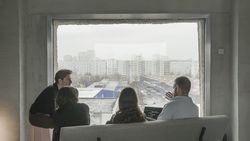
To coincide with the opening of our exhibition To Build Law, we invite you to a roundtable on renovation and rehabilitation policies in Canada. Olaf Grawert, Alina Kolar (bplus.xyz), and Juliette Cook (Ha/f Climate Design) will discuss the economic, environmental, and legal challenges of renovation.
To coincide with the opening of our exhibition To Build Law, we invite you to a roundtable on renovation and rehabilitation policies in Canada. Olaf Grawert, Alina Kolar (bplus.xyz), and Juliette Cook (Ha/f Climate Design) will discuss the economic, environmental, and legal challenges of renovation.
Location:
Shaughnessy House Keyword(s):
renovation and rehabilitation policies in Canada, roundtable, economic, environmental, and legal challenges of renovation
Shaughnessy House Keyword(s):
renovation and rehabilitation policies in Canada, roundtable, economic, environmental, and legal challenges of renovation
Date:
11 December 2024, 6pm
11 December 2024, 6pm
Title:
Tear Down or Repair
Actions:
Description:
To coincide with the opening of our exhibition To Build Law, we invite you to a roundtable on renovation and rehabilitation policies in Canada. Olaf Grawert, Alina Kolar (bplus.xyz), and Juliette Cook (Ha/f Climate Design) will discuss the economic, environmental, and legal challenges of renovation.
Tear Down or Repair
Actions:
Description:
To coincide with the opening of our exhibition To Build Law, we invite you to a roundtable on renovation and rehabilitation policies in Canada. Olaf Grawert, Alina Kolar (bplus.xyz), and Juliette Cook (Ha/f Climate Design) will discuss the economic, environmental, and legal challenges of renovation.
Form:
events
events
Date:
11 December 2024
6pm
11 December 2024
6pm
Location:
Shaughnessy House Keyword(s):
renovation and rehabilitation policies in Canada, roundtable, economic, environmental, and legal challenges of renovation
Shaughnessy House Keyword(s):
renovation and rehabilitation policies in Canada, roundtable, economic, environmental, and legal challenges of renovation
Level of archival description:
Series
Series
Reference number:
AP189.S2
Description:
Series 2, Software for producing the projection and narration, 2007-2008, is composed of ten different versions of the module that generates the projection and narration in the open gallery. Seven of the versions were among the files saved to a compact disc following the CCA exhibition and have been kept together as group ARCH275207. Three of the versions were on a hard drive that was used in Rovereto and comprise group ARCH275212. The core elements of each module are two application files. One of these, whose name begins with "VE1" uses parameters contained in a file called "config.txt". The other application file, called "VECalibration" displays the entire volume of the projected architectural space. The geometric parameters for a room are recorded in a separate image file called "ecan-angles.jpg". A readme file in each module explains how the different files interact with one another. It also identifies the version of the "VE1" application files and any issues that may be related to the version. Each module includes hundreds of Shockwave Flash files (.swf), each containing an animated or still image of a person or persons and/or one or more pieces of furniture. Some of the .swf files contain an image of one or more furnished rooms inhabited by one or more persons. In most versions, the config.txt file contains a URL that accesses the database containing the sensor data. The URL references the file "captorsxml.aspx". As mentioned earlier, the config.txt file also contains parameters for the projected image, including scene geometry, colors and space occupation, and lists of the .swf files for persons and objects. Most versions of the module also include twenty-one .mp3 files, one of which is "empty". The other twenty each contain an audio recording of a female voice that states values for temperature, illumination and relative humidity and narrates a scenario written by Alain Robbe-Grillet. There is a French- and English-language version of each scenario
AP189.S2
Description:
Series 2, Software for producing the projection and narration, 2007-2008, is composed of ten different versions of the module that generates the projection and narration in the open gallery. Seven of the versions were among the files saved to a compact disc following the CCA exhibition and have been kept together as group ARCH275207. Three of the versions were on a hard drive that was used in Rovereto and comprise group ARCH275212. The core elements of each module are two application files. One of these, whose name begins with "VE1" uses parameters contained in a file called "config.txt". The other application file, called "VECalibration" displays the entire volume of the projected architectural space. The geometric parameters for a room are recorded in a separate image file called "ecan-angles.jpg". A readme file in each module explains how the different files interact with one another. It also identifies the version of the "VE1" application files and any issues that may be related to the version. Each module includes hundreds of Shockwave Flash files (.swf), each containing an animated or still image of a person or persons and/or one or more pieces of furniture. Some of the .swf files contain an image of one or more furnished rooms inhabited by one or more persons. In most versions, the config.txt file contains a URL that accesses the database containing the sensor data. The URL references the file "captorsxml.aspx". As mentioned earlier, the config.txt file also contains parameters for the projected image, including scene geometry, colors and space occupation, and lists of the .swf files for persons and objects. Most versions of the module also include twenty-one .mp3 files, one of which is "empty". The other twenty each contain an audio recording of a female voice that states values for temperature, illumination and relative humidity and narrates a scenario written by Alain Robbe-Grillet. There is a French- and English-language version of each scenario
People:
Date:
2007-2008
2007-2008
Title:
Software for producing the projection and narration
Actions:
AP189.S2
Description:
Series 2, Software for producing the projection and narration, 2007-2008, is composed of ten different versions of the module that generates the projection and narration in the open gallery. Seven of the versions were among the files saved to a compact disc following the CCA exhibition and have been kept together as group ARCH275207. Three of the versions were on a hard drive that was used in Rovereto and comprise group ARCH275212. The core elements of each module are two application files. One of these, whose name begins with "VE1" uses parameters contained in a file called "config.txt". The other application file, called "VECalibration" displays the entire volume of the projected architectural space. The geometric parameters for a room are recorded in a separate image file called "ecan-angles.jpg". A readme file in each module explains how the different files interact with one another. It also identifies the version of the "VE1" application files and any issues that may be related to the version. Each module includes hundreds of Shockwave Flash files (.swf), each containing an animated or still image of a person or persons and/or one or more pieces of furniture. Some of the .swf files contain an image of one or more furnished rooms inhabited by one or more persons. In most versions, the config.txt file contains a URL that accesses the database containing the sensor data. The URL references the file "captorsxml.aspx". As mentioned earlier, the config.txt file also contains parameters for the projected image, including scene geometry, colors and space occupation, and lists of the .swf files for persons and objects. Most versions of the module also include twenty-one .mp3 files, one of which is "empty". The other twenty each contain an audio recording of a female voice that states values for temperature, illumination and relative humidity and narrates a scenario written by Alain Robbe-Grillet. There is a French- and English-language version of each scenario
Software for producing the projection and narration
Actions:
AP189.S2
Description:
Series 2, Software for producing the projection and narration, 2007-2008, is composed of ten different versions of the module that generates the projection and narration in the open gallery. Seven of the versions were among the files saved to a compact disc following the CCA exhibition and have been kept together as group ARCH275207. Three of the versions were on a hard drive that was used in Rovereto and comprise group ARCH275212. The core elements of each module are two application files. One of these, whose name begins with "VE1" uses parameters contained in a file called "config.txt". The other application file, called "VECalibration" displays the entire volume of the projected architectural space. The geometric parameters for a room are recorded in a separate image file called "ecan-angles.jpg". A readme file in each module explains how the different files interact with one another. It also identifies the version of the "VE1" application files and any issues that may be related to the version. Each module includes hundreds of Shockwave Flash files (.swf), each containing an animated or still image of a person or persons and/or one or more pieces of furniture. Some of the .swf files contain an image of one or more furnished rooms inhabited by one or more persons. In most versions, the config.txt file contains a URL that accesses the database containing the sensor data. The URL references the file "captorsxml.aspx". As mentioned earlier, the config.txt file also contains parameters for the projected image, including scene geometry, colors and space occupation, and lists of the .swf files for persons and objects. Most versions of the module also include twenty-one .mp3 files, one of which is "empty". The other twenty each contain an audio recording of a female voice that states values for temperature, illumination and relative humidity and narrates a scenario written by Alain Robbe-Grillet. There is a French- and English-language version of each scenario
Level of archival description:
Series 2
Series 2
Date:
2007-2008
2007-2008
People:
Form:
exhibitions
exhibitions
Title:
Toy Town
Toy Town
Actions:
Description:
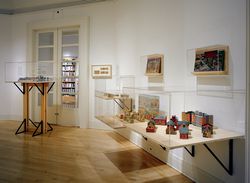
Toy Town explores how villages, towns, and cities have been represented in toys from Europe and North America. Drawn from CCA’s collection of architectural toys and games, the twenty-nine toys reflect shifting social values and different approaches to the design, organisation, and planning of communities in the nineteenth and twentieth centuries. Toy Town is the sixth in(...)
Toy Town explores how villages, towns, and cities have been represented in toys from Europe and North America. Drawn from CCA’s collection of architectural toys and games, the twenty-nine toys reflect shifting social values and different approaches to the design, organisation, and planning of communities in the nineteenth and twentieth centuries. Toy Town is the sixth in(...)
Location:
Octagonal gallery
Octagonal gallery
Date:
22 October 1997 to 31 May 1998
22 October 1997 to 31 May 1998
Title:
Toy Town
Actions:
Description:
Toy Town explores how villages, towns, and cities have been represented in toys from Europe and North America. Drawn from CCA’s collection of architectural toys and games, the twenty-nine toys reflect shifting social values and different approaches to the design, organisation, and planning of communities in the nineteenth and twentieth centuries. Toy Town is the sixth in(...)
Toy Town
Actions:
Description:
Toy Town explores how villages, towns, and cities have been represented in toys from Europe and North America. Drawn from CCA’s collection of architectural toys and games, the twenty-nine toys reflect shifting social values and different approaches to the design, organisation, and planning of communities in the nineteenth and twentieth centuries. Toy Town is the sixth in(...)
Form:
exhibitions
exhibitions
Date:
22 October 1997 to
31 May 1998
22 October 1997 to
31 May 1998
Location:
Octagonal gallery
Octagonal gallery
Level of archival description:
Project
Project
Actions:
Reference number:
AP194.S1.1997.PR02
Description:
Project records document the design process for OCEAN North’s competition entry for the Jyväskylä Music and Arts Centre in 1997. The project was titled Terra Cultura by OCEAN North. The competition was to create a multi-usage space that would include a venue for the symphonic orchestra, a music school, exhibition spaces and the possibility to host a variety of small cultural events in the Finnish city of Jyväskylä. The proposed site is in the center of the town, across the street from the Jyväskylä city church and its park, and nearby buildings designed by Alvar Aalto. OCEAN North’s concept presents a topological surface as an extension of the surrounding urban scape with two masses that would host the formal functions of the building (concert hall, music school, exhibition halls). The two volumes, or raised blocks, are divided along a diagonal elevated space, which is the extension of the ground’s topological surface filled and dubbed “Liquid Flow Space” by the design team. In their interview with Greg Lynn, Johan Bettum and Kivi Sotamaa mentioned that the idea for Jyväskylä was that it was a cloud. To reach this goal, the team used CAD software to trace streams of particles as a modelling approach. The masses of linear elements that were generated were further deconstructed and turned into “peels” and rearranged to create the masses of the building. Physical models were also used to test and further what had emerged from the digital design process, with results being fed back into the digital drawings. During the process, Bettum also brought in the idea of the internalisation of the outside, taking inspiration from the Centre Georges Pompidou. Digital records document the creative process with raster and vector images, CAD drawings and models, and few digital textual records describing the project and the program charts. Drawings and models show site and building plans, perspectives and sections; particles streaming and resulting linear masses; peels and sections identified per color; and renderings of aerials, perspectives and elevation views. OCEAN North seems to have mostly used Microstation for modelling, although there are a few files created with form*Z and 3D Studio. Some of the raster images might have been created with these software as well, showing a given stage of the design process and including renderings. There are also screen captures showing the top, front, left and perspective views of 3D models. Adobe Photoshop and Illustrator were also used to create and modify drawings and diagrams. Program charts were created in Microsoft Excel. Sources: Softspace: from a representation of form to a simulation of space, Edited by Sean Lally and Jessica Young. London, New York: Routledge, 2007. Greg Lynn, ed. Archaeology of the Digital 17: OCEAN North, Jyväskylä Music and Arts Centre, Montréal: Canadian Centre for Architecture, 2017. ePub.
AP194.S1.1997.PR02
Description:
Project records document the design process for OCEAN North’s competition entry for the Jyväskylä Music and Arts Centre in 1997. The project was titled Terra Cultura by OCEAN North. The competition was to create a multi-usage space that would include a venue for the symphonic orchestra, a music school, exhibition spaces and the possibility to host a variety of small cultural events in the Finnish city of Jyväskylä. The proposed site is in the center of the town, across the street from the Jyväskylä city church and its park, and nearby buildings designed by Alvar Aalto. OCEAN North’s concept presents a topological surface as an extension of the surrounding urban scape with two masses that would host the formal functions of the building (concert hall, music school, exhibition halls). The two volumes, or raised blocks, are divided along a diagonal elevated space, which is the extension of the ground’s topological surface filled and dubbed “Liquid Flow Space” by the design team. In their interview with Greg Lynn, Johan Bettum and Kivi Sotamaa mentioned that the idea for Jyväskylä was that it was a cloud. To reach this goal, the team used CAD software to trace streams of particles as a modelling approach. The masses of linear elements that were generated were further deconstructed and turned into “peels” and rearranged to create the masses of the building. Physical models were also used to test and further what had emerged from the digital design process, with results being fed back into the digital drawings. During the process, Bettum also brought in the idea of the internalisation of the outside, taking inspiration from the Centre Georges Pompidou. Digital records document the creative process with raster and vector images, CAD drawings and models, and few digital textual records describing the project and the program charts. Drawings and models show site and building plans, perspectives and sections; particles streaming and resulting linear masses; peels and sections identified per color; and renderings of aerials, perspectives and elevation views. OCEAN North seems to have mostly used Microstation for modelling, although there are a few files created with form*Z and 3D Studio. Some of the raster images might have been created with these software as well, showing a given stage of the design process and including renderings. There are also screen captures showing the top, front, left and perspective views of 3D models. Adobe Photoshop and Illustrator were also used to create and modify drawings and diagrams. Program charts were created in Microsoft Excel. Sources: Softspace: from a representation of form to a simulation of space, Edited by Sean Lally and Jessica Young. London, New York: Routledge, 2007. Greg Lynn, ed. Archaeology of the Digital 17: OCEAN North, Jyväskylä Music and Arts Centre, Montréal: Canadian Centre for Architecture, 2017. ePub.
People:
Date:
1997-1998
1997-1998
Title:
Terra Cultura – Jyväskylä Music and Arts Centre, international competition entry, Jyväskylä, Finland (1997)
Actions:
AP194.S1.1997.PR02
Description:
Project records document the design process for OCEAN North’s competition entry for the Jyväskylä Music and Arts Centre in 1997. The project was titled Terra Cultura by OCEAN North. The competition was to create a multi-usage space that would include a venue for the symphonic orchestra, a music school, exhibition spaces and the possibility to host a variety of small cultural events in the Finnish city of Jyväskylä. The proposed site is in the center of the town, across the street from the Jyväskylä city church and its park, and nearby buildings designed by Alvar Aalto. OCEAN North’s concept presents a topological surface as an extension of the surrounding urban scape with two masses that would host the formal functions of the building (concert hall, music school, exhibition halls). The two volumes, or raised blocks, are divided along a diagonal elevated space, which is the extension of the ground’s topological surface filled and dubbed “Liquid Flow Space” by the design team. In their interview with Greg Lynn, Johan Bettum and Kivi Sotamaa mentioned that the idea for Jyväskylä was that it was a cloud. To reach this goal, the team used CAD software to trace streams of particles as a modelling approach. The masses of linear elements that were generated were further deconstructed and turned into “peels” and rearranged to create the masses of the building. Physical models were also used to test and further what had emerged from the digital design process, with results being fed back into the digital drawings. During the process, Bettum also brought in the idea of the internalisation of the outside, taking inspiration from the Centre Georges Pompidou. Digital records document the creative process with raster and vector images, CAD drawings and models, and few digital textual records describing the project and the program charts. Drawings and models show site and building plans, perspectives and sections; particles streaming and resulting linear masses; peels and sections identified per color; and renderings of aerials, perspectives and elevation views. OCEAN North seems to have mostly used Microstation for modelling, although there are a few files created with form*Z and 3D Studio. Some of the raster images might have been created with these software as well, showing a given stage of the design process and including renderings. There are also screen captures showing the top, front, left and perspective views of 3D models. Adobe Photoshop and Illustrator were also used to create and modify drawings and diagrams. Program charts were created in Microsoft Excel. Sources: Softspace: from a representation of form to a simulation of space, Edited by Sean Lally and Jessica Young. London, New York: Routledge, 2007. Greg Lynn, ed. Archaeology of the Digital 17: OCEAN North, Jyväskylä Music and Arts Centre, Montréal: Canadian Centre for Architecture, 2017. ePub.
Terra Cultura – Jyväskylä Music and Arts Centre, international competition entry, Jyväskylä, Finland (1997)
Actions:
AP194.S1.1997.PR02
Description:
Project records document the design process for OCEAN North’s competition entry for the Jyväskylä Music and Arts Centre in 1997. The project was titled Terra Cultura by OCEAN North. The competition was to create a multi-usage space that would include a venue for the symphonic orchestra, a music school, exhibition spaces and the possibility to host a variety of small cultural events in the Finnish city of Jyväskylä. The proposed site is in the center of the town, across the street from the Jyväskylä city church and its park, and nearby buildings designed by Alvar Aalto. OCEAN North’s concept presents a topological surface as an extension of the surrounding urban scape with two masses that would host the formal functions of the building (concert hall, music school, exhibition halls). The two volumes, or raised blocks, are divided along a diagonal elevated space, which is the extension of the ground’s topological surface filled and dubbed “Liquid Flow Space” by the design team. In their interview with Greg Lynn, Johan Bettum and Kivi Sotamaa mentioned that the idea for Jyväskylä was that it was a cloud. To reach this goal, the team used CAD software to trace streams of particles as a modelling approach. The masses of linear elements that were generated were further deconstructed and turned into “peels” and rearranged to create the masses of the building. Physical models were also used to test and further what had emerged from the digital design process, with results being fed back into the digital drawings. During the process, Bettum also brought in the idea of the internalisation of the outside, taking inspiration from the Centre Georges Pompidou. Digital records document the creative process with raster and vector images, CAD drawings and models, and few digital textual records describing the project and the program charts. Drawings and models show site and building plans, perspectives and sections; particles streaming and resulting linear masses; peels and sections identified per color; and renderings of aerials, perspectives and elevation views. OCEAN North seems to have mostly used Microstation for modelling, although there are a few files created with form*Z and 3D Studio. Some of the raster images might have been created with these software as well, showing a given stage of the design process and including renderings. There are also screen captures showing the top, front, left and perspective views of 3D models. Adobe Photoshop and Illustrator were also used to create and modify drawings and diagrams. Program charts were created in Microsoft Excel. Sources: Softspace: from a representation of form to a simulation of space, Edited by Sean Lally and Jessica Young. London, New York: Routledge, 2007. Greg Lynn, ed. Archaeology of the Digital 17: OCEAN North, Jyväskylä Music and Arts Centre, Montréal: Canadian Centre for Architecture, 2017. ePub.
Level of archival description:
Project
Project
Date:
1997-1998
1997-1998
People:
Form:
textual records
textual records
Actions:
Reference number:
ARCH255585
Description:
22 publicity files - correspondence from journals: Concrete Quarterly, The Architect's Journal, Prague Quadrennial, Architectural Record, Town and Country; U.S.A. and Europe promotion requests for information; Roy Thompson Hall press kits and publication; Canadian Embassy press conference and press clippings; Teck Mining offices publication; Napp Laboratories publication; press clippings about Erickson; possible exhibition in Cambridge; architectural archives (Alberta, AGO, CCA); inter-office promotion correspondence; Erickson book; interview with Pierluigi Bonvicini.
ARCH255585
Description:
22 publicity files - correspondence from journals: Concrete Quarterly, The Architect's Journal, Prague Quadrennial, Architectural Record, Town and Country; U.S.A. and Europe promotion requests for information; Roy Thompson Hall press kits and publication; Canadian Embassy press conference and press clippings; Teck Mining offices publication; Napp Laboratories publication; press clippings about Erickson; possible exhibition in Cambridge; architectural archives (Alberta, AGO, CCA); inter-office promotion correspondence; Erickson book; interview with Pierluigi Bonvicini.
People:
Date:
1983-1985
1983-1985
Title:
Correspondence received from various from newspapers and periodicals
Actions:
ARCH255585
Description:
22 publicity files - correspondence from journals: Concrete Quarterly, The Architect's Journal, Prague Quadrennial, Architectural Record, Town and Country; U.S.A. and Europe promotion requests for information; Roy Thompson Hall press kits and publication; Canadian Embassy press conference and press clippings; Teck Mining offices publication; Napp Laboratories publication; press clippings about Erickson; possible exhibition in Cambridge; architectural archives (Alberta, AGO, CCA); inter-office promotion correspondence; Erickson book; interview with Pierluigi Bonvicini.
Correspondence received from various from newspapers and periodicals
Actions:
ARCH255585
Description:
22 publicity files - correspondence from journals: Concrete Quarterly, The Architect's Journal, Prague Quadrennial, Architectural Record, Town and Country; U.S.A. and Europe promotion requests for information; Roy Thompson Hall press kits and publication; Canadian Embassy press conference and press clippings; Teck Mining offices publication; Napp Laboratories publication; press clippings about Erickson; possible exhibition in Cambridge; architectural archives (Alberta, AGO, CCA); inter-office promotion correspondence; Erickson book; interview with Pierluigi Bonvicini.
Form:
textual records
textual records
Date:
1983-1985
1983-1985
People:


