


9835 Results
Level of archival description:
Sub-series
Sub-series
Actions:
Reference number:
AP151.S1.D10
Description:
The project files documenting the construction of the Wayfarers' Chapel and site are extensive and quite complete. The documentation is more complete for the first two units of construction than for the latter units. Thus, the internal coherence of the papers is more apparent for the earlier development of the project. The most comprehensive record of the development of the Wayfarers' Chapel is contained in the "Supervision Journal" which covers the period from 1947-1971 (files 97a/97b of the "General Files"). It should be noted particularly by researchers using these papers. The research value of the "Supervision Journal" is complemented by a substantial body of general correspondence which documents Lloyd Wright's interaction with the client and with other parties involved with the design or construction of the Chapel (the Palos Verdes Corporation, the Wayfarers Chapel Building and Properties Committee, and Reverends of the Chapel between 1947 and 1960). Further correspondence relates to the publicity for the Chapel between 1951 and 1965. The textual documents are augmented by an extensive array of visual materials, such as drawings, photographs, postcards, newspaper articles and trade catalogues, which are valuable for providing a pictorial record of the Chapel and site from its earliest through to its later development. The "Trade Catalogues and Supplier Ephemera" file (file 98 of the "General Files") contains a record of the products and supplies Lloyd Wright considered or used in the construction of the Wayfarers' Chapel.
AP151.S1.D10
Description:
The project files documenting the construction of the Wayfarers' Chapel and site are extensive and quite complete. The documentation is more complete for the first two units of construction than for the latter units. Thus, the internal coherence of the papers is more apparent for the earlier development of the project. The most comprehensive record of the development of the Wayfarers' Chapel is contained in the "Supervision Journal" which covers the period from 1947-1971 (files 97a/97b of the "General Files"). It should be noted particularly by researchers using these papers. The research value of the "Supervision Journal" is complemented by a substantial body of general correspondence which documents Lloyd Wright's interaction with the client and with other parties involved with the design or construction of the Chapel (the Palos Verdes Corporation, the Wayfarers Chapel Building and Properties Committee, and Reverends of the Chapel between 1947 and 1960). Further correspondence relates to the publicity for the Chapel between 1951 and 1965. The textual documents are augmented by an extensive array of visual materials, such as drawings, photographs, postcards, newspaper articles and trade catalogues, which are valuable for providing a pictorial record of the Chapel and site from its earliest through to its later development. The "Trade Catalogues and Supplier Ephemera" file (file 98 of the "General Files") contains a record of the products and supplies Lloyd Wright considered or used in the construction of the Wayfarers' Chapel.
People:
Date:
1946-1977
1946-1977
Title:
Wayfarers' Chapel Architect's Project Files
Actions:
AP151.S1.D10
Description:
The project files documenting the construction of the Wayfarers' Chapel and site are extensive and quite complete. The documentation is more complete for the first two units of construction than for the latter units. Thus, the internal coherence of the papers is more apparent for the earlier development of the project. The most comprehensive record of the development of the Wayfarers' Chapel is contained in the "Supervision Journal" which covers the period from 1947-1971 (files 97a/97b of the "General Files"). It should be noted particularly by researchers using these papers. The research value of the "Supervision Journal" is complemented by a substantial body of general correspondence which documents Lloyd Wright's interaction with the client and with other parties involved with the design or construction of the Chapel (the Palos Verdes Corporation, the Wayfarers Chapel Building and Properties Committee, and Reverends of the Chapel between 1947 and 1960). Further correspondence relates to the publicity for the Chapel between 1951 and 1965. The textual documents are augmented by an extensive array of visual materials, such as drawings, photographs, postcards, newspaper articles and trade catalogues, which are valuable for providing a pictorial record of the Chapel and site from its earliest through to its later development. The "Trade Catalogues and Supplier Ephemera" file (file 98 of the "General Files") contains a record of the products and supplies Lloyd Wright considered or used in the construction of the Wayfarers' Chapel.
Wayfarers' Chapel Architect's Project Files
Actions:
AP151.S1.D10
Description:
The project files documenting the construction of the Wayfarers' Chapel and site are extensive and quite complete. The documentation is more complete for the first two units of construction than for the latter units. Thus, the internal coherence of the papers is more apparent for the earlier development of the project. The most comprehensive record of the development of the Wayfarers' Chapel is contained in the "Supervision Journal" which covers the period from 1947-1971 (files 97a/97b of the "General Files"). It should be noted particularly by researchers using these papers. The research value of the "Supervision Journal" is complemented by a substantial body of general correspondence which documents Lloyd Wright's interaction with the client and with other parties involved with the design or construction of the Chapel (the Palos Verdes Corporation, the Wayfarers Chapel Building and Properties Committee, and Reverends of the Chapel between 1947 and 1960). Further correspondence relates to the publicity for the Chapel between 1951 and 1965. The textual documents are augmented by an extensive array of visual materials, such as drawings, photographs, postcards, newspaper articles and trade catalogues, which are valuable for providing a pictorial record of the Chapel and site from its earliest through to its later development. The "Trade Catalogues and Supplier Ephemera" file (file 98 of the "General Files") contains a record of the products and supplies Lloyd Wright considered or used in the construction of the Wayfarers' Chapel.
Level of archival description:
Subseries
Subseries
Date:
1946-1977
1946-1977
People:
Level of archival description:
Project
Project
Title:
Cottage High Legh
Cottage High Legh
Reference number:
AP144.S2.D29
Description:
File documents an executed project for a gamekeeper's cottage next to a pheasantry in High Legh, Cheshire, England, to replace an existing dilapidated lodge. An early alternative proposal shows a scheme for renovating the existing building. Inexpensive materials and simple construction methods were specified in order to cut costs; local builders could be engaged to construct the cottage ('Architectural Design', January 1971, p. 35). Price also designed an addition for Cottage, High Legh (1977) which was not constructed (AP144.S2.D104). Preliminary plans and sketches include details for windows, a custom built-in cabinet, wall sections, and perspectives. Design development drawings include developed details including ones for a custom-designed fireplace, site axonometric, axonometric of cottage exterior, interior perspective of dining room, and exterior perspective showing front entrance. Working drawings are almost complete, and include survey notes and drawings of the existing lodge; site and floor plans, sections, and elevations; details for a fireplace, cloakroom and metalwork; a schedule for windows, doors, and the interior finishes; an axonometric for the roof; and a landscaping plan. The project was published in "Cedric Price Supplement No. 2", 'Architectural Design', vol. 41, (January 1971), 35, and in Price, Cedric. 'Cedric Price-Works II' (London: Architectural Press, 1984), 36, 51, 113. Material in this file was produced between 1961 - 1983, and predominantly between 1961 - 1965. File contains, design development drawings, working drawings, photographic material, and textual records.
AP144.S2.D29
Description:
File documents an executed project for a gamekeeper's cottage next to a pheasantry in High Legh, Cheshire, England, to replace an existing dilapidated lodge. An early alternative proposal shows a scheme for renovating the existing building. Inexpensive materials and simple construction methods were specified in order to cut costs; local builders could be engaged to construct the cottage ('Architectural Design', January 1971, p. 35). Price also designed an addition for Cottage, High Legh (1977) which was not constructed (AP144.S2.D104). Preliminary plans and sketches include details for windows, a custom built-in cabinet, wall sections, and perspectives. Design development drawings include developed details including ones for a custom-designed fireplace, site axonometric, axonometric of cottage exterior, interior perspective of dining room, and exterior perspective showing front entrance. Working drawings are almost complete, and include survey notes and drawings of the existing lodge; site and floor plans, sections, and elevations; details for a fireplace, cloakroom and metalwork; a schedule for windows, doors, and the interior finishes; an axonometric for the roof; and a landscaping plan. The project was published in "Cedric Price Supplement No. 2", 'Architectural Design', vol. 41, (January 1971), 35, and in Price, Cedric. 'Cedric Price-Works II' (London: Architectural Press, 1984), 36, 51, 113. Material in this file was produced between 1961 - 1983, and predominantly between 1961 - 1965. File contains, design development drawings, working drawings, photographic material, and textual records.
People:
Date:
1961-1983, predominant 1961-1965
1961-1983, predominant 1961-1965
Title:
Cottage High Legh
Actions:
AP144.S2.D29
Description:
File documents an executed project for a gamekeeper's cottage next to a pheasantry in High Legh, Cheshire, England, to replace an existing dilapidated lodge. An early alternative proposal shows a scheme for renovating the existing building. Inexpensive materials and simple construction methods were specified in order to cut costs; local builders could be engaged to construct the cottage ('Architectural Design', January 1971, p. 35). Price also designed an addition for Cottage, High Legh (1977) which was not constructed (AP144.S2.D104). Preliminary plans and sketches include details for windows, a custom built-in cabinet, wall sections, and perspectives. Design development drawings include developed details including ones for a custom-designed fireplace, site axonometric, axonometric of cottage exterior, interior perspective of dining room, and exterior perspective showing front entrance. Working drawings are almost complete, and include survey notes and drawings of the existing lodge; site and floor plans, sections, and elevations; details for a fireplace, cloakroom and metalwork; a schedule for windows, doors, and the interior finishes; an axonometric for the roof; and a landscaping plan. The project was published in "Cedric Price Supplement No. 2", 'Architectural Design', vol. 41, (January 1971), 35, and in Price, Cedric. 'Cedric Price-Works II' (London: Architectural Press, 1984), 36, 51, 113. Material in this file was produced between 1961 - 1983, and predominantly between 1961 - 1965. File contains, design development drawings, working drawings, photographic material, and textual records.
Cottage High Legh
Actions:
AP144.S2.D29
Description:
File documents an executed project for a gamekeeper's cottage next to a pheasantry in High Legh, Cheshire, England, to replace an existing dilapidated lodge. An early alternative proposal shows a scheme for renovating the existing building. Inexpensive materials and simple construction methods were specified in order to cut costs; local builders could be engaged to construct the cottage ('Architectural Design', January 1971, p. 35). Price also designed an addition for Cottage, High Legh (1977) which was not constructed (AP144.S2.D104). Preliminary plans and sketches include details for windows, a custom built-in cabinet, wall sections, and perspectives. Design development drawings include developed details including ones for a custom-designed fireplace, site axonometric, axonometric of cottage exterior, interior perspective of dining room, and exterior perspective showing front entrance. Working drawings are almost complete, and include survey notes and drawings of the existing lodge; site and floor plans, sections, and elevations; details for a fireplace, cloakroom and metalwork; a schedule for windows, doors, and the interior finishes; an axonometric for the roof; and a landscaping plan. The project was published in "Cedric Price Supplement No. 2", 'Architectural Design', vol. 41, (January 1971), 35, and in Price, Cedric. 'Cedric Price-Works II' (London: Architectural Press, 1984), 36, 51, 113. Material in this file was produced between 1961 - 1983, and predominantly between 1961 - 1965. File contains, design development drawings, working drawings, photographic material, and textual records.
Level of archival description:
File 29
File 29
Date:
1961-1983, predominant 1961-1965
1961-1983, predominant 1961-1965
People:
Level of archival description:
Project
Project
Reference number:
AP178.S1.1980.PR03
Description:
The project series documents the 1980 design entry for Block 11-12 (Kottbusser Damm). While the records were held in the office’s archives this project was assigned the number 3/80. The office assigned the date 1980 for this project. This project was submitted to the International Architectural Exhibition Berlin competition (International Bauaustellung, IBA, circa 1979-1987), an urban renewal strategy for West Berlin, Germany. Siza had previously submitted three other projects to this competition: the Görtlitzer Bad swimming pool, Block 70 and 89 (Fränkelufer residential complex), and Block 121 (Bonjour Tristesse), which was his first built international project. He would later submit design proposals for two other projects: Monument to Gestapo victims Prinz-Albrecht-Palais and the Kulturforum. The design proposal for Block 11-12 was for a residential building on Kottbusserstrasse in Kreuzberg. Documenting the design proposal are drawings, photographs, negatives, slides, and textual documentation. Among the drawings are sketches, studies, elevations, floor plans, and site plans. Photographs and negatives depict the project site and surrounding area; additionally there are slides of drawings and the model. Also included is a work contract from the IBA signed by Siza and IBA official Hardt-Waltherr Hämer, as well as several notes and calculations. Note that textual documentation in this project series includes materials on Block 70 and 89, see AP178.S1.1980.PR03.008. Sketches in this project series may also include sketches related to other Berlin projects, such as Block 70 and 89.
AP178.S1.1980.PR03
Description:
The project series documents the 1980 design entry for Block 11-12 (Kottbusser Damm). While the records were held in the office’s archives this project was assigned the number 3/80. The office assigned the date 1980 for this project. This project was submitted to the International Architectural Exhibition Berlin competition (International Bauaustellung, IBA, circa 1979-1987), an urban renewal strategy for West Berlin, Germany. Siza had previously submitted three other projects to this competition: the Görtlitzer Bad swimming pool, Block 70 and 89 (Fränkelufer residential complex), and Block 121 (Bonjour Tristesse), which was his first built international project. He would later submit design proposals for two other projects: Monument to Gestapo victims Prinz-Albrecht-Palais and the Kulturforum. The design proposal for Block 11-12 was for a residential building on Kottbusserstrasse in Kreuzberg. Documenting the design proposal are drawings, photographs, negatives, slides, and textual documentation. Among the drawings are sketches, studies, elevations, floor plans, and site plans. Photographs and negatives depict the project site and surrounding area; additionally there are slides of drawings and the model. Also included is a work contract from the IBA signed by Siza and IBA official Hardt-Waltherr Hämer, as well as several notes and calculations. Note that textual documentation in this project series includes materials on Block 70 and 89, see AP178.S1.1980.PR03.008. Sketches in this project series may also include sketches related to other Berlin projects, such as Block 70 and 89.
People:
Date:
circa 1979-1981
circa 1979-1981
Title:
Block 11 e 12, Kottbusser Damm [11-12 Kottbusser Damm], Berlin, Germany (1979-1981)
Actions:
AP178.S1.1980.PR03
Description:
The project series documents the 1980 design entry for Block 11-12 (Kottbusser Damm). While the records were held in the office’s archives this project was assigned the number 3/80. The office assigned the date 1980 for this project. This project was submitted to the International Architectural Exhibition Berlin competition (International Bauaustellung, IBA, circa 1979-1987), an urban renewal strategy for West Berlin, Germany. Siza had previously submitted three other projects to this competition: the Görtlitzer Bad swimming pool, Block 70 and 89 (Fränkelufer residential complex), and Block 121 (Bonjour Tristesse), which was his first built international project. He would later submit design proposals for two other projects: Monument to Gestapo victims Prinz-Albrecht-Palais and the Kulturforum. The design proposal for Block 11-12 was for a residential building on Kottbusserstrasse in Kreuzberg. Documenting the design proposal are drawings, photographs, negatives, slides, and textual documentation. Among the drawings are sketches, studies, elevations, floor plans, and site plans. Photographs and negatives depict the project site and surrounding area; additionally there are slides of drawings and the model. Also included is a work contract from the IBA signed by Siza and IBA official Hardt-Waltherr Hämer, as well as several notes and calculations. Note that textual documentation in this project series includes materials on Block 70 and 89, see AP178.S1.1980.PR03.008. Sketches in this project series may also include sketches related to other Berlin projects, such as Block 70 and 89.
Block 11 e 12, Kottbusser Damm [11-12 Kottbusser Damm], Berlin, Germany (1979-1981)
Actions:
AP178.S1.1980.PR03
Description:
The project series documents the 1980 design entry for Block 11-12 (Kottbusser Damm). While the records were held in the office’s archives this project was assigned the number 3/80. The office assigned the date 1980 for this project. This project was submitted to the International Architectural Exhibition Berlin competition (International Bauaustellung, IBA, circa 1979-1987), an urban renewal strategy for West Berlin, Germany. Siza had previously submitted three other projects to this competition: the Görtlitzer Bad swimming pool, Block 70 and 89 (Fränkelufer residential complex), and Block 121 (Bonjour Tristesse), which was his first built international project. He would later submit design proposals for two other projects: Monument to Gestapo victims Prinz-Albrecht-Palais and the Kulturforum. The design proposal for Block 11-12 was for a residential building on Kottbusserstrasse in Kreuzberg. Documenting the design proposal are drawings, photographs, negatives, slides, and textual documentation. Among the drawings are sketches, studies, elevations, floor plans, and site plans. Photographs and negatives depict the project site and surrounding area; additionally there are slides of drawings and the model. Also included is a work contract from the IBA signed by Siza and IBA official Hardt-Waltherr Hämer, as well as several notes and calculations. Note that textual documentation in this project series includes materials on Block 70 and 89, see AP178.S1.1980.PR03.008. Sketches in this project series may also include sketches related to other Berlin projects, such as Block 70 and 89.
Level of archival description:
Project
Project
Date:
circa 1979-1981
circa 1979-1981
People:
Level of archival description:
Project
Project
Reference number:
AP178.S1.1983.PR02
Description:
The project series documents the 1983 design entry for the competition of the Prinz-Albrecht-Palais Monument to Gestapo victims. While the records were held in the office’s archives this project was assigned the number 18/80. The office assigned the date 1983 for this project. This project was submitted to the International Architectural Exhibition Berlin competition (International Bauaustellung, IBA, circa 1979-1987), an urban renewal strategy for West Berlin, Germany. Siza had previously submitted four other projects to this competition: the Görtlitzer Bad swimming pool, Block 70 and 89 (Fränkelufer residential complex), Bonjour Tristesse (Block 121), and Block 11-12. He would also submit a design proposal to the IBA competition for the Kulturforum. According to the documentation from the IBA competition, entries for the memorial were to include a pedestrian walkway that cut through the memorial parallel to Schöneberger strasse leading to Kochstrasse. Entries were also to include a playground and along Stresemann strasse there was to be the addition of a two storey building and a corner building. Other requested components included a parking lot and a partial reconstruction of the Fine Arts School. Documenting the design proposal are conceptual and design development drawings, including studies, a site axonometric drawing, ground plan, site plan and north, south, and east elevations. Also included is textual documentation on the competition as well as correspondence from IBA officials such as Marion Wilbert. Photographic materials consist of slides of plans, sections and elevations.
AP178.S1.1983.PR02
Description:
The project series documents the 1983 design entry for the competition of the Prinz-Albrecht-Palais Monument to Gestapo victims. While the records were held in the office’s archives this project was assigned the number 18/80. The office assigned the date 1983 for this project. This project was submitted to the International Architectural Exhibition Berlin competition (International Bauaustellung, IBA, circa 1979-1987), an urban renewal strategy for West Berlin, Germany. Siza had previously submitted four other projects to this competition: the Görtlitzer Bad swimming pool, Block 70 and 89 (Fränkelufer residential complex), Bonjour Tristesse (Block 121), and Block 11-12. He would also submit a design proposal to the IBA competition for the Kulturforum. According to the documentation from the IBA competition, entries for the memorial were to include a pedestrian walkway that cut through the memorial parallel to Schöneberger strasse leading to Kochstrasse. Entries were also to include a playground and along Stresemann strasse there was to be the addition of a two storey building and a corner building. Other requested components included a parking lot and a partial reconstruction of the Fine Arts School. Documenting the design proposal are conceptual and design development drawings, including studies, a site axonometric drawing, ground plan, site plan and north, south, and east elevations. Also included is textual documentation on the competition as well as correspondence from IBA officials such as Marion Wilbert. Photographic materials consist of slides of plans, sections and elevations.
People:
Date:
1983-1984
1983-1984
Title:
Monumento às vítimas da Gestapo [Monument to Gestapo victims], Prinz-Albrecht-Palais, Berlin, Germany (1983)
Actions:
AP178.S1.1983.PR02
Description:
The project series documents the 1983 design entry for the competition of the Prinz-Albrecht-Palais Monument to Gestapo victims. While the records were held in the office’s archives this project was assigned the number 18/80. The office assigned the date 1983 for this project. This project was submitted to the International Architectural Exhibition Berlin competition (International Bauaustellung, IBA, circa 1979-1987), an urban renewal strategy for West Berlin, Germany. Siza had previously submitted four other projects to this competition: the Görtlitzer Bad swimming pool, Block 70 and 89 (Fränkelufer residential complex), Bonjour Tristesse (Block 121), and Block 11-12. He would also submit a design proposal to the IBA competition for the Kulturforum. According to the documentation from the IBA competition, entries for the memorial were to include a pedestrian walkway that cut through the memorial parallel to Schöneberger strasse leading to Kochstrasse. Entries were also to include a playground and along Stresemann strasse there was to be the addition of a two storey building and a corner building. Other requested components included a parking lot and a partial reconstruction of the Fine Arts School. Documenting the design proposal are conceptual and design development drawings, including studies, a site axonometric drawing, ground plan, site plan and north, south, and east elevations. Also included is textual documentation on the competition as well as correspondence from IBA officials such as Marion Wilbert. Photographic materials consist of slides of plans, sections and elevations.
Monumento às vítimas da Gestapo [Monument to Gestapo victims], Prinz-Albrecht-Palais, Berlin, Germany (1983)
Actions:
AP178.S1.1983.PR02
Description:
The project series documents the 1983 design entry for the competition of the Prinz-Albrecht-Palais Monument to Gestapo victims. While the records were held in the office’s archives this project was assigned the number 18/80. The office assigned the date 1983 for this project. This project was submitted to the International Architectural Exhibition Berlin competition (International Bauaustellung, IBA, circa 1979-1987), an urban renewal strategy for West Berlin, Germany. Siza had previously submitted four other projects to this competition: the Görtlitzer Bad swimming pool, Block 70 and 89 (Fränkelufer residential complex), Bonjour Tristesse (Block 121), and Block 11-12. He would also submit a design proposal to the IBA competition for the Kulturforum. According to the documentation from the IBA competition, entries for the memorial were to include a pedestrian walkway that cut through the memorial parallel to Schöneberger strasse leading to Kochstrasse. Entries were also to include a playground and along Stresemann strasse there was to be the addition of a two storey building and a corner building. Other requested components included a parking lot and a partial reconstruction of the Fine Arts School. Documenting the design proposal are conceptual and design development drawings, including studies, a site axonometric drawing, ground plan, site plan and north, south, and east elevations. Also included is textual documentation on the competition as well as correspondence from IBA officials such as Marion Wilbert. Photographic materials consist of slides of plans, sections and elevations.
Level of archival description:
Project
Project
Date:
1983-1984
1983-1984
People:
Level of archival description:
Project
Project
Reference number:
AP075.S1.2004.PR02
Description:
Project series documents Cornelia Hahn Oberlander's work for the renewal of the Museum of Anthropology, at the University of British Columbia, Vancouver. This project series concerns work on the Museum grounds starting from 2005 to the early 2010s. It includes restorations work and consultations for maintenance of the grounds, various additions, including the addition of a plaza and a turnaround (also identified as a bus loop in the fonds documents) or modifications for events held on site. It also includes the installation of the Yosef Wosk Reflecting Pool, a permanent reflecting pond in 2009-2010. The pond was initially included in Oberlander original landscape design of 1975. It has since been temporarly filled in three occasions. The permanent pond was officially opened in 2010. The project series contains predominantly working drawings, such as site plans, landscape plans, planting plans, irrigation plans, and grading plans, and a few design development drawings, such as sketches, studies and details, including for the bus loop and the new plaza. The drawings for this project aslo includes sets of plans of the building used as reference. The project is also documented through textual records, including correspondence with clients, consultants and contractors, meetings notes and minutes, specifications, schematic design report and documentation. The project series also contains photographs, including digital photographs of the interior and exterior of the Museum and of the lanscaping. Source: Herrington, Susan. Cornelia Hahn Oberlander: Making the Modern Landscape, University of Virginia Press, 2014, 304 pages.
AP075.S1.2004.PR02
Description:
Project series documents Cornelia Hahn Oberlander's work for the renewal of the Museum of Anthropology, at the University of British Columbia, Vancouver. This project series concerns work on the Museum grounds starting from 2005 to the early 2010s. It includes restorations work and consultations for maintenance of the grounds, various additions, including the addition of a plaza and a turnaround (also identified as a bus loop in the fonds documents) or modifications for events held on site. It also includes the installation of the Yosef Wosk Reflecting Pool, a permanent reflecting pond in 2009-2010. The pond was initially included in Oberlander original landscape design of 1975. It has since been temporarly filled in three occasions. The permanent pond was officially opened in 2010. The project series contains predominantly working drawings, such as site plans, landscape plans, planting plans, irrigation plans, and grading plans, and a few design development drawings, such as sketches, studies and details, including for the bus loop and the new plaza. The drawings for this project aslo includes sets of plans of the building used as reference. The project is also documented through textual records, including correspondence with clients, consultants and contractors, meetings notes and minutes, specifications, schematic design report and documentation. The project series also contains photographs, including digital photographs of the interior and exterior of the Museum and of the lanscaping. Source: Herrington, Susan. Cornelia Hahn Oberlander: Making the Modern Landscape, University of Virginia Press, 2014, 304 pages.
People:
Date:
2003-2011
2003-2011
Title:
Museum of Anthropology Renewal, University of British Columbia, Vancouver, British Columbia (2004-2007)
Actions:
AP075.S1.2004.PR02
Description:
Project series documents Cornelia Hahn Oberlander's work for the renewal of the Museum of Anthropology, at the University of British Columbia, Vancouver. This project series concerns work on the Museum grounds starting from 2005 to the early 2010s. It includes restorations work and consultations for maintenance of the grounds, various additions, including the addition of a plaza and a turnaround (also identified as a bus loop in the fonds documents) or modifications for events held on site. It also includes the installation of the Yosef Wosk Reflecting Pool, a permanent reflecting pond in 2009-2010. The pond was initially included in Oberlander original landscape design of 1975. It has since been temporarly filled in three occasions. The permanent pond was officially opened in 2010. The project series contains predominantly working drawings, such as site plans, landscape plans, planting plans, irrigation plans, and grading plans, and a few design development drawings, such as sketches, studies and details, including for the bus loop and the new plaza. The drawings for this project aslo includes sets of plans of the building used as reference. The project is also documented through textual records, including correspondence with clients, consultants and contractors, meetings notes and minutes, specifications, schematic design report and documentation. The project series also contains photographs, including digital photographs of the interior and exterior of the Museum and of the lanscaping. Source: Herrington, Susan. Cornelia Hahn Oberlander: Making the Modern Landscape, University of Virginia Press, 2014, 304 pages.
Museum of Anthropology Renewal, University of British Columbia, Vancouver, British Columbia (2004-2007)
Actions:
AP075.S1.2004.PR02
Description:
Project series documents Cornelia Hahn Oberlander's work for the renewal of the Museum of Anthropology, at the University of British Columbia, Vancouver. This project series concerns work on the Museum grounds starting from 2005 to the early 2010s. It includes restorations work and consultations for maintenance of the grounds, various additions, including the addition of a plaza and a turnaround (also identified as a bus loop in the fonds documents) or modifications for events held on site. It also includes the installation of the Yosef Wosk Reflecting Pool, a permanent reflecting pond in 2009-2010. The pond was initially included in Oberlander original landscape design of 1975. It has since been temporarly filled in three occasions. The permanent pond was officially opened in 2010. The project series contains predominantly working drawings, such as site plans, landscape plans, planting plans, irrigation plans, and grading plans, and a few design development drawings, such as sketches, studies and details, including for the bus loop and the new plaza. The drawings for this project aslo includes sets of plans of the building used as reference. The project is also documented through textual records, including correspondence with clients, consultants and contractors, meetings notes and minutes, specifications, schematic design report and documentation. The project series also contains photographs, including digital photographs of the interior and exterior of the Museum and of the lanscaping. Source: Herrington, Susan. Cornelia Hahn Oberlander: Making the Modern Landscape, University of Virginia Press, 2014, 304 pages.
Level of archival description:
Project
Project
Date:
2003-2011
2003-2011
People:
Level of archival description:
Project
Project
Actions:
Reference number:
AP056.S1.1991.PR02
Description:
This project series documents the design of Cité Collégiale in Ottawa, Ontario from in 1991. The project number assigned by the office is unidentifiable. This project consisted of a competition entry for the first French language community college to be built in Ontario. The design proposed focused on the balance between the natural landscape of the site, located on Montreal Road at Aviation Parkway, the rigor of the study program and the relaxation of student life. Large wooded areas surrounding the campus would be preserved and four functional outdoor spaces would be created: La Place des Festivals (an esplanade), the theatre (for outdoor festivities), Le Carrefour des Étudiants (the student square), and le Foyer (next to the cafeteria). The campus also proposed la Grande Galerie, a triple-height space filled with natural light to serve as the main area where students could meet and study. Two types of school buildings were included in the proposal, consisting of a long, rectangular building for classrooms and offices, and the other, a less formal, open space with classrooms, amphitheatres, studios and laboratories. The scheme had two main entrances, with a large central tower that was visible when arriving from either direction. This was not the winning entry for the competition and the campus was eventually built by Brook, Brisbin and Baynon. The project is recorded through drawings, presentation paintings and a model dating from 1991. The drawings include site condition maps, sketches, perspectives, plans, elevations, axonometric drawings and presentation panels.
AP056.S1.1991.PR02
Description:
This project series documents the design of Cité Collégiale in Ottawa, Ontario from in 1991. The project number assigned by the office is unidentifiable. This project consisted of a competition entry for the first French language community college to be built in Ontario. The design proposed focused on the balance between the natural landscape of the site, located on Montreal Road at Aviation Parkway, the rigor of the study program and the relaxation of student life. Large wooded areas surrounding the campus would be preserved and four functional outdoor spaces would be created: La Place des Festivals (an esplanade), the theatre (for outdoor festivities), Le Carrefour des Étudiants (the student square), and le Foyer (next to the cafeteria). The campus also proposed la Grande Galerie, a triple-height space filled with natural light to serve as the main area where students could meet and study. Two types of school buildings were included in the proposal, consisting of a long, rectangular building for classrooms and offices, and the other, a less formal, open space with classrooms, amphitheatres, studios and laboratories. The scheme had two main entrances, with a large central tower that was visible when arriving from either direction. This was not the winning entry for the competition and the campus was eventually built by Brook, Brisbin and Baynon. The project is recorded through drawings, presentation paintings and a model dating from 1991. The drawings include site condition maps, sketches, perspectives, plans, elevations, axonometric drawings and presentation panels.
People:
Date:
1991
1991
Title:
Cité Collégiale Competition, Ottawa, Ontario (1991)
Actions:
AP056.S1.1991.PR02
Description:
This project series documents the design of Cité Collégiale in Ottawa, Ontario from in 1991. The project number assigned by the office is unidentifiable. This project consisted of a competition entry for the first French language community college to be built in Ontario. The design proposed focused on the balance between the natural landscape of the site, located on Montreal Road at Aviation Parkway, the rigor of the study program and the relaxation of student life. Large wooded areas surrounding the campus would be preserved and four functional outdoor spaces would be created: La Place des Festivals (an esplanade), the theatre (for outdoor festivities), Le Carrefour des Étudiants (the student square), and le Foyer (next to the cafeteria). The campus also proposed la Grande Galerie, a triple-height space filled with natural light to serve as the main area where students could meet and study. Two types of school buildings were included in the proposal, consisting of a long, rectangular building for classrooms and offices, and the other, a less formal, open space with classrooms, amphitheatres, studios and laboratories. The scheme had two main entrances, with a large central tower that was visible when arriving from either direction. This was not the winning entry for the competition and the campus was eventually built by Brook, Brisbin and Baynon. The project is recorded through drawings, presentation paintings and a model dating from 1991. The drawings include site condition maps, sketches, perspectives, plans, elevations, axonometric drawings and presentation panels.
Cité Collégiale Competition, Ottawa, Ontario (1991)
Actions:
AP056.S1.1991.PR02
Description:
This project series documents the design of Cité Collégiale in Ottawa, Ontario from in 1991. The project number assigned by the office is unidentifiable. This project consisted of a competition entry for the first French language community college to be built in Ontario. The design proposed focused on the balance between the natural landscape of the site, located on Montreal Road at Aviation Parkway, the rigor of the study program and the relaxation of student life. Large wooded areas surrounding the campus would be preserved and four functional outdoor spaces would be created: La Place des Festivals (an esplanade), the theatre (for outdoor festivities), Le Carrefour des Étudiants (the student square), and le Foyer (next to the cafeteria). The campus also proposed la Grande Galerie, a triple-height space filled with natural light to serve as the main area where students could meet and study. Two types of school buildings were included in the proposal, consisting of a long, rectangular building for classrooms and offices, and the other, a less formal, open space with classrooms, amphitheatres, studios and laboratories. The scheme had two main entrances, with a large central tower that was visible when arriving from either direction. This was not the winning entry for the competition and the campus was eventually built by Brook, Brisbin and Baynon. The project is recorded through drawings, presentation paintings and a model dating from 1991. The drawings include site condition maps, sketches, perspectives, plans, elevations, axonometric drawings and presentation panels.
Level of archival description:
Project
Project
Date:
1991
1991
People:
Level of archival description:
Project
Project
Reference number:
AP075.S1.1992.PR01
Description:
Project series documents Cornelia Hahn Oberlander’s project for the landscape design for Library Square, the new central branch of the Vancouver’s public library on West Georgia Street. Oberlander worked on this project in 1992-1995 with architect Moshe Safdie and architectural firm Downs/Archambault & Patners. Oberlander landscape design included a roof garden, planned to be accessible by the public, and terraces with integral planting of cascading roses of the southeast edge of the building. She was also consulted for the landscape for the street-level spaces: “Along the streets bordering the site, Oberlander selected tulip trees, except on W. Georgia Street where the city required maples.” [1] The project was completed in 1995. The project series contains sketches, design development drawings, including planting plans, landscape plans for the green roof and the plaza, working drawings, such as site plans, planting plans, irrigation plans, landscape sections and elevations, and drawings of the building used as reference. The project is also recorded through textual records, such as concept notes by Oberlander, research material, specifications, including landscape specifications, correspondence, including correspondence with architects, client and contractors, contract, financial documents, documents for plan selection, and press and articles on the project. The project series also includes photographs of the construction and landscaping work, and photographs of the completed project. Source: [1] Herrington, Susan. Cornelia Hahn Oberlander: Making the Modern Landscape, University of Virginia Press, 2014, 304 pages. p. 176.
AP075.S1.1992.PR01
Description:
Project series documents Cornelia Hahn Oberlander’s project for the landscape design for Library Square, the new central branch of the Vancouver’s public library on West Georgia Street. Oberlander worked on this project in 1992-1995 with architect Moshe Safdie and architectural firm Downs/Archambault & Patners. Oberlander landscape design included a roof garden, planned to be accessible by the public, and terraces with integral planting of cascading roses of the southeast edge of the building. She was also consulted for the landscape for the street-level spaces: “Along the streets bordering the site, Oberlander selected tulip trees, except on W. Georgia Street where the city required maples.” [1] The project was completed in 1995. The project series contains sketches, design development drawings, including planting plans, landscape plans for the green roof and the plaza, working drawings, such as site plans, planting plans, irrigation plans, landscape sections and elevations, and drawings of the building used as reference. The project is also recorded through textual records, such as concept notes by Oberlander, research material, specifications, including landscape specifications, correspondence, including correspondence with architects, client and contractors, contract, financial documents, documents for plan selection, and press and articles on the project. The project series also includes photographs of the construction and landscaping work, and photographs of the completed project. Source: [1] Herrington, Susan. Cornelia Hahn Oberlander: Making the Modern Landscape, University of Virginia Press, 2014, 304 pages. p. 176.
People:
Date:
1989-2009
1989-2009
Title:
Library Square, Vancouver, British Columbia (1992-1995)
Actions:
AP075.S1.1992.PR01
Description:
Project series documents Cornelia Hahn Oberlander’s project for the landscape design for Library Square, the new central branch of the Vancouver’s public library on West Georgia Street. Oberlander worked on this project in 1992-1995 with architect Moshe Safdie and architectural firm Downs/Archambault & Patners. Oberlander landscape design included a roof garden, planned to be accessible by the public, and terraces with integral planting of cascading roses of the southeast edge of the building. She was also consulted for the landscape for the street-level spaces: “Along the streets bordering the site, Oberlander selected tulip trees, except on W. Georgia Street where the city required maples.” [1] The project was completed in 1995. The project series contains sketches, design development drawings, including planting plans, landscape plans for the green roof and the plaza, working drawings, such as site plans, planting plans, irrigation plans, landscape sections and elevations, and drawings of the building used as reference. The project is also recorded through textual records, such as concept notes by Oberlander, research material, specifications, including landscape specifications, correspondence, including correspondence with architects, client and contractors, contract, financial documents, documents for plan selection, and press and articles on the project. The project series also includes photographs of the construction and landscaping work, and photographs of the completed project. Source: [1] Herrington, Susan. Cornelia Hahn Oberlander: Making the Modern Landscape, University of Virginia Press, 2014, 304 pages. p. 176.
Library Square, Vancouver, British Columbia (1992-1995)
Actions:
AP075.S1.1992.PR01
Description:
Project series documents Cornelia Hahn Oberlander’s project for the landscape design for Library Square, the new central branch of the Vancouver’s public library on West Georgia Street. Oberlander worked on this project in 1992-1995 with architect Moshe Safdie and architectural firm Downs/Archambault & Patners. Oberlander landscape design included a roof garden, planned to be accessible by the public, and terraces with integral planting of cascading roses of the southeast edge of the building. She was also consulted for the landscape for the street-level spaces: “Along the streets bordering the site, Oberlander selected tulip trees, except on W. Georgia Street where the city required maples.” [1] The project was completed in 1995. The project series contains sketches, design development drawings, including planting plans, landscape plans for the green roof and the plaza, working drawings, such as site plans, planting plans, irrigation plans, landscape sections and elevations, and drawings of the building used as reference. The project is also recorded through textual records, such as concept notes by Oberlander, research material, specifications, including landscape specifications, correspondence, including correspondence with architects, client and contractors, contract, financial documents, documents for plan selection, and press and articles on the project. The project series also includes photographs of the construction and landscaping work, and photographs of the completed project. Source: [1] Herrington, Susan. Cornelia Hahn Oberlander: Making the Modern Landscape, University of Virginia Press, 2014, 304 pages. p. 176.
Level of archival description:
Project
Project
Date:
1989-2009
1989-2009
People:
Level of archival description:
Sub-series
Sub-series
Reference number:
AP178.S1.2002.PR06.SS1
Description:
This project subseries documents the Parque de Pedras Salgadas, Hotel Avelames, Spa e Casa de Chá in Pedras Salgadas, Portugal. While the records were held in the office’s archives this project was assigned the number 50/00. The office assigned the date 2002 to this project. This project consisted of extensive work to the Hotel Avelames, the thermal spa and the Casa de Chà at the Pedras Salgadas Spa and Nature Park. The building program proposed the demolition of the Hotel Avelames due to the deficiency of previous alterations and enlargements to the historic building. A new four-storey hotel was proposed in its place. The thermal spa building was reimagined and modernized with an indoor pool, treatment and relaxation rooms and a sauna. The historic Casa de Chà building was also reimagined and became the Casa de Chà restaurant. Additional work was proposed for other buildings on the property, including the Casas das Freiras, to create tourist villas, but this work was not realized. The project subseries is recorded through drawings, photographic materials, study models and textual records dating from 2002-2010. The drawings are mostly reprographic copies, some with annotations and sketches, of plans, elevations, sections, details, demolition drawings, and structural, mechanical and electrical drawings. The photographic materials primarily consist of printed digital photos that show the site, historic hotel and construction work. The textual records include site reports, building programs, permit documentation, specifications, correspondence, meeting minutes, supplier records, and documentation on structural, mechanical and electrical systems.
AP178.S1.2002.PR06.SS1
Description:
This project subseries documents the Parque de Pedras Salgadas, Hotel Avelames, Spa e Casa de Chá in Pedras Salgadas, Portugal. While the records were held in the office’s archives this project was assigned the number 50/00. The office assigned the date 2002 to this project. This project consisted of extensive work to the Hotel Avelames, the thermal spa and the Casa de Chà at the Pedras Salgadas Spa and Nature Park. The building program proposed the demolition of the Hotel Avelames due to the deficiency of previous alterations and enlargements to the historic building. A new four-storey hotel was proposed in its place. The thermal spa building was reimagined and modernized with an indoor pool, treatment and relaxation rooms and a sauna. The historic Casa de Chà building was also reimagined and became the Casa de Chà restaurant. Additional work was proposed for other buildings on the property, including the Casas das Freiras, to create tourist villas, but this work was not realized. The project subseries is recorded through drawings, photographic materials, study models and textual records dating from 2002-2010. The drawings are mostly reprographic copies, some with annotations and sketches, of plans, elevations, sections, details, demolition drawings, and structural, mechanical and electrical drawings. The photographic materials primarily consist of printed digital photos that show the site, historic hotel and construction work. The textual records include site reports, building programs, permit documentation, specifications, correspondence, meeting minutes, supplier records, and documentation on structural, mechanical and electrical systems.
People:
Date:
2002-2010
2002-2010
Title:
Parque de Pedras Salgadas, Hotel Avelames, Spa e Casa de Chá [Hotel Avalames, spa and Casa de Chà restaurant, Pedras Salgadas Spa and Nature Park], Pedras Salgadas, Portugal (2002)
Actions:
AP178.S1.2002.PR06.SS1
Description:
This project subseries documents the Parque de Pedras Salgadas, Hotel Avelames, Spa e Casa de Chá in Pedras Salgadas, Portugal. While the records were held in the office’s archives this project was assigned the number 50/00. The office assigned the date 2002 to this project. This project consisted of extensive work to the Hotel Avelames, the thermal spa and the Casa de Chà at the Pedras Salgadas Spa and Nature Park. The building program proposed the demolition of the Hotel Avelames due to the deficiency of previous alterations and enlargements to the historic building. A new four-storey hotel was proposed in its place. The thermal spa building was reimagined and modernized with an indoor pool, treatment and relaxation rooms and a sauna. The historic Casa de Chà building was also reimagined and became the Casa de Chà restaurant. Additional work was proposed for other buildings on the property, including the Casas das Freiras, to create tourist villas, but this work was not realized. The project subseries is recorded through drawings, photographic materials, study models and textual records dating from 2002-2010. The drawings are mostly reprographic copies, some with annotations and sketches, of plans, elevations, sections, details, demolition drawings, and structural, mechanical and electrical drawings. The photographic materials primarily consist of printed digital photos that show the site, historic hotel and construction work. The textual records include site reports, building programs, permit documentation, specifications, correspondence, meeting minutes, supplier records, and documentation on structural, mechanical and electrical systems.
Parque de Pedras Salgadas, Hotel Avelames, Spa e Casa de Chá [Hotel Avalames, spa and Casa de Chà restaurant, Pedras Salgadas Spa and Nature Park], Pedras Salgadas, Portugal (2002)
Actions:
AP178.S1.2002.PR06.SS1
Description:
This project subseries documents the Parque de Pedras Salgadas, Hotel Avelames, Spa e Casa de Chá in Pedras Salgadas, Portugal. While the records were held in the office’s archives this project was assigned the number 50/00. The office assigned the date 2002 to this project. This project consisted of extensive work to the Hotel Avelames, the thermal spa and the Casa de Chà at the Pedras Salgadas Spa and Nature Park. The building program proposed the demolition of the Hotel Avelames due to the deficiency of previous alterations and enlargements to the historic building. A new four-storey hotel was proposed in its place. The thermal spa building was reimagined and modernized with an indoor pool, treatment and relaxation rooms and a sauna. The historic Casa de Chà building was also reimagined and became the Casa de Chà restaurant. Additional work was proposed for other buildings on the property, including the Casas das Freiras, to create tourist villas, but this work was not realized. The project subseries is recorded through drawings, photographic materials, study models and textual records dating from 2002-2010. The drawings are mostly reprographic copies, some with annotations and sketches, of plans, elevations, sections, details, demolition drawings, and structural, mechanical and electrical drawings. The photographic materials primarily consist of printed digital photos that show the site, historic hotel and construction work. The textual records include site reports, building programs, permit documentation, specifications, correspondence, meeting minutes, supplier records, and documentation on structural, mechanical and electrical systems.
Level of archival description:
Project
Project
Date:
2002-2010
2002-2010
People:
Actions:
Reference number:
DR1974:0002:036:002:001-005
Description:
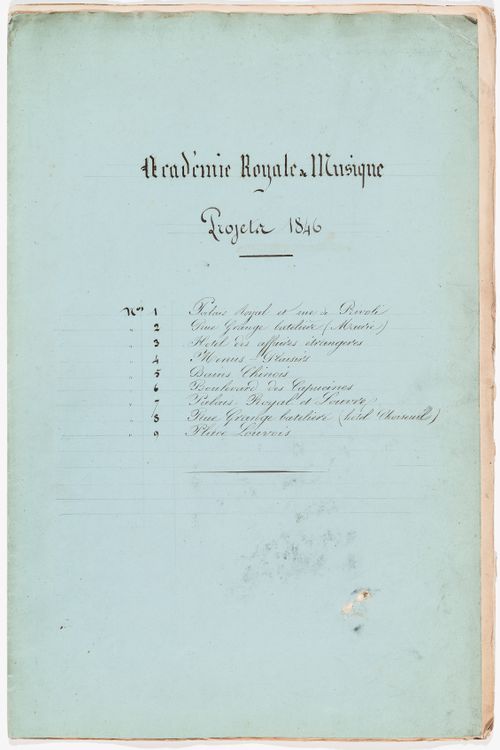
- Charles Rohault de Fleury proposed two projects for a new opera house for the Académie royale de musique, in 1846 and 1847. Portfolio DR1974:0002:036:002:001 R/V-005 R/V contains a set of transfer lithographs of the same 9 site plans in portfolio DR1974:0002:036:001:001-019, but these are unsigned and lack the revisions and the accompanying written documentation.
DR1974:0002:036:002:001-005
Description:
- Charles Rohault de Fleury proposed two projects for a new opera house for the Académie royale de musique, in 1846 and 1847. Portfolio DR1974:0002:036:002:001 R/V-005 R/V contains a set of transfer lithographs of the same 9 site plans in portfolio DR1974:0002:036:001:001-019, but these are unsigned and lack the revisions and the accompanying written documentation.
Date:
1846
1846
Title:
Academie Royale de Musique Projets 1846
Actions:
DR1974:0002:036:002:001-005
Description:
- Charles Rohault de Fleury proposed two projects for a new opera house for the Académie royale de musique, in 1846 and 1847. Portfolio DR1974:0002:036:002:001 R/V-005 R/V contains a set of transfer lithographs of the same 9 site plans in portfolio DR1974:0002:036:001:001-019, but these are unsigned and lack the revisions and the accompanying written documentation.
Academie Royale de Musique Projets 1846
Actions:
DR1974:0002:036:002:001-005
Description:
- Charles Rohault de Fleury proposed two projects for a new opera house for the Académie royale de musique, in 1846 and 1847. Portfolio DR1974:0002:036:002:001 R/V-005 R/V contains a set of transfer lithographs of the same 9 site plans in portfolio DR1974:0002:036:001:001-019, but these are unsigned and lack the revisions and the accompanying written documentation.
Date:
1846
1846
Form:
drawings
drawings
Actions:
Reference number:
DR1994:0006:006
Description:
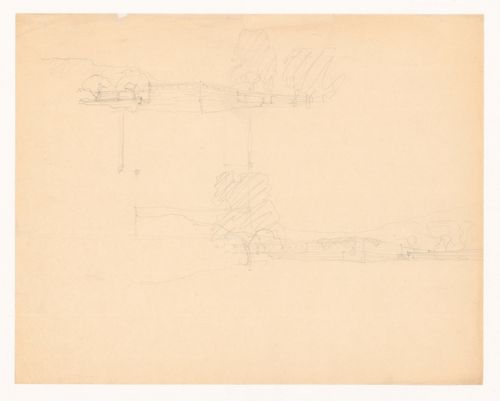
- The perspective sketches correspond with the rough plan, which shows the two wings of the court house and part of the stone wall enclosing the courtyard. The perspective drawing on the lower half of the sheet appears to have been drawn after the plan, which may reflect the architect's approach to the problem: drawing the plan and then working out the relationship between the structure to the site.
DR1994:0006:006
Description:
- The perspective sketches correspond with the rough plan, which shows the two wings of the court house and part of the stone wall enclosing the courtyard. The perspective drawing on the lower half of the sheet appears to have been drawn after the plan, which may reflect the architect's approach to the problem: drawing the plan and then working out the relationship between the structure to the site.
People:
Date:
1934
1934
Title:
Sketch perspectives and sketch plan for Mountain House
Actions:
DR1994:0006:006
Description:
- The perspective sketches correspond with the rough plan, which shows the two wings of the court house and part of the stone wall enclosing the courtyard. The perspective drawing on the lower half of the sheet appears to have been drawn after the plan, which may reflect the architect's approach to the problem: drawing the plan and then working out the relationship between the structure to the site.
Sketch perspectives and sketch plan for Mountain House
Actions:
DR1994:0006:006
Description:
- The perspective sketches correspond with the rough plan, which shows the two wings of the court house and part of the stone wall enclosing the courtyard. The perspective drawing on the lower half of the sheet appears to have been drawn after the plan, which may reflect the architect's approach to the problem: drawing the plan and then working out the relationship between the structure to the site.
Form:
drawings
drawings
Date:
1934
1934
People:


