


3141 Results
Form:
video
video
Actions:
Holdings:
Description:
1 online resource (1 video file (47 min., 4 sec.)) : sound, color
Description:
1 online resource (1 video file (47 min., 4 sec.)) : sound, color
Author:
Subject:
Publication:
[Montréal] : Canadian Centre for Architecture, [2018]
[Montréal] : Canadian Centre for Architecture, [2018]
Title:
Come and forget with Chus Martínez.
Actions:
Holdings:
Description:
1 online resource (1 video file (47 min., 4 sec.)) : sound, color
Come and forget with Chus Martínez.
Actions:
Holdings:
Description:
1 online resource (1 video file (47 min., 4 sec.)) : sound, color
Form:
video
video
Publication:
[Montréal] : Canadian Centre for Architecture, [2018]
[Montréal] : Canadian Centre for Architecture, [2018]
Author:
Subject:
Form:
audio
audio
Title:
Raimundas Malašauskas.
Raimundas Malašauskas.
Actions:
Description:
1 online resource.
Author:
Subject:
Publication:
[Place of publication not identified] : Momus, 2022.
[Place of publication not identified] : Momus, 2022.
Form:
audio
audio
Publication:
[Place of publication not identified] : Momus, 2022.
[Place of publication not identified] : Momus, 2022.
Author:
Subject:
Form:
books
books
Price:
$23.00
(available to order)
Summary:
On a visit to Auschwitz-Birkenau, Georges Didi-Huberman tears three pieces of bark from birch trees on the edge of the site. Looking at these pieces after his return home, he sees them as letters, a flood, a path, time, memory, flesh. The bark serves as a springboard to Didi-Huberman’s meditations on his visit, recorded in this spare, poetic, and powerful book. Bark is a(...)
$23.00
(available to order)
Summary:
On a visit to Auschwitz-Birkenau, Georges Didi-Huberman tears three pieces of bark from birch trees on the edge of the site. Looking at these pieces after his return home, he sees them as letters, a flood, a path, time, memory, flesh. The bark serves as a springboard to Didi-Huberman’s meditations on his visit, recorded in this spare, poetic, and powerful book. Bark is a(...)
Title:
Bark
Actions:
Price:
$23.00
(available to order)
Summary:
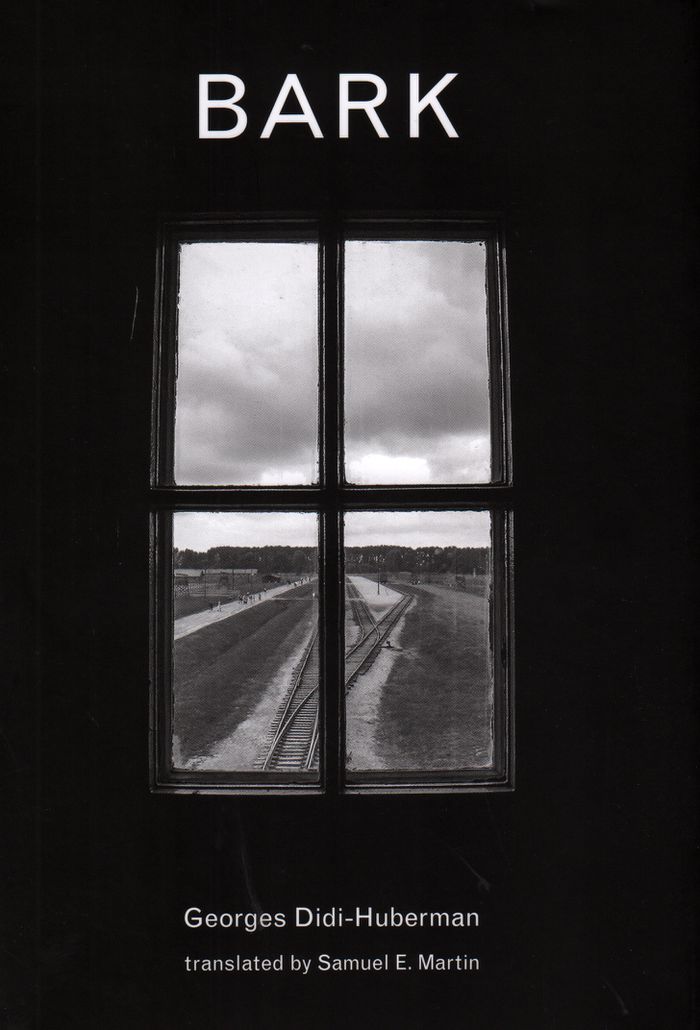
On a visit to Auschwitz-Birkenau, Georges Didi-Huberman tears three pieces of bark from birch trees on the edge of the site. Looking at these pieces after his return home, he sees them as letters, a flood, a path, time, memory, flesh. The bark serves as a springboard to Didi-Huberman’s meditations on his visit, recorded in this spare, poetic, and powerful book. Bark is a personal account, drawing not on the theoretical apparatus of scholarship but on Didi-Huberman’s own history, memory, and knowledge. The text proceeds as a series of reflections, accompanied by Didi-Huberman’s photographs of the visit. The photographs are not meant to be art—Didi-Huberman confesses that he “photographed practically everything without looking”—but approach it nevertheless. Didi-Huberman tells us that his grandparents died at Auschwitz, but his account is more universal than biographical. As he walks from place to place, he observes that in German birches are birken; Birkenau designates the meadow where the birches grow. Didi-Huberman sees and photographs the “reconstructed” execution wall; the floors of the crematorium, forgotten witnesses to killing; and the birch trees, lovely but also resembling prison bars. Taking his own photographs, he thinks of the famous photographs taken in 1944 by a member of the Sonderkommando, the only photographic documentation of the camp before the Germans destroyed it, hoping to hide the evidence of their crimes. Didi-Huberman notices a “bizarre proliferation of white flowers on the exact spot of the cremation pits.” The dead are not departed.
Bark
Actions:
Price:
$23.00
(available to order)
Summary:
On a visit to Auschwitz-Birkenau, Georges Didi-Huberman tears three pieces of bark from birch trees on the edge of the site. Looking at these pieces after his return home, he sees them as letters, a flood, a path, time, memory, flesh. The bark serves as a springboard to Didi-Huberman’s meditations on his visit, recorded in this spare, poetic, and powerful book. Bark is a personal account, drawing not on the theoretical apparatus of scholarship but on Didi-Huberman’s own history, memory, and knowledge. The text proceeds as a series of reflections, accompanied by Didi-Huberman’s photographs of the visit. The photographs are not meant to be art—Didi-Huberman confesses that he “photographed practically everything without looking”—but approach it nevertheless. Didi-Huberman tells us that his grandparents died at Auschwitz, but his account is more universal than biographical. As he walks from place to place, he observes that in German birches are birken; Birkenau designates the meadow where the birches grow. Didi-Huberman sees and photographs the “reconstructed” execution wall; the floors of the crematorium, forgotten witnesses to killing; and the birch trees, lovely but also resembling prison bars. Taking his own photographs, he thinks of the famous photographs taken in 1944 by a member of the Sonderkommando, the only photographic documentation of the camp before the Germans destroyed it, hoping to hide the evidence of their crimes. Didi-Huberman notices a “bizarre proliferation of white flowers on the exact spot of the cremation pits.” The dead are not departed.
Form:
books
books
Publication:
October 2017
October 2017
Subject:
Critical Theory
Critical Theory
Form:
books
books
Title:
Vanishing British Columbia
Vanishing British Columbia
Actions:
Price:
$39.95
(available to order)
Summary:
The old buildings and historic places of British Columbia form a kind of “roadside memory,” a tangible link with stories of settlement, change, and abandonment that reflect the great themes of our history. With small towns declining and old rural properties changing, so little of the history of these places has been recorded in museums or archives, and so much of it may(...)
$39.95
(available to order)
Summary:
The old buildings and historic places of British Columbia form a kind of “roadside memory,” a tangible link with stories of settlement, change, and abandonment that reflect the great themes of our history. With small towns declining and old rural properties changing, so little of the history of these places has been recorded in museums or archives, and so much of it may(...)
Subject:
Architecture in Canada
Architecture in Canada
Publication:
October 2005, Vancouver Toronto Seattle
October 2005, Vancouver Toronto Seattle
Title:
Vanishing British Columbia
Actions:
Price:
$39.95
(available to order)
Summary:
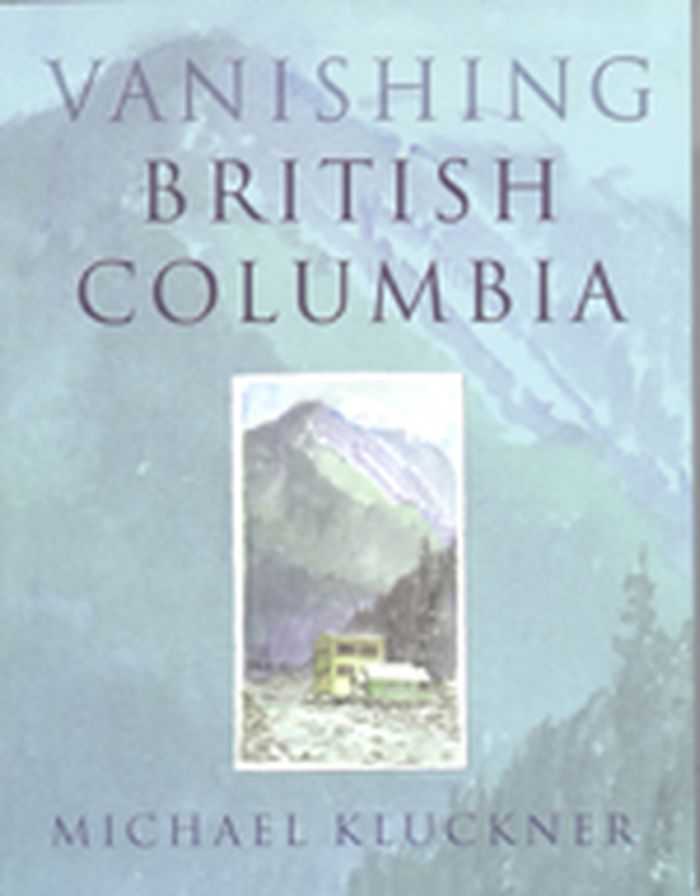
The old buildings and historic places of British Columbia form a kind of “roadside memory,” a tangible link with stories of settlement, change, and abandonment that reflect the great themes of our history. With small towns declining and old rural properties changing, so little of the history of these places has been recorded in museums or archives, and so much of it may disappear as families disperse and memories dim. More than a decade ago, Michael Kluckner began painting these dots on his personal map of the province in a watercolour sketchbook. In 1999, after he put a few of the sketches on his website, a network of correspondents emerged that eventually led him to the family letters, photo albums, and memories – all from a disappearing era of the province. Vanishing British Columbia is a record of these places and the stories they tell. It combines engaging and insightful historical commentary with over 160 of the author’s original paintings. It has an exceptional assortment of historic imagery, including old postcards, architectural plans, and photographs. The study of roadside memory demonstrates the visceral connection that people, especially those who are part of the rural-to-urban diaspora of modern times, have for the sites of their family memories. On a grander scale this approach leads to a broader understanding of more abstract historical themes and of the province’s history and culture. It also presents a compelling argument for stewardship of regional history in the face of urbanization and globalization.
Vanishing British Columbia
Actions:
Price:
$39.95
(available to order)
Summary:
The old buildings and historic places of British Columbia form a kind of “roadside memory,” a tangible link with stories of settlement, change, and abandonment that reflect the great themes of our history. With small towns declining and old rural properties changing, so little of the history of these places has been recorded in museums or archives, and so much of it may disappear as families disperse and memories dim. More than a decade ago, Michael Kluckner began painting these dots on his personal map of the province in a watercolour sketchbook. In 1999, after he put a few of the sketches on his website, a network of correspondents emerged that eventually led him to the family letters, photo albums, and memories – all from a disappearing era of the province. Vanishing British Columbia is a record of these places and the stories they tell. It combines engaging and insightful historical commentary with over 160 of the author’s original paintings. It has an exceptional assortment of historic imagery, including old postcards, architectural plans, and photographs. The study of roadside memory demonstrates the visceral connection that people, especially those who are part of the rural-to-urban diaspora of modern times, have for the sites of their family memories. On a grander scale this approach leads to a broader understanding of more abstract historical themes and of the province’s history and culture. It also presents a compelling argument for stewardship of regional history in the face of urbanization and globalization.
Form:
books
books
Publication:
October 2005, Vancouver Toronto Seattle
October 2005, Vancouver Toronto Seattle
Subject:
Architecture in Canada
Architecture in Canada
Form:
audio
audio
Title:
NET POVERA.
NET POVERA.
Actions:
Description:
1 online resource.
Author:
Subject:
Publication:
[Place of publication not identified] : New Models, 2021.
[Place of publication not identified] : New Models, 2021.
Form:
audio
audio
Publication:
[Place of publication not identified] : New Models, 2021.
[Place of publication not identified] : New Models, 2021.
Author:
Subject:
Form:
books
books
Actions:
Subject:
Publication:
Institute of Network Cultures 2009
Institute of Network Cultures 2009
Form:
books
books
Publication:
Institute of Network Cultures 2009
Institute of Network Cultures 2009
Subject:
Form:
books
books
Actions:
Subject:
Publication:
Strelka Press 2013
Strelka Press 2013
Form:
books
books
Publication:
Strelka Press 2013
Strelka Press 2013
Subject:
Form:
books
books
Subject:
Publication:
Clinamen 2016
Clinamen 2016
Form:
books
books
Publication:
Clinamen 2016
Clinamen 2016
Subject:
Form:
books
books
Title:
Smorfia.
Smorfia.
Actions:
Description:
1 online resource.
Author:
Subject:
Publication:
[Place of publication not identified] : Sorry Press, 2023.
[Place of publication not identified] : Sorry Press, 2023.
Form:
books
books
Publication:
[Place of publication not identified] : Sorry Press, 2023.
[Place of publication not identified] : Sorry Press, 2023.
Author:
Subject:
Form:
books
books
Actions:
Holdings:
Description:
92 pages : illustrations (color) ; 18 cm
Description:
92 pages : illustrations (color) ; 18 cm
Author:
Subject:
Publication:
[Eindhoven] : Set Margins', 2025
[Eindhoven] : Set Margins', 2025
Title:
The domestic encyclopaedia : oblique encounters of domestic space / Annee Grøtte Viken.
Actions:
Holdings:
Description:
92 pages : illustrations (color) ; 18 cm
The domestic encyclopaedia : oblique encounters of domestic space / Annee Grøtte Viken.
Actions:
Holdings:
Description:
92 pages : illustrations (color) ; 18 cm
Form:
books
books
Publication:
[Eindhoven] : Set Margins', 2025
[Eindhoven] : Set Margins', 2025
Author:
Subject:


