


exhibitions
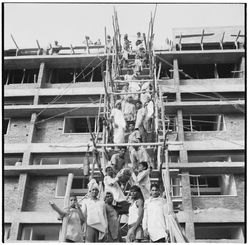
madskills: Self-Documenting Construction on Social Media investigates popular social media clips documenting construction work by those present on site. Inspired by the rise of the creator economy, contractors, builders, and tradespeople have started to record and share their skills, creativity, and concerns with a digitally connected community of peers, clients, and(...)
Octagonal gallery Keyword(s):
social media, TikTok, Instagram, architectural photography, construction workers, labour, skills
June 2024 to October 2024
madskills: Self-Documenting Construction on Social Media
Actions:
Description:
madskills: Self-Documenting Construction on Social Media investigates popular social media clips documenting construction work by those present on site. Inspired by the rise of the creator economy, contractors, builders, and tradespeople have started to record and share their skills, creativity, and concerns with a digitally connected community of peers, clients, and(...)
exhibitions
June 2024 to
October 2024
Octagonal gallery Keyword(s):
social media, TikTok, Instagram, architectural photography, construction workers, labour, skills
Project
Steel House
AP144.S2.D60
Description:
File documents an unsuccessful competition entry, in collaboration with Miles Park, Douglas Smith and Frank Newby, for a mass-produced housing system using steel, for a competition sponsored by the European Coal and Steel Community. Requirements called for rapid assembly/disassembly, and flexible unit plans that could be altered by home owners and appeal to a wide range of owners and their preferences. Schematic sketches include exterior elevations, floor plans, preliminary details, and charts for building components. Conceptual sketches show alternate unit and floor plan arrangements, and include network analysis plans, site maximization plans based on transportability, family breakdown diagrams, alternate internal unit layout plans based on age and other factors, functional area plans indicating separation possibilities, and charts which cross-reference factors such as transportability, construction, and assembly requirements. Design development drawings show typical plans, site plans, sections, elevations, details, axonometric drawings of structure and cladding, internal units, and components. Some material in this file was published in Price, Cedric, "Steel Housing", 'Architectural Design', vol. 37, (May 1967) 244, and Price, Cedric, 'Cedric Price-Works II' (London: Architectural Press, 1984) 36, 49-50, 113. Material in this file was produced between 1965 and 1969. 'High Authority of the European Coal and Steel Community' is the full name of the client as found in the textual records. The title of the competition is 'International Competition for the Design of Industrially Fabricated Dwellings'. File contains conceptual drawings, design development drawings, photographic material, presentation panels, textual records, and model.
1965-1969
Steel House
Actions:
AP144.S2.D60
Description:
File documents an unsuccessful competition entry, in collaboration with Miles Park, Douglas Smith and Frank Newby, for a mass-produced housing system using steel, for a competition sponsored by the European Coal and Steel Community. Requirements called for rapid assembly/disassembly, and flexible unit plans that could be altered by home owners and appeal to a wide range of owners and their preferences. Schematic sketches include exterior elevations, floor plans, preliminary details, and charts for building components. Conceptual sketches show alternate unit and floor plan arrangements, and include network analysis plans, site maximization plans based on transportability, family breakdown diagrams, alternate internal unit layout plans based on age and other factors, functional area plans indicating separation possibilities, and charts which cross-reference factors such as transportability, construction, and assembly requirements. Design development drawings show typical plans, site plans, sections, elevations, details, axonometric drawings of structure and cladding, internal units, and components. Some material in this file was published in Price, Cedric, "Steel Housing", 'Architectural Design', vol. 37, (May 1967) 244, and Price, Cedric, 'Cedric Price-Works II' (London: Architectural Press, 1984) 36, 49-50, 113. Material in this file was produced between 1965 and 1969. 'High Authority of the European Coal and Steel Community' is the full name of the client as found in the textual records. The title of the competition is 'International Competition for the Design of Industrially Fabricated Dwellings'. File contains conceptual drawings, design development drawings, photographic material, presentation panels, textual records, and model.
File 60
1965-1969
exhibitions
Toy Town
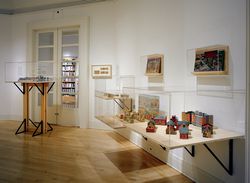
Toy Town explores how villages, towns, and cities have been represented in toys from Europe and North America. Drawn from CCA’s collection of architectural toys and games, the twenty-nine toys reflect shifting social values and different approaches to the design, organisation, and planning of communities in the nineteenth and twentieth centuries. Toy Town is the sixth in(...)
Octagonal gallery
22 October 1997 to 31 May 1998
Toy Town
Actions:
Description:
Toy Town explores how villages, towns, and cities have been represented in toys from Europe and North America. Drawn from CCA’s collection of architectural toys and games, the twenty-nine toys reflect shifting social values and different approaches to the design, organisation, and planning of communities in the nineteenth and twentieth centuries. Toy Town is the sixth in(...)
exhibitions
22 October 1997 to
31 May 1998
Octagonal gallery
webpages
Making Mamak is a toolkit for all cultural workers, social organizers, and community members. The toolkit is devised to help commit to local, community-based forms of creating and gathering. Learning from arts collectives in the urban centres of Malaysia, one can develop kinships with one’s own community, formulate mutual aid, appropriate collective spaces, and start grounded social movements.
Making Mamak: Collective Ecologies of Urban Space
Actions:
Summary:
Making Mamak is a toolkit for all cultural workers, social organizers, and community members. The toolkit is devised to help commit to local, community-based forms of creating and gathering. Learning from arts collectives in the urban centres of Malaysia, one can develop kinships with one’s own community, formulate mutual aid, appropriate collective spaces, and start grounded social movements.
webpages
Project
CI005.S1.1922.PR1
Description:
The city of Rotterdam in May 1922 commissioned a project to re-house homeless slum-dwellers and to alleviate Rotterdam's crisis in housing shortage: the housing unit was known as The Witte Dorp housing community, in the polder of Oud-Mathenesse. Oud designed the site plan and dwellings for this municipal housing project of 343 dwellings, eight shop units and a fire-engine shed. Oud created a geometric street plan with short axes that joined at the playground and townscape with identical facades of row houses facing one another. The houses were white with contrasting red roofs, blue front doors and yellow door frames and window casings (Taverne et al. 2001, 250). Project series includes drawings of plans and eighteen photographs, including exterior views and photographs of a plan.
1922-1924
Oud-Mathenesse Municipal Housing Scheme, Rotterdam, Netherlands (1922-1924)
Actions:
CI005.S1.1922.PR1
Description:
The city of Rotterdam in May 1922 commissioned a project to re-house homeless slum-dwellers and to alleviate Rotterdam's crisis in housing shortage: the housing unit was known as The Witte Dorp housing community, in the polder of Oud-Mathenesse. Oud designed the site plan and dwellings for this municipal housing project of 343 dwellings, eight shop units and a fire-engine shed. Oud created a geometric street plan with short axes that joined at the playground and townscape with identical facades of row houses facing one another. The houses were white with contrasting red roofs, blue front doors and yellow door frames and window casings (Taverne et al. 2001, 250). Project series includes drawings of plans and eighteen photographs, including exterior views and photographs of a plan.
project
1922-1924
archives
Level of archival description:
Fonds
AP075
Synopsis:
The Cornelia Hahn Oberlander fonds documents Oberlander's professional activities as a landscape architect. It contains over 203 projects that span from 1950 to 2018 predominantly in Canada and in the United States, but also in Germany. The fonds is a complete record of Oberlander's work, and comprises her playground projects, roof gardens, and public space landscapes, as well as landscape designs for private residences, as well as administrative records from her practice, her professional engagements, and her research materials. The material in this fonds is dated from 1936 to 2021.
1936-2021
Cornelia Hahn Oberlander fonds
Actions:
AP075
Synopsis:
The Cornelia Hahn Oberlander fonds documents Oberlander's professional activities as a landscape architect. It contains over 203 projects that span from 1950 to 2018 predominantly in Canada and in the United States, but also in Germany. The fonds is a complete record of Oberlander's work, and comprises her playground projects, roof gardens, and public space landscapes, as well as landscape designs for private residences, as well as administrative records from her practice, her professional engagements, and her research materials. The material in this fonds is dated from 1936 to 2021.
archives
Level of archival description:
Fonds
1936-2021
archives
Level of archival description:
Fonds
Shoei Yoh fonds
AP166
Synopsis:
The Shoei Yoh fonds (1976-2014, predominant 1990-1996) documents a selection of works by the Japanese architect and designer Shoei Yoh and the firm Shoei Yoh + Architects. The selection is comprised of two projects that were featured in the CCA exhibition Archaeology of the Digital (May 7-October 27, 2013)—the Galaxy Toyama Gymnasium and the unbuilt Odawara Municipal Sports Complex --and five other projects.The fonds also includes some published material by and about Shoei Yoh.
1976-2014, predominant 1990-1996
Shoei Yoh fonds
Actions:
AP166
Synopsis:
The Shoei Yoh fonds (1976-2014, predominant 1990-1996) documents a selection of works by the Japanese architect and designer Shoei Yoh and the firm Shoei Yoh + Architects. The selection is comprised of two projects that were featured in the CCA exhibition Archaeology of the Digital (May 7-October 27, 2013)—the Galaxy Toyama Gymnasium and the unbuilt Odawara Municipal Sports Complex --and five other projects.The fonds also includes some published material by and about Shoei Yoh.
archives
Level of archival description:
Fonds
1976-2014, predominant 1990-1996
articles
Fictions of Fictions
Fictions of Fictions
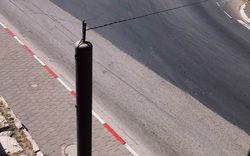
Piper Bernbaum on the material facts and urban fictions of the Eruv wars in Jerusalem
Actions:
Figuring Territory
exhibitions
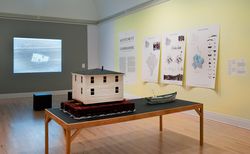
Although immigration is a dominant topic in contemporary culture, its discussion is often limited to the human experience, such as the crossing of borders and issues about national identity. Journeys takes a different perspective: how movements impact the environment. Examples range from the coconut that can drift freely on the ocean current and re-seed wherever it finds(...)
Main galleries
20 October 2010 to 13 March 2011
Journeys: How travelling fruit, ideas and buildings rearrange our environment
Actions:
Description:
Although immigration is a dominant topic in contemporary culture, its discussion is often limited to the human experience, such as the crossing of borders and issues about national identity. Journeys takes a different perspective: how movements impact the environment. Examples range from the coconut that can drift freely on the ocean current and re-seed wherever it finds(...)
exhibitions
20 October 2010 to
13 March 2011
Main galleries
Project
AP178.S1.1990.PR03
Description:
This project series documents the Urban design for Boulevard Brune, Cité de Jeunesse in Paris, France. While the records were held in the office’s archives this project was assigned the number 5/90. The office assigned the date 1990 to this project. This project consisted of a competition entry for the fourth and last phase of a social housing program for the young postmen of Paris. The competition was organized by the Ministère des Postes et des Télécommunications. The proposal for the Boulevard Brune building included four units; a school for mailmen (Edificio A), two housing buildings (Edificio B and C), and a community center (Edificio D). The program also mentioned a parking lot. Alvaro Siza was one of the three finalists selected but was not chosen for the project. Documenting this project are sketches, studies and site plans. Textual material includes project documentation, competition documentation, and correspondence. Photographs, photomontages and negatives document the project site.
1983-1991
Plano Urbanístico Boulevard Brune [Urban design for Boulevard Brune, Cité de Jeunesse], Paris, France (1990)
Actions:
AP178.S1.1990.PR03
Description:
This project series documents the Urban design for Boulevard Brune, Cité de Jeunesse in Paris, France. While the records were held in the office’s archives this project was assigned the number 5/90. The office assigned the date 1990 to this project. This project consisted of a competition entry for the fourth and last phase of a social housing program for the young postmen of Paris. The competition was organized by the Ministère des Postes et des Télécommunications. The proposal for the Boulevard Brune building included four units; a school for mailmen (Edificio A), two housing buildings (Edificio B and C), and a community center (Edificio D). The program also mentioned a parking lot. Alvaro Siza was one of the three finalists selected but was not chosen for the project. Documenting this project are sketches, studies and site plans. Textual material includes project documentation, competition documentation, and correspondence. Photographs, photomontages and negatives document the project site.
Project
1983-1991


