


5179 Results
Form:
textual records, graphic materials
Quantity:
26 textual record(s)
textual records, graphic materials
Quantity:
26 textual record(s)
Actions:
Reference number:
DR1987:0865:001-023
Description:
- This group of correspondence, clippings and other documents was compiled by the architect, Lloyd Wright, for his own record while he was pursuing the commission for Boeing Airport, Burbank, Los Angeles County, California. He was not successful in obtaining the commission. The correspondence includes letters to and from Lloyd Wright, drafts for and carbon copies of these same letters, and telegrams to Lloyd Wright. Other documents include three newspaper clippings, an estimate and notes. Of the clippings, one reports on the beginning of work on Boeing Airport, the second announces a new meteorological station for pilots in the San Fernando Valley, and includes details of other aviation industry investments in the area, and the third is another account of the initiation of Boeing Airport. The latter clipping is folded up with a sheet noting the address of Lloyd St. John. Although the estimate is not identified by project name, it was probably prepared for Lloyd Wright's Boeing Airport proposal, which included an airport, manufacturing plant and other amenities, all mentioned in the estimate.
DR1987:0865:001-023
Description:
- This group of correspondence, clippings and other documents was compiled by the architect, Lloyd Wright, for his own record while he was pursuing the commission for Boeing Airport, Burbank, Los Angeles County, California. He was not successful in obtaining the commission. The correspondence includes letters to and from Lloyd Wright, drafts for and carbon copies of these same letters, and telegrams to Lloyd Wright. Other documents include three newspaper clippings, an estimate and notes. Of the clippings, one reports on the beginning of work on Boeing Airport, the second announces a new meteorological station for pilots in the San Fernando Valley, and includes details of other aviation industry investments in the area, and the third is another account of the initiation of Boeing Airport. The latter clipping is folded up with a sheet noting the address of Lloyd St. John. Although the estimate is not identified by project name, it was probably prepared for Lloyd Wright's Boeing Airport proposal, which included an airport, manufacturing plant and other amenities, all mentioned in the estimate.
People:
Subject:
architecture
architecture
Date:
printed 1929 ?
printed 1929 ?
Title:
Boeing Airport, Burbank, California: Correspondence and other documents relating to Lloyd Wright's design
Actions:
DR1987:0865:001-023
Description:
- This group of correspondence, clippings and other documents was compiled by the architect, Lloyd Wright, for his own record while he was pursuing the commission for Boeing Airport, Burbank, Los Angeles County, California. He was not successful in obtaining the commission. The correspondence includes letters to and from Lloyd Wright, drafts for and carbon copies of these same letters, and telegrams to Lloyd Wright. Other documents include three newspaper clippings, an estimate and notes. Of the clippings, one reports on the beginning of work on Boeing Airport, the second announces a new meteorological station for pilots in the San Fernando Valley, and includes details of other aviation industry investments in the area, and the third is another account of the initiation of Boeing Airport. The latter clipping is folded up with a sheet noting the address of Lloyd St. John. Although the estimate is not identified by project name, it was probably prepared for Lloyd Wright's Boeing Airport proposal, which included an airport, manufacturing plant and other amenities, all mentioned in the estimate.
Boeing Airport, Burbank, California: Correspondence and other documents relating to Lloyd Wright's design
Actions:
DR1987:0865:001-023
Description:
- This group of correspondence, clippings and other documents was compiled by the architect, Lloyd Wright, for his own record while he was pursuing the commission for Boeing Airport, Burbank, Los Angeles County, California. He was not successful in obtaining the commission. The correspondence includes letters to and from Lloyd Wright, drafts for and carbon copies of these same letters, and telegrams to Lloyd Wright. Other documents include three newspaper clippings, an estimate and notes. Of the clippings, one reports on the beginning of work on Boeing Airport, the second announces a new meteorological station for pilots in the San Fernando Valley, and includes details of other aviation industry investments in the area, and the third is another account of the initiation of Boeing Airport. The latter clipping is folded up with a sheet noting the address of Lloyd St. John. Although the estimate is not identified by project name, it was probably prepared for Lloyd Wright's Boeing Airport proposal, which included an airport, manufacturing plant and other amenities, all mentioned in the estimate.
Form:
textual records, graphic materials
Quantity:
26 textual record(s)
textual records, graphic materials
Quantity:
26 textual record(s)
Date:
printed 1929 ?
printed 1929 ?
People:
Subject:
architecture
architecture
Form:
archives
Level of archival description:
Collection
archives
Level of archival description:
Collection
Title:
Eva Hollo Vecsei collection
Eva Hollo Vecsei collection
Actions:
Reference number:
CD041
Synopsis:
The Eva Hollo Vecsei collection documents the career of Hungarian-Canadian architect Eva Hollo Vecsei with a few materials from her husband’s, Andrei Vecsei, work. Records in this collection, ranging from 1959 to 2019, document key elements of several of Vecsei’s projects, including built and unbuilt designs.
CD041
Synopsis:
The Eva Hollo Vecsei collection documents the career of Hungarian-Canadian architect Eva Hollo Vecsei with a few materials from her husband’s, Andrei Vecsei, work. Records in this collection, ranging from 1959 to 2019, document key elements of several of Vecsei’s projects, including built and unbuilt designs.
People:
Date:
1959-2019
1959-2019
Title:
Eva Hollo Vecsei collection
Actions:
CD041
Synopsis:
The Eva Hollo Vecsei collection documents the career of Hungarian-Canadian architect Eva Hollo Vecsei with a few materials from her husband’s, Andrei Vecsei, work. Records in this collection, ranging from 1959 to 2019, document key elements of several of Vecsei’s projects, including built and unbuilt designs.
Eva Hollo Vecsei collection
Actions:
CD041
Synopsis:
The Eva Hollo Vecsei collection documents the career of Hungarian-Canadian architect Eva Hollo Vecsei with a few materials from her husband’s, Andrei Vecsei, work. Records in this collection, ranging from 1959 to 2019, document key elements of several of Vecsei’s projects, including built and unbuilt designs.
Form:
archives
Level of archival description:
Collection
archives
Level of archival description:
Collection
Date:
1959-2019
1959-2019
People:
Level of archival description:
Project
Project
Actions:
Reference number:
AP018.S1.1976.PR19
Description:
This project series documents the design and construction of an office building and planning for additional projects in North York, Ontario from 1976-1983. The office identified the project number as 7626. The project consisted of a ten storey office building located at 1500 Don Mills Road with approximately 250,000 square feet of space. Owned and commissioned by Marathon Realty, the majority of the building's space was designed for rental. The ground floor of the building was to host retail spaces and a connection to local transit. The project was divided into two phases. Phase I was the construction of this office building and Phase II was the construction of an additional office building and a parking structure on the same property. Under this project number, only Phase I was realized, with the additional buildings receiving their own project numbers from the office later on. The project is recorded through drawings, construction progress photographs, textual records and a mounted work of art dating from 1974-1983. The textual records include correspondence, site reports, tests and inspections, meeting minutes and reports, specifications, tenders documents, detail planning records, change orders, supplementary instructions and financial records. Also included is an article written by John C. Parkin for Canadian Architect on the development of the property, which previously hosted his own offices until their demolition before the start of this project (see box AP018.S1.1976.PR19.025). Box AP018.S1.1976.PR19.025 contains an index to the textual records, which was created by the office.
AP018.S1.1976.PR19
Description:
This project series documents the design and construction of an office building and planning for additional projects in North York, Ontario from 1976-1983. The office identified the project number as 7626. The project consisted of a ten storey office building located at 1500 Don Mills Road with approximately 250,000 square feet of space. Owned and commissioned by Marathon Realty, the majority of the building's space was designed for rental. The ground floor of the building was to host retail spaces and a connection to local transit. The project was divided into two phases. Phase I was the construction of this office building and Phase II was the construction of an additional office building and a parking structure on the same property. Under this project number, only Phase I was realized, with the additional buildings receiving their own project numbers from the office later on. The project is recorded through drawings, construction progress photographs, textual records and a mounted work of art dating from 1974-1983. The textual records include correspondence, site reports, tests and inspections, meeting minutes and reports, specifications, tenders documents, detail planning records, change orders, supplementary instructions and financial records. Also included is an article written by John C. Parkin for Canadian Architect on the development of the property, which previously hosted his own offices until their demolition before the start of this project (see box AP018.S1.1976.PR19.025). Box AP018.S1.1976.PR19.025 contains an index to the textual records, which was created by the office.
People:
Date:
1974-1983
1974-1983
Title:
Office Building, 1500 Don Mills Road, North York, Ontario (1976)
Actions:
AP018.S1.1976.PR19
Description:
This project series documents the design and construction of an office building and planning for additional projects in North York, Ontario from 1976-1983. The office identified the project number as 7626. The project consisted of a ten storey office building located at 1500 Don Mills Road with approximately 250,000 square feet of space. Owned and commissioned by Marathon Realty, the majority of the building's space was designed for rental. The ground floor of the building was to host retail spaces and a connection to local transit. The project was divided into two phases. Phase I was the construction of this office building and Phase II was the construction of an additional office building and a parking structure on the same property. Under this project number, only Phase I was realized, with the additional buildings receiving their own project numbers from the office later on. The project is recorded through drawings, construction progress photographs, textual records and a mounted work of art dating from 1974-1983. The textual records include correspondence, site reports, tests and inspections, meeting minutes and reports, specifications, tenders documents, detail planning records, change orders, supplementary instructions and financial records. Also included is an article written by John C. Parkin for Canadian Architect on the development of the property, which previously hosted his own offices until their demolition before the start of this project (see box AP018.S1.1976.PR19.025). Box AP018.S1.1976.PR19.025 contains an index to the textual records, which was created by the office.
Office Building, 1500 Don Mills Road, North York, Ontario (1976)
Actions:
AP018.S1.1976.PR19
Description:
This project series documents the design and construction of an office building and planning for additional projects in North York, Ontario from 1976-1983. The office identified the project number as 7626. The project consisted of a ten storey office building located at 1500 Don Mills Road with approximately 250,000 square feet of space. Owned and commissioned by Marathon Realty, the majority of the building's space was designed for rental. The ground floor of the building was to host retail spaces and a connection to local transit. The project was divided into two phases. Phase I was the construction of this office building and Phase II was the construction of an additional office building and a parking structure on the same property. Under this project number, only Phase I was realized, with the additional buildings receiving their own project numbers from the office later on. The project is recorded through drawings, construction progress photographs, textual records and a mounted work of art dating from 1974-1983. The textual records include correspondence, site reports, tests and inspections, meeting minutes and reports, specifications, tenders documents, detail planning records, change orders, supplementary instructions and financial records. Also included is an article written by John C. Parkin for Canadian Architect on the development of the property, which previously hosted his own offices until their demolition before the start of this project (see box AP018.S1.1976.PR19.025). Box AP018.S1.1976.PR19.025 contains an index to the textual records, which was created by the office.
Level of archival description:
Project
Project
Date:
1974-1983
1974-1983
People:
Level of archival description:
Project
Project
Actions:
Reference number:
AP018.S1.1978.PR04
Description:
This project series documents the design of a US pre-clearance facility at terminal one of the Toronto International Airport in Mississauga, Ontario in 1978. The office identified the project number as 7805. Since the early 1960s, John B. Parkin Associates, and later John C. Parkin's new firm Parkin Architects Planners, had been commissioned by the government Department of Transport Air Services to complete more than a dozen projects at the Toronto International Airport, including terminals one and two. This project consisted of the design of an area to accommodate pre-clearance screening to the US, which was located between fingers one and two at terminal one. The area is referred to as a node, and contained washrooms, customs areas, immigration areas, and a duty free that was accessible to international traffic. Many gates at terminal one had to be redesignated to accommodate this new facility. The project is recorded through drawings and textual records dating from 1978. The drawings are largely reprographic copies of floor plans and site plans, with sections of the original terminal one building included. Some drawings in this project series were created by the architectural firm Searle, Wilbee, Rowland, which was one of the names used for Parkin's firm after the merger of John B. Parkin Associates with Winnipeg-based firm Smith, Carter and Searle. The textual records include conference reports, correspondence and a feasibility report.
AP018.S1.1978.PR04
Description:
This project series documents the design of a US pre-clearance facility at terminal one of the Toronto International Airport in Mississauga, Ontario in 1978. The office identified the project number as 7805. Since the early 1960s, John B. Parkin Associates, and later John C. Parkin's new firm Parkin Architects Planners, had been commissioned by the government Department of Transport Air Services to complete more than a dozen projects at the Toronto International Airport, including terminals one and two. This project consisted of the design of an area to accommodate pre-clearance screening to the US, which was located between fingers one and two at terminal one. The area is referred to as a node, and contained washrooms, customs areas, immigration areas, and a duty free that was accessible to international traffic. Many gates at terminal one had to be redesignated to accommodate this new facility. The project is recorded through drawings and textual records dating from 1978. The drawings are largely reprographic copies of floor plans and site plans, with sections of the original terminal one building included. Some drawings in this project series were created by the architectural firm Searle, Wilbee, Rowland, which was one of the names used for Parkin's firm after the merger of John B. Parkin Associates with Winnipeg-based firm Smith, Carter and Searle. The textual records include conference reports, correspondence and a feasibility report.
People:
Date:
1978
1978
Title:
US Pre-Clearance Facility, Toronto International Airport, Mississauga, Ontario (1978)
Actions:
AP018.S1.1978.PR04
Description:
This project series documents the design of a US pre-clearance facility at terminal one of the Toronto International Airport in Mississauga, Ontario in 1978. The office identified the project number as 7805. Since the early 1960s, John B. Parkin Associates, and later John C. Parkin's new firm Parkin Architects Planners, had been commissioned by the government Department of Transport Air Services to complete more than a dozen projects at the Toronto International Airport, including terminals one and two. This project consisted of the design of an area to accommodate pre-clearance screening to the US, which was located between fingers one and two at terminal one. The area is referred to as a node, and contained washrooms, customs areas, immigration areas, and a duty free that was accessible to international traffic. Many gates at terminal one had to be redesignated to accommodate this new facility. The project is recorded through drawings and textual records dating from 1978. The drawings are largely reprographic copies of floor plans and site plans, with sections of the original terminal one building included. Some drawings in this project series were created by the architectural firm Searle, Wilbee, Rowland, which was one of the names used for Parkin's firm after the merger of John B. Parkin Associates with Winnipeg-based firm Smith, Carter and Searle. The textual records include conference reports, correspondence and a feasibility report.
US Pre-Clearance Facility, Toronto International Airport, Mississauga, Ontario (1978)
Actions:
AP018.S1.1978.PR04
Description:
This project series documents the design of a US pre-clearance facility at terminal one of the Toronto International Airport in Mississauga, Ontario in 1978. The office identified the project number as 7805. Since the early 1960s, John B. Parkin Associates, and later John C. Parkin's new firm Parkin Architects Planners, had been commissioned by the government Department of Transport Air Services to complete more than a dozen projects at the Toronto International Airport, including terminals one and two. This project consisted of the design of an area to accommodate pre-clearance screening to the US, which was located between fingers one and two at terminal one. The area is referred to as a node, and contained washrooms, customs areas, immigration areas, and a duty free that was accessible to international traffic. Many gates at terminal one had to be redesignated to accommodate this new facility. The project is recorded through drawings and textual records dating from 1978. The drawings are largely reprographic copies of floor plans and site plans, with sections of the original terminal one building included. Some drawings in this project series were created by the architectural firm Searle, Wilbee, Rowland, which was one of the names used for Parkin's firm after the merger of John B. Parkin Associates with Winnipeg-based firm Smith, Carter and Searle. The textual records include conference reports, correspondence and a feasibility report.
Level of archival description:
Project
Project
Date:
1978
1978
People:
Form:
archives
Level of archival description:
Fonds
archives
Level of archival description:
Fonds
Actions:
Reference number:
AP226
Synopsis:
The Toyo Ito & Associates, Architects fonds, 1970 – 2011, documents the studio’s architectural work and involvement in selected exhibitions in the 1970s and 1980s. The records in this fonds represent 34 architectural projects, including built, unbuilt, and conceptual projects. The majority of the projects are located in Japan and are mostly documented through drawings as well as a limited number of videos, models, panels, textual records, and photographs. The fonds also contains records related to Toyo Ito & Associates, Architects’ participation in three exhibitions in the USA and the UK in 1978 and 1986.
AP226
Synopsis:
The Toyo Ito & Associates, Architects fonds, 1970 – 2011, documents the studio’s architectural work and involvement in selected exhibitions in the 1970s and 1980s. The records in this fonds represent 34 architectural projects, including built, unbuilt, and conceptual projects. The majority of the projects are located in Japan and are mostly documented through drawings as well as a limited number of videos, models, panels, textual records, and photographs. The fonds also contains records related to Toyo Ito & Associates, Architects’ participation in three exhibitions in the USA and the UK in 1978 and 1986.
People:
Date:
1970 - 2011
1970 - 2011
Title:
Toyo Ito & Associates, Architects fonds
Actions:
AP226
Synopsis:
The Toyo Ito & Associates, Architects fonds, 1970 – 2011, documents the studio’s architectural work and involvement in selected exhibitions in the 1970s and 1980s. The records in this fonds represent 34 architectural projects, including built, unbuilt, and conceptual projects. The majority of the projects are located in Japan and are mostly documented through drawings as well as a limited number of videos, models, panels, textual records, and photographs. The fonds also contains records related to Toyo Ito & Associates, Architects’ participation in three exhibitions in the USA and the UK in 1978 and 1986.
Toyo Ito & Associates, Architects fonds
Actions:
AP226
Synopsis:
The Toyo Ito & Associates, Architects fonds, 1970 – 2011, documents the studio’s architectural work and involvement in selected exhibitions in the 1970s and 1980s. The records in this fonds represent 34 architectural projects, including built, unbuilt, and conceptual projects. The majority of the projects are located in Japan and are mostly documented through drawings as well as a limited number of videos, models, panels, textual records, and photographs. The fonds also contains records related to Toyo Ito & Associates, Architects’ participation in three exhibitions in the USA and the UK in 1978 and 1986.
Form:
archives
Level of archival description:
Fonds
archives
Level of archival description:
Fonds
Date:
1970 - 2011
1970 - 2011
People:
Form:
archives
Level of archival description:
Fonds
archives
Level of archival description:
Fonds
Title:
Aditya Prakash fonds
Aditya Prakash fonds
Reference number:
AP206
Synopsis:
The Aditya Prakash fonds documents the professional practice of modernist Indian architect Aditya Prakash from his studies in London in 1947 to his death in 2008. His seminal work as a junior architect on the Chandigarh Capitol Project in the 1950s is recorded along with documentation from his solo career after 1960, including approximately 82 architectural projects. His professional work as an artist, photographer, writer, academic and theatre enthusiast are also well documented through drawings, photographic materials and textual records.
AP206
Synopsis:
The Aditya Prakash fonds documents the professional practice of modernist Indian architect Aditya Prakash from his studies in London in 1947 to his death in 2008. His seminal work as a junior architect on the Chandigarh Capitol Project in the 1950s is recorded along with documentation from his solo career after 1960, including approximately 82 architectural projects. His professional work as an artist, photographer, writer, academic and theatre enthusiast are also well documented through drawings, photographic materials and textual records.
People:
Date:
1947-2008
1947-2008
Title:
Aditya Prakash fonds
Actions:
AP206
Synopsis:
The Aditya Prakash fonds documents the professional practice of modernist Indian architect Aditya Prakash from his studies in London in 1947 to his death in 2008. His seminal work as a junior architect on the Chandigarh Capitol Project in the 1950s is recorded along with documentation from his solo career after 1960, including approximately 82 architectural projects. His professional work as an artist, photographer, writer, academic and theatre enthusiast are also well documented through drawings, photographic materials and textual records.
Aditya Prakash fonds
Actions:
AP206
Synopsis:
The Aditya Prakash fonds documents the professional practice of modernist Indian architect Aditya Prakash from his studies in London in 1947 to his death in 2008. His seminal work as a junior architect on the Chandigarh Capitol Project in the 1950s is recorded along with documentation from his solo career after 1960, including approximately 82 architectural projects. His professional work as an artist, photographer, writer, academic and theatre enthusiast are also well documented through drawings, photographic materials and textual records.
Form:
archives
Level of archival description:
Fonds
archives
Level of archival description:
Fonds
Date:
1947-2008
1947-2008
People:
Form:
textual records
textual records
Actions:
Reference number:
DR1974:0002:036:007:001-013
Description:
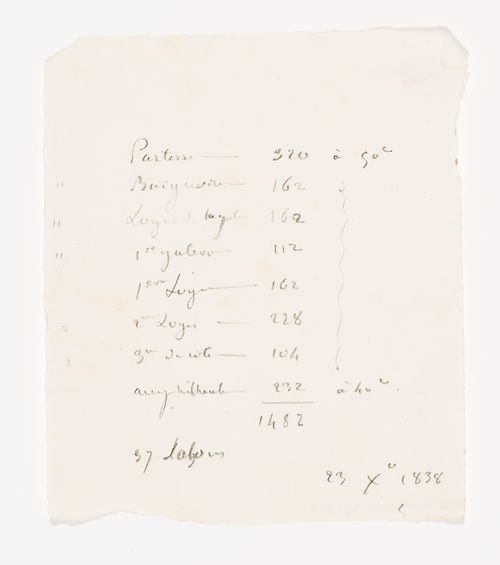
Manuscript DR1974:0002:036:007:001-013 documents the seating capacity and ticket costs of the proposed opera house. This manuscript includes information on the site of Hôtel d'Etchegoyan which probably relates to a plan for purchasing the hôtel from the Ministère des Affaires Étrangères. Also included in this manuscript are: an estimate of the cost to the state of selling the Hôtel du Timbre site and of constructing the opera house, and a list of the Opéra-Italien commission members who administered the Théâtre Royal des Italien.
DR1974:0002:036:007:001-013
Description:
Manuscript DR1974:0002:036:007:001-013 documents the seating capacity and ticket costs of the proposed opera house. This manuscript includes information on the site of Hôtel d'Etchegoyan which probably relates to a plan for purchasing the hôtel from the Ministère des Affaires Étrangères. Also included in this manuscript are: an estimate of the cost to the state of selling the Hôtel du Timbre site and of constructing the opera house, and a list of the Opéra-Italien commission members who administered the Théâtre Royal des Italien.
People:
Subject:
architecture
architecture
Date:
20 October 1839 and 14 or 16 February 1840
20 October 1839 and 14 or 16 February 1840
Title:
Cost estimates and projected rental incomes for Hôtel Etchegoyan, Hôtel du Timbre, and an opera house for the Théâtre Royal Italien on the Ministère des Affaires Étrangères and the Hôtel du Timbre site
Actions:
DR1974:0002:036:007:001-013
Description:
Manuscript DR1974:0002:036:007:001-013 documents the seating capacity and ticket costs of the proposed opera house. This manuscript includes information on the site of Hôtel d'Etchegoyan which probably relates to a plan for purchasing the hôtel from the Ministère des Affaires Étrangères. Also included in this manuscript are: an estimate of the cost to the state of selling the Hôtel du Timbre site and of constructing the opera house, and a list of the Opéra-Italien commission members who administered the Théâtre Royal des Italien.
Cost estimates and projected rental incomes for Hôtel Etchegoyan, Hôtel du Timbre, and an opera house for the Théâtre Royal Italien on the Ministère des Affaires Étrangères and the Hôtel du Timbre site
Actions:
DR1974:0002:036:007:001-013
Description:
Manuscript DR1974:0002:036:007:001-013 documents the seating capacity and ticket costs of the proposed opera house. This manuscript includes information on the site of Hôtel d'Etchegoyan which probably relates to a plan for purchasing the hôtel from the Ministère des Affaires Étrangères. Also included in this manuscript are: an estimate of the cost to the state of selling the Hôtel du Timbre site and of constructing the opera house, and a list of the Opéra-Italien commission members who administered the Théâtre Royal des Italien.
Form:
textual records
textual records
Date:
20 October 1839 and 14 or 16 February 1840
20 October 1839 and 14 or 16 February 1840
People:
Subject:
architecture
architecture
Form:
exhibitions
exhibitions
Actions:
Description:
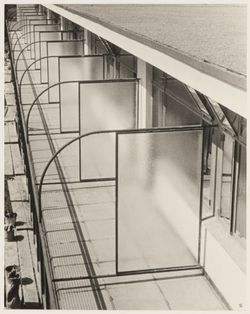
In 1929, Ilse Bing bought a Leica camera and started a photographic career that took her from Frankfurt to New York via Paris. While still in Frankfurt, she was commissioned by architect and urban planner Mart Stam to undertake a photographic survey of the modern buildings that were being erected in the city, including the Henry and Emma Budge-Heim H-block building. Built(...)
In 1929, Ilse Bing bought a Leica camera and started a photographic career that took her from Frankfurt to New York via Paris. While still in Frankfurt, she was commissioned by architect and urban planner Mart Stam to undertake a photographic survey of the modern buildings that were being erected in the city, including the Henry and Emma Budge-Heim H-block building. Built(...)
Location:
Hall cases
Hall cases
Date:
5 September 2013 to 5 December 2013
5 September 2013 to 5 December 2013
Title:
H-BLOCK: Social Housing – Ilse Bing
Actions:
Description:
In 1929, Ilse Bing bought a Leica camera and started a photographic career that took her from Frankfurt to New York via Paris. While still in Frankfurt, she was commissioned by architect and urban planner Mart Stam to undertake a photographic survey of the modern buildings that were being erected in the city, including the Henry and Emma Budge-Heim H-block building. Built(...)
H-BLOCK: Social Housing – Ilse Bing
Actions:
Description:
In 1929, Ilse Bing bought a Leica camera and started a photographic career that took her from Frankfurt to New York via Paris. While still in Frankfurt, she was commissioned by architect and urban planner Mart Stam to undertake a photographic survey of the modern buildings that were being erected in the city, including the Henry and Emma Budge-Heim H-block building. Built(...)
Form:
exhibitions
exhibitions
Date:
5 September 2013 to
5 December 2013
5 September 2013 to
5 December 2013
Location:
Hall cases
Hall cases
Form:
exhibitions
exhibitions

Actions:
Description:
In 1973, following the strikes that beset the British construction industry during the early 1970s, Alistair McAlpine commissioned a design program for his construction company, Sir Robert McAlpine Sons, that aimed to increase production efficiency and improve labour relations. Cedric Price’s proposal took the format of a two-volume report and a Portable Enclosures(...)
In 1973, following the strikes that beset the British construction industry during the early 1970s, Alistair McAlpine commissioned a design program for his construction company, Sir Robert McAlpine Sons, that aimed to increase production efficiency and improve labour relations. Cedric Price’s proposal took the format of a two-volume report and a Portable Enclosures(...)
Date:
9 February 2017 to 14 May 2017
9 February 2017 to 14 May 2017
Title:
What About Happiness on the Building Site?
Actions:
Description:
In 1973, following the strikes that beset the British construction industry during the early 1970s, Alistair McAlpine commissioned a design program for his construction company, Sir Robert McAlpine Sons, that aimed to increase production efficiency and improve labour relations. Cedric Price’s proposal took the format of a two-volume report and a Portable Enclosures(...)
What About Happiness on the Building Site?
Actions:
Description:
In 1973, following the strikes that beset the British construction industry during the early 1970s, Alistair McAlpine commissioned a design program for his construction company, Sir Robert McAlpine Sons, that aimed to increase production efficiency and improve labour relations. Cedric Price’s proposal took the format of a two-volume report and a Portable Enclosures(...)
Form:
exhibitions
exhibitions
Date:
9 February 2017 to
14 May 2017
9 February 2017 to
14 May 2017
Form:
films
films

Actions:
Description:
This film, conceived by Francesco Garutti and directed by Shahab Mihandoust, explores the controversial story of the planning and politics of a series of overpasses that span the parkways of Long Island, New York. These bridges were commissioned in the 1920s and 1930s by the public administrator Robert Moses. The story suggests that the bridges were designed to prevent(...)
This film, conceived by Francesco Garutti and directed by Shahab Mihandoust, explores the controversial story of the planning and politics of a series of overpasses that span the parkways of Long Island, New York. These bridges were commissioned in the 1920s and 1930s by the public administrator Robert Moses. The story suggests that the bridges were designed to prevent(...)
Date:
August 2014
August 2014
Title:
Misleading Innocence (tracing what a bridge can do)
Actions:
Description:
This film, conceived by Francesco Garutti and directed by Shahab Mihandoust, explores the controversial story of the planning and politics of a series of overpasses that span the parkways of Long Island, New York. These bridges were commissioned in the 1920s and 1930s by the public administrator Robert Moses. The story suggests that the bridges were designed to prevent(...)
Misleading Innocence (tracing what a bridge can do)
Actions:
Description:
This film, conceived by Francesco Garutti and directed by Shahab Mihandoust, explores the controversial story of the planning and politics of a series of overpasses that span the parkways of Long Island, New York. These bridges were commissioned in the 1920s and 1930s by the public administrator Robert Moses. The story suggests that the bridges were designed to prevent(...)
Form:
films
films
Date:
August 2014 to
August 2014
August 2014 to
August 2014


