


6245 Results
Level of archival description:
Project
Project
Actions:
Reference number:
AP164.S1.2004.D3
Description:
The project series documents the masterplan of territorial organization of the Costa del Sol, in Spain, for the account of the Secretaría General de Ordenación del Territorio y Urbanismo and the Consejeria de obras publicas y transportes of the governement of Andalucia. The firm identified this project as number 181. "Our purpose is to convert the Costa del Sol in an authentic contemporary metacity, to put it on the map of Europe's principal cities and to organize an individual and [the] unstoppable development of each municipality into a wider framework that allows the integration of infrastructures through ecological-technical corridors demanded for a metropolitan scale. It also states the authentic urban value in addition to the local natural one." (ARCH270975) Abalos & Herreros worked with Jose Seguí, Jose Maria Ezquiaga (?) and Salvador Rueda Documenting the project are conceptual, design development and presentation drawings, cartographic, photographic and reference materials, correspondence, notes and presentation documents.
AP164.S1.2004.D3
Description:
The project series documents the masterplan of territorial organization of the Costa del Sol, in Spain, for the account of the Secretaría General de Ordenación del Territorio y Urbanismo and the Consejeria de obras publicas y transportes of the governement of Andalucia. The firm identified this project as number 181. "Our purpose is to convert the Costa del Sol in an authentic contemporary metacity, to put it on the map of Europe's principal cities and to organize an individual and [the] unstoppable development of each municipality into a wider framework that allows the integration of infrastructures through ecological-technical corridors demanded for a metropolitan scale. It also states the authentic urban value in addition to the local natural one." (ARCH270975) Abalos & Herreros worked with Jose Seguí, Jose Maria Ezquiaga (?) and Salvador Rueda Documenting the project are conceptual, design development and presentation drawings, cartographic, photographic and reference materials, correspondence, notes and presentation documents.
People:
Date:
2003-2005
2003-2005
Title:
Plan de ordenación territorial, Costa del Sol, Spain (2004)
Actions:
AP164.S1.2004.D3
Description:
The project series documents the masterplan of territorial organization of the Costa del Sol, in Spain, for the account of the Secretaría General de Ordenación del Territorio y Urbanismo and the Consejeria de obras publicas y transportes of the governement of Andalucia. The firm identified this project as number 181. "Our purpose is to convert the Costa del Sol in an authentic contemporary metacity, to put it on the map of Europe's principal cities and to organize an individual and [the] unstoppable development of each municipality into a wider framework that allows the integration of infrastructures through ecological-technical corridors demanded for a metropolitan scale. It also states the authentic urban value in addition to the local natural one." (ARCH270975) Abalos & Herreros worked with Jose Seguí, Jose Maria Ezquiaga (?) and Salvador Rueda Documenting the project are conceptual, design development and presentation drawings, cartographic, photographic and reference materials, correspondence, notes and presentation documents.
Plan de ordenación territorial, Costa del Sol, Spain (2004)
Actions:
AP164.S1.2004.D3
Description:
The project series documents the masterplan of territorial organization of the Costa del Sol, in Spain, for the account of the Secretaría General de Ordenación del Territorio y Urbanismo and the Consejeria de obras publicas y transportes of the governement of Andalucia. The firm identified this project as number 181. "Our purpose is to convert the Costa del Sol in an authentic contemporary metacity, to put it on the map of Europe's principal cities and to organize an individual and [the] unstoppable development of each municipality into a wider framework that allows the integration of infrastructures through ecological-technical corridors demanded for a metropolitan scale. It also states the authentic urban value in addition to the local natural one." (ARCH270975) Abalos & Herreros worked with Jose Seguí, Jose Maria Ezquiaga (?) and Salvador Rueda Documenting the project are conceptual, design development and presentation drawings, cartographic, photographic and reference materials, correspondence, notes and presentation documents.
Level of archival description:
Project
Project
Date:
2003-2005
2003-2005
People:
Level of archival description:
Project
Project
Reference number:
AP075.S1.1952.PR02
Description:
This project series documents Cornelia Hahn Oberlander's landscape design for the Mill Creek Public Housing Complex between 40th Street, Aspen Street, and Fairmount Avenue in Philadelphia, Pennsylvania. Oberlander worked on this project in the early 1950s as Dan Kiley's associate. They both were consulting for Louis Kahn's office, Kahn, McAllister, Braik, & Day. The first phase of the project consisted of a complex of three seventeen-storey apartment towers accomodating 218 units on a four-acre site. The landscape design consisted of a system of pedestrian areas to connect the site with the city, including a central alley linking Fairmount Avenue to a common green space. Trees to provide shade were planted around the parking spaces and the housing towers. The project was completed in 1954, but most of the landscaping by Kiley and Oberlander was never realized. The Mill Creek complex was demolished in 2002 to make space for the new low-rise public housing development. The project series contains only two reprographic copies of landscape plans. Source: Herrington, Susan. Cornelia Hahn Oberlander: Making the Modern Landscape, University of Virginia Press, 2014, 304 pages.
AP075.S1.1952.PR02
Description:
This project series documents Cornelia Hahn Oberlander's landscape design for the Mill Creek Public Housing Complex between 40th Street, Aspen Street, and Fairmount Avenue in Philadelphia, Pennsylvania. Oberlander worked on this project in the early 1950s as Dan Kiley's associate. They both were consulting for Louis Kahn's office, Kahn, McAllister, Braik, & Day. The first phase of the project consisted of a complex of three seventeen-storey apartment towers accomodating 218 units on a four-acre site. The landscape design consisted of a system of pedestrian areas to connect the site with the city, including a central alley linking Fairmount Avenue to a common green space. Trees to provide shade were planted around the parking spaces and the housing towers. The project was completed in 1954, but most of the landscaping by Kiley and Oberlander was never realized. The Mill Creek complex was demolished in 2002 to make space for the new low-rise public housing development. The project series contains only two reprographic copies of landscape plans. Source: Herrington, Susan. Cornelia Hahn Oberlander: Making the Modern Landscape, University of Virginia Press, 2014, 304 pages.
People:
Date:
1952-1953
1952-1953
Title:
Mills Creek Public Housing, Philadelphia, Pennsylvania (1952-1953)
Actions:
AP075.S1.1952.PR02
Description:
This project series documents Cornelia Hahn Oberlander's landscape design for the Mill Creek Public Housing Complex between 40th Street, Aspen Street, and Fairmount Avenue in Philadelphia, Pennsylvania. Oberlander worked on this project in the early 1950s as Dan Kiley's associate. They both were consulting for Louis Kahn's office, Kahn, McAllister, Braik, & Day. The first phase of the project consisted of a complex of three seventeen-storey apartment towers accomodating 218 units on a four-acre site. The landscape design consisted of a system of pedestrian areas to connect the site with the city, including a central alley linking Fairmount Avenue to a common green space. Trees to provide shade were planted around the parking spaces and the housing towers. The project was completed in 1954, but most of the landscaping by Kiley and Oberlander was never realized. The Mill Creek complex was demolished in 2002 to make space for the new low-rise public housing development. The project series contains only two reprographic copies of landscape plans. Source: Herrington, Susan. Cornelia Hahn Oberlander: Making the Modern Landscape, University of Virginia Press, 2014, 304 pages.
Mills Creek Public Housing, Philadelphia, Pennsylvania (1952-1953)
Actions:
AP075.S1.1952.PR02
Description:
This project series documents Cornelia Hahn Oberlander's landscape design for the Mill Creek Public Housing Complex between 40th Street, Aspen Street, and Fairmount Avenue in Philadelphia, Pennsylvania. Oberlander worked on this project in the early 1950s as Dan Kiley's associate. They both were consulting for Louis Kahn's office, Kahn, McAllister, Braik, & Day. The first phase of the project consisted of a complex of three seventeen-storey apartment towers accomodating 218 units on a four-acre site. The landscape design consisted of a system of pedestrian areas to connect the site with the city, including a central alley linking Fairmount Avenue to a common green space. Trees to provide shade were planted around the parking spaces and the housing towers. The project was completed in 1954, but most of the landscaping by Kiley and Oberlander was never realized. The Mill Creek complex was demolished in 2002 to make space for the new low-rise public housing development. The project series contains only two reprographic copies of landscape plans. Source: Herrington, Susan. Cornelia Hahn Oberlander: Making the Modern Landscape, University of Virginia Press, 2014, 304 pages.
Level of archival description:
Project
Project
Date:
1952-1953
1952-1953
People:
Level of archival description:
Project
Project
Reference number:
AP075.S1.1952.PR01
Description:
This project series documents Cornelia Hahn Oberlander's landscape design for Schuylkill Falls, a public housing development on Ridge Avenue, in the East Falls neighbourhood of Philadelphia. Oberlander worked on this project from 1952-1955, after she was recruited by architect Oskar Stonorov. Oberlander worked on the landscaping with Dan Kiley. The project was initally divided in six phases and was planned to spread across five city blocks. One of the phases included the construction of two sixteen-storey housing towers, but only one was built. The building was demolished in 1996. The project series contains five landscape plans for all five city blocks project and a set of landscape specifications, the first written by Oberlander.
AP075.S1.1952.PR01
Description:
This project series documents Cornelia Hahn Oberlander's landscape design for Schuylkill Falls, a public housing development on Ridge Avenue, in the East Falls neighbourhood of Philadelphia. Oberlander worked on this project from 1952-1955, after she was recruited by architect Oskar Stonorov. Oberlander worked on the landscaping with Dan Kiley. The project was initally divided in six phases and was planned to spread across five city blocks. One of the phases included the construction of two sixteen-storey housing towers, but only one was built. The building was demolished in 1996. The project series contains five landscape plans for all five city blocks project and a set of landscape specifications, the first written by Oberlander.
People:
Date:
1952-1954
1952-1954
Title:
Schuylkill Falls, Philadelphia, Pennsylvania (1952)
Actions:
AP075.S1.1952.PR01
Description:
This project series documents Cornelia Hahn Oberlander's landscape design for Schuylkill Falls, a public housing development on Ridge Avenue, in the East Falls neighbourhood of Philadelphia. Oberlander worked on this project from 1952-1955, after she was recruited by architect Oskar Stonorov. Oberlander worked on the landscaping with Dan Kiley. The project was initally divided in six phases and was planned to spread across five city blocks. One of the phases included the construction of two sixteen-storey housing towers, but only one was built. The building was demolished in 1996. The project series contains five landscape plans for all five city blocks project and a set of landscape specifications, the first written by Oberlander.
Schuylkill Falls, Philadelphia, Pennsylvania (1952)
Actions:
AP075.S1.1952.PR01
Description:
This project series documents Cornelia Hahn Oberlander's landscape design for Schuylkill Falls, a public housing development on Ridge Avenue, in the East Falls neighbourhood of Philadelphia. Oberlander worked on this project from 1952-1955, after she was recruited by architect Oskar Stonorov. Oberlander worked on the landscaping with Dan Kiley. The project was initally divided in six phases and was planned to spread across five city blocks. One of the phases included the construction of two sixteen-storey housing towers, but only one was built. The building was demolished in 1996. The project series contains five landscape plans for all five city blocks project and a set of landscape specifications, the first written by Oberlander.
Level of archival description:
Project
Project
Date:
1952-1954
1952-1954
People:
Level of archival description:
Project
Project
Reference number:
AP178.S1.1983.PR02
Description:
The project series documents the 1983 design entry for the competition of the Prinz-Albrecht-Palais Monument to Gestapo victims. While the records were held in the office’s archives this project was assigned the number 18/80. The office assigned the date 1983 for this project. This project was submitted to the International Architectural Exhibition Berlin competition (International Bauaustellung, IBA, circa 1979-1987), an urban renewal strategy for West Berlin, Germany. Siza had previously submitted four other projects to this competition: the Görtlitzer Bad swimming pool, Block 70 and 89 (Fränkelufer residential complex), Bonjour Tristesse (Block 121), and Block 11-12. He would also submit a design proposal to the IBA competition for the Kulturforum. According to the documentation from the IBA competition, entries for the memorial were to include a pedestrian walkway that cut through the memorial parallel to Schöneberger strasse leading to Kochstrasse. Entries were also to include a playground and along Stresemann strasse there was to be the addition of a two storey building and a corner building. Other requested components included a parking lot and a partial reconstruction of the Fine Arts School. Documenting the design proposal are conceptual and design development drawings, including studies, a site axonometric drawing, ground plan, site plan and north, south, and east elevations. Also included is textual documentation on the competition as well as correspondence from IBA officials such as Marion Wilbert. Photographic materials consist of slides of plans, sections and elevations.
AP178.S1.1983.PR02
Description:
The project series documents the 1983 design entry for the competition of the Prinz-Albrecht-Palais Monument to Gestapo victims. While the records were held in the office’s archives this project was assigned the number 18/80. The office assigned the date 1983 for this project. This project was submitted to the International Architectural Exhibition Berlin competition (International Bauaustellung, IBA, circa 1979-1987), an urban renewal strategy for West Berlin, Germany. Siza had previously submitted four other projects to this competition: the Görtlitzer Bad swimming pool, Block 70 and 89 (Fränkelufer residential complex), Bonjour Tristesse (Block 121), and Block 11-12. He would also submit a design proposal to the IBA competition for the Kulturforum. According to the documentation from the IBA competition, entries for the memorial were to include a pedestrian walkway that cut through the memorial parallel to Schöneberger strasse leading to Kochstrasse. Entries were also to include a playground and along Stresemann strasse there was to be the addition of a two storey building and a corner building. Other requested components included a parking lot and a partial reconstruction of the Fine Arts School. Documenting the design proposal are conceptual and design development drawings, including studies, a site axonometric drawing, ground plan, site plan and north, south, and east elevations. Also included is textual documentation on the competition as well as correspondence from IBA officials such as Marion Wilbert. Photographic materials consist of slides of plans, sections and elevations.
People:
Date:
1983-1984
1983-1984
Title:
Monumento às vítimas da Gestapo [Monument to Gestapo victims], Prinz-Albrecht-Palais, Berlin, Germany (1983)
Actions:
AP178.S1.1983.PR02
Description:
The project series documents the 1983 design entry for the competition of the Prinz-Albrecht-Palais Monument to Gestapo victims. While the records were held in the office’s archives this project was assigned the number 18/80. The office assigned the date 1983 for this project. This project was submitted to the International Architectural Exhibition Berlin competition (International Bauaustellung, IBA, circa 1979-1987), an urban renewal strategy for West Berlin, Germany. Siza had previously submitted four other projects to this competition: the Görtlitzer Bad swimming pool, Block 70 and 89 (Fränkelufer residential complex), Bonjour Tristesse (Block 121), and Block 11-12. He would also submit a design proposal to the IBA competition for the Kulturforum. According to the documentation from the IBA competition, entries for the memorial were to include a pedestrian walkway that cut through the memorial parallel to Schöneberger strasse leading to Kochstrasse. Entries were also to include a playground and along Stresemann strasse there was to be the addition of a two storey building and a corner building. Other requested components included a parking lot and a partial reconstruction of the Fine Arts School. Documenting the design proposal are conceptual and design development drawings, including studies, a site axonometric drawing, ground plan, site plan and north, south, and east elevations. Also included is textual documentation on the competition as well as correspondence from IBA officials such as Marion Wilbert. Photographic materials consist of slides of plans, sections and elevations.
Monumento às vítimas da Gestapo [Monument to Gestapo victims], Prinz-Albrecht-Palais, Berlin, Germany (1983)
Actions:
AP178.S1.1983.PR02
Description:
The project series documents the 1983 design entry for the competition of the Prinz-Albrecht-Palais Monument to Gestapo victims. While the records were held in the office’s archives this project was assigned the number 18/80. The office assigned the date 1983 for this project. This project was submitted to the International Architectural Exhibition Berlin competition (International Bauaustellung, IBA, circa 1979-1987), an urban renewal strategy for West Berlin, Germany. Siza had previously submitted four other projects to this competition: the Görtlitzer Bad swimming pool, Block 70 and 89 (Fränkelufer residential complex), Bonjour Tristesse (Block 121), and Block 11-12. He would also submit a design proposal to the IBA competition for the Kulturforum. According to the documentation from the IBA competition, entries for the memorial were to include a pedestrian walkway that cut through the memorial parallel to Schöneberger strasse leading to Kochstrasse. Entries were also to include a playground and along Stresemann strasse there was to be the addition of a two storey building and a corner building. Other requested components included a parking lot and a partial reconstruction of the Fine Arts School. Documenting the design proposal are conceptual and design development drawings, including studies, a site axonometric drawing, ground plan, site plan and north, south, and east elevations. Also included is textual documentation on the competition as well as correspondence from IBA officials such as Marion Wilbert. Photographic materials consist of slides of plans, sections and elevations.
Level of archival description:
Project
Project
Date:
1983-1984
1983-1984
People:
Form:
exhibitions
exhibitions
Title:
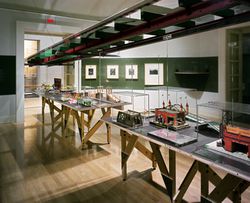
Toys and Transport
Toys and Transport
Actions:
Description:
Every new transportation link and every change in systems of urban mobility introduces new infrastructure to the urban landscape: massive cuts enabling railway tracks to converge at a terminal or junction; wide railyards that service suburban and metropolitan transit systems; the proliferation of bridges, ramps, elevated highways, freeway cuts, parking lots, and even(...)
Every new transportation link and every change in systems of urban mobility introduces new infrastructure to the urban landscape: massive cuts enabling railway tracks to converge at a terminal or junction; wide railyards that service suburban and metropolitan transit systems; the proliferation of bridges, ramps, elevated highways, freeway cuts, parking lots, and even(...)
Location:
Octagonal gallery
Octagonal gallery
Date:
15 November 2000 to 1 April 2001
15 November 2000 to 1 April 2001
Title:
Toys and Transport
Actions:
Description:
Every new transportation link and every change in systems of urban mobility introduces new infrastructure to the urban landscape: massive cuts enabling railway tracks to converge at a terminal or junction; wide railyards that service suburban and metropolitan transit systems; the proliferation of bridges, ramps, elevated highways, freeway cuts, parking lots, and even(...)
Toys and Transport
Actions:
Description:
Every new transportation link and every change in systems of urban mobility introduces new infrastructure to the urban landscape: massive cuts enabling railway tracks to converge at a terminal or junction; wide railyards that service suburban and metropolitan transit systems; the proliferation of bridges, ramps, elevated highways, freeway cuts, parking lots, and even(...)
Form:
exhibitions
exhibitions
Date:
15 November 2000 to
1 April 2001
15 November 2000 to
1 April 2001
Location:
Octagonal gallery
Octagonal gallery
Level of archival description:
Project
Project
Actions:
Reference number:
AP178.S1.2003.PR03
Description:
This project series documents a competition for the Ciudad del Flamenco de Jerez de la Frontera in Jerez de la Frontera, Spain. While the records were held in the office’s archives this project was assigned the number 56/00. The office assigned the date 2002 to this project. The competition for the Ciudad del Flamenco was part of an urban revitalization project for the historic center of Jerez. The competition was organized by the Ayuntamiento de Jerez. Six proposals were presented to the jury, including a design by Àlvaro Siza and Juan Miguel Hernández León. The project included the design of an auditorium, a museum, a documentation and research center, a school, and communal spaces. The buildings were to host The National Auditorium of Flamenco Art, the Museum and the Center for Investigation, and Documentation of the Art of Flamenco (CIDAF). The proposal was "a complex of prisms and courtyards wisely articulated between one another, rounded off by a sculptural trapezoidal and cantilevering piece'' (http://ciudaddelflamenco.jerez.es/flash/concurso.pdf p. 6). Jacques Herzog and Pierre de Meuron's proposal won the competition. Documenting this project are studies, competition drawings, and plans. Textual documentation includes correspondence with the client and competition documentation.
AP178.S1.2003.PR03
Description:
This project series documents a competition for the Ciudad del Flamenco de Jerez de la Frontera in Jerez de la Frontera, Spain. While the records were held in the office’s archives this project was assigned the number 56/00. The office assigned the date 2002 to this project. The competition for the Ciudad del Flamenco was part of an urban revitalization project for the historic center of Jerez. The competition was organized by the Ayuntamiento de Jerez. Six proposals were presented to the jury, including a design by Àlvaro Siza and Juan Miguel Hernández León. The project included the design of an auditorium, a museum, a documentation and research center, a school, and communal spaces. The buildings were to host The National Auditorium of Flamenco Art, the Museum and the Center for Investigation, and Documentation of the Art of Flamenco (CIDAF). The proposal was "a complex of prisms and courtyards wisely articulated between one another, rounded off by a sculptural trapezoidal and cantilevering piece'' (http://ciudaddelflamenco.jerez.es/flash/concurso.pdf p. 6). Jacques Herzog and Pierre de Meuron's proposal won the competition. Documenting this project are studies, competition drawings, and plans. Textual documentation includes correspondence with the client and competition documentation.
People:
Date:
circa 2003-2004
circa 2003-2004
Title:
Ciudad del Flamenco de Jerez de la Frontera, Jerez de la Frontera, Spain (2003)
Actions:
AP178.S1.2003.PR03
Description:
This project series documents a competition for the Ciudad del Flamenco de Jerez de la Frontera in Jerez de la Frontera, Spain. While the records were held in the office’s archives this project was assigned the number 56/00. The office assigned the date 2002 to this project. The competition for the Ciudad del Flamenco was part of an urban revitalization project for the historic center of Jerez. The competition was organized by the Ayuntamiento de Jerez. Six proposals were presented to the jury, including a design by Àlvaro Siza and Juan Miguel Hernández León. The project included the design of an auditorium, a museum, a documentation and research center, a school, and communal spaces. The buildings were to host The National Auditorium of Flamenco Art, the Museum and the Center for Investigation, and Documentation of the Art of Flamenco (CIDAF). The proposal was "a complex of prisms and courtyards wisely articulated between one another, rounded off by a sculptural trapezoidal and cantilevering piece'' (http://ciudaddelflamenco.jerez.es/flash/concurso.pdf p. 6). Jacques Herzog and Pierre de Meuron's proposal won the competition. Documenting this project are studies, competition drawings, and plans. Textual documentation includes correspondence with the client and competition documentation.
Ciudad del Flamenco de Jerez de la Frontera, Jerez de la Frontera, Spain (2003)
Actions:
AP178.S1.2003.PR03
Description:
This project series documents a competition for the Ciudad del Flamenco de Jerez de la Frontera in Jerez de la Frontera, Spain. While the records were held in the office’s archives this project was assigned the number 56/00. The office assigned the date 2002 to this project. The competition for the Ciudad del Flamenco was part of an urban revitalization project for the historic center of Jerez. The competition was organized by the Ayuntamiento de Jerez. Six proposals were presented to the jury, including a design by Àlvaro Siza and Juan Miguel Hernández León. The project included the design of an auditorium, a museum, a documentation and research center, a school, and communal spaces. The buildings were to host The National Auditorium of Flamenco Art, the Museum and the Center for Investigation, and Documentation of the Art of Flamenco (CIDAF). The proposal was "a complex of prisms and courtyards wisely articulated between one another, rounded off by a sculptural trapezoidal and cantilevering piece'' (http://ciudaddelflamenco.jerez.es/flash/concurso.pdf p. 6). Jacques Herzog and Pierre de Meuron's proposal won the competition. Documenting this project are studies, competition drawings, and plans. Textual documentation includes correspondence with the client and competition documentation.
Level of archival description:
Project
Project
Date:
circa 2003-2004
circa 2003-2004
People:
Form:
archives
Level of archival description:
Fonds
archives
Level of archival description:
Fonds
Title:
Shoei Yoh fonds
Shoei Yoh fonds
Reference number:
AP166
Synopsis:
The Shoei Yoh fonds (1976-2014, predominant 1990-1996) documents a selection of works by the Japanese architect and designer Shoei Yoh and the firm Shoei Yoh + Architects. The selection is comprised of two projects that were featured in the CCA exhibition Archaeology of the Digital (May 7-October 27, 2013)—the Galaxy Toyama Gymnasium and the unbuilt Odawara Municipal Sports Complex --and five other projects.The fonds also includes some published material by and about Shoei Yoh.
AP166
Synopsis:
The Shoei Yoh fonds (1976-2014, predominant 1990-1996) documents a selection of works by the Japanese architect and designer Shoei Yoh and the firm Shoei Yoh + Architects. The selection is comprised of two projects that were featured in the CCA exhibition Archaeology of the Digital (May 7-October 27, 2013)—the Galaxy Toyama Gymnasium and the unbuilt Odawara Municipal Sports Complex --and five other projects.The fonds also includes some published material by and about Shoei Yoh.
People:
Date:
1976-2014, predominant 1990-1996
1976-2014, predominant 1990-1996
Title:
Shoei Yoh fonds
Actions:
AP166
Synopsis:
The Shoei Yoh fonds (1976-2014, predominant 1990-1996) documents a selection of works by the Japanese architect and designer Shoei Yoh and the firm Shoei Yoh + Architects. The selection is comprised of two projects that were featured in the CCA exhibition Archaeology of the Digital (May 7-October 27, 2013)—the Galaxy Toyama Gymnasium and the unbuilt Odawara Municipal Sports Complex --and five other projects.The fonds also includes some published material by and about Shoei Yoh.
Shoei Yoh fonds
Actions:
AP166
Synopsis:
The Shoei Yoh fonds (1976-2014, predominant 1990-1996) documents a selection of works by the Japanese architect and designer Shoei Yoh and the firm Shoei Yoh + Architects. The selection is comprised of two projects that were featured in the CCA exhibition Archaeology of the Digital (May 7-October 27, 2013)—the Galaxy Toyama Gymnasium and the unbuilt Odawara Municipal Sports Complex --and five other projects.The fonds also includes some published material by and about Shoei Yoh.
Form:
archives
Level of archival description:
Fonds
archives
Level of archival description:
Fonds
Date:
1976-2014, predominant 1990-1996
1976-2014, predominant 1990-1996
People:
Level of archival description:
Project
Project
Reference number:
AP178.S1.1980.PR03
Description:
The project series documents the 1980 design entry for Block 11-12 (Kottbusser Damm). While the records were held in the office’s archives this project was assigned the number 3/80. The office assigned the date 1980 for this project. This project was submitted to the International Architectural Exhibition Berlin competition (International Bauaustellung, IBA, circa 1979-1987), an urban renewal strategy for West Berlin, Germany. Siza had previously submitted three other projects to this competition: the Görtlitzer Bad swimming pool, Block 70 and 89 (Fränkelufer residential complex), and Block 121 (Bonjour Tristesse), which was his first built international project. He would later submit design proposals for two other projects: Monument to Gestapo victims Prinz-Albrecht-Palais and the Kulturforum. The design proposal for Block 11-12 was for a residential building on Kottbusserstrasse in Kreuzberg. Documenting the design proposal are drawings, photographs, negatives, slides, and textual documentation. Among the drawings are sketches, studies, elevations, floor plans, and site plans. Photographs and negatives depict the project site and surrounding area; additionally there are slides of drawings and the model. Also included is a work contract from the IBA signed by Siza and IBA official Hardt-Waltherr Hämer, as well as several notes and calculations. Note that textual documentation in this project series includes materials on Block 70 and 89, see AP178.S1.1980.PR03.008. Sketches in this project series may also include sketches related to other Berlin projects, such as Block 70 and 89.
AP178.S1.1980.PR03
Description:
The project series documents the 1980 design entry for Block 11-12 (Kottbusser Damm). While the records were held in the office’s archives this project was assigned the number 3/80. The office assigned the date 1980 for this project. This project was submitted to the International Architectural Exhibition Berlin competition (International Bauaustellung, IBA, circa 1979-1987), an urban renewal strategy for West Berlin, Germany. Siza had previously submitted three other projects to this competition: the Görtlitzer Bad swimming pool, Block 70 and 89 (Fränkelufer residential complex), and Block 121 (Bonjour Tristesse), which was his first built international project. He would later submit design proposals for two other projects: Monument to Gestapo victims Prinz-Albrecht-Palais and the Kulturforum. The design proposal for Block 11-12 was for a residential building on Kottbusserstrasse in Kreuzberg. Documenting the design proposal are drawings, photographs, negatives, slides, and textual documentation. Among the drawings are sketches, studies, elevations, floor plans, and site plans. Photographs and negatives depict the project site and surrounding area; additionally there are slides of drawings and the model. Also included is a work contract from the IBA signed by Siza and IBA official Hardt-Waltherr Hämer, as well as several notes and calculations. Note that textual documentation in this project series includes materials on Block 70 and 89, see AP178.S1.1980.PR03.008. Sketches in this project series may also include sketches related to other Berlin projects, such as Block 70 and 89.
People:
Date:
circa 1979-1981
circa 1979-1981
Title:
Block 11 e 12, Kottbusser Damm [11-12 Kottbusser Damm], Berlin, Germany (1979-1981)
Actions:
AP178.S1.1980.PR03
Description:
The project series documents the 1980 design entry for Block 11-12 (Kottbusser Damm). While the records were held in the office’s archives this project was assigned the number 3/80. The office assigned the date 1980 for this project. This project was submitted to the International Architectural Exhibition Berlin competition (International Bauaustellung, IBA, circa 1979-1987), an urban renewal strategy for West Berlin, Germany. Siza had previously submitted three other projects to this competition: the Görtlitzer Bad swimming pool, Block 70 and 89 (Fränkelufer residential complex), and Block 121 (Bonjour Tristesse), which was his first built international project. He would later submit design proposals for two other projects: Monument to Gestapo victims Prinz-Albrecht-Palais and the Kulturforum. The design proposal for Block 11-12 was for a residential building on Kottbusserstrasse in Kreuzberg. Documenting the design proposal are drawings, photographs, negatives, slides, and textual documentation. Among the drawings are sketches, studies, elevations, floor plans, and site plans. Photographs and negatives depict the project site and surrounding area; additionally there are slides of drawings and the model. Also included is a work contract from the IBA signed by Siza and IBA official Hardt-Waltherr Hämer, as well as several notes and calculations. Note that textual documentation in this project series includes materials on Block 70 and 89, see AP178.S1.1980.PR03.008. Sketches in this project series may also include sketches related to other Berlin projects, such as Block 70 and 89.
Block 11 e 12, Kottbusser Damm [11-12 Kottbusser Damm], Berlin, Germany (1979-1981)
Actions:
AP178.S1.1980.PR03
Description:
The project series documents the 1980 design entry for Block 11-12 (Kottbusser Damm). While the records were held in the office’s archives this project was assigned the number 3/80. The office assigned the date 1980 for this project. This project was submitted to the International Architectural Exhibition Berlin competition (International Bauaustellung, IBA, circa 1979-1987), an urban renewal strategy for West Berlin, Germany. Siza had previously submitted three other projects to this competition: the Görtlitzer Bad swimming pool, Block 70 and 89 (Fränkelufer residential complex), and Block 121 (Bonjour Tristesse), which was his first built international project. He would later submit design proposals for two other projects: Monument to Gestapo victims Prinz-Albrecht-Palais and the Kulturforum. The design proposal for Block 11-12 was for a residential building on Kottbusserstrasse in Kreuzberg. Documenting the design proposal are drawings, photographs, negatives, slides, and textual documentation. Among the drawings are sketches, studies, elevations, floor plans, and site plans. Photographs and negatives depict the project site and surrounding area; additionally there are slides of drawings and the model. Also included is a work contract from the IBA signed by Siza and IBA official Hardt-Waltherr Hämer, as well as several notes and calculations. Note that textual documentation in this project series includes materials on Block 70 and 89, see AP178.S1.1980.PR03.008. Sketches in this project series may also include sketches related to other Berlin projects, such as Block 70 and 89.
Level of archival description:
Project
Project
Date:
circa 1979-1981
circa 1979-1981
People:
Level of archival description:
Project
Project
Reference number:
AP178.S1.1996.PR01
Description:
This project series documents the Kolonihaven - Exposição ao ar livre in Copenhagen, Denmark. While the records were held in the office’s archives this project was assigned the number 73/90 The office assigned the date 1996 to this project. At the end of the 19th century, there was an important migration of people from the rural areas to the cities in Denmark. Some migrants missed the contact with the soil and decided to built small houses with gardens to help them to adapt to their new urban life. These small Danish houses we're later named Kolonihavehus and became emblematic in Denmark. The exhibition Kolonihaven - The International challenge was held in Copenhagen by the Arken Museum of Modern Art. Fourteen international architects, including Álvaro Siza, Aldo Rossi, Mario Botta, Michael Graves, Arata Isozaki, and Leon Krier were invited to design a 7.5 square meter Danish house. Siza's design was based on his idea of a house as a child mixed with his memories of a trip to Scandinavia. The fourteen architects also participated in the exhibition "Major Projects" at the Køge Museum, in Køge, Danmark. The exhibition focused on the sketches and preliminary drawings of majort projects by each architect. Documenting this project are sketches and documentation.
AP178.S1.1996.PR01
Description:
This project series documents the Kolonihaven - Exposição ao ar livre in Copenhagen, Denmark. While the records were held in the office’s archives this project was assigned the number 73/90 The office assigned the date 1996 to this project. At the end of the 19th century, there was an important migration of people from the rural areas to the cities in Denmark. Some migrants missed the contact with the soil and decided to built small houses with gardens to help them to adapt to their new urban life. These small Danish houses we're later named Kolonihavehus and became emblematic in Denmark. The exhibition Kolonihaven - The International challenge was held in Copenhagen by the Arken Museum of Modern Art. Fourteen international architects, including Álvaro Siza, Aldo Rossi, Mario Botta, Michael Graves, Arata Isozaki, and Leon Krier were invited to design a 7.5 square meter Danish house. Siza's design was based on his idea of a house as a child mixed with his memories of a trip to Scandinavia. The fourteen architects also participated in the exhibition "Major Projects" at the Køge Museum, in Køge, Danmark. The exhibition focused on the sketches and preliminary drawings of majort projects by each architect. Documenting this project are sketches and documentation.
People:
Date:
1996
1996
Title:
Kolonihaven - The International Challenge, Copenhagen, Denmark (1996)
Actions:
AP178.S1.1996.PR01
Description:
This project series documents the Kolonihaven - Exposição ao ar livre in Copenhagen, Denmark. While the records were held in the office’s archives this project was assigned the number 73/90 The office assigned the date 1996 to this project. At the end of the 19th century, there was an important migration of people from the rural areas to the cities in Denmark. Some migrants missed the contact with the soil and decided to built small houses with gardens to help them to adapt to their new urban life. These small Danish houses we're later named Kolonihavehus and became emblematic in Denmark. The exhibition Kolonihaven - The International challenge was held in Copenhagen by the Arken Museum of Modern Art. Fourteen international architects, including Álvaro Siza, Aldo Rossi, Mario Botta, Michael Graves, Arata Isozaki, and Leon Krier were invited to design a 7.5 square meter Danish house. Siza's design was based on his idea of a house as a child mixed with his memories of a trip to Scandinavia. The fourteen architects also participated in the exhibition "Major Projects" at the Køge Museum, in Køge, Danmark. The exhibition focused on the sketches and preliminary drawings of majort projects by each architect. Documenting this project are sketches and documentation.
Kolonihaven - The International Challenge, Copenhagen, Denmark (1996)
Actions:
AP178.S1.1996.PR01
Description:
This project series documents the Kolonihaven - Exposição ao ar livre in Copenhagen, Denmark. While the records were held in the office’s archives this project was assigned the number 73/90 The office assigned the date 1996 to this project. At the end of the 19th century, there was an important migration of people from the rural areas to the cities in Denmark. Some migrants missed the contact with the soil and decided to built small houses with gardens to help them to adapt to their new urban life. These small Danish houses we're later named Kolonihavehus and became emblematic in Denmark. The exhibition Kolonihaven - The International challenge was held in Copenhagen by the Arken Museum of Modern Art. Fourteen international architects, including Álvaro Siza, Aldo Rossi, Mario Botta, Michael Graves, Arata Isozaki, and Leon Krier were invited to design a 7.5 square meter Danish house. Siza's design was based on his idea of a house as a child mixed with his memories of a trip to Scandinavia. The fourteen architects also participated in the exhibition "Major Projects" at the Køge Museum, in Køge, Danmark. The exhibition focused on the sketches and preliminary drawings of majort projects by each architect. Documenting this project are sketches and documentation.
Level of archival description:
Project
Project
Date:
1996
1996
People:
Level of archival description:
Project
Project
Reference number:
AP164.S1.2001.D4
Description:
The project series documents the competition entry for the international competition “Jubilee-Gardens” for the reorganization of the Southbank in London, England. Abalos & Herreros worked with an international team and the firm's entry was a finalist in the competition. The firm identified this project as number 139. “The competition programme asked for a new center for London. A center which would be perceived as a global icon. Comparing the statement with analogue enclaves showed that the Southbank was very small for such ambition, especially because of the fact that the project had to let as much metropolitan space open as possible. This forced to investigate how to enlarge the site. The problem was resolved by connecting adjacent areas in three levels. The original conditions and the programme offered a diverse mix of urban and natural elements: history, entertainment, culture, open spaces, the Thames… from where the conquest of the adjacent areas, the sub terrain and the margins of a linked event starts.” (ARCH270975) Documenting the project are conceptual and design development drawings, photographic and reference materials, notes, competition documents, and correspondence.
AP164.S1.2001.D4
Description:
The project series documents the competition entry for the international competition “Jubilee-Gardens” for the reorganization of the Southbank in London, England. Abalos & Herreros worked with an international team and the firm's entry was a finalist in the competition. The firm identified this project as number 139. “The competition programme asked for a new center for London. A center which would be perceived as a global icon. Comparing the statement with analogue enclaves showed that the Southbank was very small for such ambition, especially because of the fact that the project had to let as much metropolitan space open as possible. This forced to investigate how to enlarge the site. The problem was resolved by connecting adjacent areas in three levels. The original conditions and the programme offered a diverse mix of urban and natural elements: history, entertainment, culture, open spaces, the Thames… from where the conquest of the adjacent areas, the sub terrain and the margins of a linked event starts.” (ARCH270975) Documenting the project are conceptual and design development drawings, photographic and reference materials, notes, competition documents, and correspondence.
People:
Date:
1999-2001
1999-2001
Title:
Southbank Londres, London, United Kingdom (2001)
Actions:
AP164.S1.2001.D4
Description:
The project series documents the competition entry for the international competition “Jubilee-Gardens” for the reorganization of the Southbank in London, England. Abalos & Herreros worked with an international team and the firm's entry was a finalist in the competition. The firm identified this project as number 139. “The competition programme asked for a new center for London. A center which would be perceived as a global icon. Comparing the statement with analogue enclaves showed that the Southbank was very small for such ambition, especially because of the fact that the project had to let as much metropolitan space open as possible. This forced to investigate how to enlarge the site. The problem was resolved by connecting adjacent areas in three levels. The original conditions and the programme offered a diverse mix of urban and natural elements: history, entertainment, culture, open spaces, the Thames… from where the conquest of the adjacent areas, the sub terrain and the margins of a linked event starts.” (ARCH270975) Documenting the project are conceptual and design development drawings, photographic and reference materials, notes, competition documents, and correspondence.
Southbank Londres, London, United Kingdom (2001)
Actions:
AP164.S1.2001.D4
Description:
The project series documents the competition entry for the international competition “Jubilee-Gardens” for the reorganization of the Southbank in London, England. Abalos & Herreros worked with an international team and the firm's entry was a finalist in the competition. The firm identified this project as number 139. “The competition programme asked for a new center for London. A center which would be perceived as a global icon. Comparing the statement with analogue enclaves showed that the Southbank was very small for such ambition, especially because of the fact that the project had to let as much metropolitan space open as possible. This forced to investigate how to enlarge the site. The problem was resolved by connecting adjacent areas in three levels. The original conditions and the programme offered a diverse mix of urban and natural elements: history, entertainment, culture, open spaces, the Thames… from where the conquest of the adjacent areas, the sub terrain and the margins of a linked event starts.” (ARCH270975) Documenting the project are conceptual and design development drawings, photographic and reference materials, notes, competition documents, and correspondence.
Level of archival description:
Project
Project
Date:
1999-2001
1999-2001
People:


